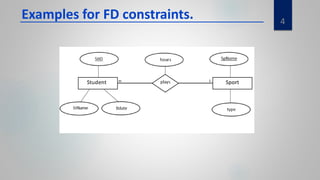
Functional dependencies (FDs) describe relationships between attributes in a database relation. FDs constrain the values that can appear across attributes for each tuple. They are used to define database normalization forms.
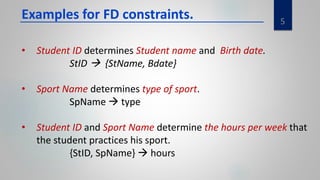
Some examples of FDs are: student ID determines student name and birthdate; sport name determines sport type; student ID and sport name determine hours practiced per week.
FDs can be trivial, non-trivial, multi-valued, or transitive. Armstrong's axioms provide rules for inferring new FDs. The closure of a set of attributes includes all attributes functionally determined by that set according to the FDs. Closures are used to identify keys, prime attributes, and equivalence of FDs.

Introduction to functional dependencies, their definition, and the relationship between attributes in relational schema.
Examples illustrating functional dependencies, including student ID determining name and birth date, and the relationship between student ID, sport name, and practice hours.
Discussion of functional dependencies as properties of relational schema attributes and their connection to keys.
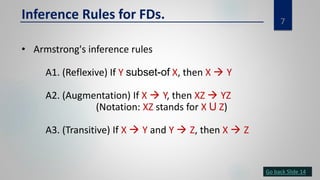
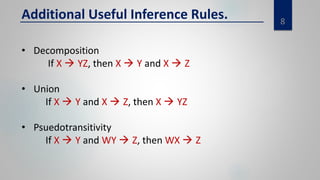
Armstrong's inference rules including reflexive, augmentation, transitive, and additional useful rules like decomposition and union.
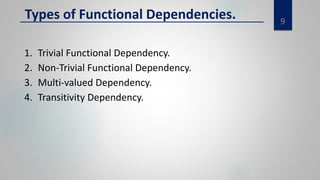
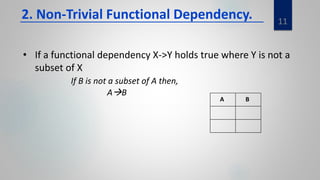
Four types of functional dependencies: trivial, non-trivial, multi-valued, and transitive, with examples.
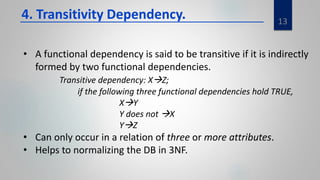
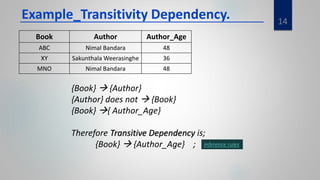
Explanation of transitive dependency, its conditions, and practical examples demonstrating these dependencies.
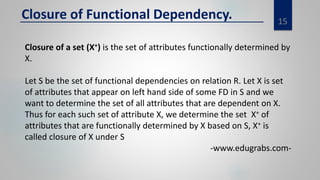
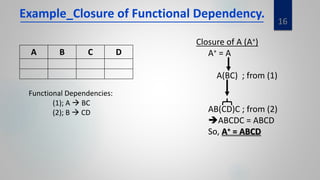
Concept of closure of functional dependency, determining functionally determined attributes and an example.
Applications of closure of functional dependency, including identifying additional FDs, keys, and attribute classifications.
Functional
Dependencies
R L DD Rajapaksha
Diploma in Software Application Development
Wayamba University of Sri Lanka, Kuliyapitiya
13 May 2018
2.
2
Functional Dependencies…?
• FunctionalDependency (FD) is a constraint that describes
the relationship between attributes in the relation (table).
• FDs and Keys are used to define the normal forms for
relations.
3.
3
Functional Dependencies…? (cont…)
Definition:
Relation schema: R {A1,A2,...,An}
X , Y are subsets of R
If R: X Y then,
If t1[X]=t2[X] then,
t1[Y]=t2[Y] in any relation instance r(R)
R
t2
t1
YX
5
Examples for FDconstraints.
• Student ID determines Student name and Birth date.
StID {StName, Bdate}
• Sport Name determines type of sport.
SpName type
• Student ID and Sport Name determine the hours per week that
the student practices his sport.
{StID, SpName} hours
6.
6
Functional Dependencies…? (cont…)
•A FD is a property of attributes in the relational schema R
(intension).
• If L is a key of the relation R, it determines all the attributes of
R.
7.
7
Inference Rules forFDs.
• Armstrong's inference rules
A1. (Reflexive) If Y subset-of X, then X Y
A2. (Augmentation) If X Y, then XZ YZ
(Notation: XZ stands for X U Z)
A3. (Transitive) If X Y and Y Z, then X Z
Go back Slide 14
8.
8
Additional Useful InferenceRules.
• Decomposition
If X YZ, then X Y and X Z
• Union
If X Y and X Z, then X YZ
• Psuedotransitivity
If X Y and WY Z, then WX Z
10
1. Trivial FunctionalDependency.
• The dependency of an attribute on a set of attributes is known
as trivial functional dependency if the set of attributes includes
that attribute.
If B is a subset of A then,
ABB
AA
BB
A B
11.
11
2. Non-Trivial FunctionalDependency.
• If a functional dependency X->Y holds true where Y is not a
subset of X
If B is not a subset of A then,
AB
A B
12.
12
3. Multi-valued Dependency.
•If there are more than one independent multi-valued attributes
in a relation, that is called “multi-valued dependency”.
bike_model manf_year colour
V001 2011 Black
V001 2011 Blue
V002 2012 Black
V002 2012 Blue
V003 2013 Black
V003 2013 Blue
bike_model ->> manf_year
bike_model ->> colour
13.
13
4. Transitivity Dependency.
•A functional dependency is said to be transitive if it is indirectly
formed by two functional dependencies.
Transitive dependency: XZ;
if the following three functional dependencies hold TRUE,
XY
Y does not X
YZ
• Can only occur in a relation of three or more attributes.
• Helps to normalizing the DB in 3NF.
15
Closure of FunctionalDependency.
Closure of a set (X+) is the set of attributes functionally determined by
X.
Let S be the set of functional dependencies on relation R. Let X is set
of attributes that appear on left hand side of some FD in S and we
want to determine the set of all attributes that are dependent on X.
Thus for each such set of attribute X, we determine the set X+ of
attributes that are functionally determined by X based on S, X+ is
called closure of X under S
-www.edugrabs.com-
16.
16
Example_Closure of FunctionalDependency.
Closure of A (A+)
A+ = A
A(BC) ; from (1)
AB(CD)C ; from (2)
ABCDC = ABCD
So, A+ = ABCD
A B C D
Functional Dependencies:
(1); A BC
(2); B CD
17.
17
Applications_Closure of FunctionalDependency.
• It is used to identify the additional FDs.
• It is used to identify keys(CKs and SKs).
• It is used to identify the Prime and Non-Prime Attributes.
• It is used to identify equivalence of FD.