Chapter 2:
Dimensions of Logistics
Learning Objectives - After reading this
chapter, you should be able to do the following:
 Understand the role and importance of
logistics in private and public organizations.
 Discuss the impact of logistics on the
economy and how effective logistics
management contributes to the vitality of the
economy.
 Understand the value-added roles of logistics
on both the macro and micro level.
 Explain logistics systems from several
perspectives.
Learning Objectives
 Understand the relationship between logistics
and the other important functional areas in a
company, including manufacturing,
marketing, and finance.
 Discuss the important management activities
in the logistics function.
Learning Objectives
 Analyze logistics systems from several
different perspectives to meet different
objectives.
 Determine the total costs and understand the
cost trade-offs in a logistics system from a
static and dynamic perspective.
Logistics Profile:
Jordano Foods
 Jordano Foods is a major vendor for SAB
Distribution, and must decide if it wants a
supply chain relationship with SAB.
 Jordano’s CEO put together a study team to
evaluate the impact of adding a logistics
systems approach.
 As you read this chapter, look for ways for
Jordano to improve its logistics processes and
supply chain relationship with SAB.
Dimensions of Logistics:
Introduction
 Logistics has come a long way since the 1960s.
 The big challenge is to manage the whole
logistics system in such a way that order
fulfillment meets or exceeds customer
expectations.
 Focus of this chapter is upon the individual
firm’s logistics system but also recognizing that
no logistics system operates in a vacuum.
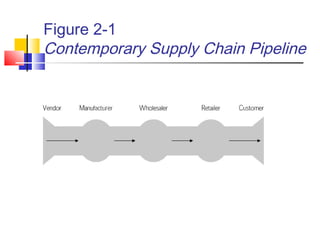
Figure 2-1
Contemporary Supply Chain Pipeline
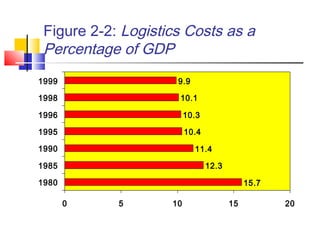
Figure 2-2: Logistics Costs as a
Percentage of GDP
15.7
12.3
11.4
10.4
10.3
10.1
9.9
0 5 10 15 20
1980
1985
1990
1995
1996
1998
1999
Logistics in the Economy:
A Macro Perspective
 As indicated in Figure 2-2, logistics costs as a
percentage of GDP have declined from 16
percent in 1980, to under 10 percent in 1999.
 Early to mid-1970s saw the figure closer to 20
percent.
 This reflects a serious improvement in the
efficiency of logistics systems.
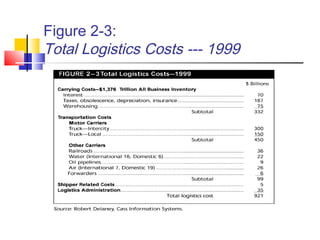
 Figure 2-3 shows a further breakdown of
logistics costs for 1999.
Figure 2-3:
Total Logistics Costs --- 1999
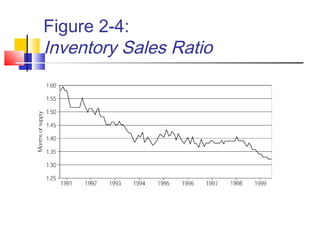
Figure 2-4:
Inventory Sales Ratio
Logistics in the Economy:
A Macro Perspective
 As indicated in Figure 2-4, the Federal
Reserve measure of inventory to sales ratios
from 1991 to 1999 clearly indicate that
companies are getting better at managing
inventory.
 Companies have been supporting larger
amounts of sales with decreasing amounts of
inventory.
Logistics in the Economy:
A Macro Perspective
 The two largest cost categories in logistics
systems are transportation and inventory.
 While we will look at this in Chapter 9, motor
carriers’ share of total freight expenditures is
$450 billion versus $99 billion for all other
carriers.
 The most frequent trade-off in logistics is
between transportation and inventory cost.
What is Logistics?
 Increased recognition through news media,
corporate-owned trailer promotions, and
television
 Increased sensitivity to service quality
provided by logistics
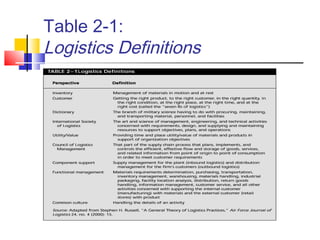
 Logistics definitions provided in Table 2-1 on
the following slide.
Table 2-1:
Logistics Definitions
What is Logistics?
 Popular logistics terms:
 Logistics Management
 Business Logistics Management
 Integrated Logistics Management
 Materials Management
 Physical Distribution Management
 Marketing Logistics
 Industrial Logistics
 Distribution
What is Logistics?:
21st Century View of Logistics
 Business Logistics – supply chain process that
plans, implements, and controls the efficient,
effective flow of goods, services, and related
information from the point of origin to the point
of use or consumption in order to meet
customer requirements.
 Military Logistics – design and integration of all
aspects of support for the operational capacity
of the military forces, and their equipment to
ensure readiness, reliability, and efficiency.
What is Logistics?:
21st Century View of Logistics
 Event Logistics – network of activities, facilities,
and personnel required to organize, schedule,
and deploy the resources for an event to take
place and to efficiently withdraw after the event.
 Service Logistics – acquisition, scheduling, and
management of the facilities/assets, personnel,
and materials to support and sustain a service
operation or business.
What is Logistics?:
Value-Added Role of Logistics
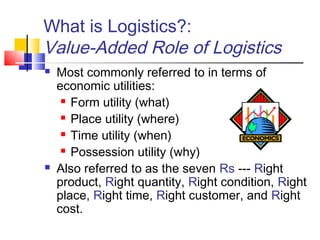
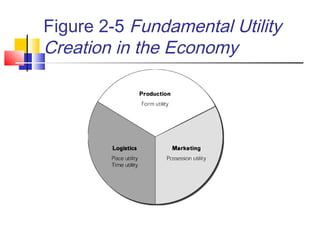
 Most commonly referred to in terms of
economic utilities:
 Form utility (what)
 Place utility (where)
 Time utility (when)
 Possession utility (why)
 Also referred to as the seven Rs --- Right
product, Right quantity, Right condition, Right
place, Right time, Right customer, and Right
cost.
Figure 2-5 Fundamental Utility
Creation in the Economy
Logistics in the Firm:
The Micro Dimension
 Logistics Interfaces with
Operations/Manufacturing
 Logistics Interfaces with Marketing
 Logistics Interfaces with Other Areas
Logistics in the Firm: Logistics Interfaces
with Operations Manufacturing
 Length of production runs
 Balance economies of long production runs
against increased costs of high inventories.
 Seasonal demand
 Acceptance of seasonal inventory
to balance lead production
times.
Logistics in the Firm: Logistics Interfaces
with Operations/Manufacturing
 Supply-side interfaces
 Stocking adequate supplies to ensure
uninterrupted production now a logistics
function.
 Protective packaging
 Principal purpose is to protect the product
from damage.
 Foreign & third party alternatives
 Some logistics functions are being
outsourced.
Logistics in the Firm:
The Micro Dimension
 Logistics Interfaces with Marketing:
The Marketing Mix – Four Ps
 Price
 Product
 Promotion
 Place
Logistics in the Firm:
Price
 Carrier pricing
 Generally, since the larger the shipment, the
cheaper the transportation rate, shipment sizes
should be tailored to the carrier’s vehicle capacity
where possible.
 Matching schedules
 Quantity discounts should be tied to carrier
quantity discounts.
 Volume relationships
 Volumes sold will affect inventory requirements.
Logistics in the Firm:
Product
 Consumer packaging
 Generally, since the size, shape, weight and other
physical characteristics of the product impact on
its storage, transportation and handling, the
logistics managers should be included in any
decisions regarding these product traits.
 A minor correction in any of the above could
conceivably cost (or save) millions of dollars in
logistical costs.
 Logistics costs are not necessarily paramount, but
they need to be considered in the decision making
process.
Logistics in the Firm:
Promotion
 Push versus pull
 The most important factor is that the logistics
division is aware of any changes in demand
patterns so that it can plan for any consequences.
 Pull strategies tend to be more erratic.
 Push strategies tend to more predictable.
 Channel competition
 The more popular a product, the easier it is to
persuade channel members to promote your
product.
Logistics in the Firm:
Place
 Wholesalers
 Generally, since wholesalers are combining
purchases for multiple retailers, the shipment sizes
tend to be larger and the number of transactions
that have to be processed are fewer, with the
result that logistics costs are smaller.
 Retailers
 With the exception of very large retailers who act
more like wholesalers, smaller sales are the norm.
These generally cost more for transportation and
order processing.
Logistics Interfaces with
Other Areas
 Manufacturing and marketing are probably the two
most important internal, functional interfaces with
logistics.
 Other important interfaces now include finance and
accounting.
 Logistics can have a major impact on return on
assets and return on investment.
 Logistics costs reported by cost systems measure
supply chain trade-offs and performance.
Logistics Activities
 Transportation
 Storage
 Packaging
 Materials handling
 Order fulfillment
 Forecasting
 Production planning
 Purchasing
 Customer service
 Site location
 Other activities
On the Line:
Toyota Distribution
 Moves more than 8 million parts and accessories every
month.
 Computer modeling re-designed the 30 year old
distribution network.
 Software looked first at Lexus Division and then at the
entire network.
 Resulted in two DCs, one in California, another in
Kentucky, feeding nine smaller DCs located around
the country.
 The new network both improved customer service and
lowered costs.
Approaches to Analyzing Logistics
Systems: Materials Management v.
Physical Distribution
 Frequently the movement and storage of raw
materials is far different from the movement
and storage of finished goods.
 Four different classifications of logistics
systems
 Balanced system - e.g., consumer products
 Heavy inbound - e.g., aircraft, construction
 Heavy outbound - e.g., chemicals
 Reverse systems - e.g., returnable products
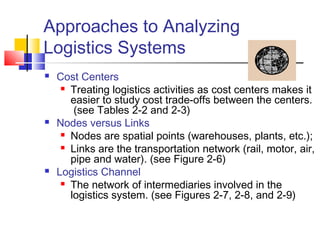
Approaches to Analyzing
Logistics Systems
 Cost Centers
 Treating logistics activities as cost centers makes it
easier to study cost trade-offs between the centers.
(see Tables 2-2 and 2-3)
 Nodes versus Links
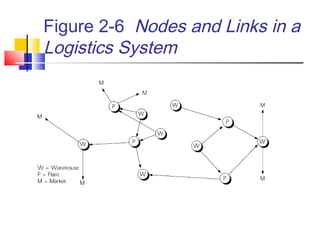
 Nodes are spatial points (warehouses, plants, etc.);
 Links are the transportation network (rail, motor, air,
pipe and water). (see Figure 2-6)
 Logistics Channel
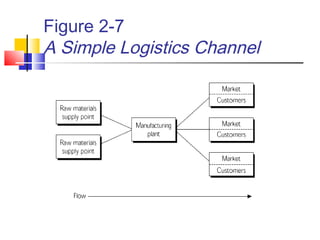
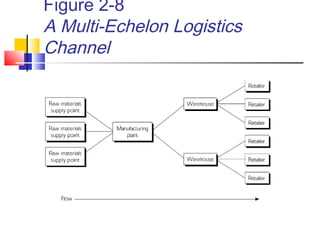
 The network of intermediaries involved in the
logistics system. (see Figures 2-7, 2-8, and 2-9)
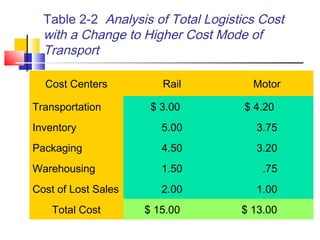
Table 2-2 Analysis of Total Logistics Cost
with a Change to Higher Cost Mode of
Transport
Cost Centers Rail Motor
Transportation $ 3.00 $ 4.20
Inventory 5.00 3.75
Packaging 4.50 3.20
Warehousing 1.50 .75
Cost of Lost Sales 2.00 1.00
Total Cost $ 15.00 $ 13.00
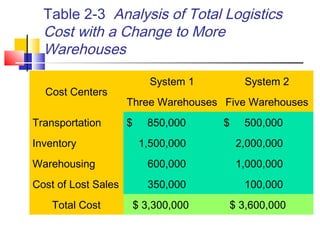
Table 2-3 Analysis of Total Logistics
Cost with a Change to More
Warehouses
Cost Centers
System 1 System 2
Three Warehouses Five Warehouses
Transportation $ 850,000 $ 500,000
Inventory 1,500,000 2,000,000
Warehousing 600,000 1,000,000
Cost of Lost Sales 350,000 100,000
Total Cost $ 3,300,000 $ 3,600,000
Figure 2-6 Nodes and Links in a
Logistics System
Figure 2-7
A Simple Logistics Channel
Figure 2-8
A Multi-Echelon Logistics
Channel
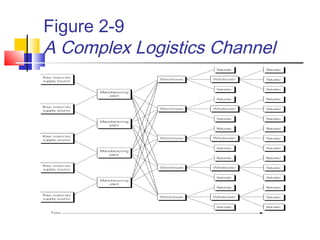
Figure 2-9
A Complex Logistics Channel
Logistics and Systems Analysis
 Cost Perspective
 Keep in mind that the most efficient
systems are not always comprised of each
system component operating at its lowest
possible cost.
 The critical concern is to have the entire
system operating at its lowest total cost.
Logistics and Systems Analysis
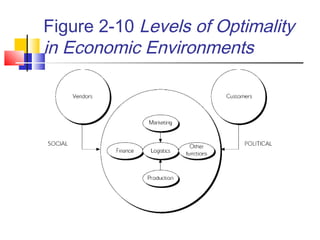
 Level of Optimality
 There are often constraints working which
result in sub-optimal outcomes.
 Additionally, logistics systems must work in
harmony with marketing, finance,
production, etc.--- this may also result in
sub-optimal logistics performance.
 See Figure 2-10 on next slide.
Figure 2-10 Levels of Optimality
in Economic Environments
Techniques of Logistics System
Analysis: Short-Run/Static Analysis
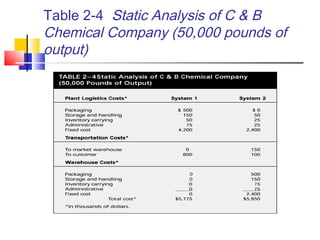
 This technique is illustrated in Table 2-4.
 Comprised a matrix-like table which presents
each of the logistics and other relevant costs
for two or more alternative logistics systems.
 The major downside to the model is that it
presents a solution which is not necessarily
the correct one at all possible volume levels.
 Examine the data presented in Table 2-4.
Table 2-4 Static Analysis of C & B
Chemical Company (50,000 pounds of
output)
Techniques of Logistics System
Analysis: Long-Run/Dynamic Analysis
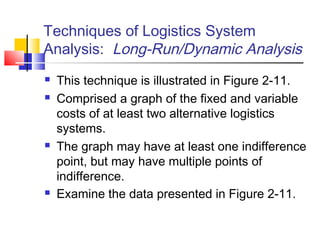
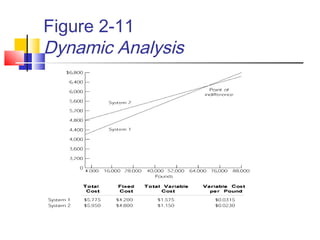
 This technique is illustrated in Figure 2-11.
 Comprised a graph of the fixed and variable
costs of at least two alternative logistics
systems.
 The graph may have at least one indifference
point, but may have multiple points of
indifference.
 Examine the data presented in Figure 2-11.
Figure 2-11
Dynamic Analysis
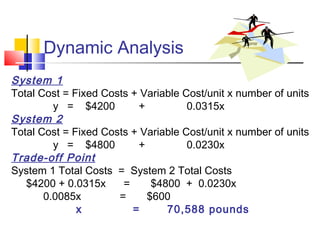
Dynamic Analysis
System 1
Total Cost = Fixed Costs + Variable Cost/unit x number of units
y = $4200 + 0.0315x
System 2
Total Cost = Fixed Costs + Variable Cost/unit x number of units
y = $4800 + 0.0230x
Trade-off Point
System 1 Total Costs = System 2 Total Costs
$4200 + 0.0315x = $4800 + 0.0230x
0.0085x = $600
x = 70,588 pounds
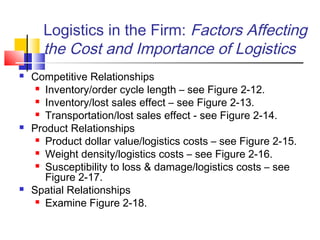
Logistics in the Firm: Factors Affecting
the Cost and Importance of Logistics
 Competitive Relationships
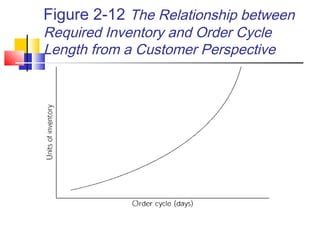
 Inventory/order cycle length – see Figure 2-12.
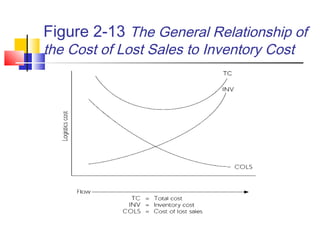
 Inventory/lost sales effect – see Figure 2-13.
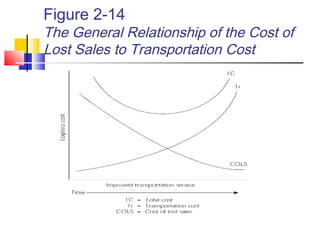
 Transportation/lost sales effect - see Figure 2-14.
 Product Relationships
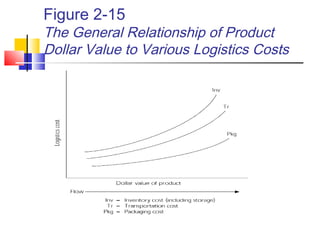
 Product dollar value/logistics costs – see Figure 2-15.
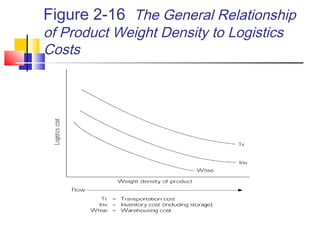
 Weight density/logistics costs – see Figure 2-16.
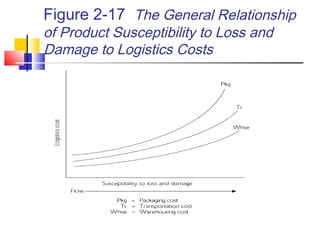
 Susceptibility to loss & damage/logistics costs – see
Figure 2-17.
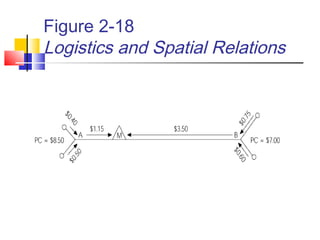
 Spatial Relationships
 Examine Figure 2-18.
Figure 2-12 The Relationship between
Required Inventory and Order Cycle
Length from a Customer Perspective
Figure 2-13 The General Relationship of
the Cost of Lost Sales to Inventory Cost
Figure 2-14
The General Relationship of the Cost of
Lost Sales to Transportation Cost
Figure 2-15
The General Relationship of Product
Dollar Value to Various Logistics Costs
Figure 2-16 The General Relationship
of Product Weight Density to Logistics
Costs
Figure 2-17 The General Relationship
of Product Susceptibility to Loss and
Damage to Logistics Costs
Figure 2-18
Logistics and Spatial Relations
Chapter 2:
Summary and Review Questions
Students should review their knowledge of the chapter
by checking out the Summary and Study Questions
for Chapter 2.
This is the last slide for Chapter 2
End of Chapter 2 Slides
Dimensions of Logistics

DIMENSION OF LOGISTICS

  • 1.
  • 2.
    Learning Objectives -After reading this chapter, you should be able to do the following:  Understand the role and importance of logistics in private and public organizations.  Discuss the impact of logistics on the economy and how effective logistics management contributes to the vitality of the economy.  Understand the value-added roles of logistics on both the macro and micro level.  Explain logistics systems from several perspectives.
  • 3.
    Learning Objectives  Understandthe relationship between logistics and the other important functional areas in a company, including manufacturing, marketing, and finance.  Discuss the important management activities in the logistics function.
  • 4.
    Learning Objectives  Analyzelogistics systems from several different perspectives to meet different objectives.  Determine the total costs and understand the cost trade-offs in a logistics system from a static and dynamic perspective.
  • 5.
    Logistics Profile: Jordano Foods Jordano Foods is a major vendor for SAB Distribution, and must decide if it wants a supply chain relationship with SAB.  Jordano’s CEO put together a study team to evaluate the impact of adding a logistics systems approach.  As you read this chapter, look for ways for Jordano to improve its logistics processes and supply chain relationship with SAB.
  • 6.
    Dimensions of Logistics: Introduction Logistics has come a long way since the 1960s.  The big challenge is to manage the whole logistics system in such a way that order fulfillment meets or exceeds customer expectations.  Focus of this chapter is upon the individual firm’s logistics system but also recognizing that no logistics system operates in a vacuum.
  • 7.
  • 8.
    Figure 2-2: LogisticsCosts as a Percentage of GDP 15.7 12.3 11.4 10.4 10.3 10.1 9.9 0 5 10 15 20 1980 1985 1990 1995 1996 1998 1999
  • 9.
    Logistics in theEconomy: A Macro Perspective  As indicated in Figure 2-2, logistics costs as a percentage of GDP have declined from 16 percent in 1980, to under 10 percent in 1999.  Early to mid-1970s saw the figure closer to 20 percent.  This reflects a serious improvement in the efficiency of logistics systems.  Figure 2-3 shows a further breakdown of logistics costs for 1999.
  • 10.
  • 11.
  • 12.
    Logistics in theEconomy: A Macro Perspective  As indicated in Figure 2-4, the Federal Reserve measure of inventory to sales ratios from 1991 to 1999 clearly indicate that companies are getting better at managing inventory.  Companies have been supporting larger amounts of sales with decreasing amounts of inventory.
  • 13.
    Logistics in theEconomy: A Macro Perspective  The two largest cost categories in logistics systems are transportation and inventory.  While we will look at this in Chapter 9, motor carriers’ share of total freight expenditures is $450 billion versus $99 billion for all other carriers.  The most frequent trade-off in logistics is between transportation and inventory cost.
  • 14.
    What is Logistics? Increased recognition through news media, corporate-owned trailer promotions, and television  Increased sensitivity to service quality provided by logistics  Logistics definitions provided in Table 2-1 on the following slide.
  • 15.
  • 16.
    What is Logistics? Popular logistics terms:  Logistics Management  Business Logistics Management  Integrated Logistics Management  Materials Management  Physical Distribution Management  Marketing Logistics  Industrial Logistics  Distribution
  • 17.
    What is Logistics?: 21stCentury View of Logistics  Business Logistics – supply chain process that plans, implements, and controls the efficient, effective flow of goods, services, and related information from the point of origin to the point of use or consumption in order to meet customer requirements.  Military Logistics – design and integration of all aspects of support for the operational capacity of the military forces, and their equipment to ensure readiness, reliability, and efficiency.
  • 18.
    What is Logistics?: 21stCentury View of Logistics  Event Logistics – network of activities, facilities, and personnel required to organize, schedule, and deploy the resources for an event to take place and to efficiently withdraw after the event.  Service Logistics – acquisition, scheduling, and management of the facilities/assets, personnel, and materials to support and sustain a service operation or business.
  • 19.
    What is Logistics?: Value-AddedRole of Logistics  Most commonly referred to in terms of economic utilities:  Form utility (what)  Place utility (where)  Time utility (when)  Possession utility (why)  Also referred to as the seven Rs --- Right product, Right quantity, Right condition, Right place, Right time, Right customer, and Right cost.
  • 20.
    Figure 2-5 FundamentalUtility Creation in the Economy
  • 21.
    Logistics in theFirm: The Micro Dimension  Logistics Interfaces with Operations/Manufacturing  Logistics Interfaces with Marketing  Logistics Interfaces with Other Areas
  • 22.
    Logistics in theFirm: Logistics Interfaces with Operations Manufacturing  Length of production runs  Balance economies of long production runs against increased costs of high inventories.  Seasonal demand  Acceptance of seasonal inventory to balance lead production times.
  • 23.
    Logistics in theFirm: Logistics Interfaces with Operations/Manufacturing  Supply-side interfaces  Stocking adequate supplies to ensure uninterrupted production now a logistics function.  Protective packaging  Principal purpose is to protect the product from damage.  Foreign & third party alternatives  Some logistics functions are being outsourced.
  • 24.
    Logistics in theFirm: The Micro Dimension  Logistics Interfaces with Marketing: The Marketing Mix – Four Ps  Price  Product  Promotion  Place
  • 25.
    Logistics in theFirm: Price  Carrier pricing  Generally, since the larger the shipment, the cheaper the transportation rate, shipment sizes should be tailored to the carrier’s vehicle capacity where possible.  Matching schedules  Quantity discounts should be tied to carrier quantity discounts.  Volume relationships  Volumes sold will affect inventory requirements.
  • 26.
    Logistics in theFirm: Product  Consumer packaging  Generally, since the size, shape, weight and other physical characteristics of the product impact on its storage, transportation and handling, the logistics managers should be included in any decisions regarding these product traits.  A minor correction in any of the above could conceivably cost (or save) millions of dollars in logistical costs.  Logistics costs are not necessarily paramount, but they need to be considered in the decision making process.
  • 27.
    Logistics in theFirm: Promotion  Push versus pull  The most important factor is that the logistics division is aware of any changes in demand patterns so that it can plan for any consequences.  Pull strategies tend to be more erratic.  Push strategies tend to more predictable.  Channel competition  The more popular a product, the easier it is to persuade channel members to promote your product.
  • 28.
    Logistics in theFirm: Place  Wholesalers  Generally, since wholesalers are combining purchases for multiple retailers, the shipment sizes tend to be larger and the number of transactions that have to be processed are fewer, with the result that logistics costs are smaller.  Retailers  With the exception of very large retailers who act more like wholesalers, smaller sales are the norm. These generally cost more for transportation and order processing.
  • 29.
    Logistics Interfaces with OtherAreas  Manufacturing and marketing are probably the two most important internal, functional interfaces with logistics.  Other important interfaces now include finance and accounting.  Logistics can have a major impact on return on assets and return on investment.  Logistics costs reported by cost systems measure supply chain trade-offs and performance.
  • 30.
    Logistics Activities  Transportation Storage  Packaging  Materials handling  Order fulfillment  Forecasting  Production planning  Purchasing  Customer service  Site location  Other activities
  • 31.
    On the Line: ToyotaDistribution  Moves more than 8 million parts and accessories every month.  Computer modeling re-designed the 30 year old distribution network.  Software looked first at Lexus Division and then at the entire network.  Resulted in two DCs, one in California, another in Kentucky, feeding nine smaller DCs located around the country.  The new network both improved customer service and lowered costs.
  • 32.
    Approaches to AnalyzingLogistics Systems: Materials Management v. Physical Distribution  Frequently the movement and storage of raw materials is far different from the movement and storage of finished goods.  Four different classifications of logistics systems  Balanced system - e.g., consumer products  Heavy inbound - e.g., aircraft, construction  Heavy outbound - e.g., chemicals  Reverse systems - e.g., returnable products
  • 33.
    Approaches to Analyzing LogisticsSystems  Cost Centers  Treating logistics activities as cost centers makes it easier to study cost trade-offs between the centers. (see Tables 2-2 and 2-3)  Nodes versus Links  Nodes are spatial points (warehouses, plants, etc.);  Links are the transportation network (rail, motor, air, pipe and water). (see Figure 2-6)  Logistics Channel  The network of intermediaries involved in the logistics system. (see Figures 2-7, 2-8, and 2-9)
  • 34.
    Table 2-2 Analysisof Total Logistics Cost with a Change to Higher Cost Mode of Transport Cost Centers Rail Motor Transportation $ 3.00 $ 4.20 Inventory 5.00 3.75 Packaging 4.50 3.20 Warehousing 1.50 .75 Cost of Lost Sales 2.00 1.00 Total Cost $ 15.00 $ 13.00
  • 35.
    Table 2-3 Analysisof Total Logistics Cost with a Change to More Warehouses Cost Centers System 1 System 2 Three Warehouses Five Warehouses Transportation $ 850,000 $ 500,000 Inventory 1,500,000 2,000,000 Warehousing 600,000 1,000,000 Cost of Lost Sales 350,000 100,000 Total Cost $ 3,300,000 $ 3,600,000
  • 36.
    Figure 2-6 Nodesand Links in a Logistics System
  • 37.
    Figure 2-7 A SimpleLogistics Channel
  • 38.
    Figure 2-8 A Multi-EchelonLogistics Channel
  • 39.
    Figure 2-9 A ComplexLogistics Channel
  • 40.
    Logistics and SystemsAnalysis  Cost Perspective  Keep in mind that the most efficient systems are not always comprised of each system component operating at its lowest possible cost.  The critical concern is to have the entire system operating at its lowest total cost.
  • 41.
    Logistics and SystemsAnalysis  Level of Optimality  There are often constraints working which result in sub-optimal outcomes.  Additionally, logistics systems must work in harmony with marketing, finance, production, etc.--- this may also result in sub-optimal logistics performance.  See Figure 2-10 on next slide.
  • 42.
    Figure 2-10 Levelsof Optimality in Economic Environments
  • 43.
    Techniques of LogisticsSystem Analysis: Short-Run/Static Analysis  This technique is illustrated in Table 2-4.  Comprised a matrix-like table which presents each of the logistics and other relevant costs for two or more alternative logistics systems.  The major downside to the model is that it presents a solution which is not necessarily the correct one at all possible volume levels.  Examine the data presented in Table 2-4.
  • 44.
    Table 2-4 StaticAnalysis of C & B Chemical Company (50,000 pounds of output)
  • 45.
    Techniques of LogisticsSystem Analysis: Long-Run/Dynamic Analysis  This technique is illustrated in Figure 2-11.  Comprised a graph of the fixed and variable costs of at least two alternative logistics systems.  The graph may have at least one indifference point, but may have multiple points of indifference.  Examine the data presented in Figure 2-11.
  • 46.
  • 47.
    Dynamic Analysis System 1 TotalCost = Fixed Costs + Variable Cost/unit x number of units y = $4200 + 0.0315x System 2 Total Cost = Fixed Costs + Variable Cost/unit x number of units y = $4800 + 0.0230x Trade-off Point System 1 Total Costs = System 2 Total Costs $4200 + 0.0315x = $4800 + 0.0230x 0.0085x = $600 x = 70,588 pounds
  • 48.
    Logistics in theFirm: Factors Affecting the Cost and Importance of Logistics  Competitive Relationships  Inventory/order cycle length – see Figure 2-12.  Inventory/lost sales effect – see Figure 2-13.  Transportation/lost sales effect - see Figure 2-14.  Product Relationships  Product dollar value/logistics costs – see Figure 2-15.  Weight density/logistics costs – see Figure 2-16.  Susceptibility to loss & damage/logistics costs – see Figure 2-17.  Spatial Relationships  Examine Figure 2-18.
  • 49.
    Figure 2-12 TheRelationship between Required Inventory and Order Cycle Length from a Customer Perspective
  • 50.
    Figure 2-13 TheGeneral Relationship of the Cost of Lost Sales to Inventory Cost
  • 51.
    Figure 2-14 The GeneralRelationship of the Cost of Lost Sales to Transportation Cost
  • 52.
    Figure 2-15 The GeneralRelationship of Product Dollar Value to Various Logistics Costs
  • 53.
    Figure 2-16 TheGeneral Relationship of Product Weight Density to Logistics Costs
  • 54.
    Figure 2-17 TheGeneral Relationship of Product Susceptibility to Loss and Damage to Logistics Costs
  • 55.
    Figure 2-18 Logistics andSpatial Relations
  • 56.
    Chapter 2: Summary andReview Questions Students should review their knowledge of the chapter by checking out the Summary and Study Questions for Chapter 2. This is the last slide for Chapter 2
  • 57.
    End of Chapter2 Slides Dimensions of Logistics