
Submitted By –
Manu Singh Baghel
PGDM -1 –A
Roll No. - 25
Supply chain management in
the internet age
Supply chain management (SCM) is essentially
information driven function, since co-ordination
between various players in the chain is the key
to effective management in the supply chain by
working together to deliver the right products –
• At

the right time
•At the right place
•At the best price.
Effective management of supply
chain results in –


Reduced lead time



Inventory and operational costs while
improving
efficient
consumer
responsiveness (ECR)



Customization, ultimately leading to
enhanced customer satisfaction and
retention.
E-SCM: The solution range
The major categories of SCM software are


Supply chain planning and execution



Warehouse management software



Transportation management software
Electronic Supply Chain
Management
SCM process is composed of a wide range of
interrelated
sub-processes –


Time dimension through which SCM activities are
segmented into short term, midterm and long term
activities i.e., scheduling, operational, tactical and
strategic.



Functional dimensions where the activities are
separated by production, transportation, storage and
sales, outside of the planning funnel and the SCM
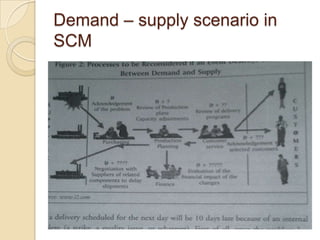
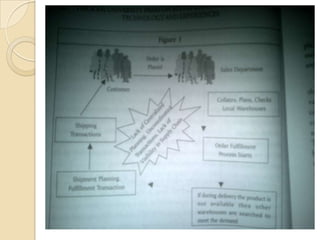
Demand – supply scenario in
SCM
Challenges of the SCM –


The late supplier delivery creates an unexpected
volume of available capacity during a certain period.



It also creates a capacity shortage in the following
period, where the delayed orders will be competing
for the capacity that might already be allocated to
other orders.



The delayed production orders may end up affecting
the distribution plans.



These delays in the distribution plan may force the
company to break the delivery promises made to
customers based on the original supply plan.


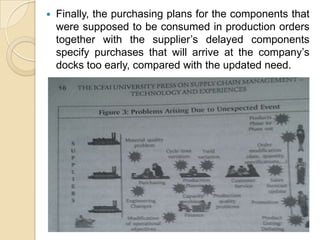
Finally, the purchasing plans for the components that
were supposed to be consumed in production orders
together with the supplier’s delayed components
specify purchases that will arrive at the company’s
docks too early, compared with the updated need.
Sourcing decisions –










Material costs
Transportation costs from supplier to facilities
Production costs paid to facilities
Material inventory costs
Inventory costs of products in facilities
Transportation costs from facilities to
warehouse
Inventory costs of products in warehouse
Transportation costs from warehouse to
customers
Models for implementing SCM –


Forecasting models – these models
allow prediction of demand based on past
data or other parameters that are
independently available. They enable
planning, given lead time necessary for
response.



Mathematical models –



Location models – help in planning the
optimal
location
of
plants
and
warehouses, considering the inbound and










Allocation models – help in optimally allocating
commodities from source to destination in a multisource, multi-dimensional environment.
Distribution network design models – these are
usually comprehensive in nature, deciding between
multi-stages
distribution
networks,
location
warehouses and bulk points and even sometimes the
transportation made choices.
Inventory models – these have key role in logistics
management e.g., buffer stocks to take care of
uncertainties at finished goods, warehouse and
retails.
Routing models – these models allow optimal
routing on a transportation network from a given
source to a destination.
Scheduling problems – these models enables
allocation of resources to particular activities.
E-SCM Portfolio – A
Contemporary View
Business challenges –








Continuous product innovation – the open
economy introduced by globalization demands the
need for continuous product innovation and
improvement on par with global standards
Improve business agility and responsiveness –
the dynamic global business environment impacts the
profitability/revenue of the enterprises dramatically
Winning market to gain competitive advantage –
the extent of competitive advantage gained and
effective use of it can answer the question of business
sustenance.
Achieving cost containment – offering world class
services/products at competitive price
SCM – Tool for maximizing
value delivery –
Decrease inventory costs by matching
production to demand
 Reduce overall production costs by
streamlining the flow of goods through
the production process and improving
information
flow
between
an
enterprise, suppliers and distributors.
 Improving customer satisfaction by
offering
increased
speed
and
adaptability.

IT – Enabled SCM –
Electronic data interchange – EDI
 Internet/extranet
 Electronic commerce
 Enterprise resource planning – ERP
 E- procurement
 Supplier relationship management –
SRM
 Advanced planning and scheduling –
APS
 E-logistics

Creating new business models
Electronic information integration – it refers
to sharing of relevant information among all the
partners of supply chain in the most
transparent and genuine way.
 Electronic synchronization of planning – it
is the process that synchronizes the
forecasting and replenishment strategies
among the partners of the supply chain.
 Electronic workflow coordination – it is one
of the important demand of supply chain. Work
flows such as financial exchange, order
execution, design
optimization, procurements, etc.



New business model – in recent year’s
new and innovative business models
have surfaced in the marketplace. Some
of them are –

Virtual resources
 Supply chain restructuring
 Service support
 Mass customization
 The Click – and – Mortar model for order
fulfilment

Bullwhip – Effect: a solution
roadmap


Change in customer orders



Price and promotions



Manufacturing scheduling



Supplier’s inability to provide at right
time



Unknown factors
The solution footprints for
Bullwhip Effect –
Batch order processing
 Logistics considerations
 Safety stock monitoring
 Creditworthiness of the customers
 Special purchase contract
 Special sales contract
 False order and cancellation

e- Technologies for effective
SCM
Barriers to E-Technologies –
The uncertain cost of implementation
 More pressing corporate priorities
 Lack of proven benefits within the
industry
 Perceived or actual low use of the
internet by customers and suppliers
 The key, privacy, taxation and emerging
intellectual property issues

Still e- technologies are
leading towards –













E – learning opportunities
Knowledge management
E – HR management
E – business intelligence
E – supply chain management
Project management
Professional service automation
Sales force automation
E – sourcing
E – marketing
SCOR Model –
SCOR model consists of the best
designs of supply chain. The 5 main
processes of this model are –
Plan
 Make
 Source
 Deliver
 Return

These are organized at 4
different hierarchal levels –


Main process



Cluster categorization (make – to –
order, make – to – stock and engineer
– to – order)



Detailed refinery



Information of the international
business enterprises
Built – to – order automobiles
(BTO) –
Knowledge management tools –


Intra – enterprise KM



Customer KM



Supplier KM



Extended inter – enterprise KM
Measurable benefits derived –


Enhanced customer responsiveness



More predictable forecasting



Enhanced speed to market



Sharing of best practises



Collaborative R&D



Profit sharing
What is RFID?? –
Radio frequency identification (RFID) is a
method of automatic identification which
relies on storing and remotely retrieving data
using devices known as RFID tags or
transponders which is a tiny object that is
either attached or incorporated to a person or
product.


Announcement by Wall – Mart regarding
RFID tags compulsion in 2003.



Initiatives by the Auto-IT centre of MIT, USA.
Bottleneck in adopting RFID –


Start from the very beginning



Effectively storing and managing huge
data



Data integration efforts



Master files for the product are usually
not configured for RFID mode
RFID compatible media –


Web service through world wide web



Global positioning systems (GPS)



RFID tags



Manufacturing execution systems (MES)



Enterprise resource planning (ERP)



Point – of – sale (POS) technology
Benefits of RFID in SCM –


Advanced Shipping Notices (ASN)



Returned goods



Anti – counterfeit



Supply chain efficiency



Improved stock management



Reduction in labour costs.
SPCM cycle contains –


Identification of performance
exceptions



Understanding the related issues and
root cause



Offering the alternative courses of
action possible



Analyzing the impact of each
Decoupled extended supply chains –
 The first information flow is the ordering and
payment system, followed by order tracking. It
is the flow from retailer to distributer and done
through internet or EDI. The information is
only visible to customers and finally for the
returns.
Semi extended supply chains –
 The major challenge with this strategy
involves managing inventory. To be successful
with it companies must carefully think through
several design decisions on how to coordinate
their channels.
Fully extended supply chains –
 The concept of famous home delivery approach is
known as fully extended supply chain. In this the
retailer’s supply chain is continuously linked from the
supply side all the way to the customer’s front door.
Centralized extended supply chains –
 This strategy has 3 major advantages –
 It eliminates the link between supplies by removing
stores.
 It sets apart decoupled extended strategies
 Working from a distribution centre rather than a store
allows aggregated inventory making it possible to
hold less inventory while having a wide range of
products and more stock.
IT in SCM –


Strategic planning for IT in SCM



Virtual enterprise and SCM



E – commerce and SCM



Infrastructure for IT in SCM



Knowledge and IT management in SCM



Implementation of IT in SCM
Impact of IT on SCM –


Information availability and visibility



Single data contract point



Decision based on total supply chain
information



Collaboration with supply chain
partners
E – SCM in Indian industries
The internet application in supply chain
management area can be classified into
4 areas –
Product and process design
 E – marketplace and exchange
 Collaborative planning
 Fulfilment management



Infomediary – a revolution in agri supply chain –
In the area of procurement, ITC developed an
innovative method using Internet. It used the
concept of infomediary – a website which provides
exclusive information related to one subject area. By
educating the suppliers – mostly farmers and
providing needed information, ITC was able to get a
lot.



E – Procurement – Supply is based on exact
requirements and the goods can be delivered just in
time. Vendors across the world can be accessed on
line anytime and production and delivery schedule
are planned accordingly. Inventory levels therefore
kept for a minimum lead time – sometimes even a
day low only.
Research methodology –


Sample
–
127
computer
hardware
companies
were
selected
from
the
membership list from MAIT (manufacturers
association of information technology – the
association of hardware, training and service
sectors of the Indian IT industry) website and
the centre for monitoring Indian economy
(CMIE) prowess database.



Questionnaire – Two sets were prepared.
On was for the procurement chain and other
for the distribution chain. It was focused on a
number of questions related to SCM. These
Data collection – Data collection was done
through a combination of e- mails, telephonic
interviews and personal interviews in
Chennai, Hyderabad, Pondicherry and
Bangalore. Total number of responses was
38 from 6 companies.
Results and analysis –
 The result of the survey was summarized
under the following subsections –
 Procurement/distribution characteristics –
including inventory, delivery time, etc.
 Transportation and warehousing
 Costs in supply chain


Procurement side – The usage of
technological infrastructure like intranet and
internet are relatively very poor in the
procurement side of the computer hardware
industry. Speed cargo is the mode of
transportation that is used by all the nodes in
the transportation link of the procurement
chain.



Distribution side – The outsourced service
providers need to improve their services to
capture the full potential of the distribution
side. Most of the hardware companies are
not fully satisfied with their outsourced
service providers, implying that there is a lot
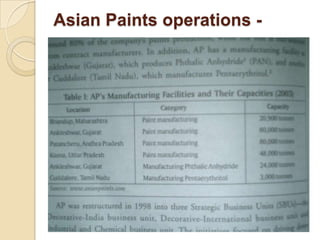
Asian Paints operations -
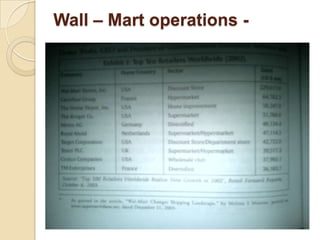
Wall – Mart operations -
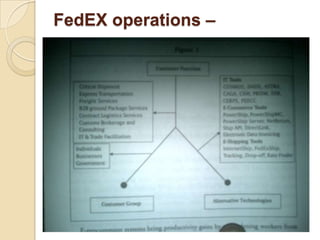
FedEX operations –
Implementation of the e –
procurement solution at FedEx
–

Phase – 1 – pilot implementation of Ariba’s e
– procurement solution that include
installation of e – commerce platform along
with Ariba buyer technology.
 Phase – 2 – rollout of Ariba buyer to around
7000 IT division employees. The managers
were given charges of producing the
business requirements, documents and
project plans.
 Phase – 3 – an overall plan was developed
to bring out each commodity whose major
supplier had electronic catalogs.

THANK YOU

Supply chain management

  • 1.
    Submitted By – ManuSingh Baghel PGDM -1 –A Roll No. - 25
  • 2.
    Supply chain managementin the internet age Supply chain management (SCM) is essentially information driven function, since co-ordination between various players in the chain is the key to effective management in the supply chain by working together to deliver the right products – • At the right time •At the right place •At the best price.
  • 3.
    Effective management ofsupply chain results in –  Reduced lead time  Inventory and operational costs while improving efficient consumer responsiveness (ECR)  Customization, ultimately leading to enhanced customer satisfaction and retention.
  • 4.
    E-SCM: The solutionrange The major categories of SCM software are  Supply chain planning and execution  Warehouse management software  Transportation management software
  • 5.
    Electronic Supply Chain Management SCMprocess is composed of a wide range of interrelated sub-processes –  Time dimension through which SCM activities are segmented into short term, midterm and long term activities i.e., scheduling, operational, tactical and strategic.  Functional dimensions where the activities are separated by production, transportation, storage and sales, outside of the planning funnel and the SCM
  • 6.
    Demand – supplyscenario in SCM
  • 7.
    Challenges of theSCM –  The late supplier delivery creates an unexpected volume of available capacity during a certain period.  It also creates a capacity shortage in the following period, where the delayed orders will be competing for the capacity that might already be allocated to other orders.  The delayed production orders may end up affecting the distribution plans.  These delays in the distribution plan may force the company to break the delivery promises made to customers based on the original supply plan.
  • 8.
     Finally, the purchasingplans for the components that were supposed to be consumed in production orders together with the supplier’s delayed components specify purchases that will arrive at the company’s docks too early, compared with the updated need.
  • 9.
    Sourcing decisions –         Materialcosts Transportation costs from supplier to facilities Production costs paid to facilities Material inventory costs Inventory costs of products in facilities Transportation costs from facilities to warehouse Inventory costs of products in warehouse Transportation costs from warehouse to customers
  • 10.
    Models for implementingSCM –  Forecasting models – these models allow prediction of demand based on past data or other parameters that are independently available. They enable planning, given lead time necessary for response.  Mathematical models –  Location models – help in planning the optimal location of plants and warehouses, considering the inbound and
  • 11.
         Allocation models –help in optimally allocating commodities from source to destination in a multisource, multi-dimensional environment. Distribution network design models – these are usually comprehensive in nature, deciding between multi-stages distribution networks, location warehouses and bulk points and even sometimes the transportation made choices. Inventory models – these have key role in logistics management e.g., buffer stocks to take care of uncertainties at finished goods, warehouse and retails. Routing models – these models allow optimal routing on a transportation network from a given source to a destination. Scheduling problems – these models enables allocation of resources to particular activities.
  • 12.
    E-SCM Portfolio –A Contemporary View Business challenges –     Continuous product innovation – the open economy introduced by globalization demands the need for continuous product innovation and improvement on par with global standards Improve business agility and responsiveness – the dynamic global business environment impacts the profitability/revenue of the enterprises dramatically Winning market to gain competitive advantage – the extent of competitive advantage gained and effective use of it can answer the question of business sustenance. Achieving cost containment – offering world class services/products at competitive price
  • 13.
    SCM – Toolfor maximizing value delivery – Decrease inventory costs by matching production to demand  Reduce overall production costs by streamlining the flow of goods through the production process and improving information flow between an enterprise, suppliers and distributors.  Improving customer satisfaction by offering increased speed and adaptability. 
  • 14.
    IT – EnabledSCM – Electronic data interchange – EDI  Internet/extranet  Electronic commerce  Enterprise resource planning – ERP  E- procurement  Supplier relationship management – SRM  Advanced planning and scheduling – APS  E-logistics 
  • 16.
    Creating new businessmodels Electronic information integration – it refers to sharing of relevant information among all the partners of supply chain in the most transparent and genuine way.  Electronic synchronization of planning – it is the process that synchronizes the forecasting and replenishment strategies among the partners of the supply chain.  Electronic workflow coordination – it is one of the important demand of supply chain. Work flows such as financial exchange, order execution, design optimization, procurements, etc. 
  • 17.
     New business model– in recent year’s new and innovative business models have surfaced in the marketplace. Some of them are – Virtual resources  Supply chain restructuring  Service support  Mass customization  The Click – and – Mortar model for order fulfilment 
  • 18.
    Bullwhip – Effect:a solution roadmap  Change in customer orders  Price and promotions  Manufacturing scheduling  Supplier’s inability to provide at right time  Unknown factors
  • 20.
    The solution footprintsfor Bullwhip Effect – Batch order processing  Logistics considerations  Safety stock monitoring  Creditworthiness of the customers  Special purchase contract  Special sales contract  False order and cancellation 
  • 21.
    e- Technologies foreffective SCM Barriers to E-Technologies – The uncertain cost of implementation  More pressing corporate priorities  Lack of proven benefits within the industry  Perceived or actual low use of the internet by customers and suppliers  The key, privacy, taxation and emerging intellectual property issues 
  • 22.
    Still e- technologiesare leading towards –           E – learning opportunities Knowledge management E – HR management E – business intelligence E – supply chain management Project management Professional service automation Sales force automation E – sourcing E – marketing
  • 23.
    SCOR Model – SCORmodel consists of the best designs of supply chain. The 5 main processes of this model are – Plan  Make  Source  Deliver  Return 
  • 24.
    These are organizedat 4 different hierarchal levels –  Main process  Cluster categorization (make – to – order, make – to – stock and engineer – to – order)  Detailed refinery  Information of the international business enterprises
  • 25.
    Built – to– order automobiles (BTO) – Knowledge management tools –  Intra – enterprise KM  Customer KM  Supplier KM  Extended inter – enterprise KM
  • 26.
    Measurable benefits derived–  Enhanced customer responsiveness  More predictable forecasting  Enhanced speed to market  Sharing of best practises  Collaborative R&D  Profit sharing
  • 27.
    What is RFID??– Radio frequency identification (RFID) is a method of automatic identification which relies on storing and remotely retrieving data using devices known as RFID tags or transponders which is a tiny object that is either attached or incorporated to a person or product.  Announcement by Wall – Mart regarding RFID tags compulsion in 2003.  Initiatives by the Auto-IT centre of MIT, USA.
  • 28.
    Bottleneck in adoptingRFID –  Start from the very beginning  Effectively storing and managing huge data  Data integration efforts  Master files for the product are usually not configured for RFID mode
  • 29.
    RFID compatible media–  Web service through world wide web  Global positioning systems (GPS)  RFID tags  Manufacturing execution systems (MES)  Enterprise resource planning (ERP)  Point – of – sale (POS) technology
  • 31.
    Benefits of RFIDin SCM –  Advanced Shipping Notices (ASN)  Returned goods  Anti – counterfeit  Supply chain efficiency  Improved stock management  Reduction in labour costs.
  • 32.
    SPCM cycle contains–  Identification of performance exceptions  Understanding the related issues and root cause  Offering the alternative courses of action possible  Analyzing the impact of each
  • 33.
    Decoupled extended supplychains –  The first information flow is the ordering and payment system, followed by order tracking. It is the flow from retailer to distributer and done through internet or EDI. The information is only visible to customers and finally for the returns. Semi extended supply chains –  The major challenge with this strategy involves managing inventory. To be successful with it companies must carefully think through several design decisions on how to coordinate their channels.
  • 34.
    Fully extended supplychains –  The concept of famous home delivery approach is known as fully extended supply chain. In this the retailer’s supply chain is continuously linked from the supply side all the way to the customer’s front door. Centralized extended supply chains –  This strategy has 3 major advantages –  It eliminates the link between supplies by removing stores.  It sets apart decoupled extended strategies  Working from a distribution centre rather than a store allows aggregated inventory making it possible to hold less inventory while having a wide range of products and more stock.
  • 35.
    IT in SCM–  Strategic planning for IT in SCM  Virtual enterprise and SCM  E – commerce and SCM  Infrastructure for IT in SCM  Knowledge and IT management in SCM  Implementation of IT in SCM
  • 36.
    Impact of ITon SCM –  Information availability and visibility  Single data contract point  Decision based on total supply chain information  Collaboration with supply chain partners
  • 37.
    E – SCMin Indian industries The internet application in supply chain management area can be classified into 4 areas – Product and process design  E – marketplace and exchange  Collaborative planning  Fulfilment management 
  • 38.
     Infomediary – arevolution in agri supply chain – In the area of procurement, ITC developed an innovative method using Internet. It used the concept of infomediary – a website which provides exclusive information related to one subject area. By educating the suppliers – mostly farmers and providing needed information, ITC was able to get a lot.  E – Procurement – Supply is based on exact requirements and the goods can be delivered just in time. Vendors across the world can be accessed on line anytime and production and delivery schedule are planned accordingly. Inventory levels therefore kept for a minimum lead time – sometimes even a day low only.
  • 39.
    Research methodology –  Sample – 127 computer hardware companies were selected from the membershiplist from MAIT (manufacturers association of information technology – the association of hardware, training and service sectors of the Indian IT industry) website and the centre for monitoring Indian economy (CMIE) prowess database.  Questionnaire – Two sets were prepared. On was for the procurement chain and other for the distribution chain. It was focused on a number of questions related to SCM. These
  • 40.
    Data collection –Data collection was done through a combination of e- mails, telephonic interviews and personal interviews in Chennai, Hyderabad, Pondicherry and Bangalore. Total number of responses was 38 from 6 companies. Results and analysis –  The result of the survey was summarized under the following subsections –  Procurement/distribution characteristics – including inventory, delivery time, etc.  Transportation and warehousing  Costs in supply chain
  • 41.
     Procurement side –The usage of technological infrastructure like intranet and internet are relatively very poor in the procurement side of the computer hardware industry. Speed cargo is the mode of transportation that is used by all the nodes in the transportation link of the procurement chain.  Distribution side – The outsourced service providers need to improve their services to capture the full potential of the distribution side. Most of the hardware companies are not fully satisfied with their outsourced service providers, implying that there is a lot
  • 42.
  • 43.
    Wall – Martoperations -
  • 44.
  • 45.
    Implementation of thee – procurement solution at FedEx – Phase – 1 – pilot implementation of Ariba’s e – procurement solution that include installation of e – commerce platform along with Ariba buyer technology.  Phase – 2 – rollout of Ariba buyer to around 7000 IT division employees. The managers were given charges of producing the business requirements, documents and project plans.  Phase – 3 – an overall plan was developed to bring out each commodity whose major supplier had electronic catalogs. 
  • 46.