The importance of urine testing
in the clinical laboratory
PFC Eaker
How is urine produced?
 Produced by the kidneys
 Drained by ureter into bladder
 Urethra brings out urine from bladder
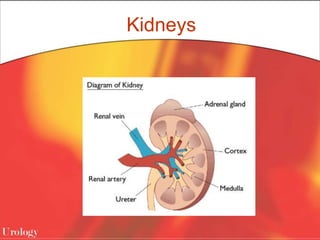
Kidneys
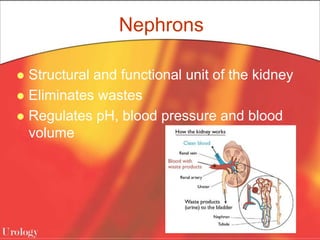
Nephrons
 Structural and functional unit of the kidney
 Eliminates wastes
 Regulates pH, blood pressure and blood
volume
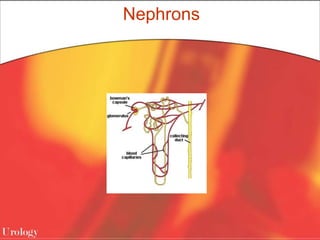
Nephrons
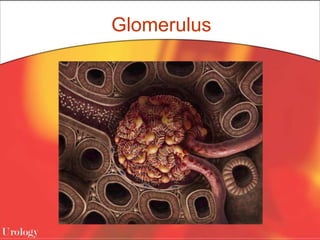
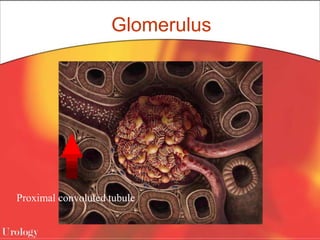
Glomerulus
 Basic filtration unit of the kidney
 First place where urine is formed in the
body
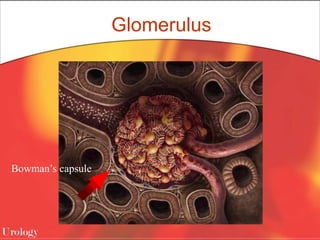
 Along with the Bowman’s capsule,
comprises the renal corpuscle
 Overall function of the kidney is measured
by the glomerular filtration rate (GFR),
which is the rate that blood is filtered
through all glomeruli
Glomerulus
Glomerulus
Bowman’s capsule
Glomerulus
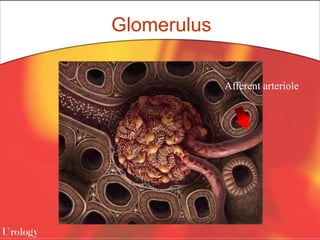
Afferent arteriole
Glomerulus
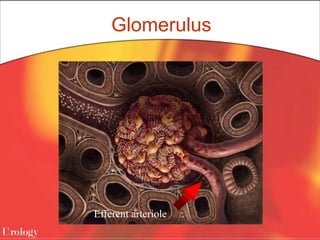
Efferent arteriole
Glomerulus
Proximal convoluted tubule
How is this process controlled?
 Anti diuretic hormone (ADH)
 Concentration of water in the blood decreases
 Increase in the osmotic pressure stimulates the
osmoreceptors in the hypothalamus
 Hypothalamus signals the posterior pituitary gland to
secrete ADH
 Blood carries ADH to the kidneys
 ADH causes the distal convoluted tubules and collecting
ducts to increase water absorption through osmosis
 Urine becomes more concentrated and volume decreases
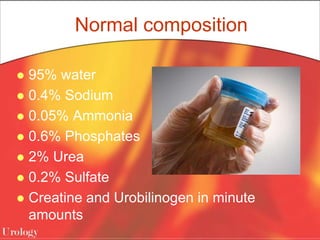
Normal composition
 95% water
 0.4% Sodium
 0.05% Ammonia
 0.6% Phosphates
 2% Urea
 0.2% Sulfate
 Creatine and Urobilinogen in minute
amounts
What can urine indicate?
 UTI
 Systemic illness
 Metabolic disorders
 Diabetes
 Pregnancy
Symptoms or problems
 Dark, strong smelling urine
 Burning urination
 Oliguria, Polyuria, Anuria
 Glycosuria, Haematuria, Semonorrhoea
 Backache, Lower abdominal pain,
Suprapubic pain
Clinical tests
 Reagent strips
Clinical tests
 Protein
 Blood
 Leukocytes
 Nitrite
 Glucose
 Ketone
 pH
 Specific gravity
 Bilirubin
 Urobilinogen
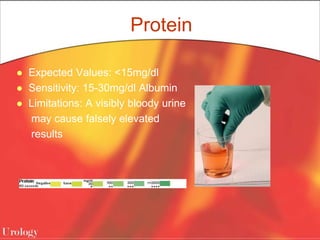
Protein
 Expected Values: <15mg/dl
 Sensitivity: 15-30mg/dl Albumin
 Limitations: A visibly bloody urine
may cause falsely elevated
results
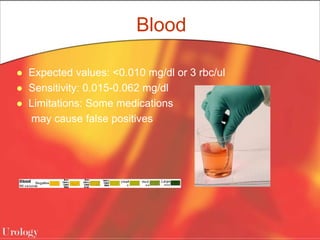
Blood
 Expected values: <0.010 mg/dl or 3 rbc/ul
 Sensitivity: 0.015-0.062 mg/dl
 Limitations: Some medications
may cause false positives
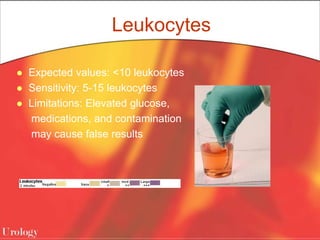
Leukocytes
 Expected values: <10 leukocytes
 Sensitivity: 5-15 leukocytes
 Limitations: Elevated glucose,
medications, and contamination
may cause false results
Nitrite
 Expected values: <0.075mg/dl
 Sensitivity: 0.06-0.1 mg/dl
 Limitations: Negative results do
not rule out significant bacteriuria
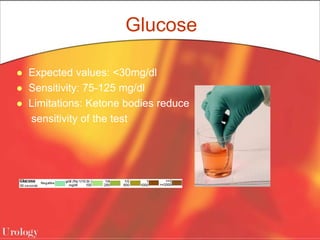
Glucose
 Expected values: <30mg/dl
 Sensitivity: 75-125 mg/dl
 Limitations: Ketone bodies reduce
sensitivity of the test
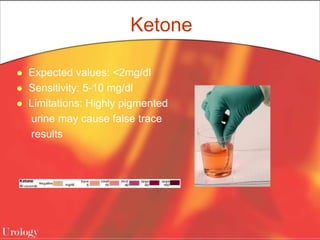
Ketone
 Expected values: <2mg/dl
 Sensitivity: 5-10 mg/dl
 Limitations: Highly pigmented
urine may cause false trace
results
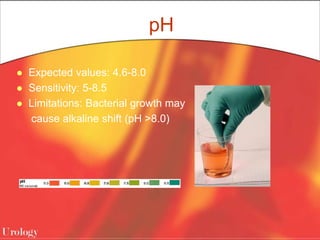
pH
 Expected values: 4.6-8.0
 Sensitivity: 5-8.5
 Limitations: Bacterial growth may
cause alkaline shift (pH >8.0)
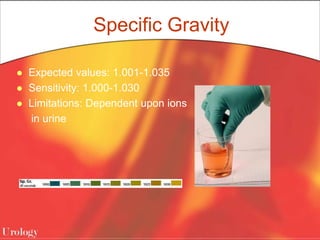
Specific Gravity
 Expected values: 1.001-1.035
 Sensitivity: 1.000-1.030
 Limitations: Dependent upon ions
in urine
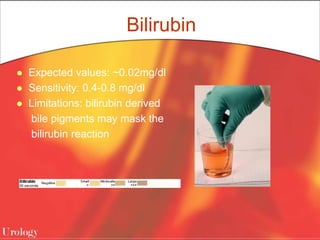
Bilirubin
 Expected values: ~0.02mg/dl
 Sensitivity: 0.4-0.8 mg/dl
 Limitations: bilirubin derived
bile pigments may mask the
bilirubin reaction
Urobilinogen
 Expected values: <1.0 mg/dl
 Sensitivity: >0.02 mg/dl
 Limitations: Test pad may react
with interfering substances known
to react with Ehrlich’s reagent
Confirmation tests
 Ictotest
 Acetest
 Clinitest
Confirmation tests
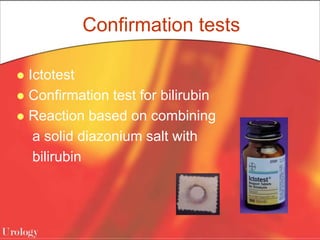
 Ictotest
 Confirmation test for bilirubin
 Reaction based on combining
a solid diazonium salt with
bilirubin
Confirmation tests
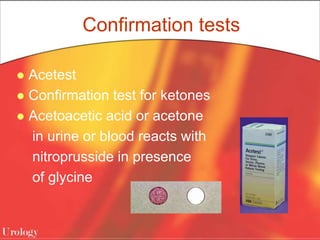
 Acetest
 Confirmation test for ketones
 Acetoacetic acid or acetone
in urine or blood reacts with
nitroprusside in presence
of glycine
Confirmation tests
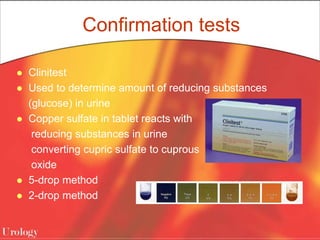
 Clinitest
 Used to determine amount of reducing substances
(glucose) in urine
 Copper sulfate in tablet reacts with
reducing substances in urine
converting cupric sulfate to cuprous
oxide
 5-drop method
 2-drop method
Questions

Urine presentation

  • 1.
    The importance ofurine testing in the clinical laboratory PFC Eaker
  • 2.
    How is urineproduced?  Produced by the kidneys  Drained by ureter into bladder  Urethra brings out urine from bladder
  • 3.
  • 4.
    Nephrons  Structural andfunctional unit of the kidney  Eliminates wastes  Regulates pH, blood pressure and blood volume
  • 5.
  • 6.
    Glomerulus  Basic filtrationunit of the kidney  First place where urine is formed in the body  Along with the Bowman’s capsule, comprises the renal corpuscle  Overall function of the kidney is measured by the glomerular filtration rate (GFR), which is the rate that blood is filtered through all glomeruli
  • 7.
  • 8.
  • 9.
  • 10.
  • 11.
  • 12.
    How is thisprocess controlled?  Anti diuretic hormone (ADH)  Concentration of water in the blood decreases  Increase in the osmotic pressure stimulates the osmoreceptors in the hypothalamus  Hypothalamus signals the posterior pituitary gland to secrete ADH  Blood carries ADH to the kidneys  ADH causes the distal convoluted tubules and collecting ducts to increase water absorption through osmosis  Urine becomes more concentrated and volume decreases
  • 13.
    Normal composition  95%water  0.4% Sodium  0.05% Ammonia  0.6% Phosphates  2% Urea  0.2% Sulfate  Creatine and Urobilinogen in minute amounts
  • 14.
    What can urineindicate?  UTI  Systemic illness  Metabolic disorders  Diabetes  Pregnancy
  • 15.
    Symptoms or problems Dark, strong smelling urine  Burning urination  Oliguria, Polyuria, Anuria  Glycosuria, Haematuria, Semonorrhoea  Backache, Lower abdominal pain, Suprapubic pain
  • 16.
  • 17.
    Clinical tests  Protein Blood  Leukocytes  Nitrite  Glucose  Ketone  pH  Specific gravity  Bilirubin  Urobilinogen
  • 18.
    Protein  Expected Values:<15mg/dl  Sensitivity: 15-30mg/dl Albumin  Limitations: A visibly bloody urine may cause falsely elevated results
  • 19.
    Blood  Expected values:<0.010 mg/dl or 3 rbc/ul  Sensitivity: 0.015-0.062 mg/dl  Limitations: Some medications may cause false positives
  • 20.
    Leukocytes  Expected values:<10 leukocytes  Sensitivity: 5-15 leukocytes  Limitations: Elevated glucose, medications, and contamination may cause false results
  • 21.
    Nitrite  Expected values:<0.075mg/dl  Sensitivity: 0.06-0.1 mg/dl  Limitations: Negative results do not rule out significant bacteriuria
  • 22.
    Glucose  Expected values:<30mg/dl  Sensitivity: 75-125 mg/dl  Limitations: Ketone bodies reduce sensitivity of the test
  • 23.
    Ketone  Expected values:<2mg/dl  Sensitivity: 5-10 mg/dl  Limitations: Highly pigmented urine may cause false trace results
  • 24.
    pH  Expected values:4.6-8.0  Sensitivity: 5-8.5  Limitations: Bacterial growth may cause alkaline shift (pH >8.0)
  • 25.
    Specific Gravity  Expectedvalues: 1.001-1.035  Sensitivity: 1.000-1.030  Limitations: Dependent upon ions in urine
  • 26.
    Bilirubin  Expected values:~0.02mg/dl  Sensitivity: 0.4-0.8 mg/dl  Limitations: bilirubin derived bile pigments may mask the bilirubin reaction
  • 27.
    Urobilinogen  Expected values:<1.0 mg/dl  Sensitivity: >0.02 mg/dl  Limitations: Test pad may react with interfering substances known to react with Ehrlich’s reagent
  • 28.
  • 29.
    Confirmation tests  Ictotest Confirmation test for bilirubin  Reaction based on combining a solid diazonium salt with bilirubin
  • 30.
    Confirmation tests  Acetest Confirmation test for ketones  Acetoacetic acid or acetone in urine or blood reacts with nitroprusside in presence of glycine
  • 31.
    Confirmation tests  Clinitest Used to determine amount of reducing substances (glucose) in urine  Copper sulfate in tablet reacts with reducing substances in urine converting cupric sulfate to cuprous oxide  5-drop method  2-drop method
  • 32.