RENAL FUNCTION
BIOCHEMISTRY
Bsc Nursing 3rd
Semester
MR.GOVINDA GAJBHIYE
B.SC. NURSING, MSC NURSING, M.A CLINICAL PSYCHOLOGIST
Introduction Of Renal Function
 Kidneys help maintain homeostasis by excreting
waste products, regulating fluid balance, and
producing hormones (erythropoietin, renin,
calcitriol).
 Tip:- (erythropoietin is a hormone that stimulates
red blood cell production, renin is an enzyme that
initiates the renin-angiotensin-aldosterone system
to regulate blood pressure, and calcitriol is the
active form of Vitamin D that promotes calcium
absorption for bone health)
Continue.......
Tests detect kidney abnormalities early
and monitor renal disease progression.
A Renal Function Test (RFT), or
Kidney Function Test (KFT), is a group
of blood and urine tests to assess
kidney health and function.
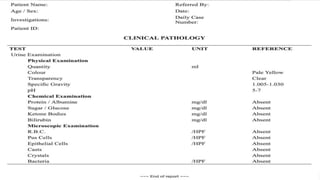
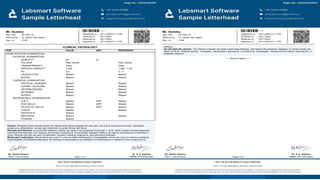
Urine Examination
Examination of Urine
Physical and Chemical Examination
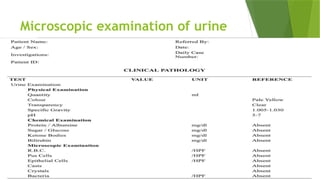
 In clinical biochemistry, urine is tested and report is given on a
urine sample. The procedure is called urine analysis .
 If the kidneys are not functioning properly, waste products can
accumulate in the blood, and fluid levels can increase to
dangerous volumes, causing damage to the body or a potentially
life-threatening situation.
 Numerous conditions and diseases can result in damage to the
kidneys.
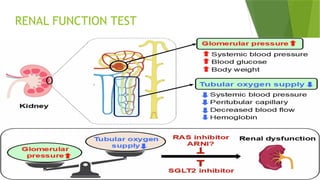
RENAL FUNCTION TEST
1. Glomerular Function Tests
These test how well the kidneys filter waste products.
Blood Urea – Measures urea levels in blood (high in renal failure).
Serum Creatinine – More reliable than urea for kidney function.
Clearance Tests
Inulin clearance – Gold standard for Glomerular Filtration Rate
(GFR).
Creatinine clearance – Commonly used to estimate GFR.
Urea clearance – Less accurate, sometimes used.
🔹 2. Tubular Function Tests
These check the kidney tubules’ ability to concentrate and dilute urine,
and maintain acid-base balance.
concentration test – After water restriction, kidneys should concentrate
urine.
Urine dilution test – After excess water intake, kidneys should dilute
urine.
Acidification test – Measures kidney’s ability to excrete hydrogen ions.
Phenolsulfonphthalein (PSP) test – Old test, measures tubular excretion
function.
 Proteins in urine – Presence indicates tubular/glomerular damage.
Routine Clinical Test
Urine examination
 Physical
Chemical
Microscopic examination
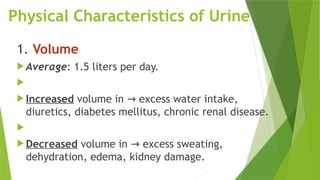
Physical Characteristics of Urine
1. Volume
 Average: 1.5 liters per day.

 Increased volume in excess water intake,
→
diuretics, diabetes mellitus, chronic renal disease.

 Decreased volume in excess sweating,
→
dehydration, edema, kidney damage.
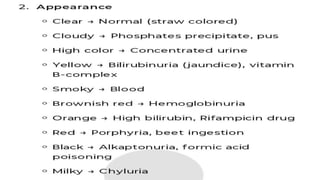
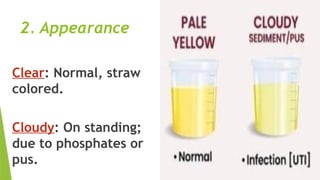
2. Appearance
Clear: Normal, straw
colored.
Cloudy: On standing;
due to phosphates or
pus.
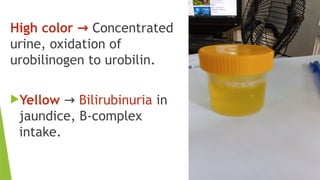
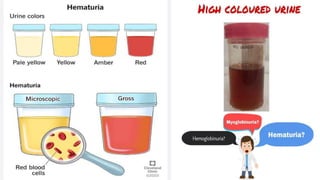
High color → Concentrated
urine, oxidation of
urobilinogen to urobilin.
Yellow → Bilirubinuria in
jaundice, B-complex
intake.
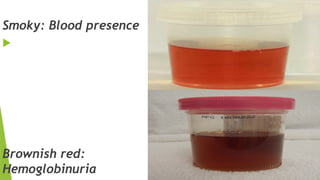
Smoky: Blood presence

Brownish red:
Hemoglobinuria
Orange: High bilirubin,
Rifampicin intake
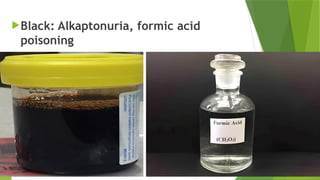
Black: Alkaptonuria, formic acid
poisoning
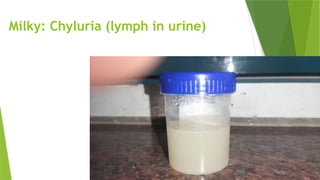
Milky: Chyluria (lymph in urine)
Chyluria is a rare condition where
chyle (lymph and fats from the
intestines) leaks into the urinary
tract, causing urine to appear
milky white. It is primarily caused
by parasitic infections,
3. Odor :- गंध,
Normal Urine:- faint aromatic smell
(volatile organic acids).
Diabetic ketoacidosis: fruity odor
(acetone).
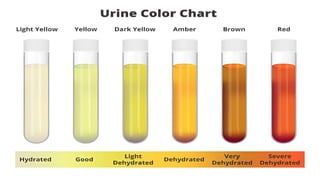
4. Color
Normal: straw-colored (amber yellow)
due to pigment urochrome.
In jaundice: urine turns yellow
(bilirubin present).
1. Specific Gravity
Normal range: 1.015 – 1.025
Theoretical extremes: 1.003 – 1.032
Clinical significance:
↓ Specific gravity excessive water intake, chronic nephritis,
→
diabetes insipidus.
↑ Specific gravity diabetes mellitus,
→ nephrosis, excessive
perspiration.
In chronic renal failure, usually fixed at 1.010.
🔹 1. Reaction (pH)
Normal: Acidic (pH 4.5 – 6.5)
Alkaline in: urinary tract infection,
vegetarian diet, after meals.
Acidic in: metabolic acidosis, diabetes
mellitus, starvation.
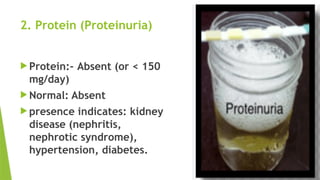
2. Protein (Proteinuria)
 Protein:- Absent (or < 150
mg/day)
 Normal: Absent
 presence indicates: kidney
disease (nephritis,
nephrotic syndrome),
hypertension, diabetes.
Blood in Urine
Hematuria Seen in nephritis and postrenal
→
hemorrhage.
Hemoglobinuria Due to abnormal hemolysis.
→
Tests available: Hemastix strips (rapid detection).
Negative
Yellow 🟡 🟡
Positive – Light
Grean Spots
Grean
Reducing Sugars (Glycosuria)
( presence of glucose in urine)
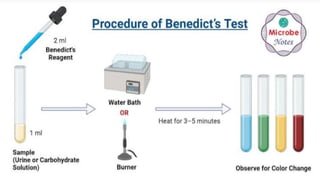
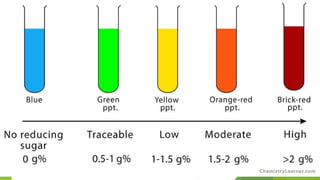
Benedict’s test: Used to know % of reducing sugars
in urine.
Procedure:
Take ~1 mL Benedict’s reagent in a test tube.
Add 4–5 drops of urine sample.
Heat to boiling.
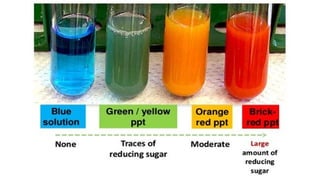
 Positive test → reddish-brown (orange, olive-
green) precipitate.
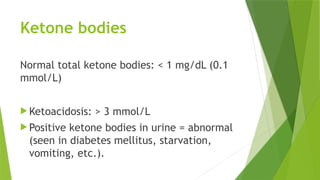
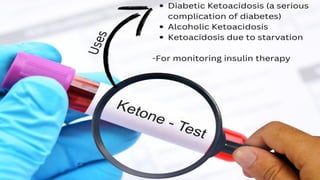
Ketone bodies
Normal total ketone bodies: < 1 mg/dL (0.1
mmol/L)
 Ketoacidosis: > 3 mmol/L
 Positive ketone bodies in urine = abnormal
(seen in diabetes mellitus, starvation,
vomiting, etc.).
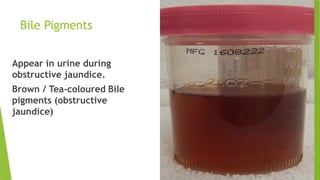
Bile Pigments
Appear in urine during
obstructive jaundice.
Brown / Tea-coloured Bile
pigments (obstructive
jaundice)
Microscopic examination of urine
1. Cells
RBCs (Red Blood Cells):
WBCs (Pus cells):
Epithelial cells:
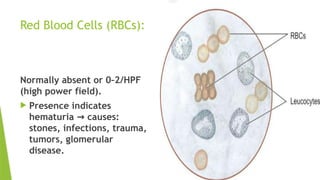
Red Blood Cells (RBCs):
Normally absent or 0–2/HPF
(high power field).
 Presence indicates
hematuria causes:
→
stones, infections, trauma,
tumors, glomerular
disease.
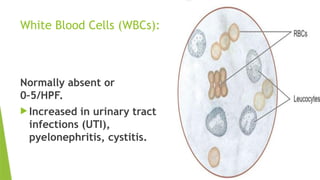
White Blood Cells (WBCs):
Normally absent or
0–5/HPF.
 Increased in urinary tract
infections (UTI),
pyelonephritis, cystitis.
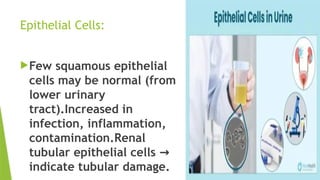
Epithelial Cells:
Few squamous epithelial
cells may be normal (from
lower urinary
tract).Increased in
infection, inflammation,
contamination.Renal
tubular epithelial cells →
indicate tubular damage.
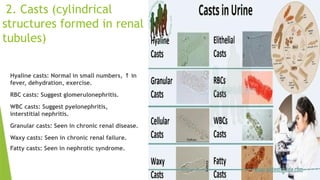
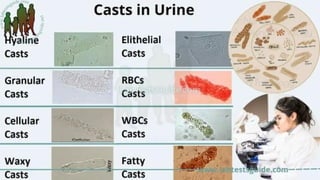
2. Casts (cylindrical
structures formed in renal
tubules)
Hyaline casts: Normal in small numbers, in
↑
fever, dehydration, exercise.
RBC casts: Suggest glomerulonephritis.
WBC casts: Suggest pyelonephritis,
interstitial nephritis.
Granular casts: Seen in chronic renal disease.
Waxy casts: Seen in chronic renal failure.
Fatty casts: Seen in nephrotic syndrome.
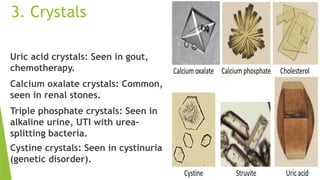
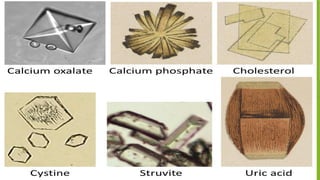
3. Crystals
Uric acid crystals: Seen in gout,
chemotherapy.
Calcium oxalate crystals: Common,
seen in renal stones.
Triple phosphate crystals: Seen in
alkaline urine, UTI with urea-
splitting bacteria.
Cystine crystals: Seen in cystinuria
(genetic disorder).
🔹 4. Microorganisms
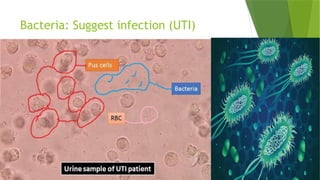
Bacteria: Suggest infection (UTI).
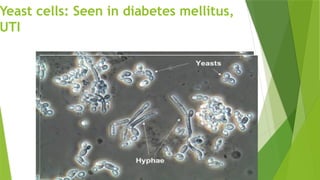
Yeast cells: Seen in diabetes
mellitus.Yeast cells in urine, known as
candiduria, can indicate a urinary tract
infection (UTI)
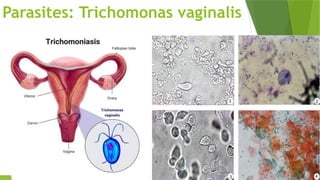
Parasites: Trichomonas vaginalis may be
detected.
Bacteria: Suggest infection (UTI)
Yeast cells: Seen in diabetes mellitus,
UTI
Parasites: Trichomonas vaginalis
KFT ( BLOOD TEST)
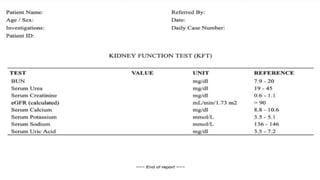
Blood Tests in KFT
1. Blood Urea
Normal range: 15–40 mg/dL (varies slightly
by lab)
Increased in: Renal failure, dehydration, high
protein diet, GI bleeding.
Decreased in: Severe liver disease,
malnutrition, overhydration.
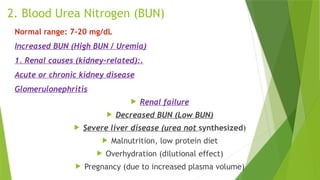
2. Blood Urea Nitrogen (BUN)
Normal range: 7–20 mg/dL
Increased BUN (High BUN / Uremia)
1. Renal causes (kidney-related):.
Acute or chronic kidney disease
Glomerulonephritis
 Renal failure
 Decreased BUN (Low BUN)
 Severe liver disease (urea not synthesized)
 Malnutrition, low protein diet
 Overhydration (dilutional effect)
 Pregnancy (due to increased plasma volume)
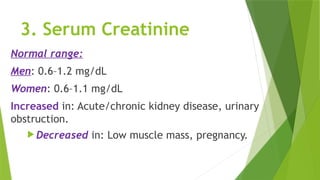
3. Serum Creatinine
Normal range:
Men: 0.6–1.2 mg/dL
Women: 0.6–1.1 mg/dL
Increased in: Acute/chronic kidney disease, urinary
obstruction.
 Decreased in: Low muscle mass, pregnancy.
🔹 4. Uric Acid
Normal range:
Men: 3.4–7.0 mg/dL
Women: 2.4–6.0 mg/dL
 Increased in renal failure, leukemia, chemotherapy.
 Gout ( arthritis)
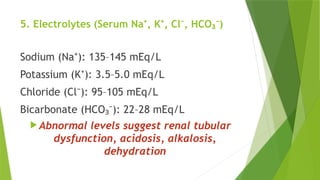
5. Electrolytes (Serum Na , K , Cl , HCO )
⁺ ⁺ ⁻ ₃⁻
Sodium (Na ): 135–145 mEq/L
⁺
Potassium (K ): 3.5–5.0 mEq/L
⁺
Chloride (Cl ): 95–105 mEq/L
⁻
Bicarbonate (HCO ): 22–28 mEq/L
₃⁻
 Abnormal levels suggest renal tubular
dysfunction, acidosis, alkalosis,
dehydration
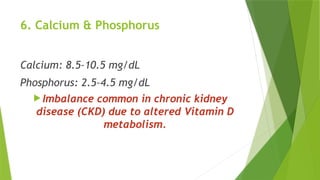
6. Calcium & Phosphorus
Calcium: 8.5–10.5 mg/dL
Phosphorus: 2.5–4.5 mg/dL
 Imbalance common in chronic kidney
disease (CKD) due to altered Vitamin D
metabolism.
7. Glomerular Filtration Rate (GFR)
Estimated from Serum Creatinine using
formulas.
Normal GFR: 90–120 mL/min/1.73m²
 <60 Chronic kidney disease (if
→
persistent).
RENAL FUNCTION TEST BSC NURSING 2ND SEMESTERS

RENAL FUNCTION TEST BSC NURSING 2ND SEMESTERS

  • 1.
    RENAL FUNCTION BIOCHEMISTRY Bsc Nursing3rd Semester MR.GOVINDA GAJBHIYE B.SC. NURSING, MSC NURSING, M.A CLINICAL PSYCHOLOGIST
  • 2.
    Introduction Of RenalFunction  Kidneys help maintain homeostasis by excreting waste products, regulating fluid balance, and producing hormones (erythropoietin, renin, calcitriol).  Tip:- (erythropoietin is a hormone that stimulates red blood cell production, renin is an enzyme that initiates the renin-angiotensin-aldosterone system to regulate blood pressure, and calcitriol is the active form of Vitamin D that promotes calcium absorption for bone health)
  • 3.
    Continue....... Tests detect kidneyabnormalities early and monitor renal disease progression. A Renal Function Test (RFT), or Kidney Function Test (KFT), is a group of blood and urine tests to assess kidney health and function.
  • 4.
  • 5.
    Examination of Urine Physicaland Chemical Examination  In clinical biochemistry, urine is tested and report is given on a urine sample. The procedure is called urine analysis .  If the kidneys are not functioning properly, waste products can accumulate in the blood, and fluid levels can increase to dangerous volumes, causing damage to the body or a potentially life-threatening situation.  Numerous conditions and diseases can result in damage to the kidneys.
  • 6.
  • 7.
    1. Glomerular FunctionTests These test how well the kidneys filter waste products. Blood Urea – Measures urea levels in blood (high in renal failure). Serum Creatinine – More reliable than urea for kidney function. Clearance Tests Inulin clearance – Gold standard for Glomerular Filtration Rate (GFR). Creatinine clearance – Commonly used to estimate GFR. Urea clearance – Less accurate, sometimes used.
  • 8.
    🔹 2. TubularFunction Tests These check the kidney tubules’ ability to concentrate and dilute urine, and maintain acid-base balance. concentration test – After water restriction, kidneys should concentrate urine. Urine dilution test – After excess water intake, kidneys should dilute urine. Acidification test – Measures kidney’s ability to excrete hydrogen ions. Phenolsulfonphthalein (PSP) test – Old test, measures tubular excretion function.  Proteins in urine – Presence indicates tubular/glomerular damage.
  • 9.
    Routine Clinical Test Urineexamination  Physical Chemical Microscopic examination
  • 13.
    Physical Characteristics ofUrine 1. Volume  Average: 1.5 liters per day.   Increased volume in excess water intake, → diuretics, diabetes mellitus, chronic renal disease.   Decreased volume in excess sweating, → dehydration, edema, kidney damage.
  • 14.
    2. Appearance Clear: Normal,straw colored. Cloudy: On standing; due to phosphates or pus.
  • 15.
    High color →Concentrated urine, oxidation of urobilinogen to urobilin. Yellow → Bilirubinuria in jaundice, B-complex intake.
  • 16.
  • 17.
  • 18.
  • 19.
  • 20.
    Chyluria is arare condition where chyle (lymph and fats from the intestines) leaks into the urinary tract, causing urine to appear milky white. It is primarily caused by parasitic infections,
  • 21.
    3. Odor :-गंध, Normal Urine:- faint aromatic smell (volatile organic acids). Diabetic ketoacidosis: fruity odor (acetone).
  • 22.
    4. Color Normal: straw-colored(amber yellow) due to pigment urochrome. In jaundice: urine turns yellow (bilirubin present).
  • 24.
    1. Specific Gravity Normalrange: 1.015 – 1.025 Theoretical extremes: 1.003 – 1.032 Clinical significance: ↓ Specific gravity excessive water intake, chronic nephritis, → diabetes insipidus. ↑ Specific gravity diabetes mellitus, → nephrosis, excessive perspiration. In chronic renal failure, usually fixed at 1.010.
  • 26.
    🔹 1. Reaction(pH) Normal: Acidic (pH 4.5 – 6.5) Alkaline in: urinary tract infection, vegetarian diet, after meals. Acidic in: metabolic acidosis, diabetes mellitus, starvation.
  • 27.
    2. Protein (Proteinuria) Protein:- Absent (or < 150 mg/day)  Normal: Absent  presence indicates: kidney disease (nephritis, nephrotic syndrome), hypertension, diabetes.
  • 28.
    Blood in Urine HematuriaSeen in nephritis and postrenal → hemorrhage. Hemoglobinuria Due to abnormal hemolysis. → Tests available: Hemastix strips (rapid detection).
  • 30.
    Negative Yellow 🟡 🟡 Positive– Light Grean Spots Grean
  • 31.
    Reducing Sugars (Glycosuria) (presence of glucose in urine) Benedict’s test: Used to know % of reducing sugars in urine. Procedure: Take ~1 mL Benedict’s reagent in a test tube. Add 4–5 drops of urine sample. Heat to boiling.  Positive test → reddish-brown (orange, olive- green) precipitate.
  • 35.
    Ketone bodies Normal totalketone bodies: < 1 mg/dL (0.1 mmol/L)  Ketoacidosis: > 3 mmol/L  Positive ketone bodies in urine = abnormal (seen in diabetes mellitus, starvation, vomiting, etc.).
  • 37.
    Bile Pigments Appear inurine during obstructive jaundice. Brown / Tea-coloured Bile pigments (obstructive jaundice)
  • 38.
  • 39.
    1. Cells RBCs (RedBlood Cells): WBCs (Pus cells): Epithelial cells:
  • 40.
    Red Blood Cells(RBCs): Normally absent or 0–2/HPF (high power field).  Presence indicates hematuria causes: → stones, infections, trauma, tumors, glomerular disease.
  • 41.
    White Blood Cells(WBCs): Normally absent or 0–5/HPF.  Increased in urinary tract infections (UTI), pyelonephritis, cystitis.
  • 42.
    Epithelial Cells: Few squamousepithelial cells may be normal (from lower urinary tract).Increased in infection, inflammation, contamination.Renal tubular epithelial cells → indicate tubular damage.
  • 43.
    2. Casts (cylindrical structuresformed in renal tubules) Hyaline casts: Normal in small numbers, in ↑ fever, dehydration, exercise. RBC casts: Suggest glomerulonephritis. WBC casts: Suggest pyelonephritis, interstitial nephritis. Granular casts: Seen in chronic renal disease. Waxy casts: Seen in chronic renal failure. Fatty casts: Seen in nephrotic syndrome.
  • 45.
    3. Crystals Uric acidcrystals: Seen in gout, chemotherapy. Calcium oxalate crystals: Common, seen in renal stones. Triple phosphate crystals: Seen in alkaline urine, UTI with urea- splitting bacteria. Cystine crystals: Seen in cystinuria (genetic disorder).
  • 47.
    🔹 4. Microorganisms Bacteria:Suggest infection (UTI). Yeast cells: Seen in diabetes mellitus.Yeast cells in urine, known as candiduria, can indicate a urinary tract infection (UTI) Parasites: Trichomonas vaginalis may be detected.
  • 48.
  • 49.
    Yeast cells: Seenin diabetes mellitus, UTI
  • 50.
  • 51.
  • 53.
    Blood Tests inKFT 1. Blood Urea Normal range: 15–40 mg/dL (varies slightly by lab) Increased in: Renal failure, dehydration, high protein diet, GI bleeding. Decreased in: Severe liver disease, malnutrition, overhydration.
  • 54.
    2. Blood UreaNitrogen (BUN) Normal range: 7–20 mg/dL Increased BUN (High BUN / Uremia) 1. Renal causes (kidney-related):. Acute or chronic kidney disease Glomerulonephritis  Renal failure  Decreased BUN (Low BUN)  Severe liver disease (urea not synthesized)  Malnutrition, low protein diet  Overhydration (dilutional effect)  Pregnancy (due to increased plasma volume)
  • 55.
    3. Serum Creatinine Normalrange: Men: 0.6–1.2 mg/dL Women: 0.6–1.1 mg/dL Increased in: Acute/chronic kidney disease, urinary obstruction.  Decreased in: Low muscle mass, pregnancy.
  • 56.
    🔹 4. UricAcid Normal range: Men: 3.4–7.0 mg/dL Women: 2.4–6.0 mg/dL  Increased in renal failure, leukemia, chemotherapy.  Gout ( arthritis)
  • 58.
    5. Electrolytes (SerumNa , K , Cl , HCO ) ⁺ ⁺ ⁻ ₃⁻ Sodium (Na ): 135–145 mEq/L ⁺ Potassium (K ): 3.5–5.0 mEq/L ⁺ Chloride (Cl ): 95–105 mEq/L ⁻ Bicarbonate (HCO ): 22–28 mEq/L ₃⁻  Abnormal levels suggest renal tubular dysfunction, acidosis, alkalosis, dehydration
  • 59.
    6. Calcium &Phosphorus Calcium: 8.5–10.5 mg/dL Phosphorus: 2.5–4.5 mg/dL  Imbalance common in chronic kidney disease (CKD) due to altered Vitamin D metabolism.
  • 60.
    7. Glomerular FiltrationRate (GFR) Estimated from Serum Creatinine using formulas. Normal GFR: 90–120 mL/min/1.73m²  <60 Chronic kidney disease (if → persistent).