


ANATOMY AND PHYSIOLOGY OF THE SYSTEM
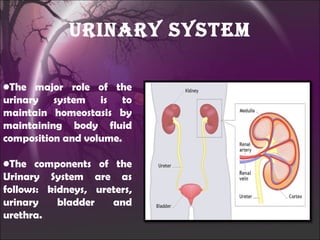
URINARY SYSTEM The major role of the urinary system is to maintain homeostasis by maintaining body fluid composition and volume. The components of the Urinary System are as follows: kidneys, ureters, urinary bladder and urethra.
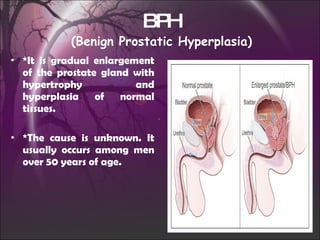
BPH (Benign Prostatic Hyperplasia) *It is gradual enlargement of the prostate gland with hypertrophy and hyperplasia of normal tissues. *The cause is unknown. It usually occurs among men over 50 years of age.
Aging process in males results to hormonal imbalance . The estrogen levels become higher than the androgen levels. This cause hyperplasia of the prostate gland. The enlargement causes compression of the urethra and base of the bladder. This leads to urinary obstruction. If untreated, it results to a serious complication –  renal failure .
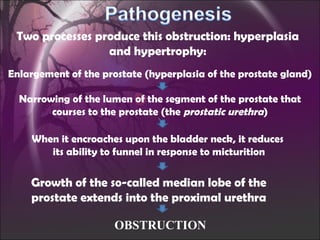
Two processes produce this obstruction: hyperplasia and hypertrophy: Enlargement of the prostate (hyperplasia of the prostate gland) Narrowing of the lumen of the segment of the prostate that courses to the prostate (the  prostatic urethra ) When it encroaches upon the bladder neck, it reduces its ability to funnel in response to micturition Growth of the so-called median lobe of the prostate extends into the proximal urethra OBSTRUCTION
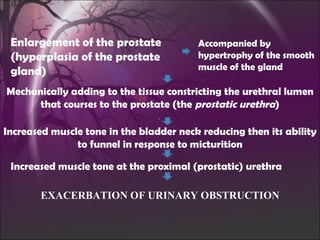
Enlargement of the prostate (hyperplasia of the prostate gland)  Accompanied by hypertrophy of the smooth muscle of the gland Mechanically adding to the tissue constricting the urethral lumen that courses to the prostate (the  prostatic urethra ) Increased muscle tone in the bladder neck reducing then its ability to funnel in response to micturition Increased muscle tone at the proximal (prostatic) urethra EXACERBATION OF URINARY OBSTRUCTION
Nocturia ( frequent voiding at night) the frequent manifestation that occurs. The other manifestations are frequency, urgency, hesitancy (difficulty in initiating urination, takes few minutes before urine flows), decreased caliber of urinary stream and force, increased residual urine, hematuria, UTI. Abdominal straining with urination,  volume and force of urinary stream. Sensation that bladder has not completely emptied.  Recurrent urinary tract infection It is validated by rectal examination, cystoscopy and ultrasound. ASSESSMENT
DIAGNOSTICS Digital Rectal Examination (DRE) - reveals a large, rubbery, and non    tender prostate gland. Urinalysis and Urodynamic studies - to assess urine flow Renal function tests including serum-creatinine level (complete blood studies) - to determine wether there is renal    impairment. Ultrasound Cystoscopy – visualization of urinary bladder Biopsy
Preoperative Care Ultrasonography - reassure client that ultrasound is painless and not invasive - fleet enema 45 minutes before procedure Cystoscopy - preop protocol; obtain    consent - urine culture or Gram stain  must be negative - place client in lithotomy    position - urethra is prepared with a    water-soluble lubricant    containing 2% lidocaine - ext. Genetelia are prepped w/    antiseptic sol’n  e.g.,      povidone/iodine. Postoperative Care Cystoscopy – hematuria is    expected    - instruct client to force    fluids    - report any frank    bleeding or clots in    the urine or    manifestations of UTI   - warm baths and    NSAIDS Biopsy – immediately apply pressure to the puncture  site   - apply sterile dressing   - check puncture site    for bleeding , V/S   - force fluids to    promote urination    and to prevent clot    formation   - limited activity for    the first 24 hrs.
Complications Nursing Diagnosis Urinary elimination, alteration in pattern related to surgery Pain related to bladder spasm Infection/injury (hemorrhage), potential for, related to surgery Sexual dysfunction, potential related to surgery Knowledge deficit (activity restriction, prevention of complications) related to lack of information with advanced BPH, urinary tract obstruction may occur as urine is unable to pass through the prostate. Urinary obstruction can lead to UTI’s and, if unrelieved, renal failure
Interventions Medical - ongoing assessment of a symptom - reducing urethral obstruction by relaxing smooth    muscle w/in the prostate, proximal urethra &    bladder neck  (Alpha-1-adrenergic blockers) - 5-alpha-reductase  (finasteride (Proscar) and    dutasteride) Surgical - TURP, Suprapubic Prostatectomy, Retropubic    Prostatectomy, and Perineal Prostatectomy Nursing Care Promotive - balance and healthy diet - regular exercise - health teachings Preventive - teach men to report any lower urinary tract    symptoms that may be indicative of BPH - teach men on how to perform TSE - teach men to practice safer sex to prevent      infections of the reproductive organs
Curative - Medications that reduces urethral obstruction by    relaxing smooth muscle w/in the prostate,    proximal urethra & bladder neck  (Alpha-1-   adrenergic blockers) - Surgery: TURP, Suprapubic Prostatectomy,      Retropubic Prostatectomy, and Perineal      Prostatectomy Rehabilitative - reassure clients that loss of control in urination is    almost always temporary and will resolve  - teach and encourage Kegel exercises
is an inflammation of the kidney and upper urinary tract that usually results from non contagious bacterial infection of the bladder (cystitis) the cause may be an active infection in the kidney or the remnants of a previous infection There two types: acute and chronic pyelonephritis. PYELONEPHRITIS
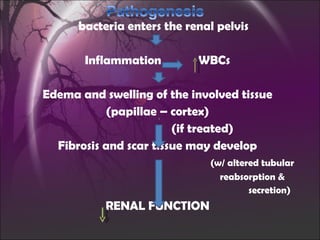
bacteria enters the renal pelvis Inflammation  WBCs Edema and swelling of the involved tissue (papillae – cortex) (if treated) Fibrosis and scar tissue may develop (w/ altered tubular  reabsorption &  secretion) RENAL FUNCTION
Acute Pyelonephritis Client seems to be in acute distress fever, chills, nausea, flank pain on the affected side, headache, muscle pain, and in general prostration Dysuria, frequency, urgency Urine is cloudy/bloody, foul-smelling ASSESSMENT Chronic Pyelonephritis Discovered incidentally when  the client is evaluated for hpn. Hypertension itself is the most frequent manifestation of the disease. Lab results may show azotemia, pyuria, anemia, &proteinuria. Demonstrates poor urine-concentrrating ability
DIAGNOSTICS X-ray studies, intravenous pyelography (IVP) cystourethrogram Ultrasound, CT scan, MRI Radionuclide imaging  w/ gallium citrate and indium-111 (In  111 ) Urine culture and sensitiviy tests IV urogram, measurements of creatinine clearance, BUN & Crea. levels
Preoparative Care - screening for allergies or sensitivity - instruct px about  necessary bowel prep.  - tell client that there is sensation of flushing and warmth, salty taste, nausea. If occurs, take deep, full breath Intraoparative Care - assess for allergic reactions immediately after injection of the contrast medium (urticaria, itching, diaphoresis, and resp. distress or failure) - antihistamines, steroids and emergency cart must be ready available
Postoperative Care: Monitor hydration status after IVP to reduce the risk of renal failure in susceptible clients If not contraindicated, force fluids to promote renal clearance of the contrast medium. Monitor output Observe for mild reactions for iodine, such as hives, nausea or parotid swelling. Complications End Stage Renal Disease (ESRD) – for Chronic pyelonephritis Hypertension, formation of kidney stones
NURSING DIAGNOSIS Risk for Deficient Fluid Volume related to fever, nausea, vomiting, and possible diarrhea Acute pain related to an inflammatory process in the kidney and possible colic. Readiness for enhanced therapeutic regimen management
Interventions Medical Prepare client for antibiotic thrapy IV fluid for client w/ severe nausea and vomiting Pain reliever as indicated, antipyretics for fever, urinary analgesics Nursing Care Promotive Healthy lifestyle Health teachings Preventive Provision of information on lifestyle measures: Perineal hygiene-wiping front-back Acidification of the urine(take ascorbic acid and other juice) Ensuring adequate fluid intake
Curative Give antibiotics as indicated (2-3 weeks course) Ciprofloxacin (Cipro) Ampicillin (Omnipen) trimethoprim-sulfamethoxazole (Bactrim, Septra May require hospitalization if the patient is severely ill For chronic p., 6 mos course of antibiotics until infection is clear Fluid intake Rehabilitative Health maintenance Importance of completing the course of antibiotics Follow-up cultures to ensure that infection has been eradicated
CYSTITIS Is the  inflammation of the urinary bladder Sometimes cystitis and urethritis are referred to collectively as a lower urinary tract infection, or UTI Most of the time, the inflammation is caused by a bacterial infection common female problem, esp. to pregnant ones (no prostatic fluid and short urethra) uncommon in younger and middle-aged men, but may occur as complications of bacterial infections of the kidney or prostate gland In children, cystitis is often caused by congenital abnormalities (present at birth) of the urinary tract
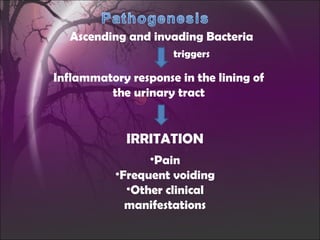
Ascending and invading Bacteria Inflammatory response in the lining of the urinary tract triggers IRRITATION Pain Frequent voiding Other clinical manifestations
ASSESSMENT Frequency (voiding at close intervals) Urgency (strong desire to void) Dysuria  Foul-smelling urine Suprapubic pain Malaise, fever, chills, nausea and vomiting Low back pain Routine urinalysis and Creatinine and Sensitivity test of urine support presence of UTI (rbc, wbs, pus, and bacteria in the urine For elderly, lethargy, altered sensorium, anorexia, new incontinence, hyperventilation,  grade fever
DIAGNOSTICS Urinalysis (presence of rbc, wbc, pus and bacteria) Urine cultures Bacterial colony counts Cellular studies Preoperative Care advise client to obtain a urine midstream give adequate instructions to the client regarding antibiotic therapy & dietary & activity restrictions needed during antibiotic therapy for surgery, do preop protocol
Postoperative Care Maintain hydration status IV Fluids Adequate fluid intake Complications Urethrovesical reflux Urosepsis Pyelonephritis
NURSING DIAGNOSIS Impaired Urinary Elimination Acute Pain related to infection within the urinary tract Deficient Knowledge about factors predisposing the patient to infection and recurrence, detection and prevention of recurrence, and pharmacvologic therapy
INTERVENTIONS Medical Acute Pharmacologic Therapy  ( Antibacterial agents) Long-term Pharmacologic Therapy  (another short course -3 to 4 days of full-dose antimicrobial therapy followed by a regular bedtime dose of an antimicrobial agent may be prescribed) Patient Education Surgical - are performed only to address structural      anomalies that cause repeated infections
NURSING CARE Promotive Healthy lifestyle Teaching Patients Self Care Preventive Practicing Careful Personal Hygiene Practice “3 W’s” Wash  hands before and after using the toilet Wear  cotton underwear Wipe  perineum from front to back Increasing fluid intake to promote voiding and dilution of urind Urinating regularly and more frequently Drink cranberry juice!
Curative Administer medications as prescribed Urinary Tract Analgesics Urinary Antiseptics Fluoroquinolones Sulfonamides Cholinergic Antispasmodics Rehabilitative Recognition of lifestyle changes-to dec. Risk factors Ability to restate the medication protocol
WILM’S TUMOR Is the type of childhood cancer that begins in the kidney It is a malignant tumor Most common type of kidney cancer among children  Can develop in both (bilateral) or in one (unilateral) kidney. Is only often found after it has grown to a size of 8 oz Risk factor- hemihypertrphy for children It accounts for 6% of all childhood cancers. • It generally grows to a large size before it is diagnosed, usually before the child reaches age 5. • The tumor expands the renal parenchyma, and the capsule of the kidney becomes stretched over the surface of the tumor. • Staging if from I (limited to kidney) to IV (matastasis) and stage V, which indicates bilateral involvement (rare). • The tumor may metastasize to the  lymph nodes , lungs, liver, and brain.
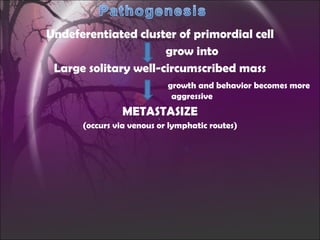
Undeferentiated cluster of primordial cell grow into Large solitary well-circumscribed mass growth and behavior becomes more  aggressive METASTASIZE (occurs via venous or lymphatic routes)
ASSESSMENT Firm, non tender abdominal mass Hematuria Low grade fever HPN Possible anemia Weight loss Malaise Anorexia Stomach pain Nausea and vomiting
DIAGNOSTICS IVP Chest CT scan Chest MRI Sonogram Chest Xray
COMPLICATION Spread of the Tumor to the vitsl organs HPN Kidney damage may occur
INTERVENTION Medical IV combination chemo Analgesic for pain Radiotherapy SURGICAL - Nephroureterectomy - resection of involved abdominal structure - kidney transplant
NURSING CARE Preventive/Curative/Rehabilitative do not palpate the abdomen as palpation and handling aids in metastasis provide care for a client with nephrectomy provide care for client receiving chemo and radiation therapy continue follow-up care


Urinary System

  • 1.
      ANATOMY ANDPHYSIOLOGY OF THE SYSTEM
  • 2.
    URINARY SYSTEM Themajor role of the urinary system is to maintain homeostasis by maintaining body fluid composition and volume. The components of the Urinary System are as follows: kidneys, ureters, urinary bladder and urethra.
  • 3.
    BPH (Benign ProstaticHyperplasia) *It is gradual enlargement of the prostate gland with hypertrophy and hyperplasia of normal tissues. *The cause is unknown. It usually occurs among men over 50 years of age.
  • 4.
    Aging process inmales results to hormonal imbalance . The estrogen levels become higher than the androgen levels. This cause hyperplasia of the prostate gland. The enlargement causes compression of the urethra and base of the bladder. This leads to urinary obstruction. If untreated, it results to a serious complication – renal failure .
  • 5.
    Two processes producethis obstruction: hyperplasia and hypertrophy: Enlargement of the prostate (hyperplasia of the prostate gland) Narrowing of the lumen of the segment of the prostate that courses to the prostate (the prostatic urethra ) When it encroaches upon the bladder neck, it reduces its ability to funnel in response to micturition Growth of the so-called median lobe of the prostate extends into the proximal urethra OBSTRUCTION
  • 6.
    Enlargement of theprostate (hyperplasia of the prostate gland) Accompanied by hypertrophy of the smooth muscle of the gland Mechanically adding to the tissue constricting the urethral lumen that courses to the prostate (the prostatic urethra ) Increased muscle tone in the bladder neck reducing then its ability to funnel in response to micturition Increased muscle tone at the proximal (prostatic) urethra EXACERBATION OF URINARY OBSTRUCTION
  • 7.
    Nocturia ( frequentvoiding at night) the frequent manifestation that occurs. The other manifestations are frequency, urgency, hesitancy (difficulty in initiating urination, takes few minutes before urine flows), decreased caliber of urinary stream and force, increased residual urine, hematuria, UTI. Abdominal straining with urination, volume and force of urinary stream. Sensation that bladder has not completely emptied. Recurrent urinary tract infection It is validated by rectal examination, cystoscopy and ultrasound. ASSESSMENT
  • 8.
    DIAGNOSTICS Digital RectalExamination (DRE) - reveals a large, rubbery, and non tender prostate gland. Urinalysis and Urodynamic studies - to assess urine flow Renal function tests including serum-creatinine level (complete blood studies) - to determine wether there is renal impairment. Ultrasound Cystoscopy – visualization of urinary bladder Biopsy
  • 9.
    Preoperative Care Ultrasonography- reassure client that ultrasound is painless and not invasive - fleet enema 45 minutes before procedure Cystoscopy - preop protocol; obtain consent - urine culture or Gram stain must be negative - place client in lithotomy position - urethra is prepared with a water-soluble lubricant containing 2% lidocaine - ext. Genetelia are prepped w/ antiseptic sol’n e.g., povidone/iodine. Postoperative Care Cystoscopy – hematuria is expected - instruct client to force fluids - report any frank bleeding or clots in the urine or manifestations of UTI - warm baths and NSAIDS Biopsy – immediately apply pressure to the puncture site - apply sterile dressing - check puncture site for bleeding , V/S - force fluids to promote urination and to prevent clot formation - limited activity for the first 24 hrs.
  • 10.
    Complications Nursing DiagnosisUrinary elimination, alteration in pattern related to surgery Pain related to bladder spasm Infection/injury (hemorrhage), potential for, related to surgery Sexual dysfunction, potential related to surgery Knowledge deficit (activity restriction, prevention of complications) related to lack of information with advanced BPH, urinary tract obstruction may occur as urine is unable to pass through the prostate. Urinary obstruction can lead to UTI’s and, if unrelieved, renal failure
  • 11.
    Interventions Medical -ongoing assessment of a symptom - reducing urethral obstruction by relaxing smooth muscle w/in the prostate, proximal urethra & bladder neck (Alpha-1-adrenergic blockers) - 5-alpha-reductase (finasteride (Proscar) and dutasteride) Surgical - TURP, Suprapubic Prostatectomy, Retropubic Prostatectomy, and Perineal Prostatectomy Nursing Care Promotive - balance and healthy diet - regular exercise - health teachings Preventive - teach men to report any lower urinary tract symptoms that may be indicative of BPH - teach men on how to perform TSE - teach men to practice safer sex to prevent infections of the reproductive organs
  • 12.
    Curative - Medicationsthat reduces urethral obstruction by relaxing smooth muscle w/in the prostate, proximal urethra & bladder neck (Alpha-1- adrenergic blockers) - Surgery: TURP, Suprapubic Prostatectomy, Retropubic Prostatectomy, and Perineal Prostatectomy Rehabilitative - reassure clients that loss of control in urination is almost always temporary and will resolve - teach and encourage Kegel exercises
  • 13.
    is an inflammationof the kidney and upper urinary tract that usually results from non contagious bacterial infection of the bladder (cystitis) the cause may be an active infection in the kidney or the remnants of a previous infection There two types: acute and chronic pyelonephritis. PYELONEPHRITIS
  • 14.
    bacteria enters therenal pelvis Inflammation WBCs Edema and swelling of the involved tissue (papillae – cortex) (if treated) Fibrosis and scar tissue may develop (w/ altered tubular reabsorption & secretion) RENAL FUNCTION
  • 15.
    Acute Pyelonephritis Clientseems to be in acute distress fever, chills, nausea, flank pain on the affected side, headache, muscle pain, and in general prostration Dysuria, frequency, urgency Urine is cloudy/bloody, foul-smelling ASSESSMENT Chronic Pyelonephritis Discovered incidentally when the client is evaluated for hpn. Hypertension itself is the most frequent manifestation of the disease. Lab results may show azotemia, pyuria, anemia, &proteinuria. Demonstrates poor urine-concentrrating ability
  • 16.
    DIAGNOSTICS X-ray studies,intravenous pyelography (IVP) cystourethrogram Ultrasound, CT scan, MRI Radionuclide imaging w/ gallium citrate and indium-111 (In 111 ) Urine culture and sensitiviy tests IV urogram, measurements of creatinine clearance, BUN & Crea. levels
  • 17.
    Preoparative Care -screening for allergies or sensitivity - instruct px about necessary bowel prep. - tell client that there is sensation of flushing and warmth, salty taste, nausea. If occurs, take deep, full breath Intraoparative Care - assess for allergic reactions immediately after injection of the contrast medium (urticaria, itching, diaphoresis, and resp. distress or failure) - antihistamines, steroids and emergency cart must be ready available
  • 18.
    Postoperative Care: Monitorhydration status after IVP to reduce the risk of renal failure in susceptible clients If not contraindicated, force fluids to promote renal clearance of the contrast medium. Monitor output Observe for mild reactions for iodine, such as hives, nausea or parotid swelling. Complications End Stage Renal Disease (ESRD) – for Chronic pyelonephritis Hypertension, formation of kidney stones
  • 19.
    NURSING DIAGNOSIS Riskfor Deficient Fluid Volume related to fever, nausea, vomiting, and possible diarrhea Acute pain related to an inflammatory process in the kidney and possible colic. Readiness for enhanced therapeutic regimen management
  • 20.
    Interventions Medical Prepareclient for antibiotic thrapy IV fluid for client w/ severe nausea and vomiting Pain reliever as indicated, antipyretics for fever, urinary analgesics Nursing Care Promotive Healthy lifestyle Health teachings Preventive Provision of information on lifestyle measures: Perineal hygiene-wiping front-back Acidification of the urine(take ascorbic acid and other juice) Ensuring adequate fluid intake
  • 21.
    Curative Give antibioticsas indicated (2-3 weeks course) Ciprofloxacin (Cipro) Ampicillin (Omnipen) trimethoprim-sulfamethoxazole (Bactrim, Septra May require hospitalization if the patient is severely ill For chronic p., 6 mos course of antibiotics until infection is clear Fluid intake Rehabilitative Health maintenance Importance of completing the course of antibiotics Follow-up cultures to ensure that infection has been eradicated
  • 22.
    CYSTITIS Is the inflammation of the urinary bladder Sometimes cystitis and urethritis are referred to collectively as a lower urinary tract infection, or UTI Most of the time, the inflammation is caused by a bacterial infection common female problem, esp. to pregnant ones (no prostatic fluid and short urethra) uncommon in younger and middle-aged men, but may occur as complications of bacterial infections of the kidney or prostate gland In children, cystitis is often caused by congenital abnormalities (present at birth) of the urinary tract
  • 23.
    Ascending and invadingBacteria Inflammatory response in the lining of the urinary tract triggers IRRITATION Pain Frequent voiding Other clinical manifestations
  • 24.
    ASSESSMENT Frequency (voidingat close intervals) Urgency (strong desire to void) Dysuria Foul-smelling urine Suprapubic pain Malaise, fever, chills, nausea and vomiting Low back pain Routine urinalysis and Creatinine and Sensitivity test of urine support presence of UTI (rbc, wbs, pus, and bacteria in the urine For elderly, lethargy, altered sensorium, anorexia, new incontinence, hyperventilation, grade fever
  • 25.
    DIAGNOSTICS Urinalysis (presenceof rbc, wbc, pus and bacteria) Urine cultures Bacterial colony counts Cellular studies Preoperative Care advise client to obtain a urine midstream give adequate instructions to the client regarding antibiotic therapy & dietary & activity restrictions needed during antibiotic therapy for surgery, do preop protocol
  • 26.
    Postoperative Care Maintainhydration status IV Fluids Adequate fluid intake Complications Urethrovesical reflux Urosepsis Pyelonephritis
  • 27.
    NURSING DIAGNOSIS ImpairedUrinary Elimination Acute Pain related to infection within the urinary tract Deficient Knowledge about factors predisposing the patient to infection and recurrence, detection and prevention of recurrence, and pharmacvologic therapy
  • 28.
    INTERVENTIONS Medical AcutePharmacologic Therapy ( Antibacterial agents) Long-term Pharmacologic Therapy (another short course -3 to 4 days of full-dose antimicrobial therapy followed by a regular bedtime dose of an antimicrobial agent may be prescribed) Patient Education Surgical - are performed only to address structural anomalies that cause repeated infections
  • 29.
    NURSING CARE PromotiveHealthy lifestyle Teaching Patients Self Care Preventive Practicing Careful Personal Hygiene Practice “3 W’s” Wash hands before and after using the toilet Wear cotton underwear Wipe perineum from front to back Increasing fluid intake to promote voiding and dilution of urind Urinating regularly and more frequently Drink cranberry juice!
  • 30.
    Curative Administer medicationsas prescribed Urinary Tract Analgesics Urinary Antiseptics Fluoroquinolones Sulfonamides Cholinergic Antispasmodics Rehabilitative Recognition of lifestyle changes-to dec. Risk factors Ability to restate the medication protocol
  • 31.
    WILM’S TUMOR Isthe type of childhood cancer that begins in the kidney It is a malignant tumor Most common type of kidney cancer among children Can develop in both (bilateral) or in one (unilateral) kidney. Is only often found after it has grown to a size of 8 oz Risk factor- hemihypertrphy for children It accounts for 6% of all childhood cancers. • It generally grows to a large size before it is diagnosed, usually before the child reaches age 5. • The tumor expands the renal parenchyma, and the capsule of the kidney becomes stretched over the surface of the tumor. • Staging if from I (limited to kidney) to IV (matastasis) and stage V, which indicates bilateral involvement (rare). • The tumor may metastasize to the lymph nodes , lungs, liver, and brain.
  • 32.
    Undeferentiated cluster ofprimordial cell grow into Large solitary well-circumscribed mass growth and behavior becomes more aggressive METASTASIZE (occurs via venous or lymphatic routes)
  • 33.
    ASSESSMENT Firm, nontender abdominal mass Hematuria Low grade fever HPN Possible anemia Weight loss Malaise Anorexia Stomach pain Nausea and vomiting
  • 34.
    DIAGNOSTICS IVP ChestCT scan Chest MRI Sonogram Chest Xray
  • 35.
    COMPLICATION Spread ofthe Tumor to the vitsl organs HPN Kidney damage may occur
  • 36.
    INTERVENTION Medical IVcombination chemo Analgesic for pain Radiotherapy SURGICAL - Nephroureterectomy - resection of involved abdominal structure - kidney transplant
  • 37.
    NURSING CARE Preventive/Curative/Rehabilitativedo not palpate the abdomen as palpation and handling aids in metastasis provide care for a client with nephrectomy provide care for client receiving chemo and radiation therapy continue follow-up care
  • 38.
  • 39.