Introduction To Urology
SAYED M ELEWEEDY
PROF. OF UROLOGY
UROLOGY DEPARTMENT
AL-AZHAR UNIVERSITY
CAIRO, EGYPT
Urology
A surgical specialty devoted to the study and
treatment of disorders of the genitourinary tract of
the male and urinary tract of the female.
Urology
 15 % of patients presenting to a physician have a
urologic complaint or abnormality.
Urology
 Urologists have a unique position in medicine
 Their patients encompass all age groups
 Prenatal
 Pediatric
 Adolescent
 Adult
 Geriatric.
 Their patients comprised both gender
Urology
Urology combines management of:
– Medical problems
Urinary tract infections
Benign prostatic hyperplasia
– Surgical problems
The surgical management of urolithiasis
The surgical management of cancers
The correction of congenital abnormalities
Correcting certain types of incontinence.
Urology
Wide overlap of urology with other specialties
1. Nephrology
2. Andrology
3. Pediatric surgery
4. The medical fields of oncology
5. Endocrinology.
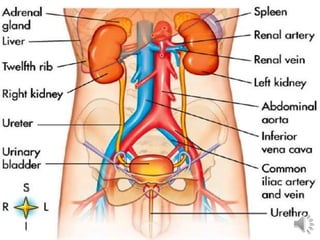
The organs covered by urology
– Adrenal glands
– Kidneys
– Ureters
– Urinary bladder
– Urethra
– The male reproductive organs
Testes
Epididymis
Vas deferens
Seminal vesicles
Prostate
Penis
Symptoms of urological
diseases
UROLOGIC MANIFESTATIONS OF
DISEASE
1. Direct
• Signs and symptoms that are directly related to the GUT:
• Hematuria
• Scrotal swelling
2. Indirect
• Manifestation Referred to or from Other Organ Systems:
• A stone in the kidney or upper ureter
• Symptoms of nausea and vomiting.
• Ipsilateral testicular pain
3.Primary urologic disorders may be hidden and
manifested in different organ or systems.
• Bone pain and pathologic fracture
• Secondary to metastatic carcinoma arising in the genito-urinary tract .
UROLOGIC MANIFESTATIONS OF DISEASE
4. Primary disease in other organ systems may result in
secondary urologic signs and symptoms that initially lead the
patient to the urologist.
• D.M :
• Frequency, polyurea and nocturia.
• ED
• Glucosuria
• D.I
• Other signs and symptoms mimicking urologic disease are related to
inflammatory or neoplastic processes arising in other organs:
1. Lower lobes of the lungs
2. Gastrointestinal tract
3. Female internal genitalia
UROLOGIC MANIFESTATIONS OF DISEASE
5. Systemic constitutional manifestations
• Fever, weight loss, and malaise
May be present in:
• Acute and chronic inflammatory disorders
• Renal failure
• Genitourinary carcinoma with or without metastases.
UROLOGIC MANIFESTATIONS OF DISEASE
6. Asymptomatic presentation
Extensive disease may exist within the genitourinary tract without
any signs or symptoms
• Large renal calculi
• Neoplasms may only be found incidentally during other examination.
• Far-advanced renal deterioration may occur prior to the detection of
silent reflux or obstruction.
UROLOGIC MANIFESTATIONS OF DISEASE
HISTORY
Urologic symptoms
A. Pain and discomfort
B. Alterations of micturition
C. Changes in the gross appearance of the urine
D. Abnormal appearance and/or function of the external
genitalia
Pain
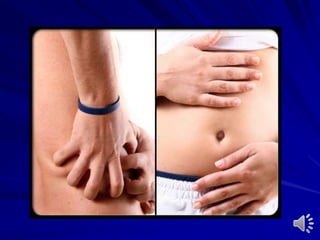
1. Pain within the genitourinary tract generally arises from
 Distention or inflammation
2. Pain can be experienced directly or referred
3. Referred pain is a relatively common symptom of GU disease.
Renal pain
A. The kidney and its capsule are innervated by
 Sensory fibers traveling to the TI0-LI
B. The etiology of renal pain may be due either to
 Distention
 Capsular
 Renal collecting system.
 Inflammation
C. Renal pain characters:
 A dull, aching sensation felt in area of the costovertebral angle
 A sharp colicky nature felt in the area of the flank, with radiation around
the abdomen into the groin and ipsilateral scrotum or labium.
Ureteral pain
• The upper ureter is innervated in a similar fashion to
the kidney.
• Upper Ureteral pain has a similar distribution to that of renal pain.
• The lower ureter sends sensory fibers to the cord
through ganglia subserving the major pelvic organs.
• Pain derived from the lower ureter is generally felt in the suprapubic
area, bladder, penis, or urethra.
Ureteral pain
• Etiologic mechanism for Ureteral pain is
• Sudden obstruction and Ureteral distention.
• Acute renal and Ureteral colic are among the most severe types
of pain known to humankind.
Other urologic pains
 Cystalgia (vesical pain)
 Persistent pain localized behind pubic bone
 Urethralgia
 Pain along the urethra
 Prostatic pain
 Sharp pain promoting to the perineum
 Orchalgia
 Pain localized to the testes, often propagating along the spermatic
cord
Changes in urine volume
 Polyuria-
 Diuresis > 1500-2000 ml/24h
 Oliguria -
 Diuresis < 500 ml/24h
 Anuria -
 Diuresis < 100 ml/24h
Changes in urine appearance
 Hematuria:
 Blood in urine
 Cloudy urine
 Pyuria (presence of pus in urine)
 Chyluria (presence of fatty lymph in the urine)
 Bacteriuria :
 Presence of bacteria in urine
Changes in urine appearance
 Proteinuria-:
 Proteins in urine
 Pneumaturia :
 Passage of gas with urine
 Necroturia :
 Necrotic tissues in the urine
Voiding Disorders
 Frequency :
 Voiding too often (>8/day)
 Nocturia:
 Frequent voiding at night (after sleep)
 Urine retention:
 Inability to void
 Acute
 chronic
 Strangury:
 Painful voiding
Voiding disorders
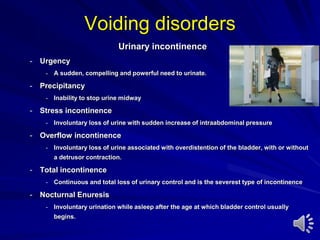
Urinary incontinence
- Urgency
- A sudden, compelling and powerful need to urinate.
- Precipitancy
- Inability to stop urine midway
- Stress incontinence
- Involuntary loss of urine with sudden increase of intraabdominal pressure
- Overflow incontinence
- Involuntary loss of urine associated with overdistention of the bladder, with or without
a detrusor contraction.
- Total incontinence
- Continuous and total loss of urinary control and is the severest type of incontinence
- Nocturnal Enuresis
- Involuntary urination while asleep after the age at which bladder control usually
begins.
Voiding Disorders
Obstructive symptoms
- Hesitancy:
- Voiding initiation delay
- Interrupted voiding
- Weak urine stream
- Incomplete voiding
- Necessity of abdominal pressure during voiding
- Retention
Voiding Disorders
Irritative Symptoms
- Frequency
- Urgency
- Dysuria
History of Other urological
diseases
– Corective operations in childhood
– Urolithiasis
– Urogenital infection
– Blood in urine
– Sexually transmitted diseases
– Catheterizations, endoscopy, trauma /biking,
riding horses/ → strictures
History of other diseases
 DM
 Systemic neurological Disasters
 operations in pelvic region
 Obstetric and gynecologic history
 Abuse of analgetic medication
 Risk jobs, exposition of carcenogenic substances
 Allergic history
Examination Of Urologic Patient
Examination
– General examination
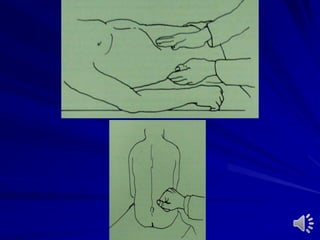
– Abdominal
– Local
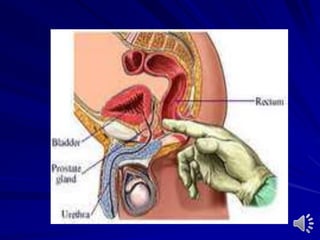
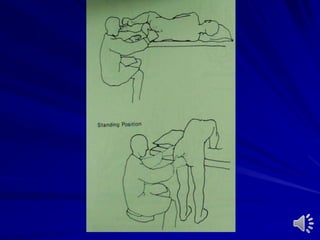
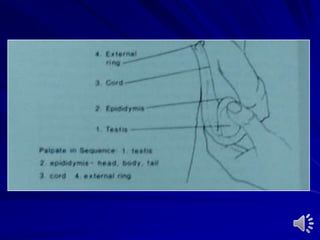
DRE
External genitalia examination
Basic neurological examination
Investigations
Diagnostic Lab Tests
Urinalysis
1. Physical Characteristics &
Measurements
– appearance
– color
– odor
– specific gravity
2. Chemical Measurements
– pH
– protein; glucose
– ketones
– bilirubin; urobilinogen
– leukocytes; nitrite
– blood
3. Microscopic
– cells (wbc, RBCs, sperm)
– casts
– crystals
– bacteria
4. Detection of Bacteriuria
– nitrite test
qualitative or screening test
– C & S
Colony Count
Organism
Antibiotics sensitivity
Other Diagnostic Lab Tests
Blood tests
Blood urea / creatinine
Blood glucose
CBC ------ anemia if decreased EPO production
Urine culture & sensitivity (C&S)
Include colony count
Imaging studies
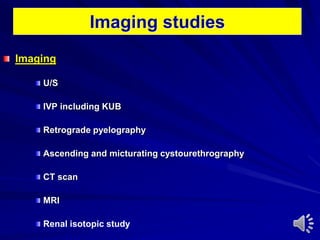
Imaging
U/S
IVP including KUB
Retrograde pyelography
Ascending and micturating cystourethrography
CT scan
MRI
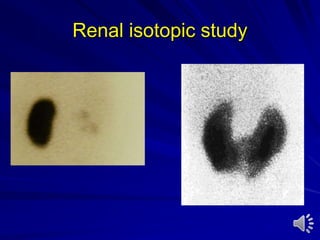
Renal isotopic study
Interventional studies
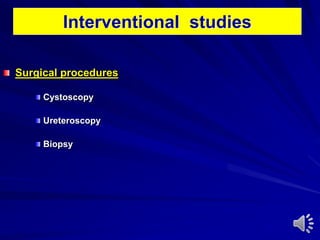
Surgical procedures
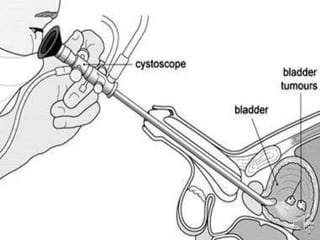
Cystoscopy
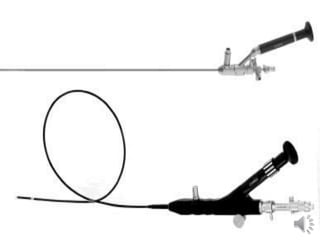
Ureteroscopy
Biopsy
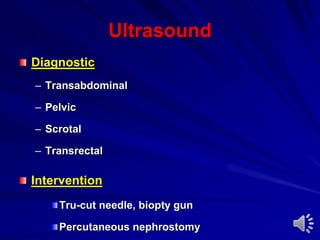
Ultrasound
Diagnostic
– Transabdominal
– Pelvic
– Scrotal
– Transrectal
Intervention
Tru-cut needle, biopty gun
Percutaneous nephrostomy
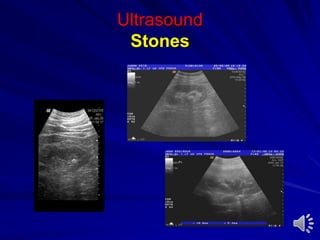
Ultrasound
Stones
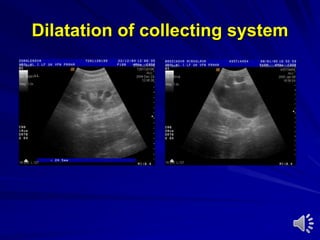
Dilatation of collecting system
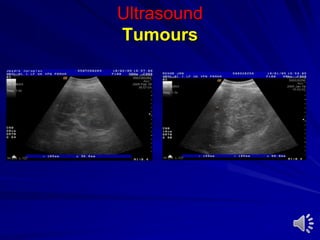
Ultrasound
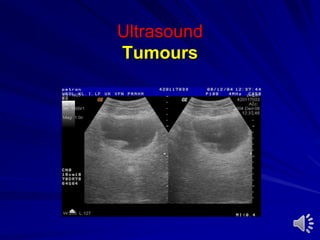
Tumours
Ultrasound
Tumours
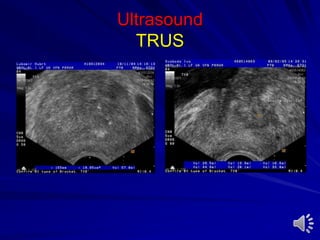
Ultrasound
TRUS
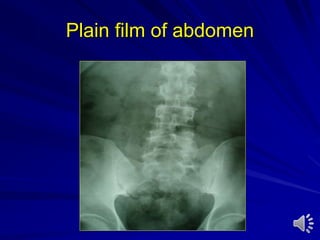
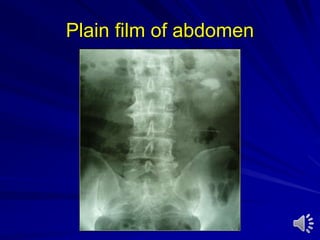
Plain film of abdomen
KUB
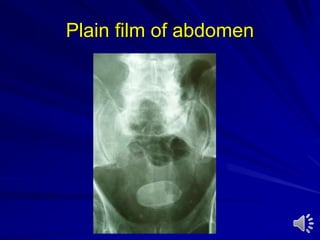
Plain film of abdomen
Disadvantages
Preparation
Radiolucent stones
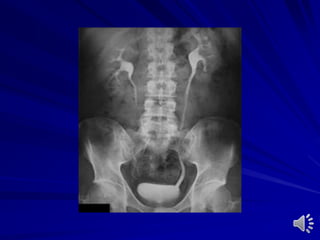
INTRAVENOUS UROGRAPHY
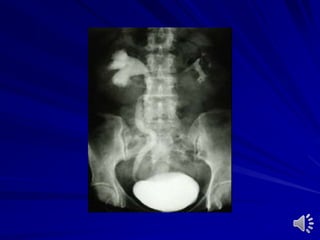
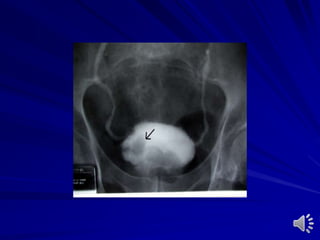
IVU
IVU
Disadvantages
Needs normal renal function
Patient preparation
Contrast disorders
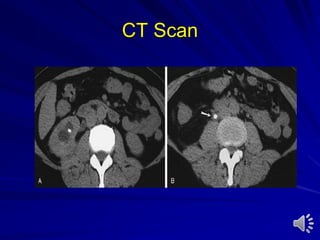
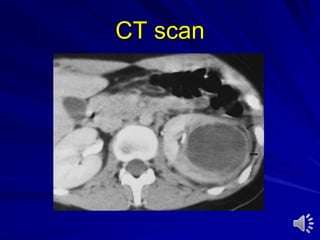
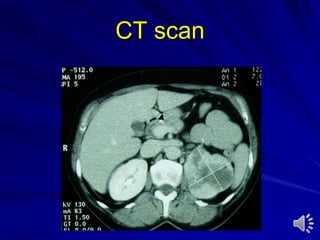
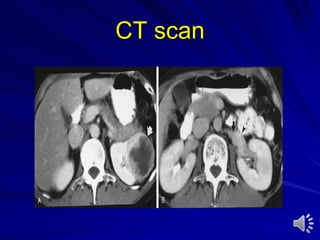
Computed tomography (CT) scan
With or without contrast medium
Indications:
– Stones
– Trauma
– Tumours
– Scaring of retroperitoneum
– Lymphadenopathy in genitourinary tumors
– Metastatic dissease
CT Scan
CT scan
CT scan
CT scan
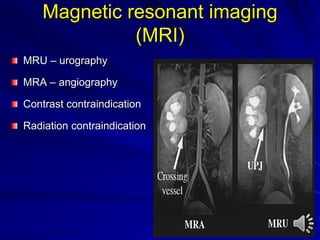
Magnetic resonant imaging
(MRI)
MRU – urography
MRA – angiography
Contrast contraindication
Radiation contraindication
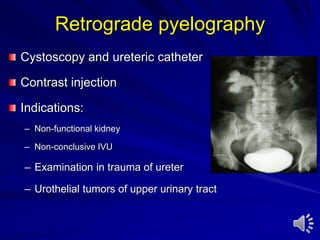
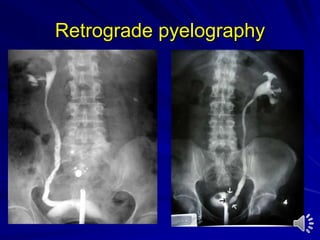
Retrograde pyelography
Cystoscopy and ureteric catheter
Contrast injection
Indications:
– Non-functional kidney
– Non-conclusive IVU
– Examination in trauma of ureter
– Urothelial tumors of upper urinary tract
Retrograde pyelography
Advanteges:
– History of contrast allergy .
– Non-functional or non-visualized kidney in IVU
Disadvanteges:
– Invasive examination
– Needing anesthesia
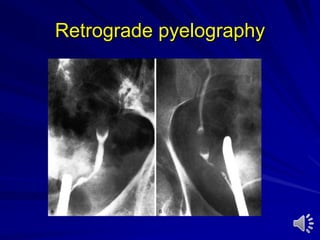
Retrograde pyelography
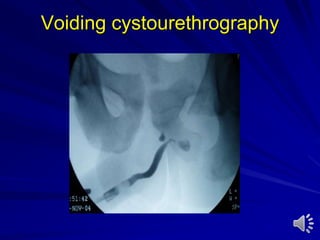
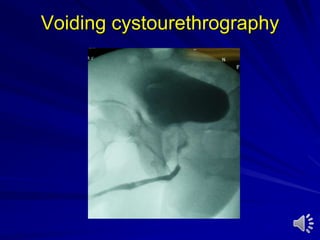
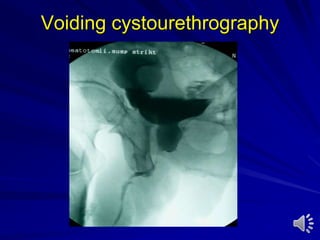
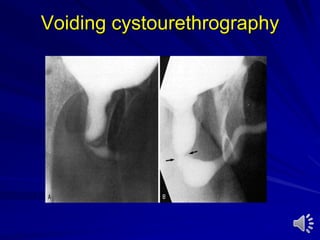
Ascending And Micturating
Cystourethrography
Catheter in the urethra and fill it with contrast medium
Catheter in the bladder and fill it with contrast medium
Indications:
– Trauma
– Vesicoureteral reflux
– Posterior urethral valve
– Stricture urethra
– Stress incontinence
– Fistula
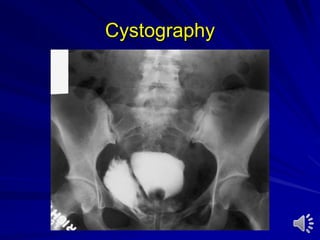
Cystography
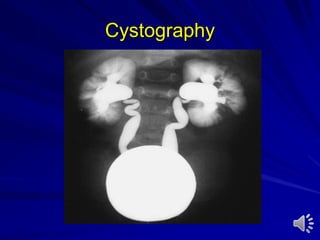
Cystography
Voiding cystourethrography
Renal isotopic study
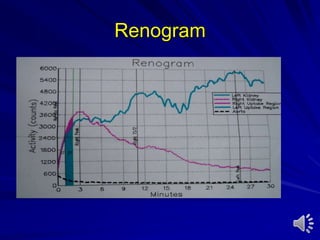
Renogram
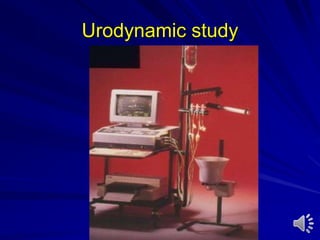
Urodynamic study
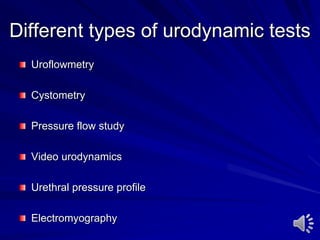
Different types of urodynamic tests
Uroflowmetry
Cystometry
Pressure flow study
Video urodynamics
Urethral pressure profile
Electromyography
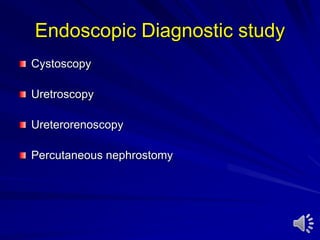
Endoscopic Diagnostic study
Cystoscopy
Uretroscopy
Ureterorenoscopy
Percutaneous nephrostomy
Introduction to urology by sayed eleweedy

Introduction to urology by sayed eleweedy

  • 1.
    Introduction To Urology SAYEDM ELEWEEDY PROF. OF UROLOGY UROLOGY DEPARTMENT AL-AZHAR UNIVERSITY CAIRO, EGYPT
  • 2.
    Urology A surgical specialtydevoted to the study and treatment of disorders of the genitourinary tract of the male and urinary tract of the female.
  • 3.
    Urology  15 %of patients presenting to a physician have a urologic complaint or abnormality.
  • 4.
    Urology  Urologists havea unique position in medicine  Their patients encompass all age groups  Prenatal  Pediatric  Adolescent  Adult  Geriatric.  Their patients comprised both gender
  • 5.
    Urology Urology combines managementof: – Medical problems Urinary tract infections Benign prostatic hyperplasia – Surgical problems The surgical management of urolithiasis The surgical management of cancers The correction of congenital abnormalities Correcting certain types of incontinence.
  • 6.
    Urology Wide overlap ofurology with other specialties 1. Nephrology 2. Andrology 3. Pediatric surgery 4. The medical fields of oncology 5. Endocrinology.
  • 7.
    The organs coveredby urology – Adrenal glands – Kidneys – Ureters – Urinary bladder – Urethra – The male reproductive organs Testes Epididymis Vas deferens Seminal vesicles Prostate Penis
  • 9.
  • 10.
    UROLOGIC MANIFESTATIONS OF DISEASE 1.Direct • Signs and symptoms that are directly related to the GUT: • Hematuria • Scrotal swelling 2. Indirect • Manifestation Referred to or from Other Organ Systems: • A stone in the kidney or upper ureter • Symptoms of nausea and vomiting. • Ipsilateral testicular pain
  • 11.
    3.Primary urologic disordersmay be hidden and manifested in different organ or systems. • Bone pain and pathologic fracture • Secondary to metastatic carcinoma arising in the genito-urinary tract . UROLOGIC MANIFESTATIONS OF DISEASE
  • 12.
    4. Primary diseasein other organ systems may result in secondary urologic signs and symptoms that initially lead the patient to the urologist. • D.M : • Frequency, polyurea and nocturia. • ED • Glucosuria • D.I • Other signs and symptoms mimicking urologic disease are related to inflammatory or neoplastic processes arising in other organs: 1. Lower lobes of the lungs 2. Gastrointestinal tract 3. Female internal genitalia UROLOGIC MANIFESTATIONS OF DISEASE
  • 13.
    5. Systemic constitutionalmanifestations • Fever, weight loss, and malaise May be present in: • Acute and chronic inflammatory disorders • Renal failure • Genitourinary carcinoma with or without metastases. UROLOGIC MANIFESTATIONS OF DISEASE

  • 14.
    6. Asymptomatic presentation Extensivedisease may exist within the genitourinary tract without any signs or symptoms • Large renal calculi • Neoplasms may only be found incidentally during other examination. • Far-advanced renal deterioration may occur prior to the detection of silent reflux or obstruction. UROLOGIC MANIFESTATIONS OF DISEASE
  • 15.
    HISTORY Urologic symptoms A. Painand discomfort B. Alterations of micturition C. Changes in the gross appearance of the urine D. Abnormal appearance and/or function of the external genitalia
  • 16.
    Pain 1. Pain withinthe genitourinary tract generally arises from  Distention or inflammation 2. Pain can be experienced directly or referred 3. Referred pain is a relatively common symptom of GU disease.
  • 17.
    Renal pain A. Thekidney and its capsule are innervated by  Sensory fibers traveling to the TI0-LI B. The etiology of renal pain may be due either to  Distention  Capsular  Renal collecting system.  Inflammation C. Renal pain characters:  A dull, aching sensation felt in area of the costovertebral angle  A sharp colicky nature felt in the area of the flank, with radiation around the abdomen into the groin and ipsilateral scrotum or labium.
  • 18.
    Ureteral pain • Theupper ureter is innervated in a similar fashion to the kidney. • Upper Ureteral pain has a similar distribution to that of renal pain. • The lower ureter sends sensory fibers to the cord through ganglia subserving the major pelvic organs. • Pain derived from the lower ureter is generally felt in the suprapubic area, bladder, penis, or urethra.
  • 19.
    Ureteral pain • Etiologicmechanism for Ureteral pain is • Sudden obstruction and Ureteral distention. • Acute renal and Ureteral colic are among the most severe types of pain known to humankind.
  • 21.
    Other urologic pains Cystalgia (vesical pain)  Persistent pain localized behind pubic bone  Urethralgia  Pain along the urethra  Prostatic pain  Sharp pain promoting to the perineum  Orchalgia  Pain localized to the testes, often propagating along the spermatic cord
  • 22.
    Changes in urinevolume  Polyuria-  Diuresis > 1500-2000 ml/24h  Oliguria -  Diuresis < 500 ml/24h  Anuria -  Diuresis < 100 ml/24h
  • 23.
    Changes in urineappearance  Hematuria:  Blood in urine  Cloudy urine  Pyuria (presence of pus in urine)  Chyluria (presence of fatty lymph in the urine)  Bacteriuria :  Presence of bacteria in urine
  • 24.
    Changes in urineappearance  Proteinuria-:  Proteins in urine  Pneumaturia :  Passage of gas with urine  Necroturia :  Necrotic tissues in the urine
  • 25.
    Voiding Disorders  Frequency:  Voiding too often (>8/day)  Nocturia:  Frequent voiding at night (after sleep)  Urine retention:  Inability to void  Acute  chronic  Strangury:  Painful voiding
  • 26.
    Voiding disorders Urinary incontinence -Urgency - A sudden, compelling and powerful need to urinate. - Precipitancy - Inability to stop urine midway - Stress incontinence - Involuntary loss of urine with sudden increase of intraabdominal pressure - Overflow incontinence - Involuntary loss of urine associated with overdistention of the bladder, with or without a detrusor contraction. - Total incontinence - Continuous and total loss of urinary control and is the severest type of incontinence - Nocturnal Enuresis - Involuntary urination while asleep after the age at which bladder control usually begins.
  • 27.
    Voiding Disorders Obstructive symptoms -Hesitancy: - Voiding initiation delay - Interrupted voiding - Weak urine stream - Incomplete voiding - Necessity of abdominal pressure during voiding - Retention
  • 28.
    Voiding Disorders Irritative Symptoms -Frequency - Urgency - Dysuria
  • 29.
    History of Otherurological diseases – Corective operations in childhood – Urolithiasis – Urogenital infection – Blood in urine – Sexually transmitted diseases – Catheterizations, endoscopy, trauma /biking, riding horses/ → strictures
  • 30.
    History of otherdiseases  DM  Systemic neurological Disasters  operations in pelvic region  Obstetric and gynecologic history  Abuse of analgetic medication  Risk jobs, exposition of carcenogenic substances  Allergic history
  • 31.
  • 32.
    Examination – General examination –Abdominal – Local DRE External genitalia examination Basic neurological examination
  • 37.
  • 38.
    Diagnostic Lab Tests Urinalysis 1.Physical Characteristics & Measurements – appearance – color – odor – specific gravity 2. Chemical Measurements – pH – protein; glucose – ketones – bilirubin; urobilinogen – leukocytes; nitrite – blood 3. Microscopic – cells (wbc, RBCs, sperm) – casts – crystals – bacteria 4. Detection of Bacteriuria – nitrite test qualitative or screening test – C & S Colony Count Organism Antibiotics sensitivity
  • 39.
    Other Diagnostic LabTests Blood tests Blood urea / creatinine Blood glucose CBC ------ anemia if decreased EPO production Urine culture & sensitivity (C&S) Include colony count
  • 40.
    Imaging studies Imaging U/S IVP includingKUB Retrograde pyelography Ascending and micturating cystourethrography CT scan MRI Renal isotopic study
  • 41.
  • 42.
    Ultrasound Diagnostic – Transabdominal – Pelvic –Scrotal – Transrectal Intervention Tru-cut needle, biopty gun Percutaneous nephrostomy
  • 43.
  • 44.
  • 45.
  • 46.
  • 47.
  • 48.
    Plain film ofabdomen KUB
  • 49.
  • 50.
  • 51.
  • 52.
    Plain film ofabdomen Disadvantages Preparation Radiolucent stones
  • 53.
  • 57.
    IVU Disadvantages Needs normal renalfunction Patient preparation Contrast disorders
  • 58.
    Computed tomography (CT)scan With or without contrast medium Indications: – Stones – Trauma – Tumours – Scaring of retroperitoneum – Lymphadenopathy in genitourinary tumors – Metastatic dissease
  • 59.
  • 60.
  • 61.
  • 62.
  • 63.
    Magnetic resonant imaging (MRI) MRU– urography MRA – angiography Contrast contraindication Radiation contraindication
  • 64.
    Retrograde pyelography Cystoscopy andureteric catheter Contrast injection Indications: – Non-functional kidney – Non-conclusive IVU – Examination in trauma of ureter – Urothelial tumors of upper urinary tract
  • 65.
    Retrograde pyelography Advanteges: – Historyof contrast allergy . – Non-functional or non-visualized kidney in IVU Disadvanteges: – Invasive examination – Needing anesthesia
  • 66.
  • 67.
  • 68.
    Ascending And Micturating Cystourethrography Catheterin the urethra and fill it with contrast medium Catheter in the bladder and fill it with contrast medium Indications: – Trauma – Vesicoureteral reflux – Posterior urethral valve – Stricture urethra – Stress incontinence – Fistula
  • 69.
  • 70.
  • 71.
  • 72.
  • 73.
  • 74.
  • 75.
  • 76.
  • 77.
  • 78.
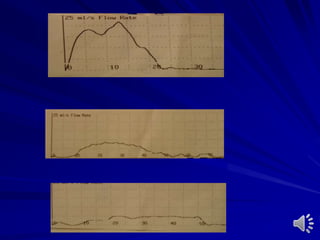
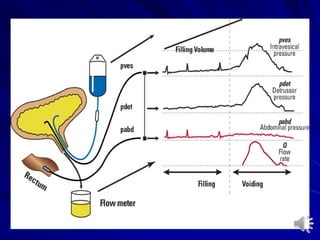
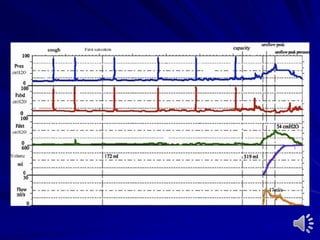
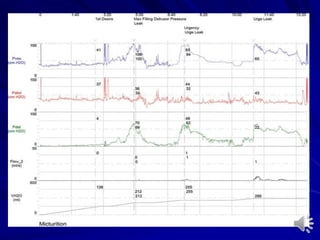
    Different types ofurodynamic tests Uroflowmetry Cystometry Pressure flow study Video urodynamics Urethral pressure profile Electromyography
  • 83.