THE URINARY SYSTEM Chapter 29 A&P
OBJECTIVES Describe the purpose and function of the urinary system Identify the organs and the function of each List 3 processes involved in the production of urine Normal constituents of urine. Common disorders Lifespan considerations Case study
INTRODUCTION The urinary system consists of organs that produce and excrete urine from the body. Urine contains waste: mostly excess water, salts and nitrogen compounds. Primary organs are the kidneys Normal adult bladder can store up to .5 liters. Also responsible for regulating blood volume and blood pressure. Regulates electrolytes.
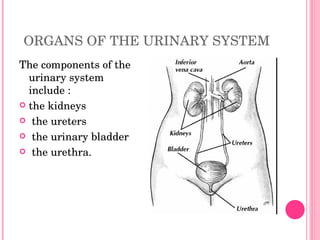
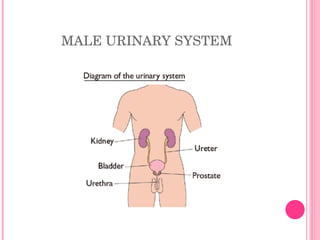
ORGANS OF THE URINARY SYSTEM The components of the urinary system include : the kidneys the ureters the urinary bladder  the urethra.
MALE URINARY SYSTEM
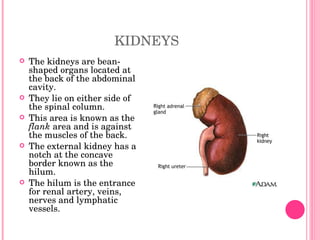
KIDNEYS The kidneys are bean-shaped organs located at the back of the abdominal cavity. They lie on either side of the spinal column. This area is known as the  flank  area and is against the muscles of the back. The external kidney has a notch at the concave border known as the hilum.  The hilum is the entrance for renal artery, veins, nerves and lymphatic vessels.
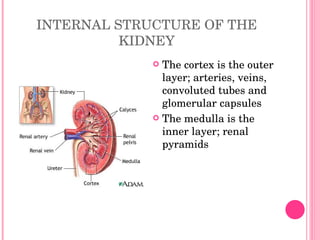
INTERNAL STRUCTURE OF THE KIDNEY The cortex is the outer layer; arteries, veins, convoluted tubes and glomerular capsules The medulla is the inner layer; renal pyramids
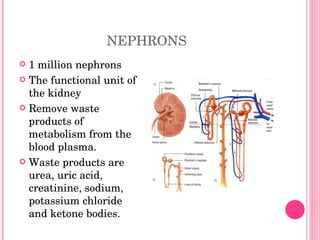
NEPHRONS 1 million nephrons The functional unit of the kidney Remove waste products of metabolism from the blood plasma. Waste products are urea, uric acid, creatinine, sodium, potassium chloride and ketone bodies.
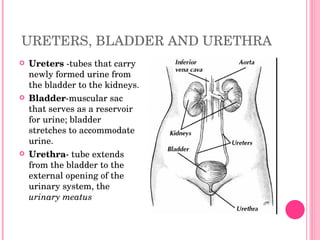
URETERS, BLADDER AND URETHRA Ureters  -tubes that carry newly formed urine from the bladder to the kidneys. Bladder -muscular sac that serves as a reservoir for urine; bladder stretches to accommodate urine. Urethra - tube extends from the bladder to the external opening of the urinary system, the  urinary meatus
URINE The formation of urine has 3 processes, filtration, reabsorption and tubular secretion. Urine consists of 95% water and 5% solid substances. The need to urinate is usually felt at 300-350ml of urine in the bladder. Typically 1000-1500 mL is voided daily. Observations of urine?
COMMON DISORDERS Cystitis- inflammation of the bladder “honeymoon disease” Glomerulonephritis- a type of kidney disease Incontinence- stress, urge, overflow, functional, reflex and mixed Kidney stones- renal calculi caused my mineral salt deposits in the kidneys Polycystic kidney disease- cysts develop in the kidneys Pyelonephritis- infection of the kidney and renal pelvis. Renal Failure- kidney do not function as they should
LIFESPAN CONSIDERATIONS Child At 10 weeks gestation the kidney begin to form Newborns kidneys are not able to concentrate urine Kidneys are more susceptible to trauma Diapers- more susceptible to UTI Older Adult Kidney lose mass and the blood vessels degenerate Kidneys lose their ability to filter Dehydration can happen more quickly Electrolyte balance happens more quickly Loss of muscles tome in urinary structures Decreased bladder capacity
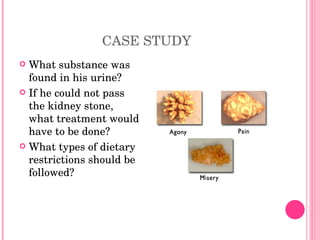
CASE STUDY What substance was found in his urine? If he could not pass the kidney stone, what treatment would have to be done? What types of dietary restrictions should be followed?
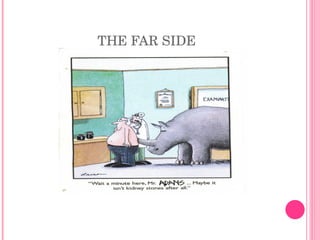
THE FAR SIDE

A&P Chapter 30 The Urinary System

  • 1.
    THE URINARY SYSTEMChapter 29 A&P
  • 2.
    OBJECTIVES Describe thepurpose and function of the urinary system Identify the organs and the function of each List 3 processes involved in the production of urine Normal constituents of urine. Common disorders Lifespan considerations Case study
  • 3.
    INTRODUCTION The urinarysystem consists of organs that produce and excrete urine from the body. Urine contains waste: mostly excess water, salts and nitrogen compounds. Primary organs are the kidneys Normal adult bladder can store up to .5 liters. Also responsible for regulating blood volume and blood pressure. Regulates electrolytes.
  • 4.
    ORGANS OF THEURINARY SYSTEM The components of the urinary system include : the kidneys the ureters the urinary bladder the urethra.
  • 5.
  • 6.
    KIDNEYS The kidneysare bean-shaped organs located at the back of the abdominal cavity. They lie on either side of the spinal column. This area is known as the flank area and is against the muscles of the back. The external kidney has a notch at the concave border known as the hilum. The hilum is the entrance for renal artery, veins, nerves and lymphatic vessels.
  • 7.
    INTERNAL STRUCTURE OFTHE KIDNEY The cortex is the outer layer; arteries, veins, convoluted tubes and glomerular capsules The medulla is the inner layer; renal pyramids
  • 8.
    NEPHRONS 1 millionnephrons The functional unit of the kidney Remove waste products of metabolism from the blood plasma. Waste products are urea, uric acid, creatinine, sodium, potassium chloride and ketone bodies.
  • 9.
    URETERS, BLADDER ANDURETHRA Ureters -tubes that carry newly formed urine from the bladder to the kidneys. Bladder -muscular sac that serves as a reservoir for urine; bladder stretches to accommodate urine. Urethra - tube extends from the bladder to the external opening of the urinary system, the urinary meatus
  • 10.
    URINE The formationof urine has 3 processes, filtration, reabsorption and tubular secretion. Urine consists of 95% water and 5% solid substances. The need to urinate is usually felt at 300-350ml of urine in the bladder. Typically 1000-1500 mL is voided daily. Observations of urine?
  • 11.
    COMMON DISORDERS Cystitis-inflammation of the bladder “honeymoon disease” Glomerulonephritis- a type of kidney disease Incontinence- stress, urge, overflow, functional, reflex and mixed Kidney stones- renal calculi caused my mineral salt deposits in the kidneys Polycystic kidney disease- cysts develop in the kidneys Pyelonephritis- infection of the kidney and renal pelvis. Renal Failure- kidney do not function as they should
  • 12.
    LIFESPAN CONSIDERATIONS ChildAt 10 weeks gestation the kidney begin to form Newborns kidneys are not able to concentrate urine Kidneys are more susceptible to trauma Diapers- more susceptible to UTI Older Adult Kidney lose mass and the blood vessels degenerate Kidneys lose their ability to filter Dehydration can happen more quickly Electrolyte balance happens more quickly Loss of muscles tome in urinary structures Decreased bladder capacity
  • 13.
    CASE STUDY Whatsubstance was found in his urine? If he could not pass the kidney stone, what treatment would have to be done? What types of dietary restrictions should be followed?
  • 14.