The Clinical
Laboratory
Laboratory Organizational Divisions:
Department of Pathology
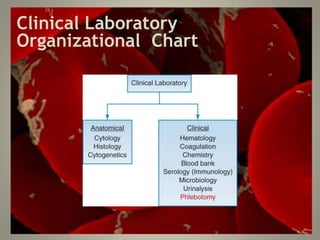
 Anatomical
 Responsible for the analysis of tissues from
the body including surgical specimens, frozen
sections, biopsies, cytological specimens &
autopsies
Laboratory Organizational Divisions:
Department of Pathology
 Anatomical
 Cytology: looking for abnormal cells (ie, cancer)
 Cytologic specimens (tissue & body fluids)
 Pap smears
 Histology
 Surgical specimens
 Frozen sections
 Biopsies
 Autopsies
 Cytogenetics
 Genetic testing (blood, amniotic fluid, tissue & bone
marrow)
Laboratory Organizational Divisions
Department of Pathology continued
 Clinical
 Hematology/Coagulation
 Chemistry
 Blood Bank
 Serology
 Microbiology
 Urinalysis
 Phlebotomy
 Specimen processing
 Laboratory Information System (LIS)
Clinical Laboratory
Organizational Chart
Lab Sections: Hematology
 The study of the formed (cellular)
elements of the blood for the purpose of
making a diagnosis.
Hematology
 RBCs, WBCs and platelets are counted and classified
 Most common body fluid analyzed is whole blood
(blood as it comes from the client without removing
 any components)
 Whole blood is obtained using a collection tube with
an anticoagulant to prevent clotting
*Lavender collection tubes
*Anticoagulant EDTA
*Requires immediate inversion of tube 8 times to
activate
Hematology
 Blood is analyzed as whole, plasma or
serum
*Plasma: liquid portion of blood from
a specimen that has not been
allowed to clot; contains
fibrinogen
*Serum: specimen allowed to clot; no
fibrinogen
Hematology
Complete Blood Count (CBC) most common
whole blood test
White blood cell (WBC) count is a count of the actual number of white blood
cells per volume of blood.
White blood cell differential looks at the types of white blood cells present.
There are five different types of white blood cells, each with its own function
in protecting us from infection.
Red blood cell (RBC) count is a count of the actual number of red blood cells
per volume of blood. Both increases and decreases can point to abnormal
conditions.
Hemoglobin measures the amount of oxygen-carrying protein in the blood.
Hematocrit measures the percentage of red blood cells in a given volume of
whole blood.
Hematology
Complete Blood Count (CBC) most common whole
blood test continued:
The platelet count is the number of platelets in a given volume of blood. Both
increases and decreases can point to abnormal conditions of excess bleeding
or clotting.
Mean corpuscular volume (MCV) is a measurement of the average size of your
RBCs.
Mean corpuscular hemoglobin (MCH) is a calculation of the average amount of
oxygen-carrying hemoglobin inside a red blood cell.
Mean corpuscular hemoglobin concentration (MCHC) is a calculation of the
average concentration of hemoglobin inside a red cell.
Red cell distribution width (RDW) is a calculation of the variation in the size of
your RBCs.
Coagulation Studies in Hematology
 Coagulation Studies (clotting times)
*PT and PTT
*Light Blue collection tubes
*Anticoagulant used is sodium
citrate
*Must be returned to the lab in
30 minutes
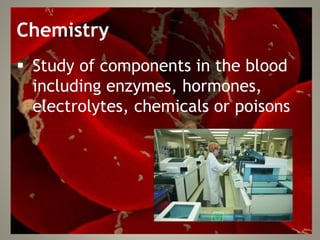
Chemistry
 Study of components in the blood
including enzymes, hormones,
electrolytes, chemicals or poisons
Chemistry
 Most automated area of the lab
 Tests performed on serum, plasma, urine and other
body fluids
 Serum and plasma obtained by using the centrifuge
*Must be completed within one hour of collection
*Serum separator tubes contain gel
*Must allow specimen to clot completely prior to
centrifuge
*Red, green, gray or dark blue collection tubes
Chemistry
 Chem 7 & Chem 17 most common
tests to assess general health; gives
your doctor important information
about the current status of your
kidneys, blood sugar, and electrolyte
and acid/base balance
 Cardiac enzymes and drug screening
also common
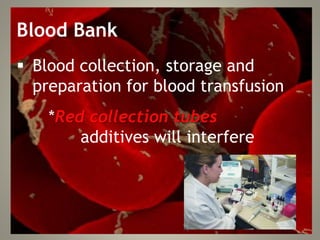
Blood Bank
 Blood collection, storage and
preparation for blood transfusion
*Red collection tubes
additives will interfere
Blood Bank
 Blood typed and for blood group and Rh factor
 Units (pints) collected and tested for presence of
blood-borne pathogens; stored for transfusion
- 42 days: how long most donated red blood cells
can be stored
- 5 days: how long most donated platelets can be
stored
- 1 year: how long frozen plasma can be stored
 Autologous transfusion
*Donate your own blood for personal transfusion if
needed from upcoming surgery, usually
beginning 3-5 weeks before procedure
Blood Bank
 Most Common Tests
Type & Crossmatch = ABO, Rh
typing and compatibility
Type & Screen = ABO, Rh typing
and antibody screen
Group & Type = ABO and Rh
typing
Serology (Immunology)
 Evaluates the body’s immune
response through the detection of
antibodies to bacteria, fungi,
parasites, and viruses and antibodies
produces against body substances
(autoimmunity)
Serology (Immunology)
 Most Common Tests
Anti-HIV
Hepatitis B Surface Antigen
VDRL for syphilis
Western blot confirms HIV
HCG = pregnancy
Red collection tubes
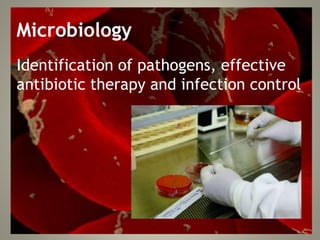
Microbiology
Identification of pathogens, effective
antibiotic therapy and infection control
Microbiology
 Culture & Sensitivity most common procedure = ID
pathogen & most effective antibiotic
 Bacteria is IDed based on morphology & gram stain
reactions
 Types of Specimens
Blood
Sputum
Wounds
Feces
Urine
GI tract
Throat
Microbiology
 Yellow collection tubes using sterile
technique
 Most Common Tests
Blood culture
Culture & Sensitivity
Gram stain
Ova & parasites
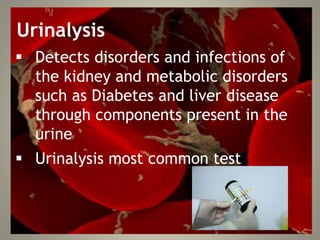
Urinalysis
 Detects disorders and infections of
the kidney and metabolic disorders
such as Diabetes and liver disease
through components present in the
urine
 Urinalysis most common test
Laboratory Management
• Laboratory Director (Pathologist)
– Credentials
• Medical doctor (MD)
– Functions
• Anatomic pathology
• Clinical pathology
• Laboratory Manager (Administrator)
– Credentials
• Master’s degree and 5 or more years of laboratory
experience
– Functions
• Technical and administrative management
Clinical Laboratory Personnel
 Medical Laboratory Scientist (MLS)
 Bachelor of science degree (4 year)
 Performs laboratory testing requiring independent
judgment
 Minimal supervision
 Medical Laboratory Technician (MLT)
 Associate degree (2 year)
 Performs laboratory testing by protocol under
supervision
 Phlebotomist (PBT)
 High school diploma
 Phlebotomy training program
 Sample collection and processing

The clinical laboratory

  • 1.
  • 2.
    Laboratory Organizational Divisions: Departmentof Pathology  Anatomical  Responsible for the analysis of tissues from the body including surgical specimens, frozen sections, biopsies, cytological specimens & autopsies
  • 3.
    Laboratory Organizational Divisions: Departmentof Pathology  Anatomical  Cytology: looking for abnormal cells (ie, cancer)  Cytologic specimens (tissue & body fluids)  Pap smears  Histology  Surgical specimens  Frozen sections  Biopsies  Autopsies  Cytogenetics  Genetic testing (blood, amniotic fluid, tissue & bone marrow)
  • 4.
    Laboratory Organizational Divisions Departmentof Pathology continued  Clinical  Hematology/Coagulation  Chemistry  Blood Bank  Serology  Microbiology  Urinalysis  Phlebotomy  Specimen processing  Laboratory Information System (LIS)
  • 5.
  • 6.
    Lab Sections: Hematology The study of the formed (cellular) elements of the blood for the purpose of making a diagnosis.
  • 7.
    Hematology  RBCs, WBCsand platelets are counted and classified  Most common body fluid analyzed is whole blood (blood as it comes from the client without removing  any components)  Whole blood is obtained using a collection tube with an anticoagulant to prevent clotting *Lavender collection tubes *Anticoagulant EDTA *Requires immediate inversion of tube 8 times to activate
  • 8.
    Hematology  Blood isanalyzed as whole, plasma or serum *Plasma: liquid portion of blood from a specimen that has not been allowed to clot; contains fibrinogen *Serum: specimen allowed to clot; no fibrinogen
  • 9.
    Hematology Complete Blood Count(CBC) most common whole blood test White blood cell (WBC) count is a count of the actual number of white blood cells per volume of blood. White blood cell differential looks at the types of white blood cells present. There are five different types of white blood cells, each with its own function in protecting us from infection. Red blood cell (RBC) count is a count of the actual number of red blood cells per volume of blood. Both increases and decreases can point to abnormal conditions. Hemoglobin measures the amount of oxygen-carrying protein in the blood. Hematocrit measures the percentage of red blood cells in a given volume of whole blood.
  • 10.
    Hematology Complete Blood Count(CBC) most common whole blood test continued: The platelet count is the number of platelets in a given volume of blood. Both increases and decreases can point to abnormal conditions of excess bleeding or clotting. Mean corpuscular volume (MCV) is a measurement of the average size of your RBCs. Mean corpuscular hemoglobin (MCH) is a calculation of the average amount of oxygen-carrying hemoglobin inside a red blood cell. Mean corpuscular hemoglobin concentration (MCHC) is a calculation of the average concentration of hemoglobin inside a red cell. Red cell distribution width (RDW) is a calculation of the variation in the size of your RBCs.
  • 11.
    Coagulation Studies inHematology  Coagulation Studies (clotting times) *PT and PTT *Light Blue collection tubes *Anticoagulant used is sodium citrate *Must be returned to the lab in 30 minutes
  • 12.
    Chemistry  Study ofcomponents in the blood including enzymes, hormones, electrolytes, chemicals or poisons
  • 13.
    Chemistry  Most automatedarea of the lab  Tests performed on serum, plasma, urine and other body fluids  Serum and plasma obtained by using the centrifuge *Must be completed within one hour of collection *Serum separator tubes contain gel *Must allow specimen to clot completely prior to centrifuge *Red, green, gray or dark blue collection tubes
  • 14.
    Chemistry  Chem 7& Chem 17 most common tests to assess general health; gives your doctor important information about the current status of your kidneys, blood sugar, and electrolyte and acid/base balance  Cardiac enzymes and drug screening also common
  • 15.
    Blood Bank  Bloodcollection, storage and preparation for blood transfusion *Red collection tubes additives will interfere
  • 16.
    Blood Bank  Bloodtyped and for blood group and Rh factor  Units (pints) collected and tested for presence of blood-borne pathogens; stored for transfusion - 42 days: how long most donated red blood cells can be stored - 5 days: how long most donated platelets can be stored - 1 year: how long frozen plasma can be stored  Autologous transfusion *Donate your own blood for personal transfusion if needed from upcoming surgery, usually beginning 3-5 weeks before procedure
  • 17.
    Blood Bank  MostCommon Tests Type & Crossmatch = ABO, Rh typing and compatibility Type & Screen = ABO, Rh typing and antibody screen Group & Type = ABO and Rh typing
  • 18.
    Serology (Immunology)  Evaluatesthe body’s immune response through the detection of antibodies to bacteria, fungi, parasites, and viruses and antibodies produces against body substances (autoimmunity)
  • 19.
    Serology (Immunology)  MostCommon Tests Anti-HIV Hepatitis B Surface Antigen VDRL for syphilis Western blot confirms HIV HCG = pregnancy Red collection tubes
  • 20.
    Microbiology Identification of pathogens,effective antibiotic therapy and infection control
  • 21.
    Microbiology  Culture &Sensitivity most common procedure = ID pathogen & most effective antibiotic  Bacteria is IDed based on morphology & gram stain reactions  Types of Specimens Blood Sputum Wounds Feces Urine GI tract Throat
  • 22.
    Microbiology  Yellow collectiontubes using sterile technique  Most Common Tests Blood culture Culture & Sensitivity Gram stain Ova & parasites
  • 23.
    Urinalysis  Detects disordersand infections of the kidney and metabolic disorders such as Diabetes and liver disease through components present in the urine  Urinalysis most common test
  • 24.
    Laboratory Management • LaboratoryDirector (Pathologist) – Credentials • Medical doctor (MD) – Functions • Anatomic pathology • Clinical pathology • Laboratory Manager (Administrator) – Credentials • Master’s degree and 5 or more years of laboratory experience – Functions • Technical and administrative management
  • 25.
    Clinical Laboratory Personnel Medical Laboratory Scientist (MLS)  Bachelor of science degree (4 year)  Performs laboratory testing requiring independent judgment  Minimal supervision  Medical Laboratory Technician (MLT)  Associate degree (2 year)  Performs laboratory testing by protocol under supervision  Phlebotomist (PBT)  High school diploma  Phlebotomy training program  Sample collection and processing