Objectives
Functional anatomy of respiratory system
Mechanics of breathing
Transport of gases
Regulation of respiration
Pulmonary circulation
Lung function tests
Hypoxia and others conditions
Effect of high barometric pressure
Common disorders of respiratory system
Oxygen CellHi I am O2
,you can call
me oxygen, and I will be your guide today.
I advise you keep all feet
and hands inside the ride at all times.
JH
Respiratory Intro
You may be asking, what is the Respiratory
system?
Well, the Respiratory system is the system
that helps you breath in and out, so oxygen
(02) can be pumped through your body and
carbon dioxide (CO2) can be removed from
the blood stream.
You must remember that the Respiratory
system is made up of many different organs.
Anatomy of respiratory system
• The organs of respiratory system include:
– Nose
– Nasal cavity
– Paranasal sinuses
– Pharynx
– Larynx
– Trachea
– Bronchi and there small bronches
– Lungs which contain alveoli
Anatomy of respiratory system
• The organs of respiratory system include:
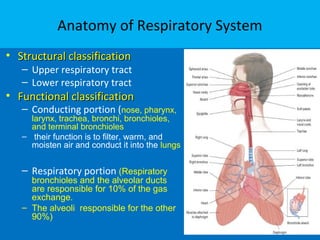
Anatomy of Respiratory System
• Structural classificationStructural classification
– Upper respiratory tract
– Lower respiratory tract
• Functional classificationFunctional classification
– Conducting portion (nose, pharynx,
larynx, trachea, bronchi, bronchioles,
and terminal bronchioles
– their function is to filter, warm, and
moisten air and conduct it into the lungs
– Respiratory portion (Respiratory
bronchioles and the alveolar ducts
are responsible for 10% of the gas
exchange.
– The alveoli responsible for the other
90%)
The Respiratory System
• Function of Respiratory systemFunction of Respiratory system
 To provide oxygen (O2) to and eliminate carbon
dioxide (CO2) from the cells of the body.
 Filters, warm and moisten the inspired air
 Produces sound
 Contains receptors for smell
 Rids the body of some excess water and heat
 Helps regulate blood pH
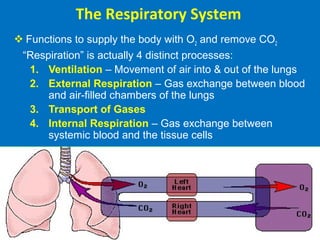
The Respiratory System
 Functions to supply the body with O2 and remove CO2
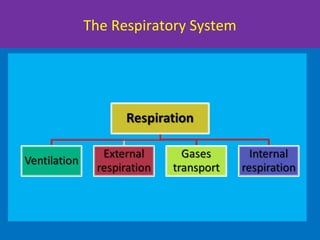
“Respiration” is actually 4 distinct processes:
1. Ventilation – Movement of air into & out of the lungs
2. External Respiration – Gas exchange between blood
and air-filled chambers of the lungs
3. Transport of Gases
4. Internal Respiration – Gas exchange between
systemic blood and the tissue cells
The Respiratory System
Here is a overview picture of
the Respiratory System.
Just go to the next slide to see
it.
Picture Intro.
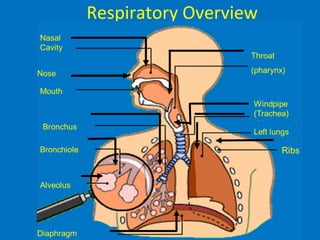
Respiratory Overview
Welcome
Now we will begin our tour.
Welcome to…
MB
Nasal Passage
Bronchi Tubes
Alveoli (air-sacs)
Thin-walled blood vessels called
capillaries
Very thin cells line
the alveoli so that O2
and CO2 can pass in
and out of the blood.
Bronchioles pass
air to and from
your alveoli.
The Trachea
is held open
by partial
rings of
cartilage.
Tongue
Pharynx
Where
are We?
We are here.
The Nose
• Only externally visible part of the respiratory
system.
• Functions include:
• Providing an airway for respiration
• Moistening and warming air
• Filtering inspired air
• Serving as a resonating center for speech
• Housing the olfactory receptors.
Chapter 22, Respiratory System 16
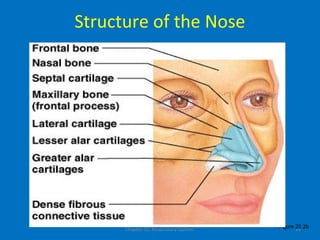
Structure of the Nose
Figure 22.2b
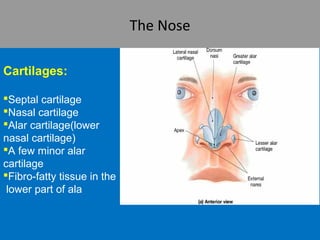
The Nose
Cartilages:
Septal cartilage
Nasal cartilage
Alar cartilage(lower
nasal cartilage)
A few minor alar
cartilage
Fibro-fatty tissue in the
lower part of ala
18
Nasal Cavity
• Lies in and posterior to the external nose
• Is divided by a midline nasal septum
• Opens posteriorly into the nasal pharynx via
internal nares
• The ethmoid and sphenoid bones form the
roof
• The floor is formed by the hard and soft
palates
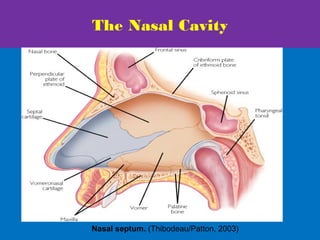
The Nasal Cavity
Nasal septum. (Thibodeau/Patton, 2003)
The Lateral Walls of Nasal Cavity
1. Inferior meatus:
nasolacrimal duct
2. Middle meatus:
• Maxillary sinus
• Frontal sinus
• Anterior ethmoid sinuses
1. Superior meatus:
posterior ethmoid sinuses
2. Sphenoethmoidal recess:
sphenoid sinus
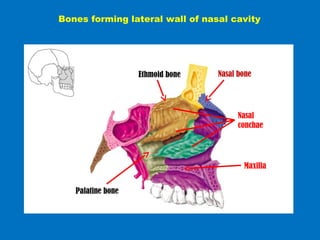
Bones forming lateral wall of nasal cavity
Nasal boneEthmoid bone
Nasal
conchae
Maxilla
Palatine bone
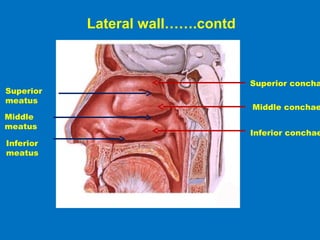
Superior concha
Middle conchae
Inferior conchae
Superior
meatus
Middle
meatus
Inferior
meatus
Lateral wall…….contd
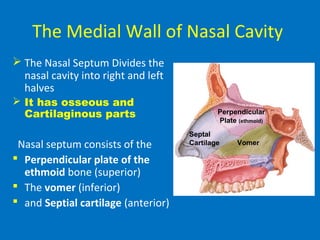
The Medial Wall of Nasal Cavity
 The Nasal Septum Divides the
nasal cavity into right and left
halves
 It has osseous and
Cartilaginous parts
Nasal septum consists of the
 Perpendicular plate of the
ethmoid bone (superior)
 The vomer (inferior)
 and Septial cartilage (anterior)
Perpendicular
Plate (ethmoid)
Septal
Cartilage Vomer
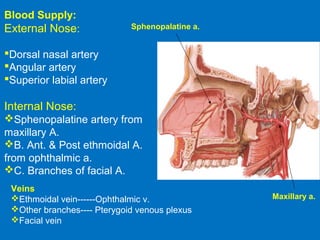
Blood Supply:
External Nose:
Dorsal nasal artery
Angular artery
Superior labial artery
Internal Nose:
Sphenopalatine artery from
maxillary A.
B. Ant. & Post ethmoidal A.
from ophthalmic a.
C. Branches of facial A.
Sphenopalatine a.
Maxillary a.
Veins
Ethmoidal vein------Ophthalmic v.
Other branches---- Pterygoid venous plexus
Facial vein
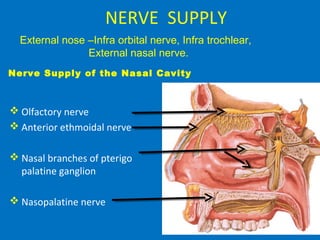
NERVE SUPPLY
 Olfactory nerve
 Anterior ethmoidal nerve
 Nasal branches of pterigo
palatine ganglion
 Nasopalatine nerve
External nose –Infra orbital nerve, Infra trochlear,
External nasal nerve.
Nerve Supply of the Nasal Cavity
The Nasal Cavity
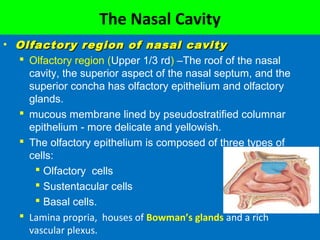
• Olfactory region of nasal cavityOlfactory region of nasal cavity
 Olfactory region (Upper 1/3 rd) –The roof of the nasal
cavity, the superior aspect of the nasal septum, and the
superior concha has olfactory epithelium and olfactory
glands.
 mucous membrane lined by pseudostratified columnar
epithelium - more delicate and yellowish.
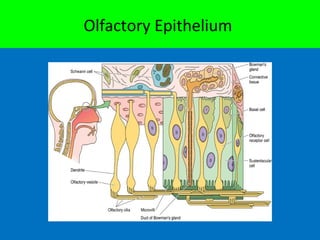
 The olfactory epithelium is composed of three types of
cells:
 Olfactory cells
 Sustentacular cells
 Basal cells.
 Lamina propria, houses of Bowman’s glands and a rich
vascular plexus.
Olfactory Epithelium
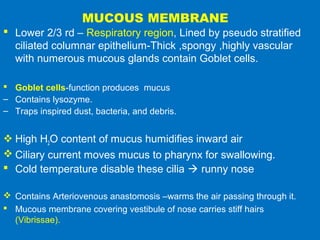
MUCOUS MEMBRANE
 Lower 2/3 rd – Respiratory region, Lined by pseudo stratified
ciliated columnar epithelium-Thick ,spongy ,highly vascular
with numerous mucous glands contain Goblet cells.
 Goblet cells-function produces mucus
– Contains lysozyme.
– Traps inspired dust, bacteria, and debris.
 High H2O content of mucus humidifies inward air
 Ciliary current moves mucus to pharynx for swallowing.
 Cold temperature disable these cilia  runny nose
 Contains Arteriovenous anastomosis –warms the air passing through it.
 Mucous membrane covering vestibule of nose carries stiff hairs
(Vibrissae).
This is where it all begins.
This is where the oxygen first
enters your body and also where
Carbon Dioxide leaves.
The Nose and Mouth
MB
The Nose and Mouth
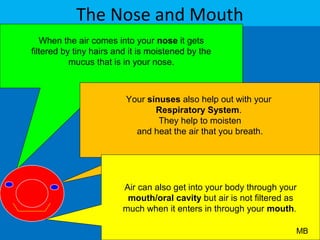
When the air comes into your nose it gets
filtered by tiny hairs and it is moistened by the
mucus that is in your nose.
Your sinuses also help out with your
Respiratory System.
They help to moisten
and heat the air that you breath.
Air can also get into your body through your
mouth/oral cavity but air is not filtered as
much when it enters in through your mouth.
MB
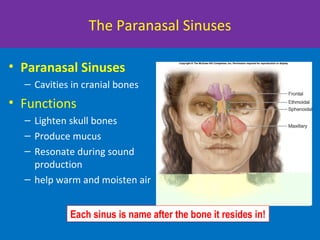
The Paranasal Sinuses
• Paranasal Sinuses
– Cavities in cranial bones
• Functions
– Lighten skull bones
– Produce mucus
– Resonate during sound
production
– help warm and moisten air
Each sinus is name after the bone it resides in!
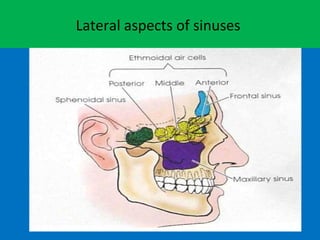
Lateral aspects of sinuses
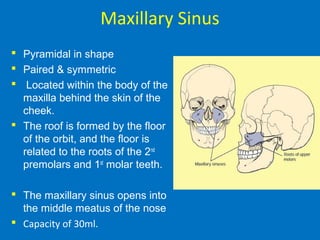
Maxillary Sinus
 Pyramidal in shape
 Paired & symmetric
 Located within the body of the
maxilla behind the skin of the
cheek.
 The roof is formed by the floor
of the orbit, and the floor is
related to the roots of the 2nd
premolars and 1st
molar teeth.
 The maxillary sinus opens into
the middle meatus of the nose
 Capacity of 30ml.
Frontal Sinuses
 Rarely symmetrical
 Contained within the frontal
bone .
 Separated from each other by
a bony septum.
 Each sinus is roughly triangular
 Extending upward above the
medial end of the eyebrow and
backward into the medial part
of the roof of the orbit.
 Opens into the middle meatus
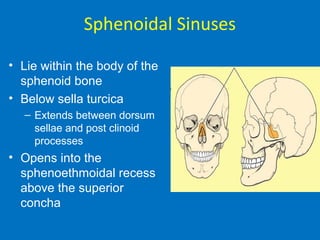
Sphenoidal Sinuses
• Lie within the body of the
sphenoid bone
• Below sella turcica
– Extends between dorsum
sellae and post clinoid
processes
• Opens into the
sphenoethmoidal recess
above the superior
concha
Ethmoid Sinuses
• They are anterior, middle, and
posterior
• They are contained within the
ethmoid bone, between the nose
and the orbit
• Anterior & middle
– Drains into middle nasal meatus
• Posterior
– Drain into superior nasal meatus
• Separated from the orbit by a
thin plate of bone so that
infection can readily spread from
the sinuses into the orbit
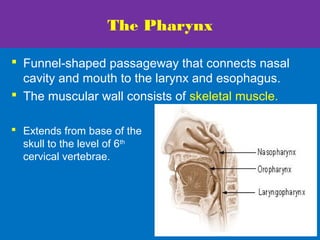
The Pharynx
 Funnel-shaped passageway that connects nasal
cavity and mouth to the larynx and esophagus.
 The muscular wall consists of skeletal muscle.
 Extends from base of the
skull to the level of 6th
cervical vertebrae.
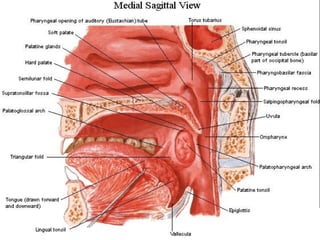
The Pharynx
The nasopharynx – air passage
– Lined by respiratory epithelium
• (pseudostratified Ciliated columnar
epithelium)
– Pharyngeal tonsil
– Auditory tube
Oral and laryngeal region
– Passageway for air, food,
and drink
– Stratified squamous epith.
Nasopharynx
• Boundaries:
• Roof: body of sphenoid &
basal part of the occipital
bone
• Floor: upper surface of soft
palate and pharyngeal
isthmus
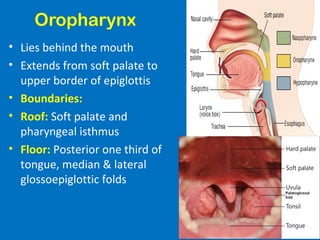
Oropharynx
• Lies behind the mouth
• Extends from soft palate to
upper border of epiglottis
• Boundaries:
• Roof: Soft palate and
pharyngeal isthmus
• Floor: Posterior one third of
tongue, median & lateral
glossoepiglottic folds
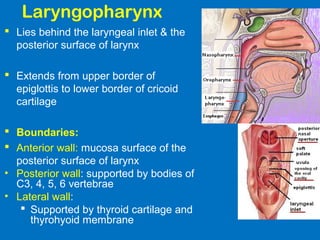
Laryngopharynx
 Lies behind the laryngeal inlet & the
posterior surface of larynx
 Extends from upper border of
epiglottis to lower border of cricoid
cartilage
 Boundaries:
 Anterior wall: mucosa surface of the
posterior surface of larynx
• Posterior wall: supported by bodies of
C3, 4, 5, 6 vertebrae
• Lateral wall:
 Supported by thyroid cartilage and
thyrohyoid membrane
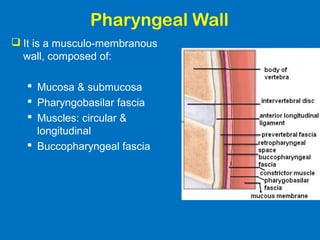
Pharyngeal Wall
 It is a musculo-membranous
wall, composed of:
 Mucosa & submucosa
 Pharyngobasilar fascia
 Muscles: circular &
longitudinal
 Buccopharyngeal fascia
Nerve supply of the pharynx
Motor supply
Cranial part of accessory nerve
Glossopharyngeal nerve.
Recurrent laryngeal nerve
External laryngeal nerve.
Sensory supply
Pharyngeal branch of pterygo-palatine ganglion.
Glossopharyngeal nerve.
Internal laryngeal nerve.
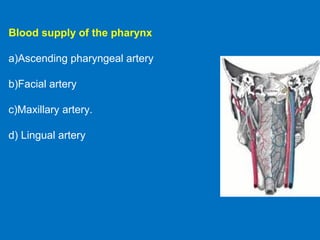
Blood supply of the pharynx
a)Ascending pharyngeal artery
b)Facial artery
c)Maxillary artery.
d) Lingual artery
46
The Larynx (Voicebox)
 Extends from the level of the 4th
to the 6th
cervical
vertebrae
 Attaches to hyoid bone superiorly
 Inferiorly is continuous with trachea (windpipe)
 Three functions:
1. Produces vocalizations (speech)
2. Provides an open airway (breathing)
3. Switching mechanism to route air and food into proper
channels
• Closed during swallowing
• Open during breathing
47
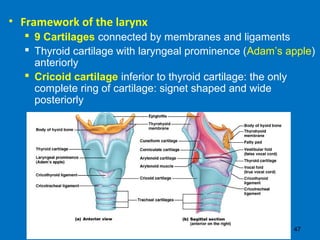
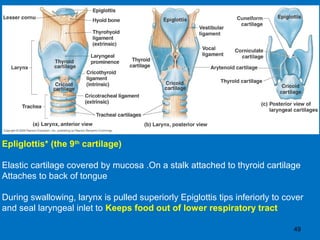
• Framework of the larynx
 9 Cartilages connected by membranes and ligaments
 Thyroid cartilage with laryngeal prominence (Adam’s apple)
anteriorly
 Cricoid cartilage inferior to thyroid cartilage: the only
complete ring of cartilage: signet shaped and wide
posteriorly
48
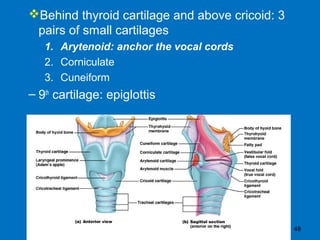
Behind thyroid cartilage and above cricoid: 3
pairs of small cartilages
1. Arytenoid: anchor the vocal cords
2. Corniculate
3. Cuneiform
– 9th
cartilage: epiglottis
49
Epliglottis* (the 9th
cartilage)
Elastic cartilage covered by mucosa .On a stalk attached to thyroid cartilage
Attaches to back of tongue
During swallowing, larynx is pulled superiorly Epiglottis tips inferiorly to cover
and seal laryngeal inlet to Keeps food out of lower respiratory tract
50
*
*
Posterior views
51
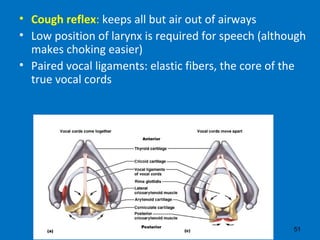
• Cough reflex: keeps all but air out of airways
• Low position of larynx is required for speech (although
makes choking easier)
• Paired vocal ligaments: elastic fibers, the core of the
true vocal cords
52
• Pair of mucosal vocal folds (true vocal cords)
over the ligaments: white because avascular
53
• Innervation of larynx (makes surgery at neck risky)
– Recurrent laryngeal nerves of Vagus
– Vagus nerve
– Damage to one: Hoarseness
– Damage to both: can only Whisper
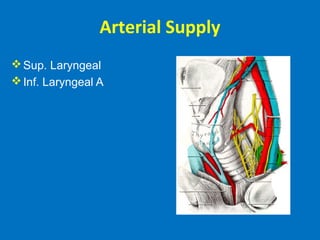
Arterial Supply
Sup. Laryngeal
Inf. Laryngeal A
The Larynx
Histology Structures
Epithelial lining:
Superior portion of larynx is lined by stratified squamous
epithelium
Below the vocal folds – pseudostratified ciliated
columnar epithelium.
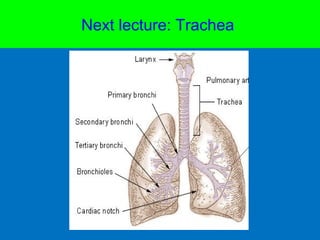
Next lecture: Trachea
Upper respiratory system- anatomy

Upper respiratory system- anatomy

  • 2.
    Objectives Functional anatomy ofrespiratory system Mechanics of breathing Transport of gases Regulation of respiration Pulmonary circulation Lung function tests Hypoxia and others conditions Effect of high barometric pressure Common disorders of respiratory system
  • 3.
    Oxygen CellHi Iam O2 ,you can call me oxygen, and I will be your guide today. I advise you keep all feet and hands inside the ride at all times. JH
  • 4.
    Respiratory Intro You maybe asking, what is the Respiratory system? Well, the Respiratory system is the system that helps you breath in and out, so oxygen (02) can be pumped through your body and carbon dioxide (CO2) can be removed from the blood stream. You must remember that the Respiratory system is made up of many different organs.
  • 5.
    Anatomy of respiratorysystem • The organs of respiratory system include: – Nose – Nasal cavity – Paranasal sinuses – Pharynx – Larynx – Trachea – Bronchi and there small bronches – Lungs which contain alveoli
  • 6.
    Anatomy of respiratorysystem • The organs of respiratory system include:
  • 7.
    Anatomy of RespiratorySystem • Structural classificationStructural classification – Upper respiratory tract – Lower respiratory tract • Functional classificationFunctional classification – Conducting portion (nose, pharynx, larynx, trachea, bronchi, bronchioles, and terminal bronchioles – their function is to filter, warm, and moisten air and conduct it into the lungs – Respiratory portion (Respiratory bronchioles and the alveolar ducts are responsible for 10% of the gas exchange. – The alveoli responsible for the other 90%)
  • 8.
    The Respiratory System •Function of Respiratory systemFunction of Respiratory system  To provide oxygen (O2) to and eliminate carbon dioxide (CO2) from the cells of the body.  Filters, warm and moisten the inspired air  Produces sound  Contains receptors for smell  Rids the body of some excess water and heat  Helps regulate blood pH
  • 9.
    The Respiratory System Functions to supply the body with O2 and remove CO2 “Respiration” is actually 4 distinct processes: 1. Ventilation – Movement of air into & out of the lungs 2. External Respiration – Gas exchange between blood and air-filled chambers of the lungs 3. Transport of Gases 4. Internal Respiration – Gas exchange between systemic blood and the tissue cells
  • 10.
  • 11.
    Here is aoverview picture of the Respiratory System. Just go to the next slide to see it. Picture Intro.
  • 12.
  • 13.
    Welcome Now we willbegin our tour. Welcome to… MB
  • 14.
    Nasal Passage Bronchi Tubes Alveoli(air-sacs) Thin-walled blood vessels called capillaries Very thin cells line the alveoli so that O2 and CO2 can pass in and out of the blood. Bronchioles pass air to and from your alveoli. The Trachea is held open by partial rings of cartilage. Tongue Pharynx Where are We? We are here.
  • 15.
    The Nose • Onlyexternally visible part of the respiratory system. • Functions include: • Providing an airway for respiration • Moistening and warming air • Filtering inspired air • Serving as a resonating center for speech • Housing the olfactory receptors.
  • 16.
    Chapter 22, RespiratorySystem 16 Structure of the Nose Figure 22.2b
  • 17.
    The Nose Cartilages: Septal cartilage Nasalcartilage Alar cartilage(lower nasal cartilage) A few minor alar cartilage Fibro-fatty tissue in the lower part of ala
  • 18.
    18 Nasal Cavity • Liesin and posterior to the external nose • Is divided by a midline nasal septum • Opens posteriorly into the nasal pharynx via internal nares • The ethmoid and sphenoid bones form the roof • The floor is formed by the hard and soft palates
  • 19.
    The Nasal Cavity Nasalseptum. (Thibodeau/Patton, 2003)
  • 20.
    The Lateral Wallsof Nasal Cavity 1. Inferior meatus: nasolacrimal duct 2. Middle meatus: • Maxillary sinus • Frontal sinus • Anterior ethmoid sinuses 1. Superior meatus: posterior ethmoid sinuses 2. Sphenoethmoidal recess: sphenoid sinus
  • 21.
    Bones forming lateralwall of nasal cavity Nasal boneEthmoid bone Nasal conchae Maxilla Palatine bone
  • 22.
    Superior concha Middle conchae Inferiorconchae Superior meatus Middle meatus Inferior meatus Lateral wall…….contd
  • 23.
    The Medial Wallof Nasal Cavity  The Nasal Septum Divides the nasal cavity into right and left halves  It has osseous and Cartilaginous parts Nasal septum consists of the  Perpendicular plate of the ethmoid bone (superior)  The vomer (inferior)  and Septial cartilage (anterior) Perpendicular Plate (ethmoid) Septal Cartilage Vomer
  • 24.
    Blood Supply: External Nose: Dorsalnasal artery Angular artery Superior labial artery Internal Nose: Sphenopalatine artery from maxillary A. B. Ant. & Post ethmoidal A. from ophthalmic a. C. Branches of facial A. Sphenopalatine a. Maxillary a. Veins Ethmoidal vein------Ophthalmic v. Other branches---- Pterygoid venous plexus Facial vein
  • 25.
    NERVE SUPPLY  Olfactorynerve  Anterior ethmoidal nerve  Nasal branches of pterigo palatine ganglion  Nasopalatine nerve External nose –Infra orbital nerve, Infra trochlear, External nasal nerve. Nerve Supply of the Nasal Cavity
  • 26.
    The Nasal Cavity •Olfactory region of nasal cavityOlfactory region of nasal cavity  Olfactory region (Upper 1/3 rd) –The roof of the nasal cavity, the superior aspect of the nasal septum, and the superior concha has olfactory epithelium and olfactory glands.  mucous membrane lined by pseudostratified columnar epithelium - more delicate and yellowish.  The olfactory epithelium is composed of three types of cells:  Olfactory cells  Sustentacular cells  Basal cells.  Lamina propria, houses of Bowman’s glands and a rich vascular plexus.
  • 27.
  • 28.
    MUCOUS MEMBRANE  Lower2/3 rd – Respiratory region, Lined by pseudo stratified ciliated columnar epithelium-Thick ,spongy ,highly vascular with numerous mucous glands contain Goblet cells.  Goblet cells-function produces mucus – Contains lysozyme. – Traps inspired dust, bacteria, and debris.  High H2O content of mucus humidifies inward air  Ciliary current moves mucus to pharynx for swallowing.  Cold temperature disable these cilia  runny nose  Contains Arteriovenous anastomosis –warms the air passing through it.  Mucous membrane covering vestibule of nose carries stiff hairs (Vibrissae).
  • 29.
    This is whereit all begins. This is where the oxygen first enters your body and also where Carbon Dioxide leaves. The Nose and Mouth MB
  • 30.
    The Nose andMouth When the air comes into your nose it gets filtered by tiny hairs and it is moistened by the mucus that is in your nose. Your sinuses also help out with your Respiratory System. They help to moisten and heat the air that you breath. Air can also get into your body through your mouth/oral cavity but air is not filtered as much when it enters in through your mouth. MB
  • 31.
    The Paranasal Sinuses •Paranasal Sinuses – Cavities in cranial bones • Functions – Lighten skull bones – Produce mucus – Resonate during sound production – help warm and moisten air Each sinus is name after the bone it resides in!
  • 32.
  • 33.
    Maxillary Sinus  Pyramidalin shape  Paired & symmetric  Located within the body of the maxilla behind the skin of the cheek.  The roof is formed by the floor of the orbit, and the floor is related to the roots of the 2nd premolars and 1st molar teeth.  The maxillary sinus opens into the middle meatus of the nose  Capacity of 30ml.
  • 34.
    Frontal Sinuses  Rarelysymmetrical  Contained within the frontal bone .  Separated from each other by a bony septum.  Each sinus is roughly triangular  Extending upward above the medial end of the eyebrow and backward into the medial part of the roof of the orbit.  Opens into the middle meatus
  • 35.
    Sphenoidal Sinuses • Liewithin the body of the sphenoid bone • Below sella turcica – Extends between dorsum sellae and post clinoid processes • Opens into the sphenoethmoidal recess above the superior concha
  • 36.
    Ethmoid Sinuses • Theyare anterior, middle, and posterior • They are contained within the ethmoid bone, between the nose and the orbit • Anterior & middle – Drains into middle nasal meatus • Posterior – Drain into superior nasal meatus • Separated from the orbit by a thin plate of bone so that infection can readily spread from the sinuses into the orbit
  • 37.
    The Pharynx  Funnel-shapedpassageway that connects nasal cavity and mouth to the larynx and esophagus.  The muscular wall consists of skeletal muscle.  Extends from base of the skull to the level of 6th cervical vertebrae.
  • 38.
    The Pharynx The nasopharynx– air passage – Lined by respiratory epithelium • (pseudostratified Ciliated columnar epithelium) – Pharyngeal tonsil – Auditory tube Oral and laryngeal region – Passageway for air, food, and drink – Stratified squamous epith.
  • 40.
    Nasopharynx • Boundaries: • Roof:body of sphenoid & basal part of the occipital bone • Floor: upper surface of soft palate and pharyngeal isthmus
  • 41.
    Oropharynx • Lies behindthe mouth • Extends from soft palate to upper border of epiglottis • Boundaries: • Roof: Soft palate and pharyngeal isthmus • Floor: Posterior one third of tongue, median & lateral glossoepiglottic folds
  • 42.
    Laryngopharynx  Lies behindthe laryngeal inlet & the posterior surface of larynx  Extends from upper border of epiglottis to lower border of cricoid cartilage  Boundaries:  Anterior wall: mucosa surface of the posterior surface of larynx • Posterior wall: supported by bodies of C3, 4, 5, 6 vertebrae • Lateral wall:  Supported by thyroid cartilage and thyrohyoid membrane
  • 43.
    Pharyngeal Wall  Itis a musculo-membranous wall, composed of:  Mucosa & submucosa  Pharyngobasilar fascia  Muscles: circular & longitudinal  Buccopharyngeal fascia
  • 44.
    Nerve supply ofthe pharynx Motor supply Cranial part of accessory nerve Glossopharyngeal nerve. Recurrent laryngeal nerve External laryngeal nerve. Sensory supply Pharyngeal branch of pterygo-palatine ganglion. Glossopharyngeal nerve. Internal laryngeal nerve.
  • 45.
    Blood supply ofthe pharynx a)Ascending pharyngeal artery b)Facial artery c)Maxillary artery. d) Lingual artery
  • 46.
    46 The Larynx (Voicebox) Extends from the level of the 4th to the 6th cervical vertebrae  Attaches to hyoid bone superiorly  Inferiorly is continuous with trachea (windpipe)  Three functions: 1. Produces vocalizations (speech) 2. Provides an open airway (breathing) 3. Switching mechanism to route air and food into proper channels • Closed during swallowing • Open during breathing
  • 47.
    47 • Framework ofthe larynx  9 Cartilages connected by membranes and ligaments  Thyroid cartilage with laryngeal prominence (Adam’s apple) anteriorly  Cricoid cartilage inferior to thyroid cartilage: the only complete ring of cartilage: signet shaped and wide posteriorly
  • 48.
    48 Behind thyroid cartilageand above cricoid: 3 pairs of small cartilages 1. Arytenoid: anchor the vocal cords 2. Corniculate 3. Cuneiform – 9th cartilage: epiglottis
  • 49.
    49 Epliglottis* (the 9th cartilage) Elasticcartilage covered by mucosa .On a stalk attached to thyroid cartilage Attaches to back of tongue During swallowing, larynx is pulled superiorly Epiglottis tips inferiorly to cover and seal laryngeal inlet to Keeps food out of lower respiratory tract
  • 50.
  • 51.
    51 • Cough reflex:keeps all but air out of airways • Low position of larynx is required for speech (although makes choking easier) • Paired vocal ligaments: elastic fibers, the core of the true vocal cords
  • 52.
    52 • Pair ofmucosal vocal folds (true vocal cords) over the ligaments: white because avascular
  • 53.
    53 • Innervation oflarynx (makes surgery at neck risky) – Recurrent laryngeal nerves of Vagus – Vagus nerve – Damage to one: Hoarseness – Damage to both: can only Whisper
  • 54.
  • 55.
    The Larynx Histology Structures Epitheliallining: Superior portion of larynx is lined by stratified squamous epithelium Below the vocal folds – pseudostratified ciliated columnar epithelium.
  • 56.