Anatomy of respiratory system
Introduction
• breathing is the process that brings oxygen in the
air into your lungs and moves oxygen and
through your body.
• Our lungs remove the oxygen and pass it through
our bloodstream, where it's carried off to the
tissues and organs that allow us to walk, talk, and
move.
• Our lungs also take carbon dioxide from our
blood and release it into the air when we breathe
out.
Introduction
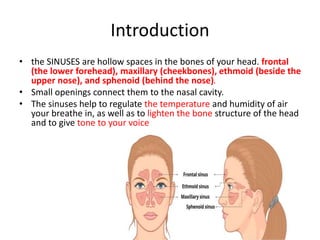
• the SINUSES are hollow spaces in the bones of your head. frontal
(the lower forehead), maxillary (cheekbones), ethmoid (beside the
upper nose), and sphenoid (behind the nose).
• Small openings connect them to the nasal cavity.
• The sinuses help to regulate the temperature and humidity of air
your breathe in, as well as to lighten the bone structure of the head
and to give tone to your voice
Introduction
• Air can also enters through your ORAL
CAVITY (mouth), especially if you have a
mouth-breathing habit or your nasal passages
may be temporarily blocked.
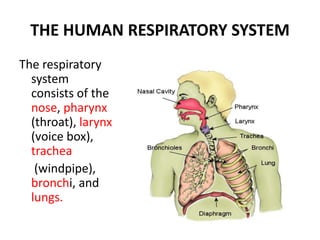
THE HUMAN RESPIRATORY SYSTEM
The respiratory
system
consists of the
nose, pharynx
(throat), larynx
(voice box),
trachea
(windpipe),
bronchi, and
lungs.
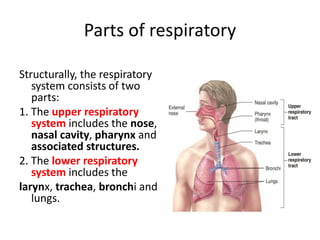
Parts of respiratory
Structurally, the respiratory
system consists of two
parts:
1. The upper respiratory
system includes the nose,
nasal cavity, pharynx and
associated structures.
2. The lower respiratory
system includes the
larynx, trachea, bronchi and
lungs.
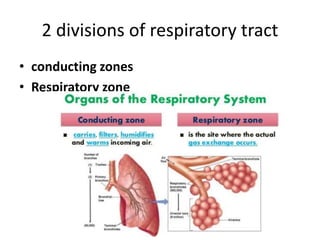
2 divisions of respiratory tract
• conducting zones
• Respiratory zone
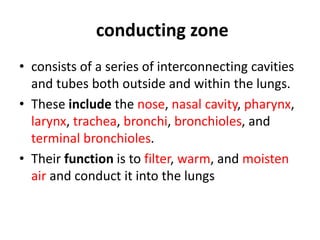
conducting zone
• consists of a series of interconnecting cavities
and tubes both outside and within the lungs.
• These include the nose, nasal cavity, pharynx,
larynx, trachea, bronchi, bronchioles, and
terminal bronchioles.
• Their function is to filter, warm, and moisten
air and conduct it into the lungs
Respiratory zone
• consists of tubes and tissues within the lungs
where gas exchange occurs.
• These include the respiratory bronchioles,
alveolar ducts, alveolar sacs and alveoli. (Gas
exchange occur in these zone)
• PRESENTER TWO
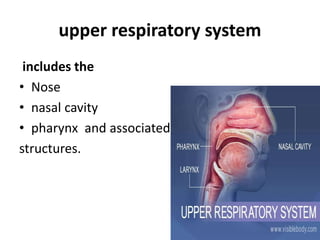
upper respiratory system
includes the
• Nose
• nasal cavity
• pharynx and associated
structures.
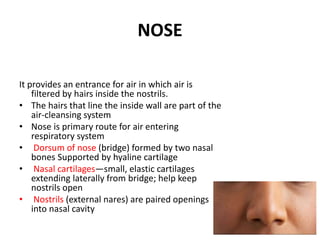
NOSE
It provides an entrance for air in which air is
filtered by hairs inside the nostrils.
• The hairs that line the inside wall are part of the
air-cleansing system
• Nose is primary route for air entering
respiratory system
• Dorsum of nose (bridge) formed by two nasal
bones Supported by hyaline cartilage
• Nasal cartilages—small, elastic cartilages
extending laterally from bridge; help keep
nostrils open
• Nostrils (external nares) are paired openings
into nasal cavity
The Functions of the Nose
• Filter the air
• Humidify the air
• Warm the air
• Site for sense of small
• To generate resonance in speech
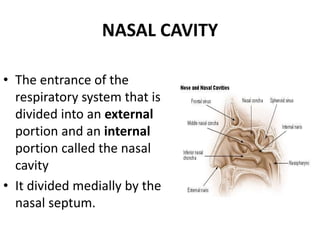
NASAL CAVITY
• The entrance of the
respiratory system that is
divided into an external
portion and an internal
portion called the nasal
cavity
• It divided medially by the
nasal septum.
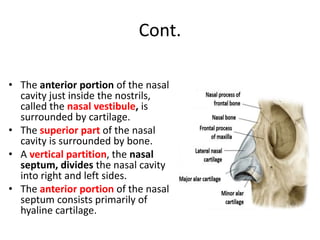
Cont.
• The anterior portion of the nasal
cavity just inside the nostrils,
called the nasal vestibule, is
surrounded by cartilage.
• The superior part of the nasal
cavity is surrounded by bone.
• A vertical partition, the nasal
septum, divides the nasal cavity
into right and left sides.
• The anterior portion of the nasal
septum consists primarily of
hyaline cartilage.
PHARYNX
• is a funnel-shaped tube
• shared by respiratory and digestive systems
• about 13 cm long that starts at the internal nares
and extends to the level of the cricoid cartilage,
• the most inferior cartilage of the larynx.
The pharynx lies just
posterior to the nasal and oral cavities,
superior to the larynx, and anterior to the cervical
vertebrae
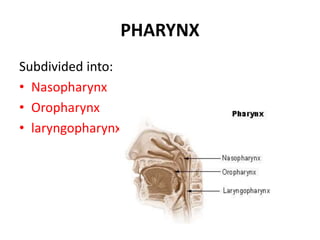
PHARYNX
Subdivided into:
• Nasopharynx
• Oropharynx
• laryngopharynx
PHARYNX
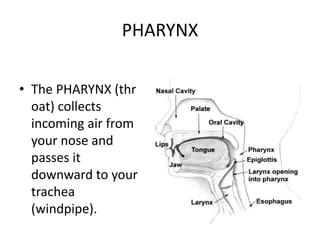
• The PHARYNX (thr
oat) collects
incoming air from
your nose and
passes it
downward to your
trachea
(windpipe).
Nasopharynx
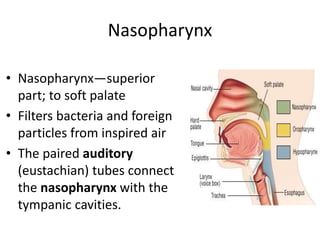
• Nasopharynx—superior
part; to soft palate
• Filters bacteria and foreign
particles from inspired air
• The paired auditory
(eustachian) tubes connect
the nasopharynx with the
tympanic cavities.
Oropharynx
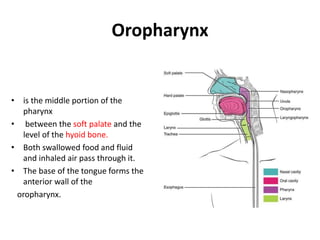
• is the middle portion of the
pharynx
• between the soft palate and the
level of the hyoid bone.
• Both swallowed food and fluid
and inhaled air pass through it.
• The base of the tongue forms the
anterior wall of the
oropharynx.
laryngopharynx
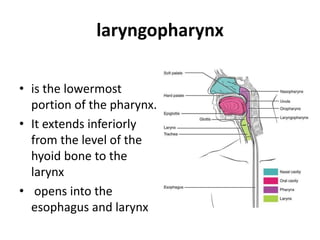
• is the lowermost
portion of the pharynx.
• It extends inferiorly
from the level of the
hyoid bone to the
larynx
• opens into the
esophagus and larynx
• PRESENTER THREE
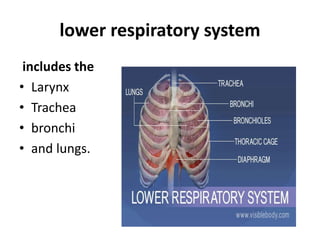
lower respiratory system
includes the
• Larynx
• Trachea
• bronchi
• and lungs.
larynx
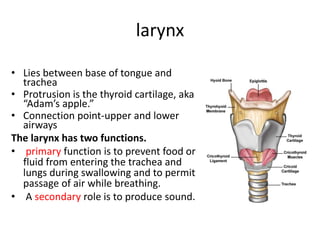
• Lies between base of tongue and
trachea
• Protrusion is the thyroid cartilage, aka
“Adam’s apple.”
• Connection point-upper and lower
airways
The larynx has two functions.
• primary function is to prevent food or
fluid from entering the trachea and
lungs during swallowing and to permit
passage of air while breathing.
• A secondary role is to produce sound.
larynx
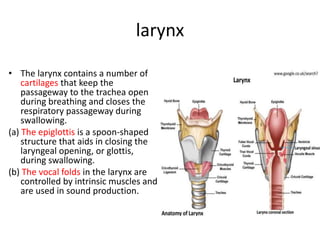
• The larynx contains a number of
cartilages that keep the
passageway to the trachea open
during breathing and closes the
respiratory passageway during
swallowing.
(a) The epiglottis is a spoon-shaped
structure that aids in closing the
laryngeal opening, or glottis,
during swallowing.
(b) The vocal folds in the larynx are
controlled by intrinsic muscles and
are used in sound production.
Trachea
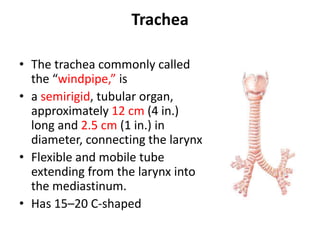
• The trachea commonly called
the “windpipe,” is
• a semirigid, tubular organ,
approximately 12 cm (4 in.)
long and 2.5 cm (1 in.) in
diameter, connecting the larynx
• Flexible and mobile tube
extending from the larynx into
the mediastinum.
• Has 15–20 C-shaped
Cont.
• tracheal cartilages ensure that the airway will
always remain open.
• The open part of each of these cartilages faces
the esophagus and permits the esophagus to
expand slightly into the trachea during
swallowing.
• Medial to the lungs, the trachea splits to form
the right and left principal bronchi.
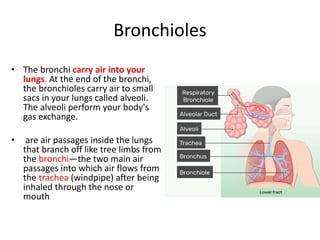
Bronchioles
• The bronchi carry air into your
lungs. At the end of the bronchi,
the bronchioles carry air to small
sacs in your lungs called alveoli.
The alveoli perform your body's
gas exchange.
• are air passages inside the lungs
that branch off like tree limbs from
the bronchi—the two main air
passages into which air flows from
the trachea (windpipe) after being
inhaled through the nose or
mouth
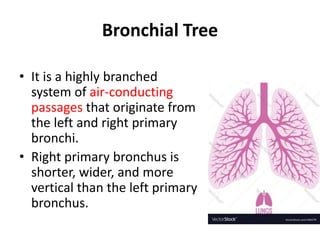
Bronchial Tree
• It is a highly branched
system of air-conducting
passages that originate from
the left and right primary
bronchi.
• Right primary bronchus is
shorter, wider, and more
vertical than the left primary
bronchus.
Anatomy of the Lungs
• Lung occupies most of the space
within the thoracic cavity. It has a
conical shape.
• Toward the midline, the lungs are
separated from each other by the
mediastinum and this is called the
mediastinal surface
• The mediastinum is a complex
anatomic space within the central
thoracic cavity, surrounded by the
lungs.
Costal surface of the lung.
• The relatively broad, rounded surface in
contact with the thoracic wall is called the
costal surface of the lung.
• The lungs extend laterally from the heart to
the ribs on both sides of the chest and
continue posteriorly toward the spine.
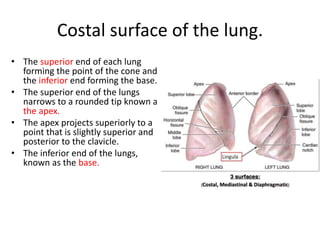
Costal surface of the lung.
• The superior end of each lung
forming the point of the cone and
the inferior end forming the base.
• The superior end of the lungs
narrows to a rounded tip known as
the apex.
• The apex projects superiorly to a
point that is slightly superior and
posterior to the clavicle.
• The inferior end of the lungs,
known as the base.
Cont.
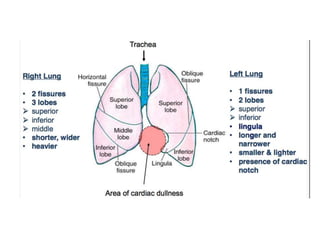
Left lung
Divided into
• 2lobes by oblique 1 fissure
• Smaller than the right lung
• Cardiac notch accommodates the heart
• Weight- left lung - 550 gms
Right lung
Divided into
• 3lobes by oblique and horizontal 2 fissure
• Located more superiorly in the body due to liver on right side •
• Weight- right lung - 600 gms
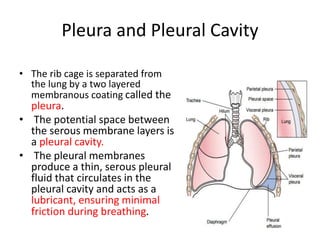
Pleura and Pleural Cavity
• The rib cage is separated from
the lung by a two layered
membranous coating called the
pleura.
• The potential space between
the serous membrane layers is
a pleural cavity.
• The pleural membranes
produce a thin, serous pleural
fluid that circulates in the
pleural cavity and acts as a
lubricant, ensuring minimal
friction during breathing.
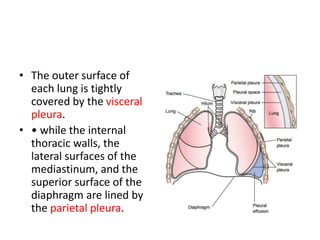
• The outer surface of
each lung is tightly
covered by the visceral
pleura.
• • while the internal
thoracic walls, the
lateral surfaces of the
mediastinum, and the
superior surface of the
diaphragm are lined by
the parietal pleura.
Questions
1. What is the names of the sinuses?
2. What is the human respiratory system consist
of?
3. What are the nasal cartilages?
4. Mention three functions of the nose?
5. How many sections is the left and right lung
divided?
Any Question

L12__Respiratory_system_anatomy[1].pptx

  • 1.
  • 2.
    Introduction • breathing isthe process that brings oxygen in the air into your lungs and moves oxygen and through your body. • Our lungs remove the oxygen and pass it through our bloodstream, where it's carried off to the tissues and organs that allow us to walk, talk, and move. • Our lungs also take carbon dioxide from our blood and release it into the air when we breathe out.
  • 3.
    Introduction • the SINUSESare hollow spaces in the bones of your head. frontal (the lower forehead), maxillary (cheekbones), ethmoid (beside the upper nose), and sphenoid (behind the nose). • Small openings connect them to the nasal cavity. • The sinuses help to regulate the temperature and humidity of air your breathe in, as well as to lighten the bone structure of the head and to give tone to your voice
  • 4.
    Introduction • Air canalso enters through your ORAL CAVITY (mouth), especially if you have a mouth-breathing habit or your nasal passages may be temporarily blocked.
  • 5.
    THE HUMAN RESPIRATORYSYSTEM The respiratory system consists of the nose, pharynx (throat), larynx (voice box), trachea (windpipe), bronchi, and lungs.
  • 6.
    Parts of respiratory Structurally,the respiratory system consists of two parts: 1. The upper respiratory system includes the nose, nasal cavity, pharynx and associated structures. 2. The lower respiratory system includes the larynx, trachea, bronchi and lungs.
  • 7.
    2 divisions ofrespiratory tract • conducting zones • Respiratory zone
  • 8.
    conducting zone • consistsof a series of interconnecting cavities and tubes both outside and within the lungs. • These include the nose, nasal cavity, pharynx, larynx, trachea, bronchi, bronchioles, and terminal bronchioles. • Their function is to filter, warm, and moisten air and conduct it into the lungs
  • 9.
    Respiratory zone • consistsof tubes and tissues within the lungs where gas exchange occurs. • These include the respiratory bronchioles, alveolar ducts, alveolar sacs and alveoli. (Gas exchange occur in these zone)
  • 10.
  • 11.
    upper respiratory system includesthe • Nose • nasal cavity • pharynx and associated structures.
  • 12.
    NOSE It provides anentrance for air in which air is filtered by hairs inside the nostrils. • The hairs that line the inside wall are part of the air-cleansing system • Nose is primary route for air entering respiratory system • Dorsum of nose (bridge) formed by two nasal bones Supported by hyaline cartilage • Nasal cartilages—small, elastic cartilages extending laterally from bridge; help keep nostrils open • Nostrils (external nares) are paired openings into nasal cavity
  • 13.
    The Functions ofthe Nose • Filter the air • Humidify the air • Warm the air • Site for sense of small • To generate resonance in speech
  • 14.
    NASAL CAVITY • Theentrance of the respiratory system that is divided into an external portion and an internal portion called the nasal cavity • It divided medially by the nasal septum.
  • 15.
    Cont. • The anteriorportion of the nasal cavity just inside the nostrils, called the nasal vestibule, is surrounded by cartilage. • The superior part of the nasal cavity is surrounded by bone. • A vertical partition, the nasal septum, divides the nasal cavity into right and left sides. • The anterior portion of the nasal septum consists primarily of hyaline cartilage.
  • 16.
    PHARYNX • is afunnel-shaped tube • shared by respiratory and digestive systems • about 13 cm long that starts at the internal nares and extends to the level of the cricoid cartilage, • the most inferior cartilage of the larynx. The pharynx lies just posterior to the nasal and oral cavities, superior to the larynx, and anterior to the cervical vertebrae
  • 17.
    PHARYNX Subdivided into: • Nasopharynx •Oropharynx • laryngopharynx
  • 18.
    PHARYNX • The PHARYNX(thr oat) collects incoming air from your nose and passes it downward to your trachea (windpipe).
  • 19.
    Nasopharynx • Nasopharynx—superior part; tosoft palate • Filters bacteria and foreign particles from inspired air • The paired auditory (eustachian) tubes connect the nasopharynx with the tympanic cavities.
  • 20.
    Oropharynx • is themiddle portion of the pharynx • between the soft palate and the level of the hyoid bone. • Both swallowed food and fluid and inhaled air pass through it. • The base of the tongue forms the anterior wall of the oropharynx.
  • 21.
    laryngopharynx • is thelowermost portion of the pharynx. • It extends inferiorly from the level of the hyoid bone to the larynx • opens into the esophagus and larynx
  • 22.
  • 23.
    lower respiratory system includesthe • Larynx • Trachea • bronchi • and lungs.
  • 24.
    larynx • Lies betweenbase of tongue and trachea • Protrusion is the thyroid cartilage, aka “Adam’s apple.” • Connection point-upper and lower airways The larynx has two functions. • primary function is to prevent food or fluid from entering the trachea and lungs during swallowing and to permit passage of air while breathing. • A secondary role is to produce sound.
  • 25.
    larynx • The larynxcontains a number of cartilages that keep the passageway to the trachea open during breathing and closes the respiratory passageway during swallowing. (a) The epiglottis is a spoon-shaped structure that aids in closing the laryngeal opening, or glottis, during swallowing. (b) The vocal folds in the larynx are controlled by intrinsic muscles and are used in sound production.
  • 26.
    Trachea • The tracheacommonly called the “windpipe,” is • a semirigid, tubular organ, approximately 12 cm (4 in.) long and 2.5 cm (1 in.) in diameter, connecting the larynx • Flexible and mobile tube extending from the larynx into the mediastinum. • Has 15–20 C-shaped
  • 27.
    Cont. • tracheal cartilagesensure that the airway will always remain open. • The open part of each of these cartilages faces the esophagus and permits the esophagus to expand slightly into the trachea during swallowing. • Medial to the lungs, the trachea splits to form the right and left principal bronchi.
  • 28.
    Bronchioles • The bronchicarry air into your lungs. At the end of the bronchi, the bronchioles carry air to small sacs in your lungs called alveoli. The alveoli perform your body's gas exchange. • are air passages inside the lungs that branch off like tree limbs from the bronchi—the two main air passages into which air flows from the trachea (windpipe) after being inhaled through the nose or mouth
  • 29.
    Bronchial Tree • Itis a highly branched system of air-conducting passages that originate from the left and right primary bronchi. • Right primary bronchus is shorter, wider, and more vertical than the left primary bronchus.
  • 30.
    Anatomy of theLungs • Lung occupies most of the space within the thoracic cavity. It has a conical shape. • Toward the midline, the lungs are separated from each other by the mediastinum and this is called the mediastinal surface • The mediastinum is a complex anatomic space within the central thoracic cavity, surrounded by the lungs.
  • 31.
    Costal surface ofthe lung. • The relatively broad, rounded surface in contact with the thoracic wall is called the costal surface of the lung. • The lungs extend laterally from the heart to the ribs on both sides of the chest and continue posteriorly toward the spine.
  • 32.
    Costal surface ofthe lung. • The superior end of each lung forming the point of the cone and the inferior end forming the base. • The superior end of the lungs narrows to a rounded tip known as the apex. • The apex projects superiorly to a point that is slightly superior and posterior to the clavicle. • The inferior end of the lungs, known as the base.
  • 33.
    Cont. Left lung Divided into •2lobes by oblique 1 fissure • Smaller than the right lung • Cardiac notch accommodates the heart • Weight- left lung - 550 gms Right lung Divided into • 3lobes by oblique and horizontal 2 fissure • Located more superiorly in the body due to liver on right side • • Weight- right lung - 600 gms
  • 35.
    Pleura and PleuralCavity • The rib cage is separated from the lung by a two layered membranous coating called the pleura. • The potential space between the serous membrane layers is a pleural cavity. • The pleural membranes produce a thin, serous pleural fluid that circulates in the pleural cavity and acts as a lubricant, ensuring minimal friction during breathing.
  • 36.
    • The outersurface of each lung is tightly covered by the visceral pleura. • • while the internal thoracic walls, the lateral surfaces of the mediastinum, and the superior surface of the diaphragm are lined by the parietal pleura.
  • 37.
    Questions 1. What isthe names of the sinuses? 2. What is the human respiratory system consist of? 3. What are the nasal cartilages? 4. Mention three functions of the nose? 5. How many sections is the left and right lung divided?
  • 38.