Anatomy & Physiology
1
DR MAHFUZUR RAHMAN KHAN
DA Student
Dept of Anesthesia, Intensive Care & Pain Medicine
Shaheed Suhrawardy Medical College
The brain can survive less than three
minutes without oxygen.
The respiratory system with normal
anatomy and physiology can able to deliver
the this oxygen to the body from the air.
The passage through which it travels from
the atmosphere to the blood is called
Respiratory tract.
The Mystic MemoryThe Mystic Memory
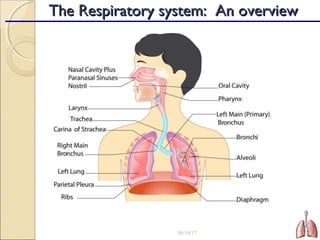
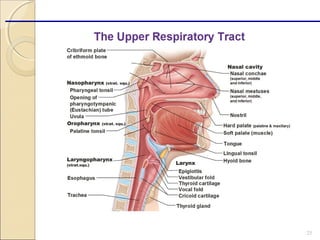
Anatomically the respiratory system is
divided into
Upper respiratory tract
oFrom the nostril to the vocal cord
Lower respiratory tract
oThe lower respiratory tract is from
bellow the vocal cord upto the alveoli
Respiratory SystemRespiratory System
Functionally it can again be divided into
Respiratory zone
oSite of gas exchange
Conductive zone
oA rigid conduits for air to reach the sites of gas
exchange
Respiratory muscles – diaphragm and other
muscles that promote ventilatio
4
Respiratory SystemRespiratory System
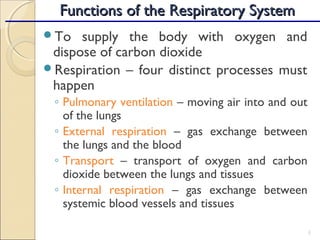
To supply the body with oxygen and
dispose of carbon dioxide
Respiration – four distinct processes must
happen
◦ Pulmonary ventilation – moving air into and out
of the lungs
◦ External respiration – gas exchange between
the lungs and the blood
◦ Transport – transport of oxygen and carbon
dioxide between the lungs and tissues
◦ Internal respiration – gas exchange between
systemic blood vessels and tissues
5
Functions of the Respiratory SystemFunctions of the Respiratory System
08/18/17 6
The Respiratory system: An overviewThe Respiratory system: An overview
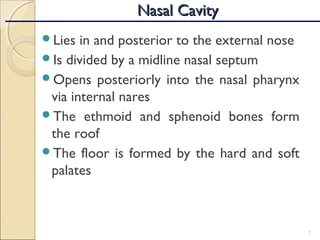
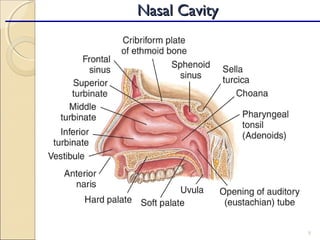
Lies in and posterior to the external nose
Is divided by a midline nasal septum
Opens posteriorly into the nasal pharynx
via internal nares
The ethmoid and sphenoid bones form
the roof
The floor is formed by the hard and soft
palates
7
Nasal CavityNasal Cavity
8
Nasal CavityNasal Cavity
9
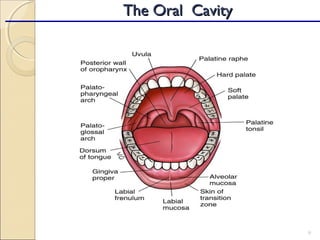
The Oral CavityThe Oral Cavity
10
Providing an airway for respiration
Moistening (humidifying) and warming the
entering air
Filtering inspired air and cleaning it of
foreign matter
Serving as a resonating chamber for speech
Housing the olfactory receptors
Sensitive mucosa triggers sneezing when
stimulated by irritating particles
Functions of the NoseFunctions of the Nose
It connects the
◦ Nasal cavity and mouth superiorly
◦ Larynx and esophagus inferiorly
Extends
◦ from the base of the skull to the level of the
sixth cervical vertebra
It is divided into
◦ Nasopharynx
◦ Oropharynx
◦ Laryngopharynx
11
PharynxPharynx
Nasopharynx
o Lies posterior to the nasal cavity, inferior to the
sphenoid, and superior to the level of the soft
palate
o Strictly an airway
Oropharynx
o Extends inferiorly from the level of the soft
palate to the epiglottis
o Serves as a common passageway for food and
air
Laryngopharynx
o Lies posterior to the upright epiglottis
12
PharynxPharynx
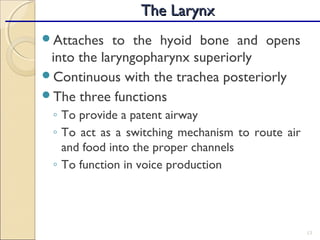
Attaches to the hyoid bone and opens
into the laryngopharynx superiorly
Continuous with the trachea posteriorly
The three functions
◦ To provide a patent airway
◦ To act as a switching mechanism to route air
and food into the proper channels
◦ To function in voice production
13
The LarynxThe Larynx
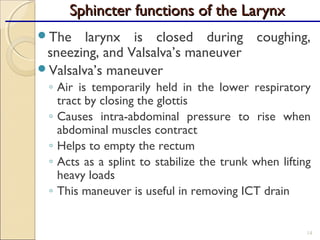
The larynx is closed during coughing,
sneezing, and Valsalva’s maneuver
Valsalva’s maneuver
◦ Air is temporarily held in the lower respiratory
tract by closing the glottis
◦ Causes intra-abdominal pressure to rise when
abdominal muscles contract
◦ Helps to empty the rectum
◦ Acts as a splint to stabilize the trunk when lifting
heavy loads
◦ This maneuver is useful in removing ICT drain
14
Sphincter functions of the LarynxSphincter functions of the Larynx
The hyoid bone, while technically not a part of the
larynx, provides muscular attachments fromabove
that aid in the laryngeal motion.
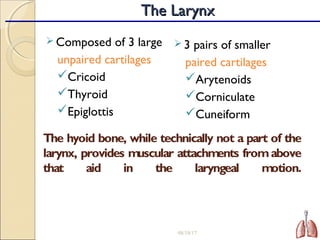
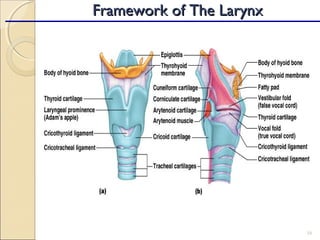
 Composed of 3 large
unpaired cartilages
Cricoid
Thyroid
Epiglottis
 3 pairs of smaller
paired cartilages
Arytenoids
Corniculate
Cuneiform
08/18/17 15
The LarynxThe Larynx
16
Framework of The LarynxFramework of The Larynx
Chapter 22, Respiratory System 17
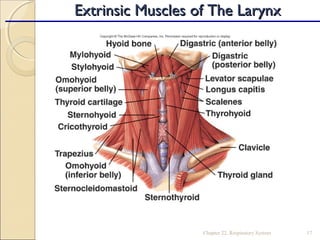
Extrinsic Muscles of The LarynxExtrinsic Muscles of The Larynx
08/18/17 18
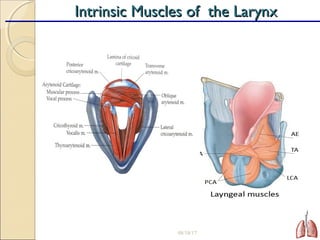
Intrinsic Muscles of the LarynxIntrinsic Muscles of the Larynx
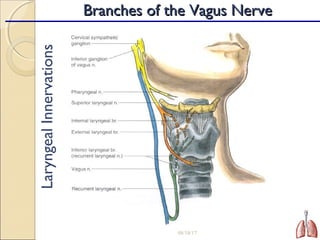
 Except the cricothyroid all the intrinsic muscles
of the larynx are innervated by the inferior
laryngeal nerve –  the terminal branch of
the recurrent laryngeal nerve.
 The cricothyroid is innervated by the external
branch of the superior laryngeal nerve.
08/18/17 19
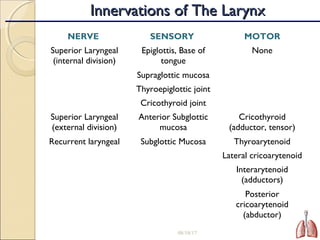
Innervations of The LarynxInnervations of The Larynx
NERVE SENSORY MOTOR
Superior Laryngeal
(internal division)
Epiglottis, Base of
tongue
None
Supraglottic mucosa
Thyroepiglottic joint
Cricothyroid joint
Superior Laryngeal
(external division)
Anterior Subglottic
mucosa
Cricothyroid
(adductor, tensor)
Recurrent laryngeal Subglottic Mucosa Thyroarytenoid
Lateral cricoarytenoid
Interarytenoid
(adductors)
Posterior
cricoarytenoid
(abductor)
08/18/17 20
Innervations of The LarynxInnervations of The Larynx
LaryngealInnervations
08/18/17 21
Branches of the Vagus NerveBranches of the Vagus Nerve
 The superior and inferior laryngeal arteries
supply the majority of blood to the larynx.
 The superior laryngeal artery originates from
the superior thyroid branch of the external
carotid artery
 The inferior laryngeal artery originates from the
inferior thyroid branch of the thyrocervical
trunk, which is a branch of the subclavian artery.
08/18/17 22
Blood Supply of The LarynxBlood Supply of The Larynx
 Length of Larynx: 44mm in male & 35mm in
female
 Diameter of Larynx: 12mm (OD) & 9mm (ID)
 Incisor to Carina: 25-27cm (M) & 21-23 cm (F)
 Nostril to Carina: 29-31cm (M) & 25-27cm(F)
 In neonates *Gum to VC: 5cm *VC to Carina
5cm
08/18/17
Some important Anatomical MeasuresSome important Anatomical Measures
24
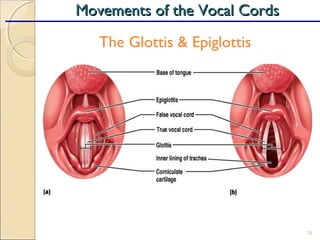
Movements of the Vocal CordsMovements of the Vocal Cords
The Glottis & Epiglottis
25
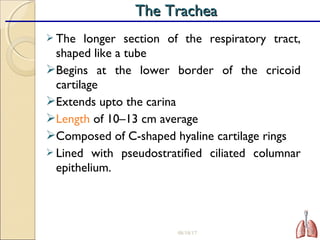
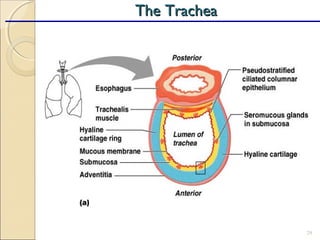
 The longer section of the respiratory tract,
shaped like a tube
Begins at the lower border of the cricoid
cartilage
Extends upto the carina
Length of 10–13 cm average
Composed of C-shaped hyaline cartilage rings
 Lined with pseudostratified ciliated columnar
epithelium.
08/18/17 26
The TracheaThe Trachea
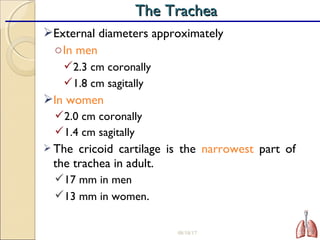
External diameters approximately
oIn men
2.3 cm coronally
1.8 cm sagitally
In women
2.0 cm coronally
1.4 cm sagitally
 The cricoid cartilage is the narrowest part of
the trachea in adult.
17 mm in men
13 mm in women.
08/18/17 27
The TracheaThe Trachea
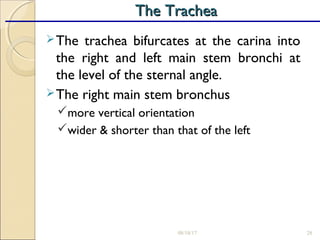
The trachea bifurcates at the carina into
the right and left main stem bronchi at
the level of the sternal angle.
The right main stem bronchus
more vertical orientation
wider & shorter than that of the left
08/18/17 28
The TracheaThe Trachea
29
The TracheaThe Trachea
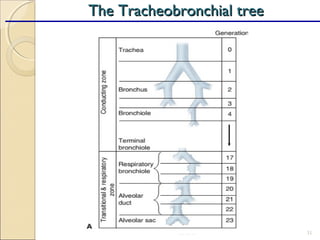
 The trachea divides and divides in dichotomous
pattern till 23 generations the final generation
end as alveolar sacs.
 Each alveolar sac contains 17 alveoli on average.
 An estimated 300 million alveoli provide an
enormous membrane (50–100 m2
) for gas
exchange in the average adult.
The trachea serves as
a conduit for ventilation
and the clearance of tracheal and bronchial
secretions.
The Tracheobronchial TreeThe Tracheobronchial Tree
08/18/17 31
The Tracheobronchial treeThe Tracheobronchial tree
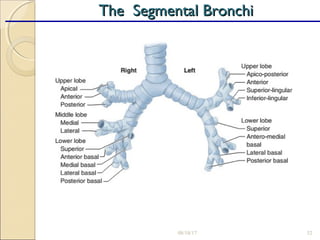
08/18/17 32
The Segmental BronchiThe Segmental Bronchi
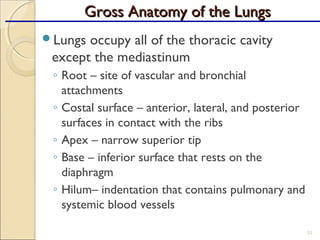
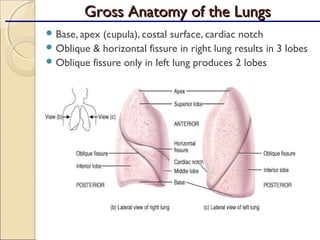
Lungs occupy all of the thoracic cavity
except the mediastinum
◦ Root – site of vascular and bronchial
attachments
◦ Costal surface – anterior, lateral, and posterior
surfaces in contact with the ribs
◦ Apex – narrow superior tip
◦ Base – inferior surface that rests on the
diaphragm
◦ Hilum– indentation that contains pulmonary and
systemic blood vessels
33
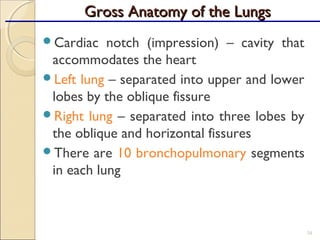
Gross Anatomy of the LungsGross Anatomy of the Lungs
Cardiac notch (impression) – cavity that
accommodates the heart
Left lung – separated into upper and lower
lobes by the oblique fissure
Right lung – separated into three lobes by
the oblique and horizontal fissures
There are 10 bronchopulmonary segments
in each lung
34
Gross Anatomy of the LungsGross Anatomy of the Lungs
 Base, apex (cupula), costal surface, cardiac notch
 Oblique & horizontal fissure in right lung results in 3 lobes
 Oblique fissure only in left lung produces 2 lobes
Gross Anatomy of the LungsGross Anatomy of the Lungs
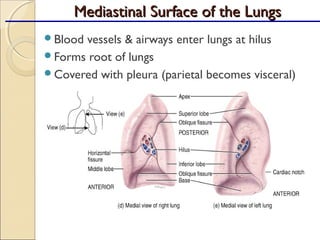
Blood vessels & airways enter lungs at hilus
Forms root of lungs
Covered with pleura (parietal becomes visceral)
Mediastinal Surface of the LungsMediastinal Surface of the Lungs
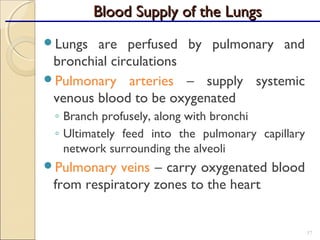
Lungs are perfused by pulmonary and
bronchial circulations
Pulmonary arteries – supply systemic
venous blood to be oxygenated
◦ Branch profusely, along with bronchi
◦ Ultimately feed into the pulmonary capillary
network surrounding the alveoli
Pulmonary veins – carry oxygenated blood
from respiratory zones to the heart
37
Blood Supply of the LungsBlood Supply of the Lungs
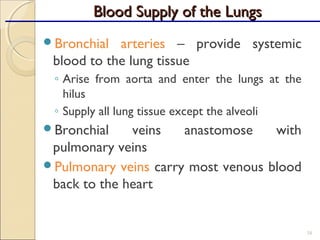
Bronchial arteries – provide systemic
blood to the lung tissue
◦ Arise from aorta and enter the lungs at the
hilus
◦ Supply all lung tissue except the alveoli
Bronchial veins anastomose with
pulmonary veins
Pulmonary veins carry most venous blood
back to the heart
38
Blood Supply of the LungsBlood Supply of the Lungs
Thin, double-layered serosa
Parietal pleura
◦ Covers the thoracic wall and superior face of
the diaphragm
◦ Continues around heart and between lungs
Visceral pleura
◦ Covers the external lung surface
◦ Divides the thoracic cavity into three chambers
 The central mediastinum
 Two lateral compartments, each containing a lung
39
PleuraePleurae
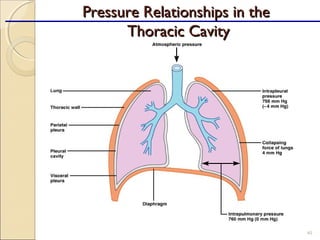
40
Pressure Relationships in thePressure Relationships in the
Thoracic CavityThoracic Cavity
The carina of the last tracheal cartilage
marks the end of the trachea and the
beginning of the right and left bronchi
Air reaching the bronchi is:
◦ Warm and cleansed of impurities
◦ Saturated with water vapor
Bronchi subdivide into secondary bronchi,
each supplying a lobe of the lungs
Air passages undergo 23 orders of
branching in the lungs
41
Conducting Zone: BronchiConducting Zone: Bronchi
Upto the terminal bronchioles
Tissue walls of bronchi mimic that of the
trachea
As conducting tubes become smaller,
structural changes occur
◦ Cartilage support structures change
◦ Epithelium types change
◦ Amount of smooth muscle increases
Bronchioles
◦ Consist of cuboidal epithelium
◦ Have a complete layer of circular smooth muscle
◦ Lack cartilage support and mucus-producing cells
42
Conducting ZoneConducting Zone
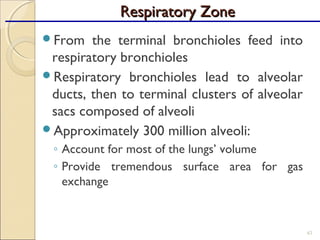
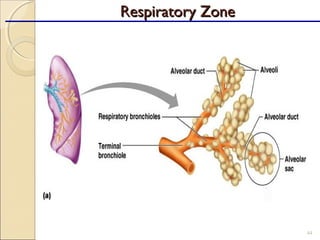
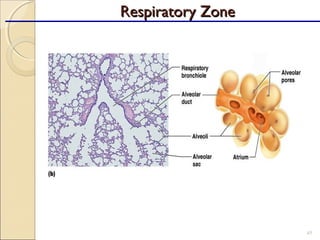
From the terminal bronchioles feed into
respiratory bronchioles
Respiratory bronchioles lead to alveolar
ducts, then to terminal clusters of alveolar
sacs composed of alveoli
Approximately 300 million alveoli:
◦ Account for most of the lungs’ volume
◦ Provide tremendous surface area for gas
exchange
43
Respiratory ZoneRespiratory Zone
44
Respiratory ZoneRespiratory Zone
45
Respiratory ZoneRespiratory Zone
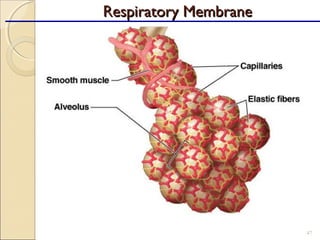
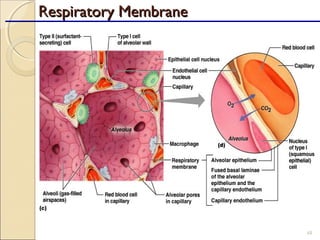
This air-blood barrier is composed of:
◦ Alveolar and capillary walls
◦ Their fused basal laminas
Alveolar walls:
◦ Are a single layer of type I epithelial cells
◦ Permit gas exchange by simple diffusion
◦ Secrete angiotensin converting enzyme (ACE)
Type II cells secrete surfactant
46
Respiratory MembraneRespiratory Membrane
47
Respiratory MembraneRespiratory Membrane
48
Respiratory MembraneRespiratory Membrane
Surrounded by fine elastic fibers
Contain open pores that:
◦ Connect adjacent alveoli
◦ Allow air pressure throughout the lung to be
equalized
House macrophages that keep alveolar
surfaces sterile
49
AlveoliAlveoli
Surface tension – the attraction of liquid
molecules to one another at a liquid-gas
interface
The liquid coating the alveolar surface is
always acting to reduce the alveoli to the
smallest possible size
Surfactant, a detergent-like complex,
reduces surface tension and helps keep
the alveoli from collapsing
50
Alveolar Surface TensionAlveolar Surface Tension
51
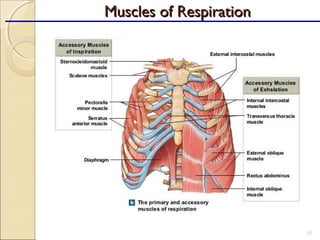
Muscles of RespirationMuscles of Respiration
08/18/17 52
The Respiratory System
Physiology
53
Breathing, or pulmonary ventilation,
consists of two phases
◦ Inspiration – air flows into the lungs
◦ Expiration – gases exit the lungs
54
BreathingBreathing
Pressure Relationships in thePressure Relationships in the
Thoracic CavityThoracic Cavity
Respiratory pressure is always described
relative to atmospheric pressure
Atmospheric pressure (Patm)
◦ Pressure exerted by the air surrounding the
body
◦ Negative respiratory pressure is less than Patm
◦ Positive respiratory pressure is greater than Patm
55
Intrapulmonary pressure (Ppul) – pressure
within the alveoli
Intrapleural pressure (Pip) – pressure within
the pleural cavity
56
Pressure Relationships in thePressure Relationships in the
Thoracic CavityThoracic Cavity
Intrapulmonary pressure and intrapleural
pressure fluctuate with the phases of
breathing
Intrapulmonary pressure always eventually
equalizes itself with atmospheric pressure
Intrapleural pressure is always less than
intrapulmonary pressure and atmospheric
pressure
57
Pressure Relationships in thePressure Relationships in the
Thoracic CavityThoracic Cavity
Two forces act to pull the lungs away from
the thoracic wall, promoting lung collapse
◦ Elasticity of lungs causes them to assume
smallest possible size
◦ Surface tension of alveolar fluid draws alveoli to
their smallest possible size
Opposing force – elasticity of the chest
wall pulls the thorax outward to enlarge
the lungs
58
Pressure Relationships in thePressure Relationships in the
Thoracic CavityThoracic Cavity
Caused by equalization of the intrapleural
pressure with the intrapulmonary pressure
Transpulmonary pressure keeps the
airways open
◦ Transpulmonary pressure – difference between
the intrapulmonary and intrapleural pressures
(Ppul – Pip)
59
Lung CollapseLung Collapse
A mechanical process that depends on
volume changes in the thoracic cavity
Volume changes lead to pressure changes,
which lead to the flow of gases to equalize
pressure
60
Pulmonary VentilationPulmonary Ventilation
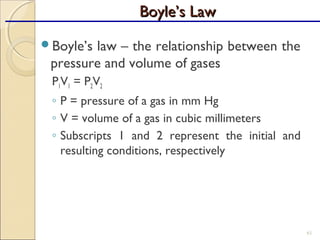
Boyle’s law – the relationship between the
pressure and volume of gases
P1V1 = P2V2
◦ P = pressure of a gas in mm Hg
◦ V = volume of a gas in cubic millimeters
◦ Subscripts 1 and 2 represent the initial and
resulting conditions, respectively
61
Boyle’s LawBoyle’s Law
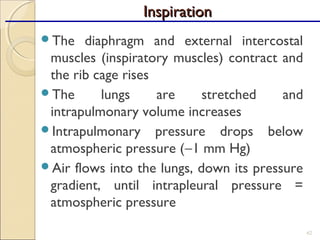
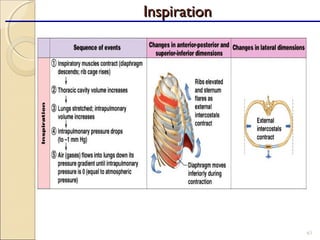
The diaphragm and external intercostal
muscles (inspiratory muscles) contract and
the rib cage rises
The lungs are stretched and
intrapulmonary volume increases
Intrapulmonary pressure drops below
atmospheric pressure (−1 mm Hg)
Air flows into the lungs, down its pressure
gradient, until intrapleural pressure =
atmospheric pressure
62
InspirationInspiration
63
InspirationInspiration
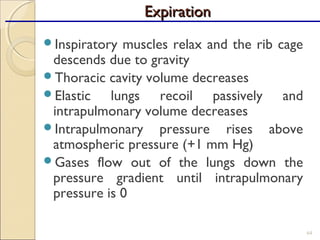
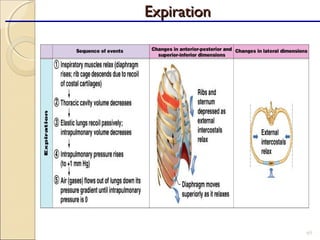
Inspiratory muscles relax and the rib cage
descends due to gravity
Thoracic cavity volume decreases
Elastic lungs recoil passively and
intrapulmonary volume decreases
Intrapulmonary pressure rises above
atmospheric pressure (+1 mm Hg)
Gases flow out of the lungs down the
pressure gradient until intrapulmonary
pressure is 0
64
ExpirationExpiration
65
ExpirationExpiration
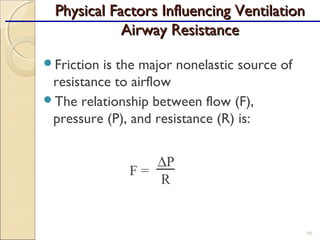
Friction is the major nonelastic source of
resistance to airflow
The relationship between flow (F),
pressure (P), and resistance (R) is:
66
Physical Factors Influencing VentilationPhysical Factors Influencing Ventilation
Airway ResistanceAirway Resistance
F =
∆P
R
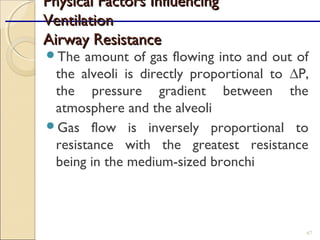
The amount of gas flowing into and out of
the alveoli is directly proportional to ∆P,
the pressure gradient between the
atmosphere and the alveoli
Gas flow is inversely proportional to
resistance with the greatest resistance
being in the medium-sized bronchi
67
Physical Factors InfluencingPhysical Factors Influencing
VentilationVentilation
Airway ResistanceAirway Resistance
As airway resistance rises, breathing
movements become more strenuous
Severely constricted or obstructed
bronchioles:
◦ Can prevent life-sustaining ventilation
◦ Can occur during acute asthma attacks which
stops ventilation
Epinephrine release via the sympathetic
nervous system dilates bronchioles and
reduces air resistance
68
Physical Factors Influencing VentilationPhysical Factors Influencing Ventilation
Airway ResistanceAirway Resistance
The ease with which lungs can be
expanded
Specifically, the measure of the change in
lung volume that occurs with a given
change in transpulmonary pressure
Determined by two main factors
◦ Distensibility of the lung tissue and surrounding
thoracic cage
◦ Surface tension of the alveoli
69
Lung ComplianceLung Compliance
Factors That Diminish Lung ComplianceFactors That Diminish Lung Compliance
Scar tissue or fibrosis that reduces the
natural resilience of the lungs
Blockage of the smaller respiratory
passages with mucus or fluid
Reduced production of surfactant
Decreased flexibility of the thoracic cage or
its decreased ability to expand
Examples include:
◦ Deformities of thorax
◦ Ossification of the costal cartilage
◦ Paralysis of intercostal muscles
70
Tidal volume (TV) – air that moves into and
out of the lungs with each breath
(approximately 500 ml)
Inspiratory reserve volume (IRV) – air that can
be inspired forcibly beyond the tidal volume
(2100–3200 ml)
Expiratory reserve volume (ERV) – air that can
be evacuated from the lungs after a tidal
expiration (1000–1200 ml)
Residual volume (RV) – air left in the lungs
after strenuous expiration (1200 ml)
71
Respiratory VolumesRespiratory Volumes
Inspiratory capacity (IC) – total amount of air
that can be inspired after a tidal expiration (IRV +
TV)
Functional residual capacity (FRC) – amount of air
remaining in the lungs after a tidal expiration
(RV + ERV)
Vital capacity (VC) – the total amount of
exchangeable air (TV + IRV + ERV)
Total lung capacity (TLC) – sum of all lung
volumes (approximately 6000 ml in males)
72
Respiratory CapacitiesRespiratory Capacities
Anatomical dead space – volume of the
conducting respiratory passages (150 ml)
Alveolar dead space – alveoli that cease to
act in gas exchange due to collapse or
obstruction
Total dead space – sum of alveolar and
anatomical dead spaces
73
Dead SpaceDead Space
Spirometer – an instrument consisting of a
hollow bell inverted over water, used to
evaluate respiratory function
Spirometry can distinguish between:
◦ Obstructive pulmonary disease – increased
airway resistance
◦ Restrictive disorders – reduction in total lung
capacity from structural or functional lung
changes
74
Pulmonary Function TestsPulmonary Function Tests
Total ventilation – total amount of gas
flow into or out of the respiratory tract in
one minute
Forced vital capacity (FVC) – gas forcibly
expelled after taking a deep breath
Forced expiratory volume (FEV) – the
amount of gas expelled during specific time
intervals of the FVC
75
Pulmonary Function TestsPulmonary Function Tests
Increases in TLC, FRC, and RV may
occur as a result of obstructive disease
Reduction in VC, TLC, FRC, and RV
result from restrictive disease
76
Pulmonary Function TestsPulmonary Function Tests
Alveolar ventilation rate (AVR) – measures
the flow of fresh gases into and out of the
alveoli during a particular time
Slow, deep breathing increases AVR and
rapid, shallow breathing decreases AVR
77
AVR = frequency X (TV – dead space)
(ml/min) (breaths/min) (ml/breath)
Alveolar VentilationAlveolar Ventilation
Most result from reflex action
Examples include: coughing, sneezing,
crying, laughing, hiccupping, and yawning
78
Nonrespiratory AirmovementNonrespiratory Airmovement
Basic Properties of Gases:Basic Properties of Gases:
Dalton’s Law of Partial PressuresDalton’s Law of Partial Pressures
Total pressure exerted by a mixture of
gases is the sum of the pressures exerted
independently by each gas in the mixture
The partial pressure of each gas is directly
proportional to its percentage in the
mixture
79
Air = 21% O2, 78% N2 and .04% CO2
Alveolar air = 14% O2, 78% N2 and 5.2% CO2
Expired air = 16% O2, 78% N2 and 4.5% CO2
Observations
◦ alveolar air has less O2 since absorbed by blood
◦ mystery-----expired air has more O2 & less CO2
than alveolar air?
◦ Anatomical dead space = 150 ml of 500 ml of
tidal volume
80
Composition of AirComposition of Air
Basic Properties of Gases: Henry’sBasic Properties of Gases: Henry’s
LawLaw
When a mixture of gases is in contact
with a liquid, each gas will dissolve in the
liquid in proportion to its partial pressure
The amount of gas that will dissolve in a
liquid also depends upon its solubility
Various gases in air have different
solubilities:
◦ Carbon dioxide is the most soluble
◦ Oxygen is 1/20th
as soluble as carbon dioxide
◦ Nitrogen is practically insoluble in plasma
81
Hyperbaric OxygenationHyperbaric Oxygenation
Clinical application of Henry’s law
Use of pressure to dissolve more O2
in the blood
◦ treatment for patients with anaerobic bacterial
infections (tetanus and gangrene)
◦ anaerobic bacteria die in the presence of O2
Hyperbaric chamber pressure raised to 3 to 4
atmospheres so that tissues absorb more O2
Used to treat heart disorders, carbon monoxide
poisoning, cerebral edema, bone infections, gas
embolisms & crush injuries
82
Composition of Alveolar GasComposition of Alveolar Gas
The atmosphere is mostly oxygen and
nitrogen, while alveoli contain more carbon
dioxide and water vapor
These differences result from:
◦ Gas exchanges in the lungs – oxygen diffuses
from the alveoli and carbon dioxide diffuses into
the alveoli
◦ Humidification of air by conducting passages
◦ The mixing of alveolar gas that occurs with each
breath
83
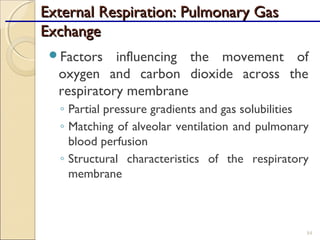
External Respiration: Pulmonary GasExternal Respiration: Pulmonary Gas
ExchangeExchange
Factors influencing the movement of
oxygen and carbon dioxide across the
respiratory membrane
◦ Partial pressure gradients and gas solubilities
◦ Matching of alveolar ventilation and pulmonary
blood perfusion
◦ Structural characteristics of the respiratory
membrane
84
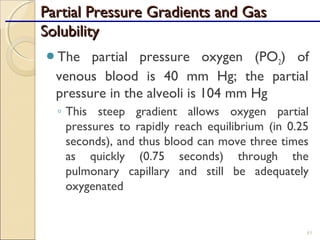
Partial Pressure Gradients and GasPartial Pressure Gradients and Gas
SolubilitySolubility
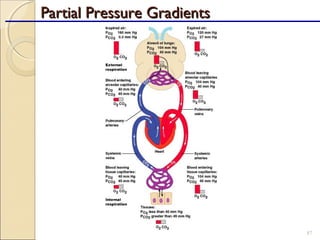
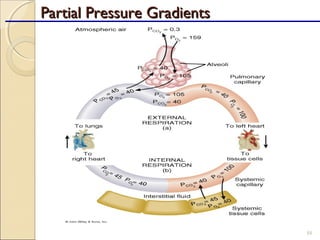
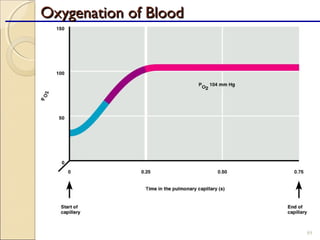
The partial pressure oxygen (PO2) of
venous blood is 40 mm Hg; the partial
pressure in the alveoli is 104 mm Hg
◦ This steep gradient allows oxygen partial
pressures to rapidly reach equilibrium (in 0.25
seconds), and thus blood can move three times
as quickly (0.75 seconds) through the
pulmonary capillary and still be adequately
oxygenated
85
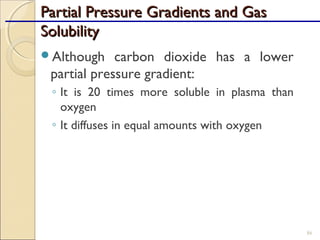
Although carbon dioxide has a lower
partial pressure gradient:
◦ It is 20 times more soluble in plasma than
oxygen
◦ It diffuses in equal amounts with oxygen
86
Partial Pressure Gradients and GasPartial Pressure Gradients and Gas
SolubilitySolubility
Partial Pressure GradientsPartial Pressure Gradients
87
88
Partial Pressure GradientsPartial Pressure Gradients
Oxygenation of BloodOxygenation of Blood
89
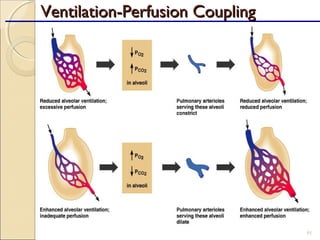
Ventilation-Perfusion CouplingVentilation-Perfusion Coupling
Ventilation – the amount of gas reaching the
alveoli
Perfusion – the blood flow reaching the
alveoli
Ventilation and perfusion must be tightly
regulated for efficient gas exchange
Changes in PCO2 in the alveoli cause changes in
the diameters of the bronchioles
◦ Passageways servicing areas where alveolar carbon
dioxide is high dilate
◦ Those serving areas where alveolar carbon dioxide
is low constrict
90
Ventilation-Perfusion CouplingVentilation-Perfusion Coupling
91
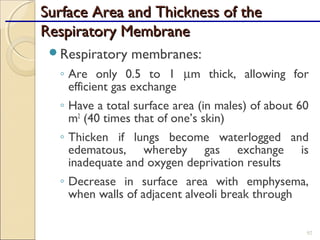
Surface Area and Thickness of theSurface Area and Thickness of the
Respiratory MembraneRespiratory Membrane
Respiratory membranes:
◦ Are only 0.5 to 1 µm thick, allowing for
efficient gas exchange
◦ Have a total surface area (in males) of about 60
m2
(40 times that of one’s skin)
◦ Thicken if lungs become waterlogged and
edematous, whereby gas exchange is
inadequate and oxygen deprivation results
◦ Decrease in surface area with emphysema,
when walls of adjacent alveoli break through
92
Internal RespirationInternal Respiration
The factors promoting gas exchange
between systemic capillaries and tissue
cells are the same as those acting in the
lungs
◦ The partial pressures and diffusion gradients are
reversed
◦ PO2 in tissue is always lower than in systemic
arterial blood
◦ PO2 of venous blood draining tissues is 40 mm
Hg and PCO2 is 45 mm Hg
93
Oxygen TransportOxygen Transport
Molecular oxygen is carried in the blood:
◦ Bound to hemoglobin (Hb) within red blood
cells
◦ Dissolved in plasma
Chapter 22, Respiratory System 94
Oxygen Transport: Role ofOxygen Transport: Role of
HemoglobinHemoglobin
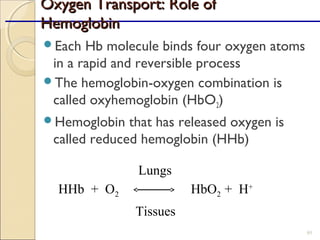
Each Hb molecule binds four oxygen atoms
in a rapid and reversible process
The hemoglobin-oxygen combination is
called oxyhemoglobin (HbO2)
Hemoglobin that has released oxygen is
called reduced hemoglobin (HHb)
95
HHb + O2
Lungs
Tissues
HbO2 + H+
Hemoglobin (Hb)Hemoglobin (Hb)
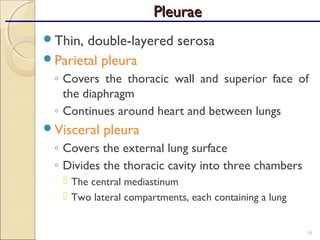
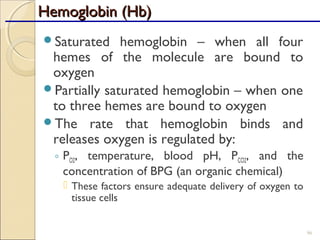
Saturated hemoglobin – when all four
hemes of the molecule are bound to
oxygen
Partially saturated hemoglobin – when one
to three hemes are bound to oxygen
The rate that hemoglobin binds and
releases oxygen is regulated by:
◦ PO2, temperature, blood pH, PCO2, and the
concentration of BPG (an organic chemical)
 These factors ensure adequate delivery of oxygen to
tissue cells
96
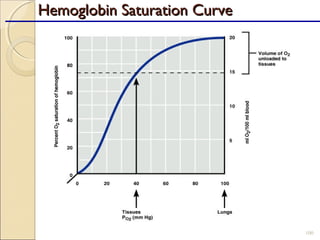
Influence of PInfluence of PO2O2 on Hemoglobinon Hemoglobin
SaturationSaturation
Hemoglobin saturation plotted against PO2
produces a oxygen-hemoglobin dissociation
curve
98% saturated arterial blood contains 20 ml
oxygen per 100 ml blood (20 vol %)
As arterial blood flows through capillaries, 5
ml oxygen are released
The saturation of hemoglobin in arterial blood
explains why breathing deeply increases the PO2
but has little effect on oxygen saturation in
hemoglobin
97
Hemoglobin Saturation CurveHemoglobin Saturation Curve
Hemoglobin is almost completely
saturated at a PO2 of 70 mm Hg
Further increases in PO2 produce only small
increases in oxygen binding
Oxygen loading and delivery to tissue is
adequate when PO2 is below normal levels
98
Hemoglobin Saturation CurveHemoglobin Saturation Curve
Only 20–25% of bound oxygen is
unloaded during one systemic circulation
If oxygen levels in tissues drop:
◦ More oxygen dissociates from hemoglobin
and is used by cells
◦ Respiratory rate or cardiac output need not
increase
Chapter 22, Respiratory System 99
Hemoglobin Saturation CurveHemoglobin Saturation Curve
100
Other Factors Influencing HemoglobinOther Factors Influencing Hemoglobin
SaturationSaturation
Temperature, H+
, PCO2, and BPG
◦ Modify the structure of hemoglobin and alter
its affinity for oxygen
◦ Increases of these factors:
 Decrease hemoglobin’s affinity for oxygen
 Enhance oxygen unloading from the blood
◦ Decreases act in the opposite manner
These parameters are all high in systemic
capillaries where oxygen unloading is the
goal
101
Factors That Increase Release ofFactors That Increase Release of
Oxygen by HemoglobinOxygen by Hemoglobin
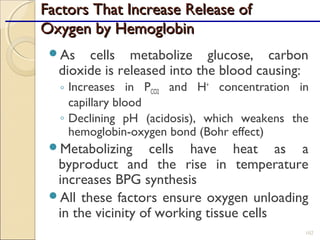
As cells metabolize glucose, carbon
dioxide is released into the blood causing:
◦ Increases in PCO2 and H+
concentration in
capillary blood
◦ Declining pH (acidosis), which weakens the
hemoglobin-oxygen bond (Bohr effect)
Metabolizing cells have heat as a
byproduct and the rise in temperature
increases BPG synthesis
All these factors ensure oxygen unloading
in the vicinity of working tissue cells
102
Hemoglobin and Oxygen Partial PressureHemoglobin and Oxygen Partial Pressure
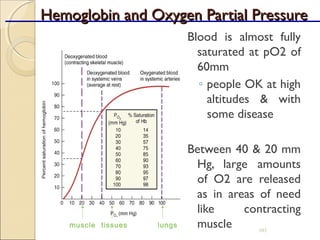
Blood is almost fully
saturated at pO2 of
60mm
◦ people OK at high
altitudes & with
some disease
Between 40 & 20 mm
Hg, large amounts
of O2 are released
as in areas of need
like contracting
muscle 103
lungsmuscle tissues
pCO2 & Oxygen ReleasepCO2 & Oxygen Release
104
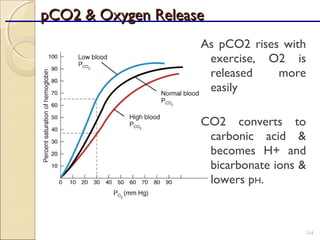
As pCO2 rises with
exercise, O2 is
released more
easily
CO2 converts to
carbonic acid &
becomes H+ and
bicarbonate ions &
lowers pH.
Acidity & Oxygen Affinity for HbAcidity & Oxygen Affinity for Hb
105
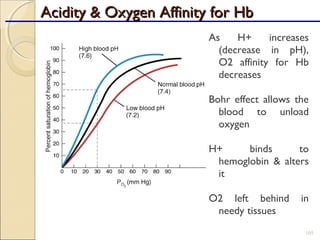
As H+ increases
(decrease in pH),
O2 affinity for Hb
decreases
Bohr effect allows the
blood to unload
oxygen
H+ binds to
hemoglobin & alters
it
O2 left behind in
needy tissues
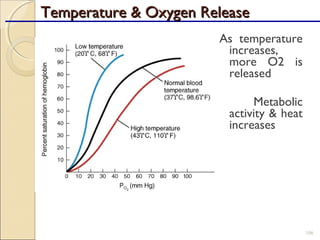
Temperature & Oxygen ReleaseTemperature & Oxygen Release
106
As temperature
increases,
more O2 is
released
Metabolic
activity & heat
increases
Hemoglobin-Nitric Oxide PartnershipHemoglobin-Nitric Oxide Partnership
Nitric oxide (NO) is a vasodilator that
plays a role in blood pressure regulation
Hemoglobin is a vasoconstrictor and a
nitric oxide scavenger (heme destroys
NO)
However, as oxygen binds to hemoglobin:
◦ Nitric oxide binds to a cysteine amino acid on
hemoglobin
◦ Bound nitric oxide is protected from
degradation by hemoglobin’s iron
107
Hemoglobin-Nitric Oxide PartnershipHemoglobin-Nitric Oxide Partnership
The hemoglobin is released as oxygen is
unloaded, causing vasodilation
As deoxygenated hemoglobin picks up
carbon dioxide, it also binds nitric oxide
and carries these gases to the lungs for
unloading
108
Carbon Dioxide TransportCarbon Dioxide Transport
Carbon dioxide is transported in the
blood in three forms
◦ Dissolved in plasma – 7 to 10%
◦ Chemically bound to hemoglobin – 20% is
carried in RBCs as carbaminohemoglobin
◦ Bicarbonate ion in plasma – 70% is
transported as bicarbonate (HCO3
–
)
109
Transport and Exchange of CarbonTransport and Exchange of Carbon
DioxideDioxide
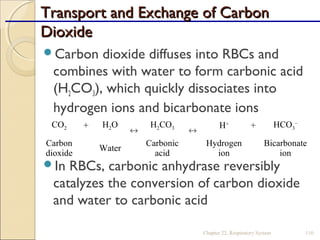
Carbon dioxide diffuses into RBCs and
combines with water to form carbonic acid
(H2CO3), which quickly dissociates into
hydrogen ions and bicarbonate ions
In RBCs, carbonic anhydrase reversibly
catalyzes the conversion of carbon dioxide
and water to carbonic acid
Chapter 22, Respiratory System 110
CO2 + H2O
↔
H2CO3
↔
H+
+ HCO3
–
Carbon
dioxide
Water
Carbonic
acid
Hydrogen
ion
Bicarbonate
ion
Transport and Exchange of CarbonTransport and Exchange of Carbon
DioxideDioxide
At the tissues:
◦ Bicarbonate quickly diffuses from RBCs into the
plasma
◦ The chloride shift – to counterbalance the
outrush of negative bicarbonate ions from the
RBCs, chloride ions (Cl–
) move from the plasma
into the erythrocytes
111
Transport and Exchange of CarbonTransport and Exchange of Carbon
DioxideDioxide
At the lungs, these processes are
reversed
◦ Bicarbonate ions move into the RBCs and
bind with hydrogen ions to form carbonic
acid
◦ Carbonic acid is then split by carbonic
anhydrase to release carbon dioxide and
water
◦ Carbon dioxide then diffuses from the blood
into the alveoli
112
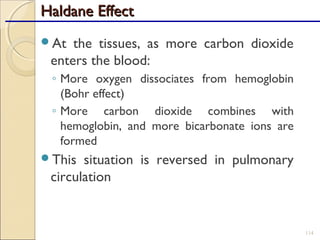
Haldane EffectHaldane Effect
The amount of carbon dioxide transported
is markedly affected by the PO2
Haldane effect – the lower the PO2 and
hemoglobin saturation with oxygen, the
more carbon dioxide can be carried in the
blood
113
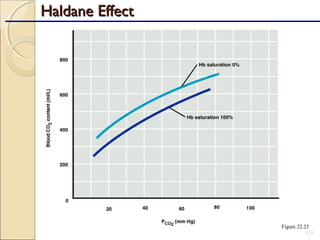
At the tissues, as more carbon dioxide
enters the blood:
◦ More oxygen dissociates from hemoglobin
(Bohr effect)
◦ More carbon dioxide combines with
hemoglobin, and more bicarbonate ions are
formed
This situation is reversed in pulmonary
circulation
114
Haldane EffectHaldane Effect
115
Figure 22.23
Haldane EffectHaldane Effect
Influence of Carbon Dioxide on BloodInfluence of Carbon Dioxide on Blood
pHpH
The carbonic acid–bicarbonate buffer
system resists blood pH changes
If hydrogen ion concentrations in blood
begin to rise, excess H+
is removed by
combining with HCO3
–
If hydrogen ion concentrations begin to
drop, carbonic acid dissociates, releasing H+
116
Influence of Carbon Dioxide on BloodInfluence of Carbon Dioxide on Blood
pHpH
Changes in respiratory rate can also:
◦ Alter blood pH
◦ Provide a fast-acting system to adjust pH
when it is disturbed by metabolic factors
117
Control of Respiration:Control of Respiration:
Medullary Respiratory CentersMedullary Respiratory Centers
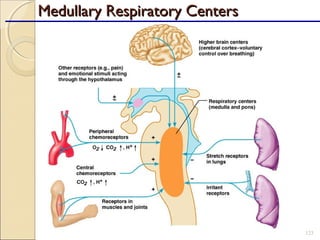
The dorsal respiratory group (DRG), or
inspiratory center:
◦ Is located near the root of nerve IX
◦ Appears to be the pacesetting respiratory
center
◦ Excites the inspiratory muscles and sets eupnea
(12-15 breaths/minute)
◦ Becomes dormant during expiration
The ventral respiratory group (VRG) is
involved in forced inspiration and
expiration
118
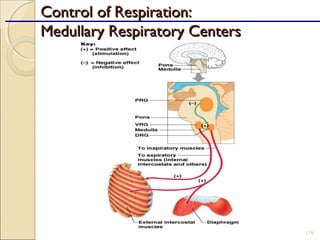
Control of Respiration:Control of Respiration:
Medullary Respiratory CentersMedullary Respiratory Centers
119
Control of Respiration:Control of Respiration:
Pons Respiratory CentersPons Respiratory Centers
Pons centers:
◦ Influence and modify activity of the medullary
centers
◦ Smooth out inspiration and expiration
transitions and vice versa
The pontine respiratory group (PRG) –
continuously inhibits the inspiration center
120
Respiratory RhythmRespiratory Rhythm
A result of reciprocal inhibition of the
interconnected neuronal networks in the
medulla
Other theories include
◦ Inspiratory neurons are pacemakers and have
intrinsic automaticity and rhythmicity
◦ Stretch receptors in the lungs establish
respiratory rhythm
121
Depth and Rate of BreathingDepth and Rate of Breathing
Inspiratory depth is determined by how
actively the respiratory center stimulates
the respiratory muscles
Rate of respiration is determined by how
long the inspiratory center is active
Respiratory centers in the pons and
medulla are sensitive to both excitatory
and inhibitory stimuli
122
Medullary Respiratory CentersMedullary Respiratory Centers
123
Depth and Rate of Breathing: ReflexesDepth and Rate of Breathing: Reflexes
Pulmonary irritant reflexes – irritants
promote reflexive constriction of air
passages
Inflation reflex (Hering-Breuer) – stretch
receptors in the lungs are stimulated by
lung inflation
Upon inflation, inhibitory signals are sent to
the medullary inspiration center to end
inhalation and allow expiration
124
Depth and Rate of Breathing: HigherDepth and Rate of Breathing: Higher
Brain CentersBrain Centers
Hypothalamic controls act through the
limbic system to modify rate and depth of
respiration
◦ Example: breath holding that occurs in anger
A rise in body temperature acts to increase
respiratory rate
Cortical controls are direct signals from the
cerebral motor cortex that bypass medullary
controls
◦ Examples: voluntary breath holding, taking a deep
breath 125
Depth and Rate of Breathing: PDepth and Rate of Breathing: PCO2CO2
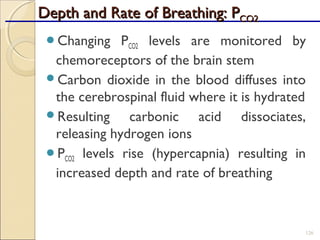
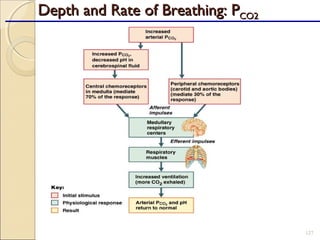
Changing PCO2 levels are monitored by
chemoreceptors of the brain stem
Carbon dioxide in the blood diffuses into
the cerebrospinal fluid where it is hydrated
Resulting carbonic acid dissociates,
releasing hydrogen ions
PCO2 levels rise (hypercapnia) resulting in
increased depth and rate of breathing
126
Depth and Rate of Breathing: PDepth and Rate of Breathing: PCO2CO2
127
Depth and Rate of Breathing: PDepth and Rate of Breathing: PCO2CO2
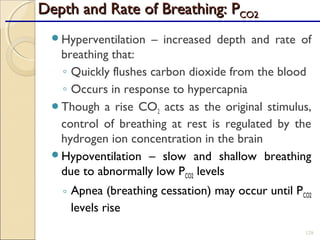
Hyperventilation – increased depth and rate of
breathing that:
◦ Quickly flushes carbon dioxide from the blood
◦ Occurs in response to hypercapnia
Though a rise CO2 acts as the original stimulus,
control of breathing at rest is regulated by the
hydrogen ion concentration in the brain
Hypoventilation – slow and shallow breathing
due to abnormally low PCO2 levels
◦ Apnea (breathing cessation) may occur until PCO2
levels rise
128
Depth and Rate of Breathing: PDepth and Rate of Breathing: PCO2CO2
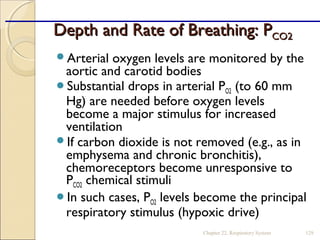
Arterial oxygen levels are monitored by the
aortic and carotid bodies
Substantial drops in arterial PO2 (to 60 mm
Hg) are needed before oxygen levels
become a major stimulus for increased
ventilation
If carbon dioxide is not removed (e.g., as in
emphysema and chronic bronchitis),
chemoreceptors become unresponsive to
PCO2 chemical stimuli
In such cases, PO2 levels become the principal
respiratory stimulus (hypoxic drive)
Chapter 22, Respiratory System 129
Depth and Rate of Breathing:Depth and Rate of Breathing:
Arterial pHArterial pH
Changes in arterial pH can modify
respiratory rate even if carbon dioxide
and oxygen levels are normal
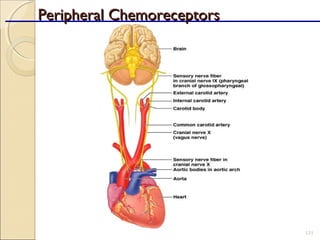
Increased ventilation in response to
falling pH is mediated by peripheral
chemoreceptors
130
Peripheral ChemoreceptorsPeripheral Chemoreceptors
131
Depth and Rate of Breathing: ArterialDepth and Rate of Breathing: Arterial
pHpH
Acidosis may reflect:
◦ Carbon dioxide retention
◦ Accumulation of lactic acid
◦ Excess fatty acids in patients with diabetes
mellitus
Respiratory system controls will attempt
to raise the pH by increasing respiratory
rate and depth
132
Respiratory Adjustments: ExerciseRespiratory Adjustments: Exercise
Respiratory adjustments are geared to
both the intensity and duration of exercise
During vigorous exercise:
◦ Ventilation can increase 20 fold
◦ Breathing becomes deeper and more vigorous,
but respiratory rate may not be significantly
changed (hyperpnea)
Exercise-enhanced breathing is not
prompted by an increase in PCO2 or a
decrease in PO2 or pH
◦ These levels remain surprisingly constant during
exercise Chapter 22, Respiratory System 133
Respiratory Adjustments: ExerciseRespiratory Adjustments: Exercise
As exercise begins:
◦ Ventilation increases abruptly, rises slowly, and
reaches a steady state
When exercise stops:
◦ Ventilation declines suddenly, then gradually
decreases to normal
Chapter 22, Respiratory System 134
Developmental AspectsDevelopmental Aspects
Olfactory placodes invaginate into
olfactory pits by the 4th
week
Laryngotracheal buds are present by the 5th
week
Mucosae of the bronchi and lung alveoli
are present by the 8th
week
By the 28th
week, a baby born prematurely
can breathe on its own
During fetal life, the lungs are filled with
fluid and blood bypasses the lungs
Gas exchange takes place via the placenta
Chapter 22, Respiratory System 135
Developmental AspectsDevelopmental Aspects
At birth, respiratory centers are activated,
alveoli inflate, and lungs begin to function
Respiratory rate is highest in newborns
and slows until adulthood
Lungs continue to mature and more alveoli
are formed until young adulthood
Respiratory efficiency decreases in old age
Chapter 22, Respiratory System 136

Respiratory system physio

  • 1.
    Anatomy & Physiology 1 DRMAHFUZUR RAHMAN KHAN DA Student Dept of Anesthesia, Intensive Care & Pain Medicine Shaheed Suhrawardy Medical College
  • 2.
    The brain cansurvive less than three minutes without oxygen. The respiratory system with normal anatomy and physiology can able to deliver the this oxygen to the body from the air. The passage through which it travels from the atmosphere to the blood is called Respiratory tract. The Mystic MemoryThe Mystic Memory
  • 3.
    Anatomically the respiratorysystem is divided into Upper respiratory tract oFrom the nostril to the vocal cord Lower respiratory tract oThe lower respiratory tract is from bellow the vocal cord upto the alveoli Respiratory SystemRespiratory System
  • 4.
    Functionally it canagain be divided into Respiratory zone oSite of gas exchange Conductive zone oA rigid conduits for air to reach the sites of gas exchange Respiratory muscles – diaphragm and other muscles that promote ventilatio 4 Respiratory SystemRespiratory System
  • 5.
    To supply thebody with oxygen and dispose of carbon dioxide Respiration – four distinct processes must happen ◦ Pulmonary ventilation – moving air into and out of the lungs ◦ External respiration – gas exchange between the lungs and the blood ◦ Transport – transport of oxygen and carbon dioxide between the lungs and tissues ◦ Internal respiration – gas exchange between systemic blood vessels and tissues 5 Functions of the Respiratory SystemFunctions of the Respiratory System
  • 6.
    08/18/17 6 The Respiratorysystem: An overviewThe Respiratory system: An overview
  • 7.
    Lies in andposterior to the external nose Is divided by a midline nasal septum Opens posteriorly into the nasal pharynx via internal nares The ethmoid and sphenoid bones form the roof The floor is formed by the hard and soft palates 7 Nasal CavityNasal Cavity
  • 8.
  • 9.
  • 10.
    10 Providing an airwayfor respiration Moistening (humidifying) and warming the entering air Filtering inspired air and cleaning it of foreign matter Serving as a resonating chamber for speech Housing the olfactory receptors Sensitive mucosa triggers sneezing when stimulated by irritating particles Functions of the NoseFunctions of the Nose
  • 11.
    It connects the ◦Nasal cavity and mouth superiorly ◦ Larynx and esophagus inferiorly Extends ◦ from the base of the skull to the level of the sixth cervical vertebra It is divided into ◦ Nasopharynx ◦ Oropharynx ◦ Laryngopharynx 11 PharynxPharynx
  • 12.
    Nasopharynx o Lies posteriorto the nasal cavity, inferior to the sphenoid, and superior to the level of the soft palate o Strictly an airway Oropharynx o Extends inferiorly from the level of the soft palate to the epiglottis o Serves as a common passageway for food and air Laryngopharynx o Lies posterior to the upright epiglottis 12 PharynxPharynx
  • 13.
    Attaches to thehyoid bone and opens into the laryngopharynx superiorly Continuous with the trachea posteriorly The three functions ◦ To provide a patent airway ◦ To act as a switching mechanism to route air and food into the proper channels ◦ To function in voice production 13 The LarynxThe Larynx
  • 14.
    The larynx isclosed during coughing, sneezing, and Valsalva’s maneuver Valsalva’s maneuver ◦ Air is temporarily held in the lower respiratory tract by closing the glottis ◦ Causes intra-abdominal pressure to rise when abdominal muscles contract ◦ Helps to empty the rectum ◦ Acts as a splint to stabilize the trunk when lifting heavy loads ◦ This maneuver is useful in removing ICT drain 14 Sphincter functions of the LarynxSphincter functions of the Larynx
  • 15.
    The hyoid bone,while technically not a part of the larynx, provides muscular attachments fromabove that aid in the laryngeal motion.  Composed of 3 large unpaired cartilages Cricoid Thyroid Epiglottis  3 pairs of smaller paired cartilages Arytenoids Corniculate Cuneiform 08/18/17 15 The LarynxThe Larynx
  • 16.
    16 Framework of TheLarynxFramework of The Larynx
  • 17.
    Chapter 22, RespiratorySystem 17 Extrinsic Muscles of The LarynxExtrinsic Muscles of The Larynx
  • 18.
    08/18/17 18 Intrinsic Musclesof the LarynxIntrinsic Muscles of the Larynx
  • 19.
     Except thecricothyroid all the intrinsic muscles of the larynx are innervated by the inferior laryngeal nerve –  the terminal branch of the recurrent laryngeal nerve.  The cricothyroid is innervated by the external branch of the superior laryngeal nerve. 08/18/17 19 Innervations of The LarynxInnervations of The Larynx
  • 20.
    NERVE SENSORY MOTOR SuperiorLaryngeal (internal division) Epiglottis, Base of tongue None Supraglottic mucosa Thyroepiglottic joint Cricothyroid joint Superior Laryngeal (external division) Anterior Subglottic mucosa Cricothyroid (adductor, tensor) Recurrent laryngeal Subglottic Mucosa Thyroarytenoid Lateral cricoarytenoid Interarytenoid (adductors) Posterior cricoarytenoid (abductor) 08/18/17 20 Innervations of The LarynxInnervations of The Larynx
  • 21.
    LaryngealInnervations 08/18/17 21 Branches ofthe Vagus NerveBranches of the Vagus Nerve
  • 22.
     The superiorand inferior laryngeal arteries supply the majority of blood to the larynx.  The superior laryngeal artery originates from the superior thyroid branch of the external carotid artery  The inferior laryngeal artery originates from the inferior thyroid branch of the thyrocervical trunk, which is a branch of the subclavian artery. 08/18/17 22 Blood Supply of The LarynxBlood Supply of The Larynx
  • 23.
     Length ofLarynx: 44mm in male & 35mm in female  Diameter of Larynx: 12mm (OD) & 9mm (ID)  Incisor to Carina: 25-27cm (M) & 21-23 cm (F)  Nostril to Carina: 29-31cm (M) & 25-27cm(F)  In neonates *Gum to VC: 5cm *VC to Carina 5cm 08/18/17 Some important Anatomical MeasuresSome important Anatomical Measures
  • 24.
    24 Movements of theVocal CordsMovements of the Vocal Cords The Glottis & Epiglottis
  • 25.
  • 26.
     The longersection of the respiratory tract, shaped like a tube Begins at the lower border of the cricoid cartilage Extends upto the carina Length of 10–13 cm average Composed of C-shaped hyaline cartilage rings  Lined with pseudostratified ciliated columnar epithelium. 08/18/17 26 The TracheaThe Trachea
  • 27.
    External diameters approximately oInmen 2.3 cm coronally 1.8 cm sagitally In women 2.0 cm coronally 1.4 cm sagitally  The cricoid cartilage is the narrowest part of the trachea in adult. 17 mm in men 13 mm in women. 08/18/17 27 The TracheaThe Trachea
  • 28.
    The trachea bifurcatesat the carina into the right and left main stem bronchi at the level of the sternal angle. The right main stem bronchus more vertical orientation wider & shorter than that of the left 08/18/17 28 The TracheaThe Trachea
  • 29.
  • 30.
     The tracheadivides and divides in dichotomous pattern till 23 generations the final generation end as alveolar sacs.  Each alveolar sac contains 17 alveoli on average.  An estimated 300 million alveoli provide an enormous membrane (50–100 m2 ) for gas exchange in the average adult. The trachea serves as a conduit for ventilation and the clearance of tracheal and bronchial secretions. The Tracheobronchial TreeThe Tracheobronchial Tree
  • 31.
    08/18/17 31 The TracheobronchialtreeThe Tracheobronchial tree
  • 32.
    08/18/17 32 The SegmentalBronchiThe Segmental Bronchi
  • 33.
    Lungs occupy allof the thoracic cavity except the mediastinum ◦ Root – site of vascular and bronchial attachments ◦ Costal surface – anterior, lateral, and posterior surfaces in contact with the ribs ◦ Apex – narrow superior tip ◦ Base – inferior surface that rests on the diaphragm ◦ Hilum– indentation that contains pulmonary and systemic blood vessels 33 Gross Anatomy of the LungsGross Anatomy of the Lungs
  • 34.
    Cardiac notch (impression)– cavity that accommodates the heart Left lung – separated into upper and lower lobes by the oblique fissure Right lung – separated into three lobes by the oblique and horizontal fissures There are 10 bronchopulmonary segments in each lung 34 Gross Anatomy of the LungsGross Anatomy of the Lungs
  • 35.
     Base, apex(cupula), costal surface, cardiac notch  Oblique & horizontal fissure in right lung results in 3 lobes  Oblique fissure only in left lung produces 2 lobes Gross Anatomy of the LungsGross Anatomy of the Lungs
  • 36.
    Blood vessels &airways enter lungs at hilus Forms root of lungs Covered with pleura (parietal becomes visceral) Mediastinal Surface of the LungsMediastinal Surface of the Lungs
  • 37.
    Lungs are perfusedby pulmonary and bronchial circulations Pulmonary arteries – supply systemic venous blood to be oxygenated ◦ Branch profusely, along with bronchi ◦ Ultimately feed into the pulmonary capillary network surrounding the alveoli Pulmonary veins – carry oxygenated blood from respiratory zones to the heart 37 Blood Supply of the LungsBlood Supply of the Lungs
  • 38.
    Bronchial arteries –provide systemic blood to the lung tissue ◦ Arise from aorta and enter the lungs at the hilus ◦ Supply all lung tissue except the alveoli Bronchial veins anastomose with pulmonary veins Pulmonary veins carry most venous blood back to the heart 38 Blood Supply of the LungsBlood Supply of the Lungs
  • 39.
    Thin, double-layered serosa Parietalpleura ◦ Covers the thoracic wall and superior face of the diaphragm ◦ Continues around heart and between lungs Visceral pleura ◦ Covers the external lung surface ◦ Divides the thoracic cavity into three chambers  The central mediastinum  Two lateral compartments, each containing a lung 39 PleuraePleurae
  • 40.
    40 Pressure Relationships inthePressure Relationships in the Thoracic CavityThoracic Cavity
  • 41.
    The carina ofthe last tracheal cartilage marks the end of the trachea and the beginning of the right and left bronchi Air reaching the bronchi is: ◦ Warm and cleansed of impurities ◦ Saturated with water vapor Bronchi subdivide into secondary bronchi, each supplying a lobe of the lungs Air passages undergo 23 orders of branching in the lungs 41 Conducting Zone: BronchiConducting Zone: Bronchi
  • 42.
    Upto the terminalbronchioles Tissue walls of bronchi mimic that of the trachea As conducting tubes become smaller, structural changes occur ◦ Cartilage support structures change ◦ Epithelium types change ◦ Amount of smooth muscle increases Bronchioles ◦ Consist of cuboidal epithelium ◦ Have a complete layer of circular smooth muscle ◦ Lack cartilage support and mucus-producing cells 42 Conducting ZoneConducting Zone
  • 43.
    From the terminalbronchioles feed into respiratory bronchioles Respiratory bronchioles lead to alveolar ducts, then to terminal clusters of alveolar sacs composed of alveoli Approximately 300 million alveoli: ◦ Account for most of the lungs’ volume ◦ Provide tremendous surface area for gas exchange 43 Respiratory ZoneRespiratory Zone
  • 44.
  • 45.
  • 46.
    This air-blood barrieris composed of: ◦ Alveolar and capillary walls ◦ Their fused basal laminas Alveolar walls: ◦ Are a single layer of type I epithelial cells ◦ Permit gas exchange by simple diffusion ◦ Secrete angiotensin converting enzyme (ACE) Type II cells secrete surfactant 46 Respiratory MembraneRespiratory Membrane
  • 47.
  • 48.
  • 49.
    Surrounded by fineelastic fibers Contain open pores that: ◦ Connect adjacent alveoli ◦ Allow air pressure throughout the lung to be equalized House macrophages that keep alveolar surfaces sterile 49 AlveoliAlveoli
  • 50.
    Surface tension –the attraction of liquid molecules to one another at a liquid-gas interface The liquid coating the alveolar surface is always acting to reduce the alveoli to the smallest possible size Surfactant, a detergent-like complex, reduces surface tension and helps keep the alveoli from collapsing 50 Alveolar Surface TensionAlveolar Surface Tension
  • 51.
  • 52.
  • 53.
  • 54.
    Breathing, or pulmonaryventilation, consists of two phases ◦ Inspiration – air flows into the lungs ◦ Expiration – gases exit the lungs 54 BreathingBreathing
  • 55.
    Pressure Relationships inthePressure Relationships in the Thoracic CavityThoracic Cavity Respiratory pressure is always described relative to atmospheric pressure Atmospheric pressure (Patm) ◦ Pressure exerted by the air surrounding the body ◦ Negative respiratory pressure is less than Patm ◦ Positive respiratory pressure is greater than Patm 55
  • 56.
    Intrapulmonary pressure (Ppul)– pressure within the alveoli Intrapleural pressure (Pip) – pressure within the pleural cavity 56 Pressure Relationships in thePressure Relationships in the Thoracic CavityThoracic Cavity
  • 57.
    Intrapulmonary pressure andintrapleural pressure fluctuate with the phases of breathing Intrapulmonary pressure always eventually equalizes itself with atmospheric pressure Intrapleural pressure is always less than intrapulmonary pressure and atmospheric pressure 57 Pressure Relationships in thePressure Relationships in the Thoracic CavityThoracic Cavity
  • 58.
    Two forces actto pull the lungs away from the thoracic wall, promoting lung collapse ◦ Elasticity of lungs causes them to assume smallest possible size ◦ Surface tension of alveolar fluid draws alveoli to their smallest possible size Opposing force – elasticity of the chest wall pulls the thorax outward to enlarge the lungs 58 Pressure Relationships in thePressure Relationships in the Thoracic CavityThoracic Cavity
  • 59.
    Caused by equalizationof the intrapleural pressure with the intrapulmonary pressure Transpulmonary pressure keeps the airways open ◦ Transpulmonary pressure – difference between the intrapulmonary and intrapleural pressures (Ppul – Pip) 59 Lung CollapseLung Collapse
  • 60.
    A mechanical processthat depends on volume changes in the thoracic cavity Volume changes lead to pressure changes, which lead to the flow of gases to equalize pressure 60 Pulmonary VentilationPulmonary Ventilation
  • 61.
    Boyle’s law –the relationship between the pressure and volume of gases P1V1 = P2V2 ◦ P = pressure of a gas in mm Hg ◦ V = volume of a gas in cubic millimeters ◦ Subscripts 1 and 2 represent the initial and resulting conditions, respectively 61 Boyle’s LawBoyle’s Law
  • 62.
    The diaphragm andexternal intercostal muscles (inspiratory muscles) contract and the rib cage rises The lungs are stretched and intrapulmonary volume increases Intrapulmonary pressure drops below atmospheric pressure (−1 mm Hg) Air flows into the lungs, down its pressure gradient, until intrapleural pressure = atmospheric pressure 62 InspirationInspiration
  • 63.
  • 64.
    Inspiratory muscles relaxand the rib cage descends due to gravity Thoracic cavity volume decreases Elastic lungs recoil passively and intrapulmonary volume decreases Intrapulmonary pressure rises above atmospheric pressure (+1 mm Hg) Gases flow out of the lungs down the pressure gradient until intrapulmonary pressure is 0 64 ExpirationExpiration
  • 65.
  • 66.
    Friction is themajor nonelastic source of resistance to airflow The relationship between flow (F), pressure (P), and resistance (R) is: 66 Physical Factors Influencing VentilationPhysical Factors Influencing Ventilation Airway ResistanceAirway Resistance F = ∆P R
  • 67.
    The amount ofgas flowing into and out of the alveoli is directly proportional to ∆P, the pressure gradient between the atmosphere and the alveoli Gas flow is inversely proportional to resistance with the greatest resistance being in the medium-sized bronchi 67 Physical Factors InfluencingPhysical Factors Influencing VentilationVentilation Airway ResistanceAirway Resistance
  • 68.
    As airway resistancerises, breathing movements become more strenuous Severely constricted or obstructed bronchioles: ◦ Can prevent life-sustaining ventilation ◦ Can occur during acute asthma attacks which stops ventilation Epinephrine release via the sympathetic nervous system dilates bronchioles and reduces air resistance 68 Physical Factors Influencing VentilationPhysical Factors Influencing Ventilation Airway ResistanceAirway Resistance
  • 69.
    The ease withwhich lungs can be expanded Specifically, the measure of the change in lung volume that occurs with a given change in transpulmonary pressure Determined by two main factors ◦ Distensibility of the lung tissue and surrounding thoracic cage ◦ Surface tension of the alveoli 69 Lung ComplianceLung Compliance
  • 70.
    Factors That DiminishLung ComplianceFactors That Diminish Lung Compliance Scar tissue or fibrosis that reduces the natural resilience of the lungs Blockage of the smaller respiratory passages with mucus or fluid Reduced production of surfactant Decreased flexibility of the thoracic cage or its decreased ability to expand Examples include: ◦ Deformities of thorax ◦ Ossification of the costal cartilage ◦ Paralysis of intercostal muscles 70
  • 71.
    Tidal volume (TV)– air that moves into and out of the lungs with each breath (approximately 500 ml) Inspiratory reserve volume (IRV) – air that can be inspired forcibly beyond the tidal volume (2100–3200 ml) Expiratory reserve volume (ERV) – air that can be evacuated from the lungs after a tidal expiration (1000–1200 ml) Residual volume (RV) – air left in the lungs after strenuous expiration (1200 ml) 71 Respiratory VolumesRespiratory Volumes
  • 72.
    Inspiratory capacity (IC)– total amount of air that can be inspired after a tidal expiration (IRV + TV) Functional residual capacity (FRC) – amount of air remaining in the lungs after a tidal expiration (RV + ERV) Vital capacity (VC) – the total amount of exchangeable air (TV + IRV + ERV) Total lung capacity (TLC) – sum of all lung volumes (approximately 6000 ml in males) 72 Respiratory CapacitiesRespiratory Capacities
  • 73.
    Anatomical dead space– volume of the conducting respiratory passages (150 ml) Alveolar dead space – alveoli that cease to act in gas exchange due to collapse or obstruction Total dead space – sum of alveolar and anatomical dead spaces 73 Dead SpaceDead Space
  • 74.
    Spirometer – aninstrument consisting of a hollow bell inverted over water, used to evaluate respiratory function Spirometry can distinguish between: ◦ Obstructive pulmonary disease – increased airway resistance ◦ Restrictive disorders – reduction in total lung capacity from structural or functional lung changes 74 Pulmonary Function TestsPulmonary Function Tests
  • 75.
    Total ventilation –total amount of gas flow into or out of the respiratory tract in one minute Forced vital capacity (FVC) – gas forcibly expelled after taking a deep breath Forced expiratory volume (FEV) – the amount of gas expelled during specific time intervals of the FVC 75 Pulmonary Function TestsPulmonary Function Tests
  • 76.
    Increases in TLC,FRC, and RV may occur as a result of obstructive disease Reduction in VC, TLC, FRC, and RV result from restrictive disease 76 Pulmonary Function TestsPulmonary Function Tests
  • 77.
    Alveolar ventilation rate(AVR) – measures the flow of fresh gases into and out of the alveoli during a particular time Slow, deep breathing increases AVR and rapid, shallow breathing decreases AVR 77 AVR = frequency X (TV – dead space) (ml/min) (breaths/min) (ml/breath) Alveolar VentilationAlveolar Ventilation
  • 78.
    Most result fromreflex action Examples include: coughing, sneezing, crying, laughing, hiccupping, and yawning 78 Nonrespiratory AirmovementNonrespiratory Airmovement
  • 79.
    Basic Properties ofGases:Basic Properties of Gases: Dalton’s Law of Partial PressuresDalton’s Law of Partial Pressures Total pressure exerted by a mixture of gases is the sum of the pressures exerted independently by each gas in the mixture The partial pressure of each gas is directly proportional to its percentage in the mixture 79
  • 80.
    Air = 21%O2, 78% N2 and .04% CO2 Alveolar air = 14% O2, 78% N2 and 5.2% CO2 Expired air = 16% O2, 78% N2 and 4.5% CO2 Observations ◦ alveolar air has less O2 since absorbed by blood ◦ mystery-----expired air has more O2 & less CO2 than alveolar air? ◦ Anatomical dead space = 150 ml of 500 ml of tidal volume 80 Composition of AirComposition of Air
  • 81.
    Basic Properties ofGases: Henry’sBasic Properties of Gases: Henry’s LawLaw When a mixture of gases is in contact with a liquid, each gas will dissolve in the liquid in proportion to its partial pressure The amount of gas that will dissolve in a liquid also depends upon its solubility Various gases in air have different solubilities: ◦ Carbon dioxide is the most soluble ◦ Oxygen is 1/20th as soluble as carbon dioxide ◦ Nitrogen is practically insoluble in plasma 81
  • 82.
    Hyperbaric OxygenationHyperbaric Oxygenation Clinicalapplication of Henry’s law Use of pressure to dissolve more O2 in the blood ◦ treatment for patients with anaerobic bacterial infections (tetanus and gangrene) ◦ anaerobic bacteria die in the presence of O2 Hyperbaric chamber pressure raised to 3 to 4 atmospheres so that tissues absorb more O2 Used to treat heart disorders, carbon monoxide poisoning, cerebral edema, bone infections, gas embolisms & crush injuries 82
  • 83.
    Composition of AlveolarGasComposition of Alveolar Gas The atmosphere is mostly oxygen and nitrogen, while alveoli contain more carbon dioxide and water vapor These differences result from: ◦ Gas exchanges in the lungs – oxygen diffuses from the alveoli and carbon dioxide diffuses into the alveoli ◦ Humidification of air by conducting passages ◦ The mixing of alveolar gas that occurs with each breath 83
  • 84.
    External Respiration: PulmonaryGasExternal Respiration: Pulmonary Gas ExchangeExchange Factors influencing the movement of oxygen and carbon dioxide across the respiratory membrane ◦ Partial pressure gradients and gas solubilities ◦ Matching of alveolar ventilation and pulmonary blood perfusion ◦ Structural characteristics of the respiratory membrane 84
  • 85.
    Partial Pressure Gradientsand GasPartial Pressure Gradients and Gas SolubilitySolubility The partial pressure oxygen (PO2) of venous blood is 40 mm Hg; the partial pressure in the alveoli is 104 mm Hg ◦ This steep gradient allows oxygen partial pressures to rapidly reach equilibrium (in 0.25 seconds), and thus blood can move three times as quickly (0.75 seconds) through the pulmonary capillary and still be adequately oxygenated 85
  • 86.
    Although carbon dioxidehas a lower partial pressure gradient: ◦ It is 20 times more soluble in plasma than oxygen ◦ It diffuses in equal amounts with oxygen 86 Partial Pressure Gradients and GasPartial Pressure Gradients and Gas SolubilitySolubility
  • 87.
    Partial Pressure GradientsPartialPressure Gradients 87
  • 88.
  • 89.
  • 90.
    Ventilation-Perfusion CouplingVentilation-Perfusion Coupling Ventilation– the amount of gas reaching the alveoli Perfusion – the blood flow reaching the alveoli Ventilation and perfusion must be tightly regulated for efficient gas exchange Changes in PCO2 in the alveoli cause changes in the diameters of the bronchioles ◦ Passageways servicing areas where alveolar carbon dioxide is high dilate ◦ Those serving areas where alveolar carbon dioxide is low constrict 90
  • 91.
  • 92.
    Surface Area andThickness of theSurface Area and Thickness of the Respiratory MembraneRespiratory Membrane Respiratory membranes: ◦ Are only 0.5 to 1 µm thick, allowing for efficient gas exchange ◦ Have a total surface area (in males) of about 60 m2 (40 times that of one’s skin) ◦ Thicken if lungs become waterlogged and edematous, whereby gas exchange is inadequate and oxygen deprivation results ◦ Decrease in surface area with emphysema, when walls of adjacent alveoli break through 92
  • 93.
    Internal RespirationInternal Respiration Thefactors promoting gas exchange between systemic capillaries and tissue cells are the same as those acting in the lungs ◦ The partial pressures and diffusion gradients are reversed ◦ PO2 in tissue is always lower than in systemic arterial blood ◦ PO2 of venous blood draining tissues is 40 mm Hg and PCO2 is 45 mm Hg 93
  • 94.
    Oxygen TransportOxygen Transport Molecularoxygen is carried in the blood: ◦ Bound to hemoglobin (Hb) within red blood cells ◦ Dissolved in plasma Chapter 22, Respiratory System 94
  • 95.
    Oxygen Transport: RoleofOxygen Transport: Role of HemoglobinHemoglobin Each Hb molecule binds four oxygen atoms in a rapid and reversible process The hemoglobin-oxygen combination is called oxyhemoglobin (HbO2) Hemoglobin that has released oxygen is called reduced hemoglobin (HHb) 95 HHb + O2 Lungs Tissues HbO2 + H+
  • 96.
    Hemoglobin (Hb)Hemoglobin (Hb) Saturatedhemoglobin – when all four hemes of the molecule are bound to oxygen Partially saturated hemoglobin – when one to three hemes are bound to oxygen The rate that hemoglobin binds and releases oxygen is regulated by: ◦ PO2, temperature, blood pH, PCO2, and the concentration of BPG (an organic chemical)  These factors ensure adequate delivery of oxygen to tissue cells 96
  • 97.
    Influence of PInfluenceof PO2O2 on Hemoglobinon Hemoglobin SaturationSaturation Hemoglobin saturation plotted against PO2 produces a oxygen-hemoglobin dissociation curve 98% saturated arterial blood contains 20 ml oxygen per 100 ml blood (20 vol %) As arterial blood flows through capillaries, 5 ml oxygen are released The saturation of hemoglobin in arterial blood explains why breathing deeply increases the PO2 but has little effect on oxygen saturation in hemoglobin 97
  • 98.
    Hemoglobin Saturation CurveHemoglobinSaturation Curve Hemoglobin is almost completely saturated at a PO2 of 70 mm Hg Further increases in PO2 produce only small increases in oxygen binding Oxygen loading and delivery to tissue is adequate when PO2 is below normal levels 98
  • 99.
    Hemoglobin Saturation CurveHemoglobinSaturation Curve Only 20–25% of bound oxygen is unloaded during one systemic circulation If oxygen levels in tissues drop: ◦ More oxygen dissociates from hemoglobin and is used by cells ◦ Respiratory rate or cardiac output need not increase Chapter 22, Respiratory System 99
  • 100.
  • 101.
    Other Factors InfluencingHemoglobinOther Factors Influencing Hemoglobin SaturationSaturation Temperature, H+ , PCO2, and BPG ◦ Modify the structure of hemoglobin and alter its affinity for oxygen ◦ Increases of these factors:  Decrease hemoglobin’s affinity for oxygen  Enhance oxygen unloading from the blood ◦ Decreases act in the opposite manner These parameters are all high in systemic capillaries where oxygen unloading is the goal 101
  • 102.
    Factors That IncreaseRelease ofFactors That Increase Release of Oxygen by HemoglobinOxygen by Hemoglobin As cells metabolize glucose, carbon dioxide is released into the blood causing: ◦ Increases in PCO2 and H+ concentration in capillary blood ◦ Declining pH (acidosis), which weakens the hemoglobin-oxygen bond (Bohr effect) Metabolizing cells have heat as a byproduct and the rise in temperature increases BPG synthesis All these factors ensure oxygen unloading in the vicinity of working tissue cells 102
  • 103.
    Hemoglobin and OxygenPartial PressureHemoglobin and Oxygen Partial Pressure Blood is almost fully saturated at pO2 of 60mm ◦ people OK at high altitudes & with some disease Between 40 & 20 mm Hg, large amounts of O2 are released as in areas of need like contracting muscle 103 lungsmuscle tissues
  • 104.
    pCO2 & OxygenReleasepCO2 & Oxygen Release 104 As pCO2 rises with exercise, O2 is released more easily CO2 converts to carbonic acid & becomes H+ and bicarbonate ions & lowers pH.
  • 105.
    Acidity & OxygenAffinity for HbAcidity & Oxygen Affinity for Hb 105 As H+ increases (decrease in pH), O2 affinity for Hb decreases Bohr effect allows the blood to unload oxygen H+ binds to hemoglobin & alters it O2 left behind in needy tissues
  • 106.
    Temperature & OxygenReleaseTemperature & Oxygen Release 106 As temperature increases, more O2 is released Metabolic activity & heat increases
  • 107.
    Hemoglobin-Nitric Oxide PartnershipHemoglobin-NitricOxide Partnership Nitric oxide (NO) is a vasodilator that plays a role in blood pressure regulation Hemoglobin is a vasoconstrictor and a nitric oxide scavenger (heme destroys NO) However, as oxygen binds to hemoglobin: ◦ Nitric oxide binds to a cysteine amino acid on hemoglobin ◦ Bound nitric oxide is protected from degradation by hemoglobin’s iron 107
  • 108.
    Hemoglobin-Nitric Oxide PartnershipHemoglobin-NitricOxide Partnership The hemoglobin is released as oxygen is unloaded, causing vasodilation As deoxygenated hemoglobin picks up carbon dioxide, it also binds nitric oxide and carries these gases to the lungs for unloading 108
  • 109.
    Carbon Dioxide TransportCarbonDioxide Transport Carbon dioxide is transported in the blood in three forms ◦ Dissolved in plasma – 7 to 10% ◦ Chemically bound to hemoglobin – 20% is carried in RBCs as carbaminohemoglobin ◦ Bicarbonate ion in plasma – 70% is transported as bicarbonate (HCO3 – ) 109
  • 110.
    Transport and Exchangeof CarbonTransport and Exchange of Carbon DioxideDioxide Carbon dioxide diffuses into RBCs and combines with water to form carbonic acid (H2CO3), which quickly dissociates into hydrogen ions and bicarbonate ions In RBCs, carbonic anhydrase reversibly catalyzes the conversion of carbon dioxide and water to carbonic acid Chapter 22, Respiratory System 110 CO2 + H2O ↔ H2CO3 ↔ H+ + HCO3 – Carbon dioxide Water Carbonic acid Hydrogen ion Bicarbonate ion
  • 111.
    Transport and Exchangeof CarbonTransport and Exchange of Carbon DioxideDioxide At the tissues: ◦ Bicarbonate quickly diffuses from RBCs into the plasma ◦ The chloride shift – to counterbalance the outrush of negative bicarbonate ions from the RBCs, chloride ions (Cl– ) move from the plasma into the erythrocytes 111
  • 112.
    Transport and Exchangeof CarbonTransport and Exchange of Carbon DioxideDioxide At the lungs, these processes are reversed ◦ Bicarbonate ions move into the RBCs and bind with hydrogen ions to form carbonic acid ◦ Carbonic acid is then split by carbonic anhydrase to release carbon dioxide and water ◦ Carbon dioxide then diffuses from the blood into the alveoli 112
  • 113.
    Haldane EffectHaldane Effect Theamount of carbon dioxide transported is markedly affected by the PO2 Haldane effect – the lower the PO2 and hemoglobin saturation with oxygen, the more carbon dioxide can be carried in the blood 113
  • 114.
    At the tissues,as more carbon dioxide enters the blood: ◦ More oxygen dissociates from hemoglobin (Bohr effect) ◦ More carbon dioxide combines with hemoglobin, and more bicarbonate ions are formed This situation is reversed in pulmonary circulation 114 Haldane EffectHaldane Effect
  • 115.
  • 116.
    Influence of CarbonDioxide on BloodInfluence of Carbon Dioxide on Blood pHpH The carbonic acid–bicarbonate buffer system resists blood pH changes If hydrogen ion concentrations in blood begin to rise, excess H+ is removed by combining with HCO3 – If hydrogen ion concentrations begin to drop, carbonic acid dissociates, releasing H+ 116
  • 117.
    Influence of CarbonDioxide on BloodInfluence of Carbon Dioxide on Blood pHpH Changes in respiratory rate can also: ◦ Alter blood pH ◦ Provide a fast-acting system to adjust pH when it is disturbed by metabolic factors 117
  • 118.
    Control of Respiration:Controlof Respiration: Medullary Respiratory CentersMedullary Respiratory Centers The dorsal respiratory group (DRG), or inspiratory center: ◦ Is located near the root of nerve IX ◦ Appears to be the pacesetting respiratory center ◦ Excites the inspiratory muscles and sets eupnea (12-15 breaths/minute) ◦ Becomes dormant during expiration The ventral respiratory group (VRG) is involved in forced inspiration and expiration 118
  • 119.
    Control of Respiration:Controlof Respiration: Medullary Respiratory CentersMedullary Respiratory Centers 119
  • 120.
    Control of Respiration:Controlof Respiration: Pons Respiratory CentersPons Respiratory Centers Pons centers: ◦ Influence and modify activity of the medullary centers ◦ Smooth out inspiration and expiration transitions and vice versa The pontine respiratory group (PRG) – continuously inhibits the inspiration center 120
  • 121.
    Respiratory RhythmRespiratory Rhythm Aresult of reciprocal inhibition of the interconnected neuronal networks in the medulla Other theories include ◦ Inspiratory neurons are pacemakers and have intrinsic automaticity and rhythmicity ◦ Stretch receptors in the lungs establish respiratory rhythm 121
  • 122.
    Depth and Rateof BreathingDepth and Rate of Breathing Inspiratory depth is determined by how actively the respiratory center stimulates the respiratory muscles Rate of respiration is determined by how long the inspiratory center is active Respiratory centers in the pons and medulla are sensitive to both excitatory and inhibitory stimuli 122
  • 123.
  • 124.
    Depth and Rateof Breathing: ReflexesDepth and Rate of Breathing: Reflexes Pulmonary irritant reflexes – irritants promote reflexive constriction of air passages Inflation reflex (Hering-Breuer) – stretch receptors in the lungs are stimulated by lung inflation Upon inflation, inhibitory signals are sent to the medullary inspiration center to end inhalation and allow expiration 124
  • 125.
    Depth and Rateof Breathing: HigherDepth and Rate of Breathing: Higher Brain CentersBrain Centers Hypothalamic controls act through the limbic system to modify rate and depth of respiration ◦ Example: breath holding that occurs in anger A rise in body temperature acts to increase respiratory rate Cortical controls are direct signals from the cerebral motor cortex that bypass medullary controls ◦ Examples: voluntary breath holding, taking a deep breath 125
  • 126.
    Depth and Rateof Breathing: PDepth and Rate of Breathing: PCO2CO2 Changing PCO2 levels are monitored by chemoreceptors of the brain stem Carbon dioxide in the blood diffuses into the cerebrospinal fluid where it is hydrated Resulting carbonic acid dissociates, releasing hydrogen ions PCO2 levels rise (hypercapnia) resulting in increased depth and rate of breathing 126
  • 127.
    Depth and Rateof Breathing: PDepth and Rate of Breathing: PCO2CO2 127
  • 128.
    Depth and Rateof Breathing: PDepth and Rate of Breathing: PCO2CO2 Hyperventilation – increased depth and rate of breathing that: ◦ Quickly flushes carbon dioxide from the blood ◦ Occurs in response to hypercapnia Though a rise CO2 acts as the original stimulus, control of breathing at rest is regulated by the hydrogen ion concentration in the brain Hypoventilation – slow and shallow breathing due to abnormally low PCO2 levels ◦ Apnea (breathing cessation) may occur until PCO2 levels rise 128
  • 129.
    Depth and Rateof Breathing: PDepth and Rate of Breathing: PCO2CO2 Arterial oxygen levels are monitored by the aortic and carotid bodies Substantial drops in arterial PO2 (to 60 mm Hg) are needed before oxygen levels become a major stimulus for increased ventilation If carbon dioxide is not removed (e.g., as in emphysema and chronic bronchitis), chemoreceptors become unresponsive to PCO2 chemical stimuli In such cases, PO2 levels become the principal respiratory stimulus (hypoxic drive) Chapter 22, Respiratory System 129
  • 130.
    Depth and Rateof Breathing:Depth and Rate of Breathing: Arterial pHArterial pH Changes in arterial pH can modify respiratory rate even if carbon dioxide and oxygen levels are normal Increased ventilation in response to falling pH is mediated by peripheral chemoreceptors 130
  • 131.
  • 132.
    Depth and Rateof Breathing: ArterialDepth and Rate of Breathing: Arterial pHpH Acidosis may reflect: ◦ Carbon dioxide retention ◦ Accumulation of lactic acid ◦ Excess fatty acids in patients with diabetes mellitus Respiratory system controls will attempt to raise the pH by increasing respiratory rate and depth 132
  • 133.
    Respiratory Adjustments: ExerciseRespiratoryAdjustments: Exercise Respiratory adjustments are geared to both the intensity and duration of exercise During vigorous exercise: ◦ Ventilation can increase 20 fold ◦ Breathing becomes deeper and more vigorous, but respiratory rate may not be significantly changed (hyperpnea) Exercise-enhanced breathing is not prompted by an increase in PCO2 or a decrease in PO2 or pH ◦ These levels remain surprisingly constant during exercise Chapter 22, Respiratory System 133
  • 134.
    Respiratory Adjustments: ExerciseRespiratoryAdjustments: Exercise As exercise begins: ◦ Ventilation increases abruptly, rises slowly, and reaches a steady state When exercise stops: ◦ Ventilation declines suddenly, then gradually decreases to normal Chapter 22, Respiratory System 134
  • 135.
    Developmental AspectsDevelopmental Aspects Olfactoryplacodes invaginate into olfactory pits by the 4th week Laryngotracheal buds are present by the 5th week Mucosae of the bronchi and lung alveoli are present by the 8th week By the 28th week, a baby born prematurely can breathe on its own During fetal life, the lungs are filled with fluid and blood bypasses the lungs Gas exchange takes place via the placenta Chapter 22, Respiratory System 135
  • 136.
    Developmental AspectsDevelopmental Aspects Atbirth, respiratory centers are activated, alveoli inflate, and lungs begin to function Respiratory rate is highest in newborns and slows until adulthood Lungs continue to mature and more alveoli are formed until young adulthood Respiratory efficiency decreases in old age Chapter 22, Respiratory System 136