Pituitary Gland
    diseases


      SMS 3023
 Dr. Mohanad R. Alwan
Endocrine Glands
• Controls many body functions
   – exerts control by releasing special chemical substances
     into the blood called Hormones
   – Hormones affect other endocrine glands or body
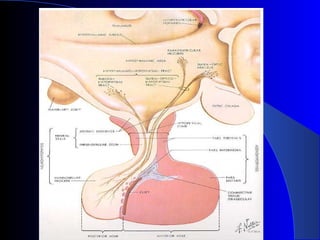
     systems
• Ductless glands
• Secrete hormones directly into bloodstream
   – Hormones are quickly distributed by bloodstream
     throughout the body
Hormones
• Chemicals produced by endocrine glands.
• Act on target organs elsewhere in body.
• Control/coordinate widespread processes:
   •   Homeostasis.
   •   Reproduction.
   •   Growth & Development.
   •   Metabolism.
   •   Response to stress.
        • Overlaps with the Sympathetic Nervous System
Hormones
Hormones are classified as:
  Proteins
  Polypeptides (amino acid derivatives)
  Lipids (fatty acid derivatives or steroids)
Hormones
Amount of hormone reaching target tissue directly
 correlates with concentration of hormone in blood.
 Constant level hormones
      • Thyroid hormones
    Variable level hormones
      • Epinephrine (adrenaline) release
    Cyclic level hormones
      • Reproductive hormones
The Endocrine System
 Consists of several glands located in various parts of
  the body
 Specific Glands
    Hypothalamus
    Pituitary
    Thyroid
    Parathyroid
    Adrenal
    Kidneys
    Pancreatic Islets
    Ovaries
    Testes
Hypothalamus
 Produces several releasing and inhibiting factors
  that stimulate or inhibit anterior pituitary’s
  secretion of hormones.
 Produces hormones that are stored in and released
  from posterior pituitary.
Hypothalamus
 Also responsible for:
    Regulation of water balance
    Esophageal swallowing
    Body temperature regulation (shivering)
    Food/water intake (appetite)
    Sleep-wake cycle
    Autonomic functions
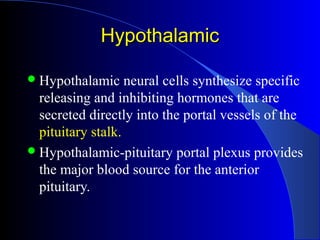
Hypothalamic

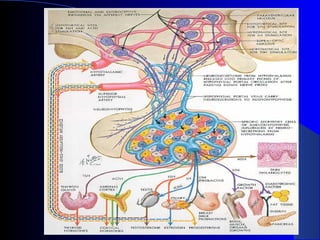
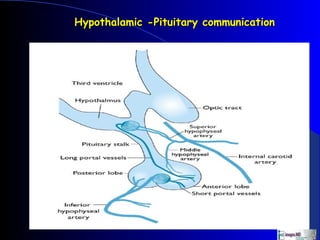
 Hypothalamic     neural cells synthesize specific
  releasing and inhibiting hormones that are
  secreted directly into the portal vessels of the
  pituitary stalk.
 Hypothalamic-pituitary portal plexus provides
  the major blood source for the anterior
  pituitary.
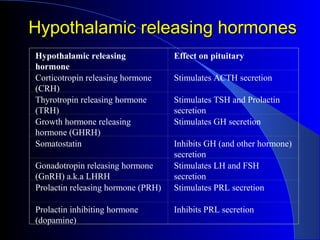
Hypothalamic releasing hormones
Hypothalamic releasing              Effect on pituitary
hormone
Corticotropin releasing hormone     Stimulates ACTH secretion
(CRH)
Thyrotropin releasing hormone       Stimulates TSH and Prolactin
(TRH)                               secretion
Growth hormone releasing            Stimulates GH secretion
hormone (GHRH)
Somatostatin                        Inhibits GH (and other hormone)
                                    secretion
Gonadotropin releasing hormone      Stimulates LH and FSH
(GnRH) a.k.a LHRH                   secretion
Prolactin releasing hormone (PRH)   Stimulates PRL secretion

Prolactin inhibiting hormone        Inhibits PRL secretion
(dopamine)
Hypothalamic -Pituitary communication
Pituitary Gland
 Small gland located on stalk hanging from base of
  brain.
 “The Master Gland”
    Primary function is to control other glands.
    Produces many hormones.
    Secretion is controlled by hypothalamus in base of brain.
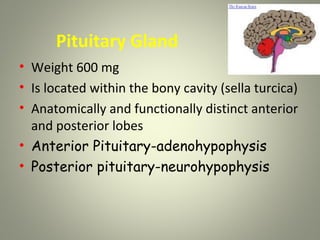
Pituitary Gland
• Weight 600 mg
• Is located within the bony cavity (sella turcica)
• Anatomically and functionally distinct anterior
  and posterior lobes
• Anterior Pituitary-adenohypophysis
• Posterior pituitary-neurohypophysis
Histology of the PG

  Anterior pituitary cells were originally
  classified as
• Acidophils cells
• Basophils cells
• Chromophope cells
Histology of PG
    Now with immunocytochemical and electron
    microscopic techniques,classified cells by their
    secretary products
•   Somatotrophs cells
•   a. GH secreting cells
•    Account about 50% of anterior P.G
•    Acidophilic stained
Histology of PG
•   Lactotrophic
•     a. Prl secreting cells
•     b. acidophilic stained
•    c. 10-15% of anterior PG
•   Thyrotrophis
•   a. TSH secreting cells
•   b. basophilic cells
•   c. < 10% of anterior PG
Histology of PG

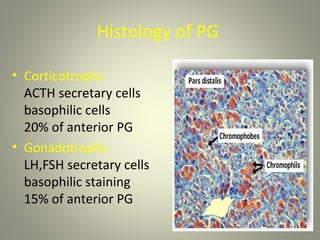
• Corticotrophs                    a.
  ACTH secretary cells          b.
  basophilic cells               c. 15-
  20% of anterior PG
• Gonadotrophs                     a.
  LH,FSH secretary cells        b.
  basophilic staining           c. 10-
  15% of anterior PG
Pituitary Development

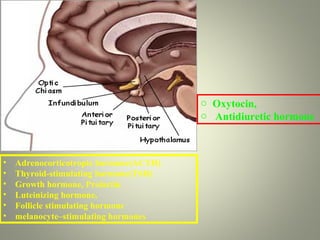
• The pituitary originate from different source.
• The anterior pituitary from Rathke´s pouch
  (which is an embryonic invagination of the pharyngeal
  epithelium).
• The posterior pituitary from an outgrow of the
  hypothalamus.
o Oxytocin,
                                        o Antidiuretic hormone


•   Adrenocorticotropic hormone(ACTH)
•   Thyroid-stimulating hormone(TSH)
•   Growth hormone, Prolactin
•   Luteinizing hormone,
•   Follicle stimulating hormone
•   melanocyte–stimulating hormones
Pituitary Gland
 Two areas
   Anterior Pituitary
   Posterior Pituitary
 Structurally, functionally different
Pituitary Gland
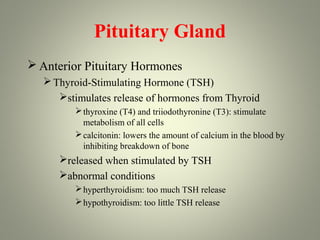
 Anterior Pituitary Hormones
   Thyroid-Stimulating Hormone (TSH)
     stimulates release of hormones from Thyroid
         thyroxine (T4) and triiodothyronine (T3): stimulate
          metabolism of all cells
         calcitonin: lowers the amount of calcium in the blood by
          inhibiting breakdown of bone
     released when stimulated by TSH
     abnormal conditions
         hyperthyroidism: too much TSH release
         hypothyroidism: too little TSH release
Pituitary Gland
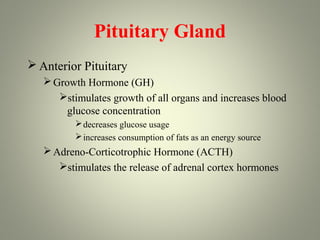
 Anterior Pituitary
    Growth Hormone (GH)
      stimulates growth of all organs and increases blood
        glucose concentration
           decreases glucose usage
           increases consumption of fats as an energy source
    Adreno-Corticotrophic Hormone (ACTH)
      stimulates the release of adrenal cortex hormones
Pituitary Gland
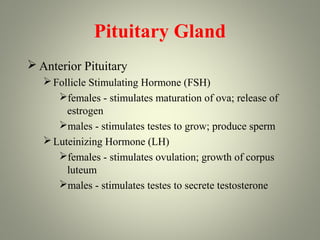
 Anterior Pituitary
    Follicle Stimulating Hormone (FSH)
      females - stimulates maturation of ova; release of
        estrogen
      males - stimulates testes to grow; produce sperm
    Luteinizing Hormone (LH)
      females - stimulates ovulation; growth of corpus
        luteum
      males - stimulates testes to secrete testosterone
Pituitary Gland
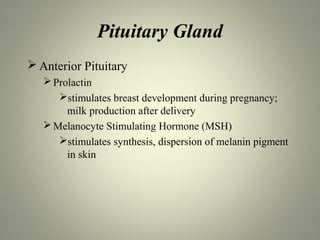
 Anterior Pituitary
    Prolactin
      stimulates breast development during pregnancy;
        milk production after delivery
    Melanocyte Stimulating Hormone (MSH)
      stimulates synthesis, dispersion of melanin pigment
        in skin
Pituitary Gland

 Posterior Pituitary
    Stores, releases two hormones produced in
     hypothalamus
      Antidiuretic hormone (ADH)
      Oxytocin
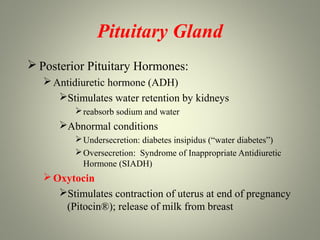
Pituitary Gland
 Posterior Pituitary Hormones:
    Antidiuretic hormone (ADH)
      Stimulates water retention by kidneys
           reabsorb sodium and water
      Abnormal conditions
           Undersecretion: diabetes insipidus (“water diabetes”)
           Oversecretion: Syndrome of Inappropriate Antidiuretic
            Hormone (SIADH)
    Oxytocin
      Stimulates contraction of uterus at end of pregnancy
       (Pitocin®); release of milk from breast
Pineal Gland
 Located within the Diencephalon
 Melatonin
   Inhibits ovarian hormones
   May regulate the body’s internal clock
Anterior Pituitary
 Isoften referred to as the “MASTER GLAND”
  because, it orchestrates the complex regulatory
  functions of multiple other endocrine glands.
Anterior Pituitary
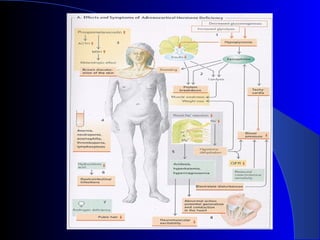
 Insufficiency
Etiology
 Reduced    pituitary function can result from
  inhereited disorders; more commonly,
 it is acquired and reflects the mass effects of
  tumors or the consequences of inflamation
  or vascular damage.
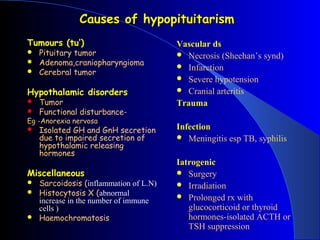
Causes of hypopituitarism
Tumours (tu’)                         Vascular ds
 Pituitary tumor                      Necrosis (Sheehan’s synd)
 Adenoma,craniopharyngioma
                                       Infarction
 Cerebral tumor
                                       Severe hypotension

Hypothalamic disorders                 Cranial arteritis
 Tumor                               Trauma
 Functional disturbance-
Eg -Anorexia nervosa
   Isolated GH and GnH secretion     Infection
    due to impaired secretion of       Meningitis esp TB, syphilis
    hypothalamic releasing
    hormones
                                      Iatrogenic
Miscellaneous                          Surgery
 Sarcoidosis (inflammation of L.N)    Irradiation
 Histocytosis X (abnormal
                                       Prolonged rx with
  increase in the number of immune
  cells )                                glucocorticoid or thyroid
 Haemochromatosis                       hormones-isolated ACTH or
                                         TSH suppression
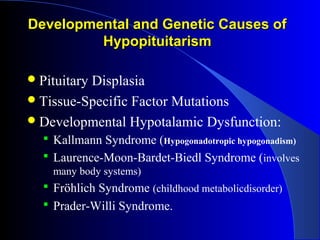
Developmental and Genetic Causes of
         Hypopituitarism

 Pituitary
          Displasia
 Tissue-Specific Factor Mutations
 Developmental Hypotalamic Dysfunction:
   Kallmann Syndrome (Hypogonadotropic hypogonadism)
   Laurence-Moon-Bardet-Biedl Syndrome (involves
    many body systems)
   Fröhlich Syndrome (childhood metabolicdisorder)
   Prader-Willi Syndrome.
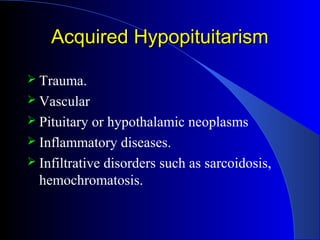
Acquired Hypopituitarism

 Trauma.
 Vascular
 Pituitary  or hypothalamic neoplasms
 Inflammatory diseases.
 Infiltrative disorders such as sarcoidosis,
  hemochromatosis.
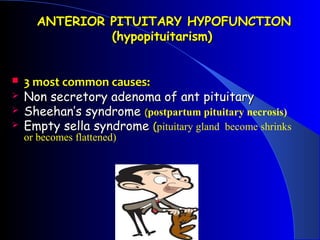
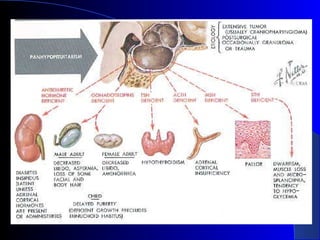
ANTERIOR PITUITARY HYPOFUNCTION
               (hypopituitarism)


   3 most common causes:
   Non secretory adenoma of ant pituitary
   Sheehan’s syndrome (postpartum pituitary necrosis)
   Empty sella syndrome (pituitary gland become shrinks
    or becomes flattened)
 Partial hypopituitarism is more frequent than complete
  loss of pit functions
 Sx/signs do not manifest until > 75% of ant lobe is
  destroyed
 GH secretion is an early feature of pit failure-effects >
  dramatic in children but less significant in adults
 LH/ FSH are affected before ACTH
 Hypothyroidism is an uncommon presenting feature of
  pit failure
Clinical features
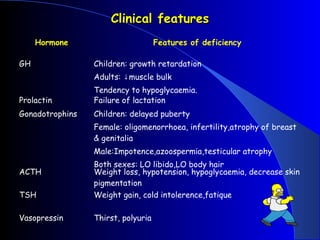
     Hormone                        Features of deficiency
GH               Children: growth retardation
                 Adults: ↓muscle bulk
                 Tendency to hypoglycaemia.
Prolactin        Failure of lactation
Gonadotrophins   Children: delayed puberty
                 Female: oligomenorrhoea, infertility,atrophy of breast
                 & genitalia
                 Male:Impotence,azoospermia,testicular atrophy
                 Both sexes: LO libido,LO body hair
ACTH             Weight loss, hypotension, hypoglycaemia, decrease skin
                 pigmentation
TSH              Weight gain, cold intolerence,fatique

Vasopressin      Thirst, polyuria
Posterior Pituitary hypofunction
                  Causes
     ADH production  cranial diabetes insipidus
      (DI)

Causes of cranial DI
   Tumours-craniopharyngioma, secondary tumours
    (metastatic CA), pituitary tumours with suprasella
    extension.
   Granulomatous disease.
   Meningitis, abscess and encephalitis.
   Vascular disorders.
   Trauma.
   Surgery.
   Idiopathic.
Posterior Pituitary hypofunction
                 Effects


   Polyuria-uncontrolled renal water excretion,
    tendency to dehydration

   Polydipsia-excessive thirst, dehydration
    stimulate thirst centre resulting in increase
    water intake
Key features

 Hypotension
 Decreased    pulse pressure
 Tachycardia
 Increased Hbg,hct and BUN
 Increased UOP
 Poor skin turgor
 Irritablilty
 Decreased coginition
 Hyperthermia
 Lethargy leading to coma
PITUITARY HYPERFUNCTION
                 (HYPERPITUITARISM)
Hyperpituitarism - excessive production of adenohypophyseal hormones


   Causes
      Pituitary adenoma
      Carcinoma (rare)
      Hypothalamic disorder-excess stimulation of the
       pituitary (rare)

   Order of frequency with which hormone secretion
     occurs in pituitary tumour is prolactin (relatively
     common) GH  ACTH  gonadotrophin  TSH
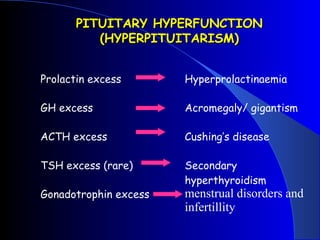
PITUITARY HYPERFUNCTION
          (HYPERPITUITARISM)


Prolactin excess       Hyperprolactinaemia

GH excess              Acromegaly/ gigantism

ACTH excess            Cushing’s disease

TSH excess (rare)      Secondary
                       hyperthyroidism
Gonadotrophin excess   menstrual disorders and
                       infertillity
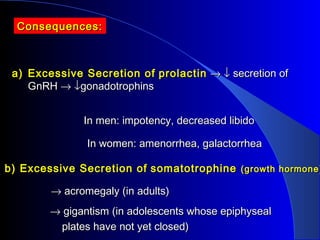
Consequences:


 a) Excessive Secretion of prolactin → ↓ secretion of
    GnRH → ↓gonadotrophins


              In men: impotency, decreased libido

               In women: amenorrhea, galactorrhea

b) Excessive Secretion of somatotrophine (growth hormone )

        → acromegaly (in adults)
        → gigantism (in adolescents whose epiphyseal
         plates have not yet closed)
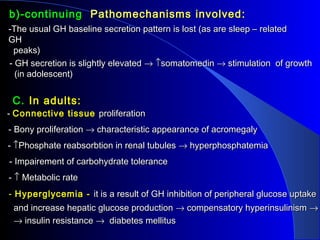
b)-continuing Pathomechanisms involved :
-The usual GH baseline secretion pattern is lost (as are sleep – related
GH
 peaks)
- GH secretion is slightly elevated → ↑somatomedin → stimulation of growth
  (in adolescent)


 C. In adult s :
- C onnective tissue proliferation
- Bony proliferation → characteristic appearance of acromegaly
- ↑Phosphate reabsorbtion in renal tubules → hyperphosphatemia
- Impairement of carbohydrate tolerance
- ↑ Metabolic rate
- H yperglycemia - it is a result of GH inhibition of peripheral glucose uptake
 and increase hepatic glucose production → compensatory hyperinsulinism →
 → insulin resistance → diabetes mellitus
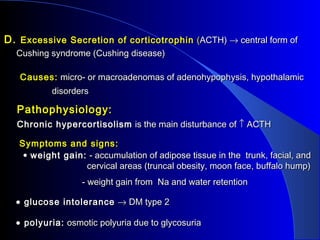
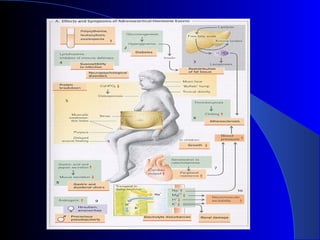
D. Excessive Secretion of corticotrophin (ACTH) → central form of
  Cushing syndrome (Cushing disease)

   Causes: micro- or macroadenomas of adenohypophysis, hypothalamic
           disorders

  Pathophysiology:
  C hronic hypercortisolism is the main disturbance of ↑ ACTH

   Symptoms and signs:
    • weight gain: - accumulation of adipose tissue in the trunk, facial, and
                  cervical areas (truncal obesity, moon face, buffalo hump)
                  - weight gain from Na and water retention

  • glucose intolerance → DM type 2

  • polyuria: osmotic polyuria due to glycosuria
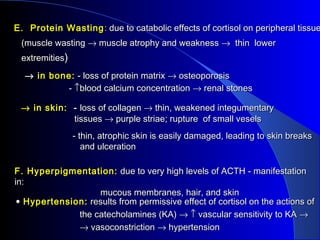
E. Protein Wasting : due to catabolic effects of cortisol on peripheral tissue
 (muscle wasting → muscle atrophy and weakness → thin lower
 extremities)

  → in bone: - loss of protein matrix → osteoporosis
          - ↑blood calcium concentration → renal stones

 → in skin: - loss of collagen → thin, weakened integumentary
            tissues → purple striae; rupture of small vesels
                - thin, atrophic skin is easily damaged, leading to skin breaks
                   and ulceration

F. Hyperpigmentation: due to very high levels of ACTH - manifestation
in:
                   mucous membranes, hair, and skin
 • Hypertension: results from permissive effect of cortisol on the actions of
              the catecholamines (KA) → ↑ vascular sensitivity to KA →
              → vasoconstriction → hypertension
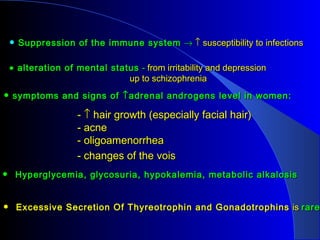
• Suppression of the immune system → ↑ susceptibility to infections

 • alteration of mental status - from irritability and depression
                            up to schizophrenia
• symptoms and signs of ↑ adrenal androgen s level in women:
                 - ↑ hair growth (especially facial hair)
                 - acne
                 - oligoamenorrhea
                 - changes of the vois
• Hyperglycemia, glycosuria, hypokalemia, metabolic alkalosis


• Excessive Secretion Of Thyreotrophin and Gonadotrophins is rare
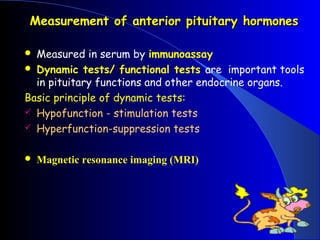
Measurement of anterior pituitary hormones

 Measured in serum by immunoassay
 Dynamic tests/ functional tests are important tools
  in pituitary functions and other endocrine organs.
Basic principle of dynamic tests:
 Hypofunction - stimulation tests
 Hyperfunction-suppression tests


   Magnetic resonance imaging (MRI)
Treatment
 Hormone    replacement therapy, including
  glucocorticoids, thyroid hormone, sex
  steroids, growth hormone and vasopressin,
  is usually free of complications.
 Glucocorticoid replacement require careful
  dose adjustments during stressful events.
THANK YOU


QUESTION?????

Lect 1-pituitary insufficiency

  • 1.
    Pituitary Gland diseases SMS 3023 Dr. Mohanad R. Alwan
  • 2.
    Endocrine Glands • Controlsmany body functions – exerts control by releasing special chemical substances into the blood called Hormones – Hormones affect other endocrine glands or body systems • Ductless glands • Secrete hormones directly into bloodstream – Hormones are quickly distributed by bloodstream throughout the body
  • 3.
    Hormones • Chemicals producedby endocrine glands. • Act on target organs elsewhere in body. • Control/coordinate widespread processes: • Homeostasis. • Reproduction. • Growth & Development. • Metabolism. • Response to stress. • Overlaps with the Sympathetic Nervous System
  • 4.
    Hormones Hormones are classifiedas: Proteins Polypeptides (amino acid derivatives) Lipids (fatty acid derivatives or steroids)
  • 5.
    Hormones Amount of hormonereaching target tissue directly correlates with concentration of hormone in blood.  Constant level hormones • Thyroid hormones  Variable level hormones • Epinephrine (adrenaline) release  Cyclic level hormones • Reproductive hormones
  • 6.
    The Endocrine System Consists of several glands located in various parts of the body  Specific Glands  Hypothalamus  Pituitary  Thyroid  Parathyroid  Adrenal  Kidneys  Pancreatic Islets  Ovaries  Testes
  • 7.
    Hypothalamus  Produces severalreleasing and inhibiting factors that stimulate or inhibit anterior pituitary’s secretion of hormones.  Produces hormones that are stored in and released from posterior pituitary.
  • 8.
    Hypothalamus  Also responsiblefor:  Regulation of water balance  Esophageal swallowing  Body temperature regulation (shivering)  Food/water intake (appetite)  Sleep-wake cycle  Autonomic functions
  • 9.
    Hypothalamic  Hypothalamic neural cells synthesize specific releasing and inhibiting hormones that are secreted directly into the portal vessels of the pituitary stalk.  Hypothalamic-pituitary portal plexus provides the major blood source for the anterior pituitary.
  • 10.
    Hypothalamic releasing hormones Hypothalamicreleasing Effect on pituitary hormone Corticotropin releasing hormone Stimulates ACTH secretion (CRH) Thyrotropin releasing hormone Stimulates TSH and Prolactin (TRH) secretion Growth hormone releasing Stimulates GH secretion hormone (GHRH) Somatostatin Inhibits GH (and other hormone) secretion Gonadotropin releasing hormone Stimulates LH and FSH (GnRH) a.k.a LHRH secretion Prolactin releasing hormone (PRH) Stimulates PRL secretion Prolactin inhibiting hormone Inhibits PRL secretion (dopamine)
  • 12.
  • 14.
    Pituitary Gland  Smallgland located on stalk hanging from base of brain.  “The Master Gland”  Primary function is to control other glands.  Produces many hormones.  Secretion is controlled by hypothalamus in base of brain.
  • 15.
    Pituitary Gland • Weight600 mg • Is located within the bony cavity (sella turcica) • Anatomically and functionally distinct anterior and posterior lobes • Anterior Pituitary-adenohypophysis • Posterior pituitary-neurohypophysis
  • 16.
    Histology of thePG Anterior pituitary cells were originally classified as • Acidophils cells • Basophils cells • Chromophope cells
  • 17.
    Histology of PG Now with immunocytochemical and electron microscopic techniques,classified cells by their secretary products • Somatotrophs cells • a. GH secreting cells • Account about 50% of anterior P.G • Acidophilic stained
  • 18.
    Histology of PG • Lactotrophic • a. Prl secreting cells • b. acidophilic stained • c. 10-15% of anterior PG • Thyrotrophis • a. TSH secreting cells • b. basophilic cells • c. < 10% of anterior PG
  • 19.
    Histology of PG •Corticotrophs a. ACTH secretary cells b. basophilic cells c. 15- 20% of anterior PG • Gonadotrophs a. LH,FSH secretary cells b. basophilic staining c. 10- 15% of anterior PG
  • 20.
    Pituitary Development • Thepituitary originate from different source. • The anterior pituitary from Rathke´s pouch (which is an embryonic invagination of the pharyngeal epithelium). • The posterior pituitary from an outgrow of the hypothalamus.
  • 21.
    o Oxytocin, o Antidiuretic hormone • Adrenocorticotropic hormone(ACTH) • Thyroid-stimulating hormone(TSH) • Growth hormone, Prolactin • Luteinizing hormone, • Follicle stimulating hormone • melanocyte–stimulating hormones
  • 22.
    Pituitary Gland  Twoareas Anterior Pituitary Posterior Pituitary  Structurally, functionally different
  • 23.
    Pituitary Gland  AnteriorPituitary Hormones  Thyroid-Stimulating Hormone (TSH) stimulates release of hormones from Thyroid  thyroxine (T4) and triiodothyronine (T3): stimulate metabolism of all cells  calcitonin: lowers the amount of calcium in the blood by inhibiting breakdown of bone released when stimulated by TSH abnormal conditions  hyperthyroidism: too much TSH release  hypothyroidism: too little TSH release
  • 24.
    Pituitary Gland  AnteriorPituitary  Growth Hormone (GH) stimulates growth of all organs and increases blood glucose concentration  decreases glucose usage  increases consumption of fats as an energy source  Adreno-Corticotrophic Hormone (ACTH) stimulates the release of adrenal cortex hormones
  • 25.
    Pituitary Gland  AnteriorPituitary  Follicle Stimulating Hormone (FSH) females - stimulates maturation of ova; release of estrogen males - stimulates testes to grow; produce sperm  Luteinizing Hormone (LH) females - stimulates ovulation; growth of corpus luteum males - stimulates testes to secrete testosterone
  • 26.
    Pituitary Gland  AnteriorPituitary  Prolactin stimulates breast development during pregnancy; milk production after delivery  Melanocyte Stimulating Hormone (MSH) stimulates synthesis, dispersion of melanin pigment in skin
  • 27.
    Pituitary Gland  PosteriorPituitary  Stores, releases two hormones produced in hypothalamus Antidiuretic hormone (ADH) Oxytocin
  • 28.
    Pituitary Gland  PosteriorPituitary Hormones:  Antidiuretic hormone (ADH) Stimulates water retention by kidneys  reabsorb sodium and water Abnormal conditions  Undersecretion: diabetes insipidus (“water diabetes”)  Oversecretion: Syndrome of Inappropriate Antidiuretic Hormone (SIADH)  Oxytocin Stimulates contraction of uterus at end of pregnancy (Pitocin®); release of milk from breast
  • 29.
    Pineal Gland  Locatedwithin the Diencephalon  Melatonin  Inhibits ovarian hormones  May regulate the body’s internal clock
  • 30.
    Anterior Pituitary  Isoftenreferred to as the “MASTER GLAND” because, it orchestrates the complex regulatory functions of multiple other endocrine glands.
  • 31.
  • 32.
    Etiology  Reduced pituitary function can result from inhereited disorders; more commonly,  it is acquired and reflects the mass effects of tumors or the consequences of inflamation or vascular damage.
  • 33.
    Causes of hypopituitarism Tumours(tu’) Vascular ds  Pituitary tumor  Necrosis (Sheehan’s synd)  Adenoma,craniopharyngioma  Infarction  Cerebral tumor  Severe hypotension Hypothalamic disorders  Cranial arteritis  Tumor Trauma  Functional disturbance- Eg -Anorexia nervosa  Isolated GH and GnH secretion Infection due to impaired secretion of  Meningitis esp TB, syphilis hypothalamic releasing hormones Iatrogenic Miscellaneous  Surgery  Sarcoidosis (inflammation of L.N)  Irradiation  Histocytosis X (abnormal  Prolonged rx with increase in the number of immune cells ) glucocorticoid or thyroid  Haemochromatosis hormones-isolated ACTH or TSH suppression
  • 34.
    Developmental and GeneticCauses of Hypopituitarism  Pituitary Displasia  Tissue-Specific Factor Mutations  Developmental Hypotalamic Dysfunction:  Kallmann Syndrome (Hypogonadotropic hypogonadism)  Laurence-Moon-Bardet-Biedl Syndrome (involves many body systems)  Fröhlich Syndrome (childhood metabolicdisorder)  Prader-Willi Syndrome.
  • 35.
    Acquired Hypopituitarism  Trauma. Vascular  Pituitary or hypothalamic neoplasms  Inflammatory diseases.  Infiltrative disorders such as sarcoidosis, hemochromatosis.
  • 36.
    ANTERIOR PITUITARY HYPOFUNCTION (hypopituitarism)  3 most common causes:  Non secretory adenoma of ant pituitary  Sheehan’s syndrome (postpartum pituitary necrosis)  Empty sella syndrome (pituitary gland become shrinks or becomes flattened)
  • 37.
     Partial hypopituitarismis more frequent than complete loss of pit functions  Sx/signs do not manifest until > 75% of ant lobe is destroyed  GH secretion is an early feature of pit failure-effects > dramatic in children but less significant in adults  LH/ FSH are affected before ACTH  Hypothyroidism is an uncommon presenting feature of pit failure
  • 38.
    Clinical features Hormone Features of deficiency GH Children: growth retardation Adults: ↓muscle bulk Tendency to hypoglycaemia. Prolactin Failure of lactation Gonadotrophins Children: delayed puberty Female: oligomenorrhoea, infertility,atrophy of breast & genitalia Male:Impotence,azoospermia,testicular atrophy Both sexes: LO libido,LO body hair ACTH Weight loss, hypotension, hypoglycaemia, decrease skin pigmentation TSH Weight gain, cold intolerence,fatique Vasopressin Thirst, polyuria
  • 39.
    Posterior Pituitary hypofunction Causes  ADH production  cranial diabetes insipidus (DI) Causes of cranial DI  Tumours-craniopharyngioma, secondary tumours (metastatic CA), pituitary tumours with suprasella extension.  Granulomatous disease.  Meningitis, abscess and encephalitis.  Vascular disorders.  Trauma.  Surgery.  Idiopathic.
  • 40.
    Posterior Pituitary hypofunction Effects  Polyuria-uncontrolled renal water excretion, tendency to dehydration  Polydipsia-excessive thirst, dehydration stimulate thirst centre resulting in increase water intake
  • 41.
    Key features  Hypotension Decreased pulse pressure  Tachycardia  Increased Hbg,hct and BUN  Increased UOP  Poor skin turgor  Irritablilty  Decreased coginition  Hyperthermia  Lethargy leading to coma
  • 42.
    PITUITARY HYPERFUNCTION (HYPERPITUITARISM) Hyperpituitarism - excessive production of adenohypophyseal hormones Causes  Pituitary adenoma  Carcinoma (rare)  Hypothalamic disorder-excess stimulation of the pituitary (rare) Order of frequency with which hormone secretion occurs in pituitary tumour is prolactin (relatively common) GH  ACTH  gonadotrophin  TSH
  • 43.
    PITUITARY HYPERFUNCTION (HYPERPITUITARISM) Prolactin excess Hyperprolactinaemia GH excess Acromegaly/ gigantism ACTH excess Cushing’s disease TSH excess (rare) Secondary hyperthyroidism Gonadotrophin excess menstrual disorders and infertillity
  • 44.
    Consequences: a) ExcessiveSecretion of prolactin → ↓ secretion of GnRH → ↓gonadotrophins In men: impotency, decreased libido In women: amenorrhea, galactorrhea b) Excessive Secretion of somatotrophine (growth hormone ) → acromegaly (in adults) → gigantism (in adolescents whose epiphyseal plates have not yet closed)
  • 45.
    b)-continuing Pathomechanisms involved: -The usual GH baseline secretion pattern is lost (as are sleep – related GH peaks) - GH secretion is slightly elevated → ↑somatomedin → stimulation of growth (in adolescent) C. In adult s : - C onnective tissue proliferation - Bony proliferation → characteristic appearance of acromegaly - ↑Phosphate reabsorbtion in renal tubules → hyperphosphatemia - Impairement of carbohydrate tolerance - ↑ Metabolic rate - H yperglycemia - it is a result of GH inhibition of peripheral glucose uptake and increase hepatic glucose production → compensatory hyperinsulinism → → insulin resistance → diabetes mellitus
  • 46.
    D. Excessive Secretionof corticotrophin (ACTH) → central form of Cushing syndrome (Cushing disease) Causes: micro- or macroadenomas of adenohypophysis, hypothalamic disorders Pathophysiology: C hronic hypercortisolism is the main disturbance of ↑ ACTH Symptoms and signs: • weight gain: - accumulation of adipose tissue in the trunk, facial, and cervical areas (truncal obesity, moon face, buffalo hump) - weight gain from Na and water retention • glucose intolerance → DM type 2 • polyuria: osmotic polyuria due to glycosuria
  • 47.
    E. Protein Wasting: due to catabolic effects of cortisol on peripheral tissue (muscle wasting → muscle atrophy and weakness → thin lower extremities) → in bone: - loss of protein matrix → osteoporosis - ↑blood calcium concentration → renal stones → in skin: - loss of collagen → thin, weakened integumentary tissues → purple striae; rupture of small vesels - thin, atrophic skin is easily damaged, leading to skin breaks and ulceration F. Hyperpigmentation: due to very high levels of ACTH - manifestation in: mucous membranes, hair, and skin • Hypertension: results from permissive effect of cortisol on the actions of the catecholamines (KA) → ↑ vascular sensitivity to KA → → vasoconstriction → hypertension
  • 48.
    • Suppression ofthe immune system → ↑ susceptibility to infections • alteration of mental status - from irritability and depression up to schizophrenia • symptoms and signs of ↑ adrenal androgen s level in women: - ↑ hair growth (especially facial hair) - acne - oligoamenorrhea - changes of the vois • Hyperglycemia, glycosuria, hypokalemia, metabolic alkalosis • Excessive Secretion Of Thyreotrophin and Gonadotrophins is rare
  • 50.
    Measurement of anteriorpituitary hormones  Measured in serum by immunoassay  Dynamic tests/ functional tests are important tools in pituitary functions and other endocrine organs. Basic principle of dynamic tests:  Hypofunction - stimulation tests  Hyperfunction-suppression tests  Magnetic resonance imaging (MRI)
  • 53.
    Treatment  Hormone replacement therapy, including glucocorticoids, thyroid hormone, sex steroids, growth hormone and vasopressin, is usually free of complications.  Glucocorticoid replacement require careful dose adjustments during stressful events.
  • 54.

Editor's Notes

  • #42 Classic sign of hypvolemic shock