Hypersensitivity reactions
Overview
Definition and Introduction
Hypersensitivity reactions
Immune stimulation and Immune suppression
Definition:
 Excessive undesirable
(damaging, discomfort producing
and sometimes fatal) reactions
produced by the normal immune
system.
 Require a pre-sensitized
(immune) state of the host.
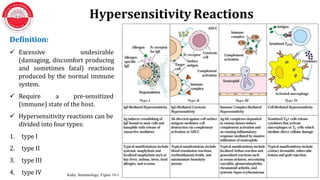
 Hypersensitivity reactions can be
divided into four types:
1. type I
2. type II
3. type III
4. type IV
Hypersensitivity Reactions
Kuby; Immunology; Figure 16-1
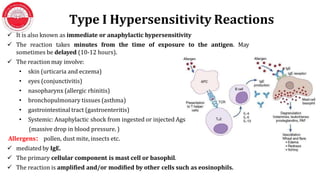
Type I Hypersensitivity Reactions
 It is also known as immediate or anaphylactic hypersensitivity
 The reaction takes minutes from the time of exposure to the antigen. May
sometimes be delayed (10-12 hours).
 The reaction may involve:
• skin (urticaria and eczema)
• eyes (conjunctivitis)
• nasopharynx (allergic rhinitis)
• bronchopulmonary tissues (asthma)
• gastrointestinal tract (gastroenteritis)
• Systemic: Anaphylactic shock from ingested or injected Ags
(massive drop in blood pressure. )
Allergens: pollen, dust mite, insects etc.
 mediated by IgE.
 The primary cellular component is mast cell or basophil.
 The reaction is amplified and/or modified by other cells such as eosinophils.
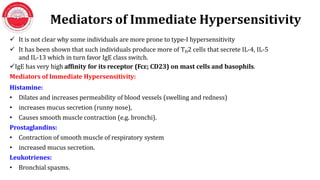
Mediators of Immediate Hypersensitivity
 It is not clear why some individuals are more prone to type-I hypersensitivity
 It has been shown that such individuals produce more of TH2 cells that secrete IL-4, IL-5
and IL-13 which in turn favor IgE class switch.
IgE has very high affinity for its receptor (Fcε; CD23) on mast cells and basophils.
Mediators of Immediate Hypersensitivity:
Histamine:
• Dilates and increases permeability of blood vessels (swelling and redness)
• increases mucus secretion (runny nose),
• Causes smooth muscle contraction (e.g. bronchi).
Prostaglandins:
• Contraction of smooth muscle of respiratory system
• increased mucus secretion.
Leukotrienes:
• Bronchial spasms.
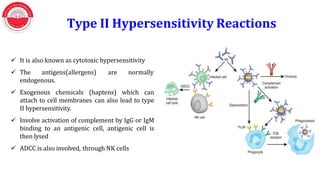
 It is also known as cytotoxic hypersensitivity
 The antigens(allergens) are normally
endogenous.
 Exogenous chemicals (haptens) which can
attach to cell membranes can also lead to type
II hypersensitivity.
 Involve activation of complement by IgG or IgM
binding to an antigenic cell, antigenic cell is
then lysed
 ADCC is also involved, through NK cells
Type II Hypersensitivity Reactions
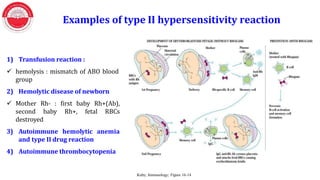
Examples of type II hypersensitivity reaction
1) Transfusion reaction :
 hemolysis : mismatch of ABO blood
group
2) Hemolytic disease of newborn
 Mother Rh- : first baby Rh+(Ab),
second baby Rh+, fetal RBCs
destroyed
3) Autoimmune hemolytic anemia
and type II drug reaction
4) Autoimmune thrombocytopenia
Kuby; Immunology; Figure 16-14
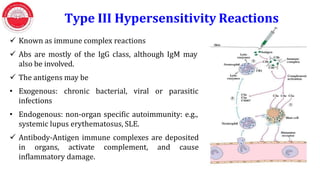
 Known as immune complex reactions
 Abs are mostly of the IgG class, although IgM may
also be involved.
 The antigens may be
• Exogenous: chronic bacterial, viral or parasitic
infections
• Endogenous: non-organ specific autoimmunity: e.g.,
systemic lupus erythematosus, SLE.
 Antibody-Antigen immune complexes are deposited
in organs, activate complement, and cause
inflammatory damage.
Type III Hypersensitivity Reactions
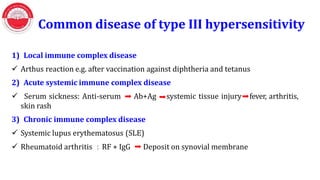
Common disease of type III hypersensitivity
1) Local immune complex disease
 Arthus reaction e.g. after vaccination against diphtheria and tetanus
2) Acute systemic immune complex disease
 Serum sickness: Anti-serum Ab+Ag
skin rash
3) Chronic immune complex disease
 Systemic lupus erythematosus (SLE)
systemic tissue injury fever, arthritis,
 Rheumatoid arthritis :RF + IgG Deposit on synovial membrane
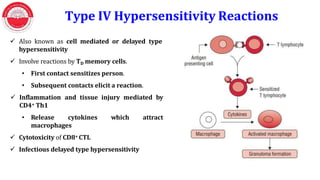
Type IV Hypersensitivity Reactions
 Also known as cell mediated or delayed type
hypersensitivity
 Involve reactions by TD memory cells.
• First contact sensitizes person.
• Subsequent contacts elicit a reaction.
 Inflammation and tissue injury mediated by
CD4+ Th1
• Release cytokines which
macrophages
 Cytotoxicity of CD8+ CTL
 Infectious delayed type hypersensitivity
attract
Common disease of type IV hypersensitivity
1) Infectious delayed type hypersensitivity
• Mantoux: OT( Old Tuberculin ) test
2) Contact dermatitis :
• Paint, drug red rash, water blister, dermatitis