Biotechnology
b.Pharma 6th semester unit-2nd
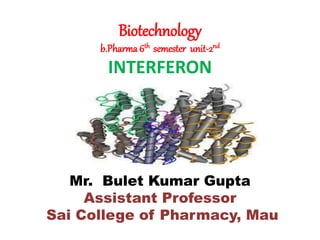
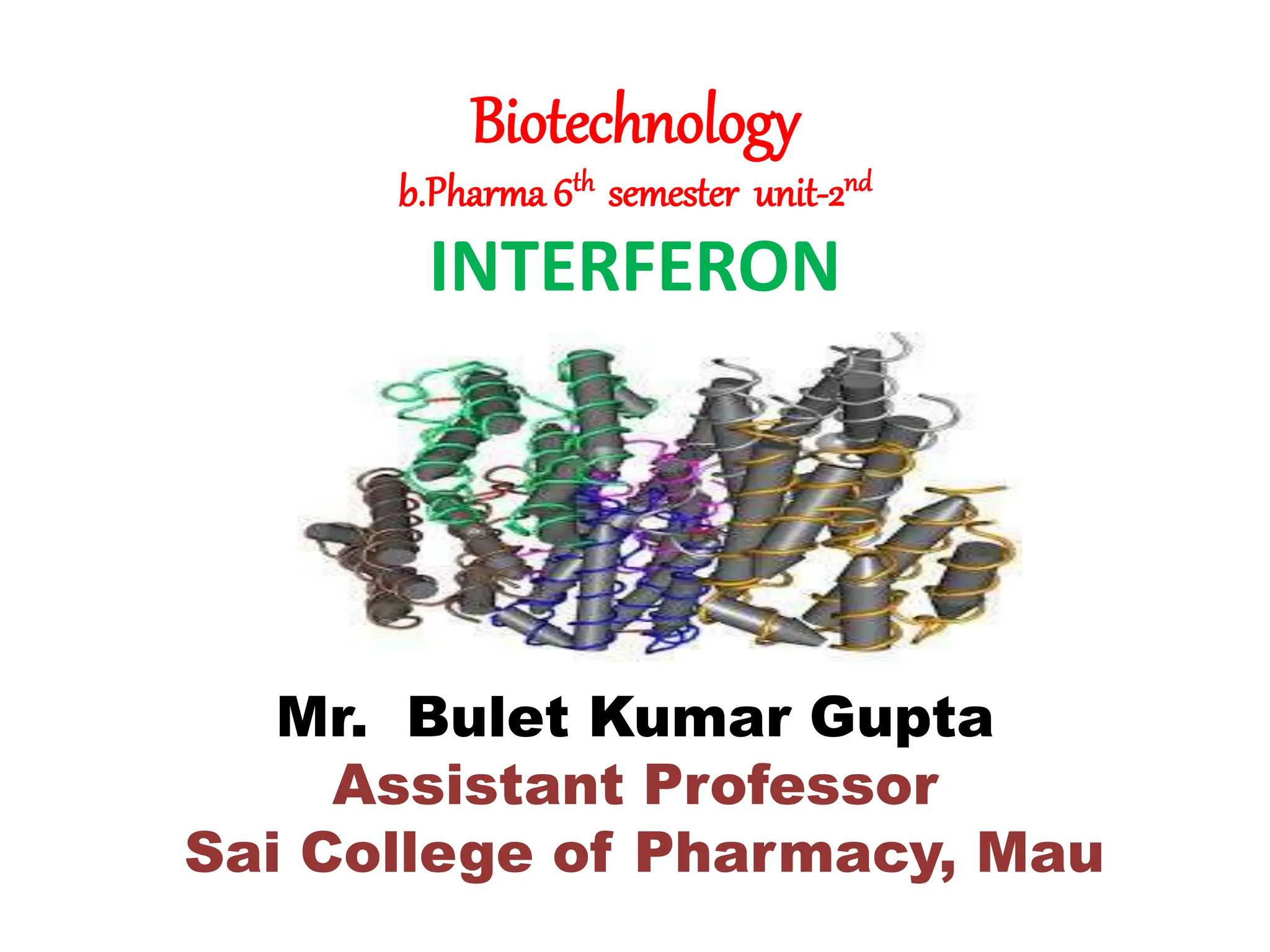
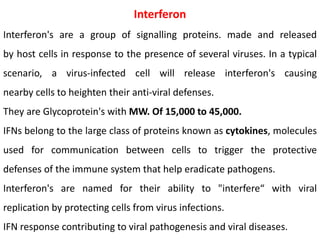
INTERFERON
Mr. Bulet Kumar Gupta
Assistant Professor
Sai College of Pharmacy, Mau
Interferon
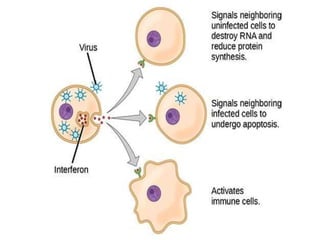
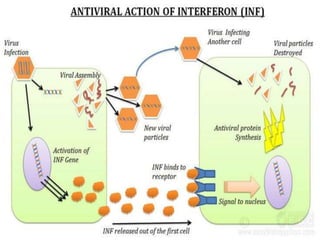
Interferon's are a group of signalling proteins. made and released
by host cells in response to the presence of several viruses. In a typical
scenario, a virus-infected cell will release interferon's causing
nearby cells to heighten their anti-viral defenses.
They are Glycoprotein's with MW. Of 15,000 to 45,000.
IFNs belong to the large class of proteins known as cytokines, molecules
used for communication between cells to trigger the protective
defenses of the immune system that help eradicate pathogens.
Interferon's are named for their ability to "interfere“ with viral
replication by protecting cells from virus infections.
IFN response contributing to viral pathogenesis and viral diseases.
IFNs also have various other functions: they activate immune
cells, such as natural killer cells and macrophages, and they increase
host defenses by up-regulating antigen presentation by virtue of
increasing the expression of major histocompatibility
complex (MHC) antigens.
Certain symptoms of infections, such as fever, muscle pain and "flu-like
symptoms", are also caused by the production of IFNs &other cytokines.
More than twenty distinct IFN genes and proteins have been identified
in animals, including humans. They are typically divided among three
classes: Type I IFN, Type II IFN, and Type III IFN. IFNs belonging to all
three classes are important for fighting viral infections and for the
regulation of the immune system.
Types of interferon
Interferon type I: All type I IFNs bind to a specific cell surface receptor
complex known as the IFN-α/β receptor (IFNAR) that consists
of IFNAR1 and IFNAR2 chains.
The type I interferon's present in humans are IFN-α, IFN-β.
It is released by any cells.
Type I interferon's bind to specific receptors on target cells, which leads
to expression of proteins that will prevent the virus from producing and
replicating its RNA and DNA.
IFN-α can be used to treat hepatitis B and C infections, while IFN-β can
be used to treat multiple sclerosis.
Interferon type II (INF-γ in humans) This is also known as
immune interferon and is activated by Interleukin-12.
Type II interferon's are also released by cytotoxic T cells and type-1 T
helper cells.
It is released by Nk-cells and T-lymphocytes.
Interferons Therapy-
Interferon beta-1a and interferon beta-1b are used to treat and
control multiple sclerosis, an autoimmune disorder.
Interferon therapy is used (in combination with chemotherapy and
radiation) as a treatment for some cancers.
This treatment can be used in hematological malignancy, such as in
leukemia and lymphomas.
Both hepatitis B and hepatitis C can be treated with IFN-α, often in
combination with other antiviral drugs.
The most frequent adverse effects are flu-like symptoms:
•Increased body temperature
•Feeling ill
•Fatigue
•Headache
•Muscle pain
•Convulsion
•Dizziness
•Hair thinning
•Depression.
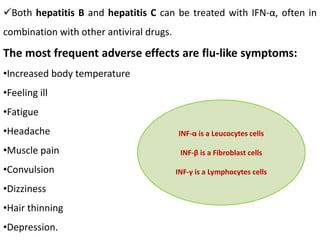
INF-α is a Leucocytes cells
INF-β is a Fibroblast cells
INF-γ is a Lymphocytes cells
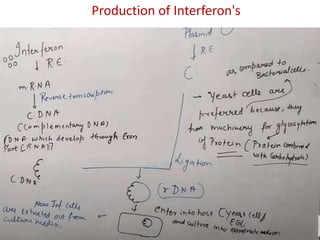
Production of Interferon's
Hepatitis B Virus (HBV)
Hepatitis B Virus (HBV) is one of the most common infectious disease.
Infection with hepatitis B virus may progress to chronic liver disease
such as chronic persistent and chronic active hepatitis, cirrhosis, and
Hepatocellular carcinoma.
WHO estimated that there are over 285 million carriers of hepatitis B
virus worldwide (about 5% of the global population).
Hepatitis B is 50 to 100 times more infectious than AIDS.
Hepatitis B is the irritation and swelling (inflammation) of the liver due
to infection with the Hepatitis B virus.
Other type of viral Hepatitis includes- Hepatitis C and Hepatitis D.
The Hepatitis B virus is a small (3200 bp DNA virus with a viral envelope.
Hepatitis B Vaccine
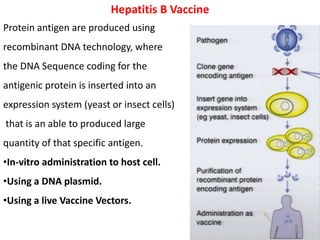
Protein antigen are produced using
recombinant DNA technology, where
the DNA Sequence coding for the
antigenic protein is inserted into an
expression system (yeast or insect cells)
that is an able to produced large
quantity of that specific antigen.
•In-vitro administration to host cell.
•Using a DNA plasmid.
•Using a live Vaccine Vectors.
Vaccine generated using Recombinant DNA Technology is called
recombinant vaccine.
This type of vaccine are manufactured with the assistance of expression
systems, such as- Bacteria, Yeast, Plants, insects and mammals.
Usually E. coli is most popular organism used for recombinant protein
expression.
Due to in part with its ease of bioprocessing, scale-up, strain
engineering, lower cost and shorter time productions.
There are various types of vaccine made possible by recombinant DNA
technology, which is classified into mainly two category-
•DNA Vaccine.
• Recombinant (Protein subunit) vaccine.
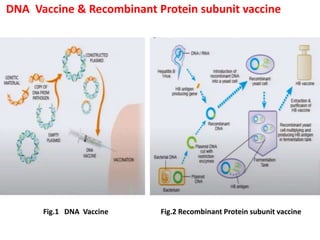
DNA Vaccine & Recombinant Protein subunit vaccine
Fig.1 DNA Vaccine Fig.2 Recombinant Protein subunit vaccine
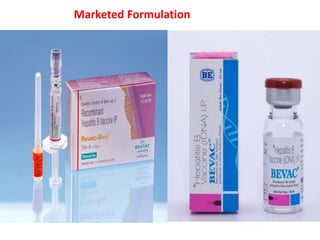
Marketed Formulation
Insulin
•Insulin is a peptide hormone produced by beta cells of the pancreatic
islets encoded in humans by the INS gene. It is considered to be the
main anabolic hormone of the body.
•It regulates the metabolism of carbohydrates, fats and protein by
promoting the absorption of glucose from the blood
into liver, fat and skeletal muscle cells.
•In these tissues the absorbed glucose is converted into
either glycogen via glycogenesis or fats (triglycerides) via lipogenesis.
•Beta cells are sensitive to blood sugar levels so that they secrete insulin
into the blood in response to high level of glucose, and inhibit secretion
of insulin when glucose levels are low.
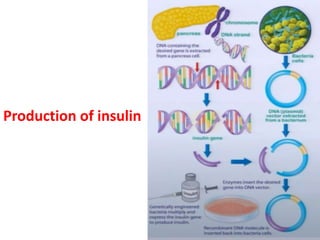
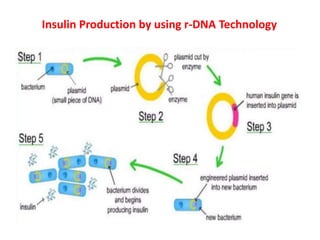
Production of insulin
Insulin Production by using r-DNA Technology
Step-1 Preparing
The human genome is isolated, the m-RNA is taken from the cell of islets
of Langerhans.
The isolated gene contains the code of human DNA for the production
of insulin.
The plasmid DNA of bacterial cell is taken out of the cells.
Note- E.coli is widely used in producing insulin but yeast also can be
used.

unit-2 interferon vaccine and hormones.pptx

  • 1.
    Biotechnology b.Pharma 6th semesterunit-2nd INTERFERON Mr. Bulet Kumar Gupta Assistant Professor Sai College of Pharmacy, Mau
  • 2.
    Interferon Interferon's are agroup of signalling proteins. made and released by host cells in response to the presence of several viruses. In a typical scenario, a virus-infected cell will release interferon's causing nearby cells to heighten their anti-viral defenses. They are Glycoprotein's with MW. Of 15,000 to 45,000. IFNs belong to the large class of proteins known as cytokines, molecules used for communication between cells to trigger the protective defenses of the immune system that help eradicate pathogens. Interferon's are named for their ability to "interfere“ with viral replication by protecting cells from virus infections. IFN response contributing to viral pathogenesis and viral diseases.
  • 4.
    IFNs also havevarious other functions: they activate immune cells, such as natural killer cells and macrophages, and they increase host defenses by up-regulating antigen presentation by virtue of increasing the expression of major histocompatibility complex (MHC) antigens. Certain symptoms of infections, such as fever, muscle pain and "flu-like symptoms", are also caused by the production of IFNs &other cytokines. More than twenty distinct IFN genes and proteins have been identified in animals, including humans. They are typically divided among three classes: Type I IFN, Type II IFN, and Type III IFN. IFNs belonging to all three classes are important for fighting viral infections and for the regulation of the immune system.
  • 6.
    Types of interferon Interferontype I: All type I IFNs bind to a specific cell surface receptor complex known as the IFN-α/β receptor (IFNAR) that consists of IFNAR1 and IFNAR2 chains. The type I interferon's present in humans are IFN-α, IFN-β. It is released by any cells. Type I interferon's bind to specific receptors on target cells, which leads to expression of proteins that will prevent the virus from producing and replicating its RNA and DNA. IFN-α can be used to treat hepatitis B and C infections, while IFN-β can be used to treat multiple sclerosis.
  • 7.
    Interferon type II(INF-γ in humans) This is also known as immune interferon and is activated by Interleukin-12. Type II interferon's are also released by cytotoxic T cells and type-1 T helper cells. It is released by Nk-cells and T-lymphocytes. Interferons Therapy- Interferon beta-1a and interferon beta-1b are used to treat and control multiple sclerosis, an autoimmune disorder. Interferon therapy is used (in combination with chemotherapy and radiation) as a treatment for some cancers. This treatment can be used in hematological malignancy, such as in leukemia and lymphomas.
  • 8.
    Both hepatitis Band hepatitis C can be treated with IFN-α, often in combination with other antiviral drugs. The most frequent adverse effects are flu-like symptoms: •Increased body temperature •Feeling ill •Fatigue •Headache •Muscle pain •Convulsion •Dizziness •Hair thinning •Depression. INF-α is a Leucocytes cells INF-β is a Fibroblast cells INF-γ is a Lymphocytes cells
  • 9.
  • 10.
    Hepatitis B Virus(HBV) Hepatitis B Virus (HBV) is one of the most common infectious disease. Infection with hepatitis B virus may progress to chronic liver disease such as chronic persistent and chronic active hepatitis, cirrhosis, and Hepatocellular carcinoma. WHO estimated that there are over 285 million carriers of hepatitis B virus worldwide (about 5% of the global population). Hepatitis B is 50 to 100 times more infectious than AIDS. Hepatitis B is the irritation and swelling (inflammation) of the liver due to infection with the Hepatitis B virus. Other type of viral Hepatitis includes- Hepatitis C and Hepatitis D. The Hepatitis B virus is a small (3200 bp DNA virus with a viral envelope.
  • 11.
    Hepatitis B Vaccine Proteinantigen are produced using recombinant DNA technology, where the DNA Sequence coding for the antigenic protein is inserted into an expression system (yeast or insect cells) that is an able to produced large quantity of that specific antigen. •In-vitro administration to host cell. •Using a DNA plasmid. •Using a live Vaccine Vectors.
  • 12.
    Vaccine generated usingRecombinant DNA Technology is called recombinant vaccine. This type of vaccine are manufactured with the assistance of expression systems, such as- Bacteria, Yeast, Plants, insects and mammals. Usually E. coli is most popular organism used for recombinant protein expression. Due to in part with its ease of bioprocessing, scale-up, strain engineering, lower cost and shorter time productions. There are various types of vaccine made possible by recombinant DNA technology, which is classified into mainly two category- •DNA Vaccine. • Recombinant (Protein subunit) vaccine.
  • 13.
    DNA Vaccine &Recombinant Protein subunit vaccine Fig.1 DNA Vaccine Fig.2 Recombinant Protein subunit vaccine
  • 14.
  • 15.
    Insulin •Insulin is apeptide hormone produced by beta cells of the pancreatic islets encoded in humans by the INS gene. It is considered to be the main anabolic hormone of the body. •It regulates the metabolism of carbohydrates, fats and protein by promoting the absorption of glucose from the blood into liver, fat and skeletal muscle cells. •In these tissues the absorbed glucose is converted into either glycogen via glycogenesis or fats (triglycerides) via lipogenesis. •Beta cells are sensitive to blood sugar levels so that they secrete insulin into the blood in response to high level of glucose, and inhibit secretion of insulin when glucose levels are low.
  • 16.
  • 17.
    Insulin Production byusing r-DNA Technology
  • 18.
    Step-1 Preparing The humangenome is isolated, the m-RNA is taken from the cell of islets of Langerhans. The isolated gene contains the code of human DNA for the production of insulin. The plasmid DNA of bacterial cell is taken out of the cells. Note- E.coli is widely used in producing insulin but yeast also can be used.