CHAPTER 10: CELL
GROWTH & DIVISION
By Maddi Montgomery
WHY DO CELLS NEED TO DIVIDE?
The larger a cell becomes
 The more demands the cell places on its DNA
 The cell has more trouble moving enough nutrients and waste across the cell
membrane
 The surface area of the cell is not large enough in comparison to the cell’s volume
BEFORE A CELL GETS TOO
LARGE…
It divides into two new daughter cells in a process called cell division.
Before cell division, the cell copies (replicates) all of its DNA.
It then divides into two new daughter cells.
Each daughter cell receives a complete set of DNA.
REPRODUCTION
Asexual = one parent.
Sexual = two parents
 New combinations of DNA
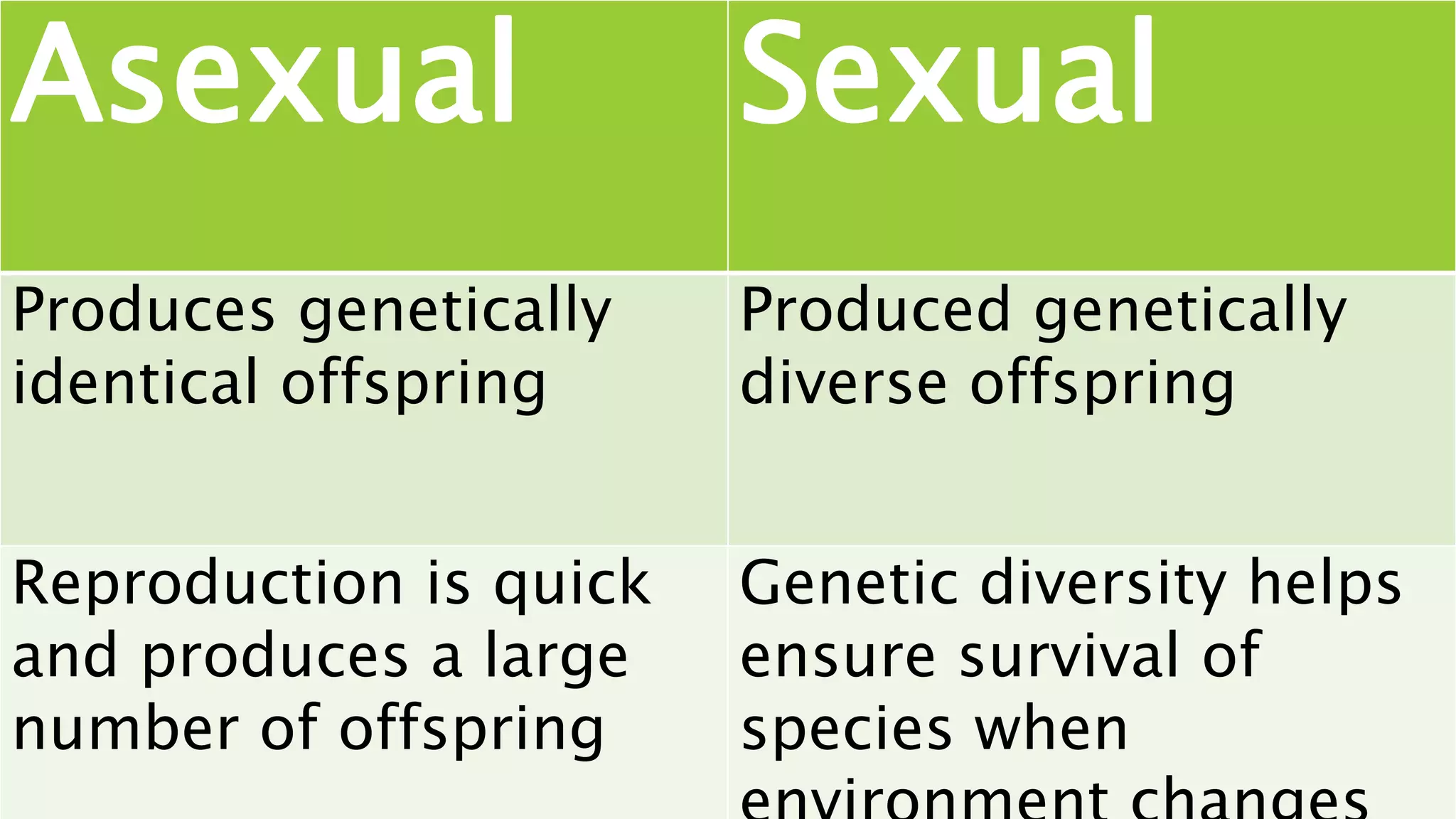
Asexual Sexual
Produces genetically
identical offspring
Produced genetically
diverse offspring
Reproduction is quick
and produces a large
number of offspring
Genetic diversity helps
ensure survival of
species when
CHROMOSOMES
Long pieces of DNA (many genes)
Humans: 23 chromosomes in sperm (dad) and 23 chromosomes from
egg (mom)
PROKARYOTIC VS EUKARYOTIC
DNA
Prokaryotes: one piece of circular DNA
Only one circular chromosome
Eukaryotes: 46 chromosomes
Occur in pairs (23 pairs, so 46 chromosomes)
Linear shape
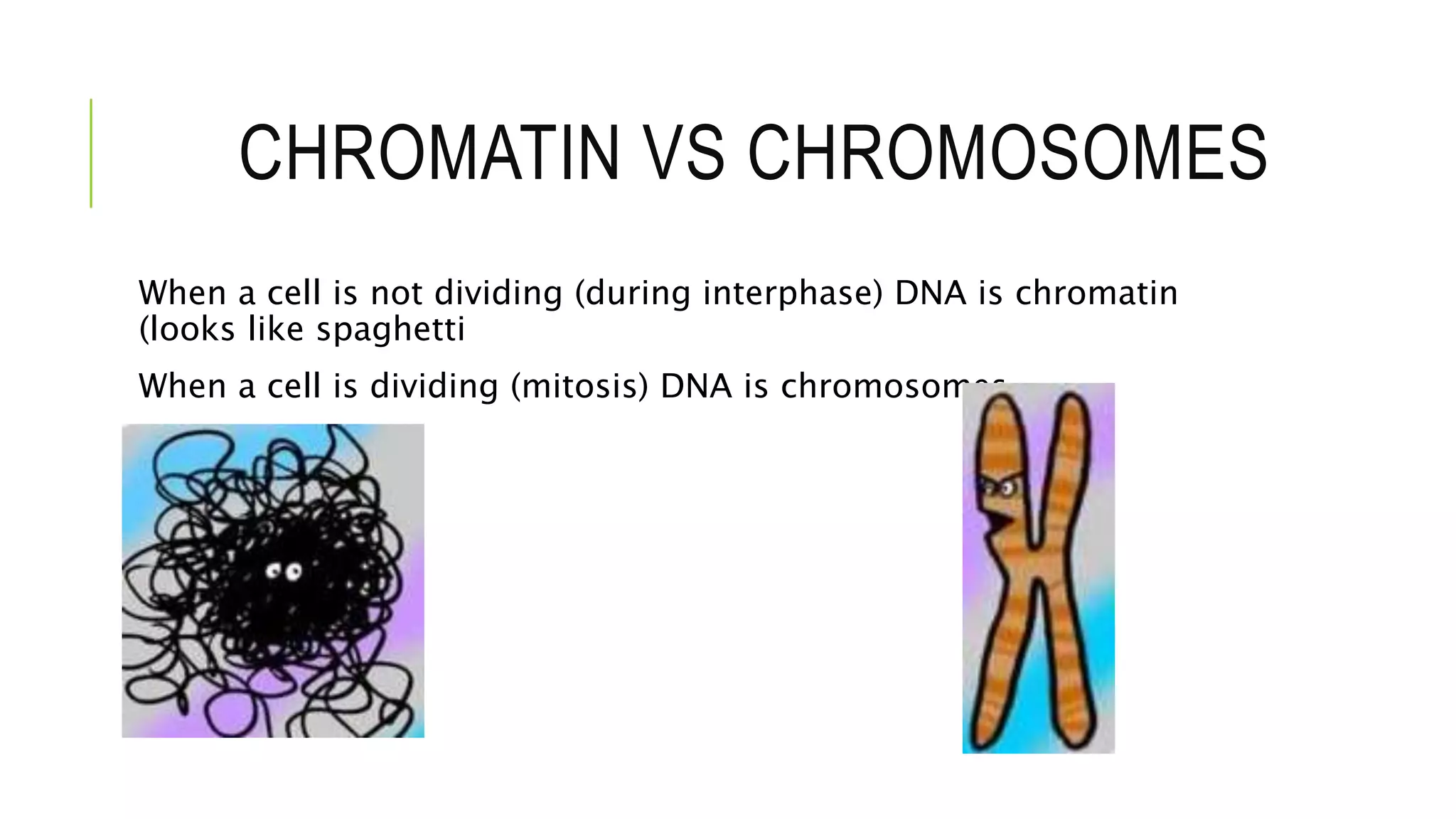
CHROMATIN VS CHROMOSOMES
When a cell is not dividing (during interphase) DNA is chromatin
(looks like spaghetti
When a cell is dividing (mitosis) DNA is chromosomes
CELL DIVISION
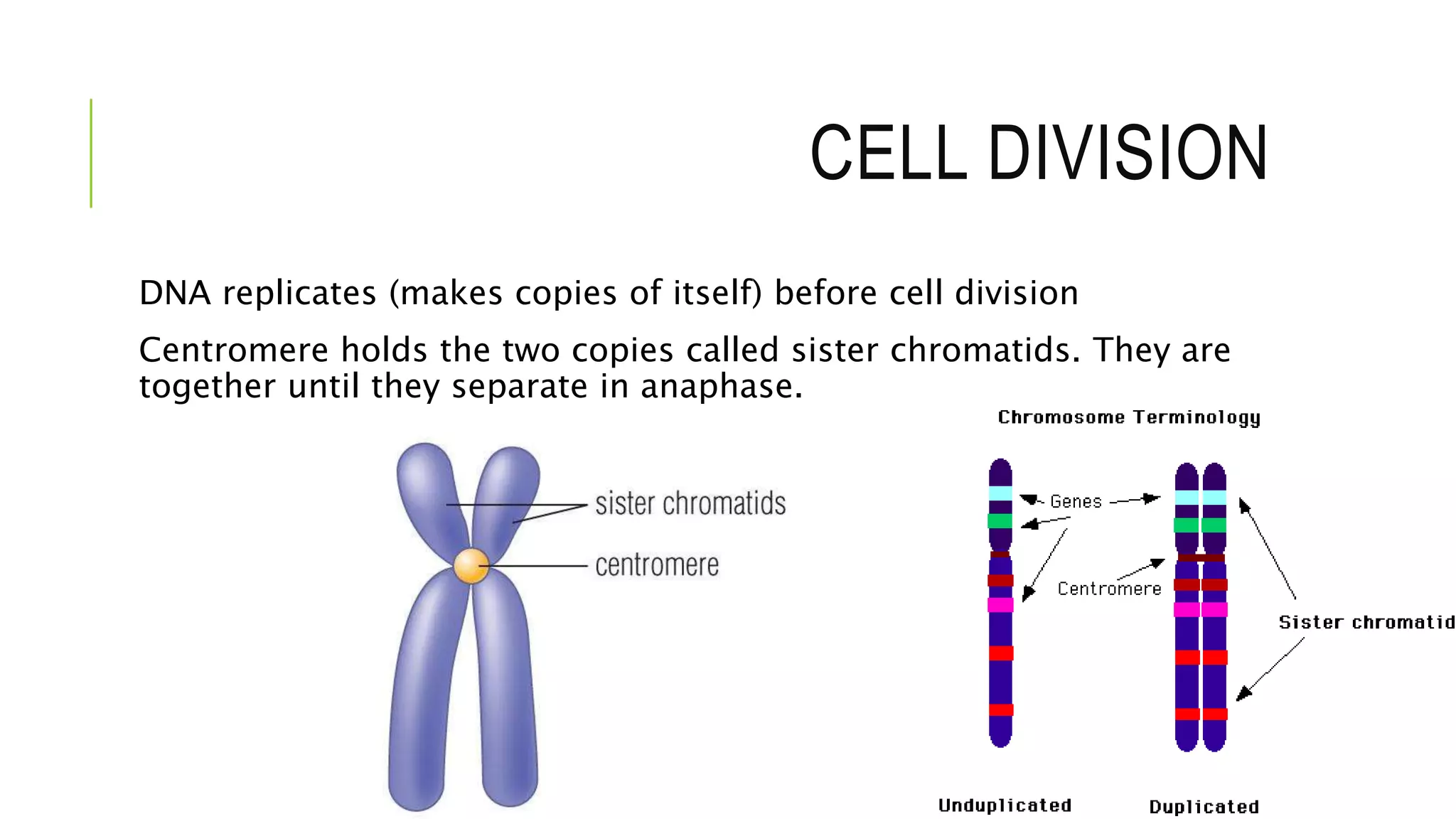
DNA replicates (makes copies of itself) before cell division
Centromere holds the two copies called sister chromatids. They are
together until they separate in anaphase.
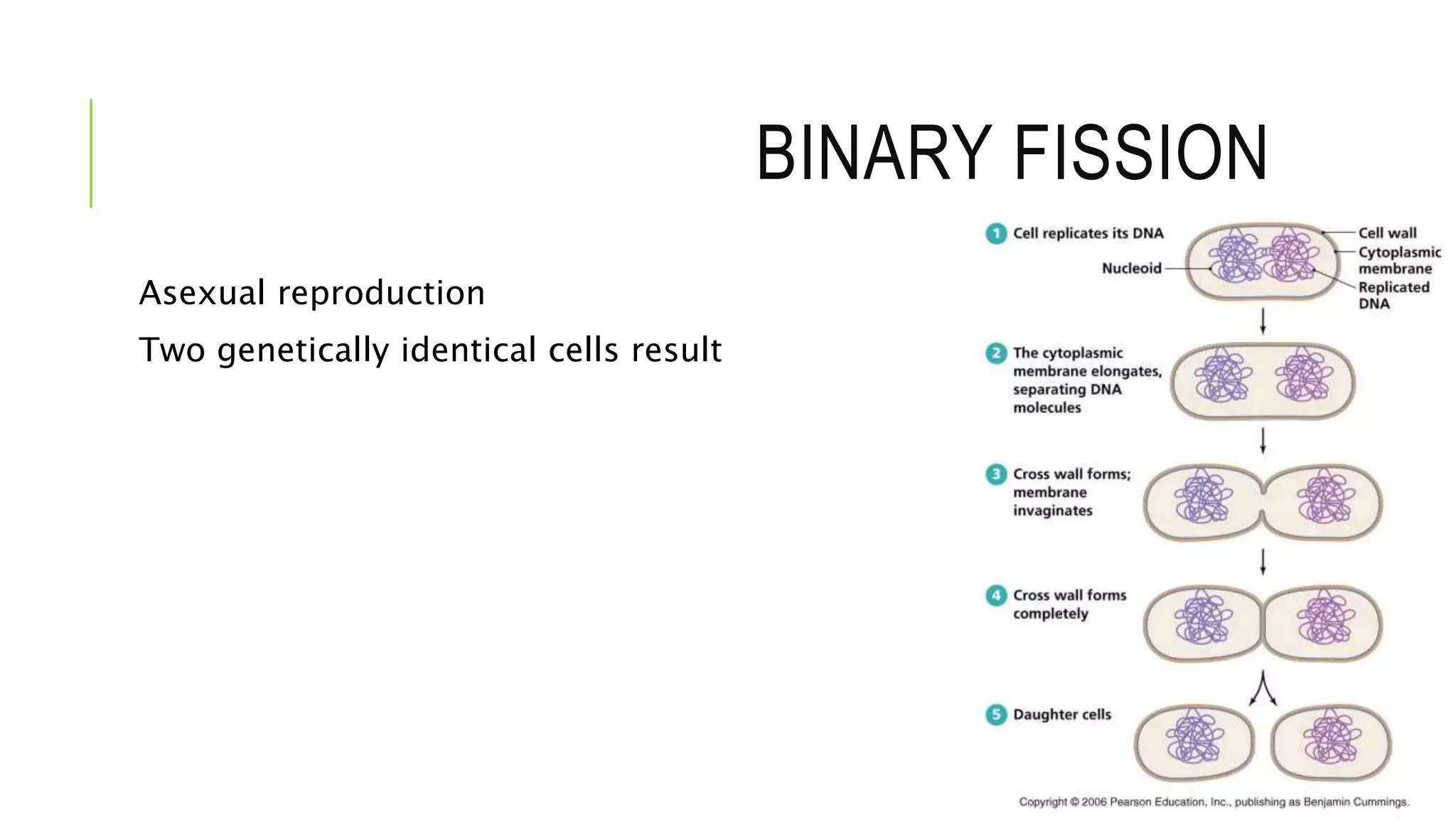
BINARY FISSION
Asexual reproduction
Two genetically identical cells result
CELL DIVISION IN EUKARYOTES
The trillions of cells that make up your body came from just one
original cell called a zygote (fertilized egg)
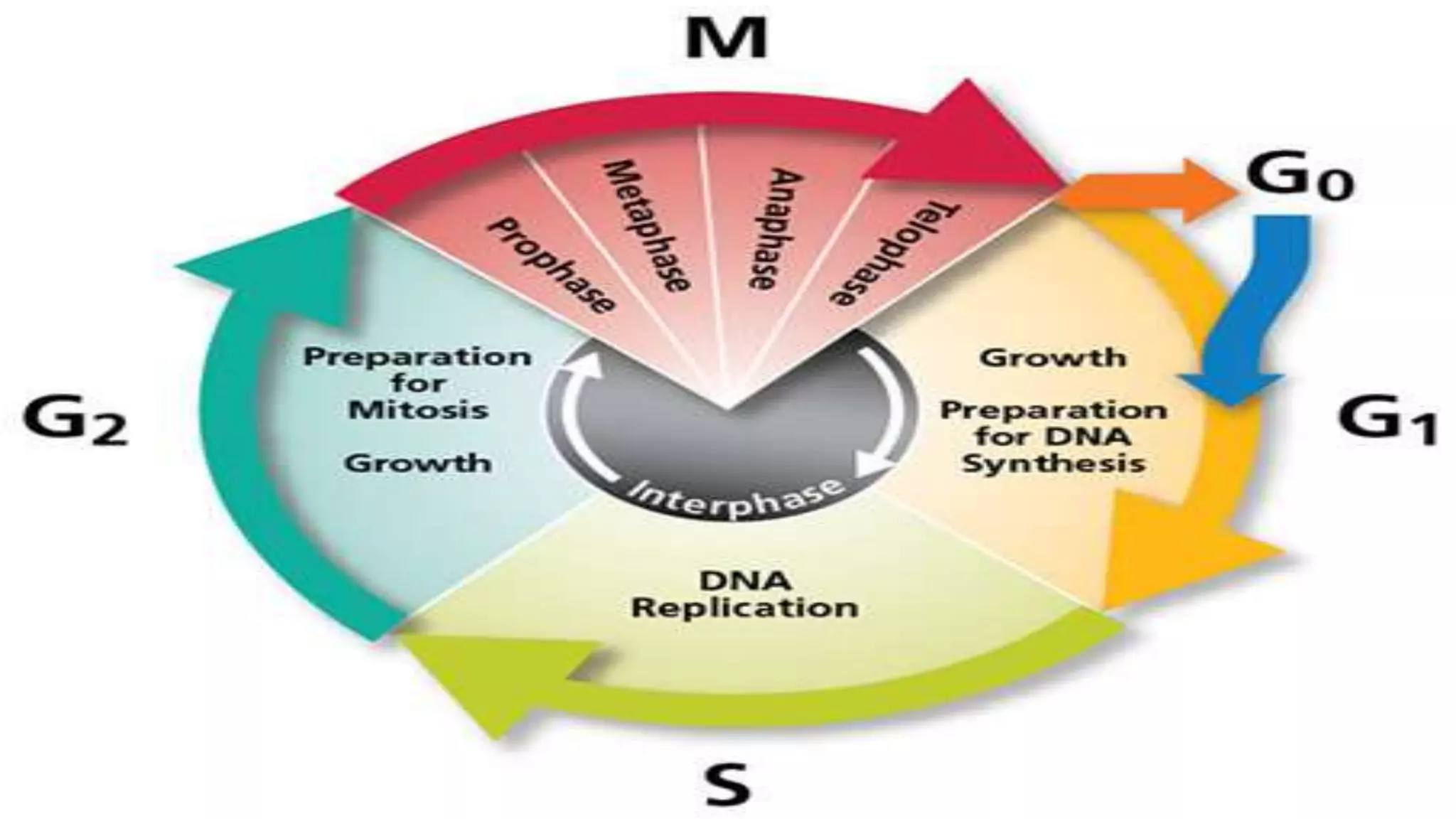
CELL CYCLE
The series of events that cells go through as they grow and divide
During the cell cycle:
A cell grow and undergoes normal cell processes
Prepares for cell division
Divides to form two daughter cells, each of which begins the
cycle again
The cell cycle consists of 4 phases
G1 (first gap phase)
S Phase (synthesis)
G2 (second gap phase)
M Phase (mitosis)
INTERPHASE
Period of growth between cell divisions
Longest phase in the cell cycle
DNA replicates during interphase
During G1, the cell:
Increases in size
Synthesizes new proteins and organelles
During the S Phase, the cell:
Chromosomes are replicated
During G2, the cell:
Organelles and molecules required for cell division are
produced
Once G2 is complete, the cell is ready to start the M phase -
Mitosis
IMPORTANT CELL STRUCTURES
INVOLVED IN MITOSIS
Chromatid: each strand of a duplicated chromosome
Centromere: the area where each pair of chromatids is joined
Centrioles: tiny structures located in the cytoplasm of animal cells
that help organize the spindle
Spindle: a fanlike microtubule structure that helps separate the
chromatids
MITOSIS
PMAT
P: prophase
M: metaphase
A: anaphase
T: telophase
PROPHASE
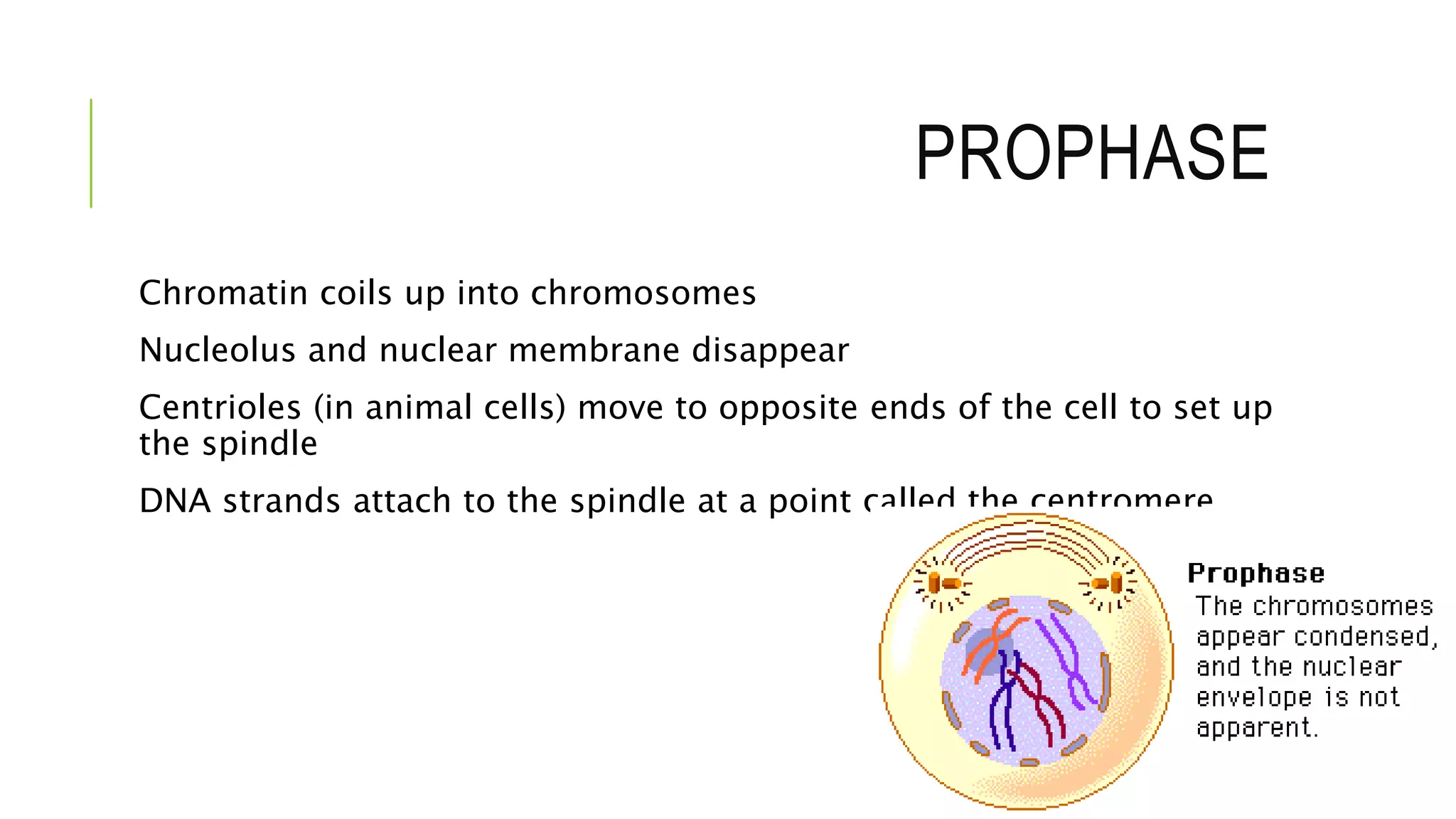
Chromatin coils up into chromosomes
Nucleolus and nuclear membrane disappear
Centrioles (in animal cells) move to opposite ends of the cell to set up
the spindle
DNA strands attach to the spindle at a point called the centromere
METAPHASE
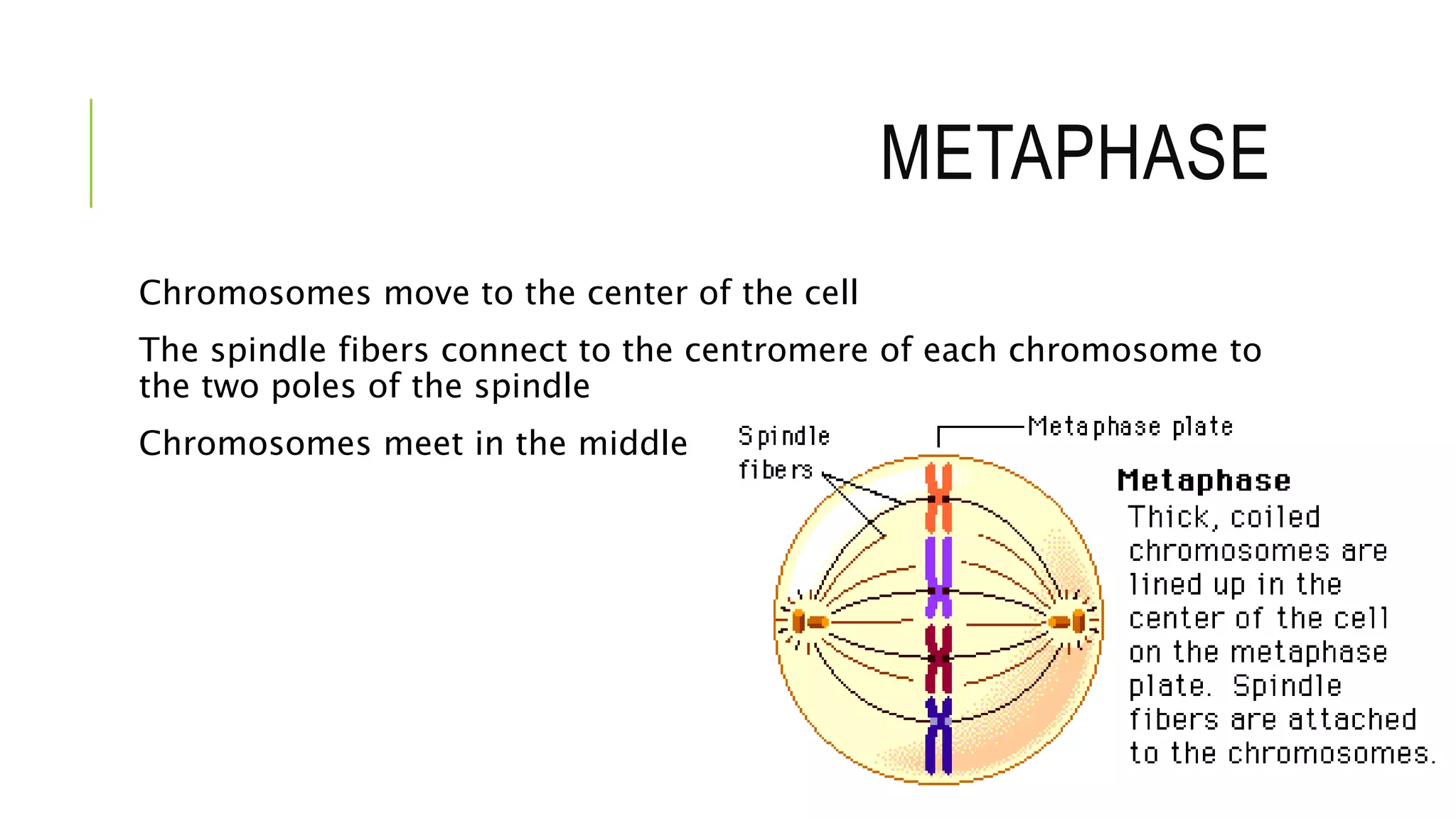
Chromosomes move to the center of the cell
The spindle fibers connect to the centromere of each chromosome to
the two poles of the spindle
Chromosomes meet in the middle
ANAPHASE
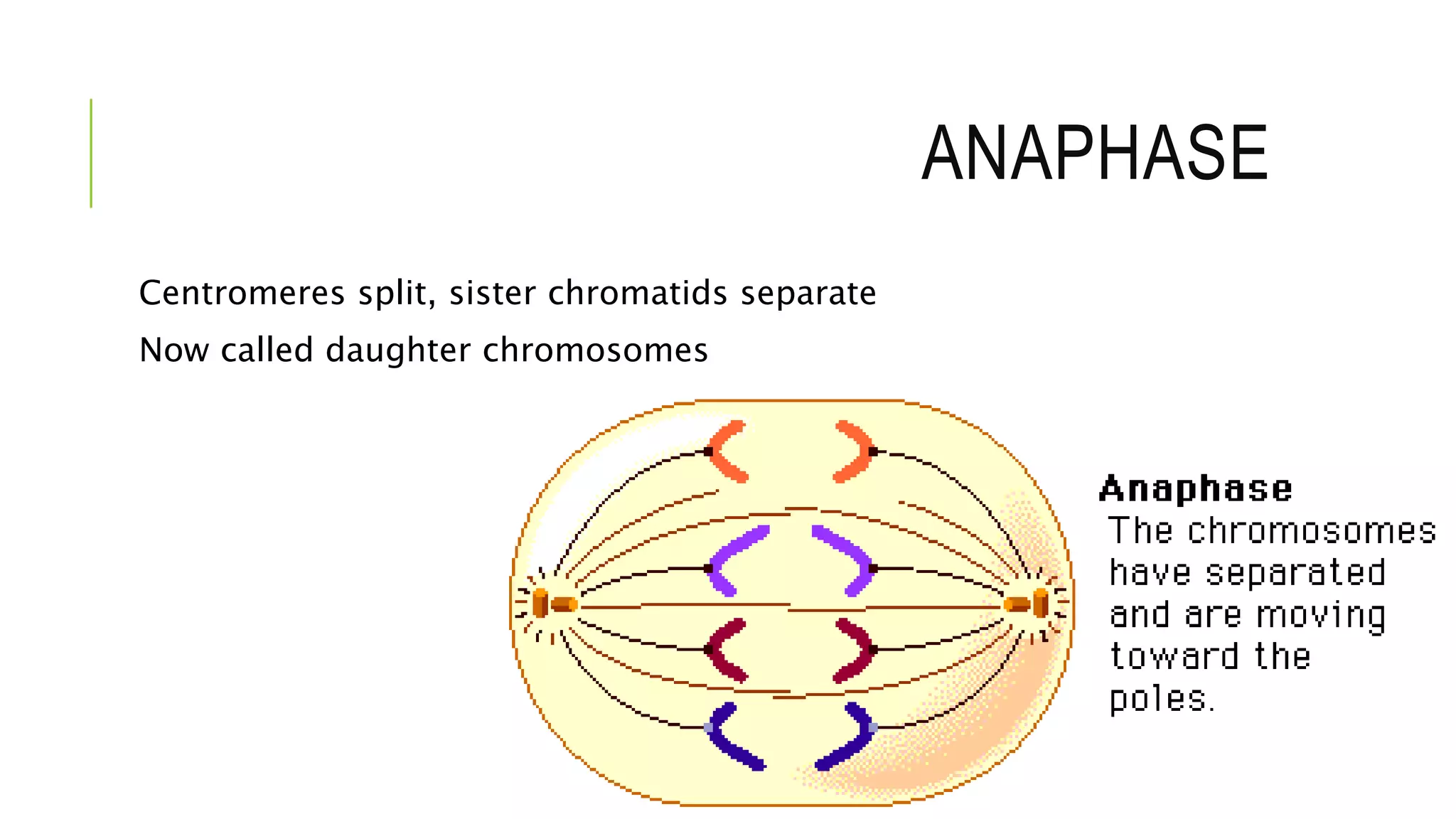
Centromeres split, sister chromatids separate
Now called daughter chromosomes
TELOPHASE
Opposite of prophase
Spindle disappears
Chromosomes uncoil to chromatin
Nuclear membrane and nucleolus reform
Cytokinesis (division of the cytoplasm) begins
Mitosis is the division of the nucleus
CYTOKINESIS
Animal cells: cell membrane pinches in
Plant cells: cell plate forms (becomes new cell)
HOW IS THE CELL CYCLE
CONTROLLED?
Regulatory proteins control cell growth and division
Examples:
Cyclins in eukaryotic cells (internal regulator: something within
the cell has triggered it to divide)
Growth factor that stimulate growth and repair (external
regulator: something outside of the cell triggered the cell to
divide)
APOPTOSIS
A process of programmed cell death
Plays a role in development by shaping the structure of tissues and
organs in the plants and animals.
CANCER
Cancer: mitosis out of control
Often occurs when regulatory proteins do not function correctly
Mass of cells can result called a tumor
TYPES OF TUMORS
Benign: not cancerous (cannot spread to other tissues)
Malignant: cancerous (can spread to other tissues)
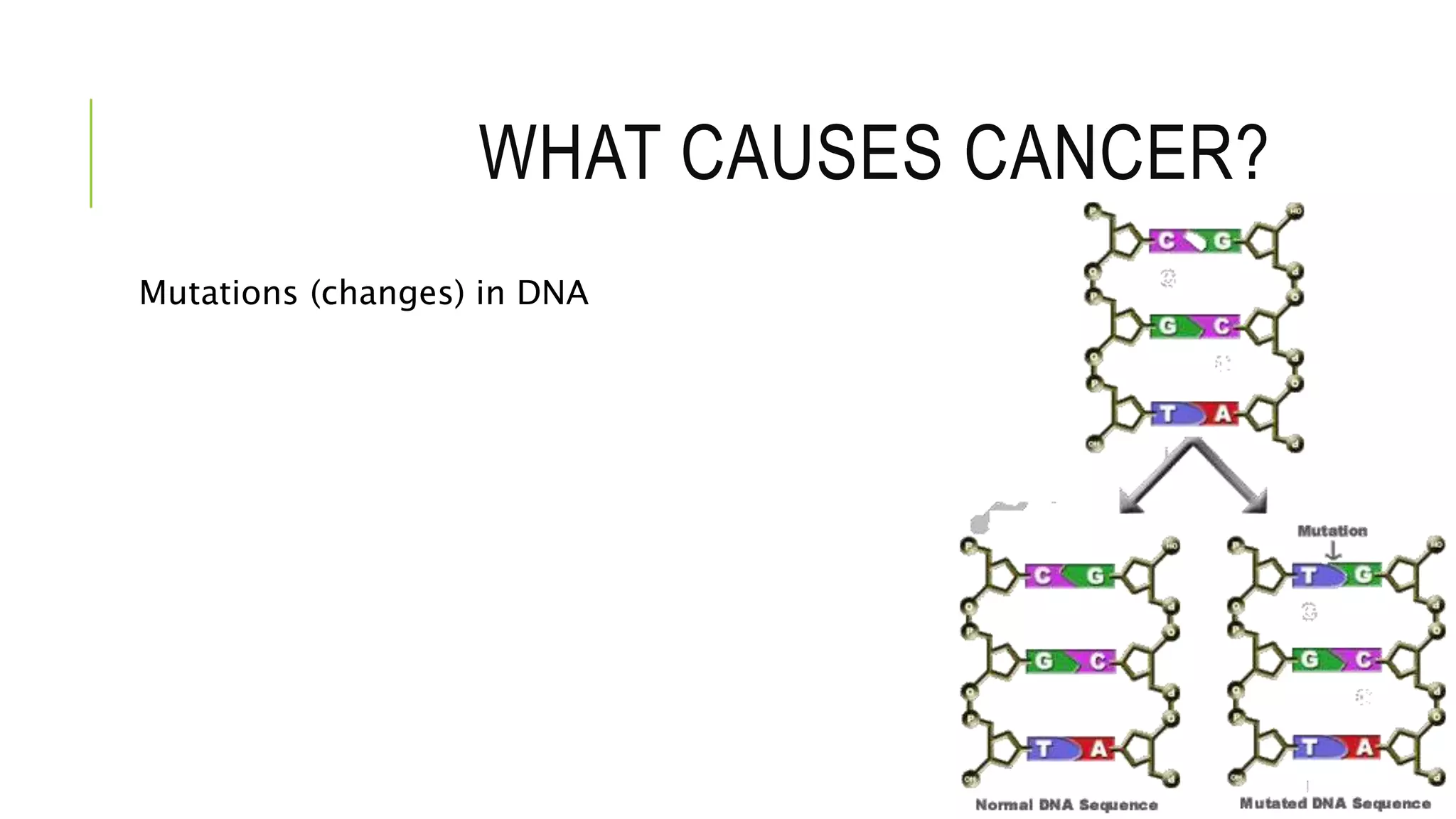
WHAT CAUSES CANCER?
Mutations (changes) in DNA
WHAT CAUSES MUTATIONS THAT
CAN LEAD TO CANCER?
Chemicals (tobacco, asbestos)
Radiation (x-rays, ultraviolet light)
Viruses
CELL DIFFERENTIATION
Your body has over 200 different types of cells
The DNA in every cell is the same
Ho do cells become different from each other?
Only a certain set of genes is actively making proteins in each
cell
STEM CELL
Totipotent: cells that have not turned off any genes (DNA) yet
Able to become whatever cell is needed
Stem cells
Fertilized egg (zygote) is totipotent
PLURIPOTENT
Cells where some genes have turned off
Can develop into most (but not all) of the body’s cell types
MULTIPOTENT
Adult stem cells can develop into may types of cells but not as many
as pluripotent embryonic stem cells.

Chapter 10

  • 1.
    CHAPTER 10: CELL GROWTH& DIVISION By Maddi Montgomery
  • 2.
    WHY DO CELLSNEED TO DIVIDE? The larger a cell becomes  The more demands the cell places on its DNA  The cell has more trouble moving enough nutrients and waste across the cell membrane  The surface area of the cell is not large enough in comparison to the cell’s volume
  • 3.
    BEFORE A CELLGETS TOO LARGE… It divides into two new daughter cells in a process called cell division. Before cell division, the cell copies (replicates) all of its DNA. It then divides into two new daughter cells. Each daughter cell receives a complete set of DNA.
  • 4.
    REPRODUCTION Asexual = oneparent. Sexual = two parents  New combinations of DNA
  • 5.
    Asexual Sexual Produces genetically identicaloffspring Produced genetically diverse offspring Reproduction is quick and produces a large number of offspring Genetic diversity helps ensure survival of species when
  • 6.
    CHROMOSOMES Long pieces ofDNA (many genes) Humans: 23 chromosomes in sperm (dad) and 23 chromosomes from egg (mom)
  • 7.
    PROKARYOTIC VS EUKARYOTIC DNA Prokaryotes:one piece of circular DNA Only one circular chromosome Eukaryotes: 46 chromosomes Occur in pairs (23 pairs, so 46 chromosomes) Linear shape
  • 8.
    CHROMATIN VS CHROMOSOMES Whena cell is not dividing (during interphase) DNA is chromatin (looks like spaghetti When a cell is dividing (mitosis) DNA is chromosomes
  • 9.
    CELL DIVISION DNA replicates(makes copies of itself) before cell division Centromere holds the two copies called sister chromatids. They are together until they separate in anaphase.
  • 10.
    BINARY FISSION Asexual reproduction Twogenetically identical cells result
  • 11.
    CELL DIVISION INEUKARYOTES The trillions of cells that make up your body came from just one original cell called a zygote (fertilized egg)
  • 12.
    CELL CYCLE The seriesof events that cells go through as they grow and divide During the cell cycle: A cell grow and undergoes normal cell processes Prepares for cell division Divides to form two daughter cells, each of which begins the cycle again The cell cycle consists of 4 phases G1 (first gap phase) S Phase (synthesis) G2 (second gap phase) M Phase (mitosis)
  • 14.
    INTERPHASE Period of growthbetween cell divisions Longest phase in the cell cycle DNA replicates during interphase During G1, the cell: Increases in size Synthesizes new proteins and organelles During the S Phase, the cell: Chromosomes are replicated During G2, the cell: Organelles and molecules required for cell division are produced Once G2 is complete, the cell is ready to start the M phase - Mitosis
  • 15.
    IMPORTANT CELL STRUCTURES INVOLVEDIN MITOSIS Chromatid: each strand of a duplicated chromosome Centromere: the area where each pair of chromatids is joined Centrioles: tiny structures located in the cytoplasm of animal cells that help organize the spindle Spindle: a fanlike microtubule structure that helps separate the chromatids
  • 16.
  • 17.
    PROPHASE Chromatin coils upinto chromosomes Nucleolus and nuclear membrane disappear Centrioles (in animal cells) move to opposite ends of the cell to set up the spindle DNA strands attach to the spindle at a point called the centromere
  • 18.
    METAPHASE Chromosomes move tothe center of the cell The spindle fibers connect to the centromere of each chromosome to the two poles of the spindle Chromosomes meet in the middle
  • 19.
    ANAPHASE Centromeres split, sisterchromatids separate Now called daughter chromosomes
  • 20.
    TELOPHASE Opposite of prophase Spindledisappears Chromosomes uncoil to chromatin Nuclear membrane and nucleolus reform Cytokinesis (division of the cytoplasm) begins Mitosis is the division of the nucleus
  • 21.
    CYTOKINESIS Animal cells: cellmembrane pinches in Plant cells: cell plate forms (becomes new cell)
  • 22.
    HOW IS THECELL CYCLE CONTROLLED? Regulatory proteins control cell growth and division Examples: Cyclins in eukaryotic cells (internal regulator: something within the cell has triggered it to divide) Growth factor that stimulate growth and repair (external regulator: something outside of the cell triggered the cell to divide)
  • 23.
    APOPTOSIS A process ofprogrammed cell death Plays a role in development by shaping the structure of tissues and organs in the plants and animals.
  • 24.
    CANCER Cancer: mitosis outof control Often occurs when regulatory proteins do not function correctly Mass of cells can result called a tumor
  • 25.
    TYPES OF TUMORS Benign:not cancerous (cannot spread to other tissues) Malignant: cancerous (can spread to other tissues)
  • 26.
  • 27.
    WHAT CAUSES MUTATIONSTHAT CAN LEAD TO CANCER? Chemicals (tobacco, asbestos) Radiation (x-rays, ultraviolet light) Viruses
  • 28.
    CELL DIFFERENTIATION Your bodyhas over 200 different types of cells The DNA in every cell is the same Ho do cells become different from each other? Only a certain set of genes is actively making proteins in each cell
  • 29.
    STEM CELL Totipotent: cellsthat have not turned off any genes (DNA) yet Able to become whatever cell is needed Stem cells Fertilized egg (zygote) is totipotent
  • 30.
    PLURIPOTENT Cells where somegenes have turned off Can develop into most (but not all) of the body’s cell types
  • 31.
    MULTIPOTENT Adult stem cellscan develop into may types of cells but not as many as pluripotent embryonic stem cells.