Chapter
 10
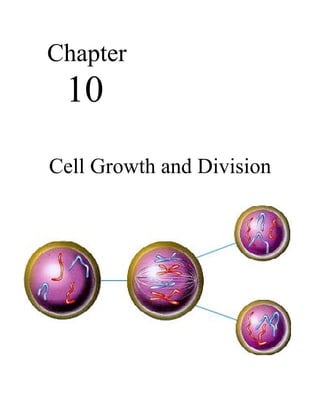
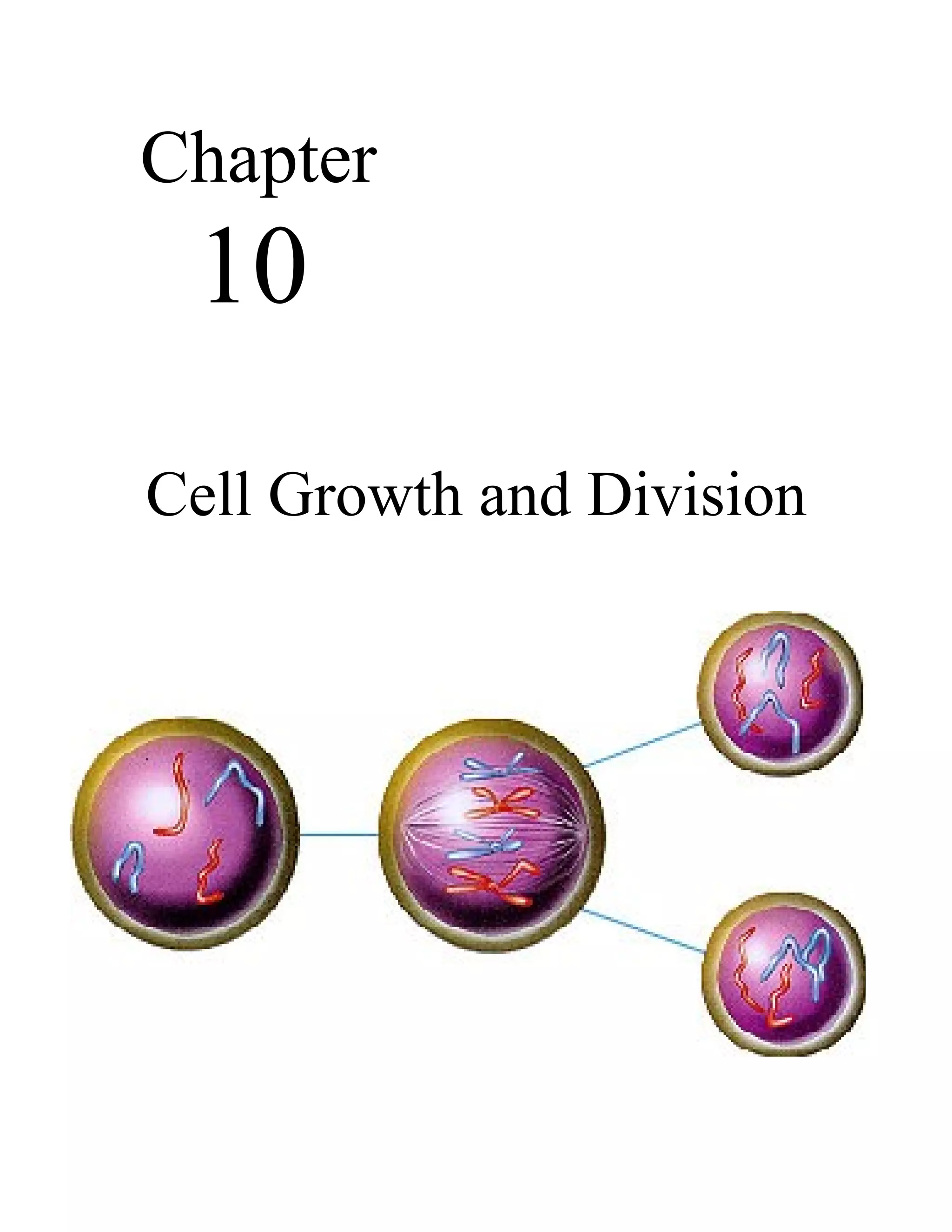
Cell Growth and Division
10-1 Cell Growth
Q: When a living thing grows, what happens to its cells? Do the cells increase in size or
increase in number?

A:

Limits to cell growth

•    There are two main reasons why cells divide rather than continuously grow
     indefinitely
1.

2.

•    If a cell got too large, it would be difficult to get sufficient amounts of oxygen and
     nutrients in and waste products out

Division of a Cell

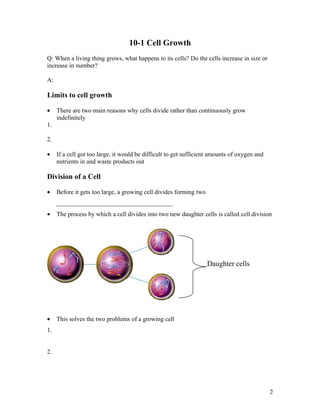
•    Before it gets too large, a growing cell divides forming two
     _____________________________________
•    The process by which a cell divides into two new daughter cells is called cell division


                                                                    Daughter cells


•    This solves the two problems of a growing cell
1.


2.


                                                                                              2
10-2 Cell Division
•    In eukaryotes cell division occurs in two main stages

1.

2.

Chromosomes

•    In eukaryotic cells, the genetic information that is passed on from one generation to
     the next is carried on __________________________________


•    Chromosomes are made of _________________ - which carries the cells coded
     information – and proteins

•    The cells of every organism have a specific number of chromosomes

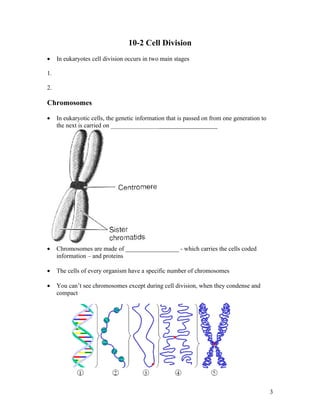
•    You can’t see chromosomes except during cell division, when they condense and
     compact


                                                                                             3
•    Before cell division, each chromosome is replicated, or copied

•    Because of this, each chromosome consists of two identical
     _____________________________________________________
•    When the cell divides, the sister chromatids separate and one chromatid goes to each
     of the two new cells

•    Each pair of chromatids are attached at an area called the centromere

The Cell Cycle

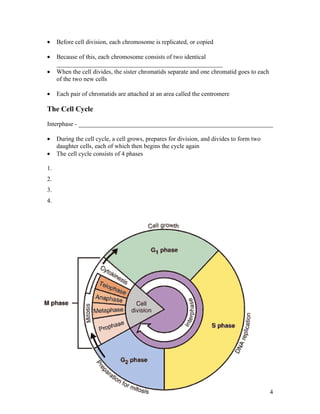
Interphase - ______________________________________________________________

•    During the cell cycle, a cell grows, prepares for division, and divides to form two
     daughter cells, each of which then begins the cycle again
•    The cell cycle consists of 4 phases

1.
2.
3.
4.


                                                                                            4
Events of the Cell Cycle

•   Interphase – can be quite long
•   Cell division takes place quickly
•   Interphase is divided into three phases G1, S, G2

•   G1 –


•   S–


•   G2 –


•   M–


Mitosis

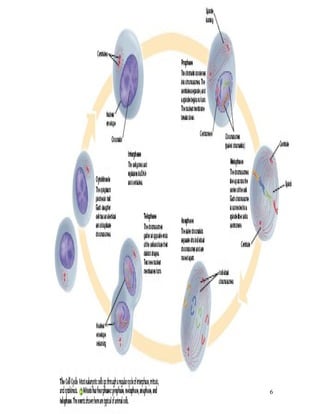
•   The events of mitosis are divided into 4 phases


                                                        5
6
•   The chromatin condenses into _______________________________________
•   The ______________________________________ separate
•   A _________________________________ begins to form
•   The __________________________________________________________ breaks
    down


Metaphase

•   Chromosomes line up down the middle of the cell
•   Each chromosome is connected to a _______________________________________
    at its centromere


Anaphase

•   The centromeres that join the sister chromatids split, allowing the sister chromatids to
    separate
•   The chromosomes continue to move until they have separated into two groups near
    the poles of the spindle


Telophase

•   Chromosomes begin to disperse into a tangle of dense material


                                                                                           7
•   A ___________________________________________________ re-forms
•   _________________________________ becomes visible


Cytokinesis

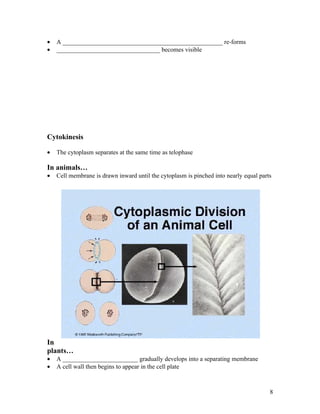
•   The cytoplasm separates at the same time as telophase

In animals…
•   Cell membrane is drawn inward until the cytoplasm is pinched into nearly equal parts


In
plants…
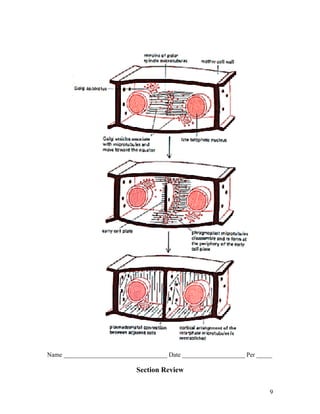
•   A ________________________ gradually develops into a separating membrane
•   A cell wall then begins to appear in the cell plate


                                                                                       8
Name _________________________________ Date ____________________ Per _____

                             Section Review

                                                                         9
1. Name the main events of the cell cycle.


2. Describe what happens during each of the four phases of mitosis.


3. Describe what happens during interphase.


4. What are chromosomes made of?


5. How do prokaryotic cells divide?


6. How is cytokinesis in plant cells similar to cytokinesis in animal cells? How is it
   different?


Life Spans of Human Cells
Like all organisms, cells have a given life span from birth to death. In multicellular
organisms, such as humans, the health of the organism depends on cells not exceeding
their life span. This is especially true of cells that tend to divide rapidly. If these cells did


                                                                                               10
not die on schedule, overcrowding of cells would occur, causing uncontrolled growth that
would be life-threatening.
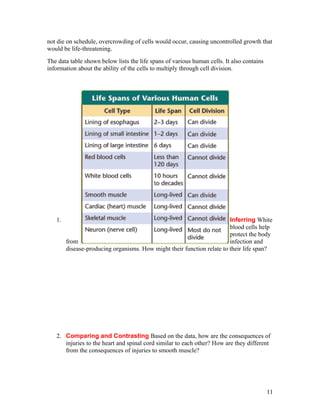
The data table shown below lists the life spans of various human cells. It also contains
information about the ability of the cells to multiply through cell division.


   1.                                                                   Inferring White
                                                                        blood cells help
                                                                        protect the body
        from                                                            infection and
        disease-producing organisms. How might their function relate to their life span?


   2. Comparing and Contrasting Based on the data, how are the consequences of
      injuries to the heart and spinal cord similar to each other? How are they different
      from the consequences of injuries to smooth muscle?


                                                                                           11
3. Formulating Hypotheses Propose a hypothesis to account for the data related
     to the cell life spans of the lining of the esophagus, small intestine, and large
     intestine.


  4. Going Further Cancer is a disease related to cell life span and cell division. If
     cancer cells were added to the data table, predict what would be written under the
     columns headed “Life Span” and “Cell Division.” Explain the reasoning
     underlying your predictions.


                     10 – 3 Regulating the Cell Cycle
Controls on Cell Division


                                                                                     12
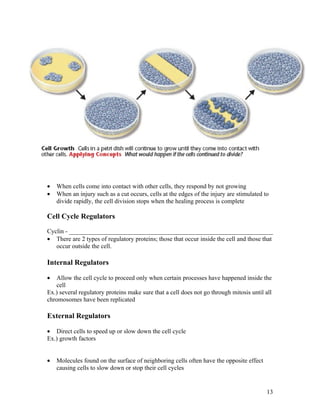
•   When cells come into contact with other cells, they respond by not growing
•   When an injury such as a cut occurs, cells at the edges of the injury are stimulated to
    divide rapidly, the cell division stops when the healing process is complete

Cell Cycle Regulators

Cyclin - _________________________________________________________________
• There are 2 types of regulatory proteins; those that occur inside the cell and those that
   occur outside the cell.

Internal Regulators

•  Allow the cell cycle to proceed only when certain processes have happened inside the
   cell
Ex.) several regulatory proteins make sure that a cell does not go through mitosis until all
chromosomes have been replicated

External Regulators

• Direct cells to speed up or slow down the cell cycle
Ex.) growth factors


•   Molecules found on the surface of neighboring cells often have the opposite effect
    causing cells to slow down or stop their cell cycles


                                                                                          13
•    These signals prevent excessive cell growth

Uncontrolled Cell Growth

•    The consequences of uncontrolled cell growth are very severe

Cancer - ________________________________________________________________
_______________________________________________________________________

• When cells divide uncontrollably, masses of cells called _______________________
can damage the surrounding tissues
• Cancer cells may break loose from tumors and spread throughout the body


Q: What causes the loss of growth control?

A:


All cancers have one thing in common: ________________________________________
_______________________________________________________________________
_

•    Some cancer cells will no longer respond to external growth regulators
•    Others fail to produce the internal regulators that ensure orderly growth

p53

•    An astonishing number of cancer cells have a defect in a gene called p53
•    p53 normally halts the cell cycle until all the chromosomes have been properly
     replicated
•    if we could fix p53 we could cure many forms of cancer

Is a cure in sight?

•    Cancer is a serious disease
•    As difficult as a cure would be, at least scientists know where to start
•    Cancer is a disease of the ____________________________________, and
     conquering cancer will require a much deeper understanding of the processes that
     control cell division


                                                                                        14
1. What chemicals regulate the cell cycle? How do they work?


2. What happens when cells do not respond to the signals that normally regulate their
   growth?


3. How do cells respond to contact with other cells?


4. Why can cancer be considered a disease of the cell cycle?


5. Critical Thinking Formulating Hypotheses Write a hypothesis about what you
   think would happen if cyclin were injected into a cell that was in mitosis.


 Designing an Anticancer Drug
 Imagine that you are developing a drug that will inhibit the growth of cancer cells.
 Use your knowledge of the cell cycle to describe how the drug would target and
 prevent the multiplication of cancer cells. Use the Internet to compare your anticancer
 treatment with those currently in use.


Name __________________________________ Date ____________________ Per ____


                                                                                           15
16

Biology - Chp10 - Cell Growth and Reproduction - Notes

  • 1.
  • 2.
    10-1 Cell Growth Q:When a living thing grows, what happens to its cells? Do the cells increase in size or increase in number? A: Limits to cell growth • There are two main reasons why cells divide rather than continuously grow indefinitely 1. 2. • If a cell got too large, it would be difficult to get sufficient amounts of oxygen and nutrients in and waste products out Division of a Cell • Before it gets too large, a growing cell divides forming two _____________________________________ • The process by which a cell divides into two new daughter cells is called cell division Daughter cells • This solves the two problems of a growing cell 1. 2. 2
  • 3.
    10-2 Cell Division • In eukaryotes cell division occurs in two main stages 1. 2. Chromosomes • In eukaryotic cells, the genetic information that is passed on from one generation to the next is carried on __________________________________ • Chromosomes are made of _________________ - which carries the cells coded information – and proteins • The cells of every organism have a specific number of chromosomes • You can’t see chromosomes except during cell division, when they condense and compact 3
  • 4.
    Before cell division, each chromosome is replicated, or copied • Because of this, each chromosome consists of two identical _____________________________________________________ • When the cell divides, the sister chromatids separate and one chromatid goes to each of the two new cells • Each pair of chromatids are attached at an area called the centromere The Cell Cycle Interphase - ______________________________________________________________ • During the cell cycle, a cell grows, prepares for division, and divides to form two daughter cells, each of which then begins the cycle again • The cell cycle consists of 4 phases 1. 2. 3. 4. 4
  • 5.
    Events of theCell Cycle • Interphase – can be quite long • Cell division takes place quickly • Interphase is divided into three phases G1, S, G2 • G1 – • S– • G2 – • M– Mitosis • The events of mitosis are divided into 4 phases 5
  • 6.
  • 7.
    The chromatin condenses into _______________________________________ • The ______________________________________ separate • A _________________________________ begins to form • The __________________________________________________________ breaks down Metaphase • Chromosomes line up down the middle of the cell • Each chromosome is connected to a _______________________________________ at its centromere Anaphase • The centromeres that join the sister chromatids split, allowing the sister chromatids to separate • The chromosomes continue to move until they have separated into two groups near the poles of the spindle Telophase • Chromosomes begin to disperse into a tangle of dense material 7
  • 8.
    A ___________________________________________________ re-forms • _________________________________ becomes visible Cytokinesis • The cytoplasm separates at the same time as telophase In animals… • Cell membrane is drawn inward until the cytoplasm is pinched into nearly equal parts In plants… • A ________________________ gradually develops into a separating membrane • A cell wall then begins to appear in the cell plate 8
  • 9.
    Name _________________________________ Date____________________ Per _____ Section Review 9
  • 10.
    1. Name themain events of the cell cycle. 2. Describe what happens during each of the four phases of mitosis. 3. Describe what happens during interphase. 4. What are chromosomes made of? 5. How do prokaryotic cells divide? 6. How is cytokinesis in plant cells similar to cytokinesis in animal cells? How is it different? Life Spans of Human Cells Like all organisms, cells have a given life span from birth to death. In multicellular organisms, such as humans, the health of the organism depends on cells not exceeding their life span. This is especially true of cells that tend to divide rapidly. If these cells did 10
  • 11.
    not die onschedule, overcrowding of cells would occur, causing uncontrolled growth that would be life-threatening. The data table shown below lists the life spans of various human cells. It also contains information about the ability of the cells to multiply through cell division. 1. Inferring White blood cells help protect the body from infection and disease-producing organisms. How might their function relate to their life span? 2. Comparing and Contrasting Based on the data, how are the consequences of injuries to the heart and spinal cord similar to each other? How are they different from the consequences of injuries to smooth muscle? 11
  • 12.
    3. Formulating HypothesesPropose a hypothesis to account for the data related to the cell life spans of the lining of the esophagus, small intestine, and large intestine. 4. Going Further Cancer is a disease related to cell life span and cell division. If cancer cells were added to the data table, predict what would be written under the columns headed “Life Span” and “Cell Division.” Explain the reasoning underlying your predictions. 10 – 3 Regulating the Cell Cycle Controls on Cell Division 12
  • 13.
    When cells come into contact with other cells, they respond by not growing • When an injury such as a cut occurs, cells at the edges of the injury are stimulated to divide rapidly, the cell division stops when the healing process is complete Cell Cycle Regulators Cyclin - _________________________________________________________________ • There are 2 types of regulatory proteins; those that occur inside the cell and those that occur outside the cell. Internal Regulators • Allow the cell cycle to proceed only when certain processes have happened inside the cell Ex.) several regulatory proteins make sure that a cell does not go through mitosis until all chromosomes have been replicated External Regulators • Direct cells to speed up or slow down the cell cycle Ex.) growth factors • Molecules found on the surface of neighboring cells often have the opposite effect causing cells to slow down or stop their cell cycles 13
  • 14.
    These signals prevent excessive cell growth Uncontrolled Cell Growth • The consequences of uncontrolled cell growth are very severe Cancer - ________________________________________________________________ _______________________________________________________________________ • When cells divide uncontrollably, masses of cells called _______________________ can damage the surrounding tissues • Cancer cells may break loose from tumors and spread throughout the body Q: What causes the loss of growth control? A: All cancers have one thing in common: ________________________________________ _______________________________________________________________________ _ • Some cancer cells will no longer respond to external growth regulators • Others fail to produce the internal regulators that ensure orderly growth p53 • An astonishing number of cancer cells have a defect in a gene called p53 • p53 normally halts the cell cycle until all the chromosomes have been properly replicated • if we could fix p53 we could cure many forms of cancer Is a cure in sight? • Cancer is a serious disease • As difficult as a cure would be, at least scientists know where to start • Cancer is a disease of the ____________________________________, and conquering cancer will require a much deeper understanding of the processes that control cell division 14
  • 15.
    1. What chemicalsregulate the cell cycle? How do they work? 2. What happens when cells do not respond to the signals that normally regulate their growth? 3. How do cells respond to contact with other cells? 4. Why can cancer be considered a disease of the cell cycle? 5. Critical Thinking Formulating Hypotheses Write a hypothesis about what you think would happen if cyclin were injected into a cell that was in mitosis. Designing an Anticancer Drug Imagine that you are developing a drug that will inhibit the growth of cancer cells. Use your knowledge of the cell cycle to describe how the drug would target and prevent the multiplication of cancer cells. Use the Internet to compare your anticancer treatment with those currently in use. Name __________________________________ Date ____________________ Per ____ 15
  • 16.