CHAPTER
8
Motivation
and Emotion
Copyright ©
Pearson Education 2013
Diversity-
Universality
Stability-Change
Mind-Body
Nature-Nurture
Person-Situation
Enduring Issues
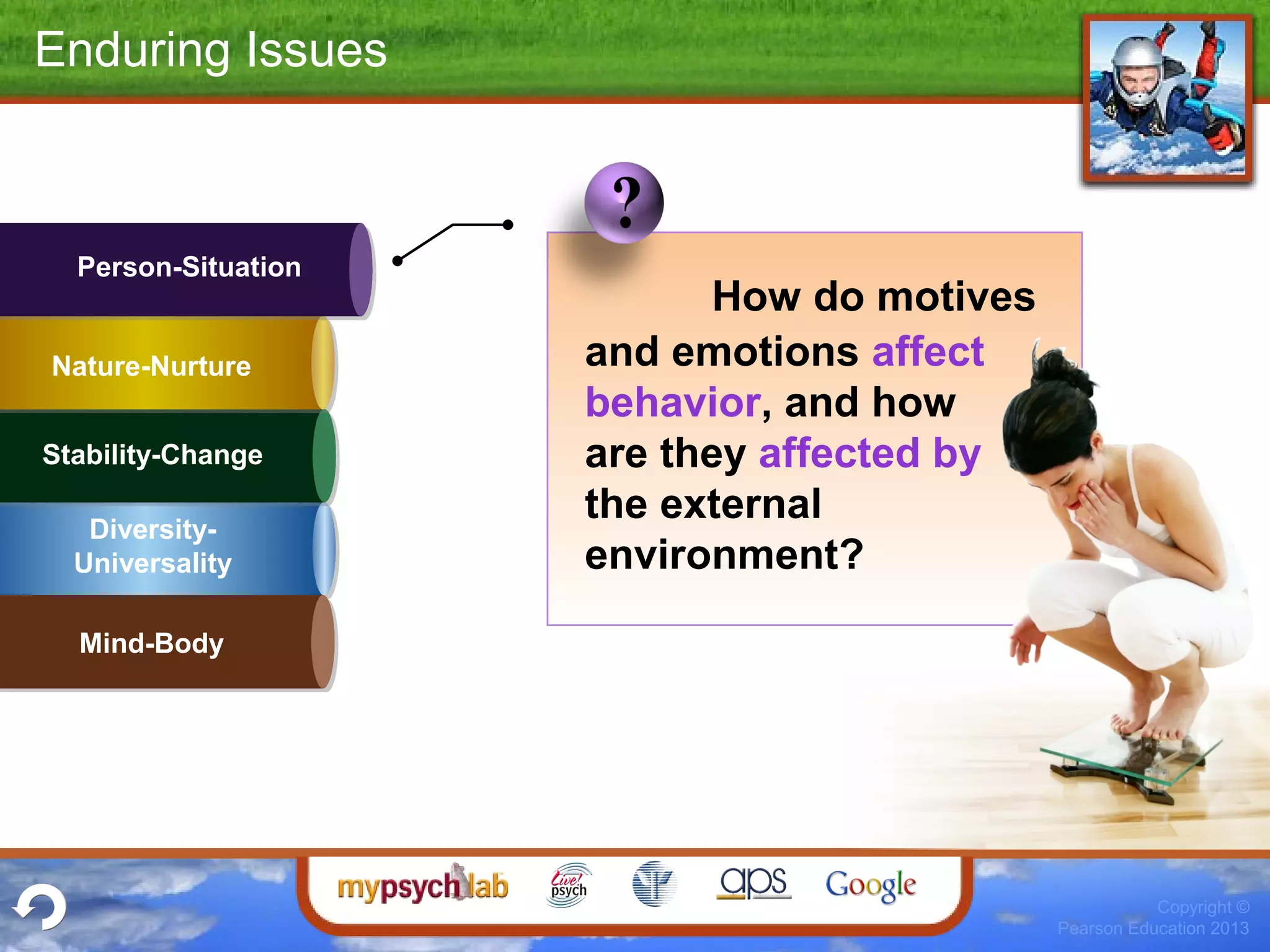
How do motives
and emotions affect
behavior, and how
are they affected by
the external
environment?
Copyright ©
Pearson Education 2013
Diversity-
Universality
Stability-Change
Mind-Body
Nature-Nurture
Person-Situation
Enduring Issues
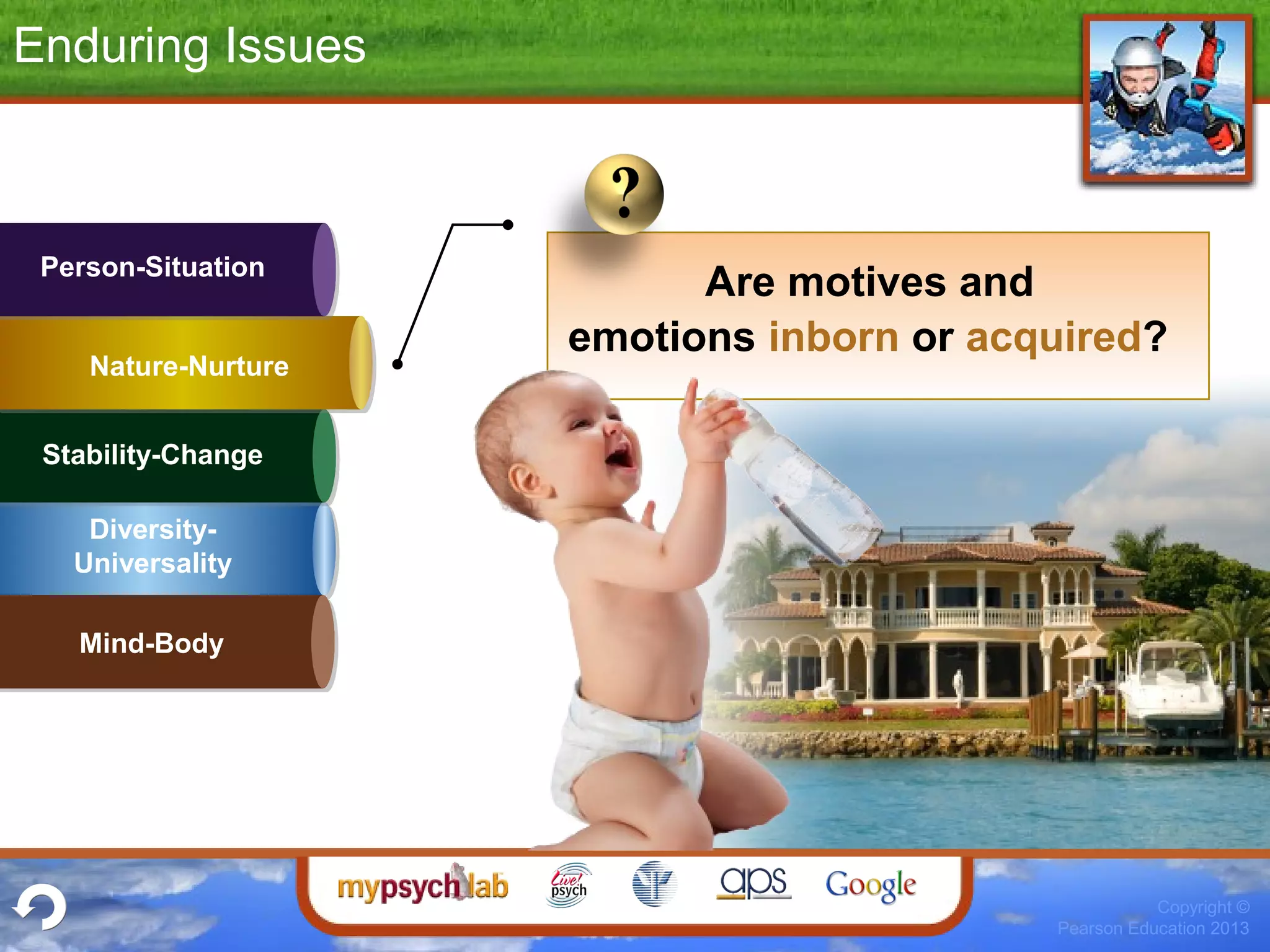
Are motives and
emotions inborn or acquired?
Copyright ©
Pearson Education 2013
Diversity-
Universality
Stability-Change
Mind-Body
Nature-Nurture
Person-Situation
Enduring Issues
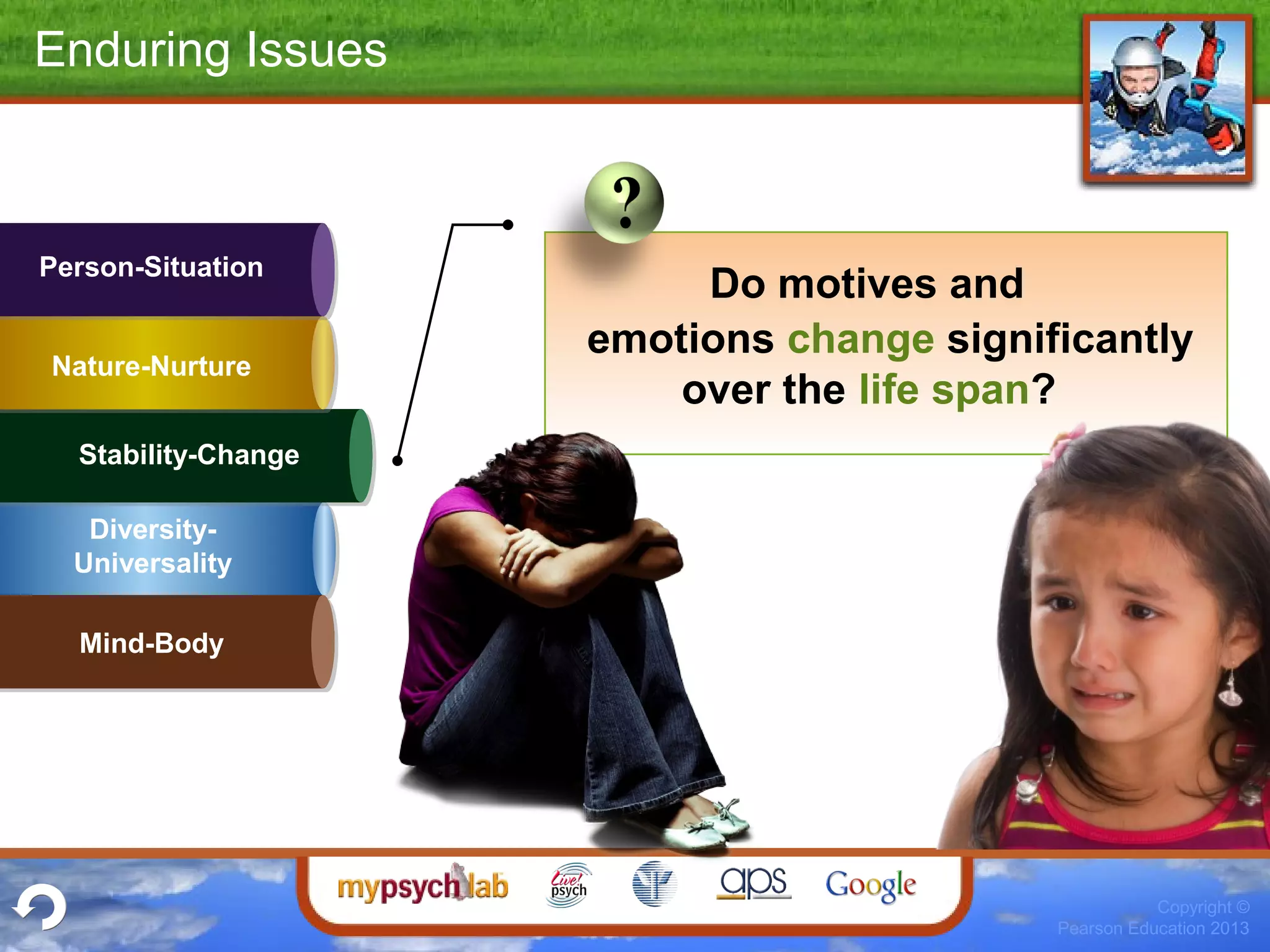
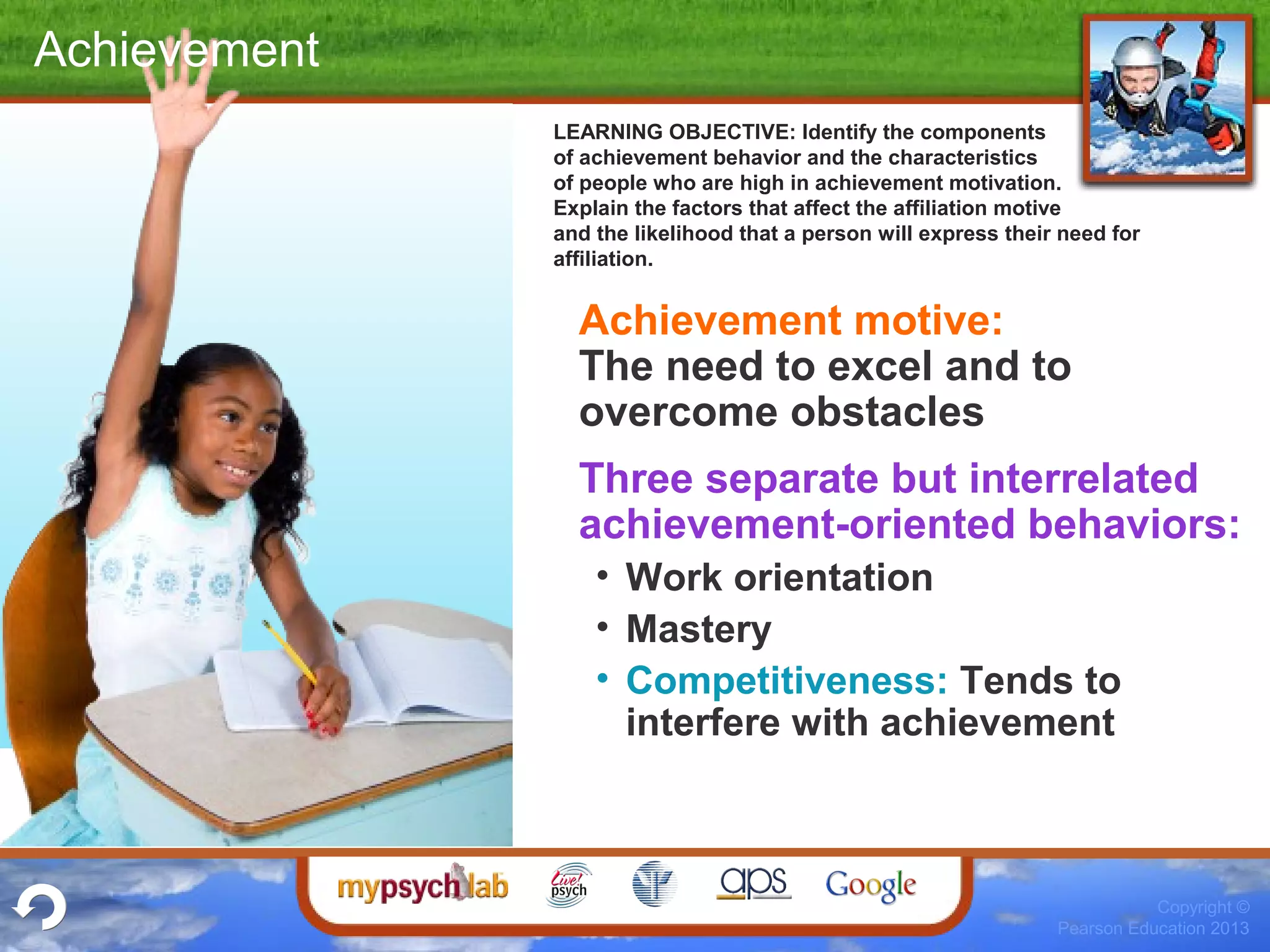
Do motives and
emotions change significantly
over the life span?
Copyright ©
Pearson Education 2013
Diversity-
Universality
Stability-Change
Mind-Body
Nature-Nurture
Person-Situation
Enduring Issues
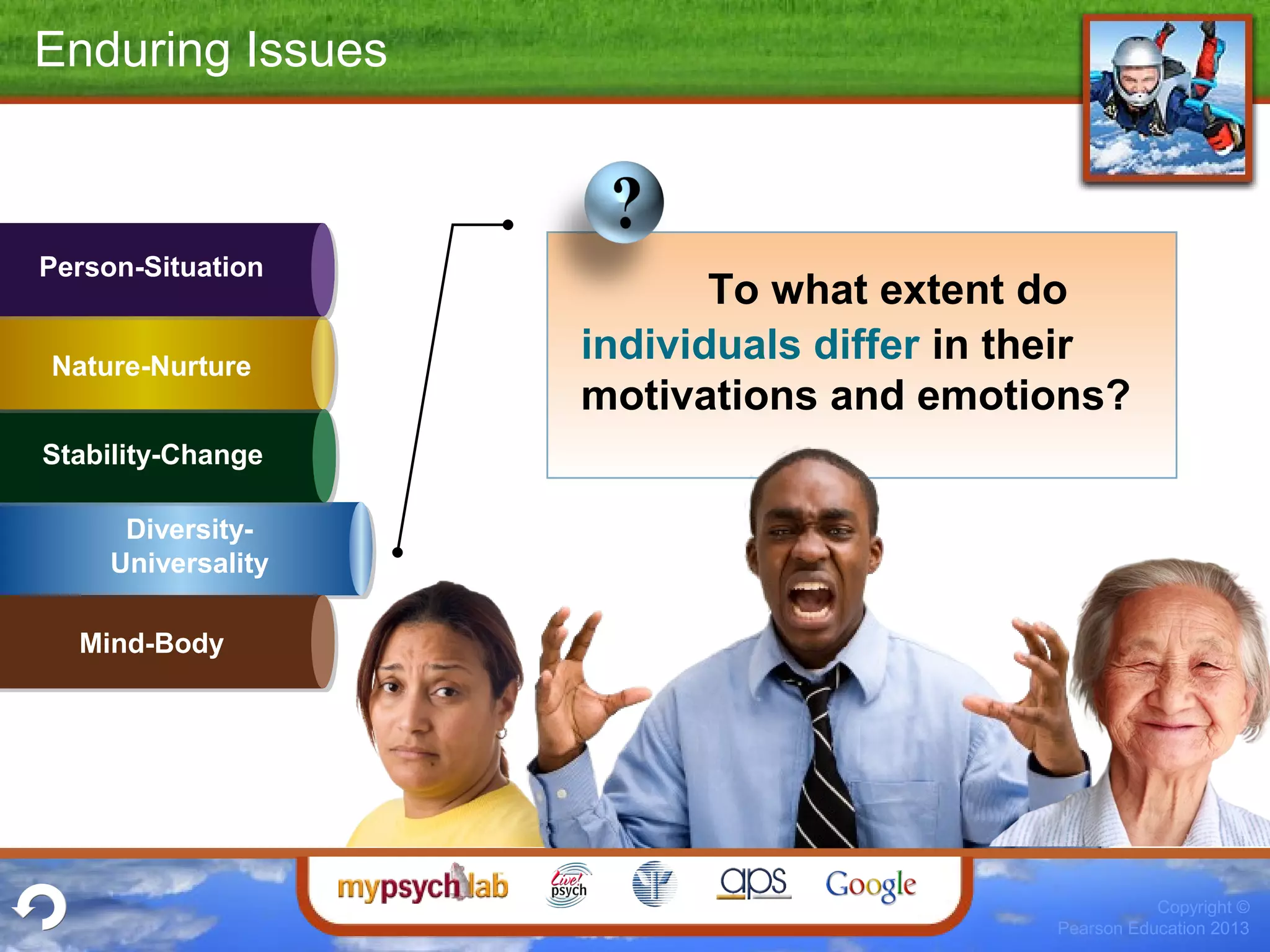
To what extent do
individuals differ in their
motivations and emotions?
Copyright ©
Pearson Education 2013
Diversity-
Universality
Stability-Change
Mind-Body
Nature-Nurture
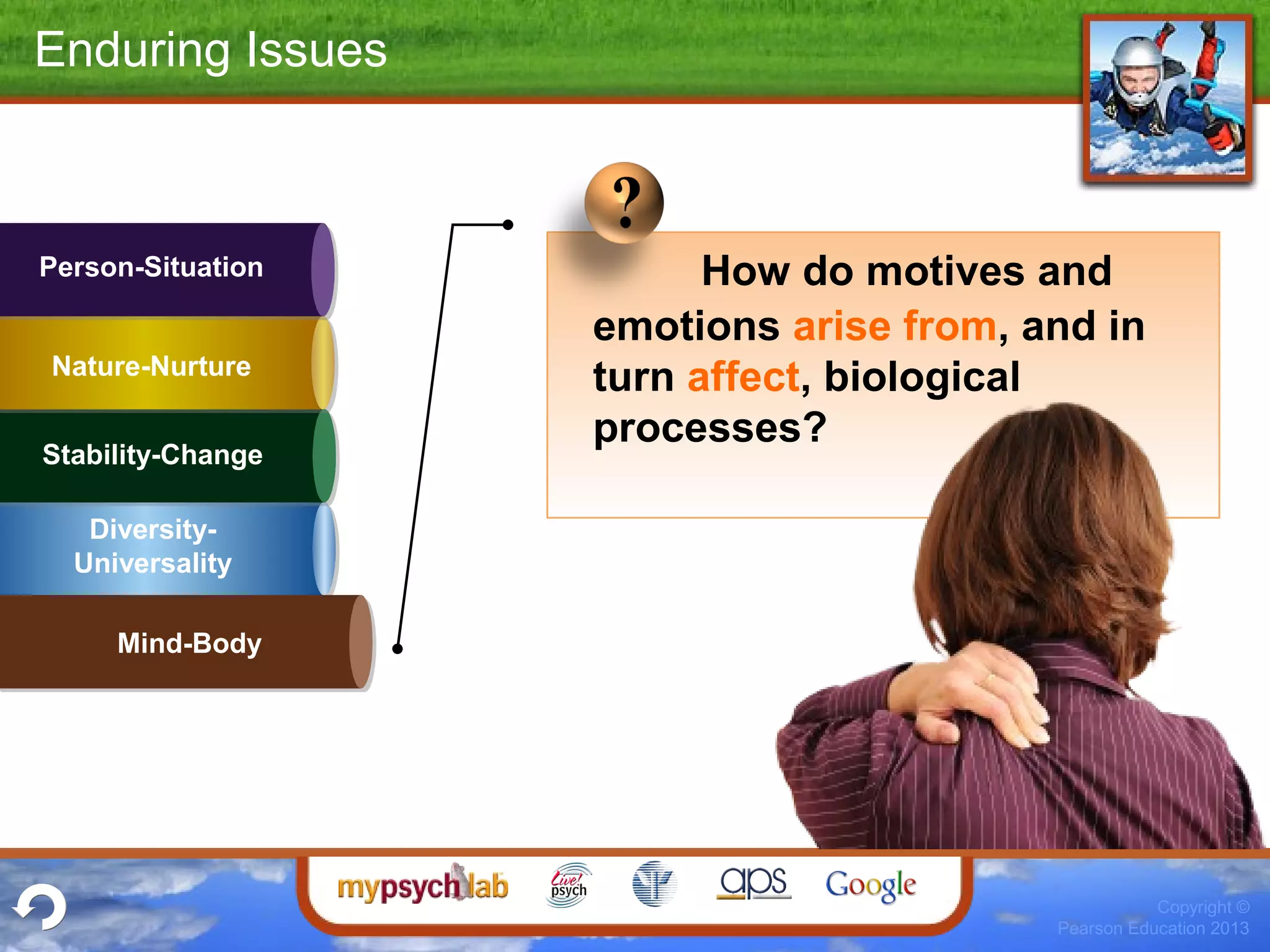
Person-Situation How do motives and
emotions arise from, and in
turn affect, biological
processes?
Enduring Issues
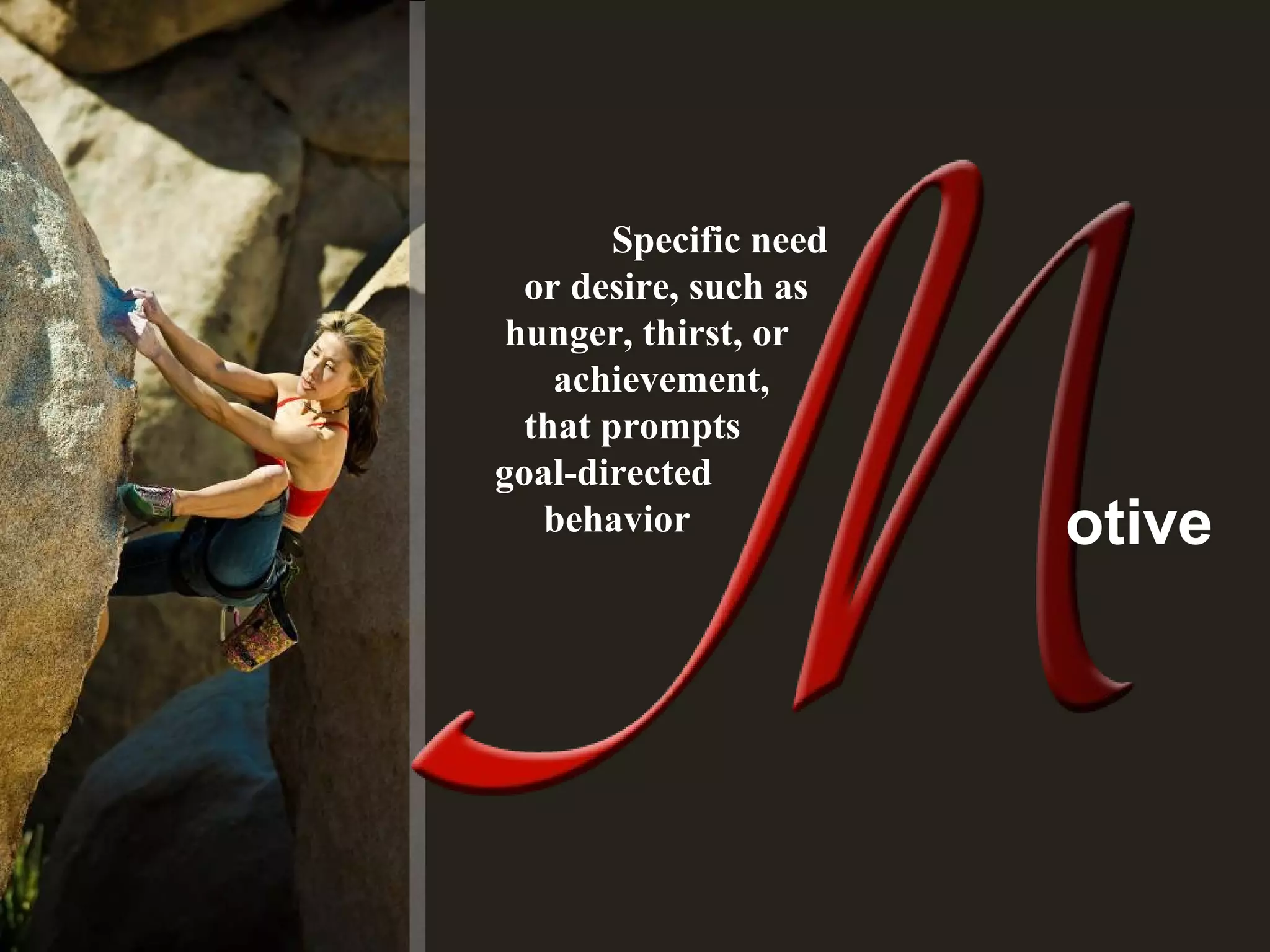
Specific need
or desire, such as
hunger, thirst, or
achievement,
that prompts
goal-directed
behavior otive
Copyright ©
Pearson Education 2013
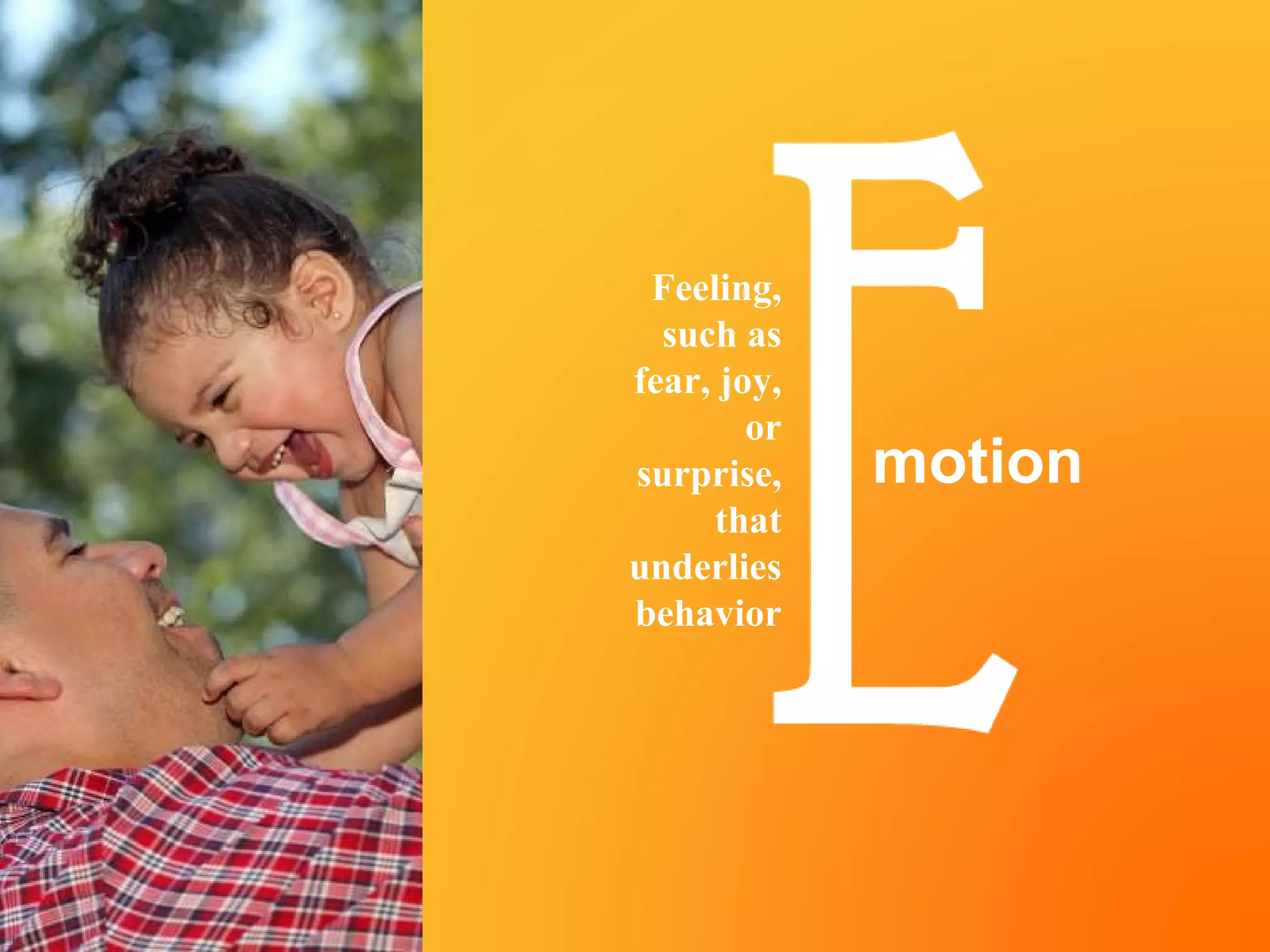
Feeling,
such as
fear, joy,
or
surprise,
that
underlies
behavior
motion
Perspectives on
Motivation
Copyright ©
Pearson Education 2013
LEARNING OBJECTIVE: Compare and contrast instincts, drive-reduction theory, and arousal theory
(including the Yerkes-Dodson law) as explanations of human behavior. Distinguish between primary
and secondary drives, intrinsic and extrinsic motivation, and summarize Maslow’s hierarchy of motives.
Instincts
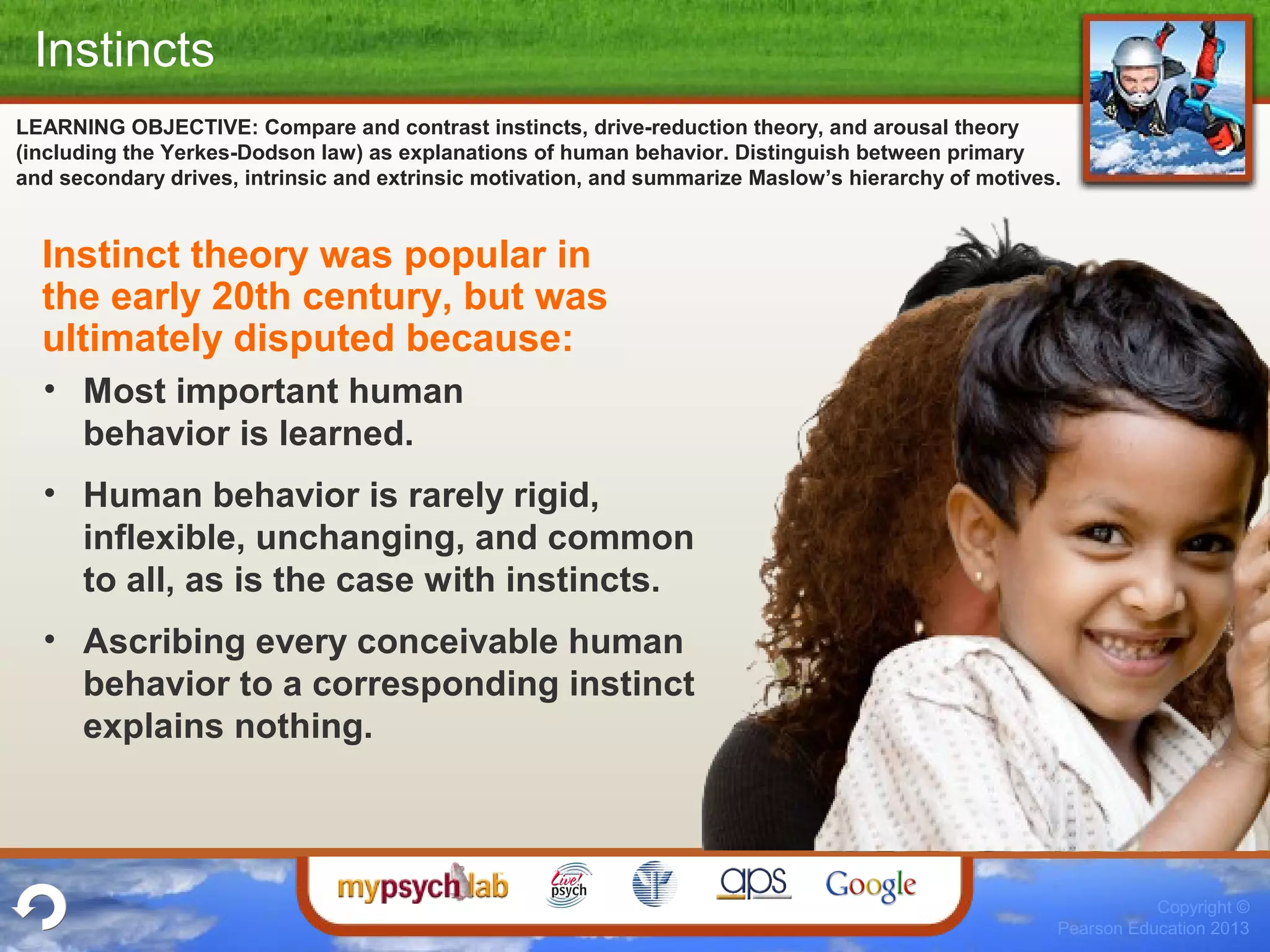
Instinct theory was popular in
the early 20th century, but was
ultimately disputed because:
• Most important human
behavior is learned.
• Human behavior is rarely rigid,
inflexible, unchanging, and common
to all, as is the case with instincts.
• Ascribing every conceivable human
behavior to a corresponding instinct
explains nothing.
Copyright ©
Pearson Education 2013
Drive Reduction Theory
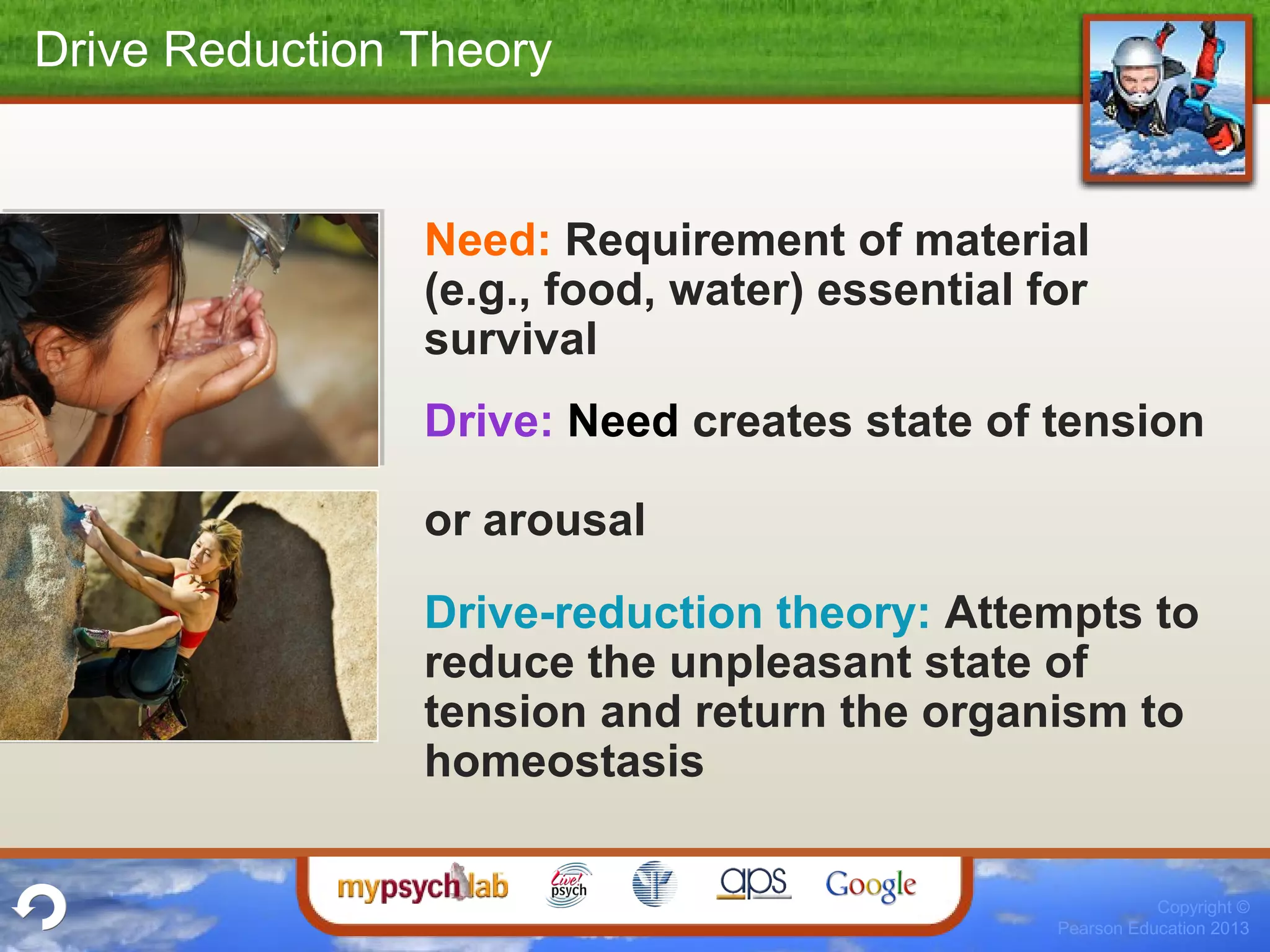
Need: Requirement of material
(e.g., food, water) essential for
survival
Drive: Need creates state of tension
or arousal
Drive-reduction theory: Attempts to
reduce the unpleasant state of
tension and return the organism to
homeostasis
Copyright ©
Pearson Education 2013
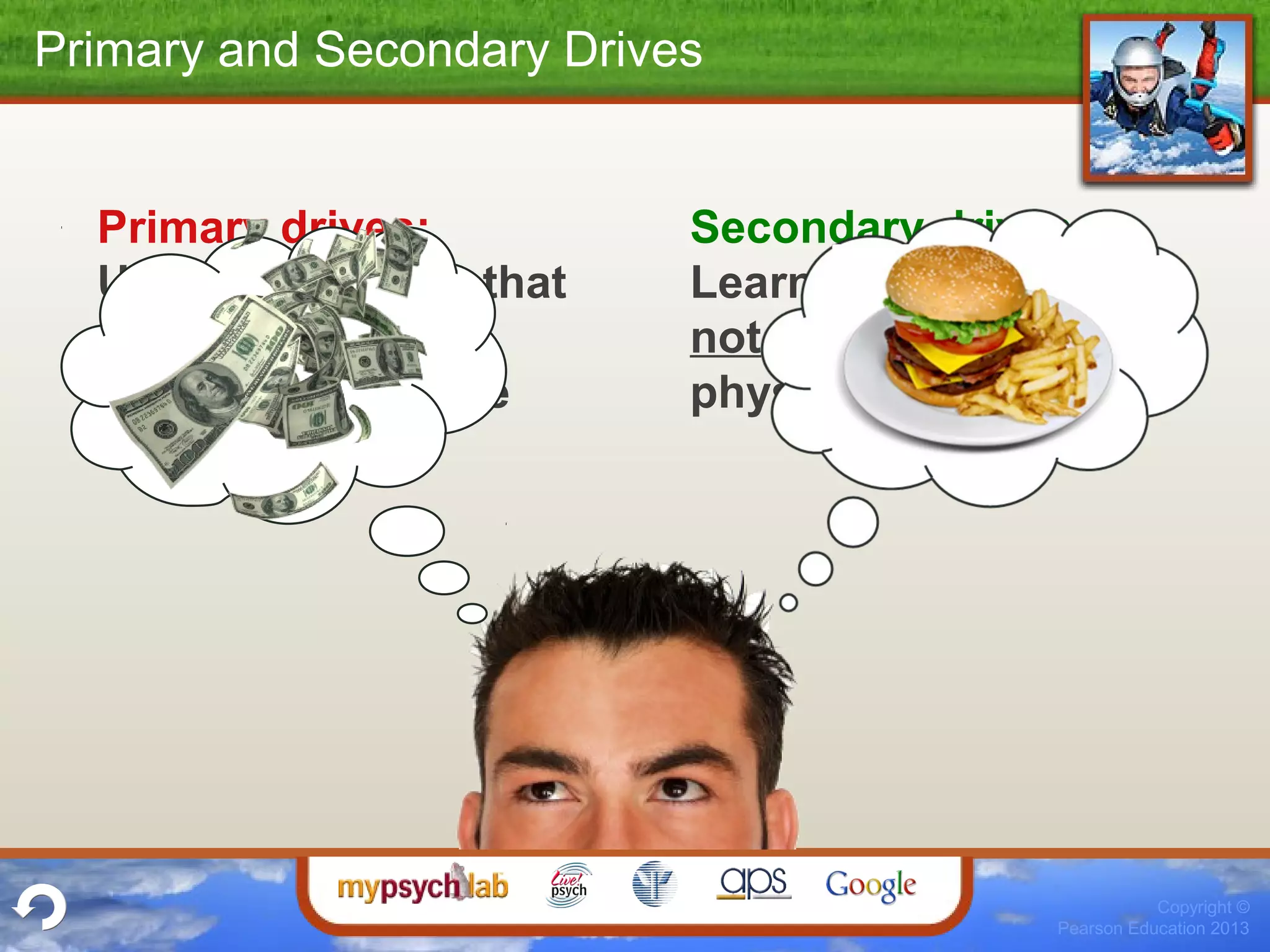
Primary drives:
Unlearned drives that
are based on a
physiological state
Secondary drives:
Learned drives that are
not based on a
physiological state
Primary and Secondary Drives
Copyright ©
Pearson Education 2013
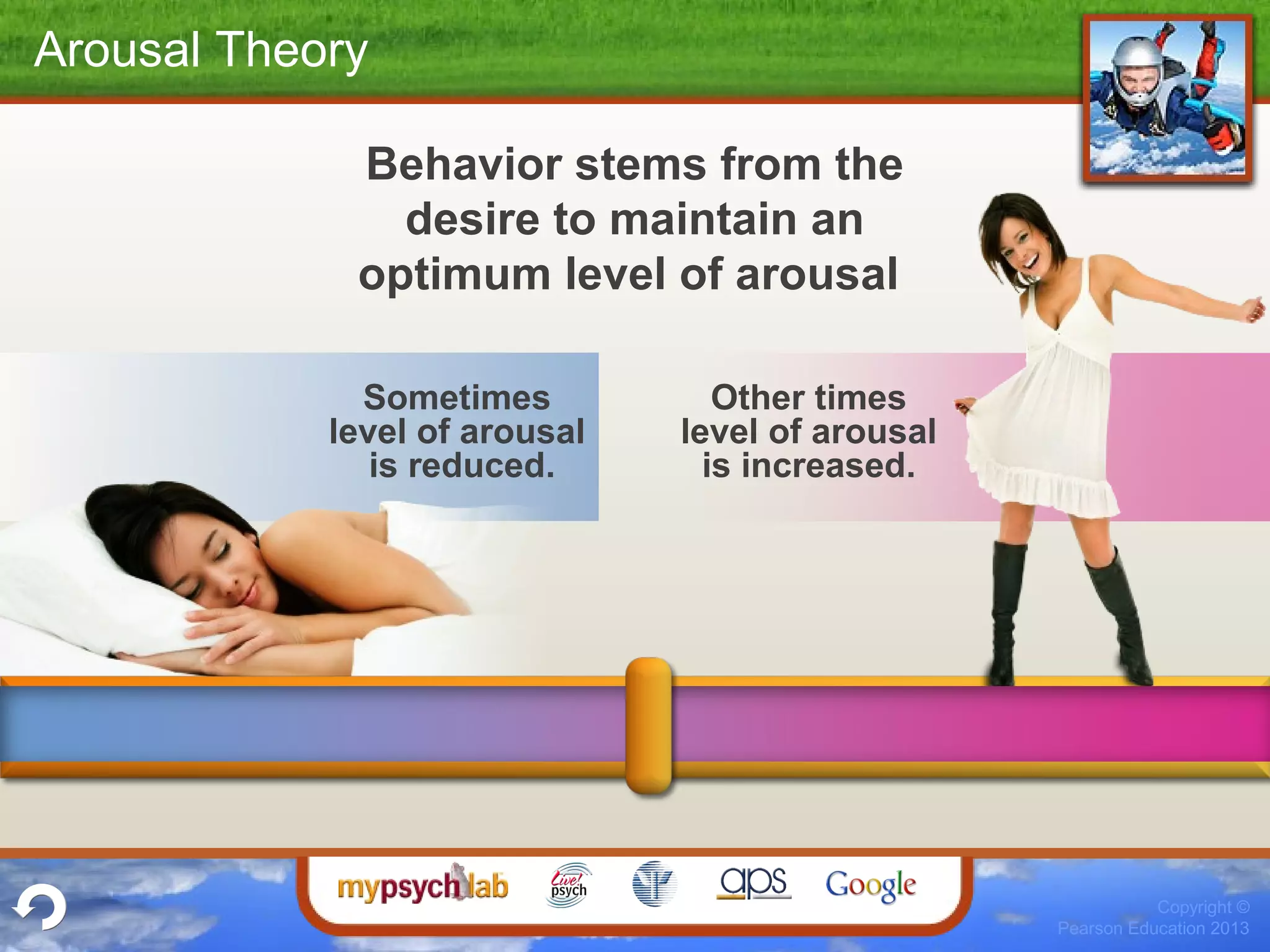
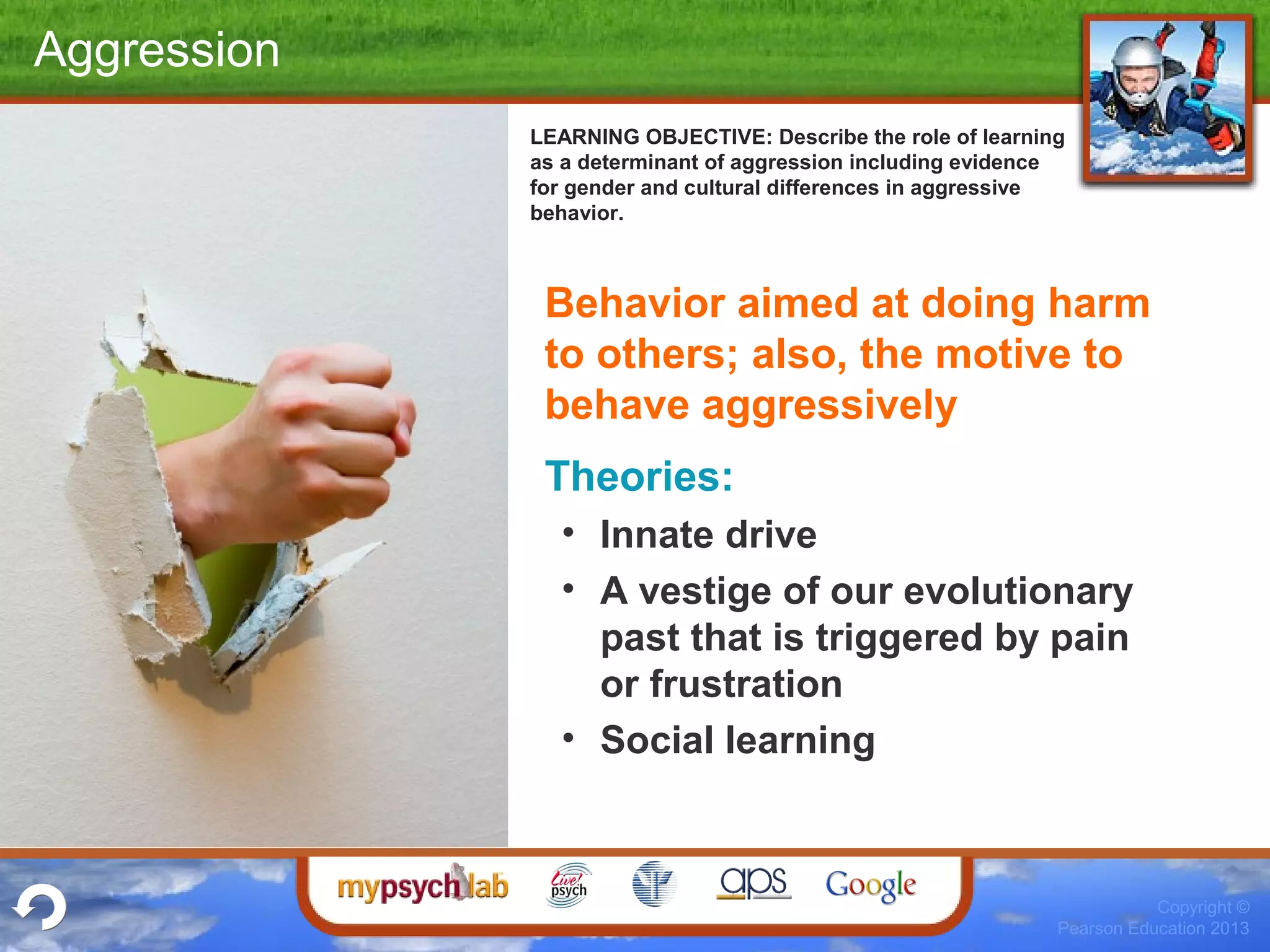
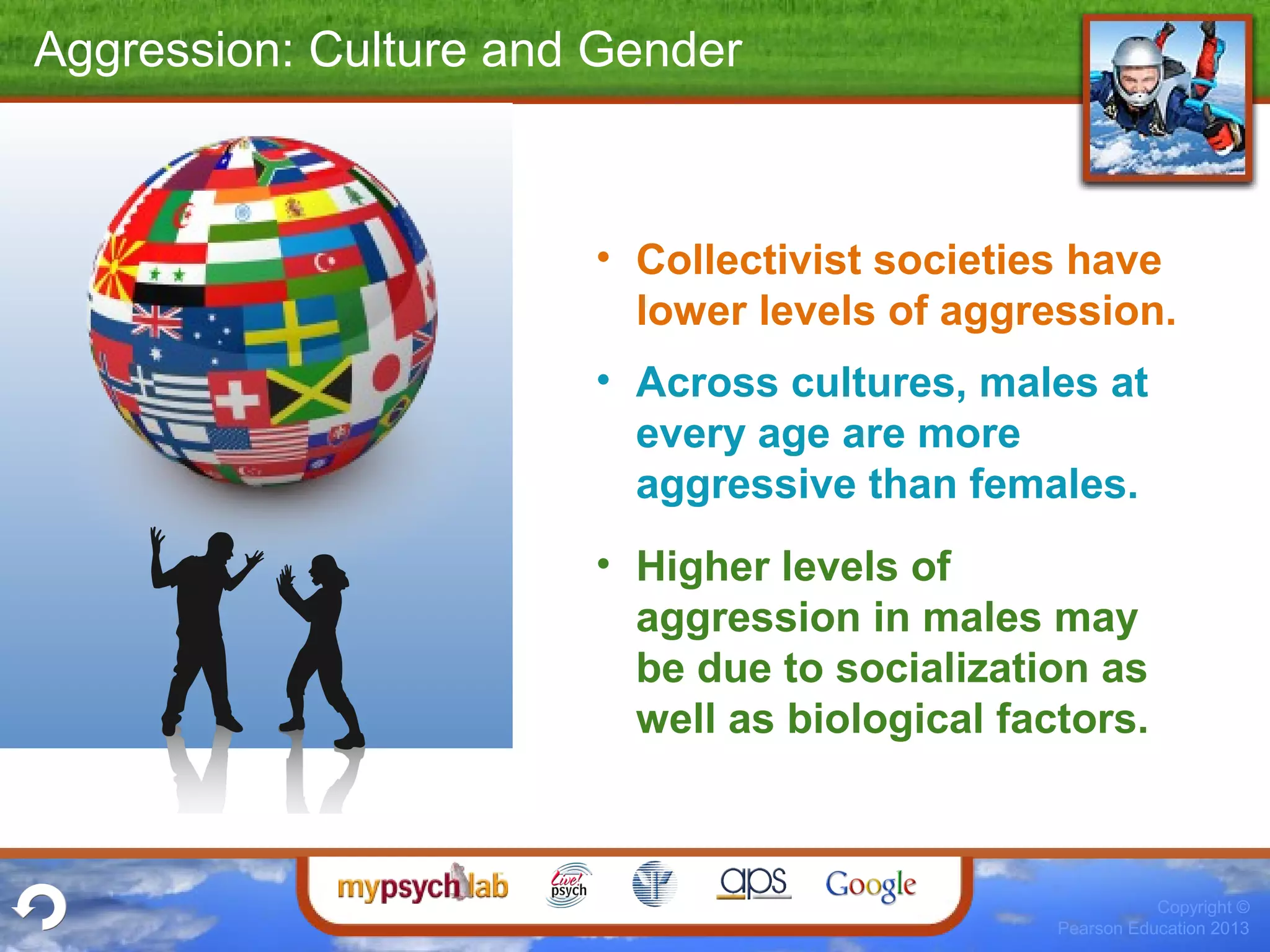
Arousal Theory
Behavior stems from the
desire to maintain an
optimum level of arousal
Sometimes
level of arousal
is reduced.
Other times
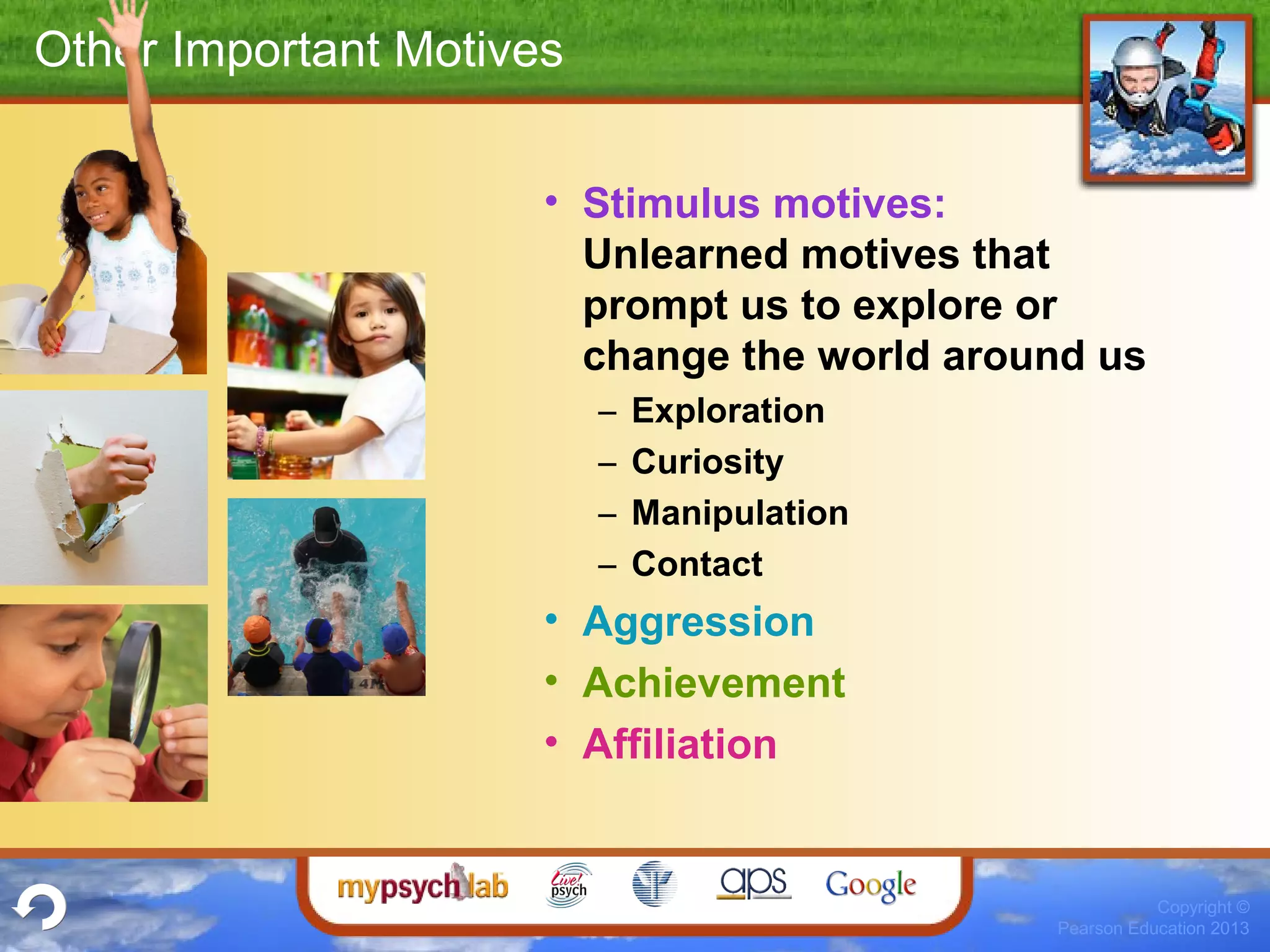
level of arousal
is increased.
Copyright ©
Pearson Education 2013
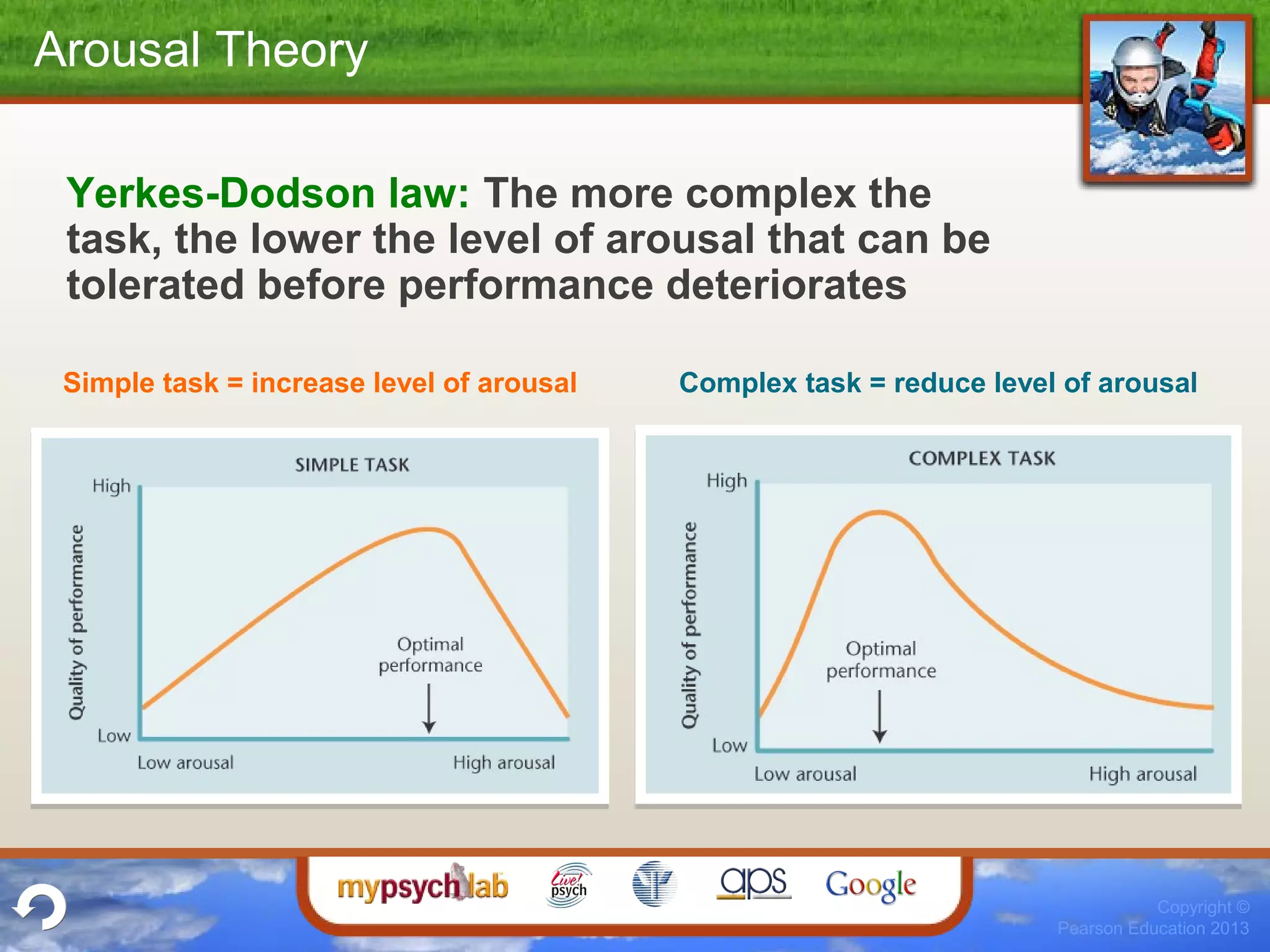
Arousal Theory
Yerkes-Dodson law: The more complex the
task, the lower the level of arousal that can be
tolerated before performance deteriorates
Simple task = increase level of arousal Complex task = reduce level of arousal
Copyright ©
Pearson Education 2013
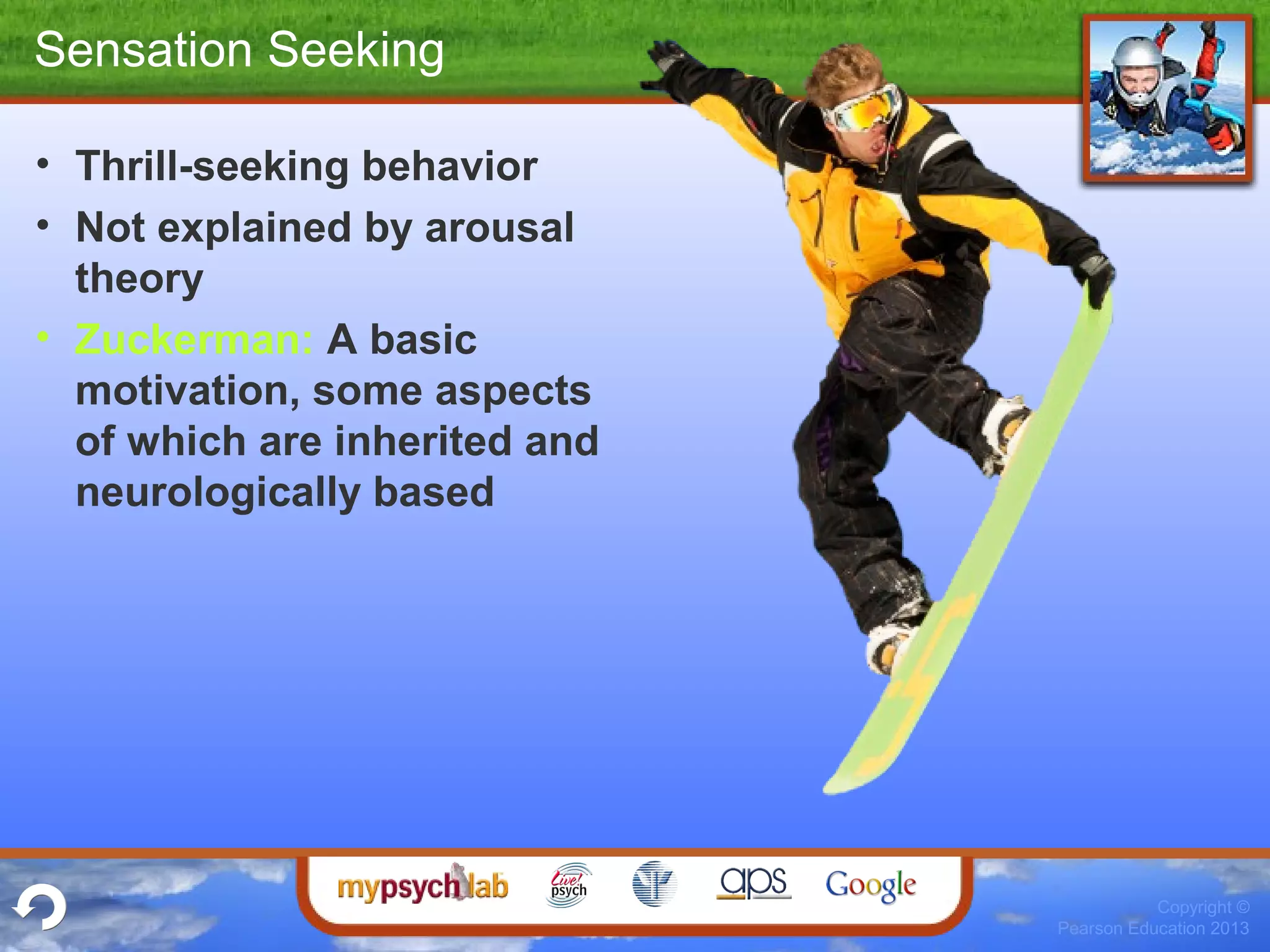
Sensation Seeking
• Thrill-seeking behavior
• Not explained by arousal
theory
• Zuckerman: A basic
motivation, some aspects
of which are inherited and
neurologically based
Copyright ©
Pearson Education 2013
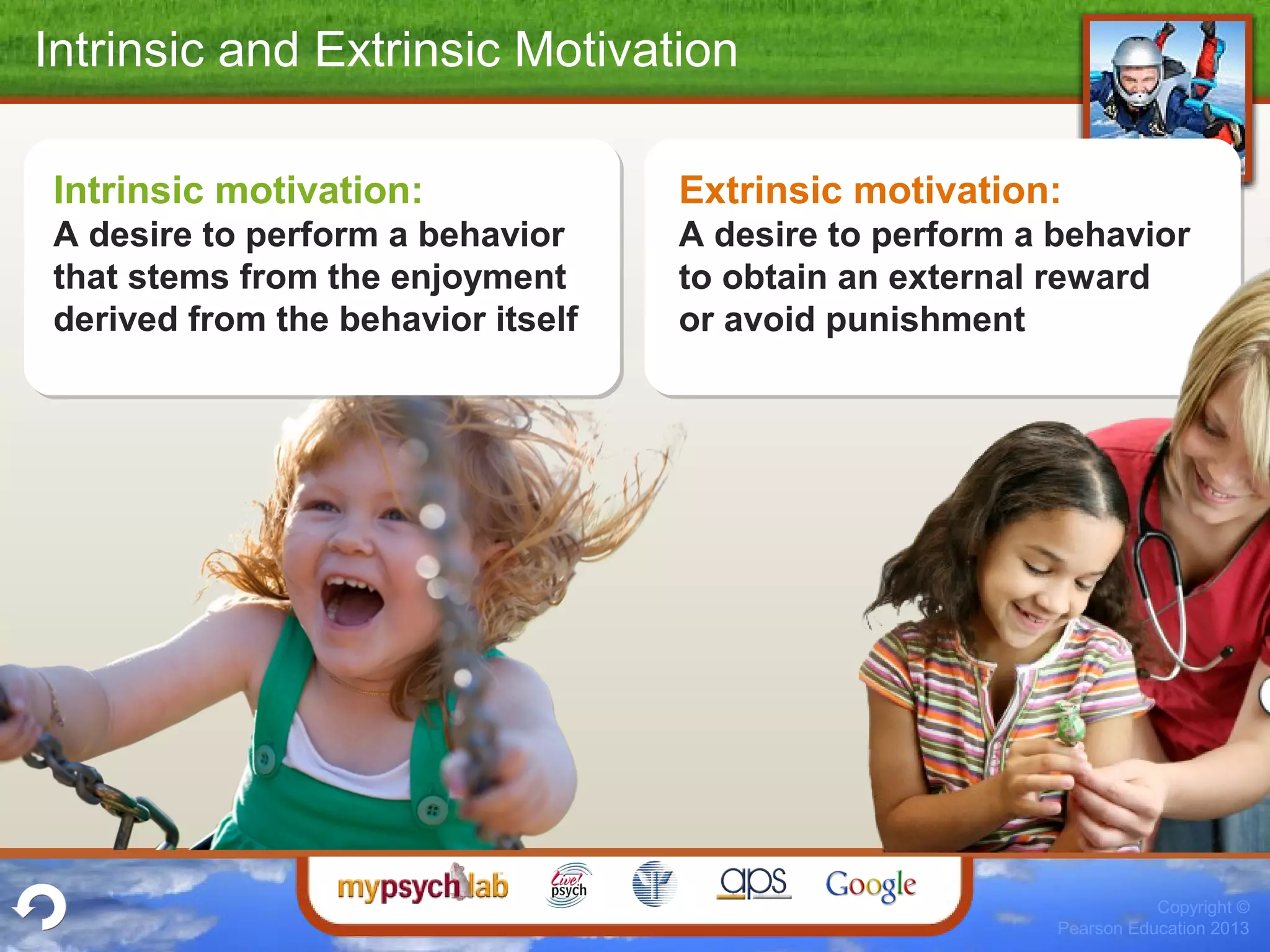
Intrinsic and Extrinsic Motivation
Intrinsic motivation:
A desire to perform a behavior
that stems from the enjoyment
derived from the behavior itself
Extrinsic motivation:
A desire to perform a behavior
to obtain an external reward
or avoid punishment
Copyright ©
Pearson Education 2013
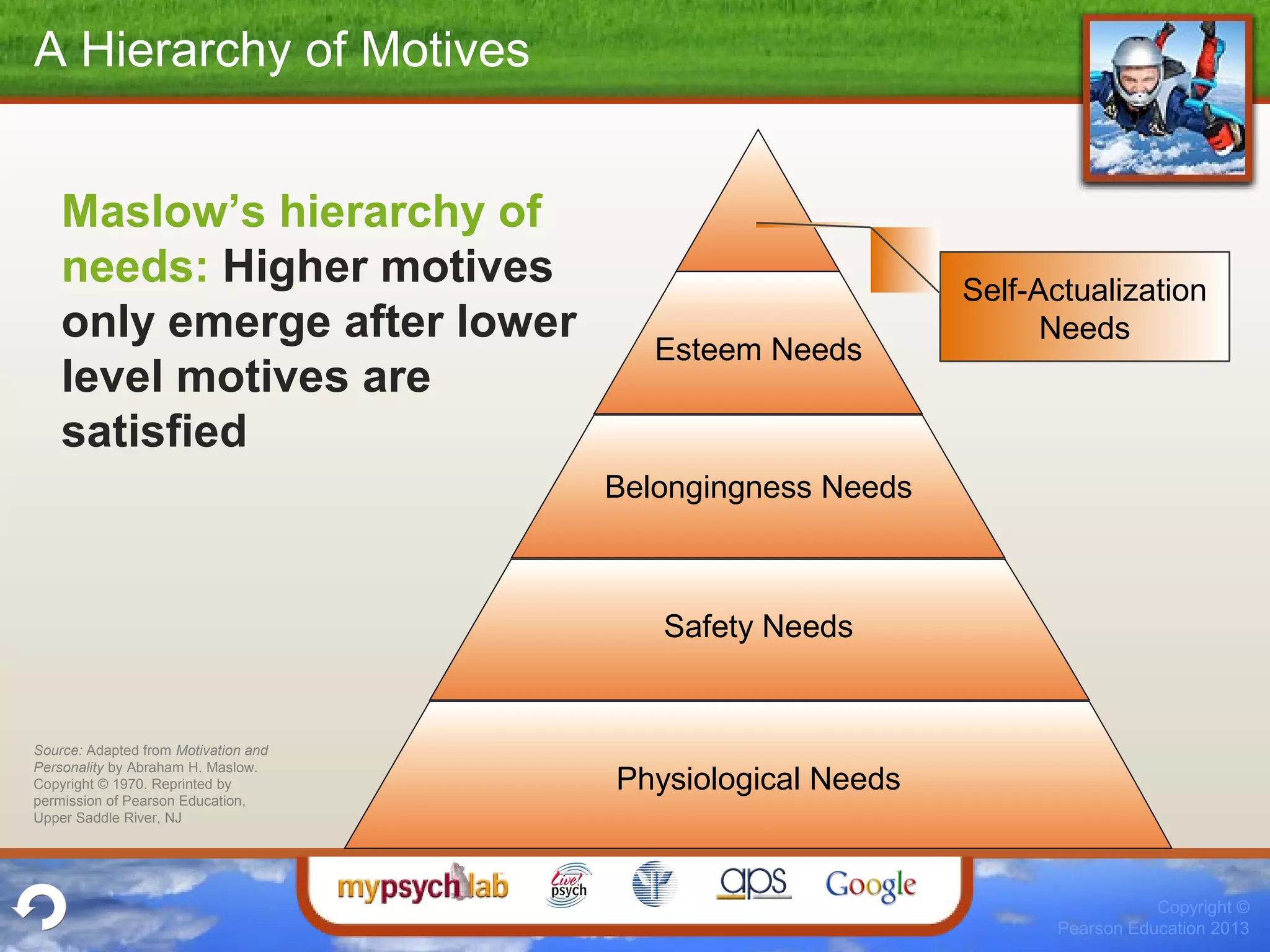
A Hierarchy of Motives
Maslow’s hierarchy of
needs: Higher motives
only emerge after lower
level motives are
satisfied
Physiological Needs
Safety Needs
Belongingness Needs
Esteem Needs
Self-Actualization
Needs
Source: Adapted from Motivation and
Personality by Abraham H. Maslow.
Copyright © 1970. Reprinted by
permission of Pearson Education,
Upper Saddle River, NJ
Hunger and
Thirst
Copyright ©
Pearson Education 2013
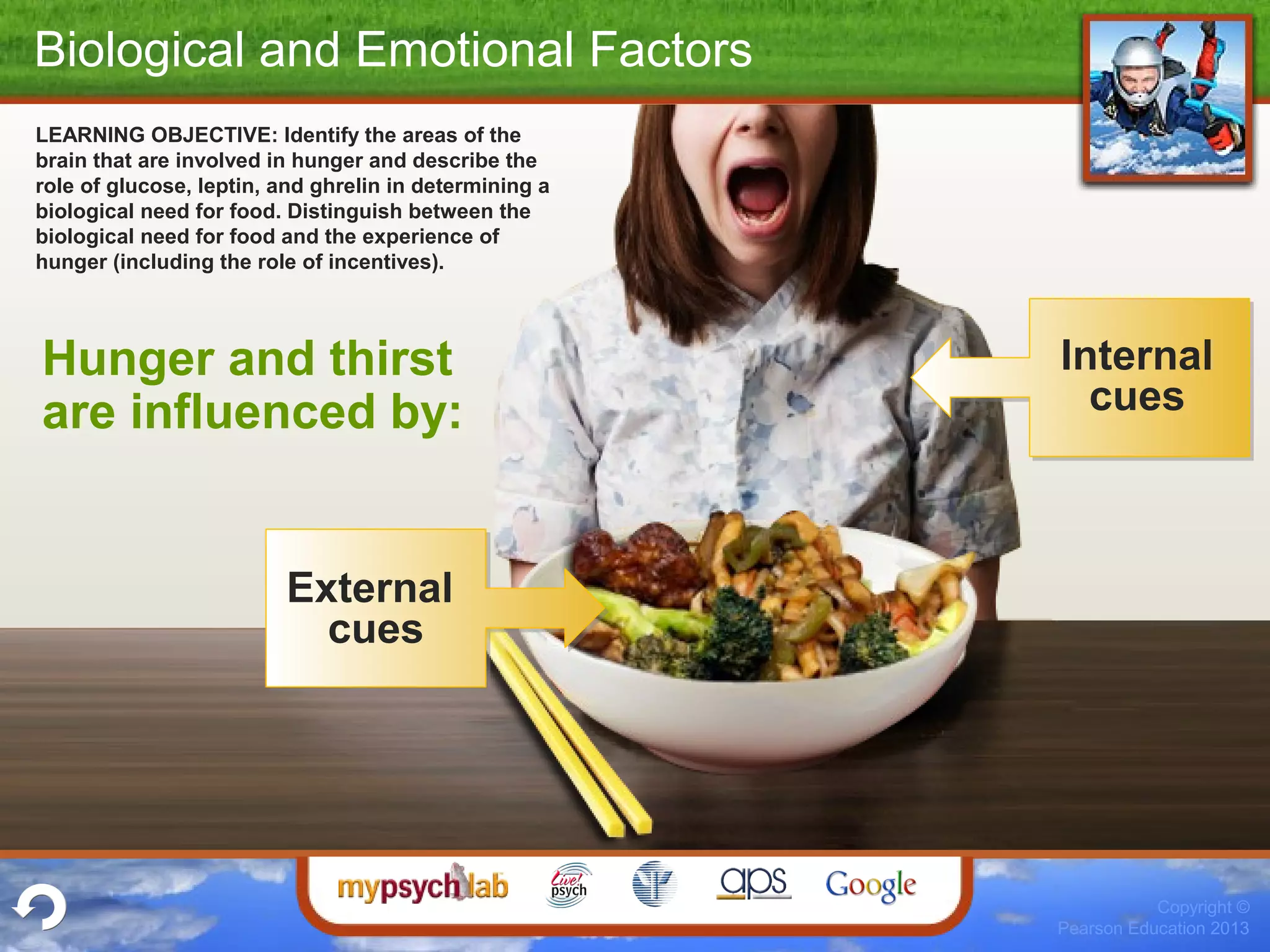
Biological and Emotional Factors
Hunger and thirst
are influenced by:
LEARNING OBJECTIVE: Identify the areas of the
brain that are involved in hunger and describe the
role of glucose, leptin, and ghrelin in determining a
biological need for food. Distinguish between the
biological need for food and the experience of
hunger (including the role of incentives).
Internal
cues
External
cues
Copyright ©
Pearson Education 2013
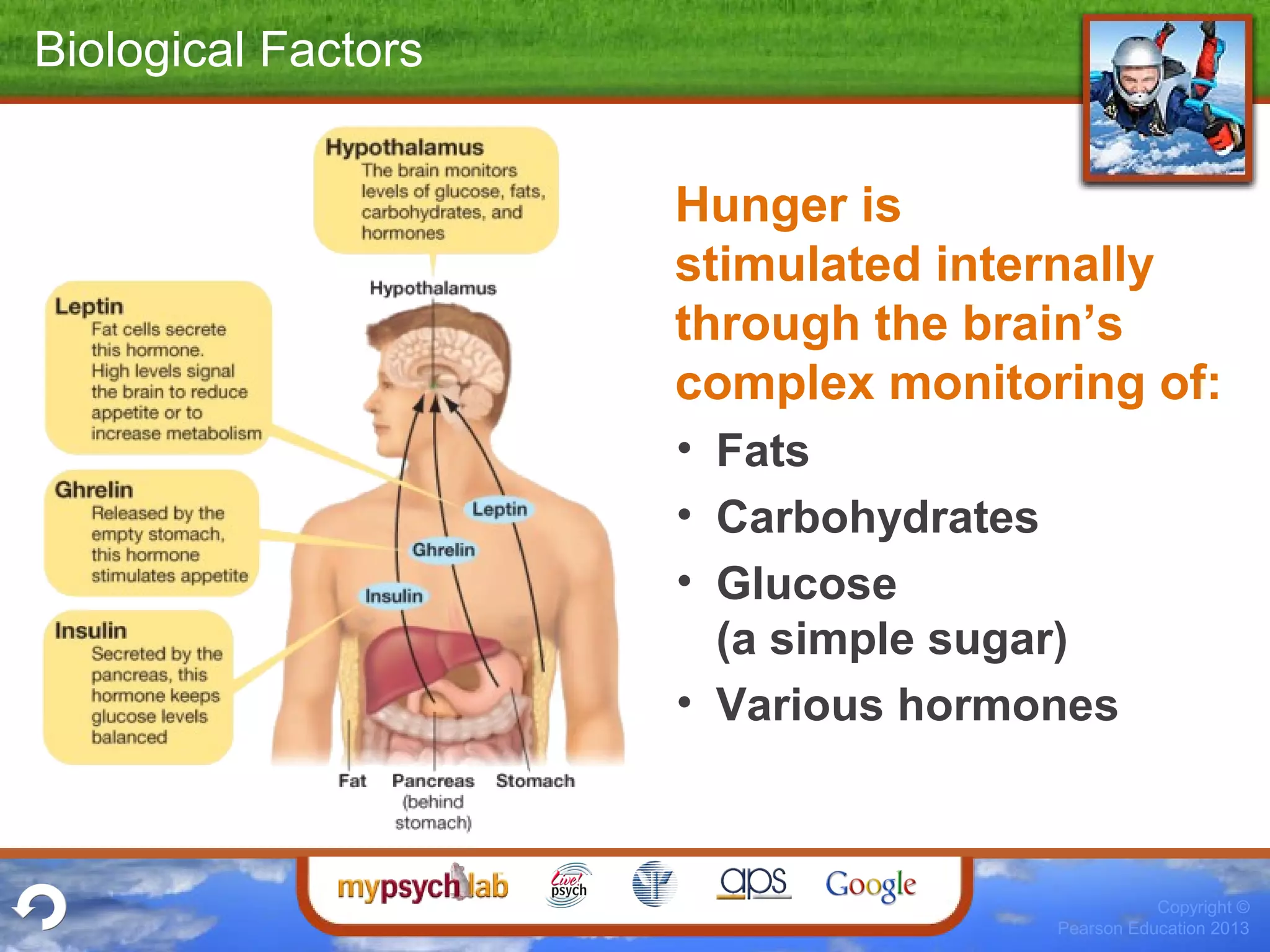
Biological Factors
Hunger is
stimulated internally
through the brain’s
complex monitoring of:
• Fats
• Carbohydrates
• Glucose
(a simple sugar)
• Various hormones
Copyright ©
Pearson Education 2013
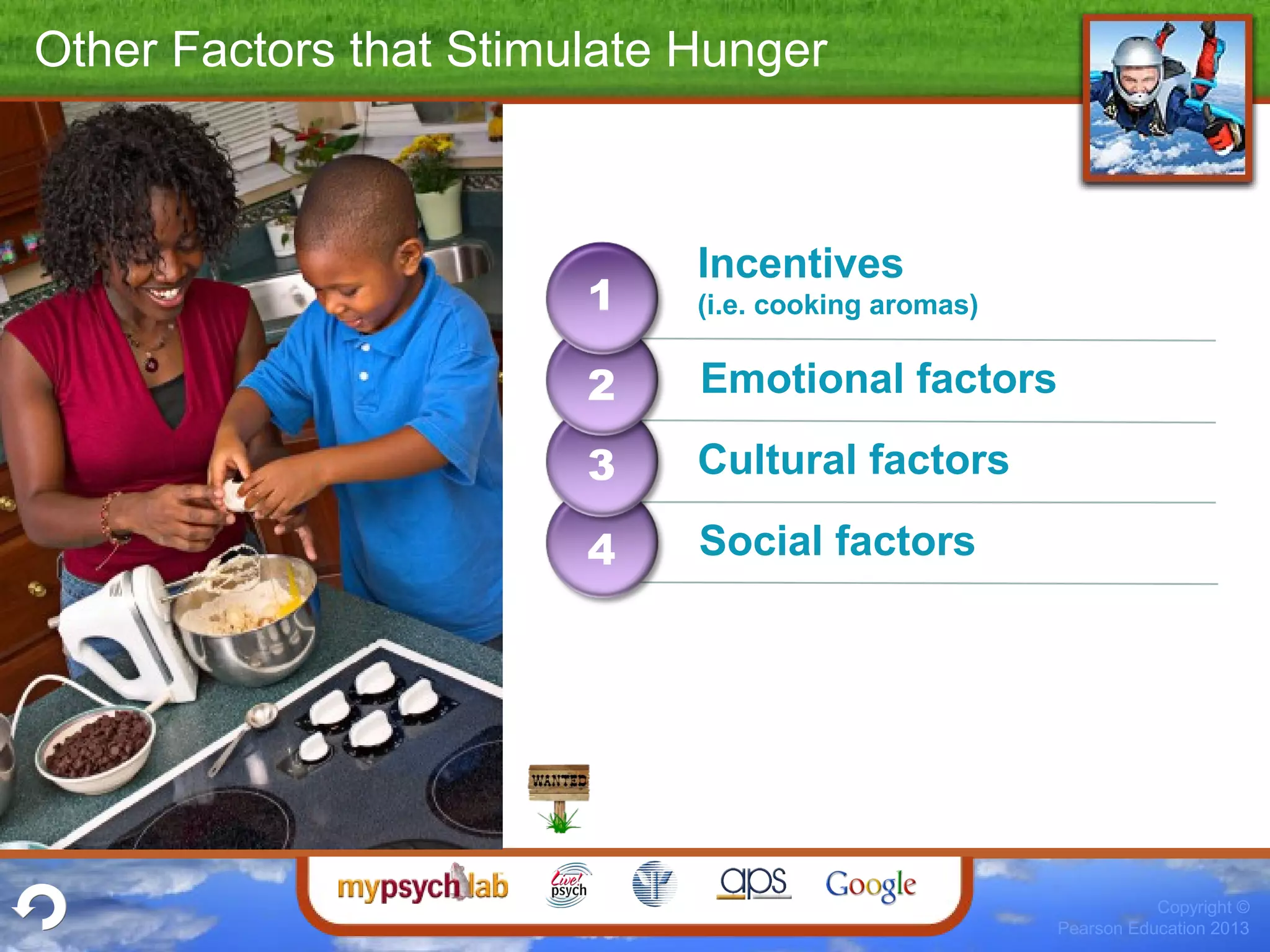
Incentives
(i.e. cooking aromas)
Emotional factors
Cultural factors
Social factors
Other Factors that Stimulate Hunger
1
2
3
4
Copyright ©
Pearson Education 2013
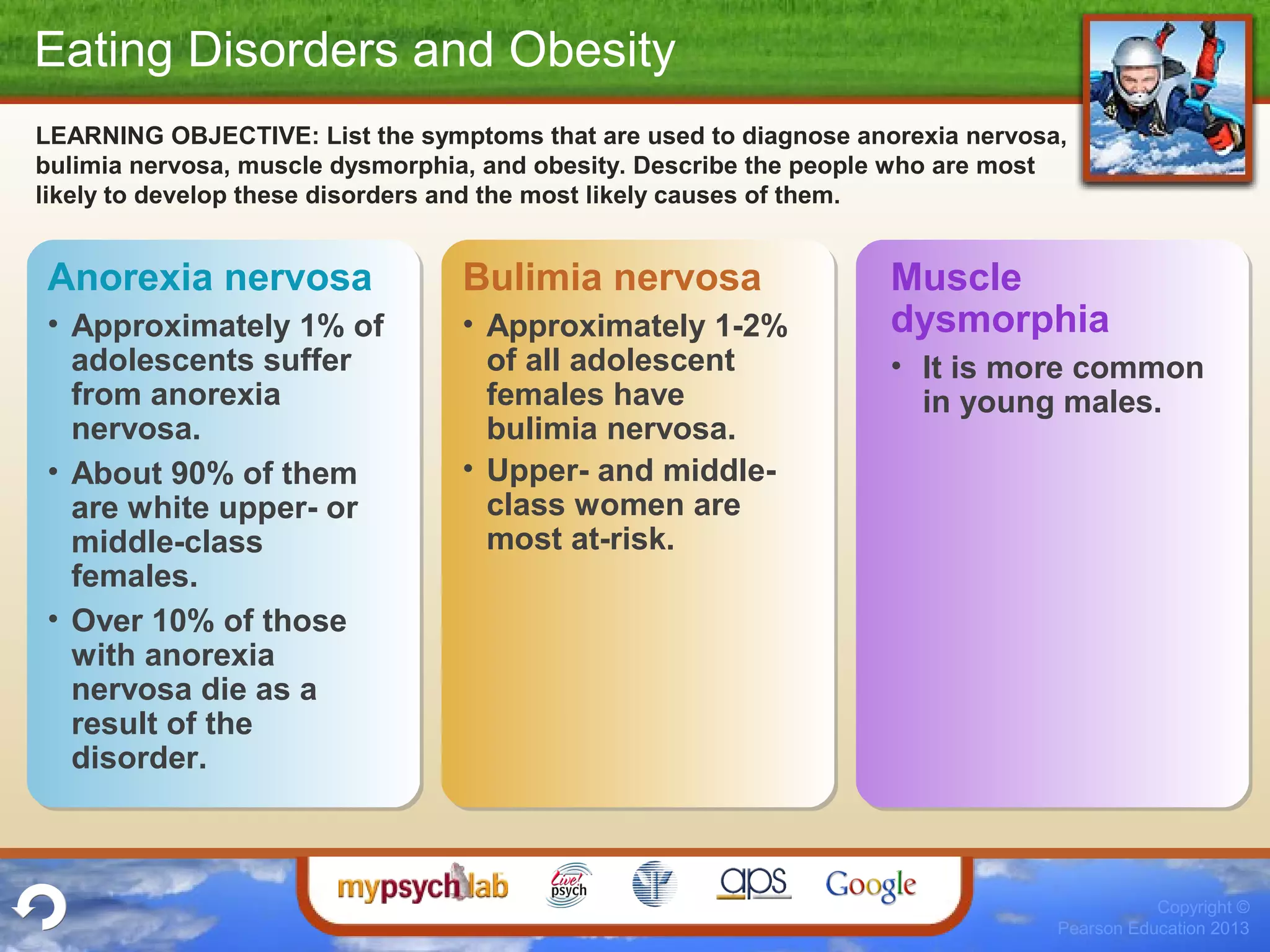
Eating Disorders and Obesity
LEARNING OBJECTIVE: List the symptoms that are used to diagnose anorexia nervosa,
bulimia nervosa, muscle dysmorphia, and obesity. Describe the people who are most
likely to develop these disorders and the most likely causes of them.
Anorexia nervosa
• Approximately 1% of
adolescents suffer
from anorexia
nervosa.
• About 90% of them
are white upper- or
middle-class
females.
• Over 10% of those
with anorexia
nervosa die as a
result of the
disorder.
Bulimia nervosa
• Approximately 1-2%
of all adolescent
females have
bulimia nervosa.
• Upper- and middle-
class women are
most at-risk.
Muscle
dysmorphia
• It is more common
in young males.
Copyright ©
Pearson Education 2013
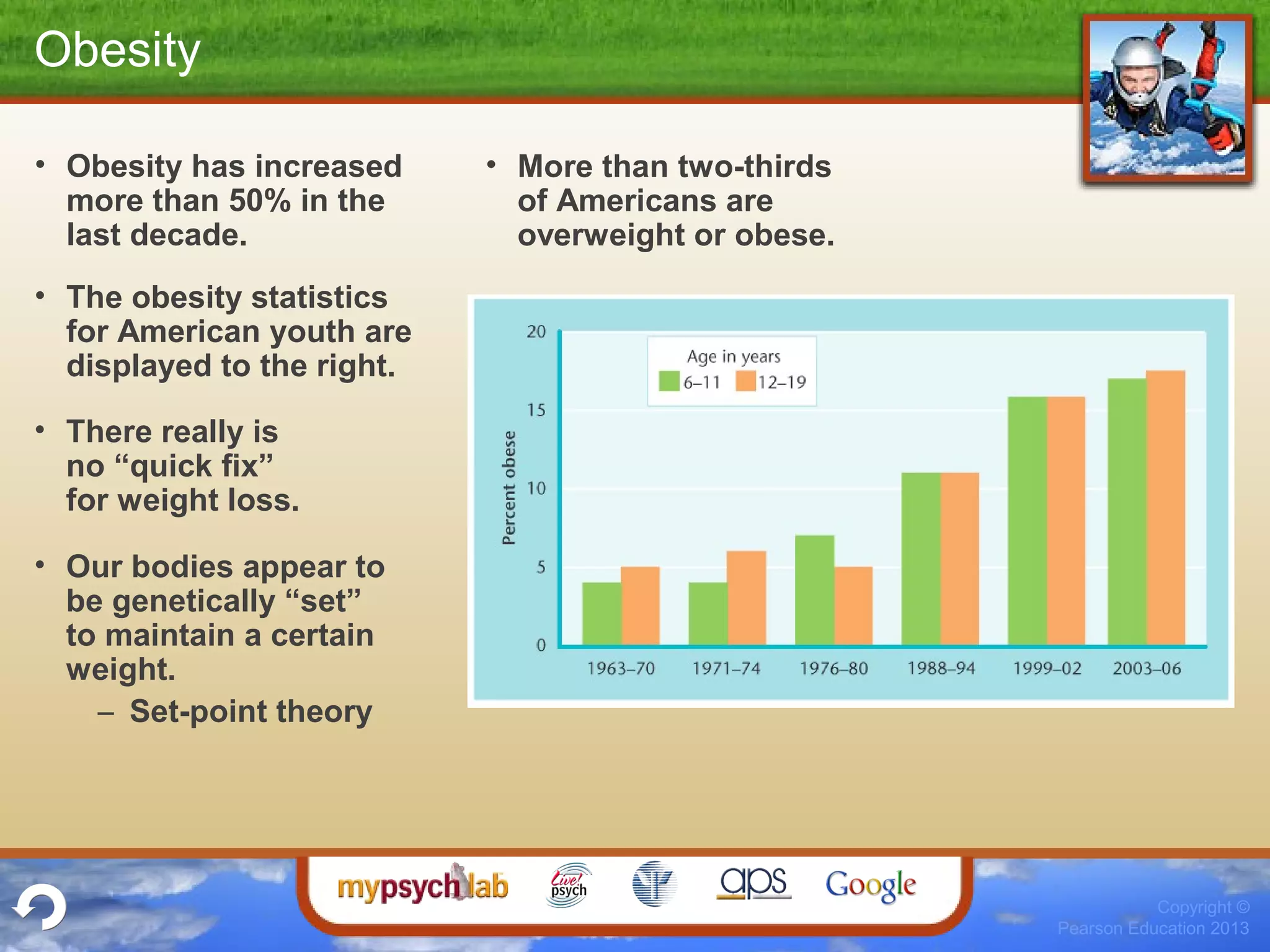
Obesity
• Obesity has increased
more than 50% in the
last decade.
• More than two-thirds
of Americans are
overweight or obese.
• The obesity statistics
for American youth are
displayed to the right.
• There really is
no “quick fix”
for weight loss.
• Our bodies appear to
be genetically “set”
to maintain a certain
weight.
– Set-point theory
Applying Psychology
Copyright ©
Pearson Education 2013
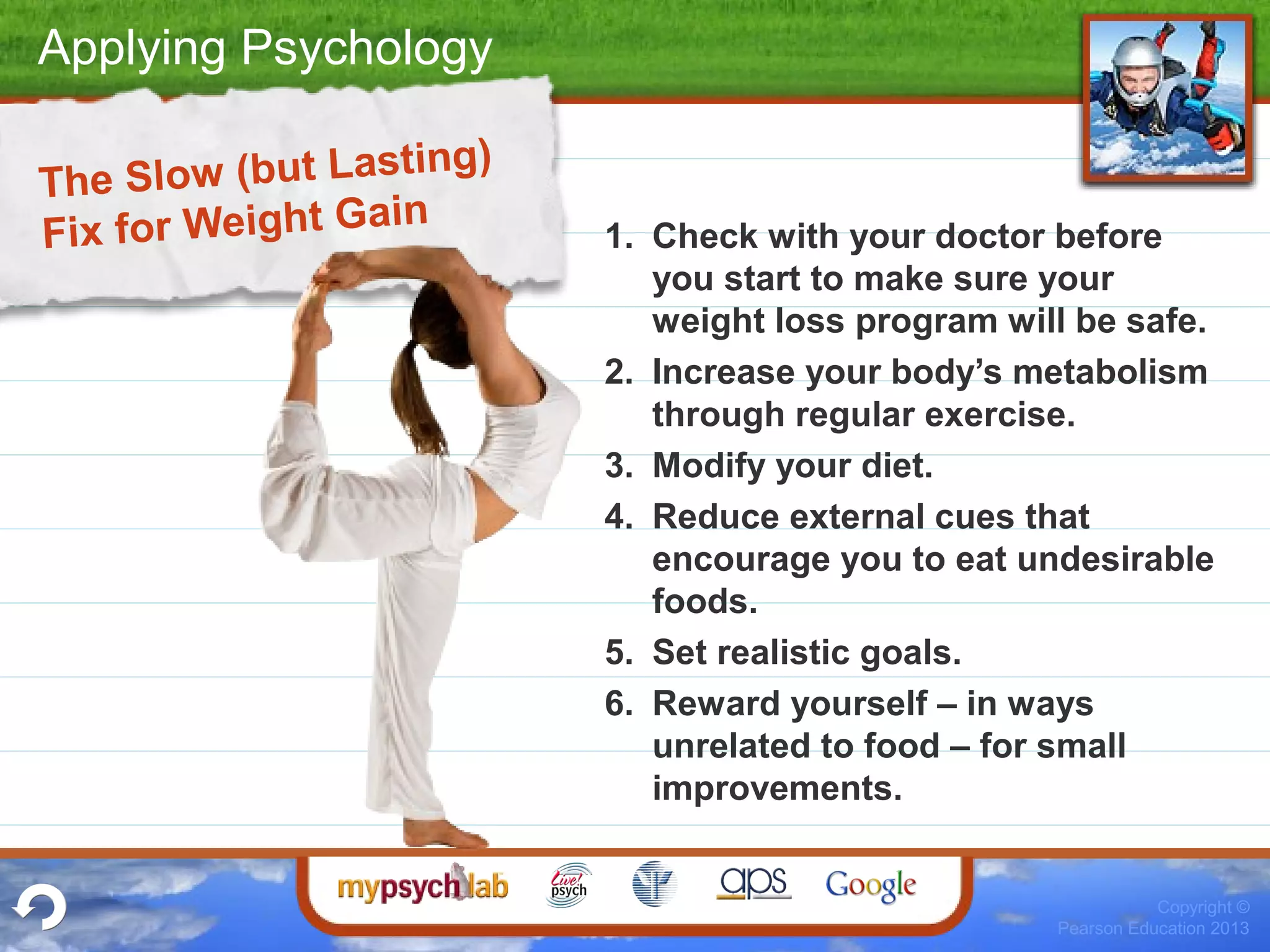
The Slow (but Lasting)
Fix for Weight Gain
1. Check with your doctor before
you start to make sure your
weight loss program will be safe.
2. Increase your body’s metabolism
through regular exercise.
3. Modify your diet.
4. Reduce external cues that
encourage you to eat undesirable
foods.
5. Set realistic goals.
6. Reward yourself – in ways
unrelated to food – for small
improvements.
Sex
Copyright ©
Pearson Education 2013
Sexual
motivation is
similar to, and
different from,
other primary
drives.
Biological Factors
LEARNING OBJECTIVE: Describe how sexual motivation is both similar to and different
from other primary drives. Identify the factors (biological and nonbiological) that affect
sexual motivation.
Similar
Sex is considered
a primary drive
because it is
unlearned and is
a physiological
state.
Different
Sex is vital only
to the survival of
the species, not
to the survival of
the individual.
Copyright ©
Pearson Education 2013
Biological Factors
Testosterone (the primary male sex hormone)
– Baseline levels associated with frequency of sexual
behavior/satisfaction in males and females
Pheromones
– Some evidence that they are secreted in the sweat
glands of the armpits and in the genitals
– May influence sexual attraction
Brain
– Limbic system and insula: involved in sexual
excitement
Sexual response cycle
– Typical sequence of events characterizing sexual
response in males and females
Copyright ©
Pearson Education 2013
Sexual Response Cycle
LEARNING OBJECTIVE: Describe the sexual response cycle and how it differs for
men and women. Briefly explain what is meant by the statement that “research
indicates that the sex lives of most Americans differ significantly from media
portrayals.”
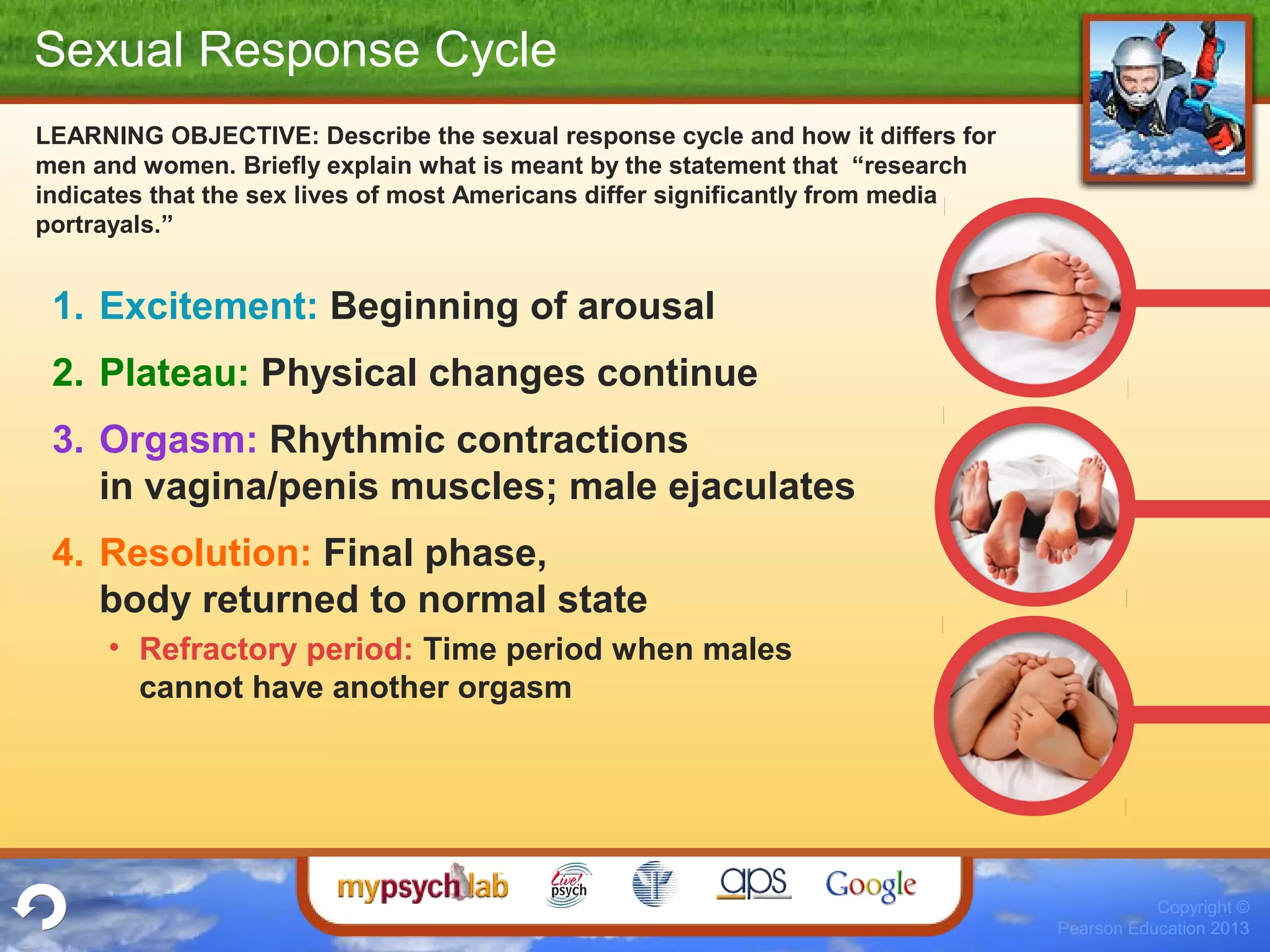
1. Excitement: Beginning of arousal
2. Plateau: Physical changes continue
3. Orgasm: Rhythmic contractions
in vagina/penis muscles; male ejaculates
4. Resolution: Final phase,
body returned to normal state
• Refractory period: Time period when males
cannot have another orgasm
Copyright ©
Pearson Education 2013
Cultural and Environmental Factors
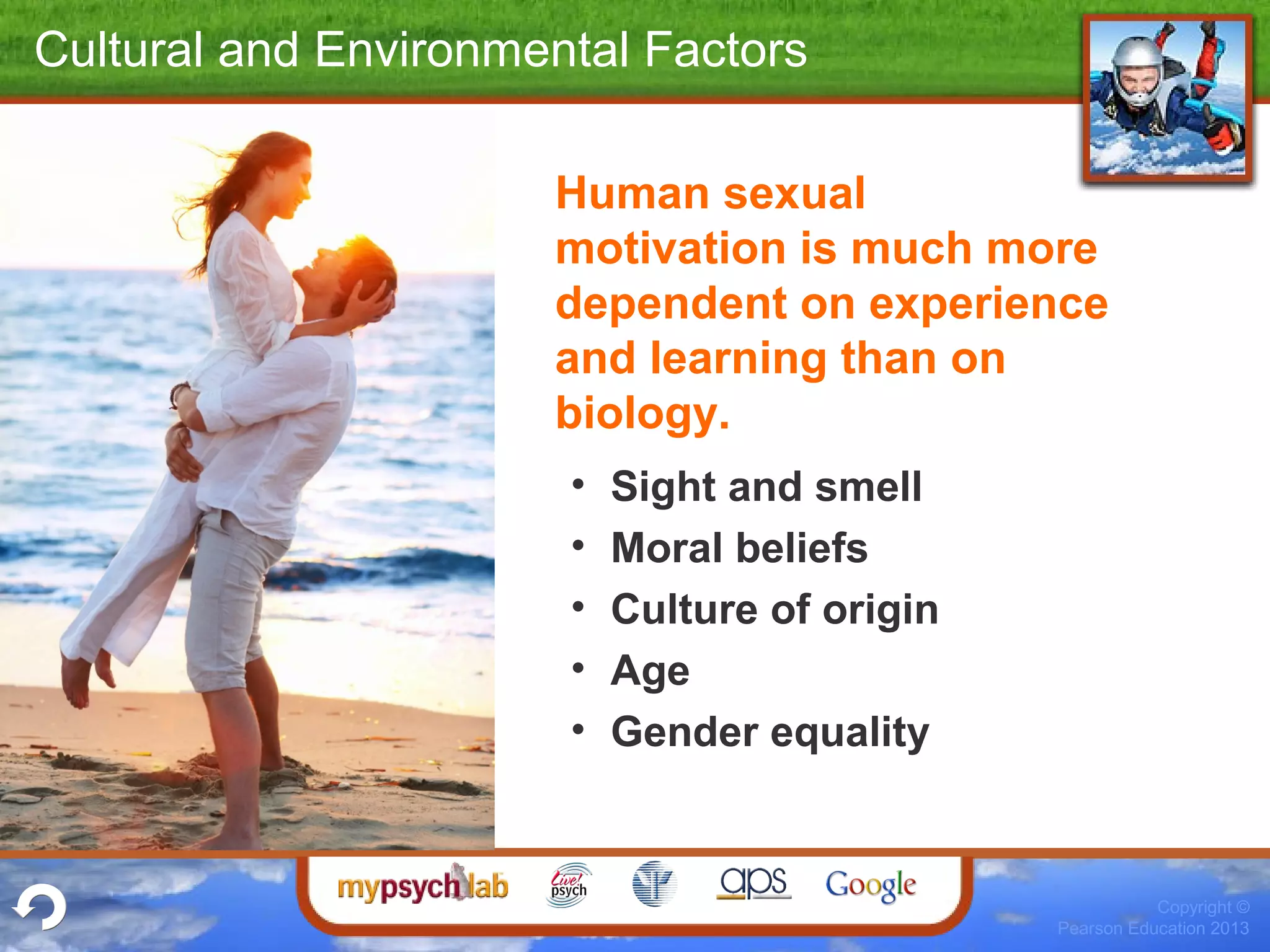
Human sexual
motivation is much more
dependent on experience
and learning than on
biology.
• Sight and smell
• Moral beliefs
• Culture of origin
• Age
• Gender equality
Copyright ©
Pearson Education 2013
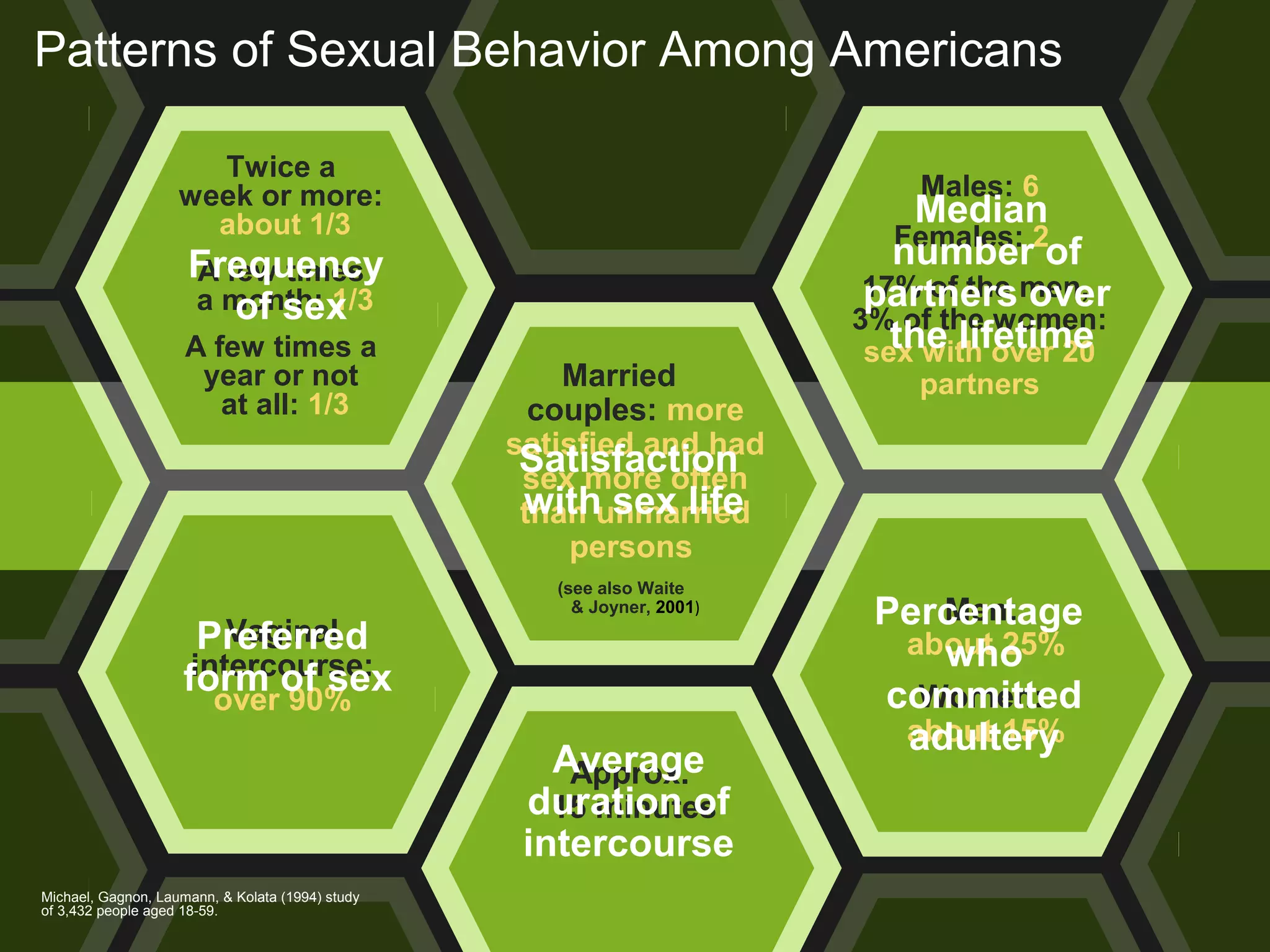
Michael, Gagnon, Laumann, & Kolata (1994) study
of 3,432 people aged 18-59.
Patterns of Sexual Behavior Among Americans
Twice a
week or more:
about 1/3
A few times
a month: 1/3
A few times a
year or not
at all: 1/3
Approx.
15 minutes
Vaginal
intercourse:
over 90%
Married
couples: more
satisfied and had
sex more often
than unmarried
persons
(see also Waite
& Joyner, 2001)
Males: 6
Females: 2
17% of the men,
3% of the women:
sex with over 20
partners
Men:
about 25%
Women:
about 15%
Average
duration of
intercourse
Median
number of
partners over
the lifetime
Percentage
who
committed
adultery
Frequency
of sex
Preferred
form of sex
Satisfaction
with sex life
Copyright ©
Pearson Education 2013
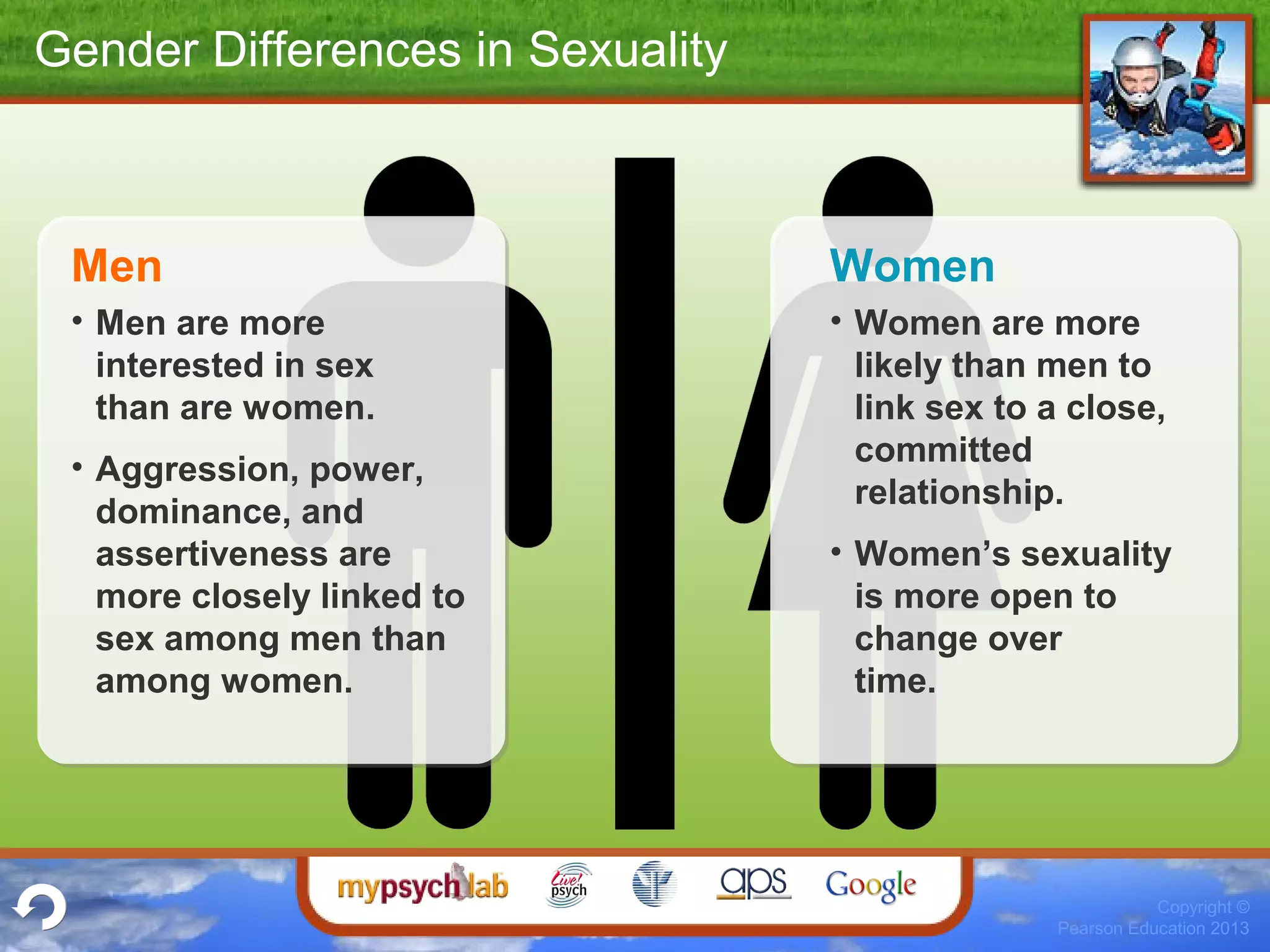
Gender Differences in Sexuality
Men
• Men are more
interested in sex
than are women.
• Aggression, power,
dominance, and
assertiveness are
more closely linked to
sex among men than
among women.
Women
• Women are more
likely than men to
link sex to a close,
committed
relationship.
• Women’s sexuality
is more open to
change over
time.
Copyright ©
Pearson Education 2013
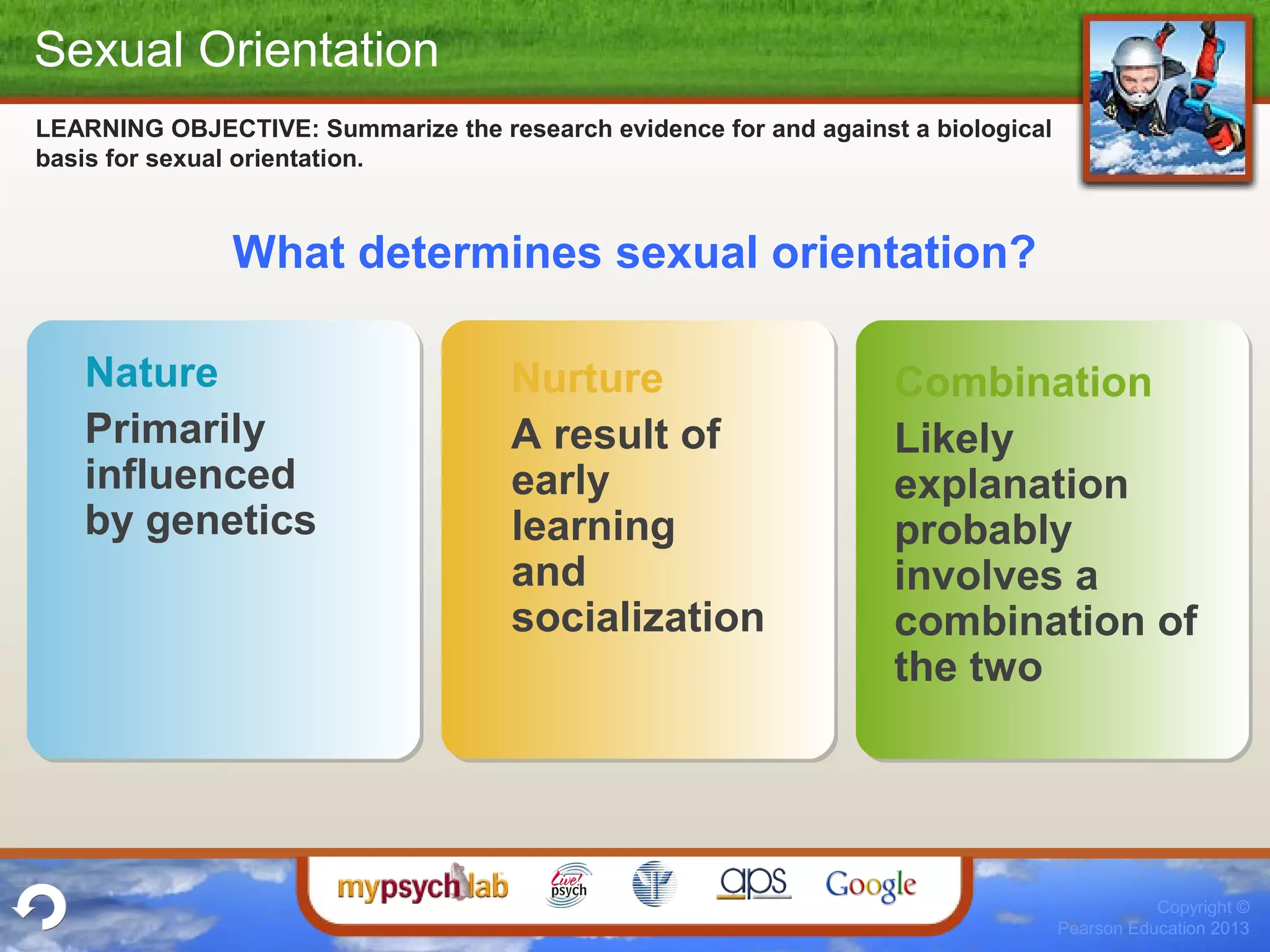
Sexual Orientation
LEARNING OBJECTIVE: Summarize the research evidence for and against a biological
basis for sexual orientation.
What determines sexual orientation?
Nature
Primarily
influenced
by genetics
Nurture
A result of
early
learning
and
socialization
Combination
Likely
explanation
probably
involves a
combination of
the two
Other Important
Motives
Copyright ©
Pearson Education 2013
Other Important Motives
• Stimulus motives:
Unlearned motives that
prompt us to explore or
change the world around us
– Exploration
– Curiosity
– Manipulation
– Contact
• Aggression
• Achievement
• Affiliation
Copyright ©
Pearson Education 2013
Exploration and Curiosity
• Sparked by the new and
unknown
• Directed toward no more
specific goal other than
“finding out”
• Not unique to humans
• Disagreement about the nature
and causes of curiosity
LEARNING OBJECTIVE: Briefly describe the major
stimulus motives: exploration, curiosity,
manipulation, and contact.
Copyright ©
Pearson Education 2013
Manipulation and Contact
• Limited to primates,
who have agile fingers
and toes
• Manipulation: An active
process
• Contact: Can be either active
or passive
• Harlow (1958) and Harlow &
Zimmerman (1959): Studies
with monkeys demonstrating
the human need for contact
Copyright ©
Pearson Education 2013
Aggression
Behavior aimed at doing harm
to others; also, the motive to
behave aggressively
Theories:
• Innate drive
• A vestige of our evolutionary
past that is triggered by pain
or frustration
• Social learning
LEARNING OBJECTIVE: Describe the role of learning
as a determinant of aggression including evidence
for gender and cultural differences in aggressive
behavior.
Copyright ©
Pearson Education 2013
Aggression: Culture and Gender
• Collectivist societies have
lower levels of aggression.
• Across cultures, males at
every age are more
aggressive than females.
• Higher levels of
aggression in males may
be due to socialization as
well as biological factors.
Copyright ©
Pearson Education 2013
Achievement
Achievement motive:
The need to excel and to
overcome obstacles
Three separate but interrelated
achievement-oriented behaviors:
• Work orientation
• Mastery
• Competitiveness: Tends to
interfere with achievement
LEARNING OBJECTIVE: Identify the components
of achievement behavior and the characteristics
of people who are high in achievement motivation.
Explain the factors that affect the affiliation motive
and the likelihood that a person will express their need for
affiliation.
Copyright ©
Pearson Education 2013
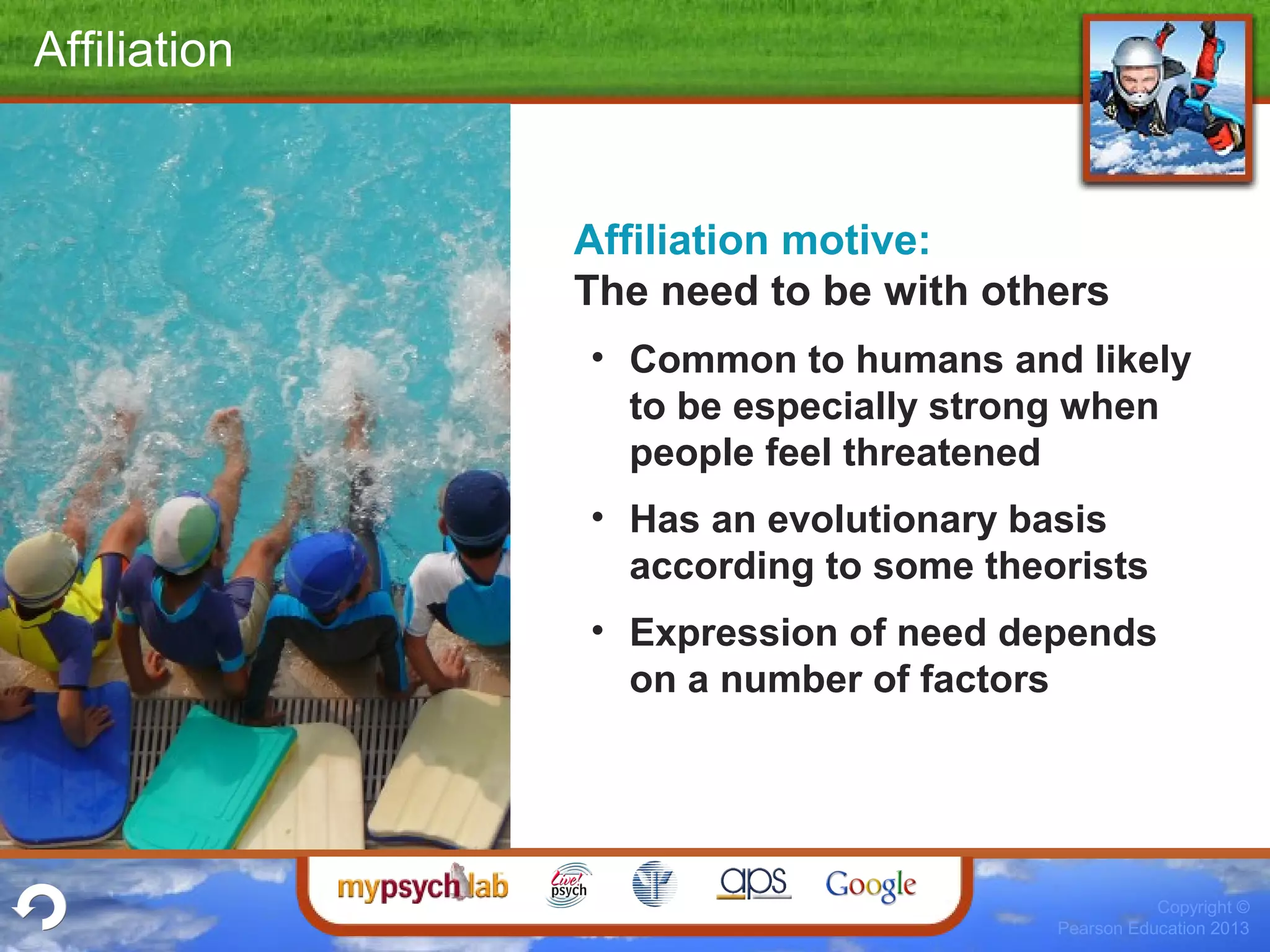
Affiliation
Affiliation motive:
The need to be with others
• Common to humans and likely
to be especially strong when
people feel threatened
• Has an evolutionary basis
according to some theorists
• Expression of need depends
on a number of factors
Emotions
Copyright ©
Pearson Education 2013
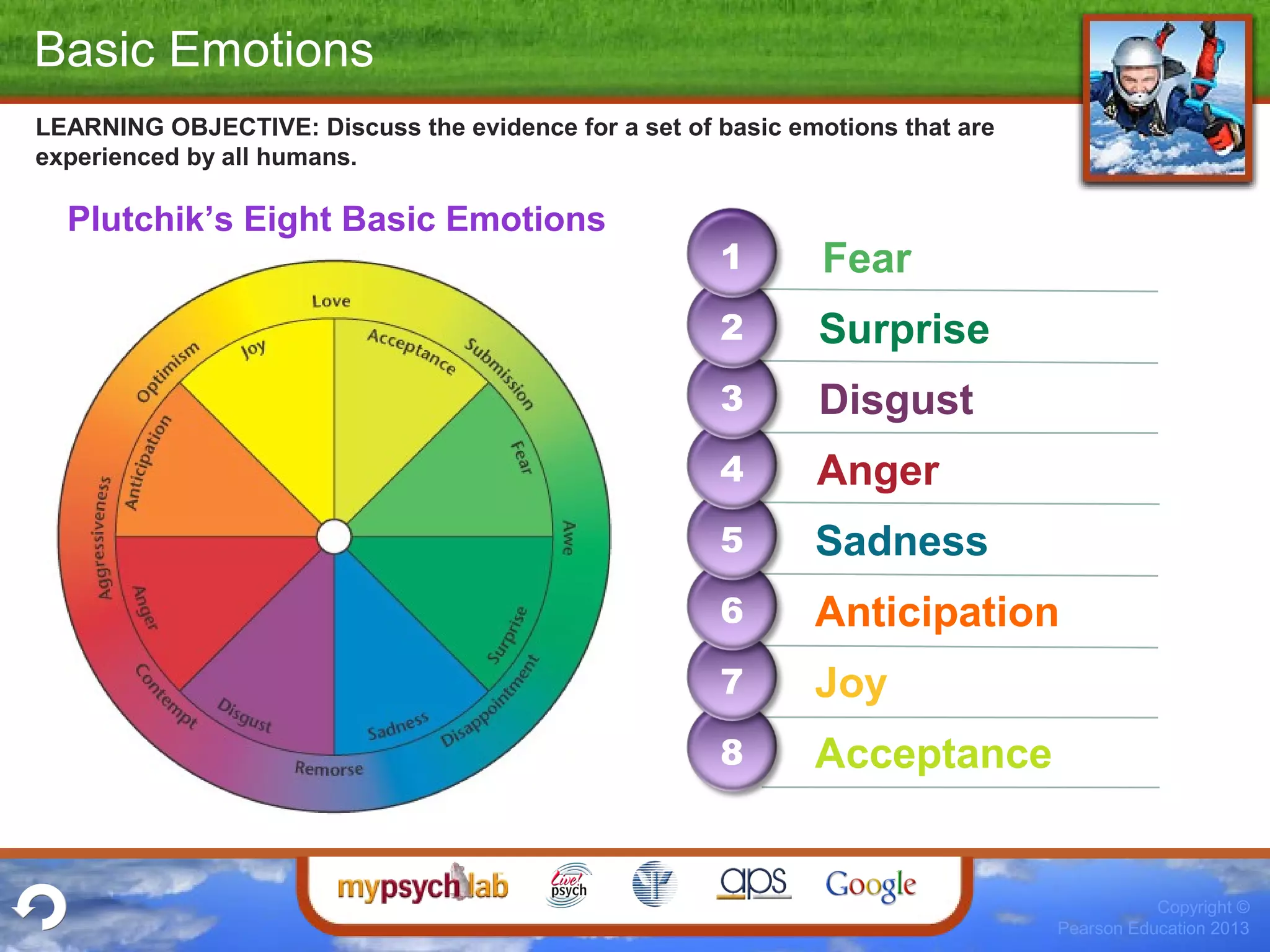
Fear
Surprise
Disgust
Anger
Sadness
Anticipation
Joy
Acceptance
Plutchik’s Eight Basic Emotions
LEARNING OBJECTIVE: Discuss the evidence for a set of basic emotions that are
experienced by all humans.
Basic Emotions
1
2
3
4
5
6
7
8
Copyright ©
Pearson Education 2013
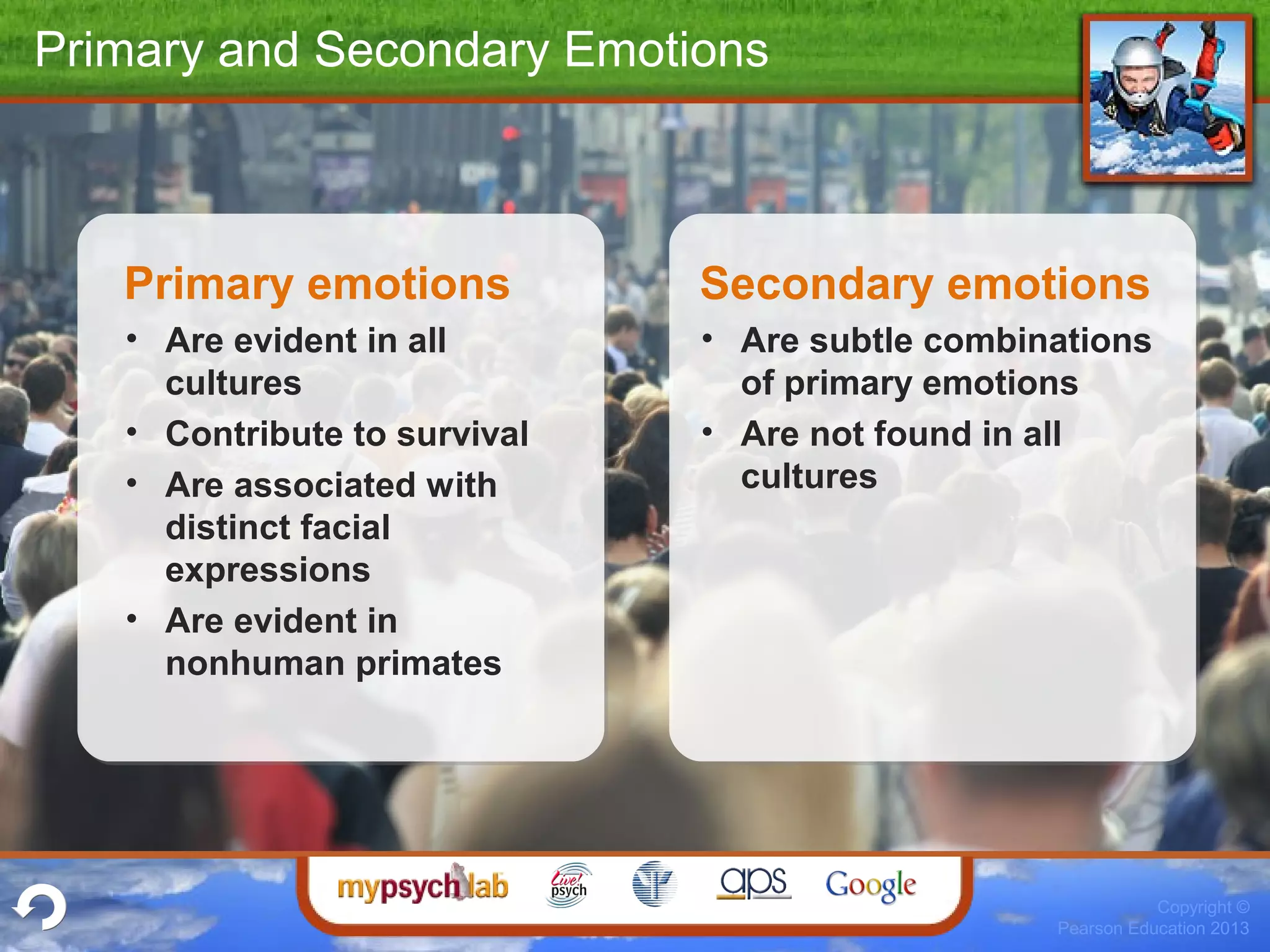
Primary and Secondary Emotions
Primary emotions
• Are evident in all
cultures
• Contribute to survival
• Are associated with
distinct facial
expressions
• Are evident in
nonhuman primates
Secondary emotions
• Are subtle combinations
of primary emotions
• Are not found in all
cultures
Copyright ©
Pearson Education 2013
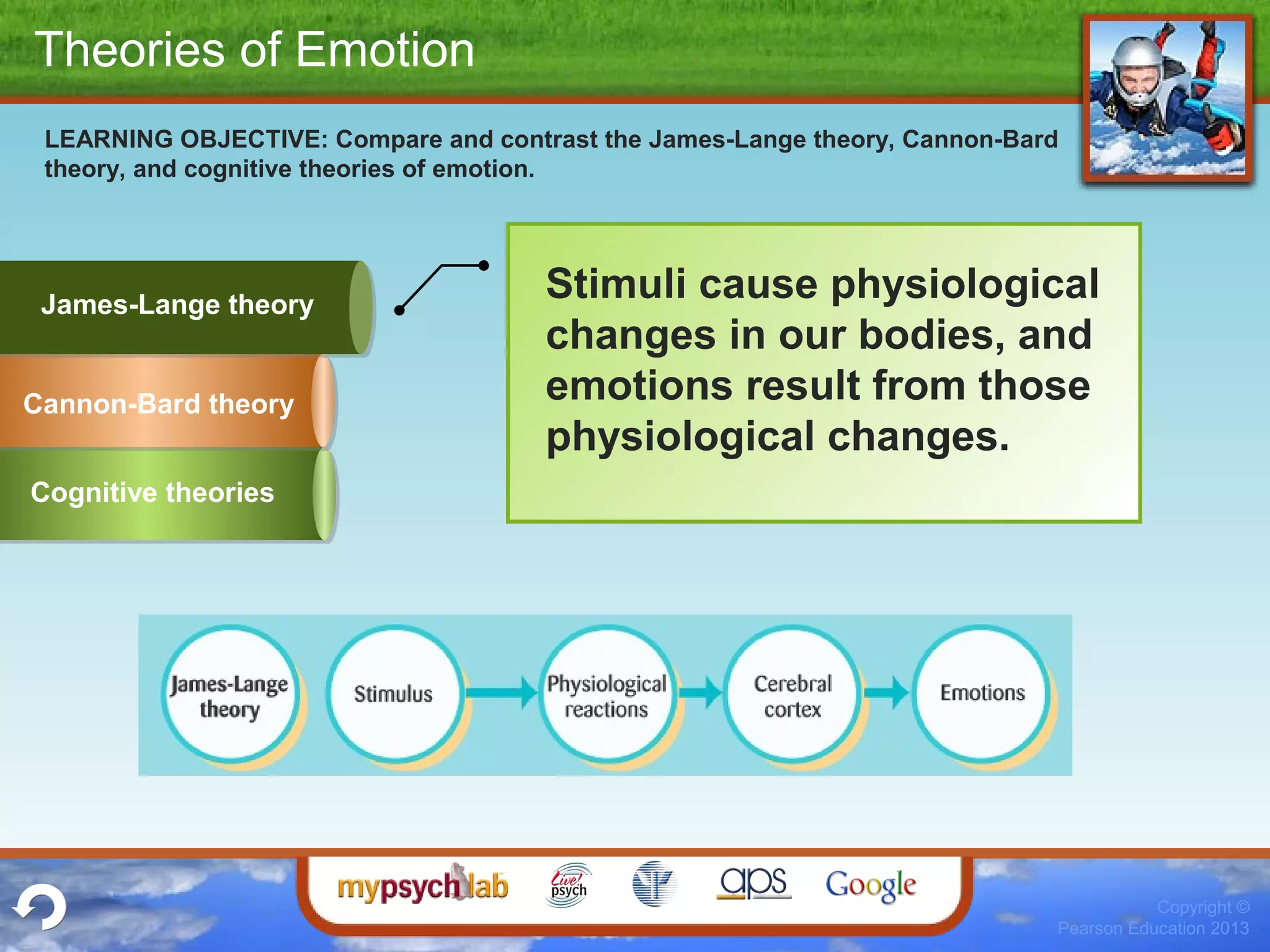
Stimuli cause physiological
changes in our bodies, and
emotions result from those
physiological changes.
LEARNING OBJECTIVE: Compare and contrast the James-Lange theory, Cannon-Bard
theory, and cognitive theories of emotion.
Theories of Emotion
Cognitive theories
Cannon-Bard theory
James-Lange theory
Copyright ©
Pearson Education 2013
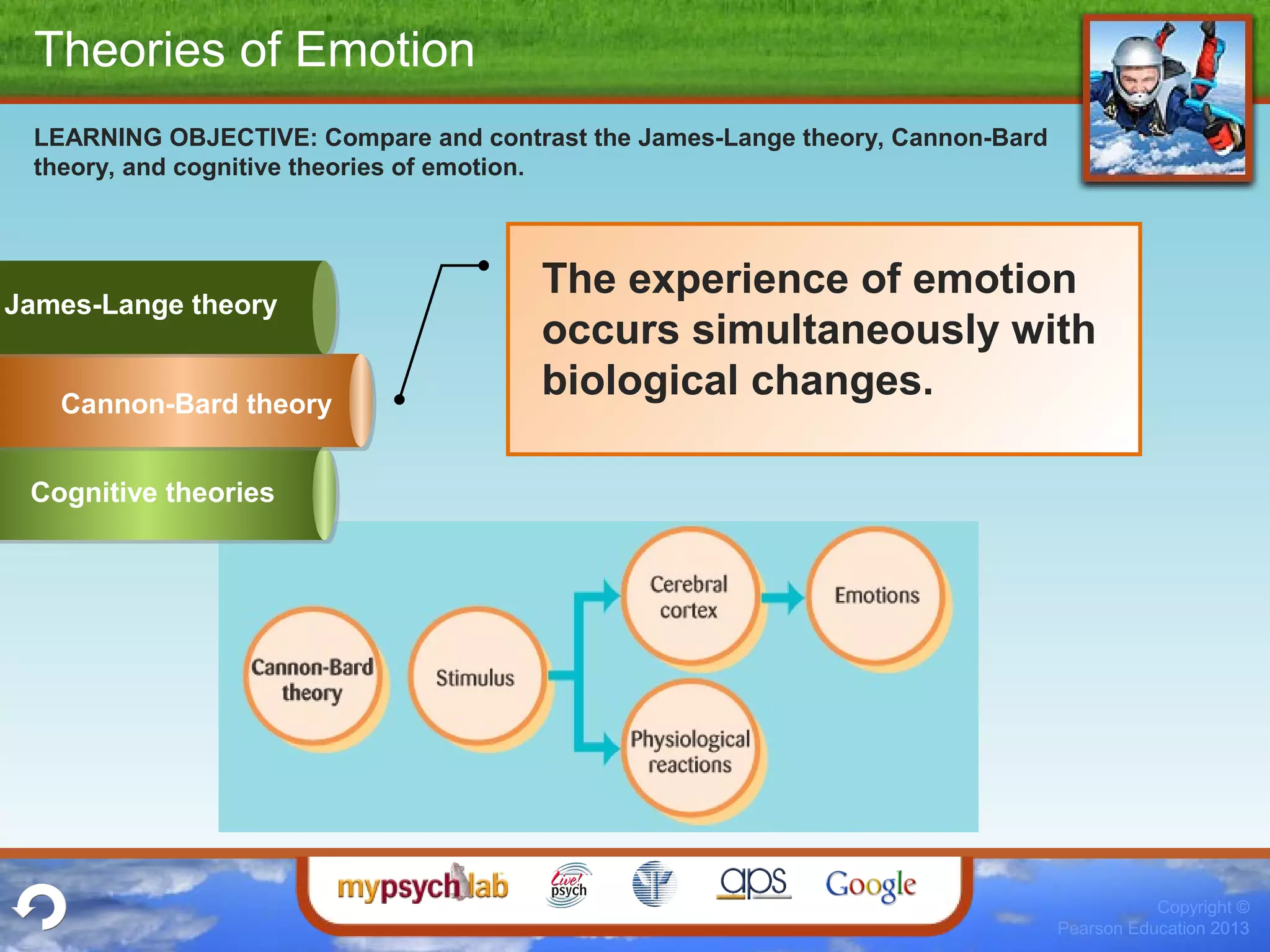
The experience of emotion
occurs simultaneously with
biological changes.
LEARNING OBJECTIVE: Compare and contrast the James-Lange theory, Cannon-Bard
theory, and cognitive theories of emotion.
Theories of Emotion
Cognitive theories
Cannon-Bard theory
James-Lange theory
Copyright ©
Pearson Education 2013
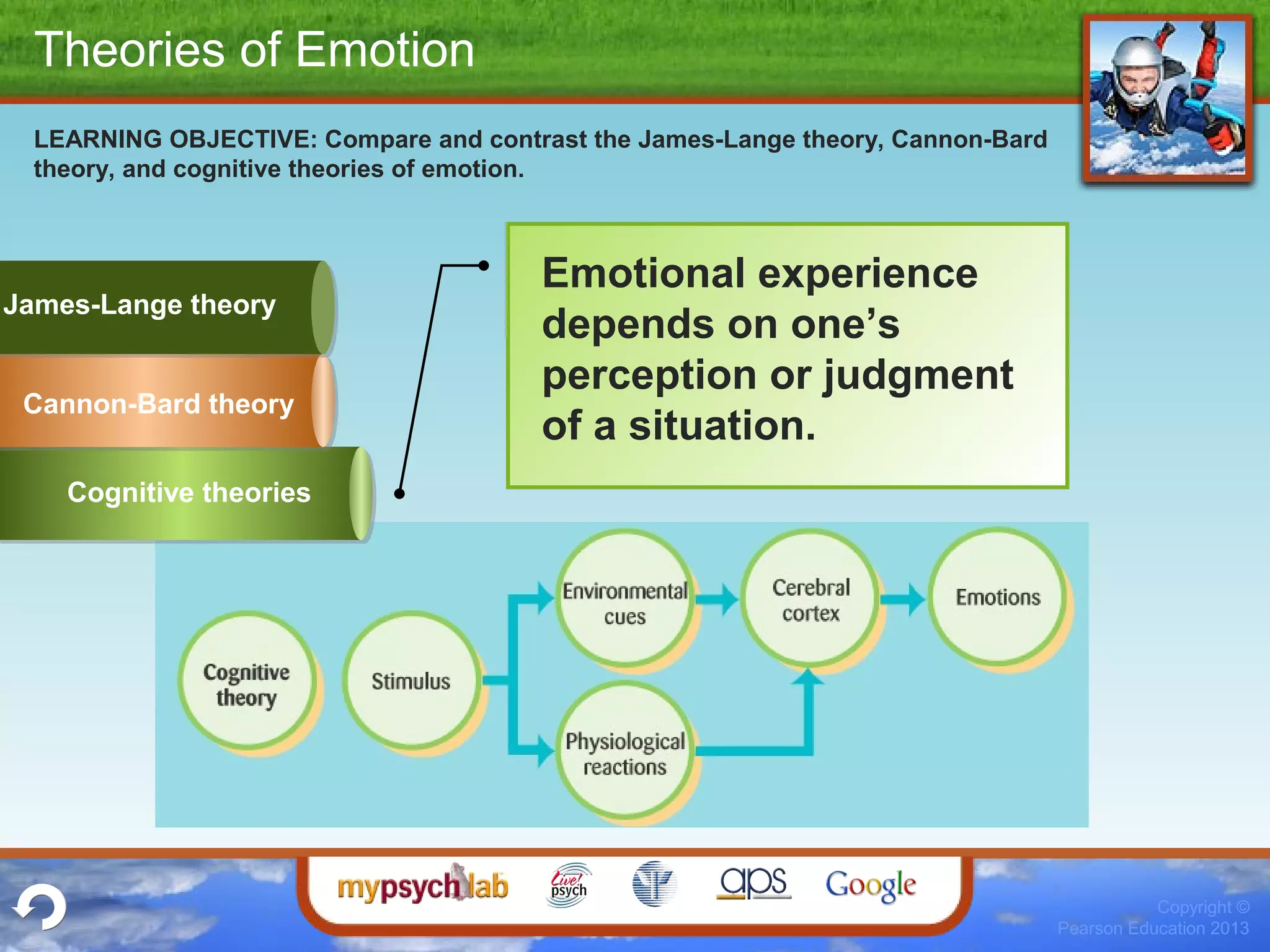
Emotional experience
depends on one’s
perception or judgment
of a situation.
LEARNING OBJECTIVE: Compare and contrast the James-Lange theory, Cannon-Bard
theory, and cognitive theories of emotion.
Theories of Emotion
Cognitive theories
Cannon-Bard theory
James-Lange theory
Communicating
Emotion
Copyright ©
Pearson Education 2013
LEARNING OBJECTIVE: Explain the importance of facial expressions in communicating emotion and
identify the areas of the brain that are responsible for interpreting facial expressions. Describe the
role of body language, gestures, and personal space in communicating emotions.
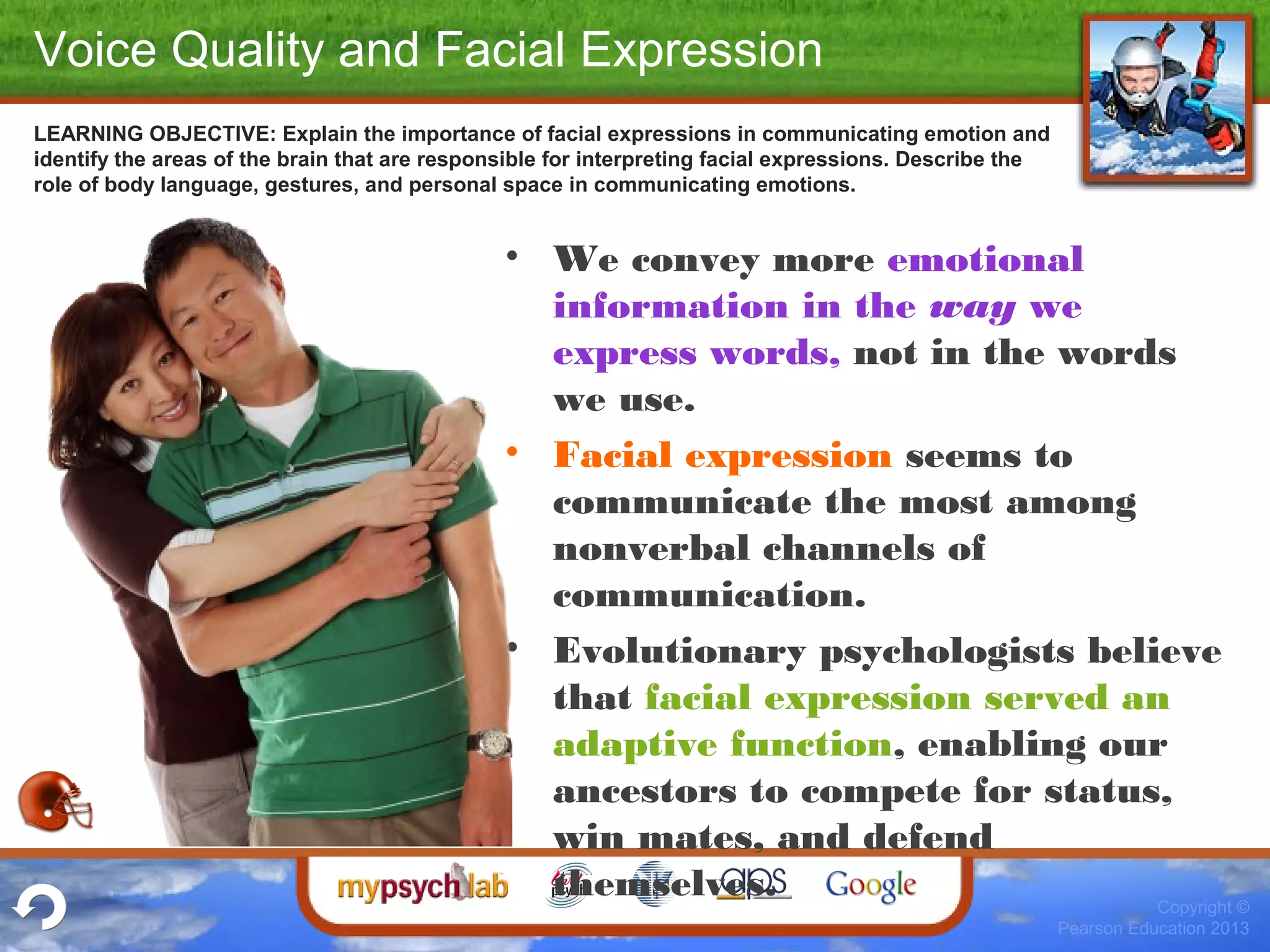
• We convey more emotional
information in the way we
express words, not in the words
we use.
• Facial expression seems to
communicate the most among
nonverbal channels of
communication.
• Evolutionary psychologists believe
that facial expression served an
adaptive function, enabling our
ancestors to compete for status,
win mates, and defend
themselves.
Voice Quality and Facial Expression
Copyright ©
Pearson Education 2013
How the Brain Reads the Face
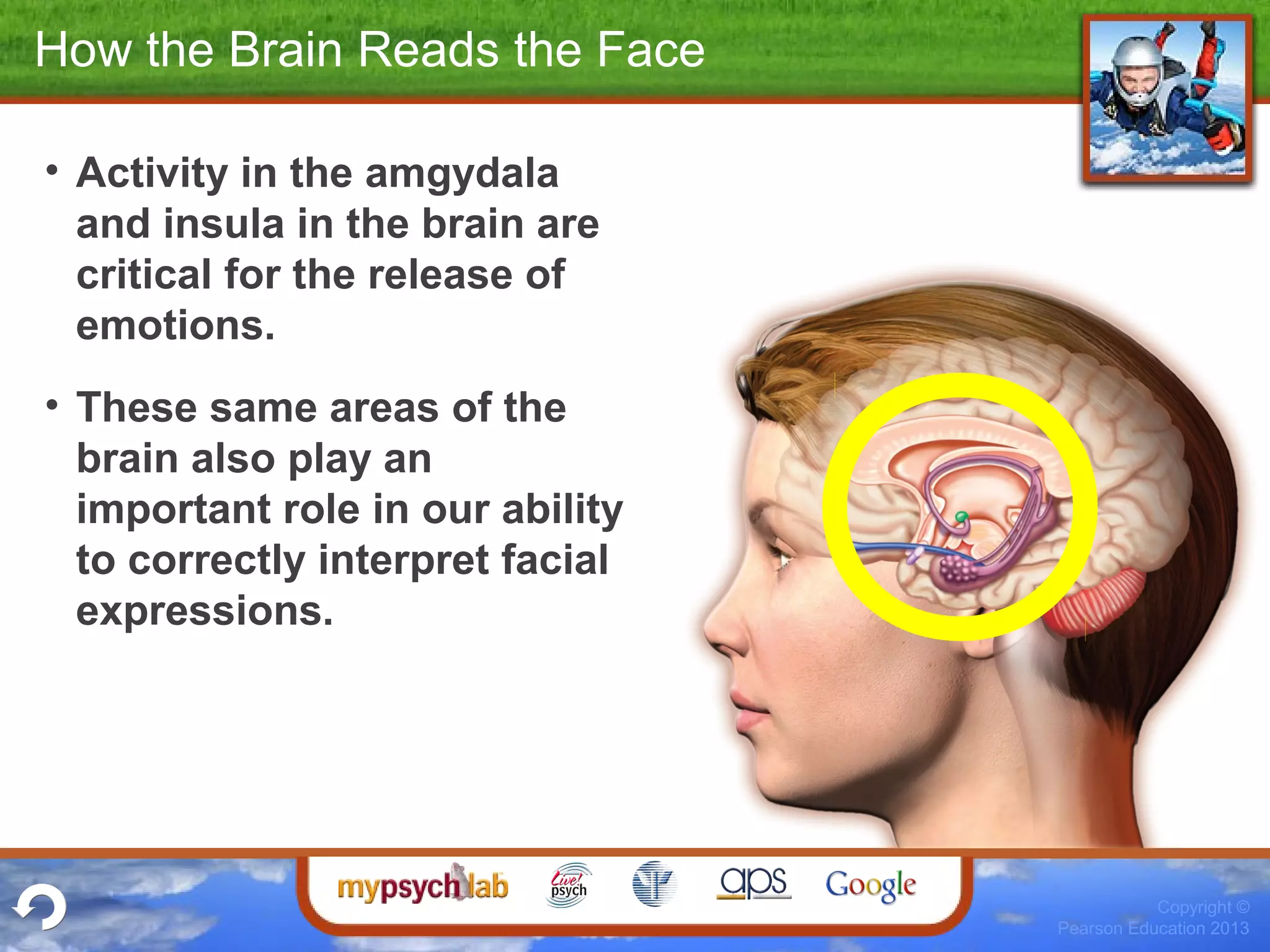
• Activity in the amgydala
and insula in the brain are
critical for the release of
emotions.
• These same areas of the
brain also play an
important role in our ability
to correctly interpret facial
expressions.
Copyright ©
Pearson Education 2013
Body Language, Personal Space,
and Gestures
Copyright ©
Pearson Education 2013
Gender and Emotion
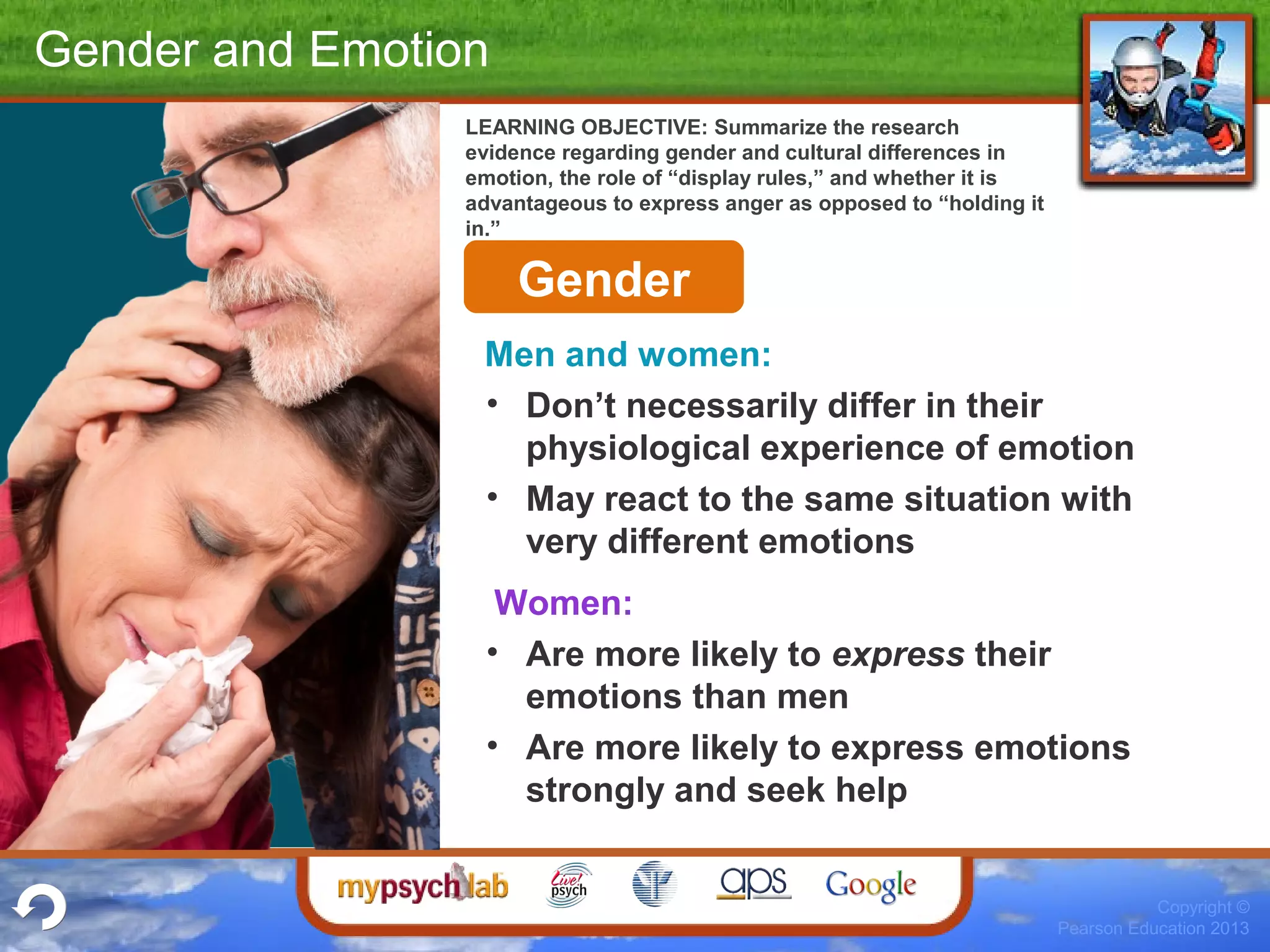
Men and women:
• Don’t necessarily differ in their
physiological experience of emotion
• May react to the same situation with
very different emotions
Women:
• Are more likely to express their
emotions than men
• Are more likely to express emotions
strongly and seek help
LEARNING OBJECTIVE: Summarize the research
evidence regarding gender and cultural differences in
emotion, the role of “display rules,” and whether it is
advantageous to express anger as opposed to “holding it
in.”
Gender
Copyright ©
Pearson Education 2013
Culture and Emotion
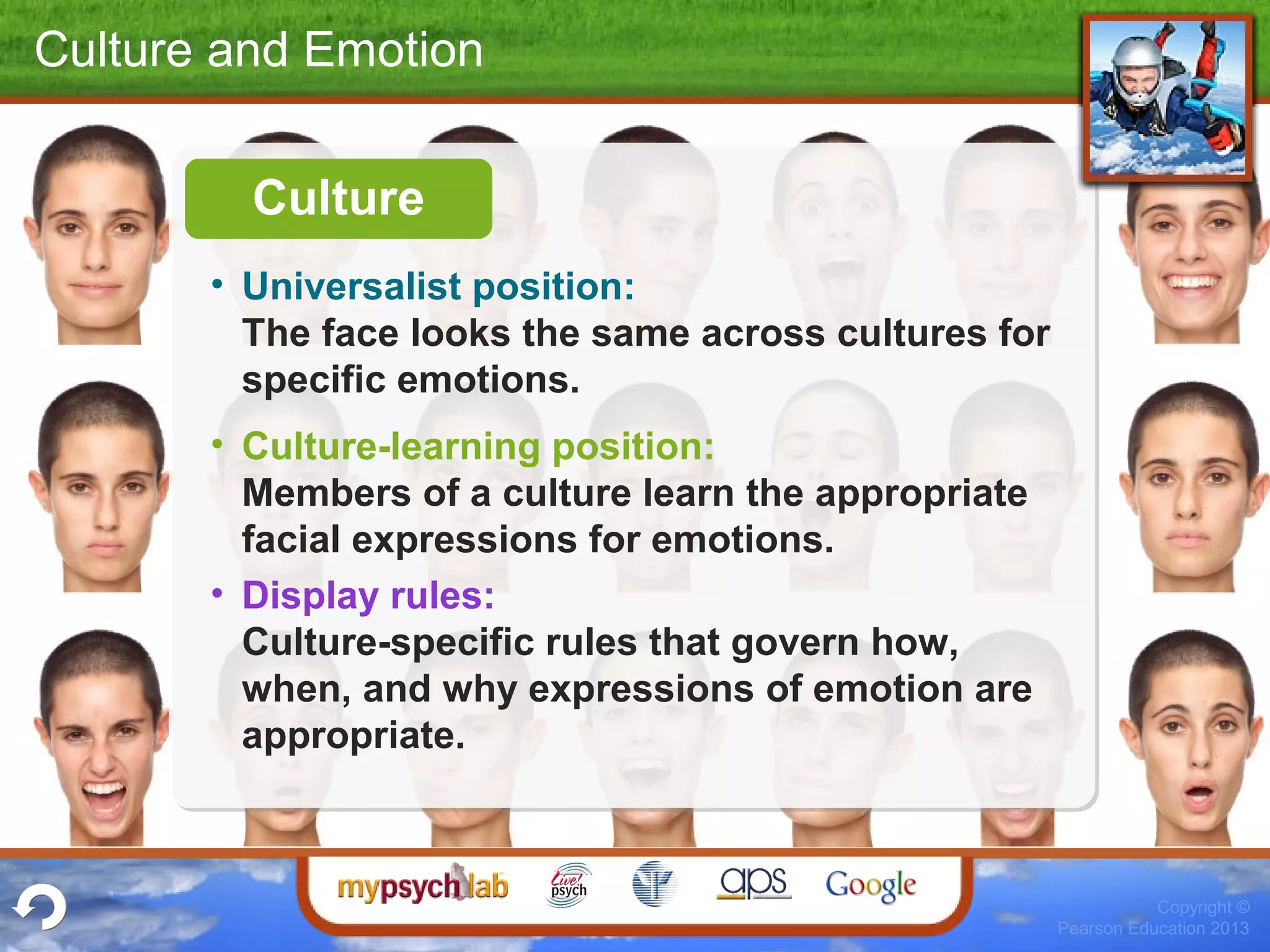
• Universalist position:
The face looks the same across cultures for
specific emotions.
• Culture-learning position:
Members of a culture learn the appropriate
facial expressions for emotions.
• Display rules:
Culture-specific rules that govern how,
when, and why expressions of emotion are
appropriate.
Culture
Acknowledgments
Slide # Image Description Image Source
text
template
upside down blue sky & grass ©iStockphoto.com/Konrad Lew
chapter
template
skydiving ©istockphoto.com/Aleksander Trankov
3 woman looking at scale ©istockphoto.com/Lise Gagne
4 baby w/ bottle ©istockphoto.com/Photo studio FD
4 fancy house ©istockphoto.com/Andrea Hill
5 girl crying ©istockphoto.com/Jesus Ayala
5 depressed teenager ©istockphoto.com/Aldo Murillo
6 happy woman ©istockphoto.com/bo1982
6 sad woman ©istockphoto.com/Silver Spiral Arts
6 angry man ©istockphoto.com/Hakimata Photography & Makeup
7 neck pain ©istockphoto.com/Martin Novak
8 woman rock climbing ©istockphoto.com/Greg Epperson
9 man and baby ©istockphoto.com/Barbara Sauder
11 girl chewing fingers: fear ©istockphoto.com/jlmatt
11 woman with hands over face: shame ©istockphoto.com/Soubrette
11 child: shyness ©istockphoto.com/elkor
12 child drinking water ©istockphoto.com/VARDHAN
12 person rock climbing ©istockphoto.com/Greg Epperson
13 head ©istockphoto.com/Angel Herrero de Frutos
13 money ©istockphoto.com/Kyu Oh
13 food - burger & fries ©istockphoto.com/Adolfo Lazo
14 young woman dancing happily ©istockphoto.com/Justin Horrocks
14 young woman sleeping happily ©istockphoto.com/Justin Horrocks
15 Figure 8.1: The Yerkes-Dodson law Morris/Maisto, 9/e p. 261
16 snowboarder ©istockphoto.com/Ben Blankenburg
17 girl on swing ©istockphoto.com/HooRoo Graphics
17 doctor giving child candy ©istockphoto.com/killerb10
18 Maslow's Hierarchy of Needs Adapted from Morris/Maisto, 9/e p. 262
20 hungry ©istockphoto.com/Neil Wysocki
20 bowl ©istockphoto.com/Jill Chen
20 dish of noodles ©istockphoto.com/Jamesmcq24
21 Figure 8.3: Physiological factors regulating appetite and body
weight
Morris/Maisto, 9/e p. 264
22 cooking ©istockphoto.com/Sean Locke
22 icon: wanted sign Charlie Levin, adapting wooden board image from
©istockphoto.com/andynwt
24 Figure 8.4: Rising obesity among American youth Morris/Maisto, 9/e p. 267
25 person exercising ©istockphoto.com/Overprint
25 scrap of paper ©istockphoto.com/Trevor Hunt
29 sex feet arousal ©istockphoto.com/Rapid Eye Media
29 sex feet climax ©istockphoto.com/Rapid Eye Media
29 sex feet post ©istockphoto.com/Niko Guido
30 Figure 10.3 From Ciccarelli, Psychology, 2/e p. 409
Figure 10.4 From Ciccarelli, Psychology, 2/e p. 409
31 woman jumping into a man's arms ©istockphoto.com/Yuri Arcurs
32 Figure 8.6: Frequency of sexual behavior around the world Morris/Maisto, 9/e p. 271
34 restroom doors - gender symbols ©istockphoto.com/k-libre
37 kid looking at bug ©istockphoto.com/Barssé
37 girl reaching for soda ©istockphoto.com/maska82
37 punch through wall ©istockphoto.com/Sami Suni
37 girl raising her hand ©istockphoto.com/bonniej graphic design
37 Singapore swim class ©istockphoto.com/arturbo
38 cat looking around a door ©istockphoto.com/tirc83
38 kid looking at bug ©istockphoto.com/Barssé
39 girl reaching for soda ©istockphoto.com/maska82
40 punch through wall ©istockphoto.com/Sami Suni
41 globe w/ flags ©istockphoto.com/Stay Media Productions
41 silhouettes - hate fighting TrapdoorMedia
42 girl raising her hand ©istockphoto.com/bonniej graphic design
43 Singapore swim class ©istockphoto.com/arturbo
45 Figure 8.7: Plutchik's eight basic emotions Morris/Maisto, 9/e p. 279
46 crowd ©istockphoto.com/adisa
47 Figure 8.10: James-Lange Theory Morris/Maisto, 9/e p. 281
48 Figure 8.10: Canon-Bard Theory Morris/Maisto, 9/e p. 281
49 Figure 8.10: Cognitive Theory Morris/Maisto, 9/e p. 281
51 icon: helmet ©istockphoto.com/Li Shen Jun
51 couple hugging ©istockphoto.com/ODonnell Photograf
52 Illustration: profile with brain From Ciccarelli, Psychology, 2/e p. 70
53 little girl hugging and kissing little boy ©istockphoto.com/Nicolesy, Inc. | Nicole S. Young
53 couple in kitchen ©istockphoto.com/Denis Raev
53 couple on couch ©istockphoto.com/Lev Olkha
54 woman expressing feelings to a man ©istockphoto.com/Lokibaho
55 woman facial expressions ©istockphoto.com/ZoneCreative
56 Open Your Book - textbook cover Shutterstock
56 Open Your Book - textbook background From Ciccarelli, Psychology, 1/e pp. 213-214
56 Open Your Book - open textbook From Ciccarelli, Psychology, 1/e pp. 114-115
58 topbar: cactus ©istockphoto.com/Lee Daniels
58 topbar: wooden board ©istockphoto.com/andynwt
58 text messaging ©iStockphoto.com/Freeze Frame Studio, Inc.
59 topbar: helmets ©istockphoto.com/Li Shen Jun
59 topbar: athletic field ©istockphoto.com/Jamie Otterstetter
60 tabletop of stationery ©istockphoto.com/Stuart Burford

Unit 4: Motivation and Emotion (Week 5)

  • 1.
  • 2.
    Copyright © Pearson Education2013 Diversity- Universality Stability-Change Mind-Body Nature-Nurture Person-Situation Enduring Issues How do motives and emotions affect behavior, and how are they affected by the external environment?
  • 3.
    Copyright © Pearson Education2013 Diversity- Universality Stability-Change Mind-Body Nature-Nurture Person-Situation Enduring Issues Are motives and emotions inborn or acquired?
  • 4.
    Copyright © Pearson Education2013 Diversity- Universality Stability-Change Mind-Body Nature-Nurture Person-Situation Enduring Issues Do motives and emotions change significantly over the life span?
  • 5.
    Copyright © Pearson Education2013 Diversity- Universality Stability-Change Mind-Body Nature-Nurture Person-Situation Enduring Issues To what extent do individuals differ in their motivations and emotions?
  • 6.
    Copyright © Pearson Education2013 Diversity- Universality Stability-Change Mind-Body Nature-Nurture Person-Situation How do motives and emotions arise from, and in turn affect, biological processes? Enduring Issues
  • 7.
    Specific need or desire,such as hunger, thirst, or achievement, that prompts goal-directed behavior otive
  • 8.
    Copyright © Pearson Education2013 Feeling, such as fear, joy, or surprise, that underlies behavior motion
  • 9.
  • 10.
    Copyright © Pearson Education2013 LEARNING OBJECTIVE: Compare and contrast instincts, drive-reduction theory, and arousal theory (including the Yerkes-Dodson law) as explanations of human behavior. Distinguish between primary and secondary drives, intrinsic and extrinsic motivation, and summarize Maslow’s hierarchy of motives. Instincts Instinct theory was popular in the early 20th century, but was ultimately disputed because: • Most important human behavior is learned. • Human behavior is rarely rigid, inflexible, unchanging, and common to all, as is the case with instincts. • Ascribing every conceivable human behavior to a corresponding instinct explains nothing.
  • 11.
    Copyright © Pearson Education2013 Drive Reduction Theory Need: Requirement of material (e.g., food, water) essential for survival Drive: Need creates state of tension or arousal Drive-reduction theory: Attempts to reduce the unpleasant state of tension and return the organism to homeostasis
  • 12.
    Copyright © Pearson Education2013 Primary drives: Unlearned drives that are based on a physiological state Secondary drives: Learned drives that are not based on a physiological state Primary and Secondary Drives
  • 13.
    Copyright © Pearson Education2013 Arousal Theory Behavior stems from the desire to maintain an optimum level of arousal Sometimes level of arousal is reduced. Other times level of arousal is increased.
  • 14.
    Copyright © Pearson Education2013 Arousal Theory Yerkes-Dodson law: The more complex the task, the lower the level of arousal that can be tolerated before performance deteriorates Simple task = increase level of arousal Complex task = reduce level of arousal
  • 15.
    Copyright © Pearson Education2013 Sensation Seeking • Thrill-seeking behavior • Not explained by arousal theory • Zuckerman: A basic motivation, some aspects of which are inherited and neurologically based
  • 16.
    Copyright © Pearson Education2013 Intrinsic and Extrinsic Motivation Intrinsic motivation: A desire to perform a behavior that stems from the enjoyment derived from the behavior itself Extrinsic motivation: A desire to perform a behavior to obtain an external reward or avoid punishment
  • 17.
    Copyright © Pearson Education2013 A Hierarchy of Motives Maslow’s hierarchy of needs: Higher motives only emerge after lower level motives are satisfied Physiological Needs Safety Needs Belongingness Needs Esteem Needs Self-Actualization Needs Source: Adapted from Motivation and Personality by Abraham H. Maslow. Copyright © 1970. Reprinted by permission of Pearson Education, Upper Saddle River, NJ
  • 18.
  • 19.
    Copyright © Pearson Education2013 Biological and Emotional Factors Hunger and thirst are influenced by: LEARNING OBJECTIVE: Identify the areas of the brain that are involved in hunger and describe the role of glucose, leptin, and ghrelin in determining a biological need for food. Distinguish between the biological need for food and the experience of hunger (including the role of incentives). Internal cues External cues
  • 20.
    Copyright © Pearson Education2013 Biological Factors Hunger is stimulated internally through the brain’s complex monitoring of: • Fats • Carbohydrates • Glucose (a simple sugar) • Various hormones
  • 21.
    Copyright © Pearson Education2013 Incentives (i.e. cooking aromas) Emotional factors Cultural factors Social factors Other Factors that Stimulate Hunger 1 2 3 4
  • 22.
    Copyright © Pearson Education2013 Eating Disorders and Obesity LEARNING OBJECTIVE: List the symptoms that are used to diagnose anorexia nervosa, bulimia nervosa, muscle dysmorphia, and obesity. Describe the people who are most likely to develop these disorders and the most likely causes of them. Anorexia nervosa • Approximately 1% of adolescents suffer from anorexia nervosa. • About 90% of them are white upper- or middle-class females. • Over 10% of those with anorexia nervosa die as a result of the disorder. Bulimia nervosa • Approximately 1-2% of all adolescent females have bulimia nervosa. • Upper- and middle- class women are most at-risk. Muscle dysmorphia • It is more common in young males.
  • 23.
    Copyright © Pearson Education2013 Obesity • Obesity has increased more than 50% in the last decade. • More than two-thirds of Americans are overweight or obese. • The obesity statistics for American youth are displayed to the right. • There really is no “quick fix” for weight loss. • Our bodies appear to be genetically “set” to maintain a certain weight. – Set-point theory
  • 24.
    Applying Psychology Copyright © PearsonEducation 2013 The Slow (but Lasting) Fix for Weight Gain 1. Check with your doctor before you start to make sure your weight loss program will be safe. 2. Increase your body’s metabolism through regular exercise. 3. Modify your diet. 4. Reduce external cues that encourage you to eat undesirable foods. 5. Set realistic goals. 6. Reward yourself – in ways unrelated to food – for small improvements.
  • 25.
  • 26.
    Copyright © Pearson Education2013 Sexual motivation is similar to, and different from, other primary drives. Biological Factors LEARNING OBJECTIVE: Describe how sexual motivation is both similar to and different from other primary drives. Identify the factors (biological and nonbiological) that affect sexual motivation. Similar Sex is considered a primary drive because it is unlearned and is a physiological state. Different Sex is vital only to the survival of the species, not to the survival of the individual.
  • 27.
    Copyright © Pearson Education2013 Biological Factors Testosterone (the primary male sex hormone) – Baseline levels associated with frequency of sexual behavior/satisfaction in males and females Pheromones – Some evidence that they are secreted in the sweat glands of the armpits and in the genitals – May influence sexual attraction Brain – Limbic system and insula: involved in sexual excitement Sexual response cycle – Typical sequence of events characterizing sexual response in males and females
  • 28.
    Copyright © Pearson Education2013 Sexual Response Cycle LEARNING OBJECTIVE: Describe the sexual response cycle and how it differs for men and women. Briefly explain what is meant by the statement that “research indicates that the sex lives of most Americans differ significantly from media portrayals.” 1. Excitement: Beginning of arousal 2. Plateau: Physical changes continue 3. Orgasm: Rhythmic contractions in vagina/penis muscles; male ejaculates 4. Resolution: Final phase, body returned to normal state • Refractory period: Time period when males cannot have another orgasm
  • 29.
    Copyright © Pearson Education2013 Cultural and Environmental Factors Human sexual motivation is much more dependent on experience and learning than on biology. • Sight and smell • Moral beliefs • Culture of origin • Age • Gender equality
  • 30.
    Copyright © Pearson Education2013 Michael, Gagnon, Laumann, & Kolata (1994) study of 3,432 people aged 18-59. Patterns of Sexual Behavior Among Americans Twice a week or more: about 1/3 A few times a month: 1/3 A few times a year or not at all: 1/3 Approx. 15 minutes Vaginal intercourse: over 90% Married couples: more satisfied and had sex more often than unmarried persons (see also Waite & Joyner, 2001) Males: 6 Females: 2 17% of the men, 3% of the women: sex with over 20 partners Men: about 25% Women: about 15% Average duration of intercourse Median number of partners over the lifetime Percentage who committed adultery Frequency of sex Preferred form of sex Satisfaction with sex life
  • 31.
    Copyright © Pearson Education2013 Gender Differences in Sexuality Men • Men are more interested in sex than are women. • Aggression, power, dominance, and assertiveness are more closely linked to sex among men than among women. Women • Women are more likely than men to link sex to a close, committed relationship. • Women’s sexuality is more open to change over time.
  • 32.
    Copyright © Pearson Education2013 Sexual Orientation LEARNING OBJECTIVE: Summarize the research evidence for and against a biological basis for sexual orientation. What determines sexual orientation? Nature Primarily influenced by genetics Nurture A result of early learning and socialization Combination Likely explanation probably involves a combination of the two
  • 33.
  • 34.
    Copyright © Pearson Education2013 Other Important Motives • Stimulus motives: Unlearned motives that prompt us to explore or change the world around us – Exploration – Curiosity – Manipulation – Contact • Aggression • Achievement • Affiliation
  • 35.
    Copyright © Pearson Education2013 Exploration and Curiosity • Sparked by the new and unknown • Directed toward no more specific goal other than “finding out” • Not unique to humans • Disagreement about the nature and causes of curiosity LEARNING OBJECTIVE: Briefly describe the major stimulus motives: exploration, curiosity, manipulation, and contact.
  • 36.
    Copyright © Pearson Education2013 Manipulation and Contact • Limited to primates, who have agile fingers and toes • Manipulation: An active process • Contact: Can be either active or passive • Harlow (1958) and Harlow & Zimmerman (1959): Studies with monkeys demonstrating the human need for contact
  • 37.
    Copyright © Pearson Education2013 Aggression Behavior aimed at doing harm to others; also, the motive to behave aggressively Theories: • Innate drive • A vestige of our evolutionary past that is triggered by pain or frustration • Social learning LEARNING OBJECTIVE: Describe the role of learning as a determinant of aggression including evidence for gender and cultural differences in aggressive behavior.
  • 38.
    Copyright © Pearson Education2013 Aggression: Culture and Gender • Collectivist societies have lower levels of aggression. • Across cultures, males at every age are more aggressive than females. • Higher levels of aggression in males may be due to socialization as well as biological factors.
  • 39.
    Copyright © Pearson Education2013 Achievement Achievement motive: The need to excel and to overcome obstacles Three separate but interrelated achievement-oriented behaviors: • Work orientation • Mastery • Competitiveness: Tends to interfere with achievement LEARNING OBJECTIVE: Identify the components of achievement behavior and the characteristics of people who are high in achievement motivation. Explain the factors that affect the affiliation motive and the likelihood that a person will express their need for affiliation.
  • 40.
    Copyright © Pearson Education2013 Affiliation Affiliation motive: The need to be with others • Common to humans and likely to be especially strong when people feel threatened • Has an evolutionary basis according to some theorists • Expression of need depends on a number of factors
  • 41.
  • 42.
    Copyright © Pearson Education2013 Fear Surprise Disgust Anger Sadness Anticipation Joy Acceptance Plutchik’s Eight Basic Emotions LEARNING OBJECTIVE: Discuss the evidence for a set of basic emotions that are experienced by all humans. Basic Emotions 1 2 3 4 5 6 7 8
  • 43.
    Copyright © Pearson Education2013 Primary and Secondary Emotions Primary emotions • Are evident in all cultures • Contribute to survival • Are associated with distinct facial expressions • Are evident in nonhuman primates Secondary emotions • Are subtle combinations of primary emotions • Are not found in all cultures
  • 44.
    Copyright © Pearson Education2013 Stimuli cause physiological changes in our bodies, and emotions result from those physiological changes. LEARNING OBJECTIVE: Compare and contrast the James-Lange theory, Cannon-Bard theory, and cognitive theories of emotion. Theories of Emotion Cognitive theories Cannon-Bard theory James-Lange theory
  • 45.
    Copyright © Pearson Education2013 The experience of emotion occurs simultaneously with biological changes. LEARNING OBJECTIVE: Compare and contrast the James-Lange theory, Cannon-Bard theory, and cognitive theories of emotion. Theories of Emotion Cognitive theories Cannon-Bard theory James-Lange theory
  • 46.
    Copyright © Pearson Education2013 Emotional experience depends on one’s perception or judgment of a situation. LEARNING OBJECTIVE: Compare and contrast the James-Lange theory, Cannon-Bard theory, and cognitive theories of emotion. Theories of Emotion Cognitive theories Cannon-Bard theory James-Lange theory
  • 47.
  • 48.
    Copyright © Pearson Education2013 LEARNING OBJECTIVE: Explain the importance of facial expressions in communicating emotion and identify the areas of the brain that are responsible for interpreting facial expressions. Describe the role of body language, gestures, and personal space in communicating emotions. • We convey more emotional information in the way we express words, not in the words we use. • Facial expression seems to communicate the most among nonverbal channels of communication. • Evolutionary psychologists believe that facial expression served an adaptive function, enabling our ancestors to compete for status, win mates, and defend themselves. Voice Quality and Facial Expression
  • 49.
    Copyright © Pearson Education2013 How the Brain Reads the Face • Activity in the amgydala and insula in the brain are critical for the release of emotions. • These same areas of the brain also play an important role in our ability to correctly interpret facial expressions.
  • 50.
    Copyright © Pearson Education2013 Body Language, Personal Space, and Gestures
  • 51.
    Copyright © Pearson Education2013 Gender and Emotion Men and women: • Don’t necessarily differ in their physiological experience of emotion • May react to the same situation with very different emotions Women: • Are more likely to express their emotions than men • Are more likely to express emotions strongly and seek help LEARNING OBJECTIVE: Summarize the research evidence regarding gender and cultural differences in emotion, the role of “display rules,” and whether it is advantageous to express anger as opposed to “holding it in.” Gender
  • 52.
    Copyright © Pearson Education2013 Culture and Emotion • Universalist position: The face looks the same across cultures for specific emotions. • Culture-learning position: Members of a culture learn the appropriate facial expressions for emotions. • Display rules: Culture-specific rules that govern how, when, and why expressions of emotion are appropriate. Culture
  • 53.
  • 54.
    Slide # ImageDescription Image Source text template upside down blue sky & grass ©iStockphoto.com/Konrad Lew chapter template skydiving ©istockphoto.com/Aleksander Trankov 3 woman looking at scale ©istockphoto.com/Lise Gagne 4 baby w/ bottle ©istockphoto.com/Photo studio FD 4 fancy house ©istockphoto.com/Andrea Hill 5 girl crying ©istockphoto.com/Jesus Ayala 5 depressed teenager ©istockphoto.com/Aldo Murillo 6 happy woman ©istockphoto.com/bo1982 6 sad woman ©istockphoto.com/Silver Spiral Arts 6 angry man ©istockphoto.com/Hakimata Photography & Makeup 7 neck pain ©istockphoto.com/Martin Novak 8 woman rock climbing ©istockphoto.com/Greg Epperson 9 man and baby ©istockphoto.com/Barbara Sauder 11 girl chewing fingers: fear ©istockphoto.com/jlmatt 11 woman with hands over face: shame ©istockphoto.com/Soubrette 11 child: shyness ©istockphoto.com/elkor 12 child drinking water ©istockphoto.com/VARDHAN 12 person rock climbing ©istockphoto.com/Greg Epperson 13 head ©istockphoto.com/Angel Herrero de Frutos 13 money ©istockphoto.com/Kyu Oh 13 food - burger & fries ©istockphoto.com/Adolfo Lazo 14 young woman dancing happily ©istockphoto.com/Justin Horrocks 14 young woman sleeping happily ©istockphoto.com/Justin Horrocks 15 Figure 8.1: The Yerkes-Dodson law Morris/Maisto, 9/e p. 261 16 snowboarder ©istockphoto.com/Ben Blankenburg 17 girl on swing ©istockphoto.com/HooRoo Graphics
  • 55.
    17 doctor givingchild candy ©istockphoto.com/killerb10 18 Maslow's Hierarchy of Needs Adapted from Morris/Maisto, 9/e p. 262 20 hungry ©istockphoto.com/Neil Wysocki 20 bowl ©istockphoto.com/Jill Chen 20 dish of noodles ©istockphoto.com/Jamesmcq24 21 Figure 8.3: Physiological factors regulating appetite and body weight Morris/Maisto, 9/e p. 264 22 cooking ©istockphoto.com/Sean Locke 22 icon: wanted sign Charlie Levin, adapting wooden board image from ©istockphoto.com/andynwt 24 Figure 8.4: Rising obesity among American youth Morris/Maisto, 9/e p. 267 25 person exercising ©istockphoto.com/Overprint 25 scrap of paper ©istockphoto.com/Trevor Hunt 29 sex feet arousal ©istockphoto.com/Rapid Eye Media 29 sex feet climax ©istockphoto.com/Rapid Eye Media 29 sex feet post ©istockphoto.com/Niko Guido 30 Figure 10.3 From Ciccarelli, Psychology, 2/e p. 409 Figure 10.4 From Ciccarelli, Psychology, 2/e p. 409 31 woman jumping into a man's arms ©istockphoto.com/Yuri Arcurs 32 Figure 8.6: Frequency of sexual behavior around the world Morris/Maisto, 9/e p. 271 34 restroom doors - gender symbols ©istockphoto.com/k-libre 37 kid looking at bug ©istockphoto.com/Barssé 37 girl reaching for soda ©istockphoto.com/maska82 37 punch through wall ©istockphoto.com/Sami Suni 37 girl raising her hand ©istockphoto.com/bonniej graphic design 37 Singapore swim class ©istockphoto.com/arturbo 38 cat looking around a door ©istockphoto.com/tirc83 38 kid looking at bug ©istockphoto.com/Barssé
  • 56.
    39 girl reachingfor soda ©istockphoto.com/maska82 40 punch through wall ©istockphoto.com/Sami Suni 41 globe w/ flags ©istockphoto.com/Stay Media Productions 41 silhouettes - hate fighting TrapdoorMedia 42 girl raising her hand ©istockphoto.com/bonniej graphic design 43 Singapore swim class ©istockphoto.com/arturbo 45 Figure 8.7: Plutchik's eight basic emotions Morris/Maisto, 9/e p. 279 46 crowd ©istockphoto.com/adisa 47 Figure 8.10: James-Lange Theory Morris/Maisto, 9/e p. 281 48 Figure 8.10: Canon-Bard Theory Morris/Maisto, 9/e p. 281 49 Figure 8.10: Cognitive Theory Morris/Maisto, 9/e p. 281 51 icon: helmet ©istockphoto.com/Li Shen Jun 51 couple hugging ©istockphoto.com/ODonnell Photograf 52 Illustration: profile with brain From Ciccarelli, Psychology, 2/e p. 70 53 little girl hugging and kissing little boy ©istockphoto.com/Nicolesy, Inc. | Nicole S. Young 53 couple in kitchen ©istockphoto.com/Denis Raev 53 couple on couch ©istockphoto.com/Lev Olkha 54 woman expressing feelings to a man ©istockphoto.com/Lokibaho 55 woman facial expressions ©istockphoto.com/ZoneCreative 56 Open Your Book - textbook cover Shutterstock 56 Open Your Book - textbook background From Ciccarelli, Psychology, 1/e pp. 213-214 56 Open Your Book - open textbook From Ciccarelli, Psychology, 1/e pp. 114-115 58 topbar: cactus ©istockphoto.com/Lee Daniels 58 topbar: wooden board ©istockphoto.com/andynwt 58 text messaging ©iStockphoto.com/Freeze Frame Studio, Inc. 59 topbar: helmets ©istockphoto.com/Li Shen Jun 59 topbar: athletic field ©istockphoto.com/Jamie Otterstetter 60 tabletop of stationery ©istockphoto.com/Stuart Burford

Editor's Notes

  • #11 Instincts – inborn, inflexible, goal-directed behaviors that are characteristic of an entire species.
  • #12 Drive – state of tension or arousal that motivates behavior. Drive-reduction theory – asserts that motivated behavior is aimed at reducing a state of bodily tension or arousal and returning the organism to homeostasis (the state of balance and stability in which the organism functions effectively). The theory cannot explain all kinds of behavior. It implies that people will do little (i.e. have no motivation) when their drives are reduced, but people do many things for which there is no drive that needs to be reduced.
  • #13 Primary drives – unlearned drives, such as hunger, that are based on a physiological state. Secondary drives – learned drives, such as ambition, that are not based on a physiological state.
  • #14 Arousal theory – theory of motivation that proposes that organisms seek an optimal level of arousal; this level of arousal varies during the day and from one situation to the next. According to arousal theory, we either seek to increase our decrease our state of arousal, depending upon our momentary needs. There is no “best” level of arousal necessary to perform all tasks.
  • #15 Yerkes-Dodson Law – states that there is an optimal level of arousal for the best performance of any task; the more complex the task, the lower the level of arousal that can be tolerated before performance deteriorates. Figure source : After Hebb, 1955.
  • #16 Arousal theory fails to account for extreme thrill-seeking behavior (e.g., skydiving, bungee jumping, etc.). To address this, Zuckerman (2005) argues that sensation-seeking is a drive and that individuals vary in their level of sensation-seeking. High sensation-seekers prefer very stimulating activities while low sensation-seekers prefer more sedate and less risky behaviors. Some theorists argue that risk-taking provides adaptive benefits from an evolutionary perspective.
  • #17 Intrinsic motivation – a desire to perform a behavior that stems from the enjoyment derived from the behavior itself. Extrinsic motivation – a desire to perform a behavior to obtain an external reward or avoid punishment. An extensive analysis of the research on the effects of extrinsic rewards on the behavior of children indicated that extrinsic rewards tend to decrease a child’s intrinsic motivation and sense of personal responsibility for a behavior. Unexpected rewards or praise may increase intrinsic motivation.
  • #18 Hierarchy of needs (Abraham Maslow) – a theory of motivation holding that higher order motives involving social and personal growth only emerge after lower level motives related to survival have been satisfied. Recent research has challenged the universality of Maslow’s hierarchy, identifying cultures where physiological and safety needs have not been met, yet belongingness needs and self-esteem needs have been. Figure source : From Motivation and Personality by Abraham H. Maslow, Prentice-Hall, 1970.
  • #21 Feelings of hunger and satiation are governed by various areas in the brain and not just the hypothalamus, as once thought. The brain monitors several indicators of hunger: Glucose – a simple sugar used by the body for energy. Leptin – a hormone released by fat cells that reduces appetite. Ghrelin – a hormone produced in the stomach and small intestines that increases appetite. The brain monitors the levels of fats, carbohydrates, and insulin in the blood as well as the quantity of food that one has consumed.
  • #22 Other factors also mediate hunger: Sleep deprivation the sight, smell or thought of food time of day (if we eat at regular intervals, our bodies “learn” when it’s time for breakfast, lunch and dinner) mood (e.g., some people seek “comfort food” when sad or upset – others don’t eat at all) habits (e.g., some people develop a pattern of eating while reading or working at a desk). Incentive – external stimulus that prompts goal-directed behavior.
  • #23 Anorexia nervosa – An eating disorder characterized by an intense fear of weight gain and a distorted body image. Bulimia nervosa – An eating disorder characterized by binges of eating followed by self-induced vomiting. Muscle dysmorphia – A disorder characterized by obsessive concern with muscle size. There are numerous causes for eating disorders: Societal pressures conveyed by mass media to be thin low self-esteem being bullied during childhood (pertains to those with muscle dysmorphia) negative feedback about body weight from family members genetic predispositions Treatment of eating disorders is very difficult and some see treatment as a life-long process.
  • #24 Obesity – an excess of body fat in relation to lean body mass. Overweight – weighing more than a desirable standard (whether due to high amounts of body fat or being very muscular). Obesity is the most pressing health problem in America; two-thirds of Americans are either overweight or obese. There are many well-known causes for obesity: Overeating; genetic predisposition to be overweight or to engage in compulsive eating; eating habits established during childhood (which determines the number of fat cells that develop in the body); a sedentary lifestyle; cultural norms about eating (i.e., acceptance of the practice of a “late-night snack”) and portion size. Weight control requires a long-term program involving increasing exercise levels, modifying one’s diet, reducing eating cues, setting realistic goals and rewarding oneself for meeting them. Set point theory – a theory that our bodies are genetically predisposed to maintaining a certain weight by changing our metabolic rate and activity level in response to caloric intake.
  • #27 Sex, like other primary drives, can be turned on and off by biological conditions in the body as well as by environmental cues. Sex, unlike other primary drives, is not vital to the survival of the individual, but it is vital to the survival of the species.
  • #28 Testosterone – the primary male sex hormone. Once thought to be the primary determinant of male sex drive, it is now known that baseline levels of testosterone are associated with the frequency of sexual behavior, but momentary fluctuations in testosterone are not directly linked to sex drive. Pheromones – a substance that promotes sexual readiness in potential partners – are secreted in the sweat glands of the armpits and genitals, possibly influencing sexual attraction. The limbic system in the brain is also involved in sexual excitement.
  • #29 Masters and Johnson (1966) identified a four-stage model of the sexual response cycle. Sexual response cycle – the typical sequence of events, including excitement, plateau, orgasm and resolution, characterizing sexual response in males and females. Males, but not females, experience a refractory period after orgasm that can last from a few minutes to several hours.
  • #30 In the early stages of sexual excitement, sexual arousal is more dependent on experience than on biology. Visual cues (e.g., the sight of one’s lover), olfactory cues (e.g., the scent of perfume or after shave), as well as the setting (e.g., romantic ambiance) can result in sexual arousal. Ideas about what is moral, appropriate, and pleasurable influence sexual arousal. Rates of sexual activity vary around the world. Gender equity also influences sexual satisfaction; men and women living in cultures with gender equality report higher levels of sexual satisfaction than cultures that are paternalistic.
  • #31 Research indicates that Americans are far more conservative in their sex lives than media portrayals would indicate.
  • #33 Sexual orientation – refers to the direction of one’s sexual interest towards members of the same sex (homosexual orientation) , the other sex (heterosexual orientation) , or both sexes (bisexual orientation) . Evidence supporting a biological determination of sexual orientation has been derived from family and twin studies, as well as anatomical and physiological research revealing differences in the brains of homosexual and heterosexual men. Evidence in support of environmental determinants of sexual orientation include cross-cultural research that reveals sexual orientations occurring at different frequencies in various cultures.
  • #36 Exploratory behaviors have been observed in humans and in various animal species (e.g., dogs, rats). Exploration serves no purpose beyond satisfying one’s curiosity, which has made the behavior difficult to explain. Recent research suggests that exploration may arise in some people from a need for increased dopamine stimulation.
  • #37 The urge to touch and explore objects through manipulation is a motive limited to primates due to their agile fingers and toes. Manipulation, like exploration, serves to satisfy our curiosity. Contact is a more universal motive and often involves the whole body. Harlow’s (1958) classic research involving baby monkeys and wire mesh and cloth-covered surrogate mothers revealed a strong need for contact comfort because the baby monkeys spent most of their time clinging to the soft surrogate mothers, even thought the wire mesh surrogates provided food.
  • #38 Freud argued that aggression is a drive like hunger and thirst that builds up until it is released. However, recent research suggests that expressing anger and aggression is more likely to increase rather than reduce future aggression. Others argue that aggression is an evolved response to pain or frustration. This explanation is problematic because frustration does not necessarily lead to aggression in all instances. Aggression appears to be a response that some people learn as a response to frustration. Aggression can be learned by watching aggressive models who are rewarded when they behave aggressively (consistent with Bandura’s social cognitive theory). Interestingly, even when children watch aggressive models who get punished for being aggressive, the behavior of the children becomes more aggressive.
  • #39 Aggression and Culture Levels of aggression appear to be low in collectivistic societies, where the emphasis is on the good of the group and not on the individual. Levels of aggression are higher in individualistic societies, where individuals are encouraged to “stand up for themselves” and to put their own interests ahead of the group. Gender and Aggression Regardless of culture or age group, males are more likely than females to behave aggressively, including both verbal and physical aggression. Both biological factors and environmental factors contribute to the gender differences in aggression.
  • #40 Achievement motive – the need to excel, to overcome obstacles. Work orientation, mastery, and competitiveness are all aspects of achievement. Work orientation and mastery contribute positively to the attainment of goals, but high levels of competitiveness tend to interfere with goal achievement.
  • #41 Affiliation motive – the need to be with others. Affiliation motive, or esprit de corps – being part of a sympathetic group – is likely to be strong when people feel threatened. Affiliation motive may have evolutionary value in that maintaining social bonds results in survival and reproductive benefits. Affiliation motive is influenced by one’s normal level of affiliation (i.e., friendliness), cultural norms for what is considered proper, the perceived friendliness of others, the duration of the time spent together, as well as the emotions generated by a shared situation.
  • #43 Emotions have been very difficult for psychologists to study due to the subtle cultural variations in how they are described and expressed. Emotions are thought to be essential to survival and a major source of personal enrichment and resilience. Emotions are linked to variations in immune function, and thereby, to disease. Robert Plutchik developed a model of emotion that identifies eight basic emotions. Combinations of various emotions in Plutchik’s wheel result in different, more complex emotional experiences (e.g., experiencing both surprise and sadness results in disappointment). According to Plutchik, different emotions may combine to produce a wider range and richer spectrum of experience. Some scientists challenge Plutchik’s model of emotion, noting that it may only apply to the emotional experiences of English-speaking people. Figure source : Plutchik, 1980
  • #44 Due to cultural differences, researchers now distinguish between primary and secondary emotions: Primary emotions – emotions that are evident in all cultures, contribute to survival, are associated with distinct facial expressions, and are evident in nonhuman primates. Secondary emotions – emotions that are not found in all cultures. When Paul Eckman (1987) presented photographs that depicted various facial expressions of emotions to participants from 10 countries, he observed very high accuracy rates for the identification of six primary emotions: happiness, surprise, sadness, fear, disgust, and anger. Some researchers hold that love is also a primary emotion, but there are not universal expressions of this complex emotion.
  • #45 James-Lange theory – states that stimuli cause physiological changes in our bodies, and emotions result from those physiological changes. A significant problem with this theory is that most emotions are accompanied by very similar physiological changes.
  • #46 Cannon-Bard theory – states that the experience of emotion occurs simultaneously with biological changes.
  • #47 Cognitive theory – states that emotional experience depends on one’s perception or judgment of a situation. According to Schachter and Singer’s (1962) Two-Factor Theory of Emotion, a stimulus (like a snarling dog) produces physiological changes in us, but we then use information about the situation (e.g., the dog safely secured behind a tall fence) that tells us how to respond to the physiological changes (we should feel mildly anxious or annoyed but not terribly fearful). Challenges to Cognitive Theory Robert Zajonc argued that “feelings come first.” In some situations we might feel anxious and then have to assess why we feel that way. Carroll Izard argued that facial expressions and body postures that are assumed without conscious awareness convey information to the brain that is then interpreted as specific emotions. Many studies have indicated that facial expressions influence emotions.
  • #49 Emotions are frequently communicated via nonverbal channels of communication, including facial expressions, tone of voice, hand gestures and posture. Facial expressions communicate the most specific information. Many facial expressions are innate, not learned, and many animal species, including primates, display emotions by using similar patterns of facial muscles.
  • #50 The amygdala and insula play critical roles in our ability to interpret facial expressions. If the amygdala is damaged, individuals experience great difficulty recognizing emotions through facial expressions. The brain processes information from facial expressions so quickly (less than 1/10th of a second) that it is likely to occur unconsciously.
  • #51 Body language can convey emotions. For example, if we are sitting stiffly upright, we are tense or anxious. Personal space – the distance maintained between ourselves and others – conveys emotions that are shaped by the cultural norms within which we have been raised. Standing closer than is customary to someone else conveys either anger or affection, while maintaining greater distance may indicate dislike or fear. Explicit acts can also serve as effective nonverbal cues to emotions. A slammed door, type of handshake, or bodily contact can all convey how one person feels about another. Nonverbal cues offer some insight about the emotions of others, but they are not infallible. Nonverbal cues can also be manipulated in an attempt to conceal lying.
  • #52 Research using physiological measures of emotional arousal indicates that men and women are equally affected by the distress of others, but women are more likely to express their feelings of concern. Differences in emotional expressivity appear to be the product of socialization. Women tend to have stronger emotional reactions to self-generated thoughts and memories. Men and women sometimes react with different emotions to the same situation. For example, situations involving betrayal elicit anger in men and sadness in women. The target of anger often differs between men and women. When men get angry, they often direct their anger at others or at the situation they are in; when women get angry, they are likely to direct it at themselves. Females tend to be more skilled than males at interpreting nonverbal cues of emotion. The role of caregiver – primarily assumed by women – or the less powerful positions in society held by women (who, therefore, used their heightened sensitivity to emotional cues to help them achieve their goals), have been offered as explanations for the sex differences in interpreting nonverbal cues of emotion.
  • #53 Are facial expressions of emotion the same for every human (the universalist position ), or do facial expression vary by culture (the culture-learning position )? Research conducted separately by Eckman and Izard support the universalist position. However, cultures differ with respect to how or under what circumstances it is appropriate to express emotions. Display rules – culture-specific rules that govern how, when and why expressions of emotion are appropriate. People are often confused about the emotions being expressed by people in other cultures because of differences in these rules. “ In a study that tracked a group of women over 18 years, researchers found that those scoring high on hostility were three times more likely to die during the course of the study than those who scored low…However, this higher level of risk applied only to participants who said they got angry in many situations but did not vent their anger…(Those) who reported frequent bouts of anger, which they expressed, were in the same low-risk group as those who said they rarely or never felt angry.” – Page 285 (Morris & Maisto)