Social
Psychology
PAVITHRA NARASIMHAN
Social Psychology
 Social psychology is the study of how people and
groups interact.
 Social psychology is the scientific study of how
people's thoughts , feelings , and behaviors are
influenced by the actual, imagined, or implied
presence of others.
 3. AttitudesIn social psychology, attitudes are defined
as learned, global evaluations of a person, object,
place, or issue that influence thought and action. Put
more simply, attitudes are basic expressions of
approval or disapproval, favorability or unfavorability,
likes and dislikes
THEORIES OF ATTITUDE
 Theory of cognitive dissonance:
The theory of cognitive dissonance proposes that people
have a motivational drive to reduce dissonance by
changing their attitudes, beliefs, and behaviors, or by
justifying or rationalizing their attitudes, beliefs, and
behaviors.
THEORIES OF ATTITUDE
 Attitude Formation :
 In Social Psychology attitudes are defined as positive
or negative evaluations of objects of thought.
Attitudes typically have three components.
 The cognitive component is made up of the thoughts
and beliefs people hold about the object of the
attitude.
 The affective component consists of the emotional
feelings stimulated by the object of the attitude. The
behavioral component consists of predispositions to
act in certain ways toward an attitude object.
Contd…
 Attitudes are acquired through:
 1. social learning
 2. social comparison
 3. genetic factors (not all agree on this)
 4. Self experiences
Factors of Attitude Change
 The Communicator credibility
 expertise,
 Trustworthiness
 and attractiveness
Measurement of attitude
 Scales by Thurstone
The Thurstone scale was the first formal technique for
measuring an attitude .
It was developed by Louis Leon Thurstone , as a means of
measuring attitudes towards religion .
It is made up of statements about a particular issue, and
each statement has a numerical value indicating how
favorable or unfavorable it is judged to be. People
check each of the statements to which they agree, and
a mean score is computed, indicating their attitude.
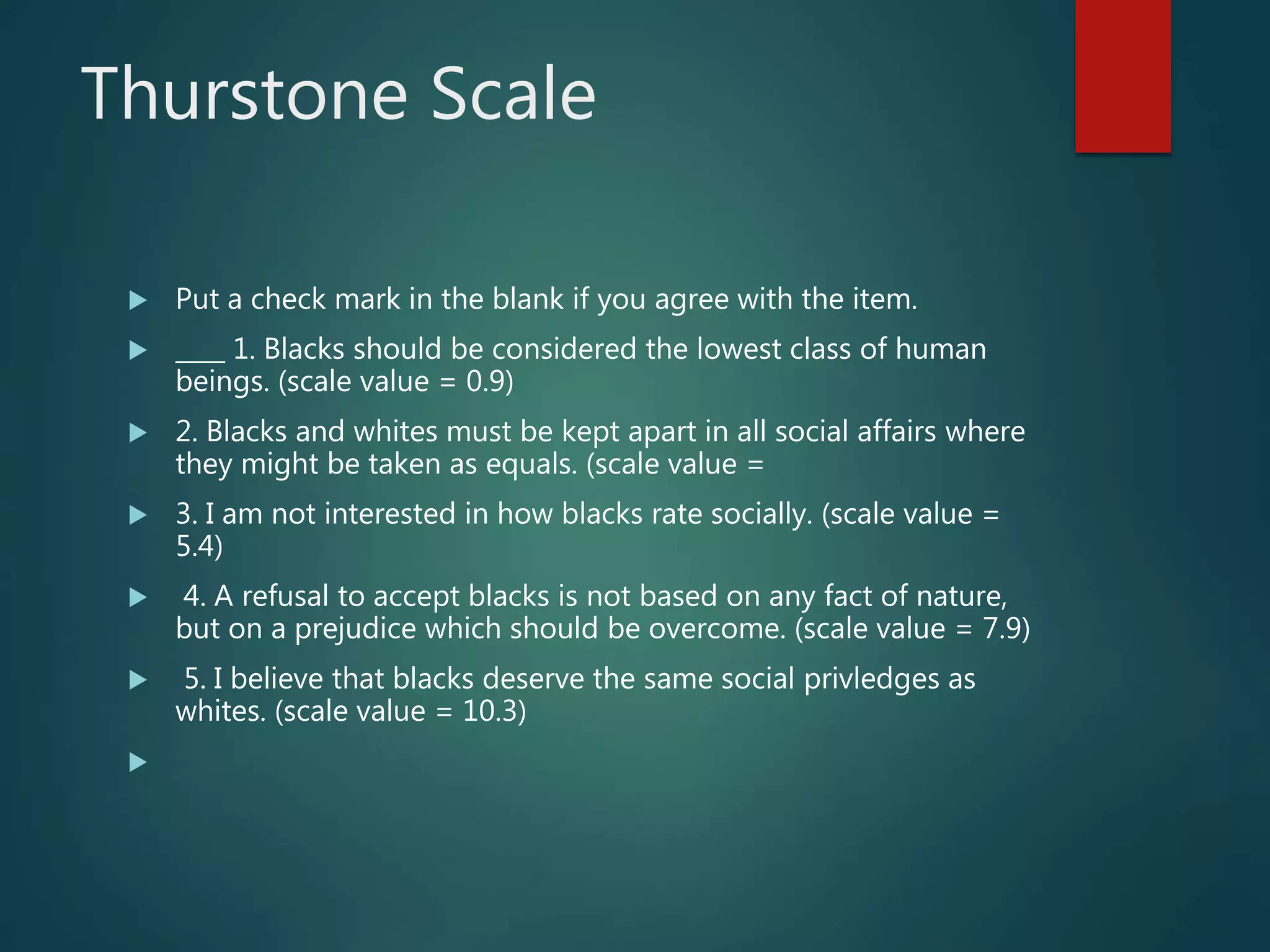
Thurstone Scale
 Put a check mark in the blank if you agree with the item.
 ____ 1. Blacks should be considered the lowest class of human
beings. (scale value = 0.9)
 2. Blacks and whites must be kept apart in all social affairs where
they might be taken as equals. (scale value =
 3. I am not interested in how blacks rate socially. (scale value =
5.4)
 4. A refusal to accept blacks is not based on any fact of nature,
but on a prejudice which should be overcome. (scale value = 7.9)
 5. I believe that blacks deserve the same social privledges as
whites. (scale value = 10.3)

 Bogardus Social Distance Scale :
 The Bogardus Social Distance Scale is a psychological
testing scale created by Emory S. Bogardus to
empirically measure people's willingness to participate
in social contacts of varying degrees of closeness with
members of diverse social groups, such as other racial
and ethnic groups
Likert scale
 It is a psychometric scale commonly used in
questionnaires , and is the most widely used scale in
survey research. When responding to a Likert
questionnaire item, respondents specify their level of
agreement to a statement.
Guttman Scale
 On a Guttman scale, items are arranged in an order so
that an individual who agrees with a particular item
also agrees with items of lower rank-order.
 For example, a series of items could be (1) I am willing
to be near ice cream
 (2)I am willing to smell ice cream
 (3)I am willing to eat ice cream
(4)I love to eat ice cream
 Agreement with any one item implies agreement with
the lower-order items.
 Prejudice :
Prejudice is a negative attitude about members of a group.
Prejudice translated into behavior is called discrimination ,
behaving differently, usually unfairly, toward group members.
Prejudice often develops through stereotypes , fixed, simplistic
(usually wrong) conceptions of traits, behaviors, and attitudes of
a particular group of people.
 Group dynamics :
 A group can be defined as two or more individuals
that are connected to each another by social
relationships . Groups tend to interact, influence each
other, and share a common identity.
 Group Conformity Conformity is the process by which
an individual's attitudes, beliefs, and behaviors are
influenced by other people. This influence occurs in
both small groups and society as a whole, and it may
be the result of subtle unconscious influences, or
direct and overt social pressure .
 Group cohesiveness :It is the force bringing group
members closer together. Cohesiveness has two
dimensions: emotional (or personal) and task -related.
The emotional aspect of cohesiveness, which was
studied more often, is derived from the connection
that members feel to other group members and to
their group as a whole.
 Group thinking :Groupthink is a type of thought
exhibited by group members who try to minimize
conflict and reach consensus without critically testing,
analyzing, and evaluating ideas. Individual creativity,
uniqueness, and independent thinking are lost in the
pursuit of group cohesiveness, as are the advantages
of reasonable balance in choice and thought that
might normally be obtained by making decisions as a
group.
 De-individuation :
De-individuation is the situation where anti-normative
behavior is released in groups in which individuals are
not seen or paid attention to as individuals. Simply put,
de-individuation is immersion in a group to the point
of which the individual ceases to be seen as such.
LEADERS
 Lewin's leadership styles
Autocratic
In the autocratic style, the leader takes decisions without
consulting with others.
Democratic
In the democratic style, the leader involves the people in
the decision-making, although the process for the final
decision may vary from the leader having the final say
to them facilitating consensus in the group.
Behavior in Groups:
 The Impact of Others Hawthorne Effect (Observer
Effect): is a type of reactivity in which individuals modi
fy or improve an aspect of their behavior in response t
o their awareness of being observed.
 Social
Facilitation: presence of others increases our performa
nce on simple tasks Ex.
Being watched while doing task vs. being alone when
doing task better on simple tasks worse on c
omplex tasks Social Impairment:
presence of others worsens our performance.
SocialLoafing:tendency to put less effort in when work
ing with others
Behavior in Groups:
 Decision Making
•Group Polarization - when group discussion leads to a
more “polarized” point of view by the group
•Groupthink - when feel pressure to conform to the
group, stops critical thinking to avoid dissention in the
group
Behavior in Groups:
 Group Polarization
 Conformity:
 Chameleon Effect: our tendency to unconsciously mimic
those around us
 Conformity: Asch Line Study
 • Conformity - yielding to social pressure • Asch’s
Conclusions
 1) subjects often conform to a group, even when the
group states clearly inaccurate conclusions
 2) conformity to a group increases with the size of the
group, up to five or six, but only when the group is
unanimous in its beliefs
 Compliance:
 Persuasion Techniques •Limited time offer •Everyone
is buying!!! •DEAL!!!
 •Reciprocation
•Foot –in-the-door(first small request then big request)
•Door-in-the-face (big – large)
•Lowball(after commitment, cost is increased)
 Contributors to Attraction • Proximity: Physical
closeness (mere exposure)
 • Physical Attractiveness: Pleasant physical appearance
(often different depending on culture),
 signs of health such as symmetry (universal) •
Similarity: Commonalities between two people •
Opposites?: Complementary Qualities • Reciprocity:
The tendency to like those who like you
 Aggression & Altruism
 Aggression: Any form of behavior intended to harm or
injure another living being Where does aggression come
from? - Instincts - Genes - Brain & Nervous System -
Substance Abuse - Mental Disorders - Hormones & NTs -
Aversive Stimuli (e.g. noise, heat, pain, bullying,
frustration), culture & learning, Violent media/video
games Altruism: Actions designed to help others with no
obvious benefit to the helper Why are we altruistic?
Evolutionary Perspective: favors survival of genes Egoistic
Model: motivated by anticipated gain Empathy-Altruism
Hypothesis: sometimes for selfish gains, other times truly
selfless & motivated by concern for others Kitty Genovese
Story…diffusion of responsibility
Components of Attitudes
 Cognitive Dissonance Definition: Sense of discomfort
or distress that occurs when a person’s behavior does
not correspond to that person’s attitudes.
 Social Categorization and ImplicitSocial Categorization
and Implicit Personality TheoryPersonality Theory •
Social Categorization:: assignment of a person one has
just met to a category based on characteristics in
common with people you have experienced in the
past
Components of Attitudes
 Attribution Theory (Heider, 1958) Definition: Inferences
that people draw about the causes of events, others’
behavior, and their own behavior Dispositional
Attribution: we attribute a person’s behavior to an
internal state (personality, abilities, etc.) Situational
Attribution: attributing a person’s behavior to an
external state (stress, abuse, hardship, wealth, etc.) •
Function: People like to explain and understand
behavior and the events that impact their lives •
Attributions are made when an event is unusual and
personal • “Just world” phenomenon

Social psy ppt

  • 1.
  • 2.
    Social Psychology  Socialpsychology is the study of how people and groups interact.  Social psychology is the scientific study of how people's thoughts , feelings , and behaviors are influenced by the actual, imagined, or implied presence of others.  3. AttitudesIn social psychology, attitudes are defined as learned, global evaluations of a person, object, place, or issue that influence thought and action. Put more simply, attitudes are basic expressions of approval or disapproval, favorability or unfavorability, likes and dislikes
  • 3.
    THEORIES OF ATTITUDE Theory of cognitive dissonance: The theory of cognitive dissonance proposes that people have a motivational drive to reduce dissonance by changing their attitudes, beliefs, and behaviors, or by justifying or rationalizing their attitudes, beliefs, and behaviors.
  • 4.
    THEORIES OF ATTITUDE Attitude Formation :  In Social Psychology attitudes are defined as positive or negative evaluations of objects of thought. Attitudes typically have three components.  The cognitive component is made up of the thoughts and beliefs people hold about the object of the attitude.  The affective component consists of the emotional feelings stimulated by the object of the attitude. The behavioral component consists of predispositions to act in certain ways toward an attitude object.
  • 5.
    Contd…  Attitudes areacquired through:  1. social learning  2. social comparison  3. genetic factors (not all agree on this)  4. Self experiences
  • 6.
    Factors of AttitudeChange  The Communicator credibility  expertise,  Trustworthiness  and attractiveness
  • 7.
    Measurement of attitude Scales by Thurstone The Thurstone scale was the first formal technique for measuring an attitude . It was developed by Louis Leon Thurstone , as a means of measuring attitudes towards religion . It is made up of statements about a particular issue, and each statement has a numerical value indicating how favorable or unfavorable it is judged to be. People check each of the statements to which they agree, and a mean score is computed, indicating their attitude.
  • 8.
    Thurstone Scale  Puta check mark in the blank if you agree with the item.  ____ 1. Blacks should be considered the lowest class of human beings. (scale value = 0.9)  2. Blacks and whites must be kept apart in all social affairs where they might be taken as equals. (scale value =  3. I am not interested in how blacks rate socially. (scale value = 5.4)  4. A refusal to accept blacks is not based on any fact of nature, but on a prejudice which should be overcome. (scale value = 7.9)  5. I believe that blacks deserve the same social privledges as whites. (scale value = 10.3) 
  • 9.
     Bogardus SocialDistance Scale :  The Bogardus Social Distance Scale is a psychological testing scale created by Emory S. Bogardus to empirically measure people's willingness to participate in social contacts of varying degrees of closeness with members of diverse social groups, such as other racial and ethnic groups
  • 10.
    Likert scale  Itis a psychometric scale commonly used in questionnaires , and is the most widely used scale in survey research. When responding to a Likert questionnaire item, respondents specify their level of agreement to a statement.
  • 11.
    Guttman Scale  Ona Guttman scale, items are arranged in an order so that an individual who agrees with a particular item also agrees with items of lower rank-order.  For example, a series of items could be (1) I am willing to be near ice cream  (2)I am willing to smell ice cream  (3)I am willing to eat ice cream (4)I love to eat ice cream  Agreement with any one item implies agreement with the lower-order items.
  • 12.
     Prejudice : Prejudiceis a negative attitude about members of a group. Prejudice translated into behavior is called discrimination , behaving differently, usually unfairly, toward group members. Prejudice often develops through stereotypes , fixed, simplistic (usually wrong) conceptions of traits, behaviors, and attitudes of a particular group of people.
  • 13.
     Group dynamics:  A group can be defined as two or more individuals that are connected to each another by social relationships . Groups tend to interact, influence each other, and share a common identity.
  • 14.
     Group ConformityConformity is the process by which an individual's attitudes, beliefs, and behaviors are influenced by other people. This influence occurs in both small groups and society as a whole, and it may be the result of subtle unconscious influences, or direct and overt social pressure .
  • 15.
     Group cohesiveness:It is the force bringing group members closer together. Cohesiveness has two dimensions: emotional (or personal) and task -related. The emotional aspect of cohesiveness, which was studied more often, is derived from the connection that members feel to other group members and to their group as a whole.
  • 16.
     Group thinking:Groupthink is a type of thought exhibited by group members who try to minimize conflict and reach consensus without critically testing, analyzing, and evaluating ideas. Individual creativity, uniqueness, and independent thinking are lost in the pursuit of group cohesiveness, as are the advantages of reasonable balance in choice and thought that might normally be obtained by making decisions as a group.
  • 17.
     De-individuation : De-individuationis the situation where anti-normative behavior is released in groups in which individuals are not seen or paid attention to as individuals. Simply put, de-individuation is immersion in a group to the point of which the individual ceases to be seen as such.
  • 18.
    LEADERS  Lewin's leadershipstyles Autocratic In the autocratic style, the leader takes decisions without consulting with others. Democratic In the democratic style, the leader involves the people in the decision-making, although the process for the final decision may vary from the leader having the final say to them facilitating consensus in the group.
  • 19.
    Behavior in Groups: The Impact of Others Hawthorne Effect (Observer Effect): is a type of reactivity in which individuals modi fy or improve an aspect of their behavior in response t o their awareness of being observed.  Social Facilitation: presence of others increases our performa nce on simple tasks Ex. Being watched while doing task vs. being alone when doing task better on simple tasks worse on c omplex tasks Social Impairment: presence of others worsens our performance. SocialLoafing:tendency to put less effort in when work ing with others
  • 20.
    Behavior in Groups: Decision Making •Group Polarization - when group discussion leads to a more “polarized” point of view by the group •Groupthink - when feel pressure to conform to the group, stops critical thinking to avoid dissention in the group
  • 21.
    Behavior in Groups: Group Polarization  Conformity:  Chameleon Effect: our tendency to unconsciously mimic those around us  Conformity: Asch Line Study  • Conformity - yielding to social pressure • Asch’s Conclusions  1) subjects often conform to a group, even when the group states clearly inaccurate conclusions  2) conformity to a group increases with the size of the group, up to five or six, but only when the group is unanimous in its beliefs
  • 22.
     Compliance:  PersuasionTechniques •Limited time offer •Everyone is buying!!! •DEAL!!!  •Reciprocation •Foot –in-the-door(first small request then big request) •Door-in-the-face (big – large) •Lowball(after commitment, cost is increased)
  • 23.
     Contributors toAttraction • Proximity: Physical closeness (mere exposure)  • Physical Attractiveness: Pleasant physical appearance (often different depending on culture),  signs of health such as symmetry (universal) • Similarity: Commonalities between two people • Opposites?: Complementary Qualities • Reciprocity: The tendency to like those who like you
  • 24.
     Aggression &Altruism  Aggression: Any form of behavior intended to harm or injure another living being Where does aggression come from? - Instincts - Genes - Brain & Nervous System - Substance Abuse - Mental Disorders - Hormones & NTs - Aversive Stimuli (e.g. noise, heat, pain, bullying, frustration), culture & learning, Violent media/video games Altruism: Actions designed to help others with no obvious benefit to the helper Why are we altruistic? Evolutionary Perspective: favors survival of genes Egoistic Model: motivated by anticipated gain Empathy-Altruism Hypothesis: sometimes for selfish gains, other times truly selfless & motivated by concern for others Kitty Genovese Story…diffusion of responsibility
  • 25.
    Components of Attitudes Cognitive Dissonance Definition: Sense of discomfort or distress that occurs when a person’s behavior does not correspond to that person’s attitudes.  Social Categorization and ImplicitSocial Categorization and Implicit Personality TheoryPersonality Theory • Social Categorization:: assignment of a person one has just met to a category based on characteristics in common with people you have experienced in the past
  • 26.
    Components of Attitudes Attribution Theory (Heider, 1958) Definition: Inferences that people draw about the causes of events, others’ behavior, and their own behavior Dispositional Attribution: we attribute a person’s behavior to an internal state (personality, abilities, etc.) Situational Attribution: attributing a person’s behavior to an external state (stress, abuse, hardship, wealth, etc.) • Function: People like to explain and understand behavior and the events that impact their lives • Attributions are made when an event is unusual and personal • “Just world” phenomenon