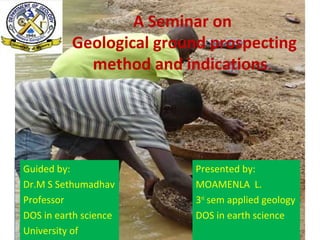
A Seminar on
Geological ground prospecting
method and indications.
Guided by:
Dr.M S Sethumadhav
Professor
DOS in earth science
University of
Presented by:
MOAMENLA L.
3rd
sem applied geology
DOS in earth science
contents
 Ground geological prospecting
 Indications
 Prospecting criteria and method
 Stages in ground prospecting
 Prospecting for deposit outcrop
 Prospecting for mechanical aureole
 Prospecting based on erratic boulders
 Prospecting in colluvium and alluvium
 Conclusions
 References
Geological ground prospecting methods and indications
• “Geological ground Prospecting” is defined as the search for
outcrops of ore deposits or ore fragments on the ground. It covers
geological fieldwork plus the laboratory studies directed to the
discovery of workable mineral concentrations.
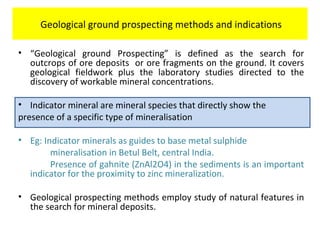
• Indicator mineral are mineral species that directly show the
presence of a specific type of mineralisation
• Eg: Indicator minerals as guides to base metal sulphide
mineralisation in Betul Belt, central India.
Presence of gahnite (ZnAl2O4) in the sediments is an important
indicator for the proximity to zinc mineralization.
• Geological prospecting methods employ study of natural features in
the search for mineral deposits.
• Prospecting criteria determine the location of the prospecting
work, it answers “where to look” for mineral deposits.
• While prospecting method determine how prospecting is to be
carried out, it answers “how to look” for mineral deposits.
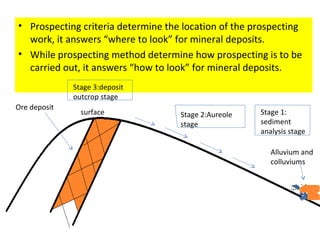
Ore deposit
surface
.,...’;’;
Alluvium and
colluviums
Stage 2:Aureole
stage
Stage 3:deposit
outcrop stage
Stage 1:
sediment
analysis stage
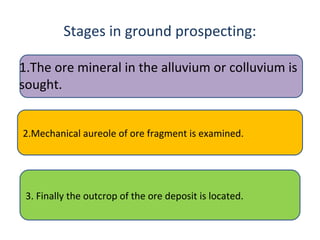
Stages in ground prospecting:
1.The ore mineral in the alluvium or colluvium is
sought.
2.Mechanical aureole of ore fragment is examined.
3. Finally the outcrop of the ore deposit is located.
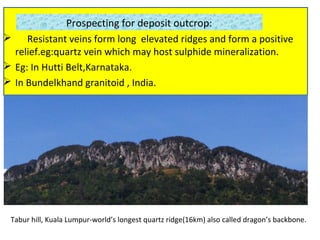
Prospecting for deposit outcrop:
 Resistant veins form long elevated ridges and form a positive
relief.eg:quartz vein which may host sulphide mineralization.
 Eg: In Hutti Belt,Karnataka.
 In Bundelkhand granitoid , India.
Tabur hill, Kuala Lumpur-world’s longest quartz ridge(16km) also called dragon’s backbone.
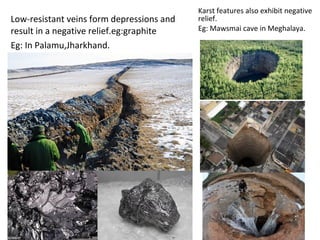
Low-resistant veins form depressions and
result in a negative relief.eg:graphite
Eg: In Palamu,Jharkhand.
Karst features also exhibit negative
relief.
Eg: Mawsmai cave in Meghalaya.
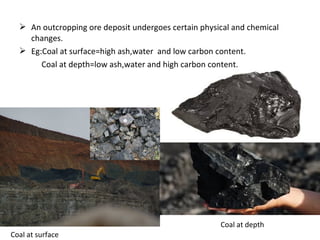
 An outcropping ore deposit undergoes certain physical and chemical
changes.
 Eg:Coal at surface=high ash,water and low carbon content.
Coal at depth=low ash,water and high carbon content.
Coal at surface
Coal at depth
Migration capacity of elements
Enrichment of mineral in gossan:
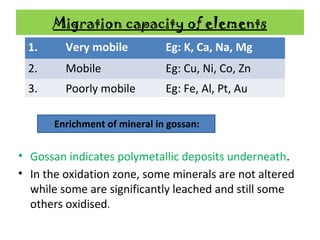
• Gossan indicates polymetallic deposits underneath.
• In the oxidation zone, some minerals are not altered
while some are significantly leached and still some
others oxidised.
1. Very mobile Eg: K, Ca, Na, Mg
2. Mobile Eg: Cu, Ni, Co, Zn
3. Poorly mobile Eg: Fe, Al, Pt, Au
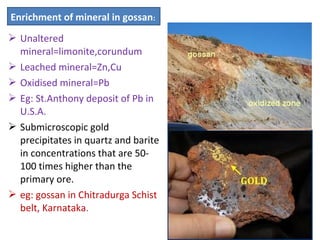
 Unaltered
mineral=limonite,corundum
 Leached mineral=Zn,Cu
 Oxidised mineral=Pb
 Eg: St.Anthony deposit of Pb in
U.S.A.
 Submicroscopic gold
precipitates in quartz and barite
in concentrations that are 50-
100 times higher than the
primary ore.
 eg: gossan in Chitradurga Schist
belt, Karnataka.
Enrichment of mineral in gossan:
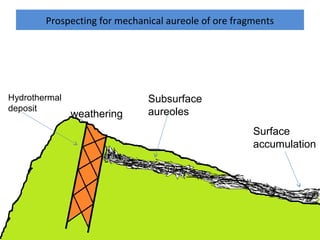
Prospecting for mechanical aureole of ore fragments
Surface
accumulation
Subsurface
aureoles
Hydrothermal
deposit
weathering
Prospecting for mechanical aureole of ore fragments.
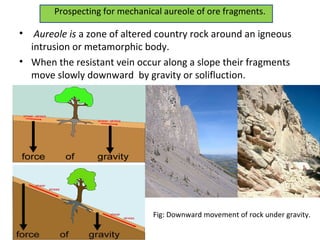
•  Aureole is a zone of altered country rock around an igneous
intrusion or metamorphic body.
• When the resistant vein occur along a slope their fragments
move slowly downward by gravity or solifluction.
Fig: Downward movement of rock under gravity.
SOLIFLUCTION
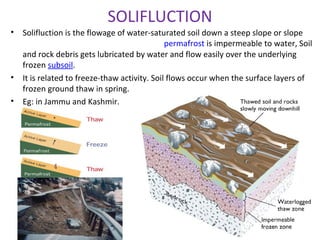
• Solifluction is the flowage of water-saturated soil down a steep slope or slope
permafrost is impermeable to water, Soil
and rock debris gets lubricated by water and flow easily over the underlying
frozen subsoil.
• It is related to freeze-thaw activity. Soil flows occur when the surface layers of
frozen ground thaw in spring.
• Eg: in Jammu and Kashmir.
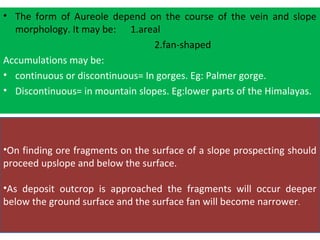
•On finding ore fragments on the surface of a slope prospecting should
proceed upslope and below the surface.
•As deposit outcrop is approached the fragments will occur deeper
below the ground surface and the surface fan will become narrower.
• The form of Aureole depend on the course of the vein and slope
morphology. It may be: 1.areal
2.fan-shaped
Accumulations may be:
• continuous or discontinuous= In gorges. Eg: Palmer gorge.
• Discontinuous= in mountain slopes. Eg:lower parts of the Himalayas.
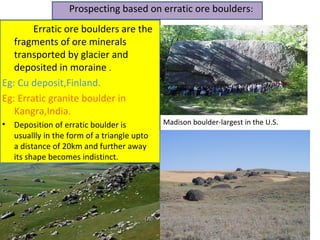
Prospecting based on erratic ore boulders:
Erratic ore boulders are the
fragments of ore minerals
transported by glacier and
deposited in moraine .
Eg: Cu deposit,Finland.
Eg: Erratic granite boulder in
Kangra,India.
• Deposition of erratic boulder is
usuallly in the form of a triangle upto
a distance of 20km and further away
its shape becomes indistinct.
Madison boulder-largest in the U.S.
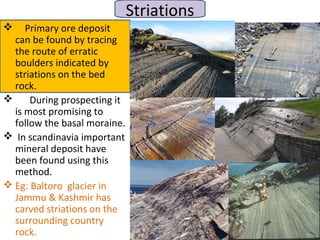
Striations
 Primary ore deposit
can be found by tracing
the route of erratic
boulders indicated by
striations on the bed
rock.
 During prospecting it
is most promising to
follow the basal moraine.
 In scandinavia important
mineral deposit have
been found using this
method.
 Eg: Baltoro glacier in
Jammu & Kashmir has
carved striations on the
surrounding country
rock.
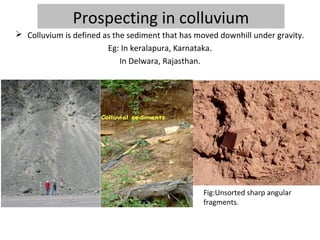
Prospecting in colluvium
 Colluvium is defined as the sediment that has moved downhill under gravity.
Eg: In keralapura, Karnataka.
In Delwara, Rajasthan.
Fig:Unsorted sharp angular
fragments.
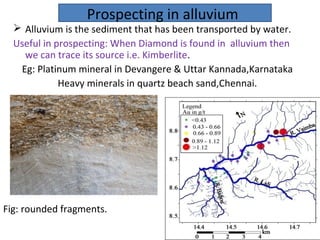
Prospecting in alluvium
 Alluvium is the sediment that has been transported by water.
Useful in prospecting: When Diamond is found in alluvium then
we can trace its source i.e. Kimberlite.
Eg: Platinum mineral in Devangere & Uttar Kannada,Karnataka
Heavy minerals in quartz beach sand,Chennai.
Fig: rounded fragments.
Conclusion
 Geological ground Prospecting is defined as the
search for outcrops of ore deposits or ore fragments
on the ground.
 Indications directly shows of the presence of ore.
 Ground prospecting methods employ natural
features in the search for mineral deposits.
 There are 3 stages of prospecting i.e. prospecting
for: deposit outcrops ,aureoles and erratic boulders.
References:
(1) Biswajit Ghosh1,  and M N Praveen2∗
1Geological Survey of India, Operation: WB-SK-AN
2Geological Survey of India, Operation: TNPK, Kerala Unit
(2) soilweb.landfood.ubc.ca › Home › PARENT MATERIAL
(3) mrdata.usgs.gov › Online Spatial Data › Geology › by state
(4) dictionary.reference.com/browse/aureole
(5) books.google.co.in/books?id=14znAAAAMAAJ
(6) www.earthsci.org/mineral/mindep/depfile/explora.htm
(7) www.ffxivguild.com/ffxiv-arr-mining-node-locations-mineral-deposits-r
(8) econgeol.geoscienceworld.org/content/58/4/601.abstract
(9) www.britannica.com/EBchecked/topic/134630/contact-metamorphism
(10) Milos kuzvart,miloslav bohmer,1986,”prospecting and exploration of 
mineral deposit”elsevier science publishers.
.
Geological ground prospecting method and indications

Geological ground prospecting method and indications

  • 1.
    A Seminar on Geologicalground prospecting method and indications. Guided by: Dr.M S Sethumadhav Professor DOS in earth science University of Presented by: MOAMENLA L. 3rd sem applied geology DOS in earth science
  • 2.
    contents  Ground geologicalprospecting  Indications  Prospecting criteria and method  Stages in ground prospecting  Prospecting for deposit outcrop  Prospecting for mechanical aureole  Prospecting based on erratic boulders  Prospecting in colluvium and alluvium  Conclusions  References
  • 3.
    Geological ground prospectingmethods and indications • “Geological ground Prospecting” is defined as the search for outcrops of ore deposits or ore fragments on the ground. It covers geological fieldwork plus the laboratory studies directed to the discovery of workable mineral concentrations. • Indicator mineral are mineral species that directly show the presence of a specific type of mineralisation • Eg: Indicator minerals as guides to base metal sulphide mineralisation in Betul Belt, central India. Presence of gahnite (ZnAl2O4) in the sediments is an important indicator for the proximity to zinc mineralization. • Geological prospecting methods employ study of natural features in the search for mineral deposits.
  • 4.
    • Prospecting criteriadetermine the location of the prospecting work, it answers “where to look” for mineral deposits. • While prospecting method determine how prospecting is to be carried out, it answers “how to look” for mineral deposits. Ore deposit surface .,...’;’; Alluvium and colluviums Stage 2:Aureole stage Stage 3:deposit outcrop stage Stage 1: sediment analysis stage
  • 5.
    Stages in groundprospecting: 1.The ore mineral in the alluvium or colluvium is sought. 2.Mechanical aureole of ore fragment is examined. 3. Finally the outcrop of the ore deposit is located.
  • 6.
    Prospecting for depositoutcrop:  Resistant veins form long elevated ridges and form a positive relief.eg:quartz vein which may host sulphide mineralization.  Eg: In Hutti Belt,Karnataka.  In Bundelkhand granitoid , India. Tabur hill, Kuala Lumpur-world’s longest quartz ridge(16km) also called dragon’s backbone.
  • 7.
    Low-resistant veins formdepressions and result in a negative relief.eg:graphite Eg: In Palamu,Jharkhand. Karst features also exhibit negative relief. Eg: Mawsmai cave in Meghalaya.
  • 8.
     An outcroppingore deposit undergoes certain physical and chemical changes.  Eg:Coal at surface=high ash,water and low carbon content. Coal at depth=low ash,water and high carbon content. Coal at surface Coal at depth
  • 9.
    Migration capacity ofelements Enrichment of mineral in gossan: • Gossan indicates polymetallic deposits underneath. • In the oxidation zone, some minerals are not altered while some are significantly leached and still some others oxidised. 1. Very mobile Eg: K, Ca, Na, Mg 2. Mobile Eg: Cu, Ni, Co, Zn 3. Poorly mobile Eg: Fe, Al, Pt, Au
  • 10.
     Unaltered mineral=limonite,corundum  Leachedmineral=Zn,Cu  Oxidised mineral=Pb  Eg: St.Anthony deposit of Pb in U.S.A.  Submicroscopic gold precipitates in quartz and barite in concentrations that are 50- 100 times higher than the primary ore.  eg: gossan in Chitradurga Schist belt, Karnataka. Enrichment of mineral in gossan:
  • 11.
    Prospecting for mechanicalaureole of ore fragments Surface accumulation Subsurface aureoles Hydrothermal deposit weathering
  • 12.
    Prospecting for mechanicalaureole of ore fragments. •  Aureole is a zone of altered country rock around an igneous intrusion or metamorphic body. • When the resistant vein occur along a slope their fragments move slowly downward by gravity or solifluction. Fig: Downward movement of rock under gravity.
  • 13.
    SOLIFLUCTION • Solifluction isthe flowage of water-saturated soil down a steep slope or slope permafrost is impermeable to water, Soil and rock debris gets lubricated by water and flow easily over the underlying frozen subsoil. • It is related to freeze-thaw activity. Soil flows occur when the surface layers of frozen ground thaw in spring. • Eg: in Jammu and Kashmir.
  • 14.
    •On finding orefragments on the surface of a slope prospecting should proceed upslope and below the surface. •As deposit outcrop is approached the fragments will occur deeper below the ground surface and the surface fan will become narrower. • The form of Aureole depend on the course of the vein and slope morphology. It may be: 1.areal 2.fan-shaped Accumulations may be: • continuous or discontinuous= In gorges. Eg: Palmer gorge. • Discontinuous= in mountain slopes. Eg:lower parts of the Himalayas.
  • 15.
    Prospecting based onerratic ore boulders: Erratic ore boulders are the fragments of ore minerals transported by glacier and deposited in moraine . Eg: Cu deposit,Finland. Eg: Erratic granite boulder in Kangra,India. • Deposition of erratic boulder is usuallly in the form of a triangle upto a distance of 20km and further away its shape becomes indistinct. Madison boulder-largest in the U.S.
  • 16.
    Striations  Primary oredeposit can be found by tracing the route of erratic boulders indicated by striations on the bed rock.  During prospecting it is most promising to follow the basal moraine.  In scandinavia important mineral deposit have been found using this method.  Eg: Baltoro glacier in Jammu & Kashmir has carved striations on the surrounding country rock.
  • 17.
    Prospecting in colluvium Colluvium is defined as the sediment that has moved downhill under gravity. Eg: In keralapura, Karnataka. In Delwara, Rajasthan. Fig:Unsorted sharp angular fragments.
  • 18.
    Prospecting in alluvium Alluvium is the sediment that has been transported by water. Useful in prospecting: When Diamond is found in alluvium then we can trace its source i.e. Kimberlite. Eg: Platinum mineral in Devangere & Uttar Kannada,Karnataka Heavy minerals in quartz beach sand,Chennai. Fig: rounded fragments.
  • 19.
    Conclusion  Geological groundProspecting is defined as the search for outcrops of ore deposits or ore fragments on the ground.  Indications directly shows of the presence of ore.  Ground prospecting methods employ natural features in the search for mineral deposits.  There are 3 stages of prospecting i.e. prospecting for: deposit outcrops ,aureoles and erratic boulders.
  • 20.
    References: (1) Biswajit Ghosh1,  and M N Praveen2∗ 1Geological Survey of India, Operation: WB-SK-AN 2Geological Survey of India, Operation: TNPK, Kerala Unit (2) soilweb.landfood.ubc.ca › Home › PARENT MATERIAL (3) mrdata.usgs.gov › Online Spatial Data › Geology › by state (4) dictionary.reference.com/browse/aureole (5) books.google.co.in/books?id=14znAAAAMAAJ (6) www.earthsci.org/mineral/mindep/depfile/explora.htm (7) www.ffxivguild.com/ffxiv-arr-mining-node-locations-mineral-deposits-r (8) econgeol.geoscienceworld.org/content/58/4/601.abstract (9) www.britannica.com/EBchecked/topic/134630/contact-metamorphism (10) Milos kuzvart,miloslav bohmer,1986,”prospecting and exploration of  mineral deposit”elsevier science publishers. .