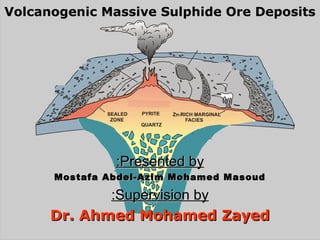
Volcanogenic Massive Sulphide Ore DepositsVolcanogenic Massive Sulphide Ore Deposits
Presented byPresented by::
Mostafa Abdel-Azim Mohamed MasoudMostafa Abdel-Azim Mohamed Masoud
Supervision bySupervision by::
Dr. Ahmed Mohamed ZayedDr. Ahmed Mohamed Zayed
11((IntroductionIntroduction
Volcanogenic massive sulphide deposits(VMSVolcanogenic massive sulphide deposits(VMS((
are type of metalsulphides ore deposits mainlyare type of metalsulphides ore deposits mainly
Cu-Zn-Pb which are associated with volcanicCu-Zn-Pb which are associated with volcanic
activity and hydrothermal solutions inactivity and hydrothermal solutions in
submarine environmentsubmarine environment..
--This type of deposits was firstly discovered inThis type of deposits was firstly discovered in
the Red Sea in the mid of 1960sthe Red Sea in the mid of 1960s
22((Smokers and its typesSmokers and its types
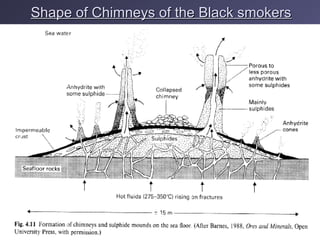
Generally, the smokers are plumes of hotGenerally, the smokers are plumes of hot
black or white hydrothermal fluids gettingblack or white hydrothermal fluids getting
out from chimney-like ventsout from chimney-like vents..
There are two types of smokers,There are two types of smokers, blackblack andand
white smokerswhite smokers..
Types of smokersTypes of smokers
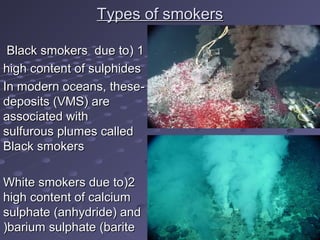
11((Black smokers due toBlack smokers due to
high content of sulphideshigh content of sulphides
--In modern oceans, theseIn modern oceans, these
deposits (VMS( aredeposits (VMS( are
associated withassociated with
sulfurous plumes calledsulfurous plumes called
Black smokersBlack smokers
22((White smokers due toWhite smokers due to
high content of calciumhigh content of calcium
sulphate (anhydride( andsulphate (anhydride( and
barium sulphate (baritebarium sulphate (barite((
33((Size(reserve( and mineralogySize(reserve( and mineralogy
a) Size (reservea) Size (reserve))
The majority of the world deposits are small and aboutThe majority of the world deposits are small and about
80%of all known deposits fall in size range 0.1-10 Mt80%of all known deposits fall in size range 0.1-10 Mt..
b) Mineralogyb) Mineralogy
The mineralogy It is simple and often consist of overThe mineralogy It is simple and often consist of over
90% iron sulphide usually as pyrite90% iron sulphide usually as pyrite..
--Chalcopyrite, Sphalerite, and Galena may be majorChalcopyrite, Sphalerite, and Galena may be major
constituent depending on deposit classconstituent depending on deposit class..
--Magnetite and Tetrahedrite may be found in minorMagnetite and Tetrahedrite may be found in minor
amountsamounts..
--The gangue is Quartz, but occationally Carbonate isThe gangue is Quartz, but occationally Carbonate is
.developed and chlorite and sericite.developed and chlorite and sericite..
Talc is found due to of metasomatismTalc is found due to of metasomatism..
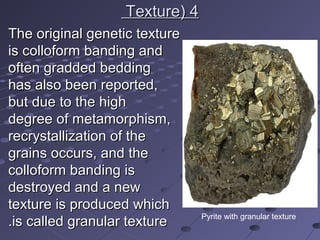
44((TextureTexture
The original genetic textureThe original genetic texture
is colloform banding andis colloform banding and
often gradded beddingoften gradded bedding
has also been reported,has also been reported,
but due to the highbut due to the high
degree of metamorphism,degree of metamorphism,
recrystallization of therecrystallization of the
grains occurs, and thegrains occurs, and the
colloform banding iscolloform banding is
destroyed and a newdestroyed and a new
texture is produced whichtexture is produced which
is called granular textureis called granular texture.. Pyrite with granular texture
Shape of Chimneys of the Black smokersShape of Chimneys of the Black smokers
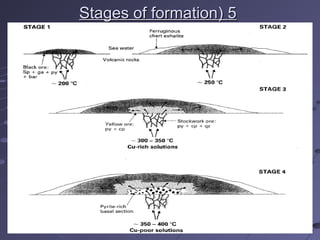
55((Stages of formationStages of formation
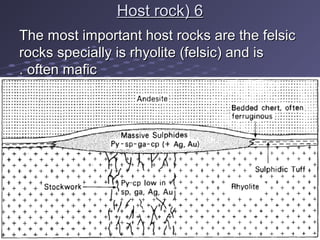
66((Host rockHost rock
The most important host rocks are the felsicThe most important host rocks are the felsic
rocks specially is rhyolite (felsic( and isrocks specially is rhyolite (felsic( and is
often maficoften mafic..
77((EnvironmentEnvironment
Is submarine environment which is associated withIs submarine environment which is associated with
volcanic activity and hydrothermal processesvolcanic activity and hydrothermal processes..
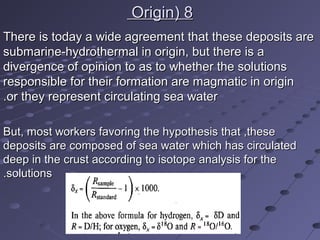
88((OriginOrigin
There is today a wide agreement that these deposits areThere is today a wide agreement that these deposits are
submarine-hydrothermal in origin, but there is asubmarine-hydrothermal in origin, but there is a
divergence of opinion to as to whether the solutionsdivergence of opinion to as to whether the solutions
responsible for their formation are magmatic in originresponsible for their formation are magmatic in origin
or they represent circulating sea wateror they represent circulating sea water..
But, most workers favoring the hypothesis that ,theseBut, most workers favoring the hypothesis that ,these
deposits are composed of sea water which has circulateddeposits are composed of sea water which has circulated
deep in the crust according to isotope analysis for thedeep in the crust according to isotope analysis for the
solutionssolutions..
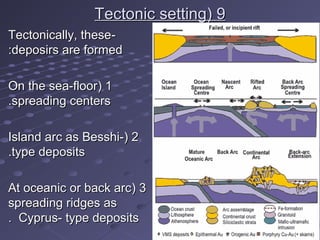
99((Tectonic settingTectonic setting
--Tectonically, theseTectonically, these
deposirs are formeddeposirs are formed::
11((On the sea-floorOn the sea-floor
spreading centersspreading centers..
22((Island arc as Besshi-Island arc as Besshi-
type depositstype deposits..
33((At oceanic or back arcAt oceanic or back arc
spreading ridges asspreading ridges as
Cyprus- type depositsCyprus- type deposits..
1010((ClassificationClassification
There are many types of classificationThere are many types of classification::
11((Iron, iron-copper, iron-copper zinc, and iron-copper-zinc-Iron, iron-copper, iron-copper zinc, and iron-copper-zinc-
lead, but generally the copper is not found on its ownlead, but generally the copper is not found on its own..
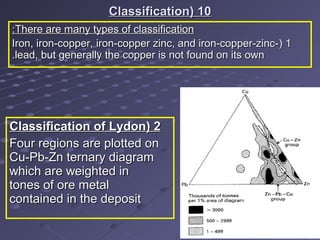
22((Classification of LydonClassification of Lydon
Four regions are plotted onFour regions are plotted on
Cu-Pb-Zn ternary diagramCu-Pb-Zn ternary diagram
which are weighted inwhich are weighted in
tones of ore metaltones of ore metal
contained in the depositcontained in the deposit
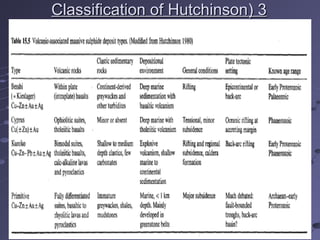
33((Classification of HutchinsonClassification of Hutchinson
1212((Shape of the depositionShape of the deposition
If the density (salinity( of theIf the density (salinity( of the
hydrothermal solutions ishydrothermal solutions is
greater than the density ofgreater than the density of
seawater, aseawater, a bowl-shapedbowl-shaped
deposits are formeddeposits are formed
If the density (salinity( of theIf the density (salinity( of the
hydrothermal solutions ishydrothermal solutions is
lesser than the density oflesser than the density of
seawater, aseawater, a mound-mound-
shapedshaped deposits aredeposits are
formedformed
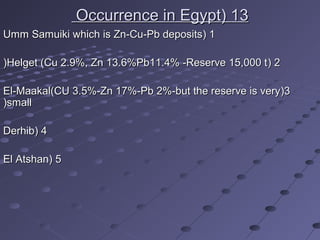
1313((Occurrence in EgyptOccurrence in Egypt
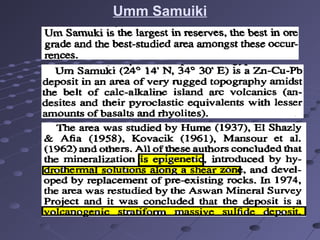
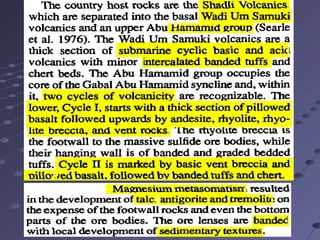
11((Umm Samuiki which is Zn-Cu-Pb depositsUmm Samuiki which is Zn-Cu-Pb deposits
22((Helget (Cu 2.9%, Zn 13.6%Pb11.4% -Reserve 15,000 tHelget (Cu 2.9%, Zn 13.6%Pb11.4% -Reserve 15,000 t((
33((El-Maakal(CU 3.5%-Zn 17%-Pb 2%-but the reserve is veryEl-Maakal(CU 3.5%-Zn 17%-Pb 2%-but the reserve is very
smallsmall((
44((DerhibDerhib
55((El AtshanEl Atshan
Umm Samuiki
ReferencesReferences
11((WikipediaWikipedia
22((Rushdi Said, Geology of Egypt,1993Rushdi Said, Geology of Egypt,1993
33((Anthony .M. Evans, Ore Geology andAnthony .M. Evans, Ore Geology and
Industrial Minerals,1992, BlackwellIndustrial Minerals,1992, Blackwell
PublisherPublisher..

Volcanogenic massive sulphide deposits

  • 1.
    Volcanogenic Massive SulphideOre DepositsVolcanogenic Massive Sulphide Ore Deposits Presented byPresented by:: Mostafa Abdel-Azim Mohamed MasoudMostafa Abdel-Azim Mohamed Masoud Supervision bySupervision by:: Dr. Ahmed Mohamed ZayedDr. Ahmed Mohamed Zayed
  • 2.
    11((IntroductionIntroduction Volcanogenic massive sulphidedeposits(VMSVolcanogenic massive sulphide deposits(VMS(( are type of metalsulphides ore deposits mainlyare type of metalsulphides ore deposits mainly Cu-Zn-Pb which are associated with volcanicCu-Zn-Pb which are associated with volcanic activity and hydrothermal solutions inactivity and hydrothermal solutions in submarine environmentsubmarine environment.. --This type of deposits was firstly discovered inThis type of deposits was firstly discovered in the Red Sea in the mid of 1960sthe Red Sea in the mid of 1960s
  • 3.
    22((Smokers and itstypesSmokers and its types Generally, the smokers are plumes of hotGenerally, the smokers are plumes of hot black or white hydrothermal fluids gettingblack or white hydrothermal fluids getting out from chimney-like ventsout from chimney-like vents.. There are two types of smokers,There are two types of smokers, blackblack andand white smokerswhite smokers..
  • 4.
    Types of smokersTypesof smokers 11((Black smokers due toBlack smokers due to high content of sulphideshigh content of sulphides --In modern oceans, theseIn modern oceans, these deposits (VMS( aredeposits (VMS( are associated withassociated with sulfurous plumes calledsulfurous plumes called Black smokersBlack smokers 22((White smokers due toWhite smokers due to high content of calciumhigh content of calcium sulphate (anhydride( andsulphate (anhydride( and barium sulphate (baritebarium sulphate (barite((
  • 5.
    33((Size(reserve( and mineralogySize(reserve(and mineralogy a) Size (reservea) Size (reserve)) The majority of the world deposits are small and aboutThe majority of the world deposits are small and about 80%of all known deposits fall in size range 0.1-10 Mt80%of all known deposits fall in size range 0.1-10 Mt.. b) Mineralogyb) Mineralogy The mineralogy It is simple and often consist of overThe mineralogy It is simple and often consist of over 90% iron sulphide usually as pyrite90% iron sulphide usually as pyrite.. --Chalcopyrite, Sphalerite, and Galena may be majorChalcopyrite, Sphalerite, and Galena may be major constituent depending on deposit classconstituent depending on deposit class.. --Magnetite and Tetrahedrite may be found in minorMagnetite and Tetrahedrite may be found in minor amountsamounts.. --The gangue is Quartz, but occationally Carbonate isThe gangue is Quartz, but occationally Carbonate is .developed and chlorite and sericite.developed and chlorite and sericite.. Talc is found due to of metasomatismTalc is found due to of metasomatism..
  • 6.
    44((TextureTexture The original genetictextureThe original genetic texture is colloform banding andis colloform banding and often gradded beddingoften gradded bedding has also been reported,has also been reported, but due to the highbut due to the high degree of metamorphism,degree of metamorphism, recrystallization of therecrystallization of the grains occurs, and thegrains occurs, and the colloform banding iscolloform banding is destroyed and a newdestroyed and a new texture is produced whichtexture is produced which is called granular textureis called granular texture.. Pyrite with granular texture
  • 7.
    Shape of Chimneysof the Black smokersShape of Chimneys of the Black smokers
  • 8.
  • 9.
    66((Host rockHost rock Themost important host rocks are the felsicThe most important host rocks are the felsic rocks specially is rhyolite (felsic( and isrocks specially is rhyolite (felsic( and is often maficoften mafic..
  • 10.
    77((EnvironmentEnvironment Is submarine environmentwhich is associated withIs submarine environment which is associated with volcanic activity and hydrothermal processesvolcanic activity and hydrothermal processes..
  • 11.
    88((OriginOrigin There is todaya wide agreement that these deposits areThere is today a wide agreement that these deposits are submarine-hydrothermal in origin, but there is asubmarine-hydrothermal in origin, but there is a divergence of opinion to as to whether the solutionsdivergence of opinion to as to whether the solutions responsible for their formation are magmatic in originresponsible for their formation are magmatic in origin or they represent circulating sea wateror they represent circulating sea water.. But, most workers favoring the hypothesis that ,theseBut, most workers favoring the hypothesis that ,these deposits are composed of sea water which has circulateddeposits are composed of sea water which has circulated deep in the crust according to isotope analysis for thedeep in the crust according to isotope analysis for the solutionssolutions..
  • 12.
    99((Tectonic settingTectonic setting --Tectonically,theseTectonically, these deposirs are formeddeposirs are formed:: 11((On the sea-floorOn the sea-floor spreading centersspreading centers.. 22((Island arc as Besshi-Island arc as Besshi- type depositstype deposits.. 33((At oceanic or back arcAt oceanic or back arc spreading ridges asspreading ridges as Cyprus- type depositsCyprus- type deposits..
  • 13.
    1010((ClassificationClassification There are manytypes of classificationThere are many types of classification:: 11((Iron, iron-copper, iron-copper zinc, and iron-copper-zinc-Iron, iron-copper, iron-copper zinc, and iron-copper-zinc- lead, but generally the copper is not found on its ownlead, but generally the copper is not found on its own.. 22((Classification of LydonClassification of Lydon Four regions are plotted onFour regions are plotted on Cu-Pb-Zn ternary diagramCu-Pb-Zn ternary diagram which are weighted inwhich are weighted in tones of ore metaltones of ore metal contained in the depositcontained in the deposit
  • 14.
  • 15.
    1212((Shape of thedepositionShape of the deposition If the density (salinity( of theIf the density (salinity( of the hydrothermal solutions ishydrothermal solutions is greater than the density ofgreater than the density of seawater, aseawater, a bowl-shapedbowl-shaped deposits are formeddeposits are formed If the density (salinity( of theIf the density (salinity( of the hydrothermal solutions ishydrothermal solutions is lesser than the density oflesser than the density of seawater, aseawater, a mound-mound- shapedshaped deposits aredeposits are formedformed
  • 16.
    1313((Occurrence in EgyptOccurrencein Egypt 11((Umm Samuiki which is Zn-Cu-Pb depositsUmm Samuiki which is Zn-Cu-Pb deposits 22((Helget (Cu 2.9%, Zn 13.6%Pb11.4% -Reserve 15,000 tHelget (Cu 2.9%, Zn 13.6%Pb11.4% -Reserve 15,000 t(( 33((El-Maakal(CU 3.5%-Zn 17%-Pb 2%-but the reserve is veryEl-Maakal(CU 3.5%-Zn 17%-Pb 2%-but the reserve is very smallsmall(( 44((DerhibDerhib 55((El AtshanEl Atshan
  • 17.
  • 19.
    ReferencesReferences 11((WikipediaWikipedia 22((Rushdi Said, Geologyof Egypt,1993Rushdi Said, Geology of Egypt,1993 33((Anthony .M. Evans, Ore Geology andAnthony .M. Evans, Ore Geology and Industrial Minerals,1992, BlackwellIndustrial Minerals,1992, Blackwell PublisherPublisher..