COSTEMSEY
ECOSYSTEM:
BIODIVERSITY
Objectives
1. Explain how species diversity
increases the probability of
adaptation and survival of
organisms in changing
environments.
2. Explain the relationship between
population growth and carrying
capacity.
3. Suggest ways to minimize impact
on the environment.
Ecosystem
Is the community of living
things interacting with the
environment
Biodiversity
A term that describes how varied
living things are in a specific area.
Organisms are part of biodiversity
and may be economically and
ecologically valuable.
Value of species:
1. Direct economic value
If their products are sources
of food, medicine, clothing,
shelter and energy. For
example are medicines
extracted from plants.
Value of species:
2. Indirect economic value
If there are benefits
produced by the organism
w/out using them. For
example certain species
cycle materials in the soil
and absorb pollutants.
Value of species:
3. Aesthetic value
A lot of species provides
visual or artistic enjoyment,
like a forested landscape
and the calming beauty of a
natural park; or they may be
used for spiritual meditation
like the Prayer Mountains. 
Stability
Resilience to withstand
changes that may occur in the
environment. There are many
changes that occur in the
environment which may be a
result of natural or human
activities. These changes may
severely reduce biodiversity
and result to the instability of
the ecosystem.
Population
a group of organisms of the
same species that live in a
certain area.
Ecologists regularly monitor the
number of organisms in many
populations
Birth Rate
Number of births in a
population.
Death/Mortality Rate
Number of deaths that are
dying in a population. 
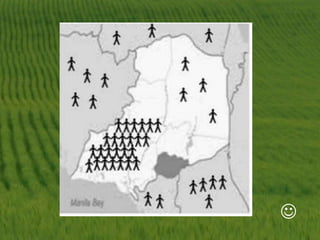
Population density refers to
the number of organisms per
unit area. If a population’s
density is very high, that
means there are a lot of
organisms crowded into a
certain area. If a population’s
density is low, that means
there are very few organisms

Carrying Capacity
Each population of organisms has
a different carrying capacity,
depending on the amount of
resources available in the area in
which it lives.
Before a population reaches its
carrying capacity, it experiences a
period of rapid growth. This period
of growth is called exponential
Carrying Capacity
population growth.
During this period, there are plenty
of resources available for all
organisms, so more births are
recorded than deaths in organisms.
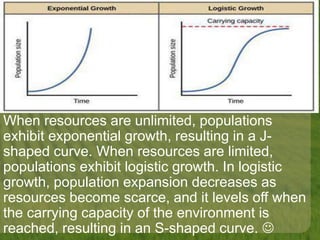
When resources are unlimited, populations
exhibit exponential growth, resulting in a J-
shaped curve. When resources are limited,
populations exhibit logistic growth. In logistic
growth, population expansion decreases as
resources become scarce, and it levels off when
the carrying capacity of the environment is
reached, resulting in an S-shaped curve. 
Limiting Factors
1. Biotic Factors
Any living thing in an
ecosystem. Examples are
plants, animals and bacteria.
2. Abiotic Factors
 Non-living things in an
ecosystem. Examples are the
sunlight, water, and rocks
Limiting Factors
1. Density-independent
such things as natural
disasters, temperature,
sunlight, and the activities of
humans in the environment.
Most of this factors are abiotic
or non living.
Limiting Factors
2. Density-dependent
For example, when a population
reaches a certain size, there
won’t be enough resources (food,
shelter, water) for all of the
organisms. This could cause the
population to stop growing when it
reaches the maximum number of
organisms that can be supported,
Limiting Factors
2. Density-dependent
 by the environment. This number
is known as the population’s
carrying capacity in a particular
environment.
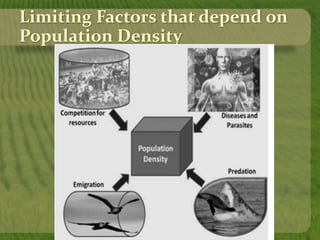
Limiting Factors that depend on
Population Density
Ecosystem
1. Manmade ecosystem
A lot of time and money to be
spend in to maintain stability
and productivity.
2. Natural ecosystem?
Energy and materials in the
environment evolved and
developed by themselves.
Environmental
Problems and Issues
Science G10 3rd Q Ecosystem and Biodiversity

Science G10 3rd Q Ecosystem and Biodiversity

  • 1.
  • 2.
  • 3.
    Objectives 1. Explain howspecies diversity increases the probability of adaptation and survival of organisms in changing environments. 2. Explain the relationship between population growth and carrying capacity. 3. Suggest ways to minimize impact on the environment.
  • 4.
    Ecosystem Is the communityof living things interacting with the environment
  • 5.
    Biodiversity A term thatdescribes how varied living things are in a specific area. Organisms are part of biodiversity and may be economically and ecologically valuable.
  • 6.
    Value of species: 1.Direct economic value If their products are sources of food, medicine, clothing, shelter and energy. For example are medicines extracted from plants.
  • 7.
    Value of species: 2.Indirect economic value If there are benefits produced by the organism w/out using them. For example certain species cycle materials in the soil and absorb pollutants.
  • 8.
    Value of species: 3.Aesthetic value A lot of species provides visual or artistic enjoyment, like a forested landscape and the calming beauty of a natural park; or they may be used for spiritual meditation like the Prayer Mountains. 
  • 9.
    Stability Resilience to withstand changesthat may occur in the environment. There are many changes that occur in the environment which may be a result of natural or human activities. These changes may severely reduce biodiversity and result to the instability of the ecosystem.
  • 10.
    Population a group oforganisms of the same species that live in a certain area. Ecologists regularly monitor the number of organisms in many populations
  • 11.
    Birth Rate Number ofbirths in a population. Death/Mortality Rate Number of deaths that are dying in a population. 
  • 12.
    Population density refersto the number of organisms per unit area. If a population’s density is very high, that means there are a lot of organisms crowded into a certain area. If a population’s density is low, that means there are very few organisms
  • 13.
  • 14.
    Carrying Capacity Each populationof organisms has a different carrying capacity, depending on the amount of resources available in the area in which it lives. Before a population reaches its carrying capacity, it experiences a period of rapid growth. This period of growth is called exponential
  • 15.
    Carrying Capacity population growth. Duringthis period, there are plenty of resources available for all organisms, so more births are recorded than deaths in organisms.
  • 16.
    When resources areunlimited, populations exhibit exponential growth, resulting in a J- shaped curve. When resources are limited, populations exhibit logistic growth. In logistic growth, population expansion decreases as resources become scarce, and it levels off when the carrying capacity of the environment is reached, resulting in an S-shaped curve. 
  • 17.
    Limiting Factors 1. BioticFactors Any living thing in an ecosystem. Examples are plants, animals and bacteria. 2. Abiotic Factors  Non-living things in an ecosystem. Examples are the sunlight, water, and rocks
  • 18.
    Limiting Factors 1. Density-independent suchthings as natural disasters, temperature, sunlight, and the activities of humans in the environment. Most of this factors are abiotic or non living.
  • 19.
    Limiting Factors 2. Density-dependent Forexample, when a population reaches a certain size, there won’t be enough resources (food, shelter, water) for all of the organisms. This could cause the population to stop growing when it reaches the maximum number of organisms that can be supported,
  • 20.
    Limiting Factors 2. Density-dependent by the environment. This number is known as the population’s carrying capacity in a particular environment.
  • 21.
    Limiting Factors thatdepend on Population Density
  • 22.
    Ecosystem 1. Manmade ecosystem Alot of time and money to be spend in to maintain stability and productivity. 2. Natural ecosystem? Energy and materials in the environment evolved and developed by themselves.
  • 23.

Editor's Notes

  • #9 Biodiversity is very important because it sustains through flow of energy the food web on earth and contributes to environmental stability
  • #12 So if birth rate is greater……. Population of organisms cannot grow forever There are two factors that limit the growth, the density-independent factors and density-dependent factors But before that we must first understand the concept of population density.
  • #13 So if birth rate is greater……. Population of organisms cannot grow forever There are two factors that limit the growth, the density-independent factors and density-dependent factors But before that we must first understand the concept of population density.
  • #14 A factor that regulates a population’s growth and is influenced by population density, is called density-dependent limiting factor. If the population’s density does not directly influence changes in population’s growth, then it is called a density-independent limiting factor.
  • #17 There are factors that limit population