YoucaN
Sheet metal basics- Stretch
forming- Explosive forming
• UNIT IV SHEET METAL PROCESSES
Sheet metal characteristics –
shearing, bending and drawing
operations – Stretch forming
operations– Formability of sheet
metal – Test methods –special
forming processes-Working principle
and applications – Hydro forming –
Rubber pad forming – Metal
spinning– Introduction of Explosive
forming, magnetic pulse forming,YoucaN
YoucaN
YoucaN
YoucaN
• Sheet metal parts offers the advantages of light weight
and versatile shape as compared to those made by
casting/ forging.
• Low carbon steel is the most commonly used sheet
metal.
• Aluminum and titanium are most common sheet
materials for aircraft and aerospace applications.
YoucaN
YoucaN
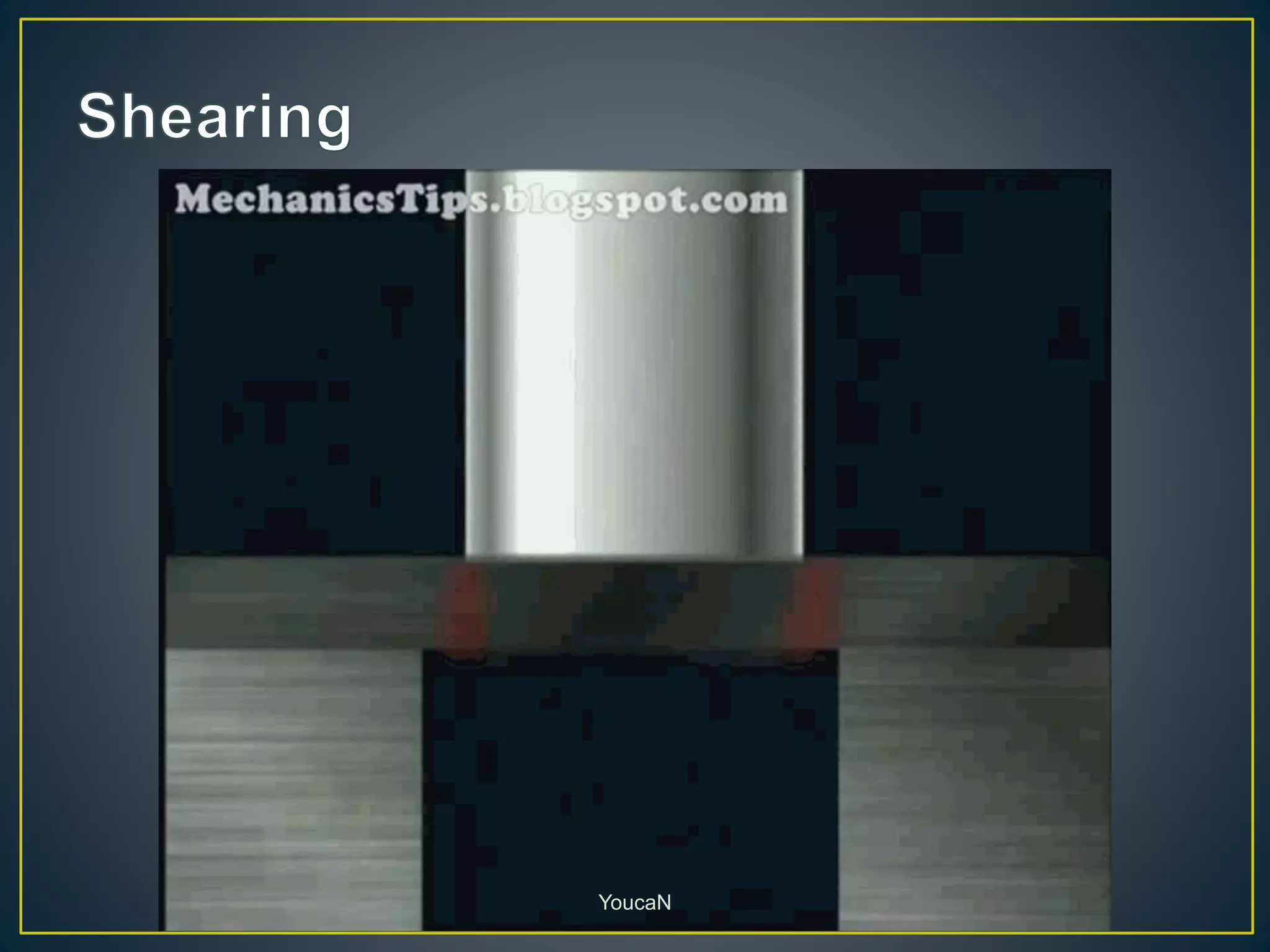
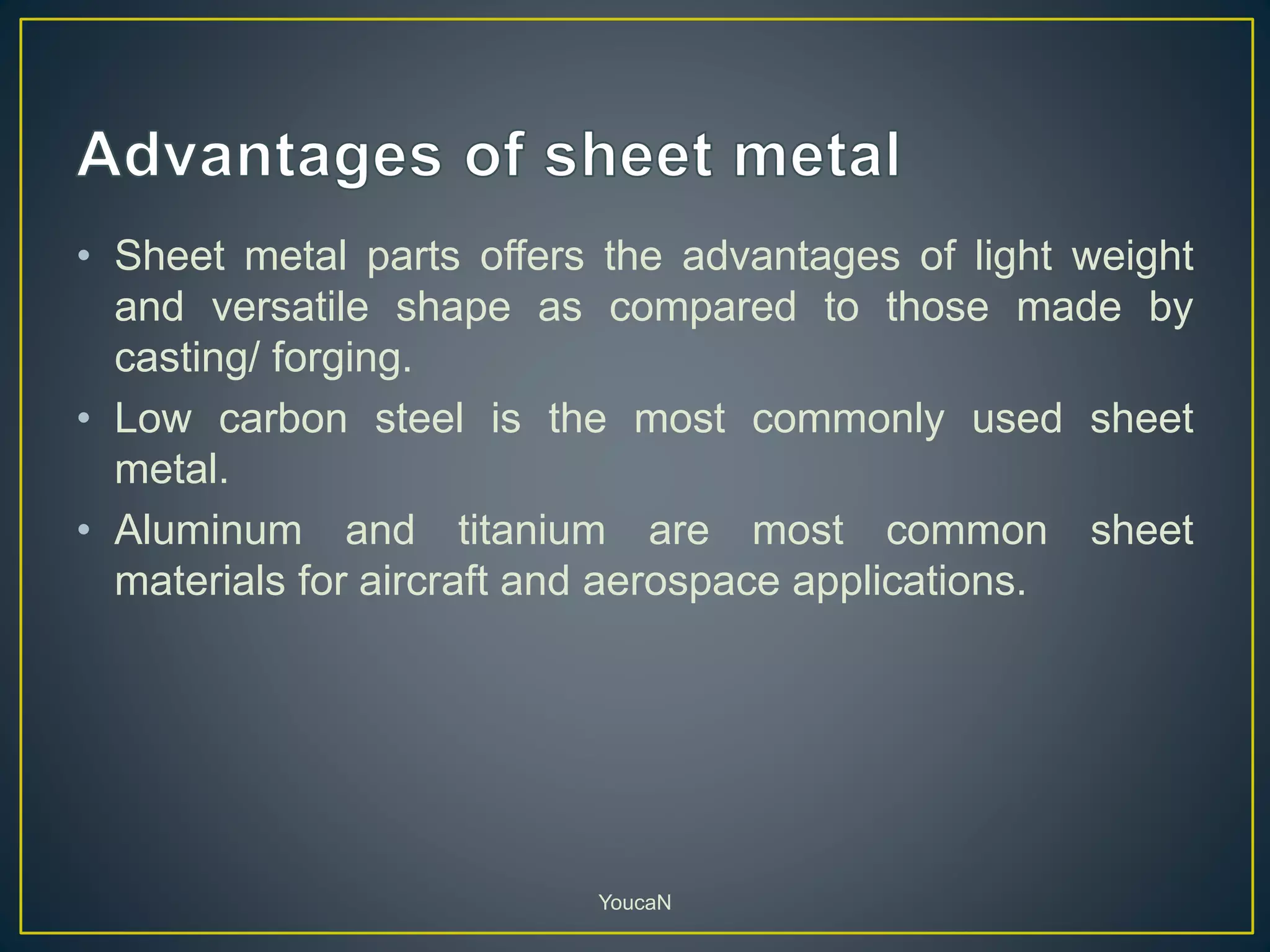
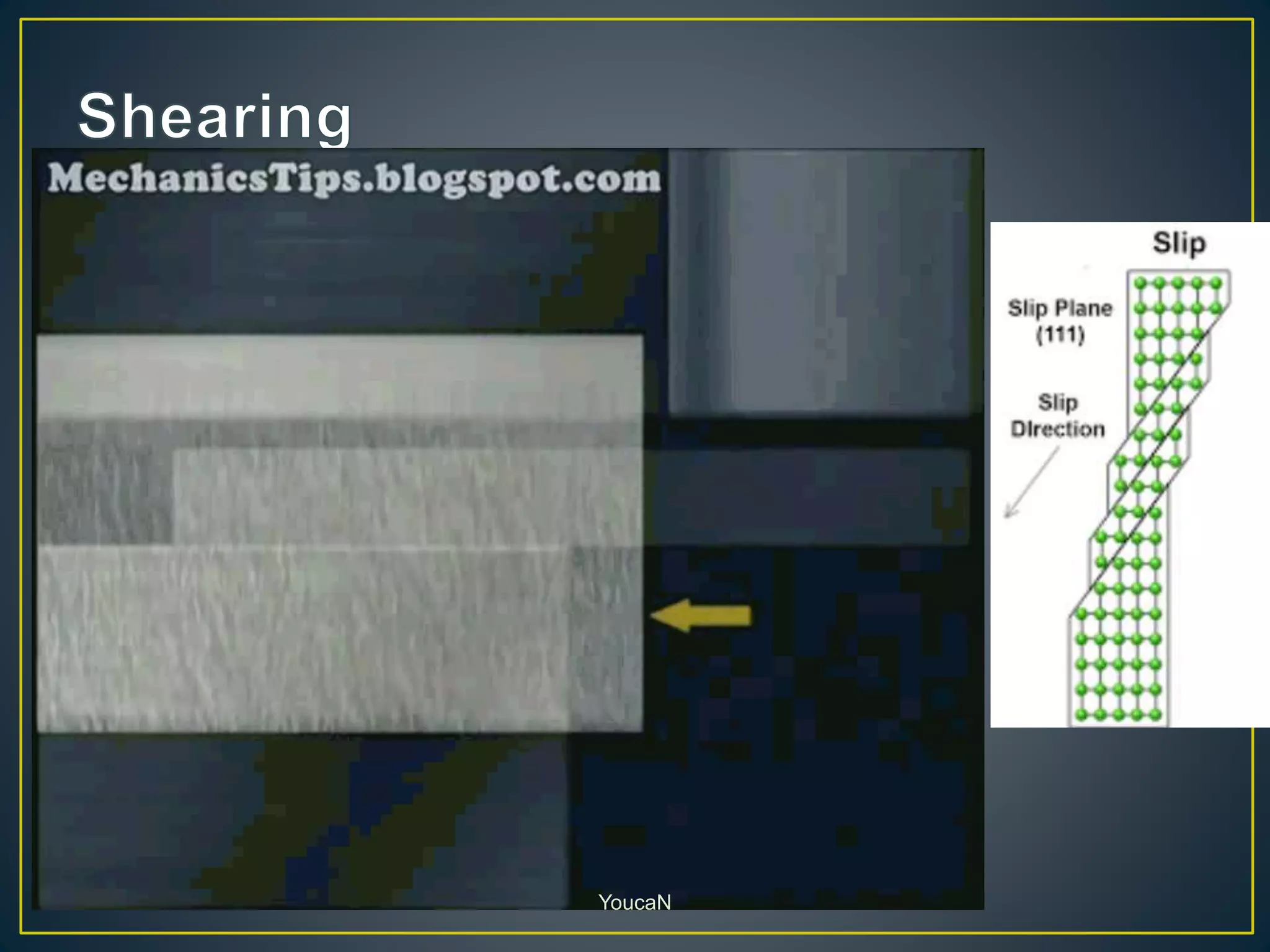
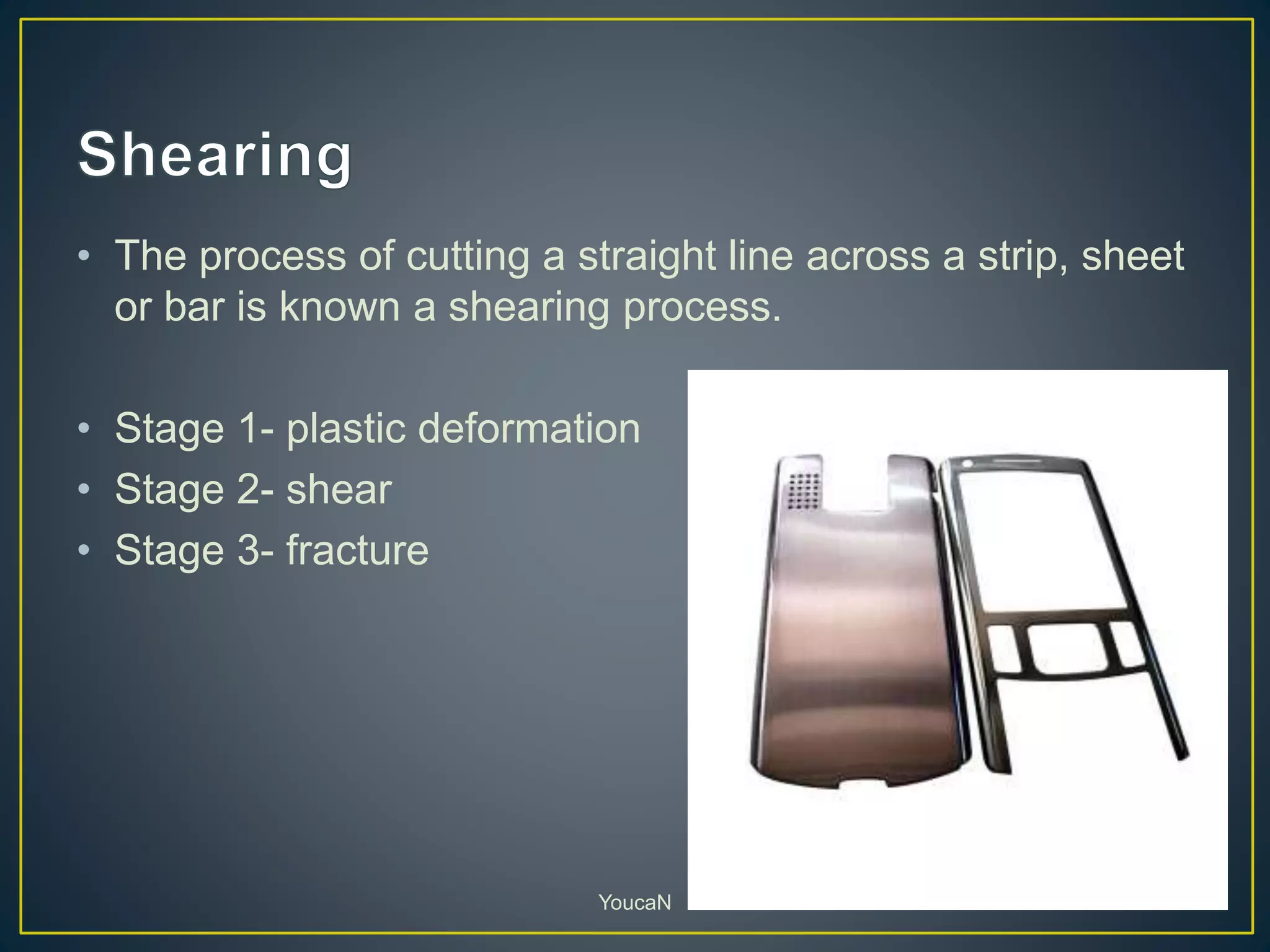
• The process of cutting a straight line across a strip, sheet
or bar is known a shearing process.
• Stage 1- plastic deformation
• Stage 2- shear
• Stage 3- fracture
YoucaN
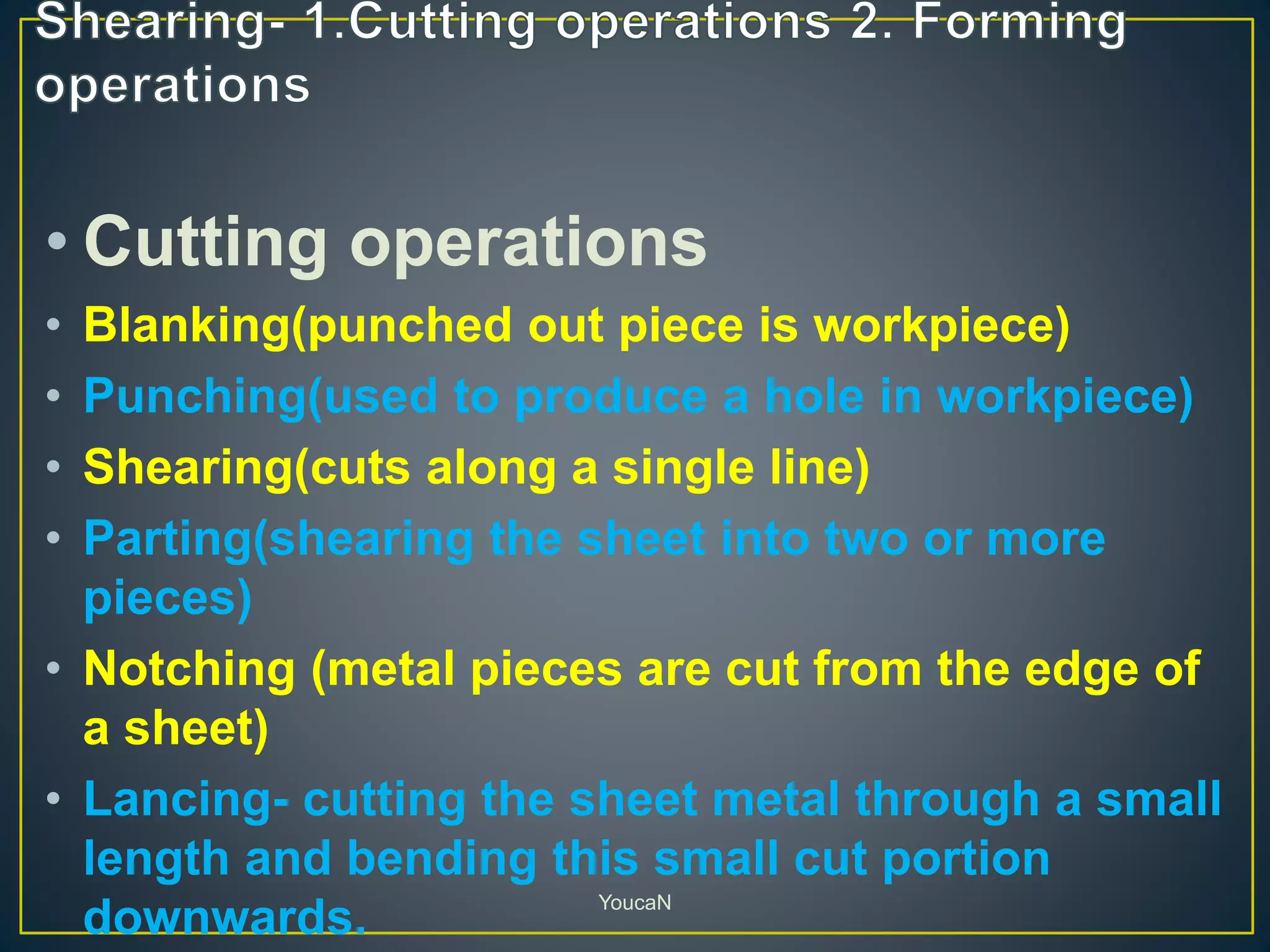
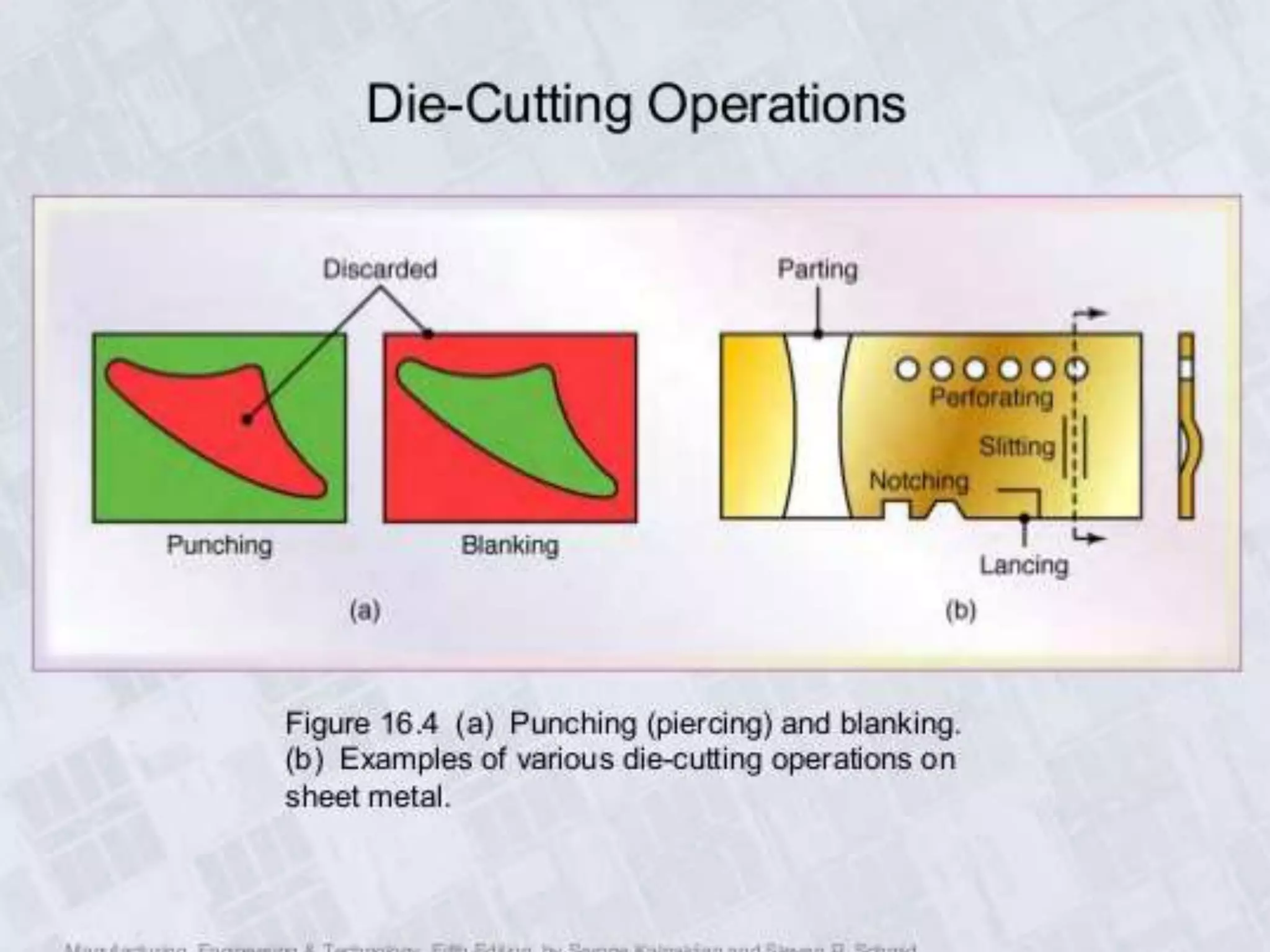
• Cutting operations
• Blanking(punched out piece is workpiece)
• Punching(used to produce a hole in workpiece)
• Shearing(cuts along a single line)
• Parting(shearing the sheet into two or more
pieces)
• Notching (metal pieces are cut from the edge of
a sheet)
• Lancing- cutting the sheet metal through a small
length and bending this small cut portion
downwards. YoucaN
YoucaN
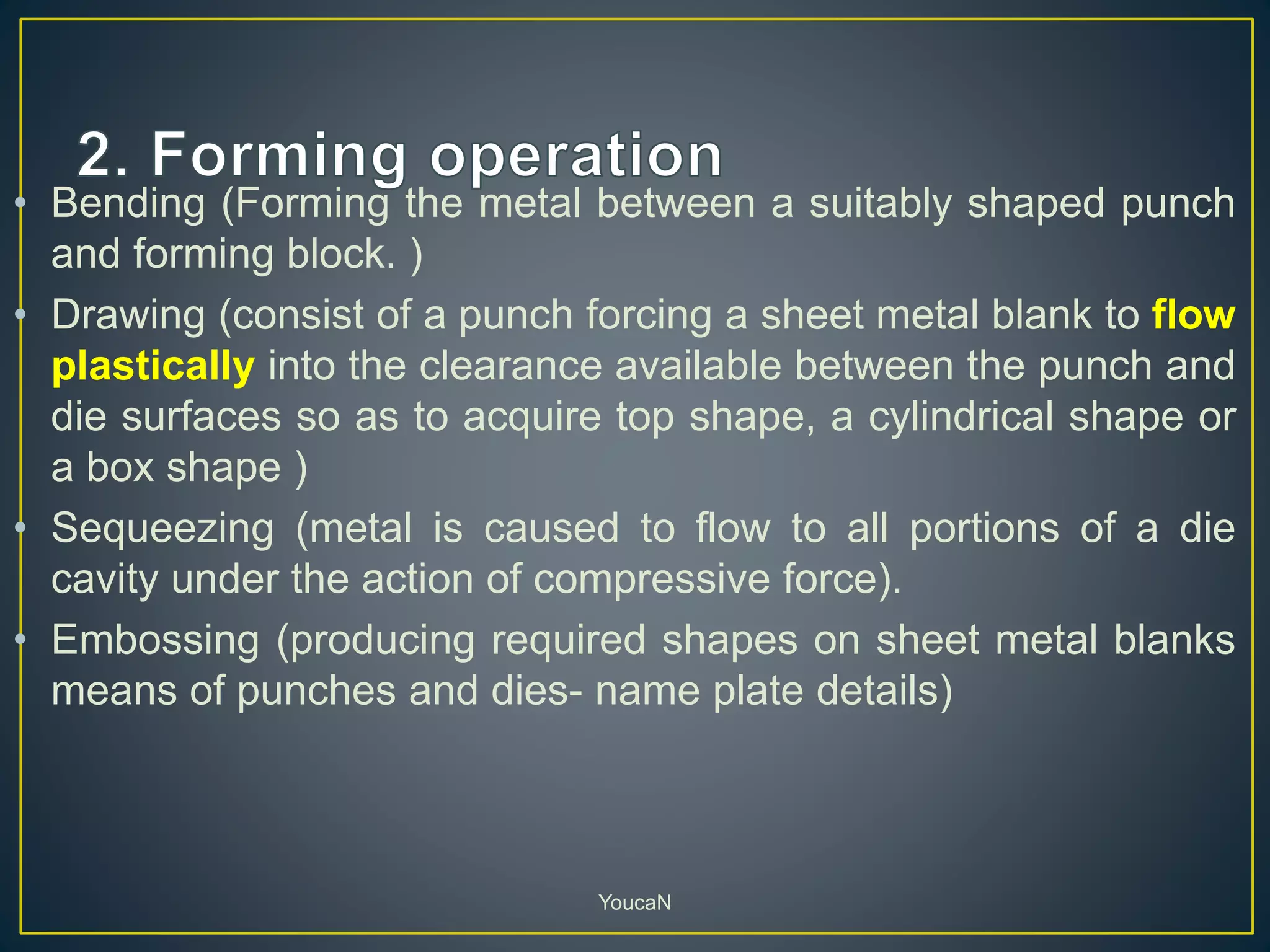
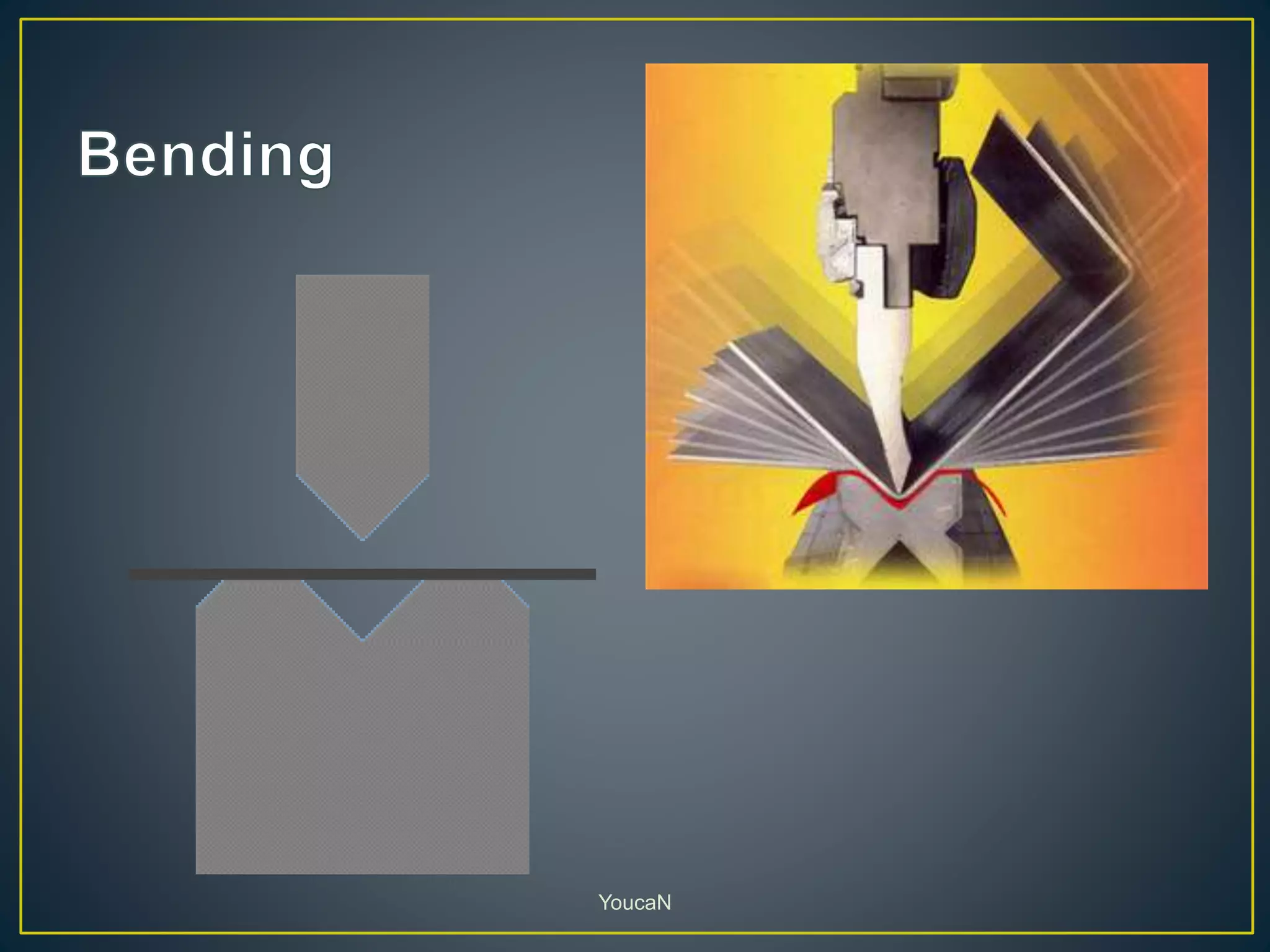
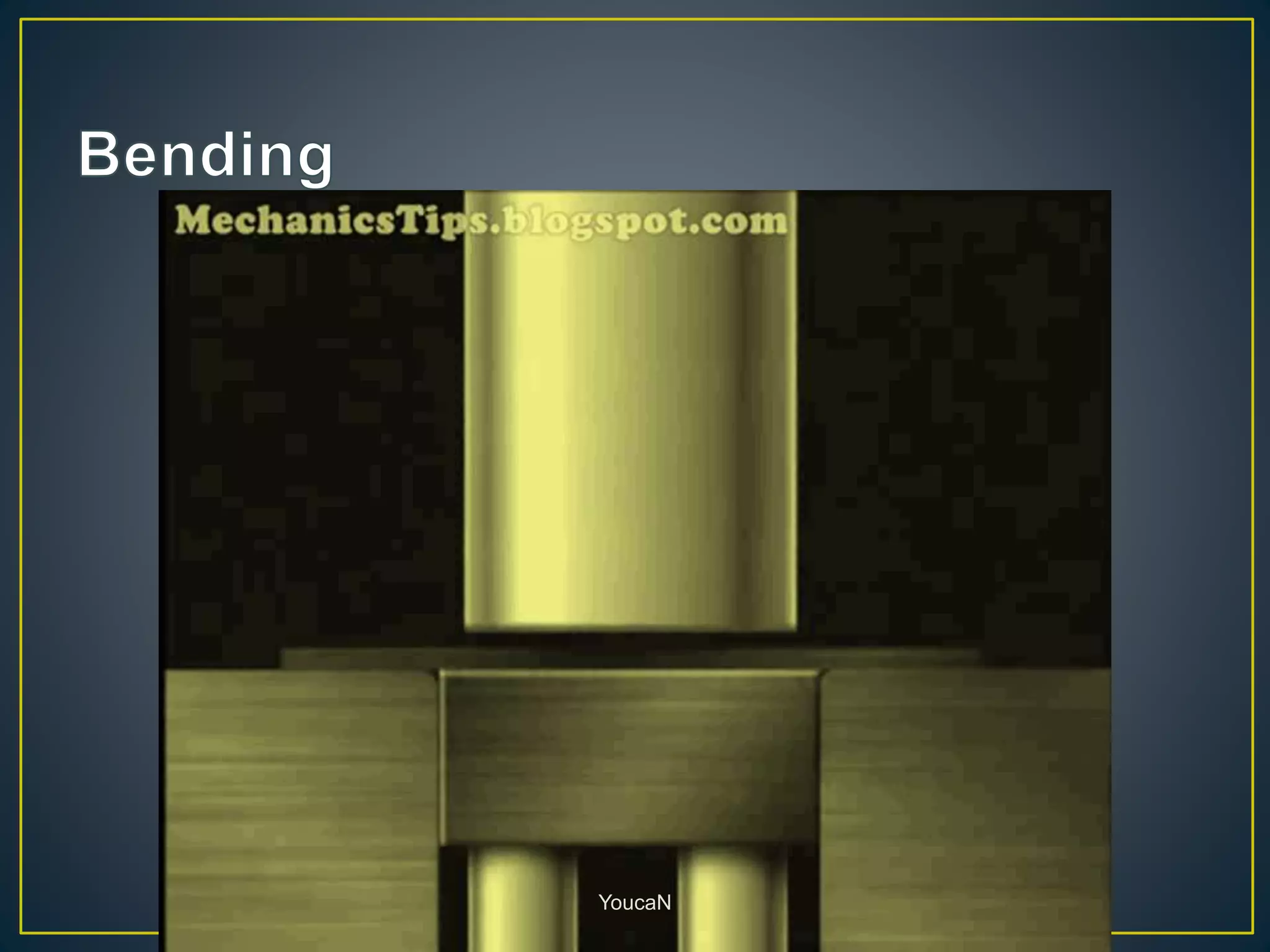
• Bending (Forming the metal between a suitably shaped punch
and forming block. )
• Drawing (consist of a punch forcing a sheet metal blank to flow
plastically into the clearance available between the punch and
die surfaces so as to acquire top shape, a cylindrical shape or
a box shape )
• Sequeezing (metal is caused to flow to all portions of a die
cavity under the action of compressive force).
• Embossing (producing required shapes on sheet metal blanks
means of punches and dies- name plate details)
YoucaN
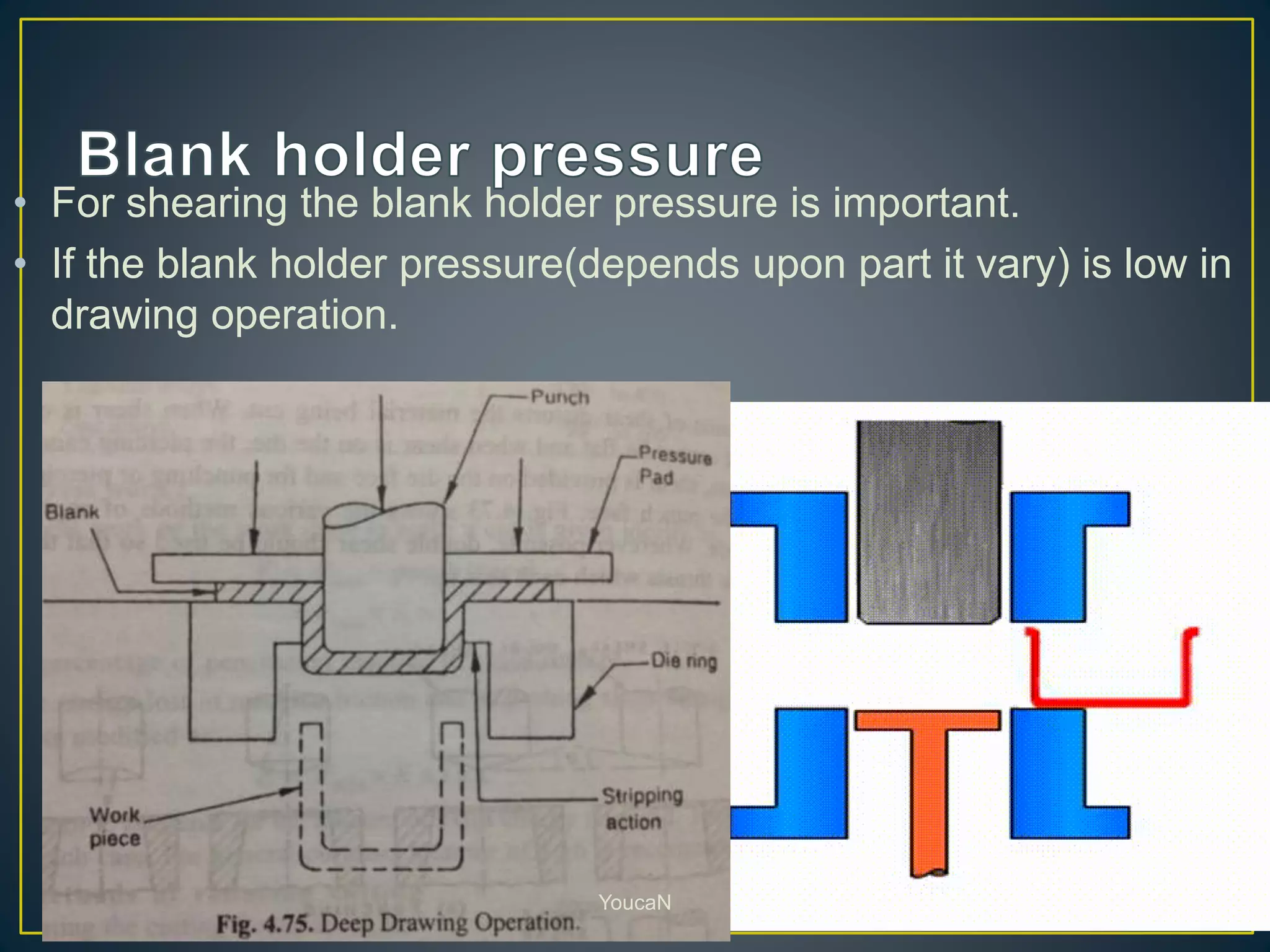
• For shearing the blank holder pressure is important.
• If the blank holder pressure(depends upon part it vary) is low in
drawing operation.
YoucaN
YoucaN
YoucaN
YoucaN
YoucaN
YoucaN
YoucaN
YoucaN
YoucaN
YoucaN
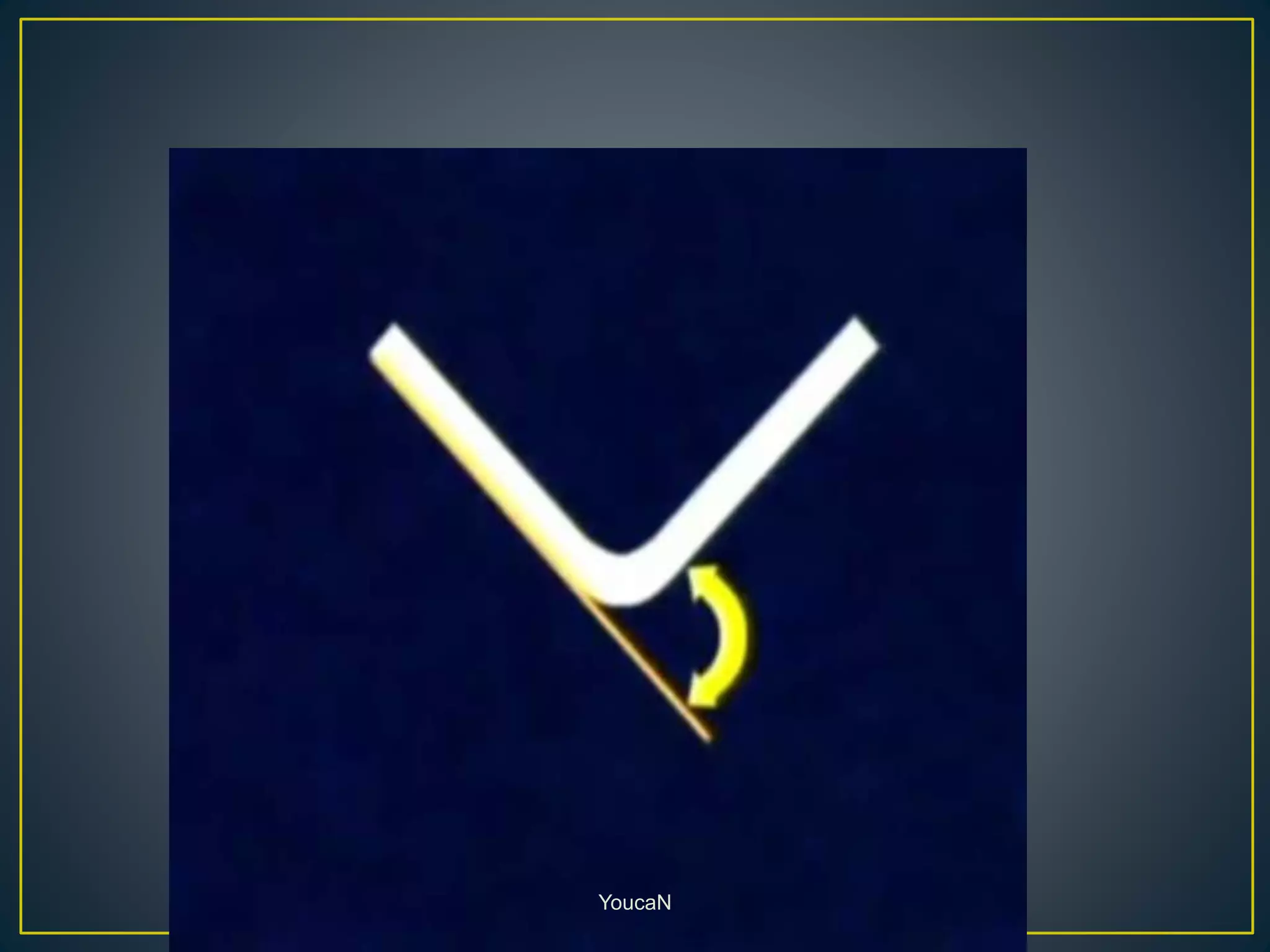
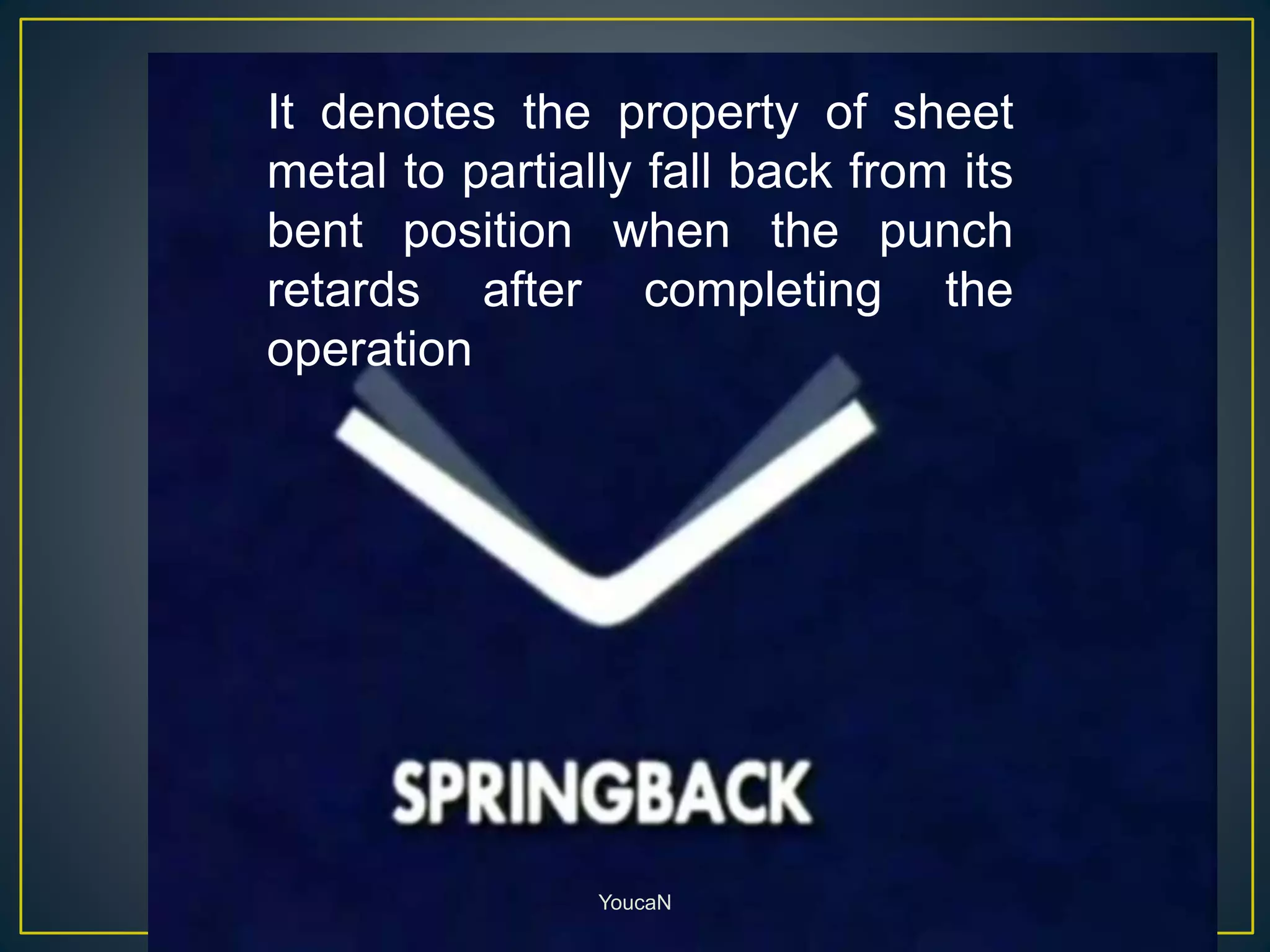
It denotes the property of sheet
metal to partially fall back from its
bent position when the punch
retards after completing the
operation
YoucaN
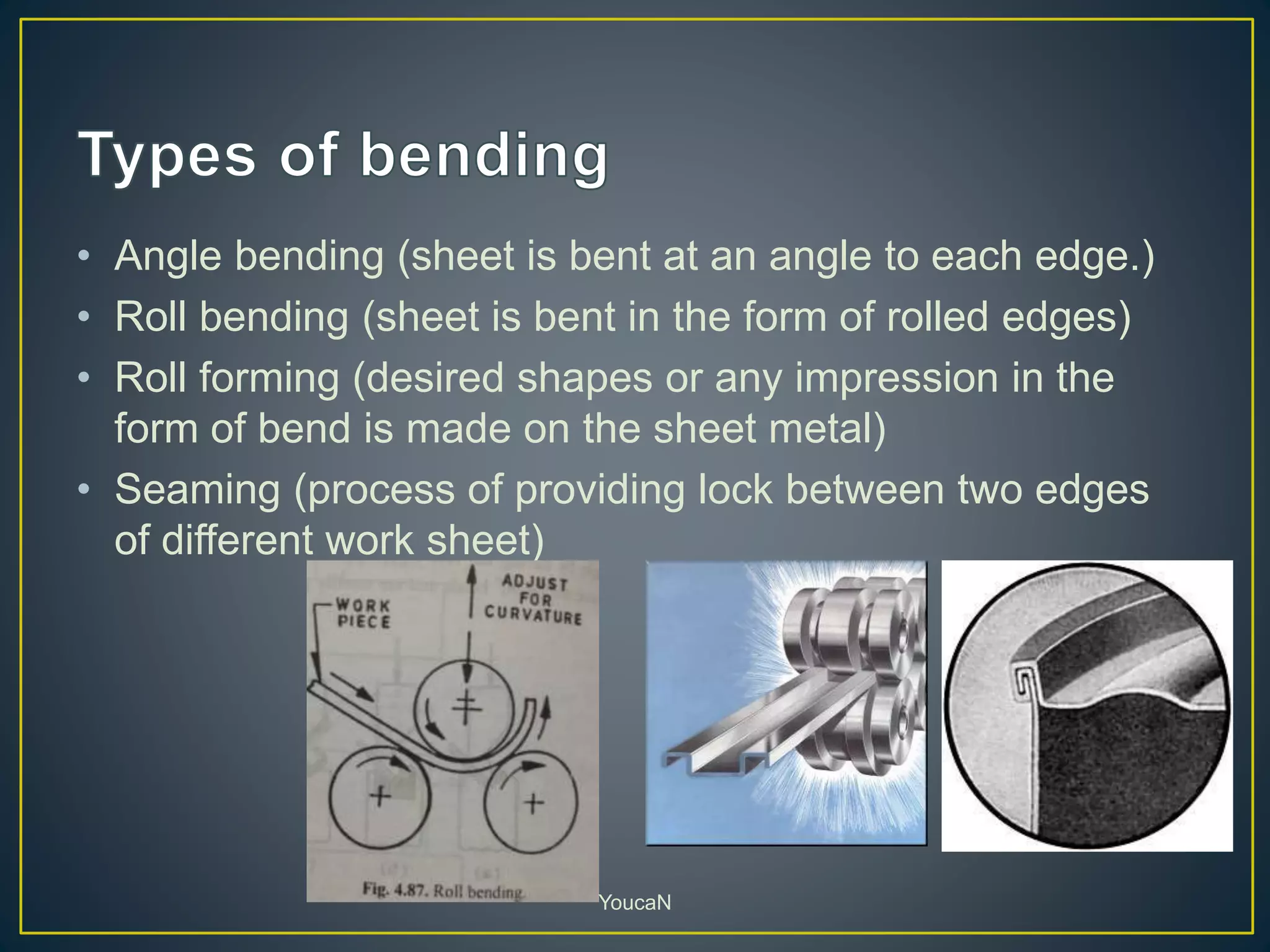
• Angle bending (sheet is bent at an angle to each edge.)
• Roll bending (sheet is bent in the form of rolled edges)
• Roll forming (desired shapes or any impression in the
form of bend is made on the sheet metal)
• Seaming (process of providing lock between two edges
of different work sheet)
YoucaN
YoucaN
YoucaN
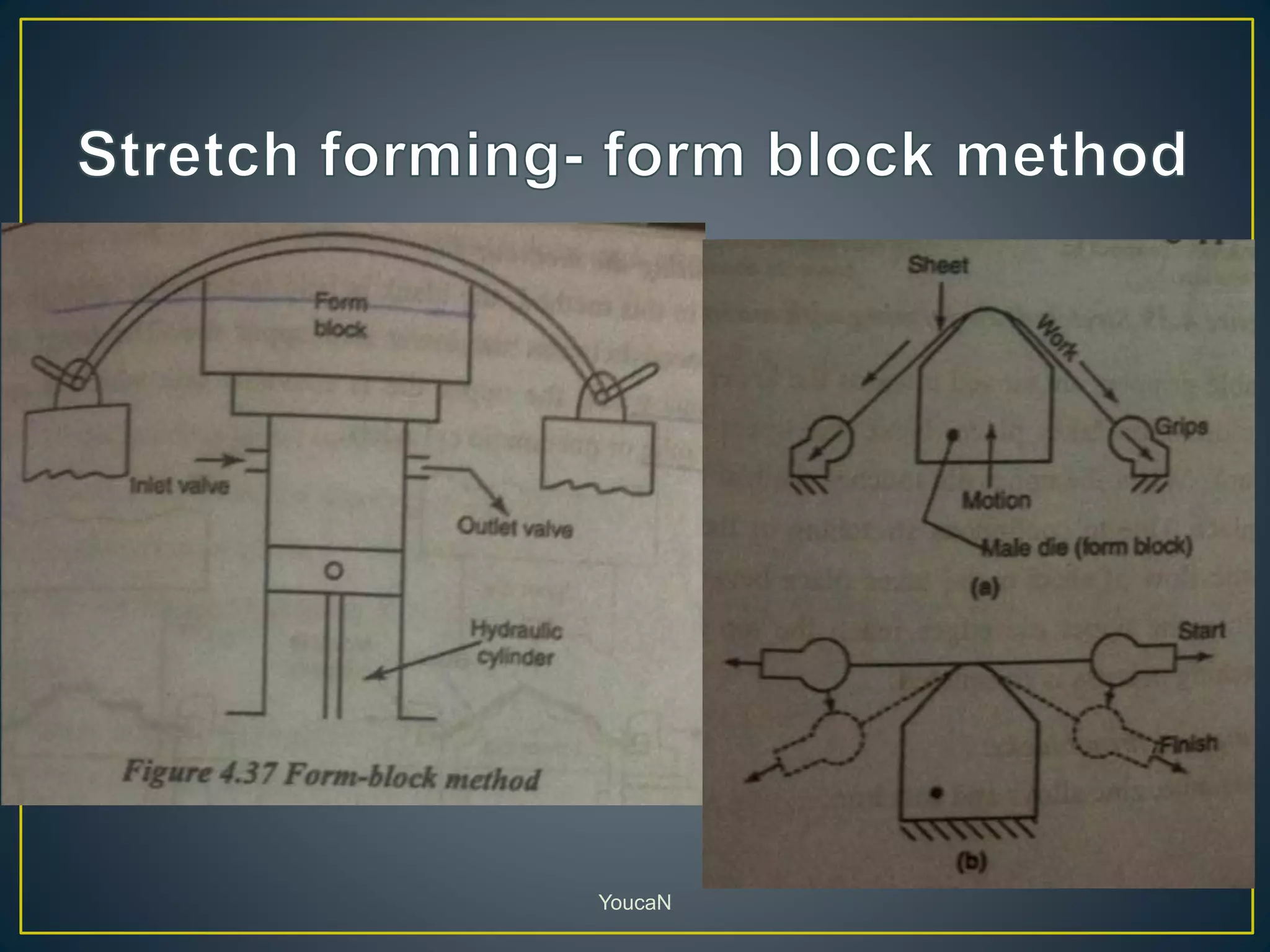
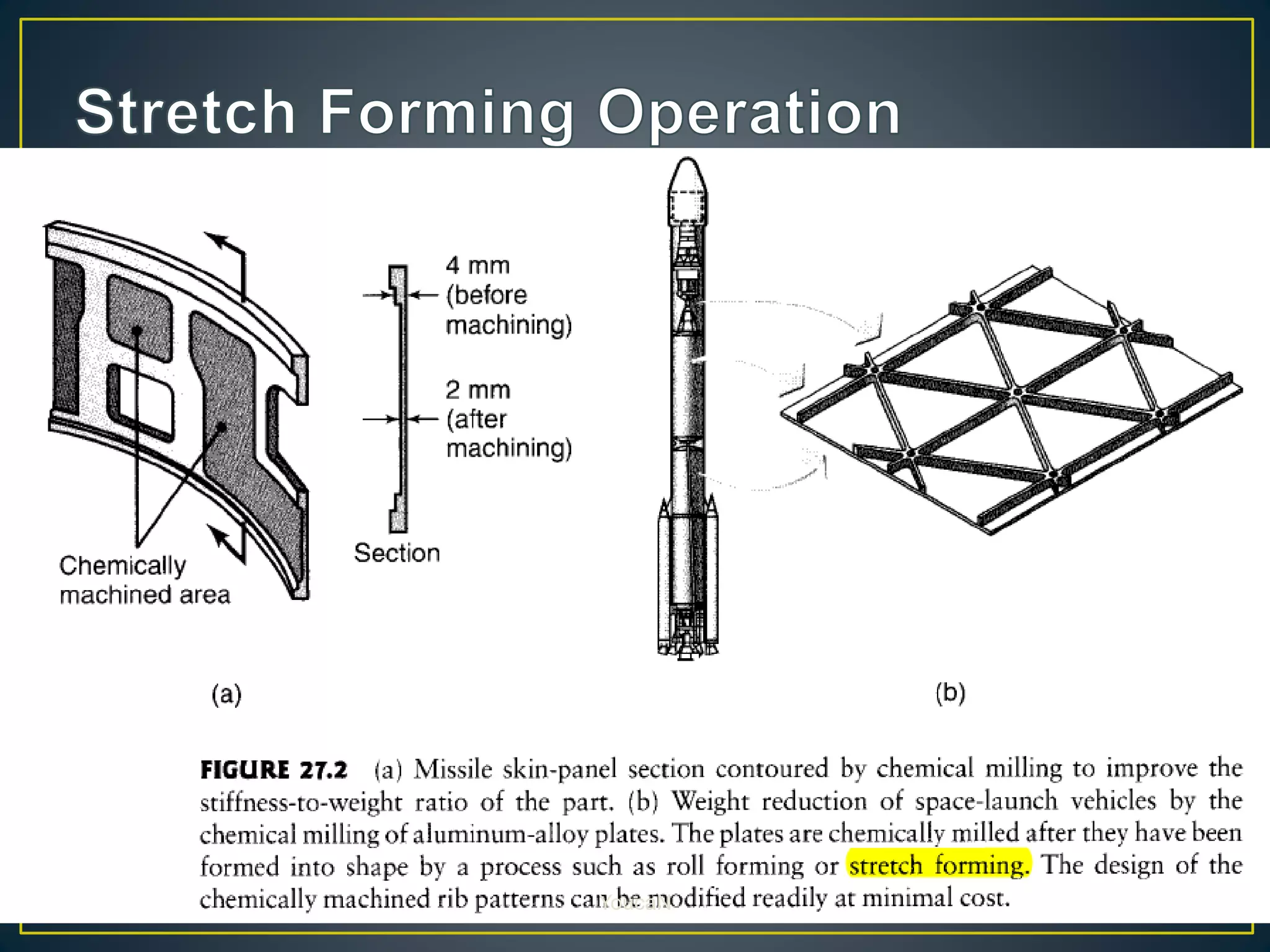
• Used to produce large accurate contoured sheets.
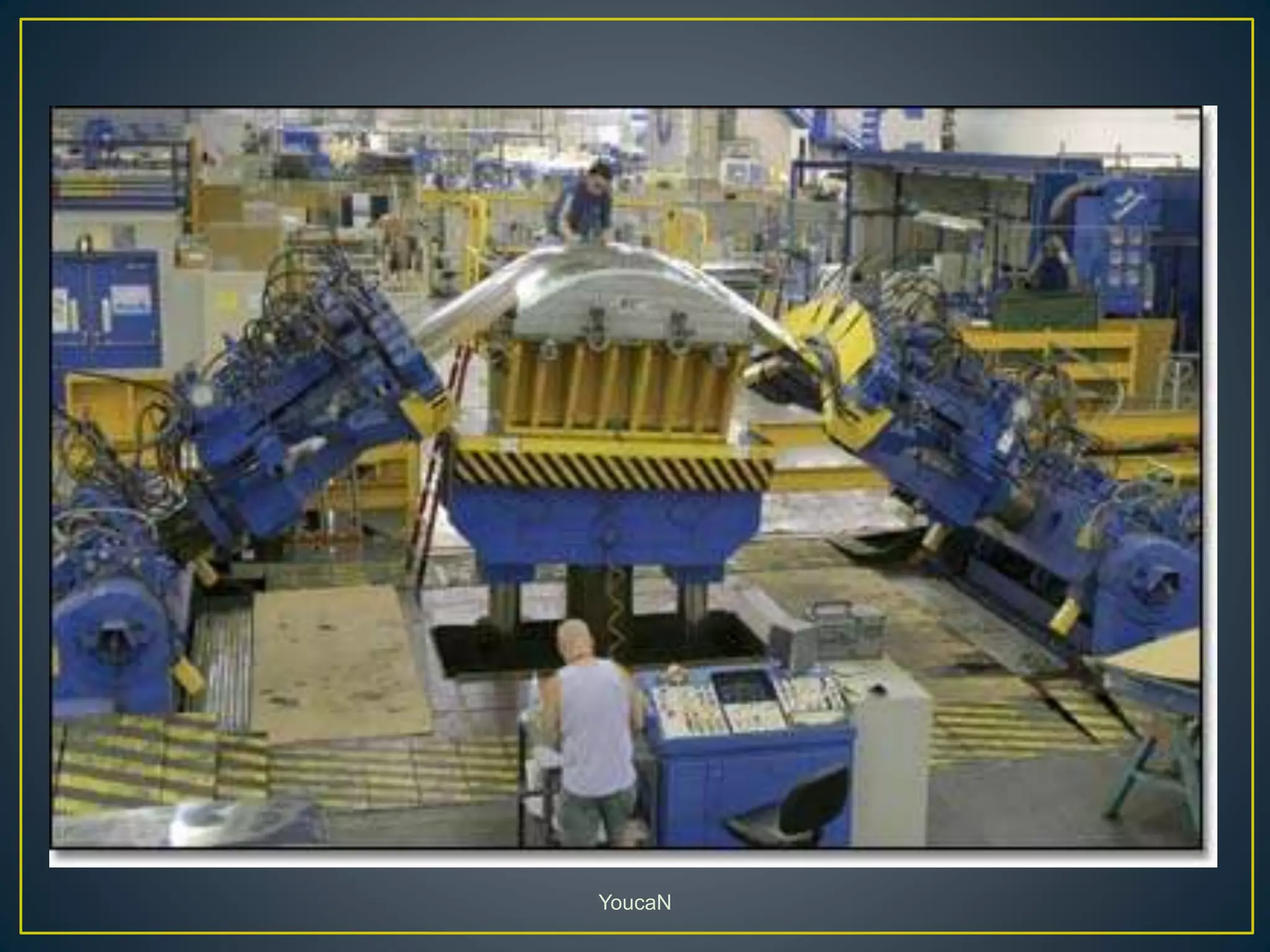
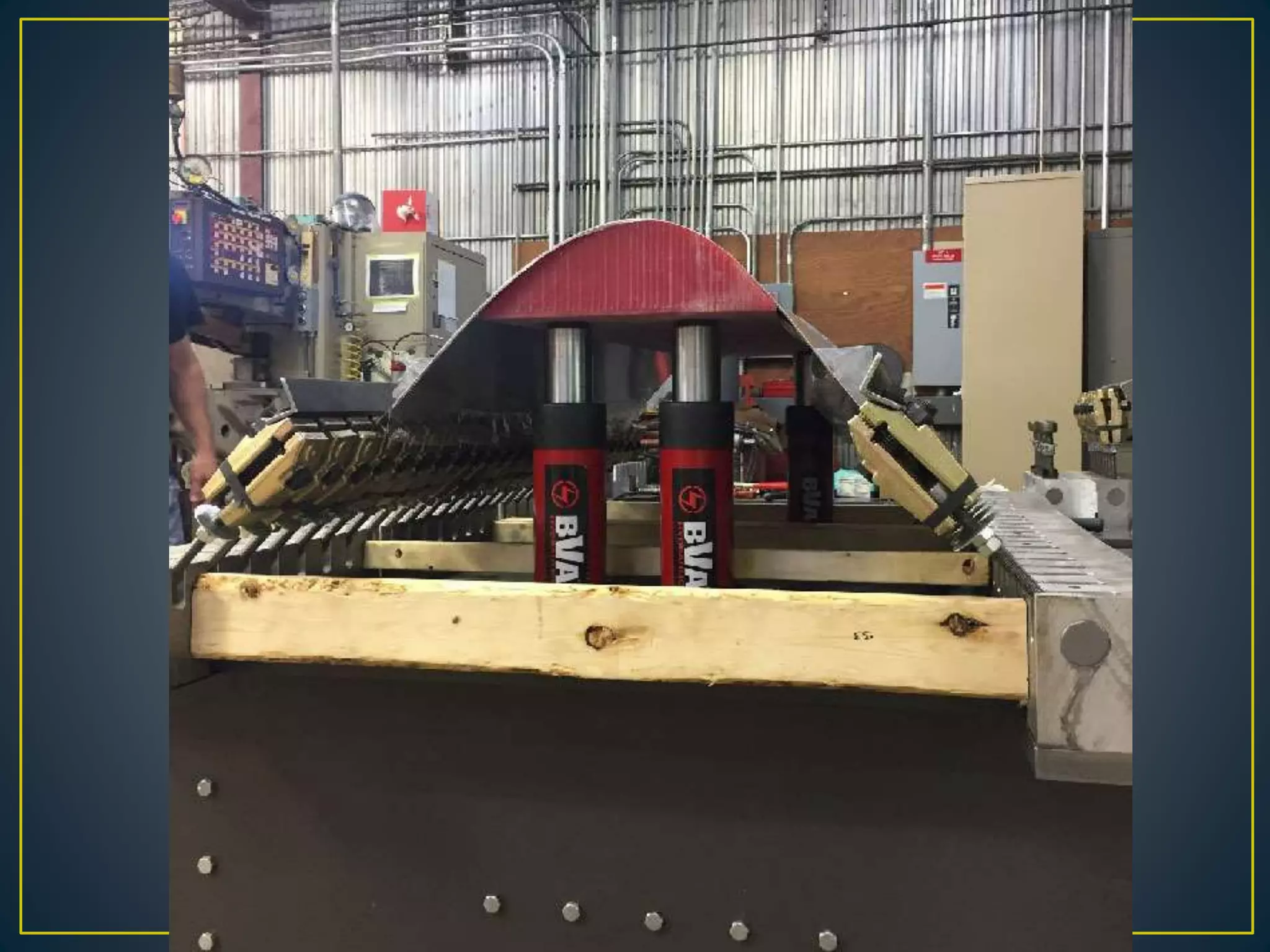
• Stretching the work beyond its elastic limit by moving a
form block towards the blank or sheet metal.
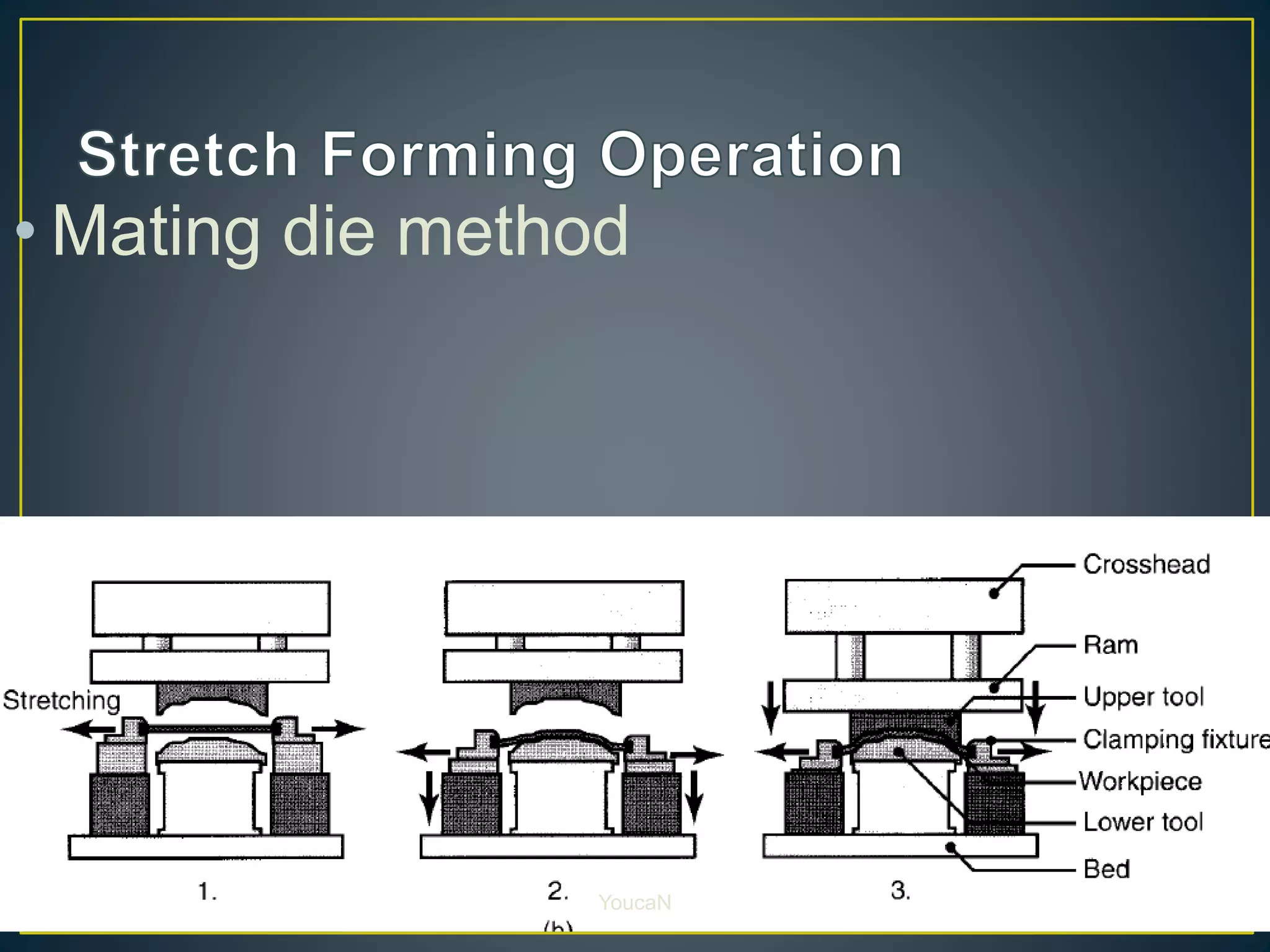
• In stretch forming, the sheet metal is clamped along its edges and
then stretched over a male die (form block or form punch).
• The die moves upward, downward, or sideways, depending on the
particular design of the machine
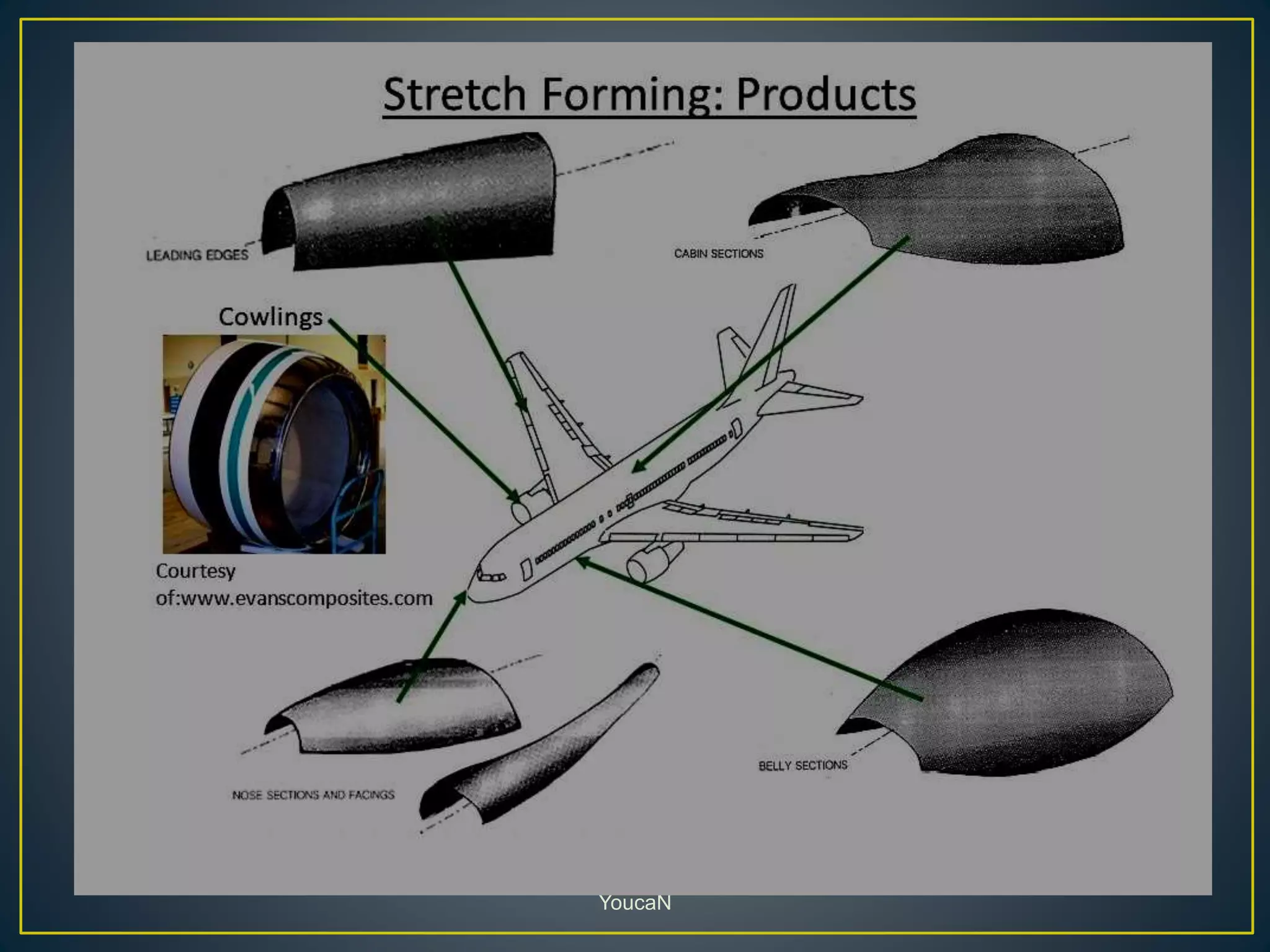
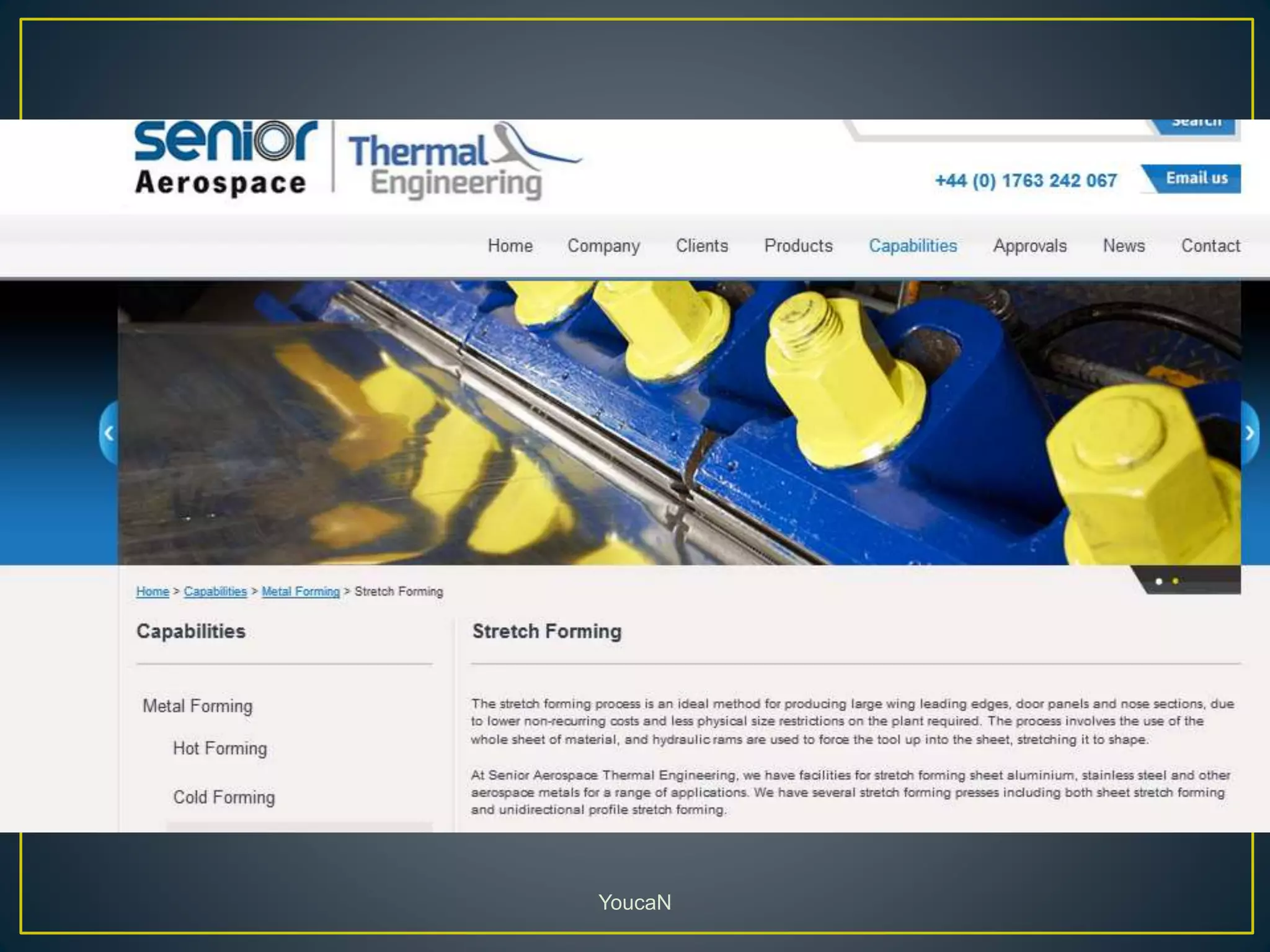
• Stretch forming is used primarily to make aircraft wing-
skin panels, fuselages, and boat hulls.
• Aluminum skins for the Boeing 767 and 757 aircraft, for example,
are made by stretch forming-with a tensile force of 9 MN.
YoucaN
YoucaN
• The rectangular sheets are 12 m >< 2.5 m >< 6.4 mm. Although this
process generally is used for low volume production, it is
versatile and economical, particularly for the aerospace industry.
• In most operations, the blank is a rectangular sheet clamped
along its narrower edges and stretched lengthwise, thus allowing
the material to shrink in width.
• Controlling the amount of stretching is important in order to
prevent tearing.
• Stretch forming cannot produce parts with sharp contours
or with reentrant corners (depressions on the surface of the die).
• Various accessory equipment can be used in conjunction with stretch
forming, including further forming with both male and female dies
while the part is under tension.
• Dies for stretch forming generally are made of zinc alloys, steel,
plastics, or wood. Most applications require little or no lubrication.YoucaN
YoucaN
YoucaN
YoucaN
YoucaN
• Mating die method
YoucaN
• Blank can be stretched in a single operation
• Spring back is reduced or eliminated when compared
to other forming methods
• Plastic deformation is due to pure tension only
• Larger parts can be formed
YoucaN
Materials used
Aluminium Alloy
Nickel and Cobalt base alloys – Stainless
Steel
• Blank thickness should be uniform throughout the length.
• Sudden changes in contour surfaces cannot be
stretched.
• Maintenance cost of hydraulic cylinders is high
• The process requires high quality form blocks
YoucaN
•limitations
• Uneven thickness of blank cannot be stretched
• Stretching of blank to the required shape of contour is
limited
• Applications
• Production of aircraft wing parts
• Production of contoured panels for truck trailer and bus
bodies in automobile industry.
YoucaN
YoucaN
YoucaN
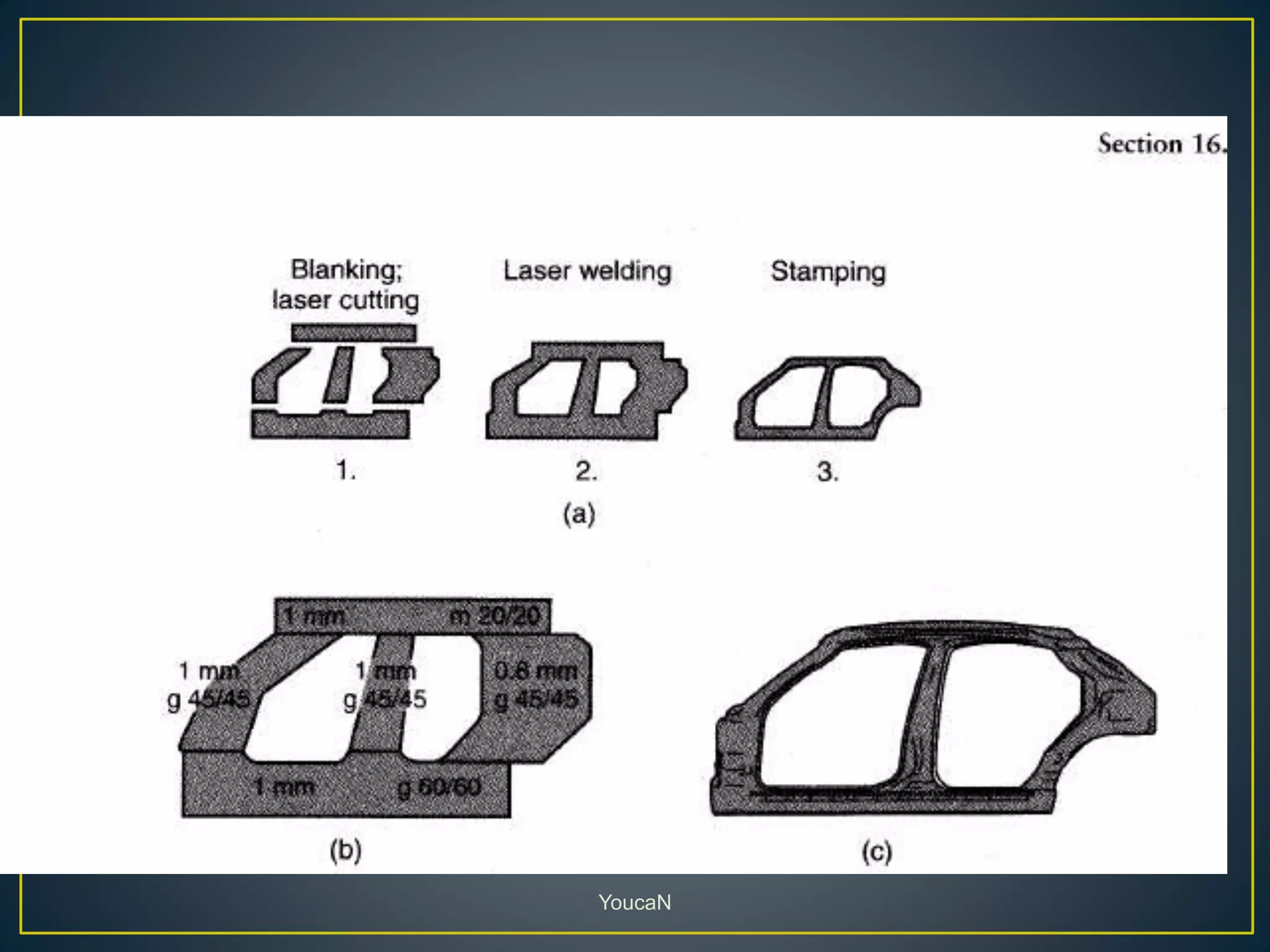
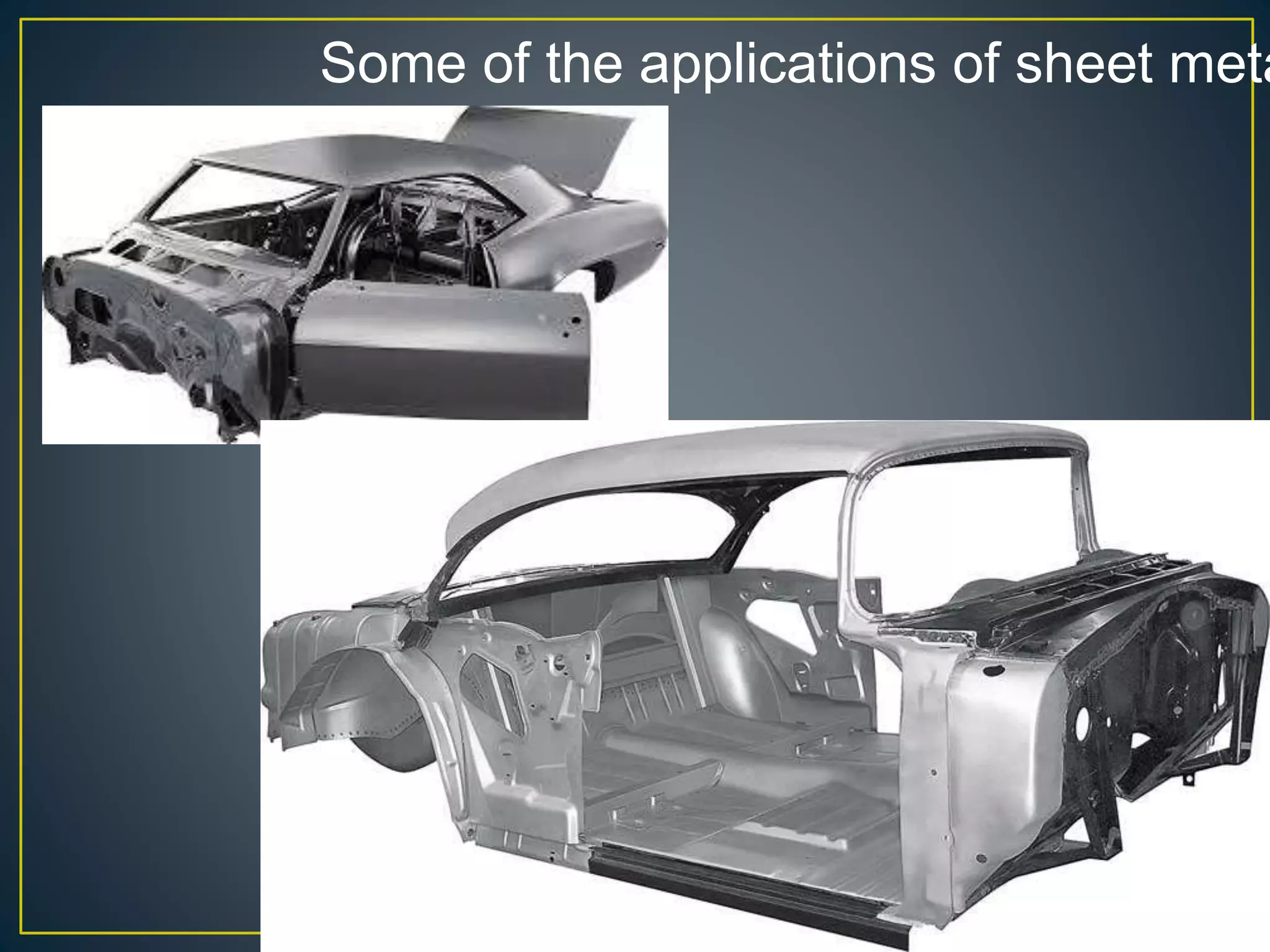
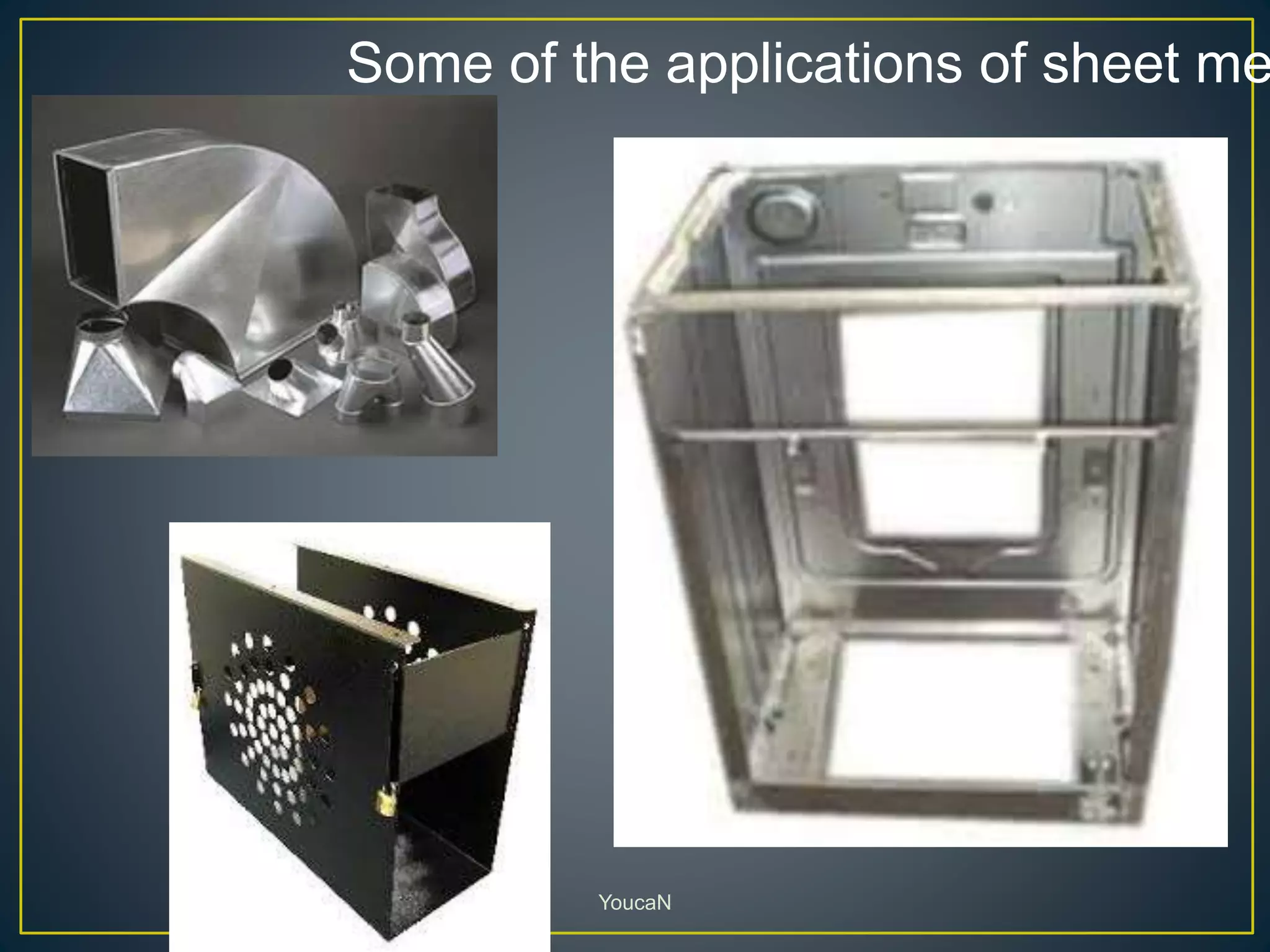
Some of the applications of sheet meta
YoucaN
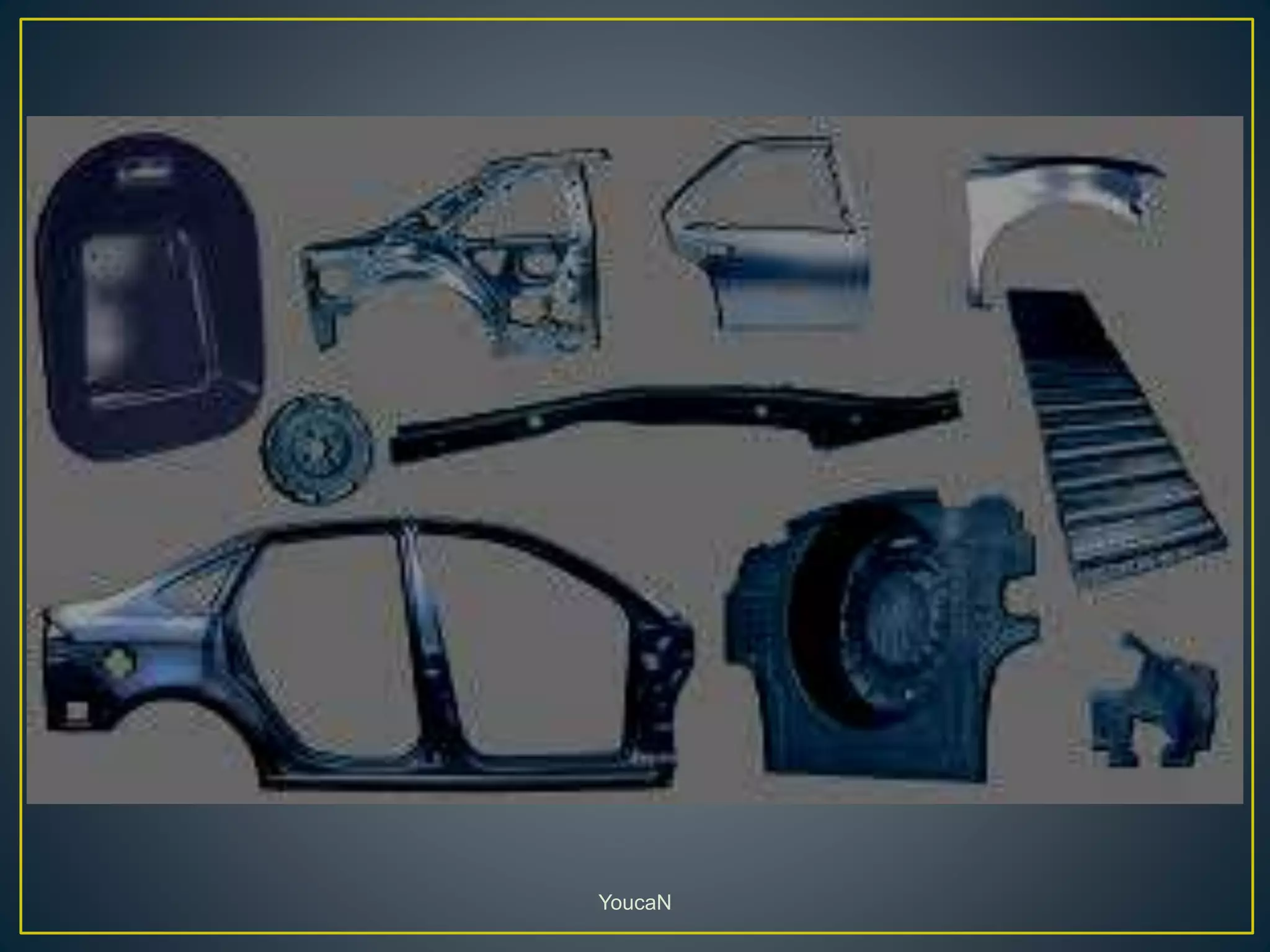
Some of the applications of sheet me
YoucaN
YoucaN
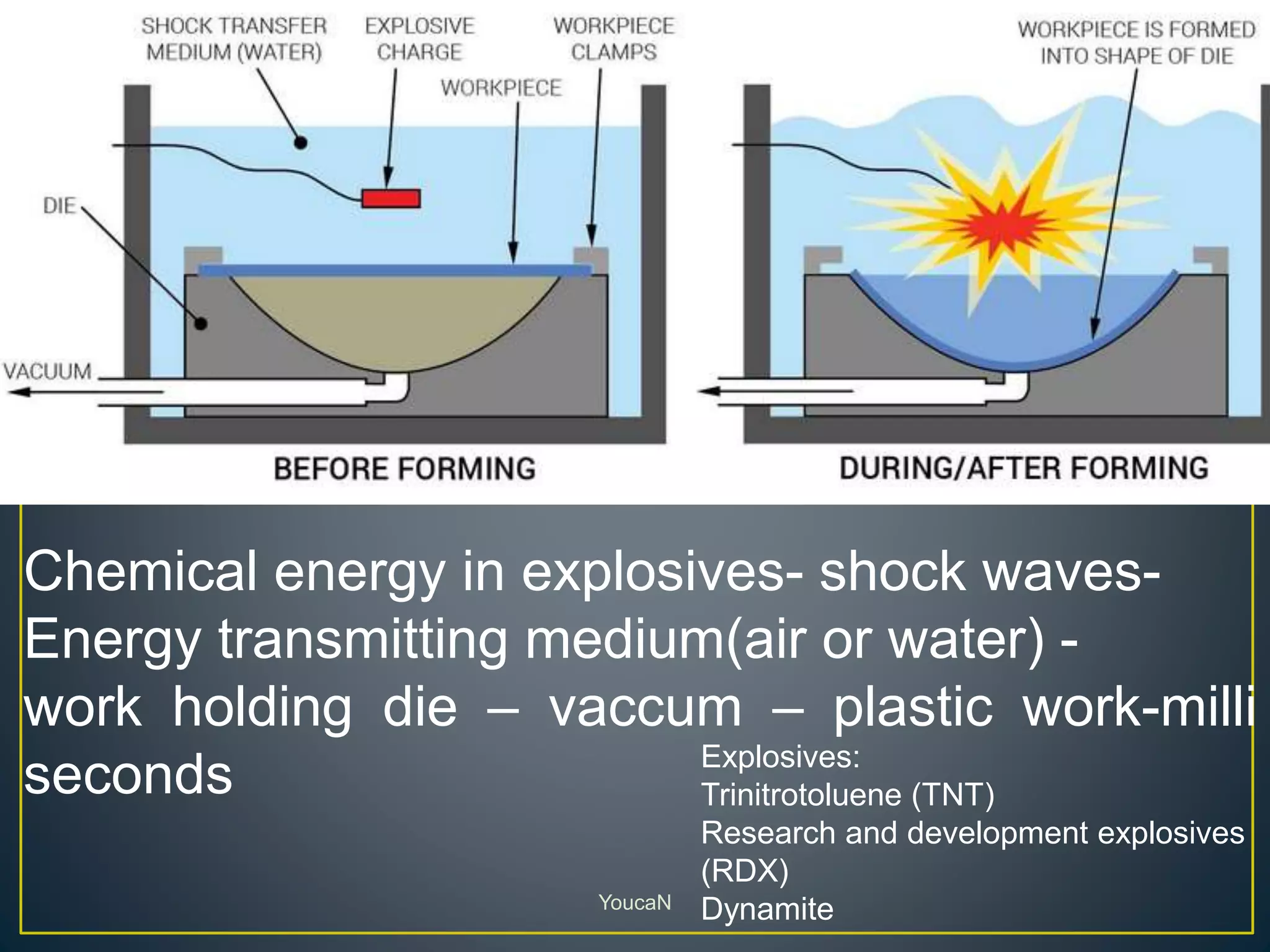
Chemical energy in explosives- shock waves-
Energy transmitting medium(air or water) -
work holding die – vaccum – plastic work-milli
seconds Explosives:
Trinitrotoluene (TNT)
Research and development explosives
(RDX)
Dynamite
• In explosive forming the chemical energy stored in
explosives is used to process the materials.
• The shock waves developed depends on the compressibility
of the energy transmitting medium.(water or air)
• Water is being less compressible than air is a better
medium.
• Terms: distance between workpiece and explosive,
amount of explosive, energy transmitting medium
• Two systems
• 1- confined system OR Contact system
• 2- unconfined system OR stand off distance methodYoucaN
YoucaN
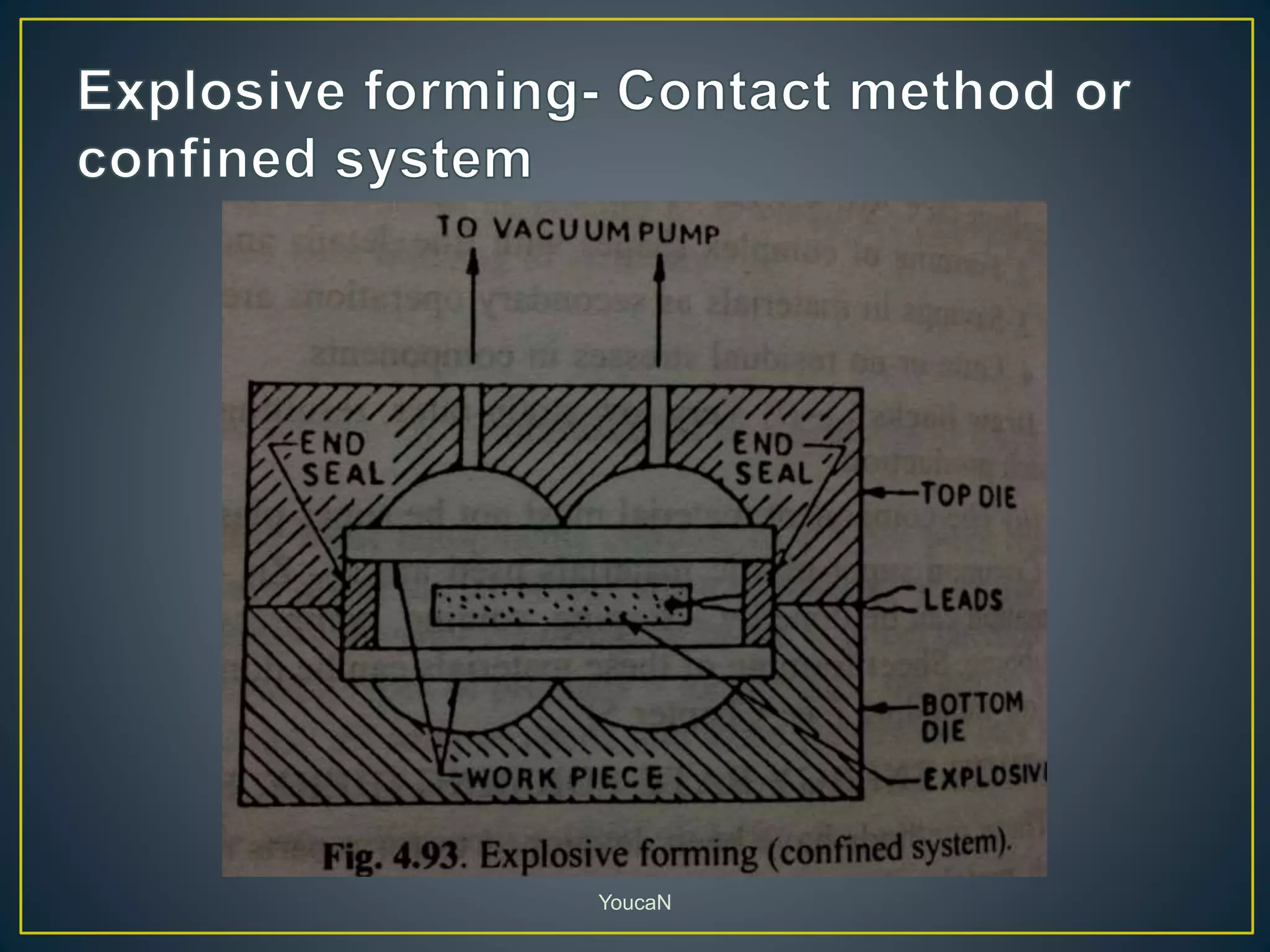
• Two or more die piece, completely encloses the workpiece.
• Between the die and the workpiece vacuum should be
produced.
• When the explosive is denonated a shock wave is
produced in the energy transmitting medium.
• This forces the workpiece into the die.
• The already created vacuum between the die and workpiece
helps to transfer the energy completely.
• That vacuum helps to form completely.
• Used to small and tubular parts for flaring and bulging
operations.
• Being a closed system there is a greater hazard of die
failure due to high pressure generated.YoucaN
YoucaN
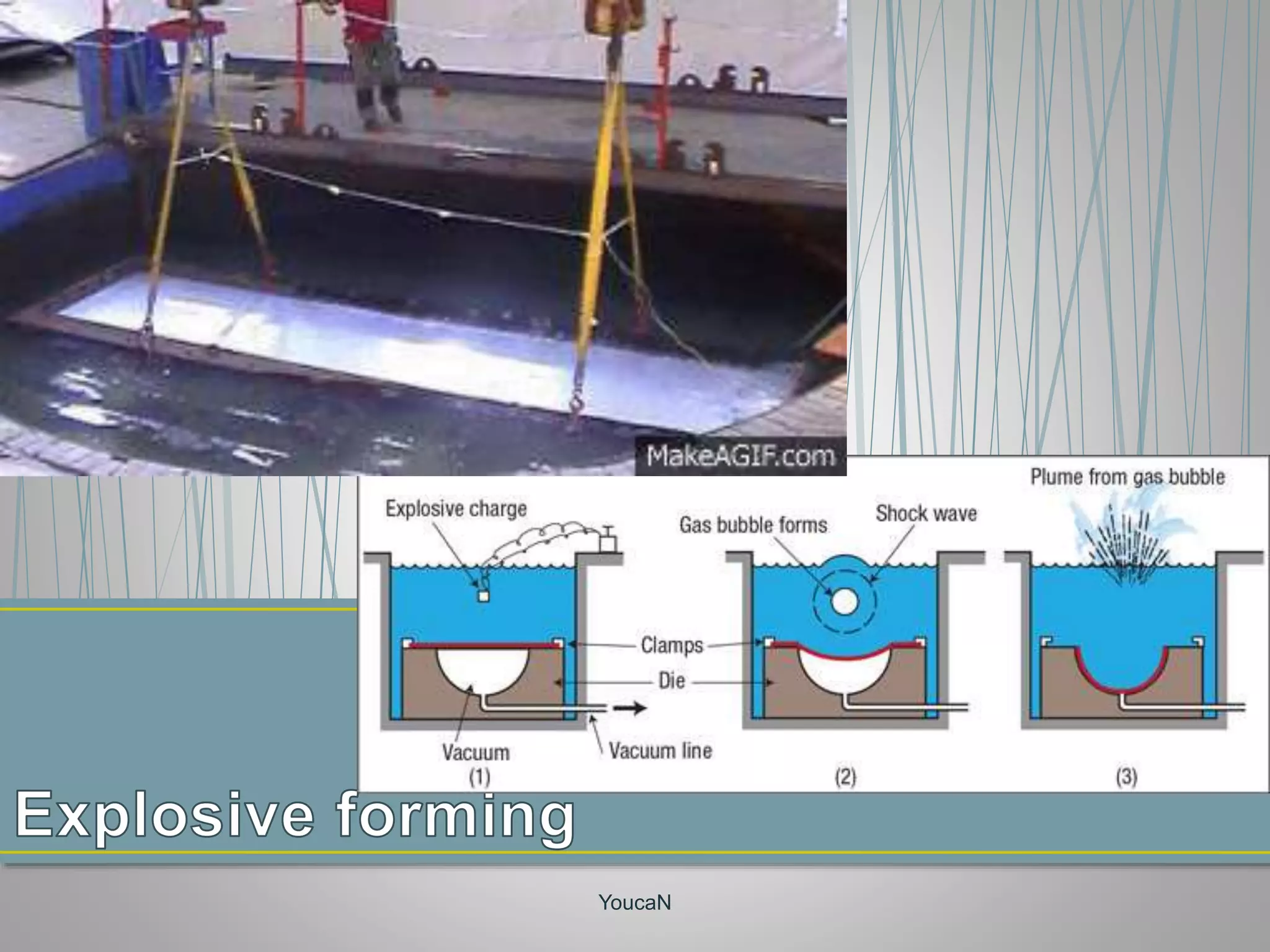
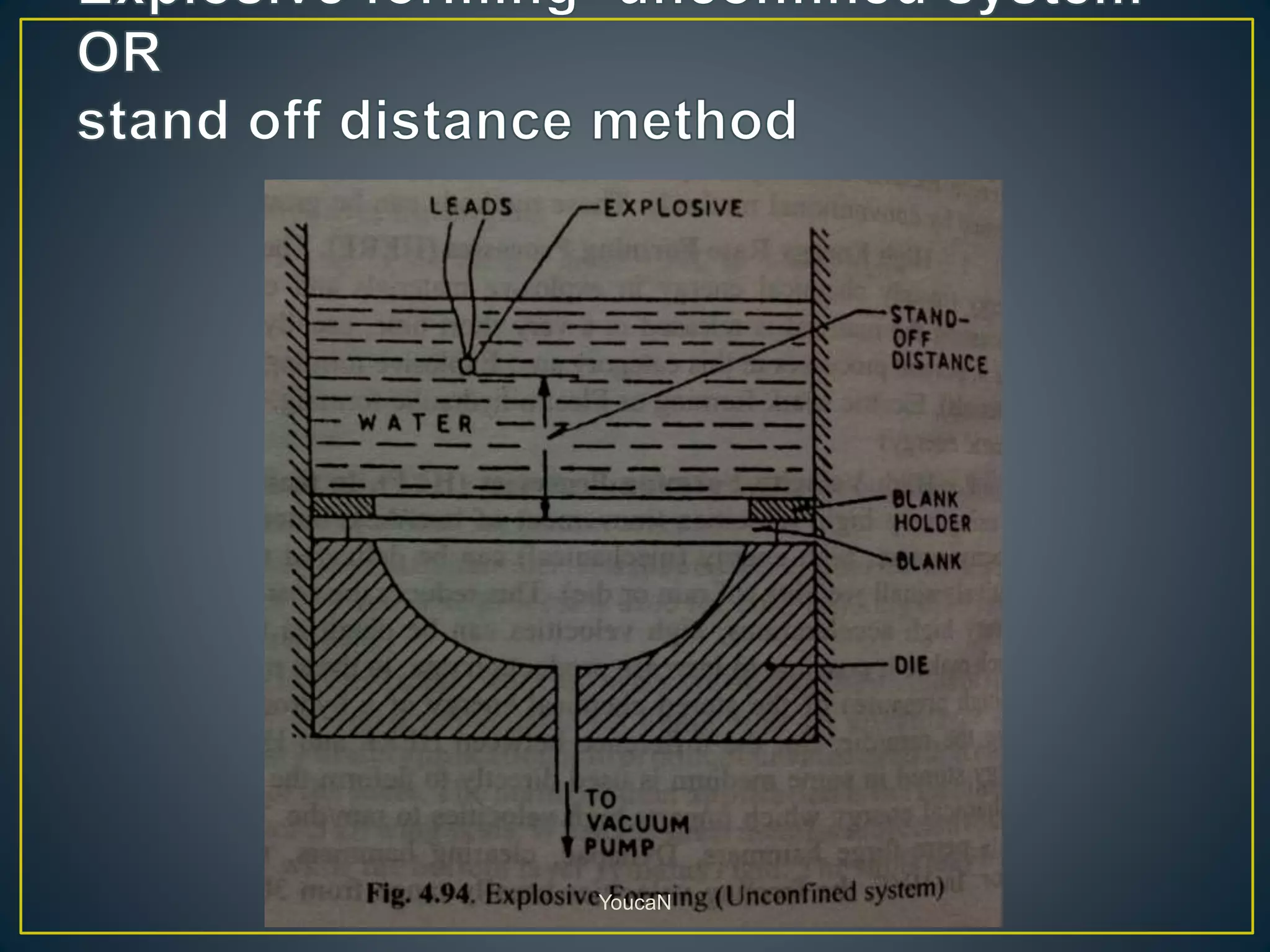
• Used to form very thin sheet to large ship plates about
25mm thick.
• Workpiece is clamped In die assembly. And the entire die
assembly is lowered in to a swimming pool. Vacuum should
be created between the plate and die.
• An explosive is denoted above or with in the water.
• The produced shock waves in the water body forces the
workpiece into the die.
YoucaN
• Low pressure explosives
• Black powder and smokeless powder
• Pressure is only 700MPa
• High pressure explosives
• Trinitrotoluene (TNT)
• Research and development explosives (RDX)
• Dynamite
• Pressure is 14000MPa.
• Deformation velocity is 9
• 230m/s
YoucaN
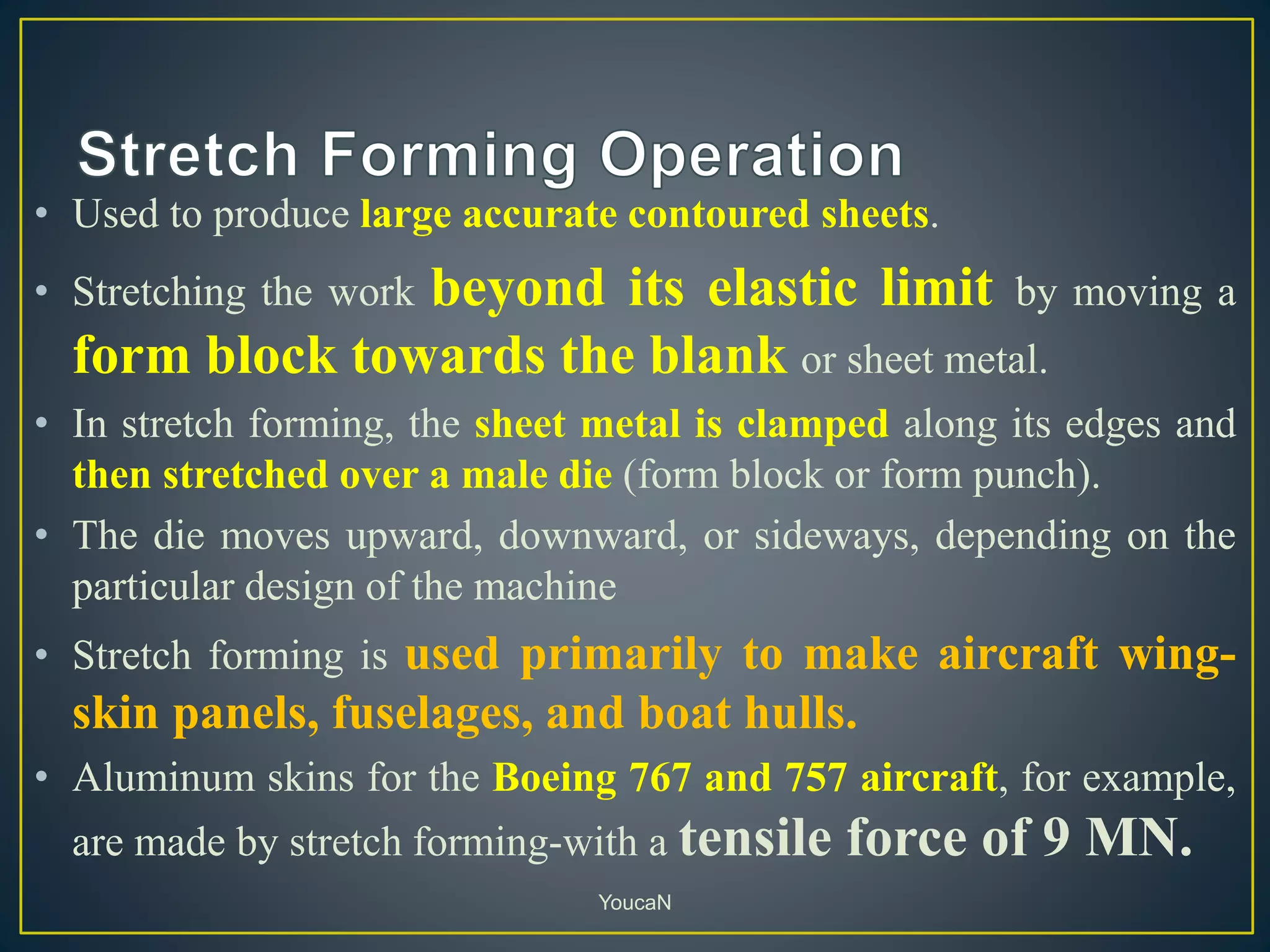
• Applications
• Radar dishes
• Rocket motor cases
• Parts which are not manufactured in conventional
methods can be prepared.
YoucaN
YoucaN

Sheet metal basics- stretch forming- explosive forming

  • 1.
    YoucaN Sheet metal basics-Stretch forming- Explosive forming
  • 2.
    • UNIT IVSHEET METAL PROCESSES Sheet metal characteristics – shearing, bending and drawing operations – Stretch forming operations– Formability of sheet metal – Test methods –special forming processes-Working principle and applications – Hydro forming – Rubber pad forming – Metal spinning– Introduction of Explosive forming, magnetic pulse forming,YoucaN
  • 3.
  • 4.
  • 5.
  • 6.
    • Sheet metalparts offers the advantages of light weight and versatile shape as compared to those made by casting/ forging. • Low carbon steel is the most commonly used sheet metal. • Aluminum and titanium are most common sheet materials for aircraft and aerospace applications. YoucaN
  • 7.
  • 8.
    • The processof cutting a straight line across a strip, sheet or bar is known a shearing process. • Stage 1- plastic deformation • Stage 2- shear • Stage 3- fracture YoucaN
  • 9.
    • Cutting operations •Blanking(punched out piece is workpiece) • Punching(used to produce a hole in workpiece) • Shearing(cuts along a single line) • Parting(shearing the sheet into two or more pieces) • Notching (metal pieces are cut from the edge of a sheet) • Lancing- cutting the sheet metal through a small length and bending this small cut portion downwards. YoucaN
  • 10.
  • 11.
    • Bending (Formingthe metal between a suitably shaped punch and forming block. ) • Drawing (consist of a punch forcing a sheet metal blank to flow plastically into the clearance available between the punch and die surfaces so as to acquire top shape, a cylindrical shape or a box shape ) • Sequeezing (metal is caused to flow to all portions of a die cavity under the action of compressive force). • Embossing (producing required shapes on sheet metal blanks means of punches and dies- name plate details) YoucaN
  • 12.
    • For shearingthe blank holder pressure is important. • If the blank holder pressure(depends upon part it vary) is low in drawing operation. YoucaN
  • 13.
  • 14.
  • 15.
  • 16.
  • 17.
  • 18.
  • 19.
  • 20.
  • 21.
  • 22.
    It denotes theproperty of sheet metal to partially fall back from its bent position when the punch retards after completing the operation YoucaN
  • 23.
    • Angle bending(sheet is bent at an angle to each edge.) • Roll bending (sheet is bent in the form of rolled edges) • Roll forming (desired shapes or any impression in the form of bend is made on the sheet metal) • Seaming (process of providing lock between two edges of different work sheet) YoucaN
  • 24.
  • 25.
  • 26.
    • Used toproduce large accurate contoured sheets. • Stretching the work beyond its elastic limit by moving a form block towards the blank or sheet metal. • In stretch forming, the sheet metal is clamped along its edges and then stretched over a male die (form block or form punch). • The die moves upward, downward, or sideways, depending on the particular design of the machine • Stretch forming is used primarily to make aircraft wing- skin panels, fuselages, and boat hulls. • Aluminum skins for the Boeing 767 and 757 aircraft, for example, are made by stretch forming-with a tensile force of 9 MN. YoucaN
  • 27.
  • 28.
    • The rectangularsheets are 12 m >< 2.5 m >< 6.4 mm. Although this process generally is used for low volume production, it is versatile and economical, particularly for the aerospace industry. • In most operations, the blank is a rectangular sheet clamped along its narrower edges and stretched lengthwise, thus allowing the material to shrink in width. • Controlling the amount of stretching is important in order to prevent tearing. • Stretch forming cannot produce parts with sharp contours or with reentrant corners (depressions on the surface of the die). • Various accessory equipment can be used in conjunction with stretch forming, including further forming with both male and female dies while the part is under tension. • Dies for stretch forming generally are made of zinc alloys, steel, plastics, or wood. Most applications require little or no lubrication.YoucaN
  • 29.
  • 30.
  • 31.
  • 32.
  • 33.
    • Mating diemethod YoucaN
  • 34.
    • Blank canbe stretched in a single operation • Spring back is reduced or eliminated when compared to other forming methods • Plastic deformation is due to pure tension only • Larger parts can be formed YoucaN Materials used Aluminium Alloy Nickel and Cobalt base alloys – Stainless Steel
  • 35.
    • Blank thicknessshould be uniform throughout the length. • Sudden changes in contour surfaces cannot be stretched. • Maintenance cost of hydraulic cylinders is high • The process requires high quality form blocks YoucaN
  • 36.
    •limitations • Uneven thicknessof blank cannot be stretched • Stretching of blank to the required shape of contour is limited • Applications • Production of aircraft wing parts • Production of contoured panels for truck trailer and bus bodies in automobile industry. YoucaN
  • 37.
  • 38.
    YoucaN Some of theapplications of sheet meta
  • 39.
    YoucaN Some of theapplications of sheet me
  • 40.
  • 41.
    YoucaN Chemical energy inexplosives- shock waves- Energy transmitting medium(air or water) - work holding die – vaccum – plastic work-milli seconds Explosives: Trinitrotoluene (TNT) Research and development explosives (RDX) Dynamite
  • 42.
    • In explosiveforming the chemical energy stored in explosives is used to process the materials. • The shock waves developed depends on the compressibility of the energy transmitting medium.(water or air) • Water is being less compressible than air is a better medium. • Terms: distance between workpiece and explosive, amount of explosive, energy transmitting medium • Two systems • 1- confined system OR Contact system • 2- unconfined system OR stand off distance methodYoucaN
  • 43.
  • 44.
    • Two ormore die piece, completely encloses the workpiece. • Between the die and the workpiece vacuum should be produced. • When the explosive is denonated a shock wave is produced in the energy transmitting medium. • This forces the workpiece into the die. • The already created vacuum between the die and workpiece helps to transfer the energy completely. • That vacuum helps to form completely. • Used to small and tubular parts for flaring and bulging operations. • Being a closed system there is a greater hazard of die failure due to high pressure generated.YoucaN
  • 45.
  • 46.
    • Used toform very thin sheet to large ship plates about 25mm thick. • Workpiece is clamped In die assembly. And the entire die assembly is lowered in to a swimming pool. Vacuum should be created between the plate and die. • An explosive is denoted above or with in the water. • The produced shock waves in the water body forces the workpiece into the die. YoucaN
  • 47.
    • Low pressureexplosives • Black powder and smokeless powder • Pressure is only 700MPa • High pressure explosives • Trinitrotoluene (TNT) • Research and development explosives (RDX) • Dynamite • Pressure is 14000MPa. • Deformation velocity is 9 • 230m/s YoucaN
  • 48.
    • Applications • Radardishes • Rocket motor cases • Parts which are not manufactured in conventional methods can be prepared. YoucaN
  • 49.