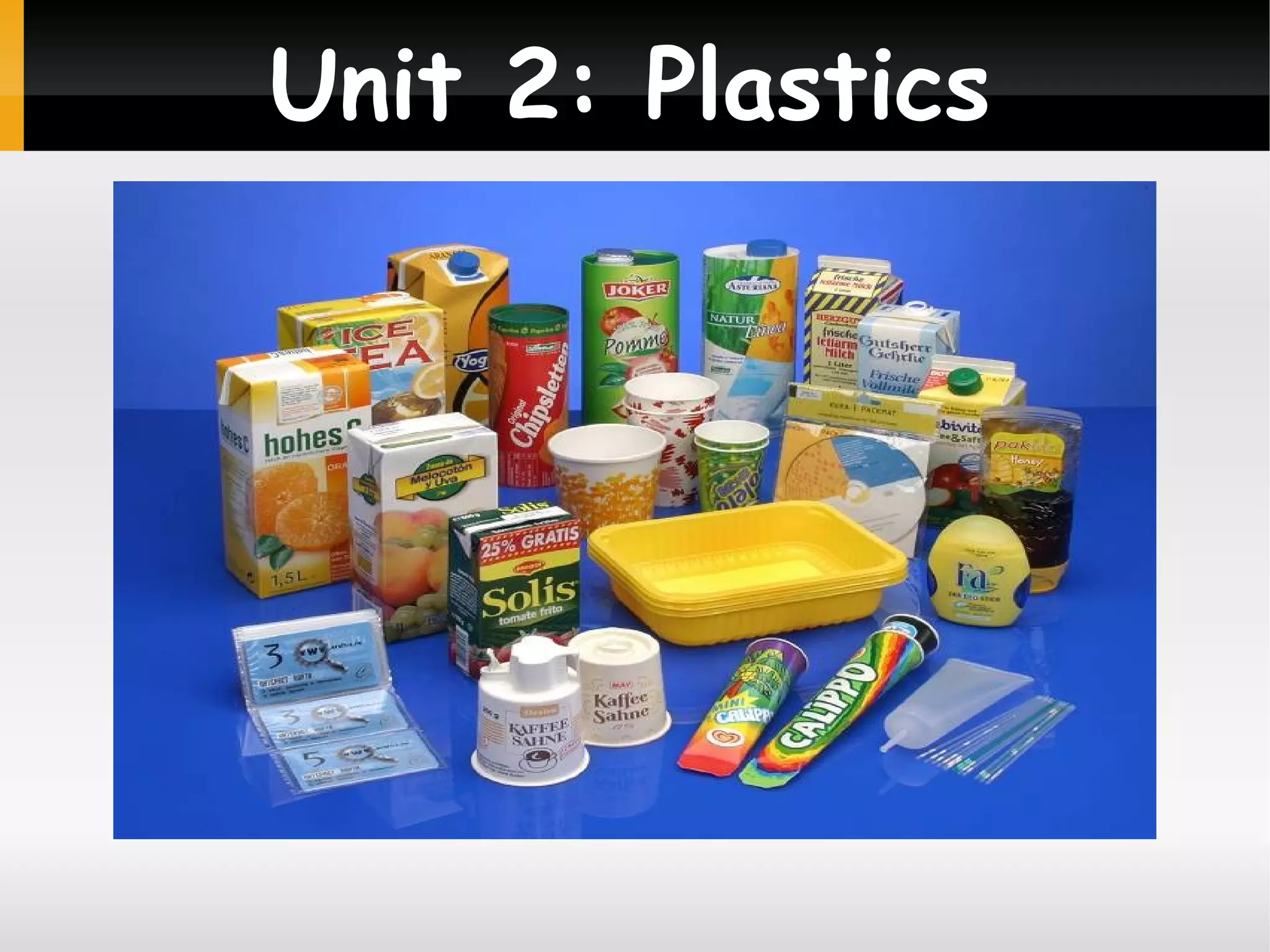
Unit 2: Plastics
Index
1. What Are Plastics?

8. Elastomers.

2. What Are Plastics Made Of?

9. Textile Fibers.

3. Obtaining Plastics.

10. Fabrication of Plastics:
Techniques.

4. Properties Of Plastics.

11. Polymerization &
Recycling.

5. Types of Plastics.
6. Thermoplastics.
7. Thermosettings.



12.Work With Plastics In
The Workshop.
What Are Plastics?






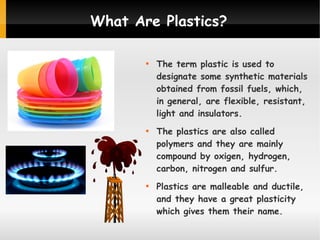
The term plastic is used to
designate some synthetic materials
obtained from fossil fuels, which,
in general, are flexible, resistant,
light and insulators.
The plastics are also called
polymers and they are mainly
compound by oxigen, hydrogen,
carbon, nitrogen and sulfur.
Plastics are malleable and ductile,
and they have a great plasticity
which gives them their name.
What Are Plastics Made Of?




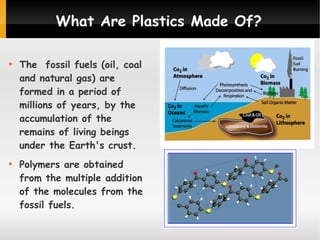
The fossil fuels (oil, coal
and natural gas) are
formed in a period of
millions of years, by the
accumulation of the
remains of living beings
under the Earth's crust.
Polymers are obtained
from the multiple addition
of the molecules from the
fossil fuels.
Obtaining Plastics

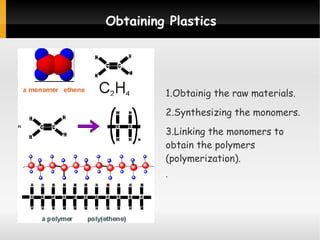
1.Obtainig the raw materials.
2.Synthesizing the monomers.
3.Linking the monomers to
obtain the polymers
(polymerization).
·
Obtaining Plastics: Polymerization
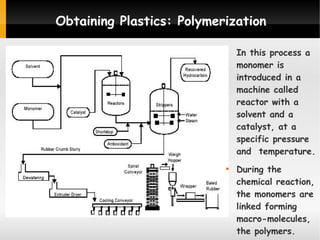
In this process a
monomer is
introduced in a
machine called
reactor with a
solvent and a
catalyst, at a
specific pressure
and temperature.


During the
chemical reaction,
the monomers are
linked forming
macro-molecules,
the polymers.
Obtaining Plastics
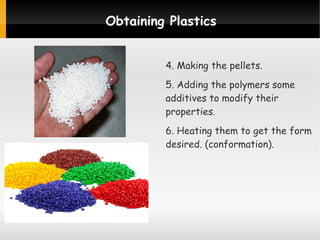
4. Making the pellets.
5. Adding the polymers some
additives to modify their
properties.
6. Heating them to get the form
desired. (conformation).
Properties Of Plastics (I)
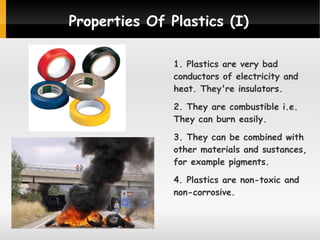
1. Plastics are very bad
conductors of electricity and
heat. They're insulators.
2. They are combustible i.e.
They can burn easily.
3. They can be combined with
other materials and sustances,
for example pigments.
4. Plastics are non-toxic and
non-corrosive.
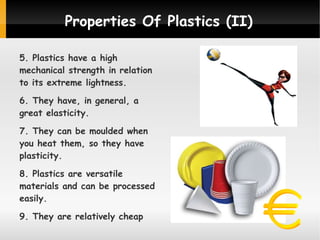
Properties Of Plastics (II)
5. Plastics have a high
mechanical strength in relation
to its extreme lightness.
6. They have, in general, a
great elasticity.
7. They can be moulded when
you heat them, so they have
plasticity.
8. Plastics are versatile
materials and can be processed
easily.
9. They are relatively cheap
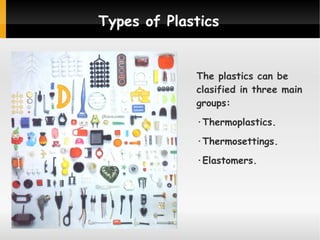
Types of Plastics

The plastics can be
clasified in three main
groups:
·Thermoplastics.
·Thermosettings.
·Elastomers.
Thermoplastics

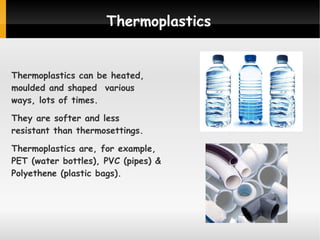
Thermoplastics can be heated,
moulded and shaped  various
ways, lots of times.
They are softer and less
resistant than thermosettings.
Thermoplastics are, for example,
PET (water bottles), PVC (pipes) &
Polyethene (plastic bags).
Thermosettings






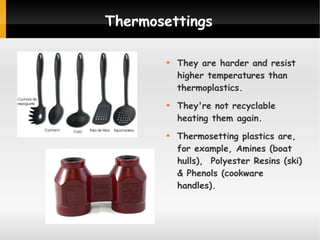
They are harder and resist
higher temperatures than
thermoplastics.
They're not recyclable
heating them again.
Thermosetting plastics are,
for example, Amines (boat
hulls), Polyester Resins (ski)
& Phenols (cookware
handles).
Elastomers








Elastomers are
characterized by their
elasticity.
They can't be recycled.
They don't resist high
temperatures.
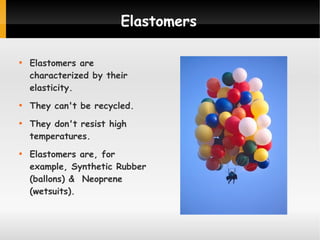
Elastomers are, for
example, Synthetic Rubber
(ballons) & Neoprene
(wetsuits).
Textile Fibers




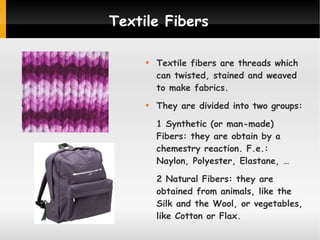
Textile fibers are threads which
can twisted, stained and weaved
to make fabrics.
They are divided into two groups:
1 Synthetic (or man-made)
Fibers: they are obtain by a
chemestry reaction. F.e.:
Naylon, Polyester, Elastane, …
2 Natural Fibers: they are
obtained from animals, like the
Silk and the Wool, or vegetables,
like Cotton or Flax.
Fabrication of Plastics: Techniques
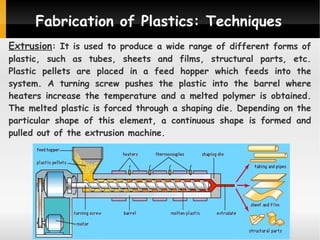
Extrusion: It is used to produce a wide range of different forms of

plastic, such as tubes, sheets and films, structural parts, etc.
Plastic pellets are placed in a feed hopper which feeds into the
system. A turning screw pushes the plastic into the barrel where
heaters increase the temperature and a melted polymer is obtained.
The melted plastic is forced through a shaping die. Depending on the
particular shape of this element, a continuous shape is formed and
pulled out of the extrusion machine.
Fabrication of Plastics: Techniques
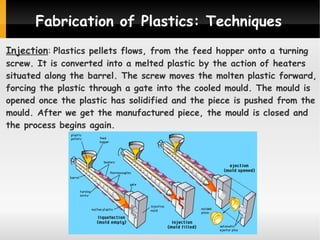
Injection: Plastics pellets flows, from the feed hopper onto a turning

screw. It is converted into a melted plastic by the action of heaters
situated along the barrel. The screw moves the molten plastic forward,
forcing the plastic through a gate into the cooled mould. The mould is
opened once the plastic has solidified and the piece is pushed from the
mould. After we get the manufactured piece, the mould is closed and
the process begins again.
Fabrication of Plastics: Techniques
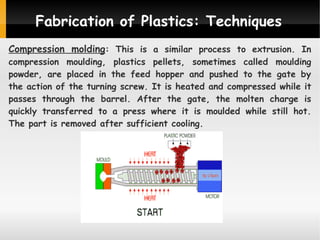
Compression molding: This is a similar process to extrusion. In

compression moulding, plastics pellets, sometimes called moulding
powder, are placed in the feed hopper and pushed to the gate by
the action of the turning screw. It is heated and compressed while it
passes through the barrel. After the gate, the molten charge is
quickly transferred to a press where it is moulded while still hot.
The part is removed after sufficient cooling.
Fabrication of Plastics: Techniques
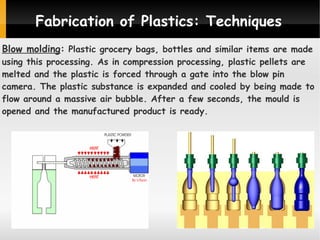
Blow molding: Plastic grocery bags, bottles and similar items are made
using this processing. As in compression processing, plastic pellets are
melted and the plastic is forced through a gate into the blow pin
camera. The plastic substance is expanded and cooled by being made to
flow around a massive air bubble. After a few seconds, the mould is
opened and the manufactured product is ready.
Fabrication of Plastics: Techniques
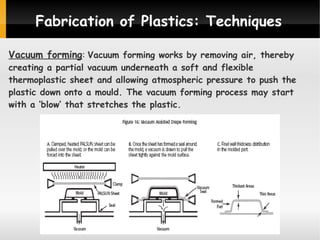
Vacuum forming: Vacuum forming works by removing air, thereby

creating a partial vacuum underneath a soft and flexible
thermoplastic sheet and allowing atmospheric pressure to push the
plastic down onto a mould. The vacuum forming process may start
with a ‘blow’ that stretches the plastic.
Fabrication of Plastics: Techniques


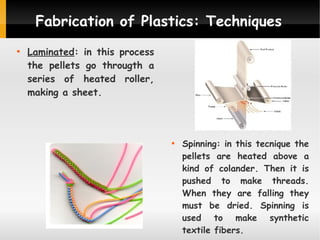
Laminated: in this process
the pellets go througth a
series of heated roller,
making a sheet.



Spinning: in this tecnique the
pellets are heated above a
kind of colander. Then it is
pushed to make threads.
When they are falling they
must be dried. Spinning is
used to make synthetic
textile fibers.
Work With Plastics In The Workshop
You must follow these eight steps:
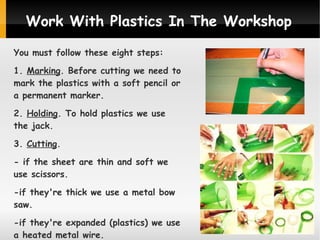
1. Marking. Before cutting we need to
mark the plastics with a soft pencil or
a permanent marker.
2. Holding. To hold plastics we use
the jack.
3. Cutting.
- if the sheet are thin and soft we
use scissors.
-if they're thick we use a metal bow
saw.
-if they're expanded (plastics) we use
a heated metal wire.
Work With Plastics In The Workshop 2
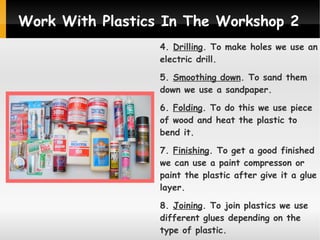
4. Drilling. To make holes we use an
electric drill.
5. Smoothing down. To sand them
down we use a sandpaper.
6. Folding. To do this we use piece
of wood and heat the plastic to
bend it.
7. Finishing. To get a good finished
we can use a paint compresson or
paint the plastic after give it a glue
layer.
8. Joining. To join plastics we use
different glues depending on the
type of plastic.
Recycling plastics





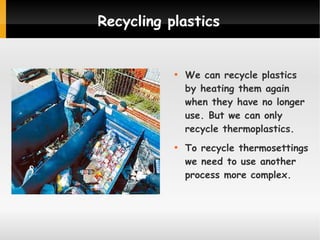
We can recycle plastics
by heating them again
when they have no longer
use. But we can only
recycle thermoplastics.
To recycle thermosettings
we need to use another
process more complex.
The End

Unit 2 Plastics

  • 1.
  • 2.
    Index 1. What ArePlastics? 8. Elastomers. 2. What Are Plastics Made Of? 9. Textile Fibers. 3. Obtaining Plastics. 10. Fabrication of Plastics: Techniques. 4. Properties Of Plastics. 11. Polymerization & Recycling. 5. Types of Plastics. 6. Thermoplastics. 7. Thermosettings.  12.Work With Plastics In The Workshop.
  • 3.
    What Are Plastics?    Theterm plastic is used to designate some synthetic materials obtained from fossil fuels, which, in general, are flexible, resistant, light and insulators. The plastics are also called polymers and they are mainly compound by oxigen, hydrogen, carbon, nitrogen and sulfur. Plastics are malleable and ductile, and they have a great plasticity which gives them their name.
  • 4.
    What Are PlasticsMade Of?   The fossil fuels (oil, coal and natural gas) are formed in a period of millions of years, by the accumulation of the remains of living beings under the Earth's crust. Polymers are obtained from the multiple addition of the molecules from the fossil fuels.
  • 5.
    Obtaining Plastics 1.Obtainig theraw materials. 2.Synthesizing the monomers. 3.Linking the monomers to obtain the polymers (polymerization). ·
  • 6.
    Obtaining Plastics: Polymerization Inthis process a monomer is introduced in a machine called reactor with a solvent and a catalyst, at a specific pressure and temperature.  During the chemical reaction, the monomers are linked forming macro-molecules, the polymers.
  • 7.
    Obtaining Plastics 4. Makingthe pellets. 5. Adding the polymers some additives to modify their properties. 6. Heating them to get the form desired. (conformation).
  • 8.
    Properties Of Plastics(I) 1. Plastics are very bad conductors of electricity and heat. They're insulators. 2. They are combustible i.e. They can burn easily. 3. They can be combined with other materials and sustances, for example pigments. 4. Plastics are non-toxic and non-corrosive.
  • 9.
    Properties Of Plastics(II) 5. Plastics have a high mechanical strength in relation to its extreme lightness. 6. They have, in general, a great elasticity. 7. They can be moulded when you heat them, so they have plasticity. 8. Plastics are versatile materials and can be processed easily. 9. They are relatively cheap
  • 10.
    Types of Plastics Theplastics can be clasified in three main groups: ·Thermoplastics. ·Thermosettings. ·Elastomers.
  • 11.
    Thermoplastics Thermoplastics can beheated, moulded and shaped  various ways, lots of times. They are softer and less resistant than thermosettings. Thermoplastics are, for example, PET (water bottles), PVC (pipes) & Polyethene (plastic bags).
  • 12.
    Thermosettings    They are harderand resist higher temperatures than thermoplastics. They're not recyclable heating them again. Thermosetting plastics are, for example, Amines (boat hulls), Polyester Resins (ski) & Phenols (cookware handles).
  • 13.
    Elastomers     Elastomers are characterized bytheir elasticity. They can't be recycled. They don't resist high temperatures. Elastomers are, for example, Synthetic Rubber (ballons) & Neoprene (wetsuits).
  • 14.
    Textile Fibers   Textile fibersare threads which can twisted, stained and weaved to make fabrics. They are divided into two groups: 1 Synthetic (or man-made) Fibers: they are obtain by a chemestry reaction. F.e.: Naylon, Polyester, Elastane, … 2 Natural Fibers: they are obtained from animals, like the Silk and the Wool, or vegetables, like Cotton or Flax.
  • 15.
    Fabrication of Plastics:Techniques Extrusion: It is used to produce a wide range of different forms of plastic, such as tubes, sheets and films, structural parts, etc. Plastic pellets are placed in a feed hopper which feeds into the system. A turning screw pushes the plastic into the barrel where heaters increase the temperature and a melted polymer is obtained. The melted plastic is forced through a shaping die. Depending on the particular shape of this element, a continuous shape is formed and pulled out of the extrusion machine.
  • 16.
    Fabrication of Plastics:Techniques Injection: Plastics pellets flows, from the feed hopper onto a turning screw. It is converted into a melted plastic by the action of heaters situated along the barrel. The screw moves the molten plastic forward, forcing the plastic through a gate into the cooled mould. The mould is opened once the plastic has solidified and the piece is pushed from the mould. After we get the manufactured piece, the mould is closed and the process begins again.
  • 17.
    Fabrication of Plastics:Techniques Compression molding: This is a similar process to extrusion. In compression moulding, plastics pellets, sometimes called moulding powder, are placed in the feed hopper and pushed to the gate by the action of the turning screw. It is heated and compressed while it passes through the barrel. After the gate, the molten charge is quickly transferred to a press where it is moulded while still hot. The part is removed after sufficient cooling.
  • 18.
    Fabrication of Plastics:Techniques Blow molding: Plastic grocery bags, bottles and similar items are made using this processing. As in compression processing, plastic pellets are melted and the plastic is forced through a gate into the blow pin camera. The plastic substance is expanded and cooled by being made to flow around a massive air bubble. After a few seconds, the mould is opened and the manufactured product is ready.
  • 19.
    Fabrication of Plastics:Techniques Vacuum forming: Vacuum forming works by removing air, thereby creating a partial vacuum underneath a soft and flexible thermoplastic sheet and allowing atmospheric pressure to push the plastic down onto a mould. The vacuum forming process may start with a ‘blow’ that stretches the plastic.
  • 20.
    Fabrication of Plastics:Techniques  Laminated: in this process the pellets go througth a series of heated roller, making a sheet.  Spinning: in this tecnique the pellets are heated above a kind of colander. Then it is pushed to make threads. When they are falling they must be dried. Spinning is used to make synthetic textile fibers.
  • 21.
    Work With PlasticsIn The Workshop You must follow these eight steps: 1. Marking. Before cutting we need to mark the plastics with a soft pencil or a permanent marker. 2. Holding. To hold plastics we use the jack. 3. Cutting. - if the sheet are thin and soft we use scissors. -if they're thick we use a metal bow saw. -if they're expanded (plastics) we use a heated metal wire.
  • 22.
    Work With PlasticsIn The Workshop 2 4. Drilling. To make holes we use an electric drill. 5. Smoothing down. To sand them down we use a sandpaper. 6. Folding. To do this we use piece of wood and heat the plastic to bend it. 7. Finishing. To get a good finished we can use a paint compresson or paint the plastic after give it a glue layer. 8. Joining. To join plastics we use different glues depending on the type of plastic.
  • 23.
    Recycling plastics   We canrecycle plastics by heating them again when they have no longer use. But we can only recycle thermoplastics. To recycle thermosettings we need to use another process more complex.
  • 24.