MANUFACTURING OF PLASTIC COMPONENTS
Types of plastics - Characteristics of the forming and shaping processes –
Moulding of Thermoplastics – Working principles and typical applications
of - Injection moulding – Plunger and screw machines – Compression
moulding, Transfer moulding – Typical industrial applications –
Introduction to Blow moulding – Rotational moulding – Film blowing –
Extrusion - Thermoforming, - Bonding of Thermoplastics.
ORGANIC MATERIALS
 Natural – Wood, Coal, Petroleum &
Natural Rubber
 Synthetic – Plastics, Synthetic rubber,
Ceramics & Glass
 Organic material - Polymers
Polymers
 Poly means ‘Many’ & ‘Mers’ means ‘Parts’
 Polymer built of several repeating
units(Monomer)
 Monomer – small molecules
 Polymer is made up of thousands of
monomers jointed together to form large
molecule.
 Plastics – Organic polymer
 The Main raw material for making plastic is
resin.
 Resin – acrylic resin, polyethylene resin
Polymerization process
 A Polymer is made up of linking thousands
of monomer and thus obtaining large
molecule is called Polymerization process
 Additives – Plasticizers (liquid form) –
Water, Organic solvents & resins
 Catalyst – Promote faster & complete
Polymerization
 Dyes – Impart desired colour
 Initiators – Initiate the reaction (H2O2)
Hydrogen peroxide
 Addition polymerization:
 Similar monomers of large numbers are added
chemically one by one
 These monomers form a long chain molecule.
 Polyethylene is produced by addition polymerization,
 Condensation polymerization :
 Two or more unlike monomers are linked and there is a
repetitive elimination of smaller molecules to form a by-
product. During this process, by-product such as water or
ammonic is formed.
Plastics
 Can be moulded into required shape
with the help of pressure or heat or
both heat and pressure
 Resin – liquid form of plastics, also raw
material for making plastics
 Types of resin: acrylic resin,
Polyethylene resin & amino resin –
Produced by polymerization process
 Catalysts, Binders & Lubricants added
with resin to form plastics
 Modifiers – To improve the mechanical
properties of plastics
 Lubricants – To reduce friction during processing ,
Avoid sticking to mould walls(Oils, Soaps and
waxes)
 Solvents – Dissolve fillers or Plasticizers & Allow
the processing in fluid state(Alcohol)
 Fillers – Mica, Cloth fiber
 Elastomers – To enhance the elastic properties
Properties of Plastics
 Elongation
 Heat resistance
 High rigidity
 Surface hardness
 High viscosity
 Density
 Chemical resistance
Thermosetting Plastics
 Thermosetting - Plastics which are hardened by
heat effecting non reversible chemical change .
 Plastics do not soften on reheating and cannot be
reworked.
 Molecules are formed by condensation
polymerization process.
 All the molecules have three dimensional
network and very strong binding force between
molecules
 Bakelite, Polyester resin, Epoxy resin(Araldite),
Silicones, Urea formaldehyde(Amino resin) &
Alkyds
 Phenol formal dehyde: Reaction of phenol with
formaldehyde.
 Produced dark colour and it has high strength, stability
and rigidity.
 Uses: plugs, knobs, pulleys, bottle caps, tooling and
forming die.
 Polyster resin: Low moisture, good electrical resistance
and variety of colours.
 It is used in paper mat, TV parts and car bodies.
 Main drawback is polyster is high cost.
 Epoxy resin: most popular variety of epoxy resins is
Araldite. Good chemical and electrical resistance.
 Mostly available in the form of liquid.
 Good resistance to wear and impact.
Thermo Plastics
 Have separate long and large size molecule arranged
side by side
 When thermoplastics are heated it becomes very soft
and rehardens on cooling
 During heating the linear bonding links between
molecules are breakup and separated. Relinking takes
place on cooling and retains their hardness.
 Cellulose nitrate – pen bodies, Table tennis balls, Frames
 Ethyl cellulose – Jigs, Fixtures, hose nozzles
 Cellulose acetate - Radio cabinets, steering wheels,
Insulating tapes
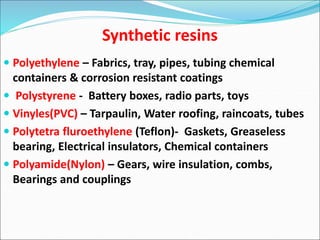
Synthetic resins
 Polyethylene – Fabrics, tray, pipes, tubing chemical
containers & corrosion resistant coatings
 Polystyrene - Battery boxes, radio parts, toys
 Vinyles(PVC) – Tarpaulin, Water roofing, raincoats, tubes
 Polytetra fluroethylene (Teflon)- Gaskets, Greaseless
bearing, Electrical insulators, Chemical containers
 Polyamide(Nylon) – Gears, wire insulation, combs,
Bearings and couplings
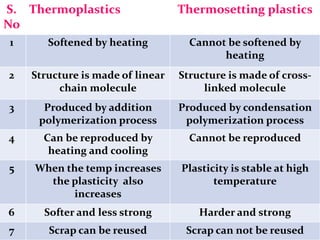
S.
No
Thermoplastics Thermosetting plastics
1 Softened by heating Cannot be softened by
heating
2 Structure is made of linear
chain molecule
Structure is made of cross-
linked molecule
3 Produced by addition
polymerization process
Produced by condensation
polymerization process
4 Can be reproduced by
heating and cooling
Cannot be reproduced
5 When the temp increases
the plasticity also
increases
Plasticity is stable at high
temperature
6 Softer and less strong Harder and strong
7 Scrap can be reused Scrap can not be reused
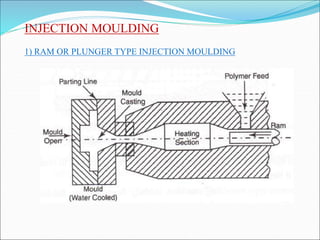
INJECTION MOULDING
1) RAM OR PLUNGER TYPE INJECTION MOULDING
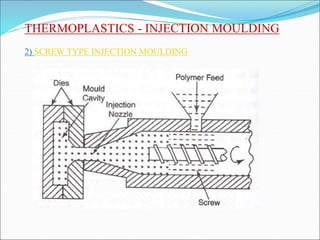
THERMOPLASTICS - INJECTION MOULDING
2) SCREW TYPE INJECTION MOULDING
THERMOPLASTICS – INDUSTRIAL APPLICATION
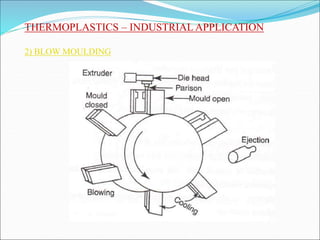
2) BLOW MOULDING
THERMOPLASTICS – INDUSTRIAL APPLICATION
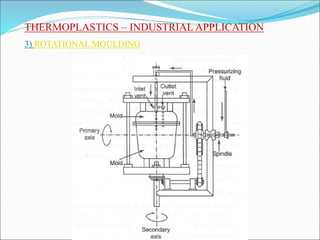
3) ROTATIONAL MOULDING
THERMOPLASTICS – INDUSTRIAL APPLICATION
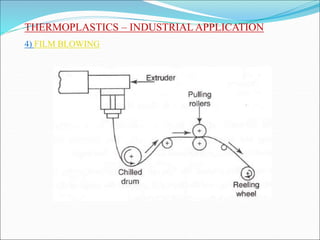
4) FILM BLOWING
THERMOPLASTICS – INDUSTRIAL APPLICATION
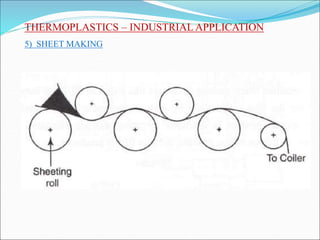
5) SHEET MAKING
THERMOPLASTICS – INDUSTRIAL APPLICATION
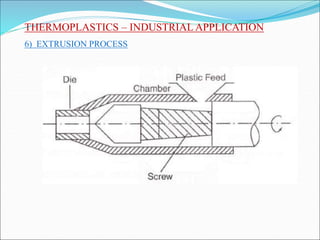
6) EXTRUSION PROCESS
THERMOPLASTICS – INDUSTRIAL APPLICATION
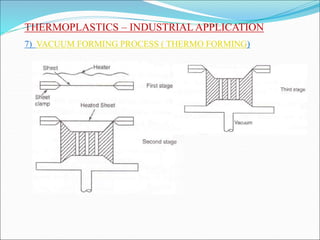
7) VACUUM FORMING PROCESS ( THERMO FORMING)
THERMOSETS
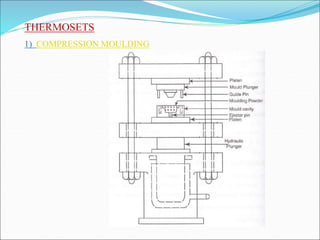
1) COMPRESSION MOULDING
THERMOSETS
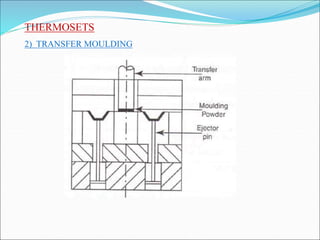
2) TRANSFER MOULDING
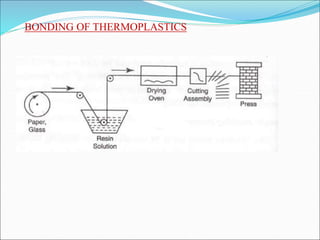
BONDING OF THERMOPLASTICS

Unit v MANUFACTURING OF PLASTIC COMPONENTS

  • 1.
    MANUFACTURING OF PLASTICCOMPONENTS Types of plastics - Characteristics of the forming and shaping processes – Moulding of Thermoplastics – Working principles and typical applications of - Injection moulding – Plunger and screw machines – Compression moulding, Transfer moulding – Typical industrial applications – Introduction to Blow moulding – Rotational moulding – Film blowing – Extrusion - Thermoforming, - Bonding of Thermoplastics.
  • 2.
    ORGANIC MATERIALS  Natural– Wood, Coal, Petroleum & Natural Rubber  Synthetic – Plastics, Synthetic rubber, Ceramics & Glass  Organic material - Polymers
  • 3.
    Polymers  Poly means‘Many’ & ‘Mers’ means ‘Parts’  Polymer built of several repeating units(Monomer)  Monomer – small molecules  Polymer is made up of thousands of monomers jointed together to form large molecule.  Plastics – Organic polymer  The Main raw material for making plastic is resin.  Resin – acrylic resin, polyethylene resin
  • 4.
    Polymerization process  APolymer is made up of linking thousands of monomer and thus obtaining large molecule is called Polymerization process  Additives – Plasticizers (liquid form) – Water, Organic solvents & resins  Catalyst – Promote faster & complete Polymerization  Dyes – Impart desired colour  Initiators – Initiate the reaction (H2O2) Hydrogen peroxide
  • 5.
     Addition polymerization: Similar monomers of large numbers are added chemically one by one  These monomers form a long chain molecule.  Polyethylene is produced by addition polymerization,  Condensation polymerization :  Two or more unlike monomers are linked and there is a repetitive elimination of smaller molecules to form a by- product. During this process, by-product such as water or ammonic is formed.
  • 6.
    Plastics  Can bemoulded into required shape with the help of pressure or heat or both heat and pressure  Resin – liquid form of plastics, also raw material for making plastics  Types of resin: acrylic resin, Polyethylene resin & amino resin – Produced by polymerization process  Catalysts, Binders & Lubricants added with resin to form plastics
  • 7.
     Modifiers –To improve the mechanical properties of plastics  Lubricants – To reduce friction during processing , Avoid sticking to mould walls(Oils, Soaps and waxes)  Solvents – Dissolve fillers or Plasticizers & Allow the processing in fluid state(Alcohol)  Fillers – Mica, Cloth fiber  Elastomers – To enhance the elastic properties
  • 8.
    Properties of Plastics Elongation  Heat resistance  High rigidity  Surface hardness  High viscosity  Density  Chemical resistance
  • 9.
    Thermosetting Plastics  Thermosetting- Plastics which are hardened by heat effecting non reversible chemical change .  Plastics do not soften on reheating and cannot be reworked.  Molecules are formed by condensation polymerization process.  All the molecules have three dimensional network and very strong binding force between molecules  Bakelite, Polyester resin, Epoxy resin(Araldite), Silicones, Urea formaldehyde(Amino resin) & Alkyds
  • 10.
     Phenol formaldehyde: Reaction of phenol with formaldehyde.  Produced dark colour and it has high strength, stability and rigidity.  Uses: plugs, knobs, pulleys, bottle caps, tooling and forming die.  Polyster resin: Low moisture, good electrical resistance and variety of colours.  It is used in paper mat, TV parts and car bodies.  Main drawback is polyster is high cost.  Epoxy resin: most popular variety of epoxy resins is Araldite. Good chemical and electrical resistance.  Mostly available in the form of liquid.  Good resistance to wear and impact.
  • 11.
    Thermo Plastics  Haveseparate long and large size molecule arranged side by side  When thermoplastics are heated it becomes very soft and rehardens on cooling  During heating the linear bonding links between molecules are breakup and separated. Relinking takes place on cooling and retains their hardness.  Cellulose nitrate – pen bodies, Table tennis balls, Frames  Ethyl cellulose – Jigs, Fixtures, hose nozzles  Cellulose acetate - Radio cabinets, steering wheels, Insulating tapes
  • 12.
    Synthetic resins  Polyethylene– Fabrics, tray, pipes, tubing chemical containers & corrosion resistant coatings  Polystyrene - Battery boxes, radio parts, toys  Vinyles(PVC) – Tarpaulin, Water roofing, raincoats, tubes  Polytetra fluroethylene (Teflon)- Gaskets, Greaseless bearing, Electrical insulators, Chemical containers  Polyamide(Nylon) – Gears, wire insulation, combs, Bearings and couplings
  • 13.
    S. No Thermoplastics Thermosetting plastics 1Softened by heating Cannot be softened by heating 2 Structure is made of linear chain molecule Structure is made of cross- linked molecule 3 Produced by addition polymerization process Produced by condensation polymerization process 4 Can be reproduced by heating and cooling Cannot be reproduced 5 When the temp increases the plasticity also increases Plasticity is stable at high temperature 6 Softer and less strong Harder and strong 7 Scrap can be reused Scrap can not be reused
  • 14.
    INJECTION MOULDING 1) RAMOR PLUNGER TYPE INJECTION MOULDING
  • 15.
    THERMOPLASTICS - INJECTIONMOULDING 2) SCREW TYPE INJECTION MOULDING
  • 16.
    THERMOPLASTICS – INDUSTRIALAPPLICATION 2) BLOW MOULDING
  • 17.
    THERMOPLASTICS – INDUSTRIALAPPLICATION 3) ROTATIONAL MOULDING
  • 18.
    THERMOPLASTICS – INDUSTRIALAPPLICATION 4) FILM BLOWING
  • 19.
    THERMOPLASTICS – INDUSTRIALAPPLICATION 5) SHEET MAKING
  • 20.
    THERMOPLASTICS – INDUSTRIALAPPLICATION 6) EXTRUSION PROCESS
  • 21.
    THERMOPLASTICS – INDUSTRIALAPPLICATION 7) VACUUM FORMING PROCESS ( THERMO FORMING)
  • 22.
  • 23.
  • 24.