PROJECT 2: 
PLASTICS 
Martín Mora 
Sarai de la Rosa 
Adrián Utrera 
Paula Monzón
Student 1 
1st Sourcing of raw materials 
 Raw materials can come from: minerals, plants, or animals. 
 They are extracted from nature. 
 Then they are modified so they obtain plastic properties. 
Examples: 
-Plant origin 
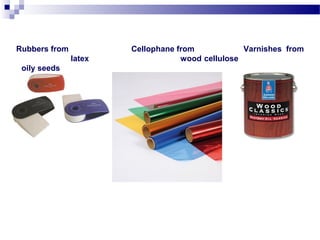
 Rubbers and gums are made from latex, a liquid extracted from tropical 
trees. 
 Rayon and cellophane are made from cotton and wood cellulose. 
 Varnishes are made from the oil of oily seeds.
Rubbers from Cellophane from Varnishes from 
latex wood cellulose 
oily seeds
-Animal origin 
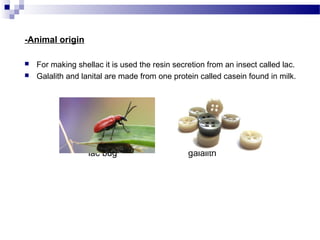
 For making shellac it is used the resin secretion from an insect called lac. 
 Galalith and lanital are made from one protein called casein found in milk. 
lac bug galalith
-Mineral origin 
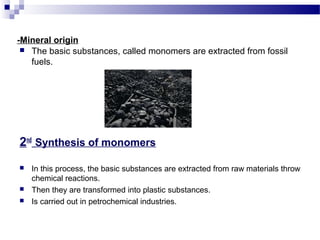
 The basic substances, called monomers are extracted from fossil 
fuels. 
2nd Synthesis of monomers 
 In this process, the basic substances are extracted from raw materials throw 
chemical reactions. 
 Then they are transformed into plastic substances. 
 Is carried out in petrochemical industries.
Shaping and finishing 
This process is when the plastic substance are manufactured and 
transformed into products. 
Thermocompression 
 For making thermosetting plastic products. 
 The process: 
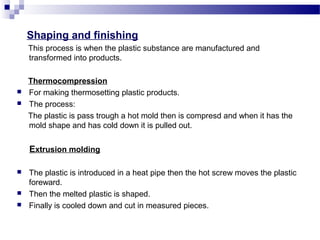
The plastic is pass trough a hot mold then is compresd and when it has the 
mold shape and has cold down it is pulled out. 
Extrusion molding 
 The plastic is introduced in a heat pipe then the hot screw moves the plastic 
foreward. 
 Then the melted plastic is shaped. 
 Finally is cooled down and cut in measured pieces.
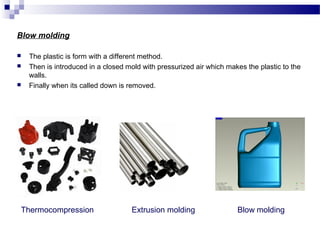
Blow molding 
 The plastic is form with a different method. 
 Then is introduced in a closed mold with pressurized air which makes the plastic to the 
walls. 
 Finally when its called down is removed. 
Thermocompression Extrusion molding Blow molding
Student 2 
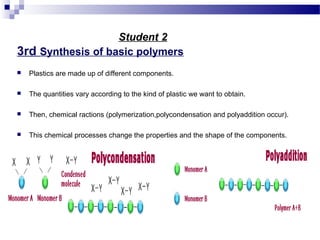
3rd Synthesis of basic polymers 
 Plastics are made up of different components. 
 The quantities vary according to the kind of plastic we want to obtain. 
 Then, chemical ractions (polymerization,polycondensation and polyaddition occur). 
 This chemical processes change the properties and the shape of the components.
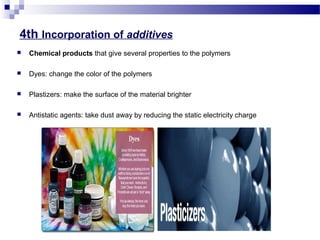
4th Incorporation of additives 
 Chemical products that give several properties to the polymers 
 Dyes: change the color of the polymers 
 Plastizers: make the surface of the material brighter 
 Antistatic agents: take dust away by reducing the static electricity charge
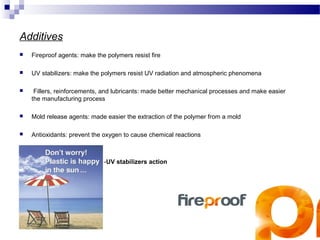
Additives 
 Fireproof agents: make the polymers resist fire 
 UV stabilizers: make the polymers resist UV radiation and atmospheric phenomena 
 Fillers, reinforcements, and lubricants: made better mechanical processes and make easier 
the manufacturing process 
 Mold release agents: made easier the extraction of the polymer from a mold 
 Antioxidants: prevent the oxygen to cause chemical reactions 
-UV stabilizers action
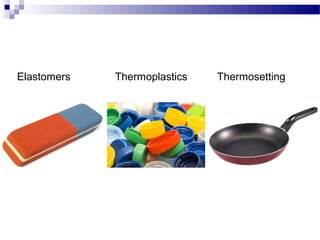
Elastomers Thermoplastics Thermosetting
Shaping and finishing 
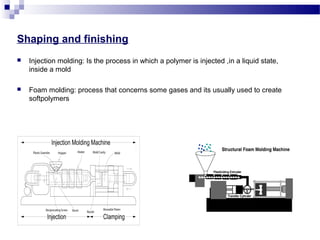
 Injection molding: Is the process in which a polymer is injected ,in a liquid state, 
inside a mold 
 Foam molding: process that concerns some gases and its usually used to create 
softpolymers
Shaping and finishing 
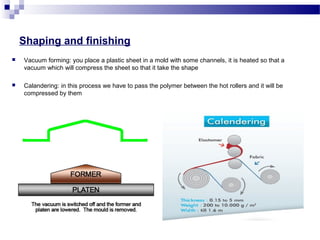
 Vacuum forming: you place a plastic sheet in a mold with some channels, it is heated so that a 
vacuum which will compress the sheet so that it take the shape 
 Calandering: in this process we have to pass the polymer between the hot rollers and it will be 
compressed by them
Student 3 
Physical Properties of Plastics 
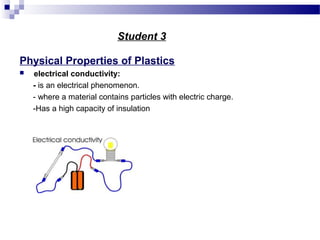
 electrical conductivity: 
- is an electrical phenomenon. 
- where a material contains particles with electric charge. 
-Has a high capacity of insulation
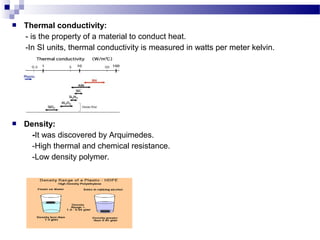
 Thermal conductivity: 
- is the property of a material to conduct heat. 
-In SI units, thermal conductivity is measured in watts per meter kelvin. 
 Density: 
-It was discovered by Arquimedes. 
-High thermal and chemical resistance. 
-Low density polymer.
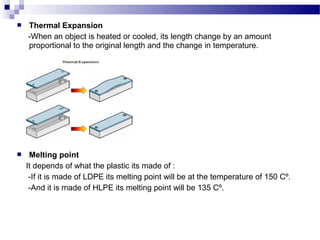
 Thermal Expansion 
-When an object is heated or cooled, its length change by an amount 
proportional to the original length and the change in temperature. 
 Melting point 
It depends of what the plastic its made of : 
-If it is made of LDPE its melting point will be at the temperature of 150 Cº. 
-And it is made of HLPE its melting point will be 135 Cº.
Mechanical Properties of Plastics 
Types of stress 
-Traction: two opposites forces that pull the plastic to the sides. 
-Compression: Two opposites forces that pull the plastic to the centre. 
-Shearing: its the deformation of a plastic in two different directions 
. 
-Torsion: Bend a plastic without breaking it. 
-Plasticity: it’s a capacity of plastics to undergo a deformation in a 
compressed form. 
-Elasticity: Its how much flexibility have an object. 
-Malleability: When you can deform a plastic althought its cold.
-Ductility: Is an ability of a hard material. 
-Resistance: It’s the ability os supporting an stress without breaking. 
-Hardness: resistance without scratching. 
-Weldability: Ability of joining with other materials when the material heats. 
Chemical properties 
-Permeability(NO) Ability of passing throught a solid without changing its 
structure. 
-Solubility: (NO) : ability of mixing with homogeneous mixtures. 
-Combustibility (YES) : ability of burning.
Biological Properties 
-Recyclability (YES) : ability of changing into an useful material 
-Toxicity (YES) : When materials are affected by toxic products. 
-Biodegradability (NO) : it’s the effect that causes the descomposition of the 
environment
Student 4 
Plastic materials classification 
 Thermosetting: -properties: fragile, difficulty of processing. 
-characteristics: Light weight, high flexibility. 
-applications: handle of frying pan, car body. 
 Thermoplastics: -properties: deform with heat, recycleable. 
-characteristics: very fragile, very rigid. 
-applications: bottles, polyethylene. 
 Elastomers: -properties: can’t melt, insoluble. 
-characteristics: low density, resistance. 
-applications: silicones, rubbers……
Bibliography 
http://wemaketechnology3eso.wikispaces.com/file/view/Materials+-+plastics.pdf 
http://en.wikipedia.org/wiki/Plastic 
http://www.ensinger-online.com/en/materials/basics-of-plastics/plastics-classification/ 
http://plc.cwru.edu/tutorial/enhanced/files/polymers/synth/synth.htm

Project2 group class

  • 1.
    PROJECT 2: PLASTICS Martín Mora Sarai de la Rosa Adrián Utrera Paula Monzón
  • 2.
    Student 1 1stSourcing of raw materials  Raw materials can come from: minerals, plants, or animals.  They are extracted from nature.  Then they are modified so they obtain plastic properties. Examples: -Plant origin  Rubbers and gums are made from latex, a liquid extracted from tropical trees.  Rayon and cellophane are made from cotton and wood cellulose.  Varnishes are made from the oil of oily seeds.
  • 3.
    Rubbers from Cellophanefrom Varnishes from latex wood cellulose oily seeds
  • 4.
    -Animal origin For making shellac it is used the resin secretion from an insect called lac.  Galalith and lanital are made from one protein called casein found in milk. lac bug galalith
  • 5.
    -Mineral origin The basic substances, called monomers are extracted from fossil fuels. 2nd Synthesis of monomers  In this process, the basic substances are extracted from raw materials throw chemical reactions.  Then they are transformed into plastic substances.  Is carried out in petrochemical industries.
  • 6.
    Shaping and finishing This process is when the plastic substance are manufactured and transformed into products. Thermocompression  For making thermosetting plastic products.  The process: The plastic is pass trough a hot mold then is compresd and when it has the mold shape and has cold down it is pulled out. Extrusion molding  The plastic is introduced in a heat pipe then the hot screw moves the plastic foreward.  Then the melted plastic is shaped.  Finally is cooled down and cut in measured pieces.
  • 7.
    Blow molding The plastic is form with a different method.  Then is introduced in a closed mold with pressurized air which makes the plastic to the walls.  Finally when its called down is removed. Thermocompression Extrusion molding Blow molding
  • 8.
    Student 2 3rdSynthesis of basic polymers  Plastics are made up of different components.  The quantities vary according to the kind of plastic we want to obtain.  Then, chemical ractions (polymerization,polycondensation and polyaddition occur).  This chemical processes change the properties and the shape of the components.
  • 9.
    4th Incorporation ofadditives  Chemical products that give several properties to the polymers  Dyes: change the color of the polymers  Plastizers: make the surface of the material brighter  Antistatic agents: take dust away by reducing the static electricity charge
  • 10.
    Additives  Fireproofagents: make the polymers resist fire  UV stabilizers: make the polymers resist UV radiation and atmospheric phenomena  Fillers, reinforcements, and lubricants: made better mechanical processes and make easier the manufacturing process  Mold release agents: made easier the extraction of the polymer from a mold  Antioxidants: prevent the oxygen to cause chemical reactions -UV stabilizers action
  • 11.
  • 12.
    Shaping and finishing  Injection molding: Is the process in which a polymer is injected ,in a liquid state, inside a mold  Foam molding: process that concerns some gases and its usually used to create softpolymers
  • 13.
    Shaping and finishing  Vacuum forming: you place a plastic sheet in a mold with some channels, it is heated so that a vacuum which will compress the sheet so that it take the shape  Calandering: in this process we have to pass the polymer between the hot rollers and it will be compressed by them
  • 14.
    Student 3 PhysicalProperties of Plastics  electrical conductivity: - is an electrical phenomenon. - where a material contains particles with electric charge. -Has a high capacity of insulation
  • 15.
     Thermal conductivity: - is the property of a material to conduct heat. -In SI units, thermal conductivity is measured in watts per meter kelvin.  Density: -It was discovered by Arquimedes. -High thermal and chemical resistance. -Low density polymer.
  • 16.
     Thermal Expansion -When an object is heated or cooled, its length change by an amount proportional to the original length and the change in temperature.  Melting point It depends of what the plastic its made of : -If it is made of LDPE its melting point will be at the temperature of 150 Cº. -And it is made of HLPE its melting point will be 135 Cº.
  • 17.
    Mechanical Properties ofPlastics Types of stress -Traction: two opposites forces that pull the plastic to the sides. -Compression: Two opposites forces that pull the plastic to the centre. -Shearing: its the deformation of a plastic in two different directions . -Torsion: Bend a plastic without breaking it. -Plasticity: it’s a capacity of plastics to undergo a deformation in a compressed form. -Elasticity: Its how much flexibility have an object. -Malleability: When you can deform a plastic althought its cold.
  • 18.
    -Ductility: Is anability of a hard material. -Resistance: It’s the ability os supporting an stress without breaking. -Hardness: resistance without scratching. -Weldability: Ability of joining with other materials when the material heats. Chemical properties -Permeability(NO) Ability of passing throught a solid without changing its structure. -Solubility: (NO) : ability of mixing with homogeneous mixtures. -Combustibility (YES) : ability of burning.
  • 19.
    Biological Properties -Recyclability(YES) : ability of changing into an useful material -Toxicity (YES) : When materials are affected by toxic products. -Biodegradability (NO) : it’s the effect that causes the descomposition of the environment
  • 20.
    Student 4 Plasticmaterials classification  Thermosetting: -properties: fragile, difficulty of processing. -characteristics: Light weight, high flexibility. -applications: handle of frying pan, car body.  Thermoplastics: -properties: deform with heat, recycleable. -characteristics: very fragile, very rigid. -applications: bottles, polyethylene.  Elastomers: -properties: can’t melt, insoluble. -characteristics: low density, resistance. -applications: silicones, rubbers……
  • 21.
    Bibliography http://wemaketechnology3eso.wikispaces.com/file/view/Materials+-+plastics.pdf http://en.wikipedia.org/wiki/Plastic http://www.ensinger-online.com/en/materials/basics-of-plastics/plastics-classification/ http://plc.cwru.edu/tutorial/enhanced/files/polymers/synth/synth.htm