Unit 1.2: Earth’s
Atmosphere
Period 4 APES
Introduction
This Unit
● Greenhouse effect: The greenhouse effect is a process by
which thermal radiation from a planetary surface is absorbed
by atmospheric greenhouse gases
● Cycling Carbon: The carbon cycle is the biogeochemical
cycle by which carbon is exchanged among the biosphere,
pedosphere, geosphere, hydrosphere, and atmosphere of
the Earth.
● Climate Zones: Are divisions of the Earth's climates into
general climate zones according to average temperatures
and average rainfall
● Weather Patterns and Storms
● Creating conditions suitable for life
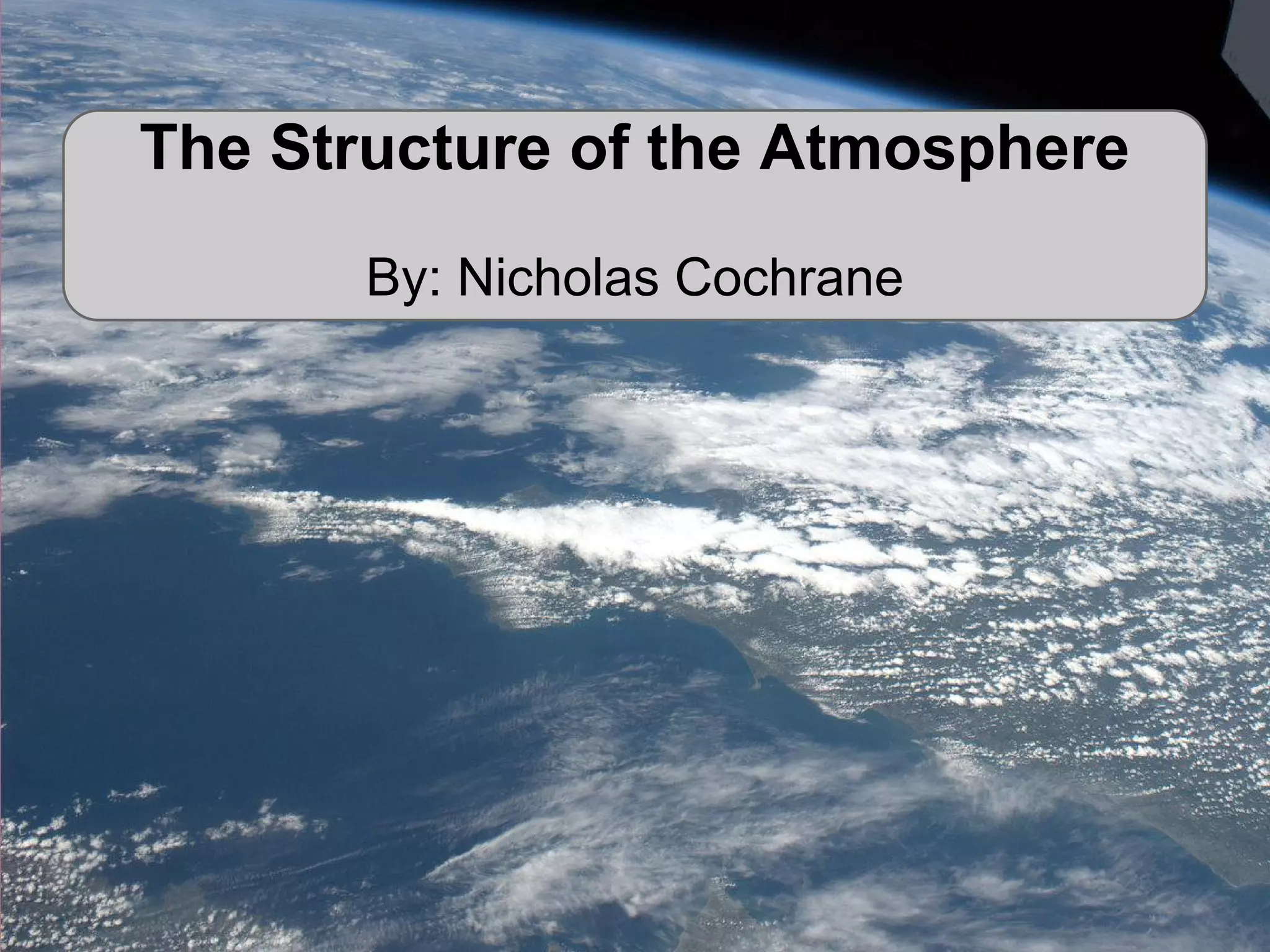
The Structure of the Atmosphere
By: Nicholas Cochrane
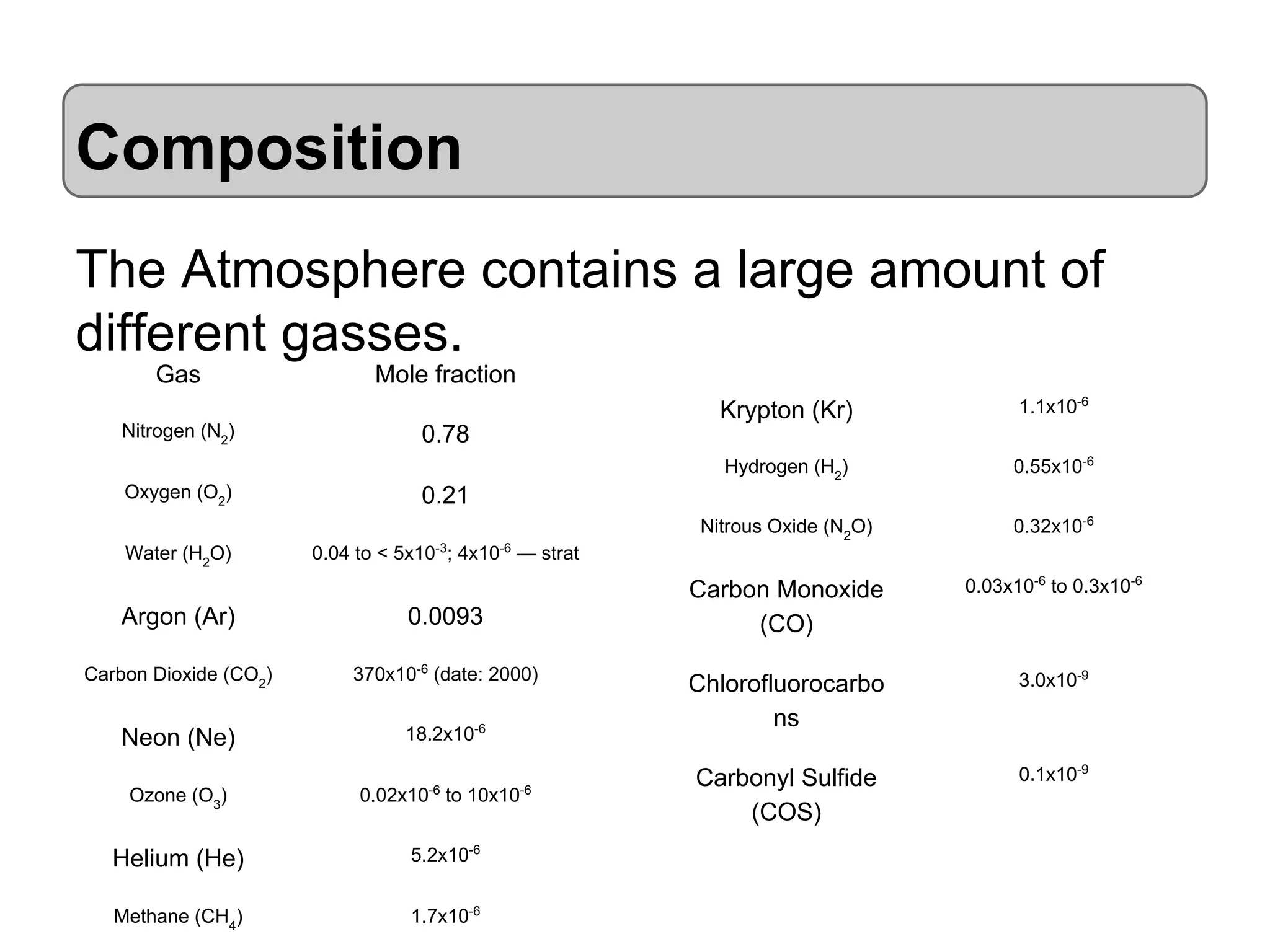
Composition
The Atmosphere contains a large amount of
different gasses.
Gas

Mole fraction

Water (H2O)

0.55x10⁻⁶

Nitrous Oxide (N2O)

Oxygen (O2)

1.1x10⁻⁶

Hydrogen (H2)

Nitrogen (N2)

Krypton (Kr)

0.32x10⁻⁶

Carbon Monoxide
(CO)

0.03x10⁻⁶ to 0.3x10⁻⁶

Chlorofluorocarbo
ns

3.0x10⁻⁹

Carbonyl Sulfide
(COS)

0.1x10⁻⁹

0.78
0.21
0.04 to < 5x10⁻³; 4x10⁻⁶ — strat

Argon (Ar)

0.0093

Carbon Dioxide (CO2)

370x10-6 (date: 2000)

Neon (Ne)

18.2x10⁻⁶
-6

Ozone (O3)

0.02x10 to 10x10

Helium (He)

5.2x10⁻⁶

Methane (CH4)

1.7x10⁻⁶

-6
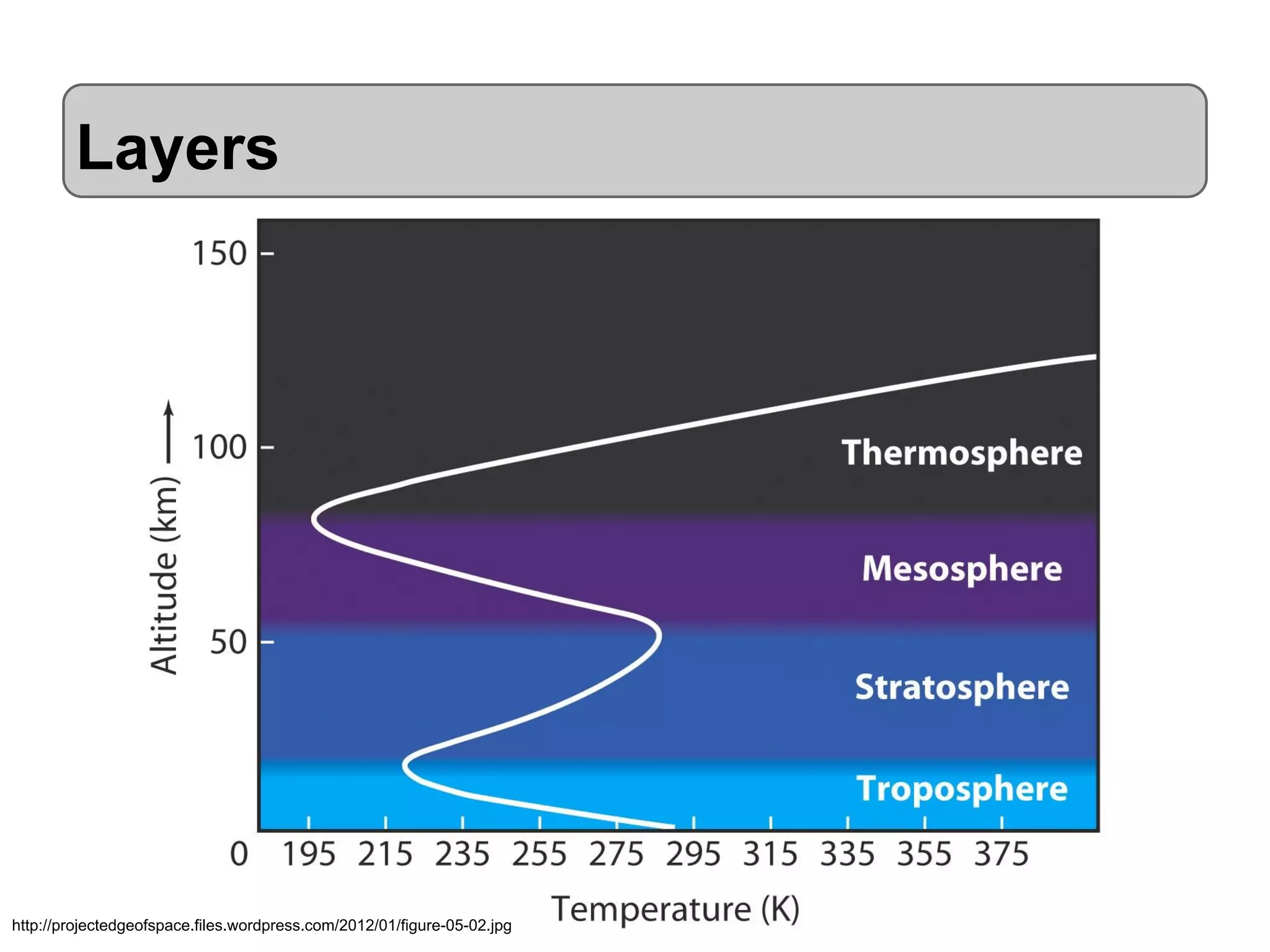
Layers

http://projectedgeofspace.files.wordpress.com/2012/01/figure-05-02.jpg
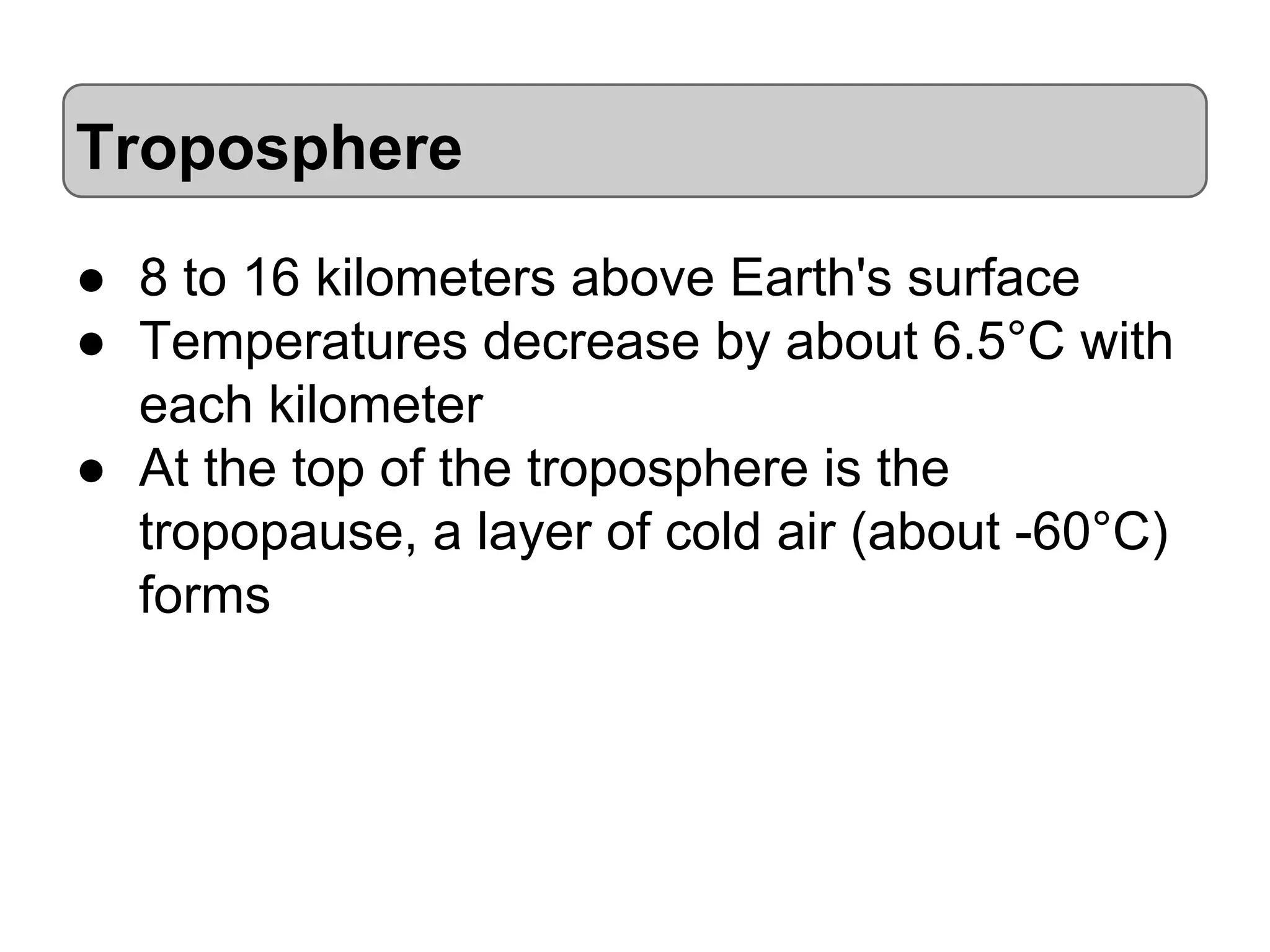
Troposphere
● 8 to 16 kilometers above Earth's surface
● Temperatures decrease by about 6.5°C with
each kilometer
● At the top of the troposphere is the
tropopause, a layer of cold air (about -60°C)
forms
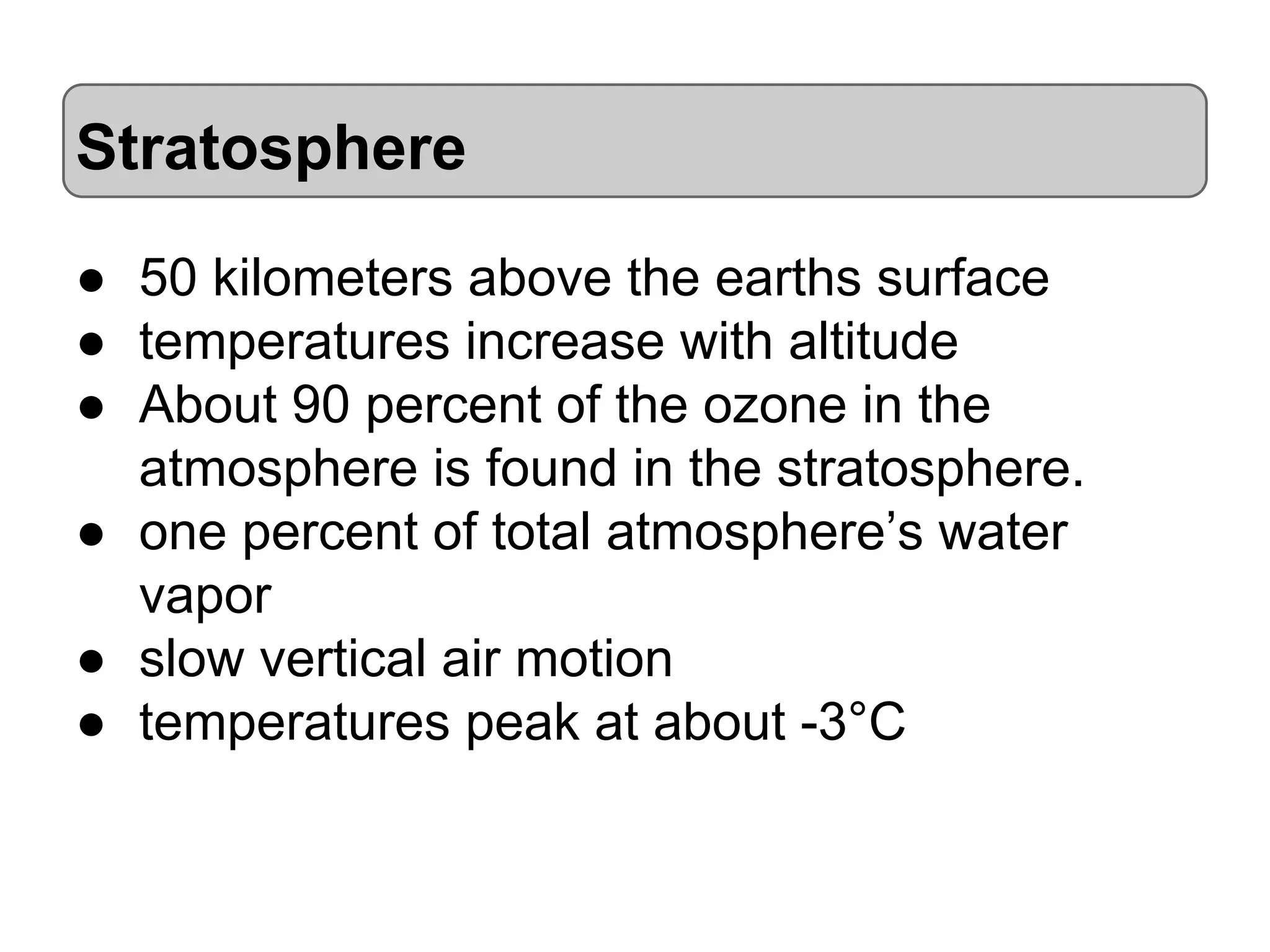
Stratosphere
● 50 kilometers above the earths surface
● temperatures increase with altitude
● About 90 percent of the ozone in the
atmosphere is found in the stratosphere.
● one percent of total atmosphere’s water
vapor
● slow vertical air motion
● temperatures peak at about -3°C
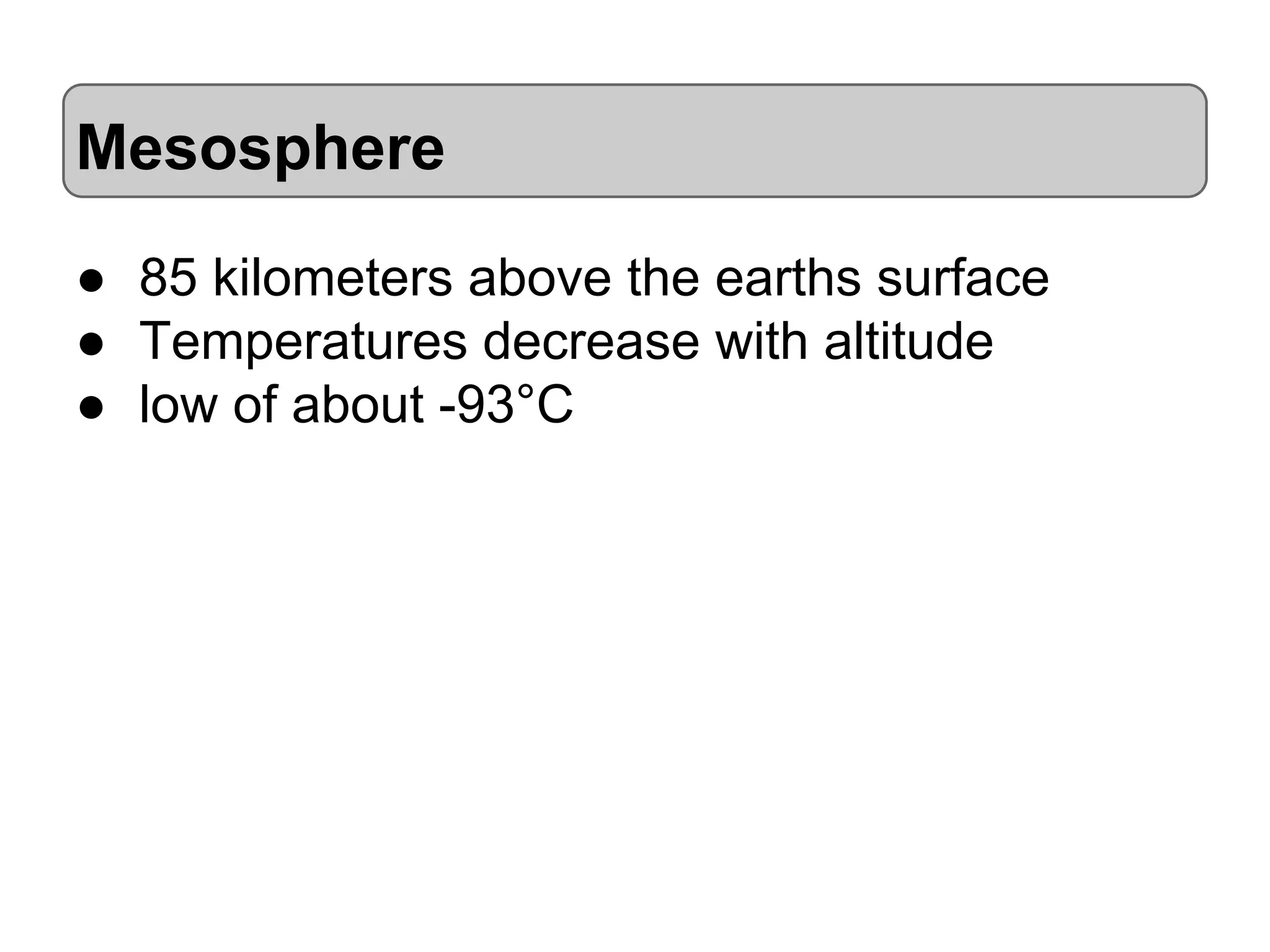
Mesosphere
● 85 kilometers above the earths surface
● Temperatures decrease with altitude
● low of about -93°C
Thermosphere
● 1,000 kilometres above the earths surface
● warm with altitude, rising higher than 1700°
C.
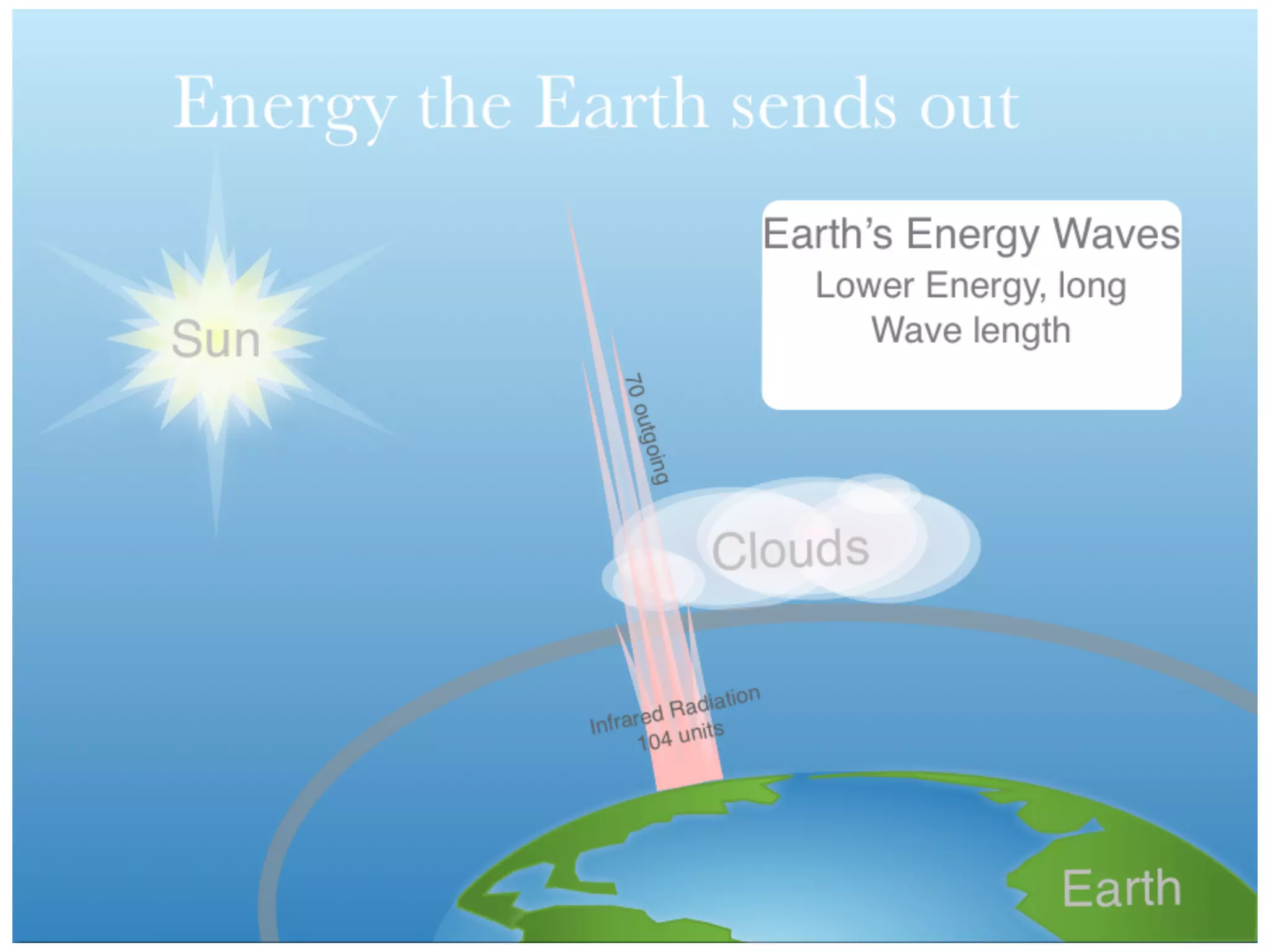
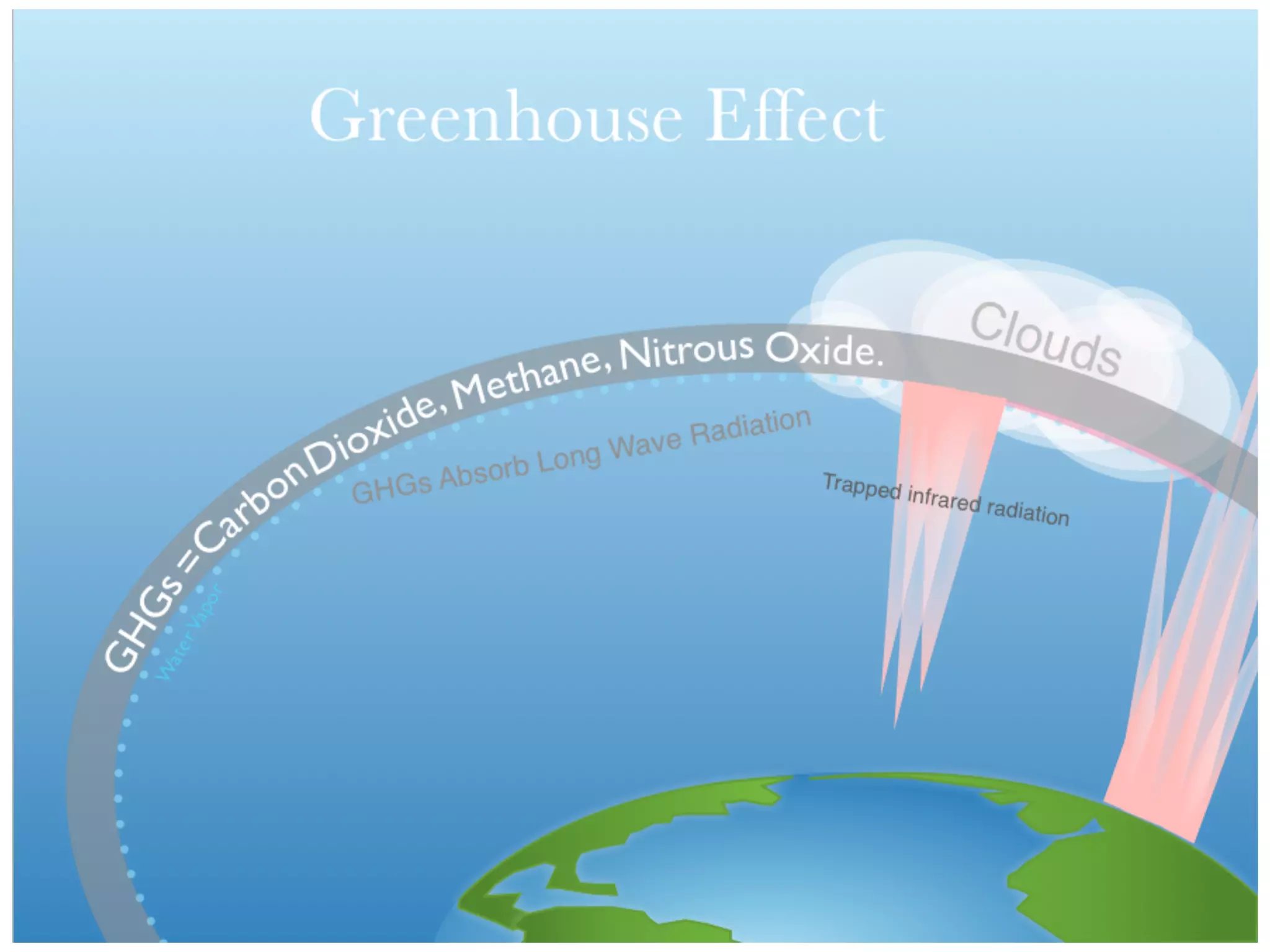
Radiative Balance and the Natural
Greenhouse Effect
Victoria Owen
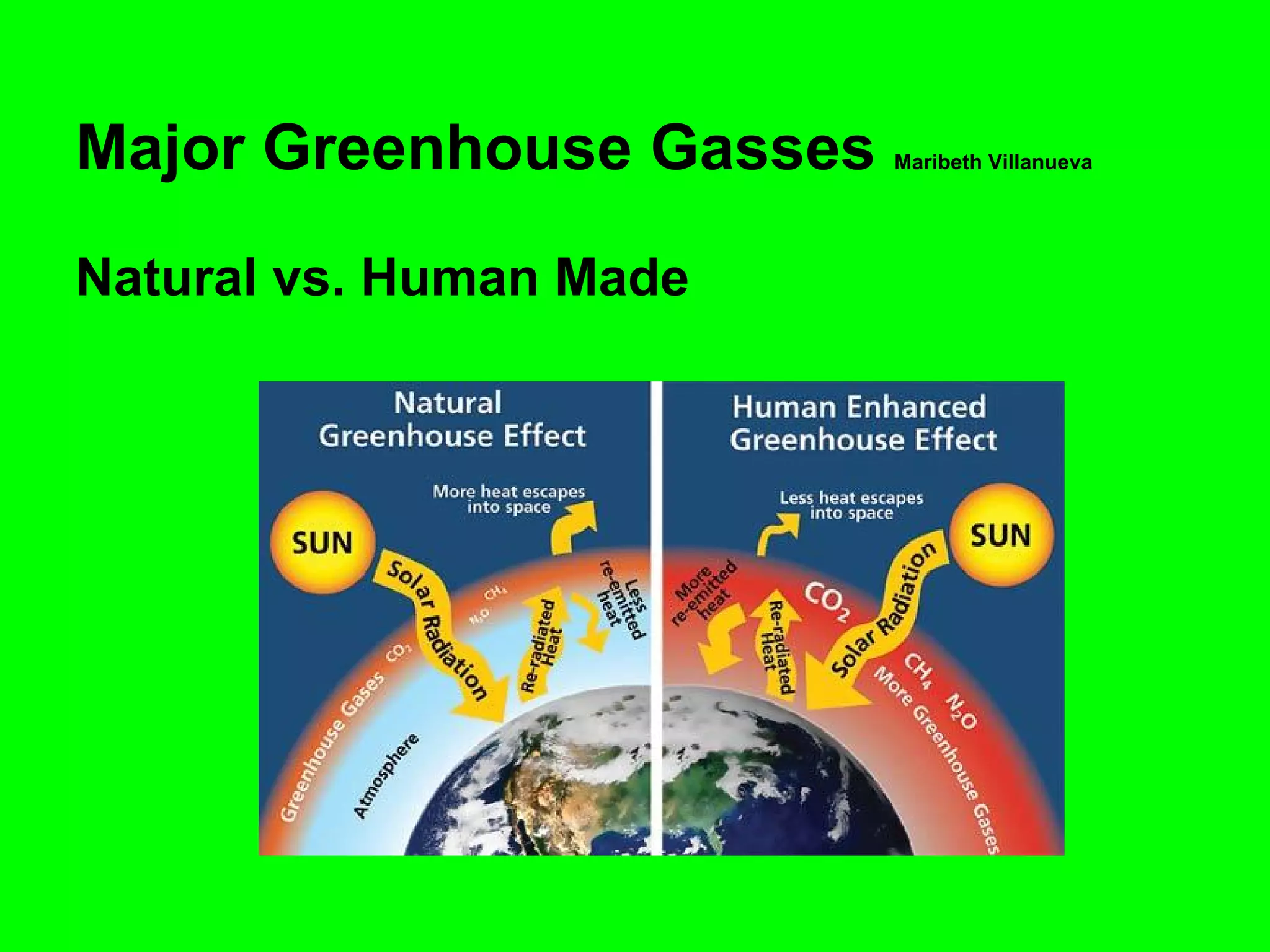
Major Greenhouse Gasses
Natural vs. Human Made
Maribeth Villanueva
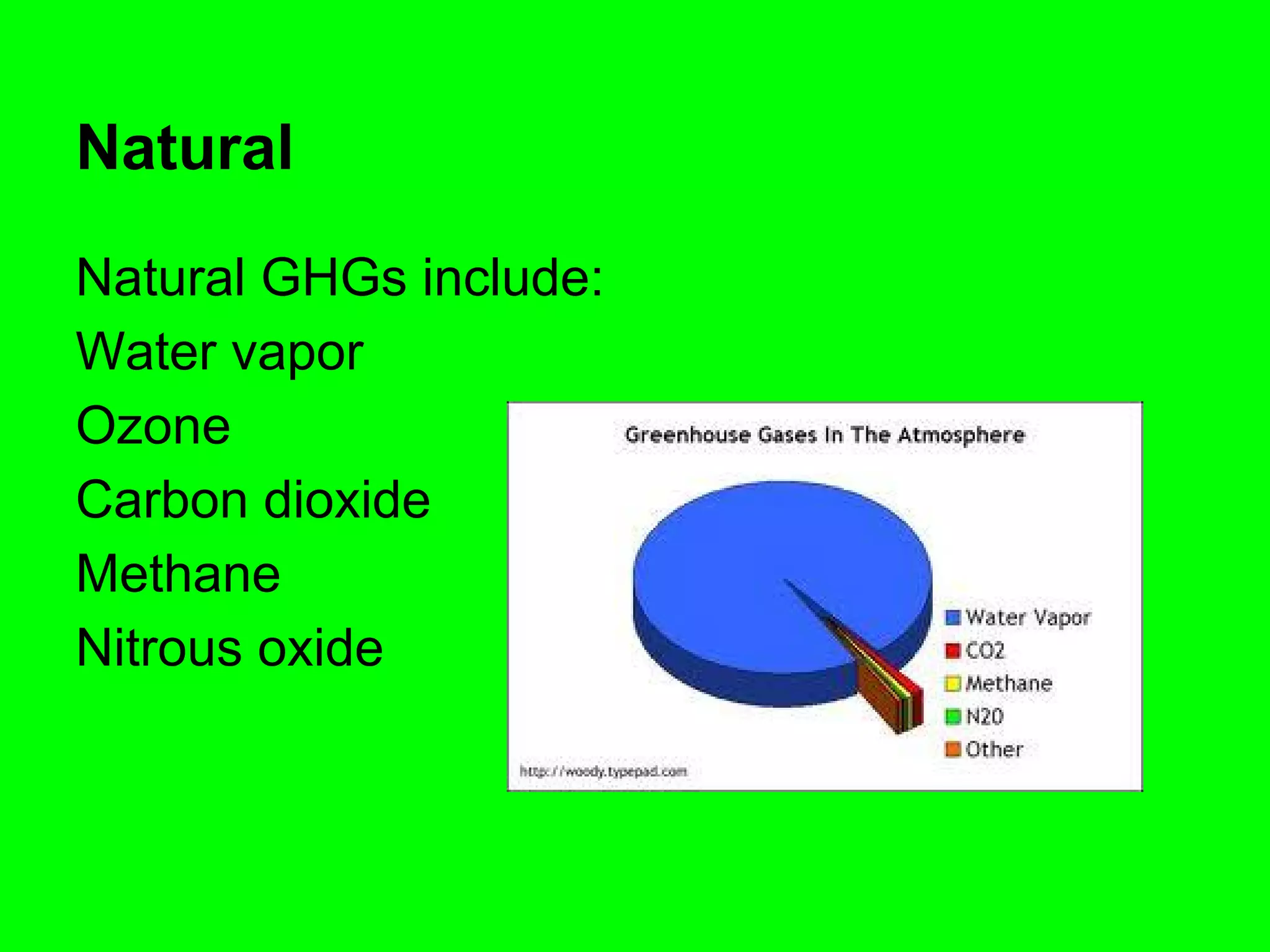
Natural
Natural GHGs include:
Water vapor
Ozone
Carbon dioxide
Methane
Nitrous oxide
Human Made
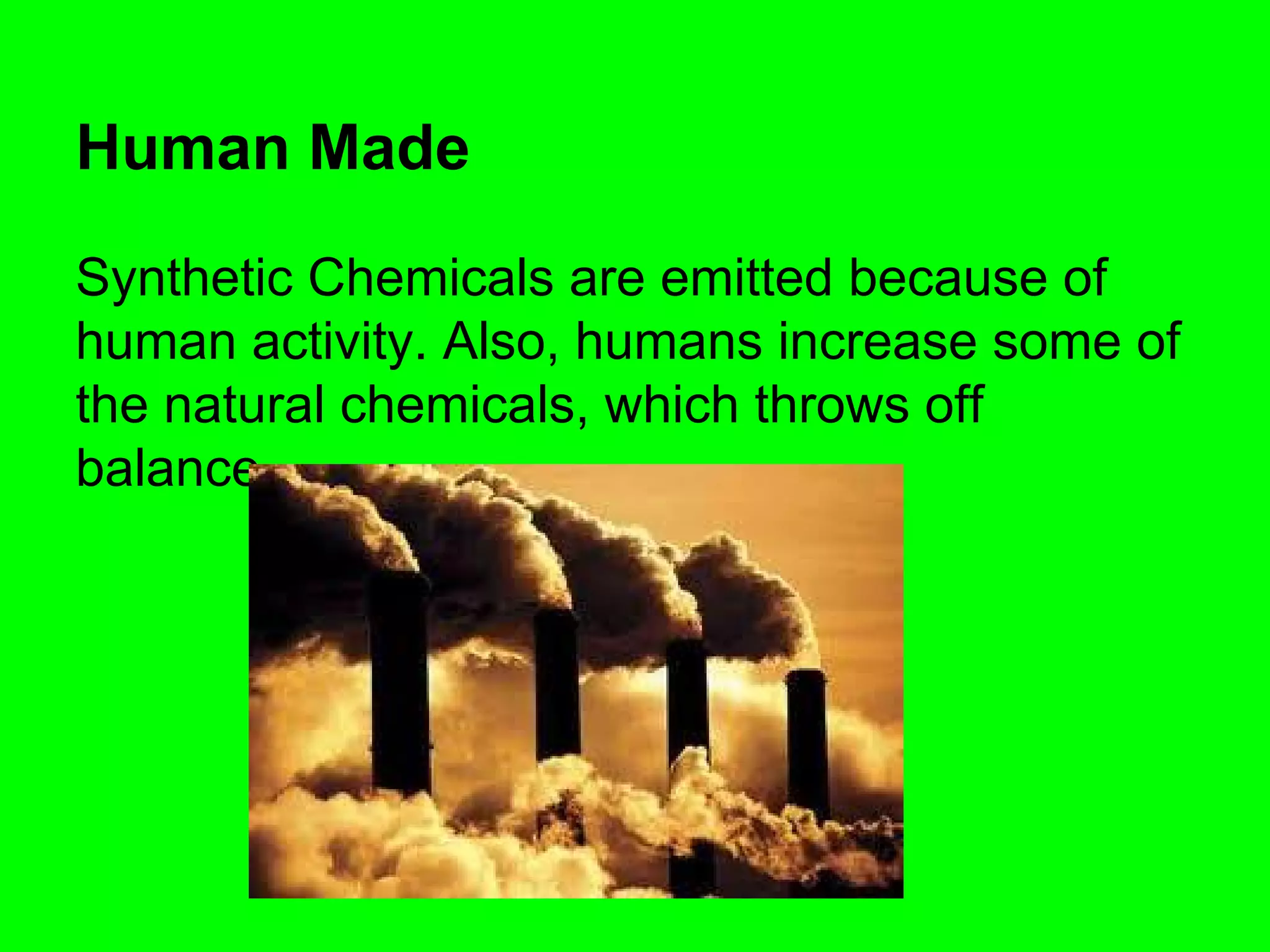
Synthetic Chemicals are emitted because of
human activity. Also, humans increase some of
the natural chemicals, which throws off
balance.
Human Made Cont.
Hydrofluorocarbons and perfluorocarbonsAKA F gases.
Vertical Motion in the Atmosphere

Karis Heidebrecht
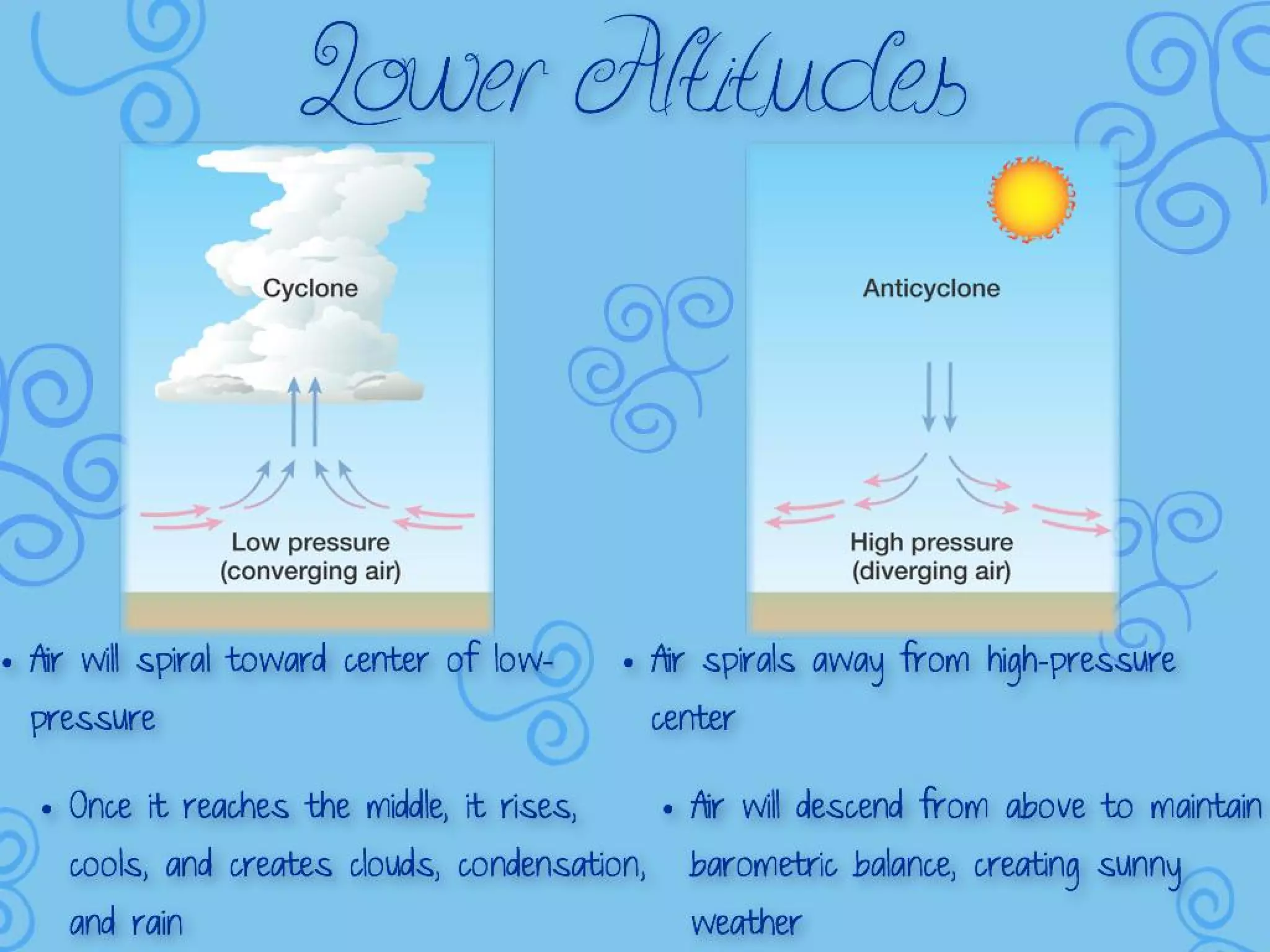
Weather Patterns
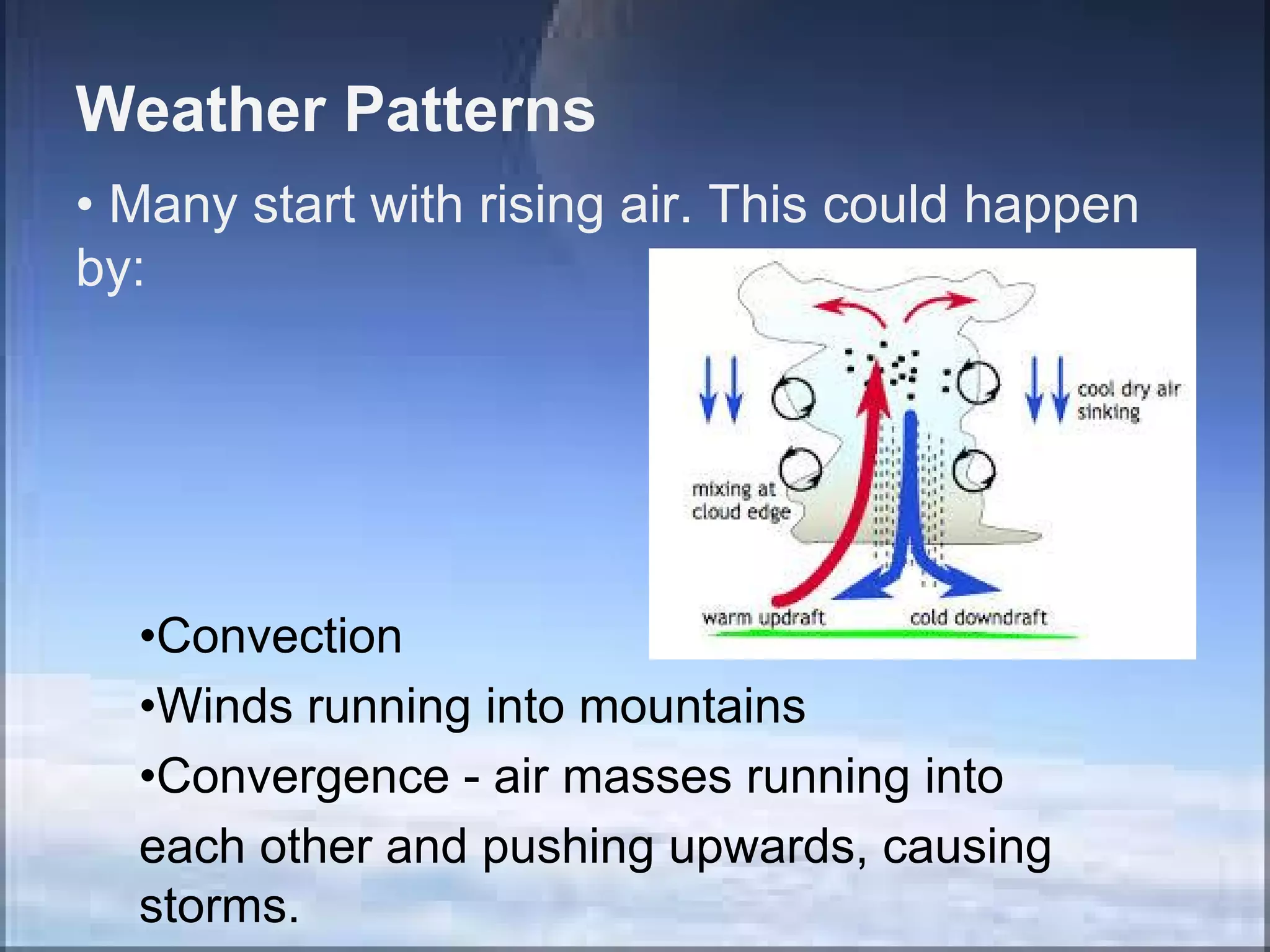
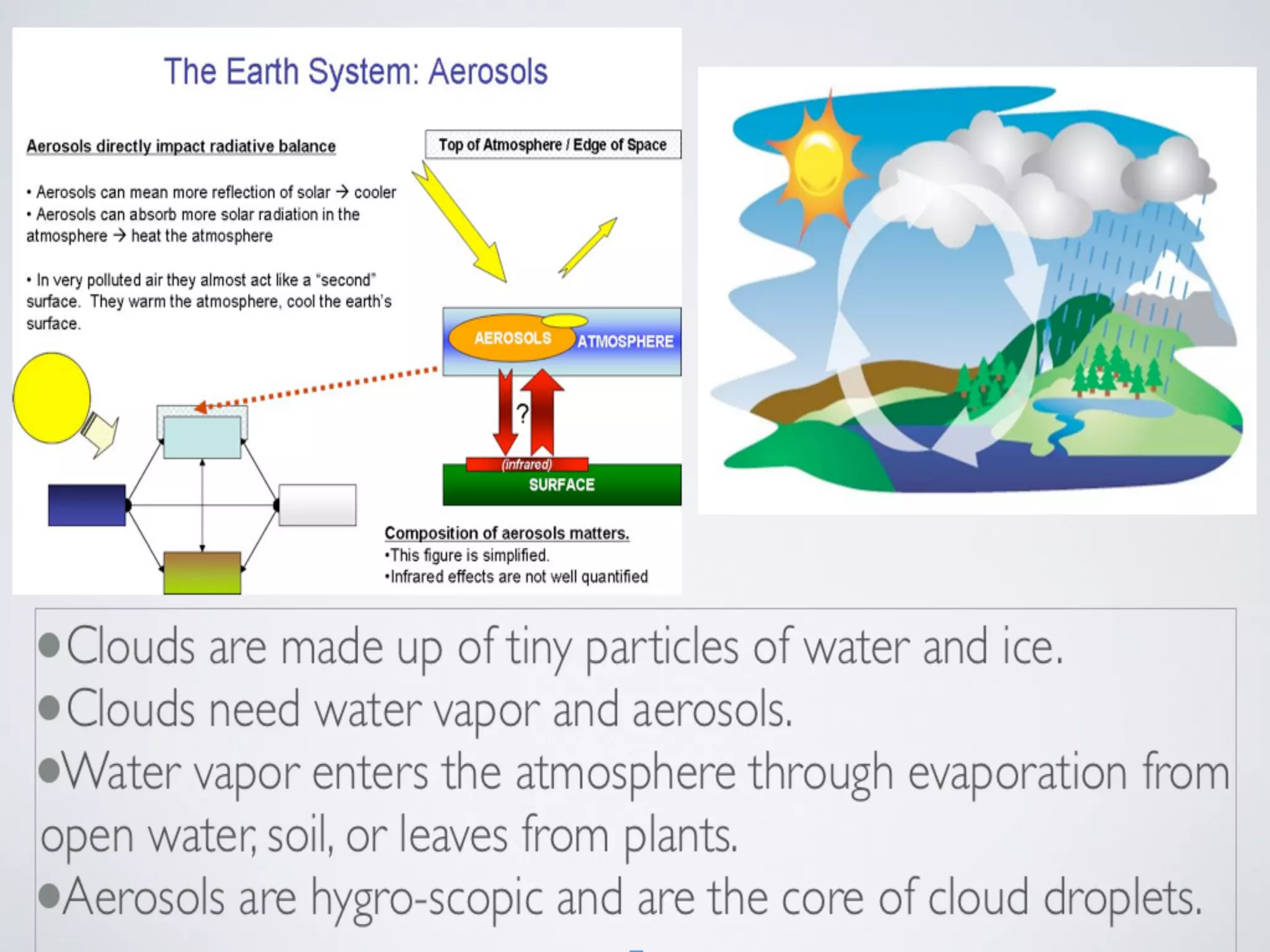
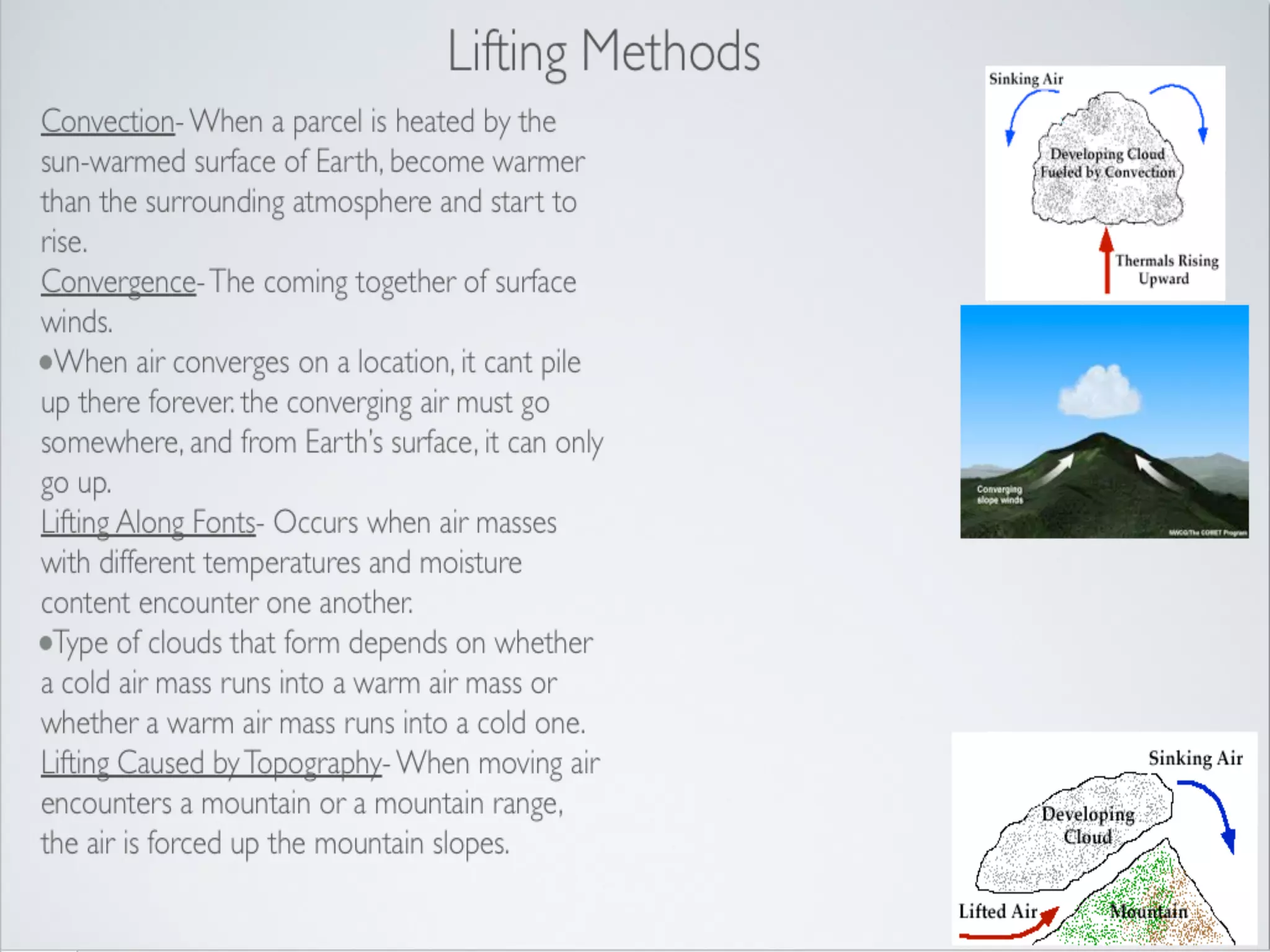
• Many start with rising air. This could happen
by:

•Convection
•Winds running into mountains
•Convergence - air masses running into
each other and pushing upwards, causing
storms.
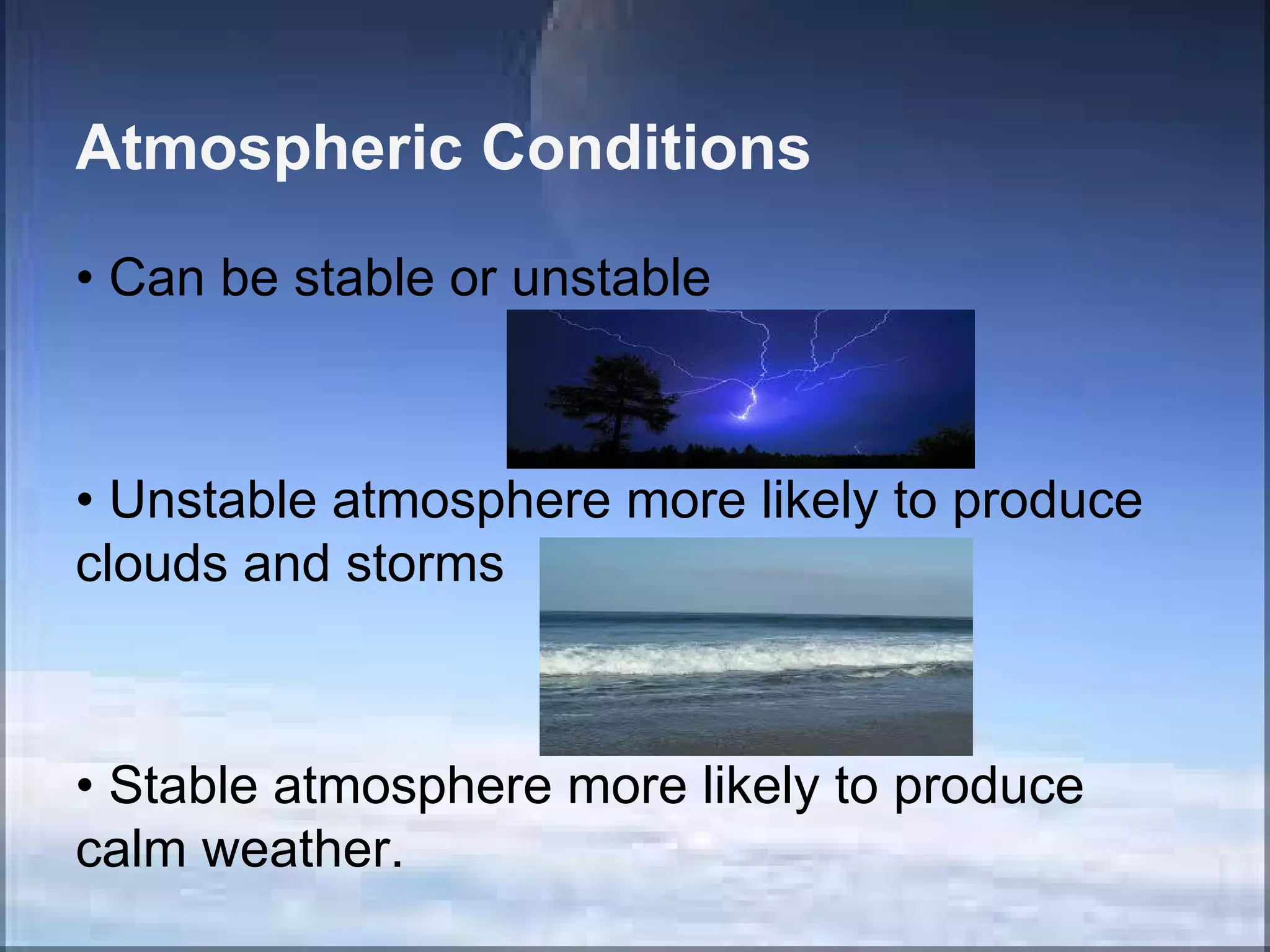
Atmospheric Conditions
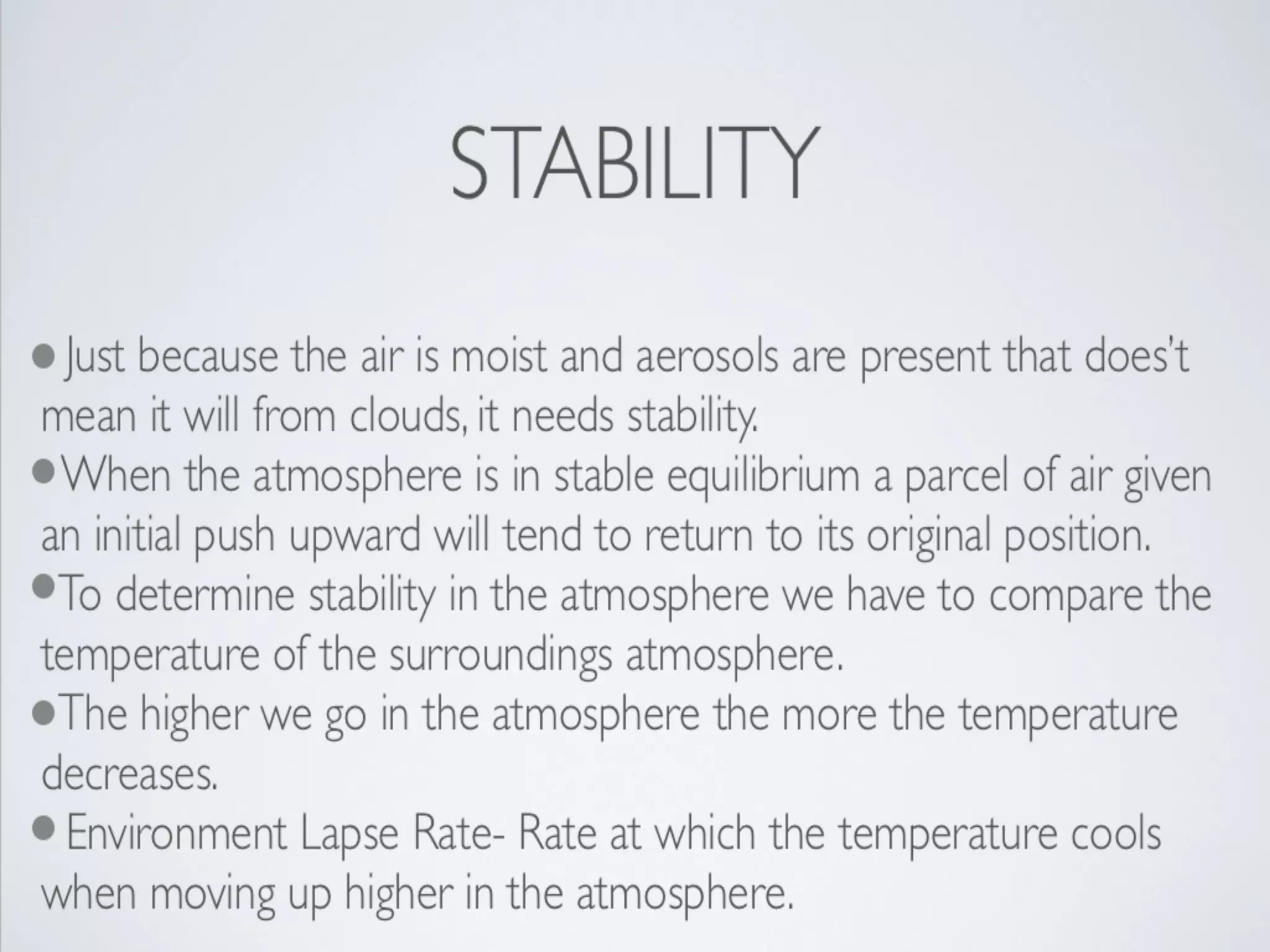
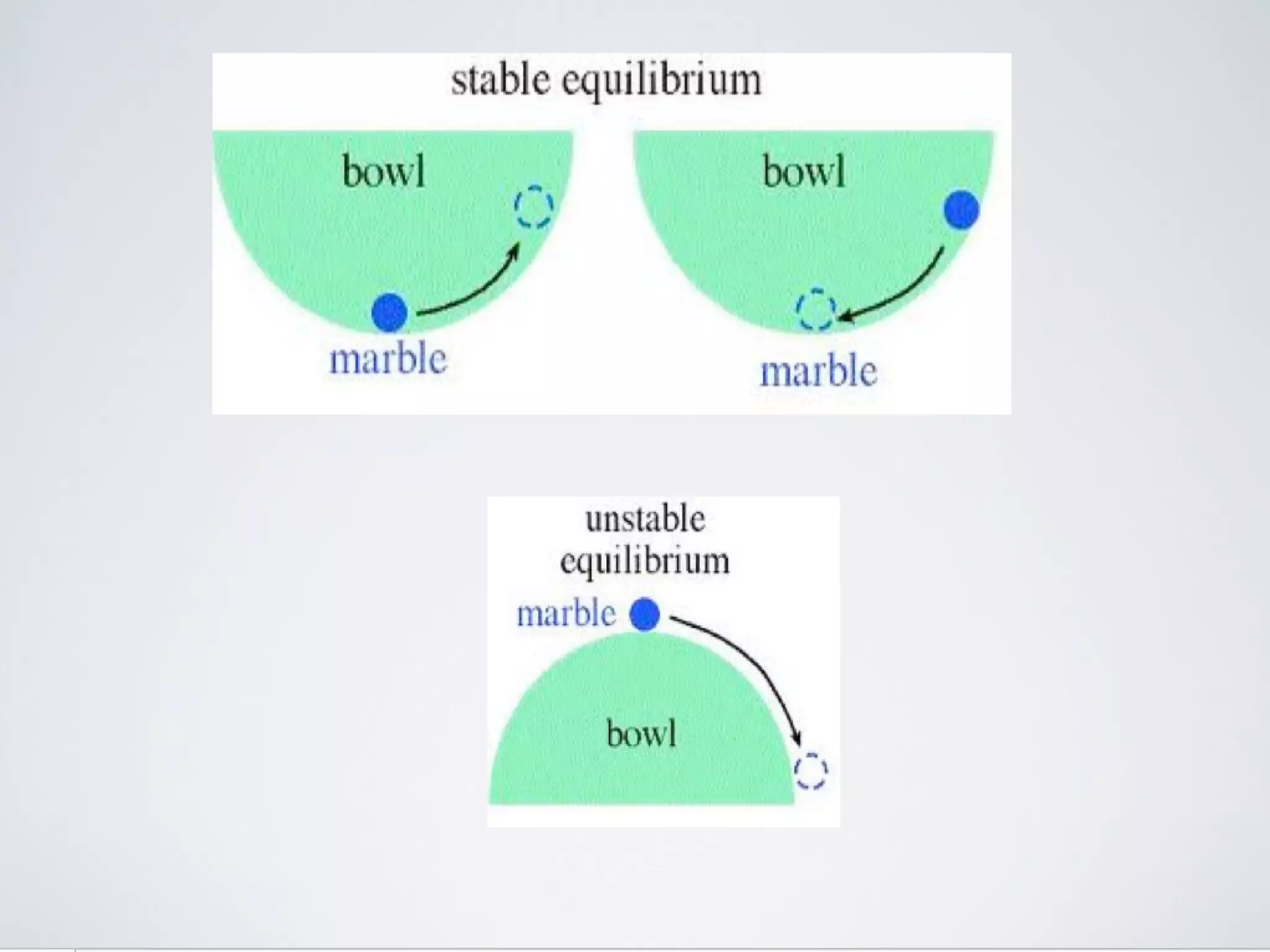
• Can be stable or unstable

• Unstable atmosphere more likely to produce
clouds and storms

• Stable atmosphere more likely to produce
calm weather.
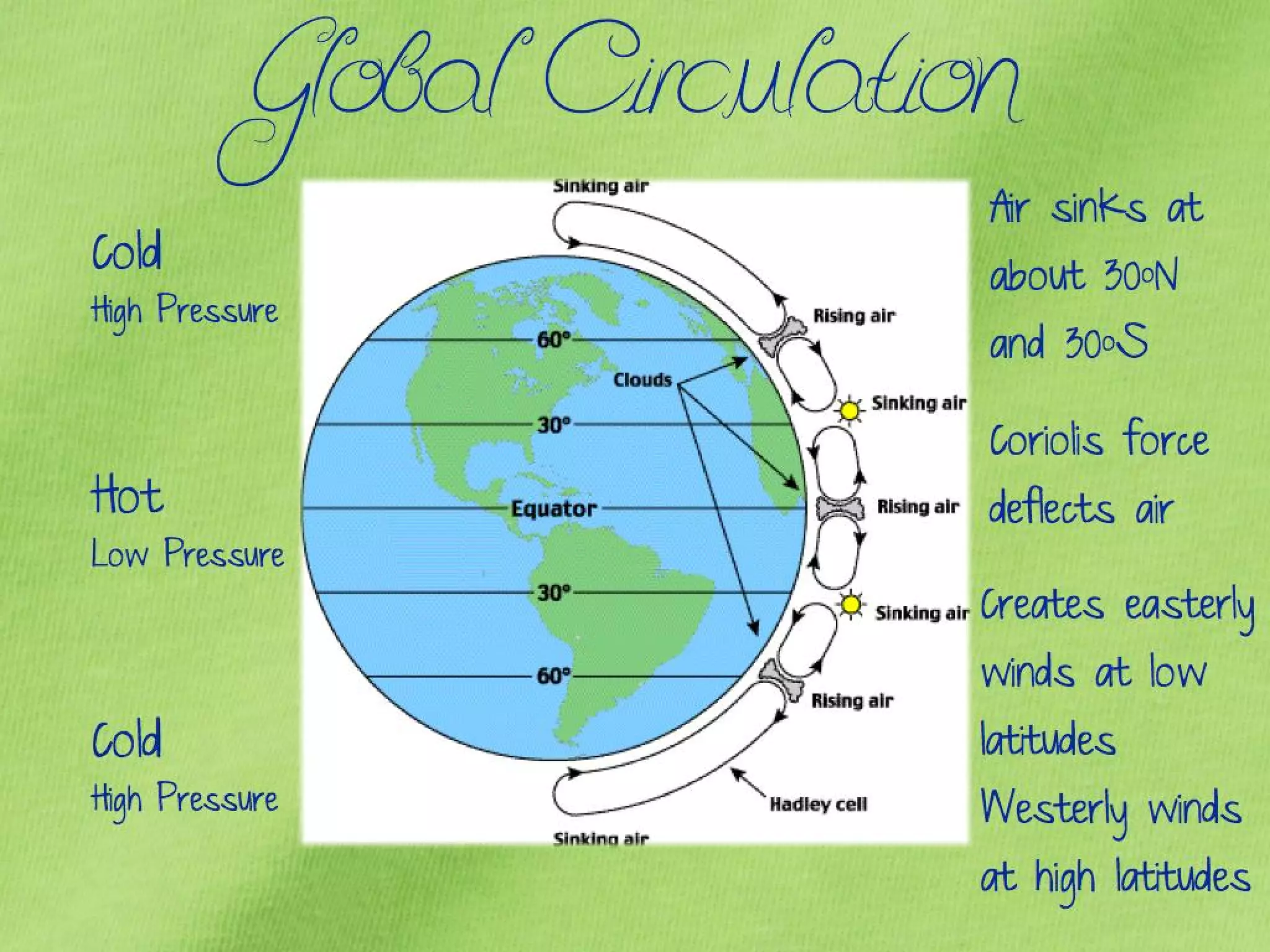
Atmospheric Circulation
Dani B
Atmospheric Circulation
Cierra Bordwine
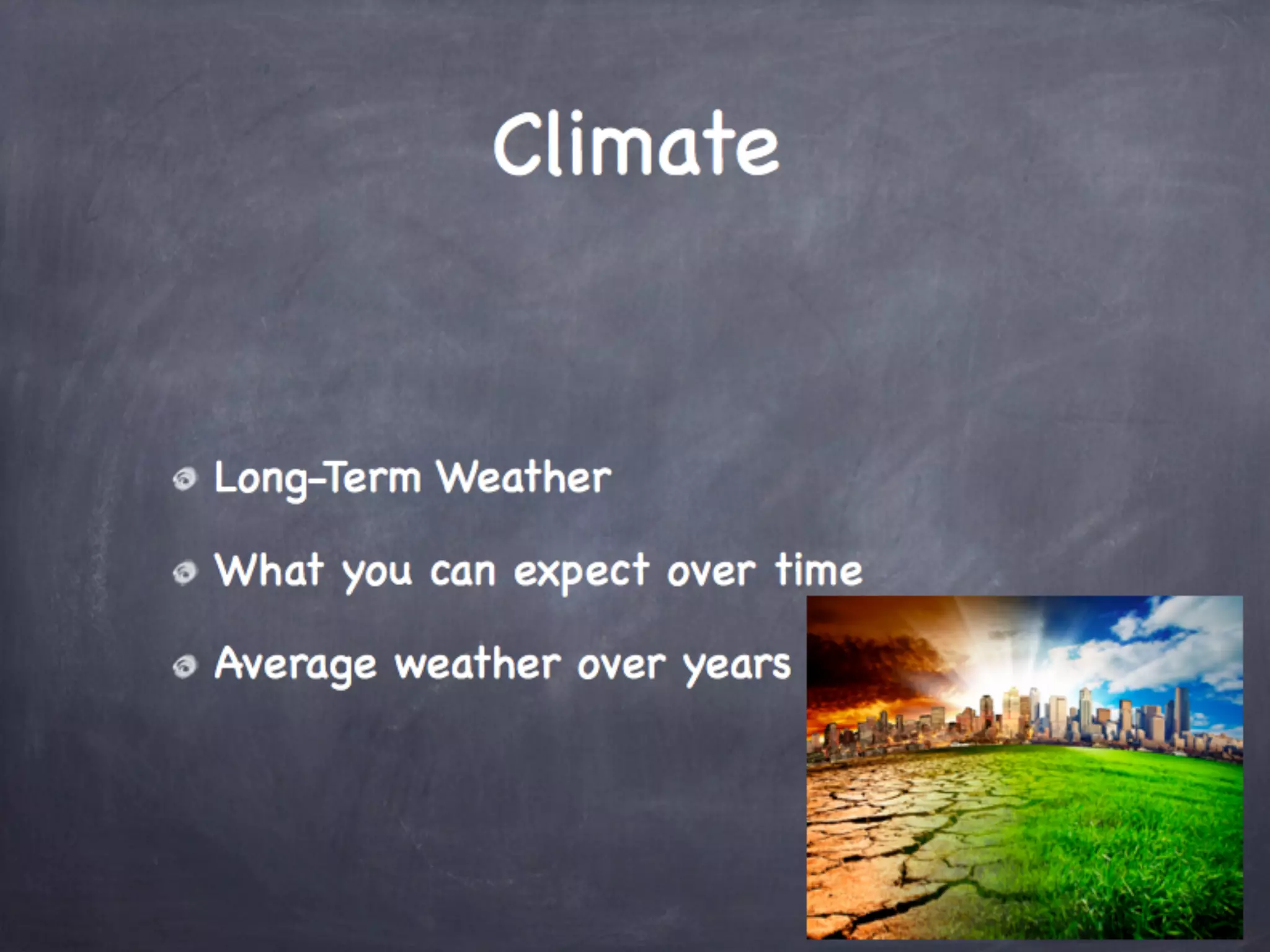
Climate, Weather and Storms
Geoffrey Ashton
The Global Carbon Cycle
Daniel Monsalve
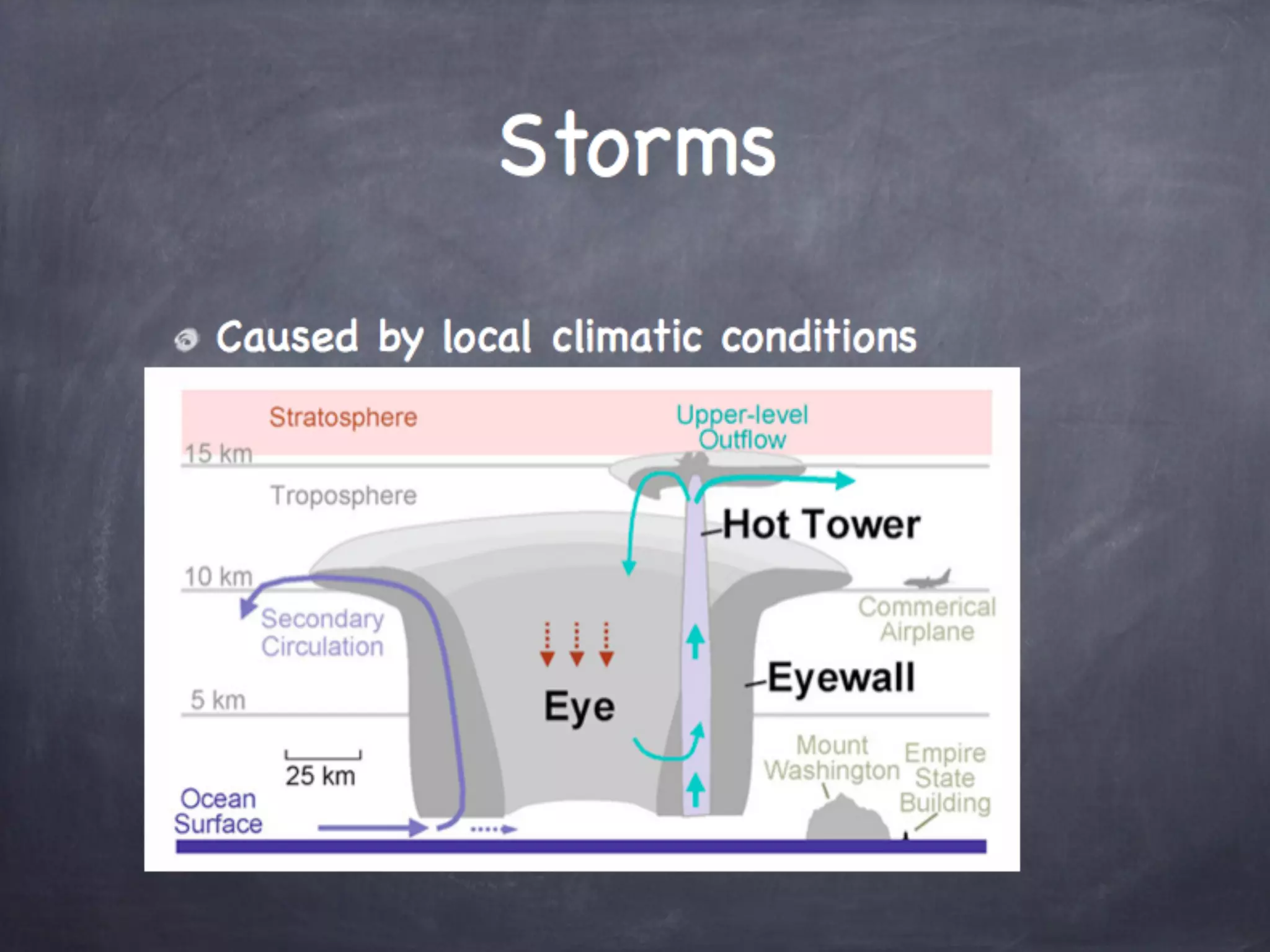
The Cycle
The carbon cycle is based around different stores
of carbon.
● CO2 in the atmosphere.
● Carbonate and carbonic acid in oceans.
● Organic matter on land or underwater.
On average a carbon atom spends
● 5 years in the atmosphere
● 380 years in oceans or sediments
● 10 years in terrestrial vegetation
Carbon Movements
Carbon in the atmosphere is scrubbed
out by rain into oceans or sediment or
absorbed into plants
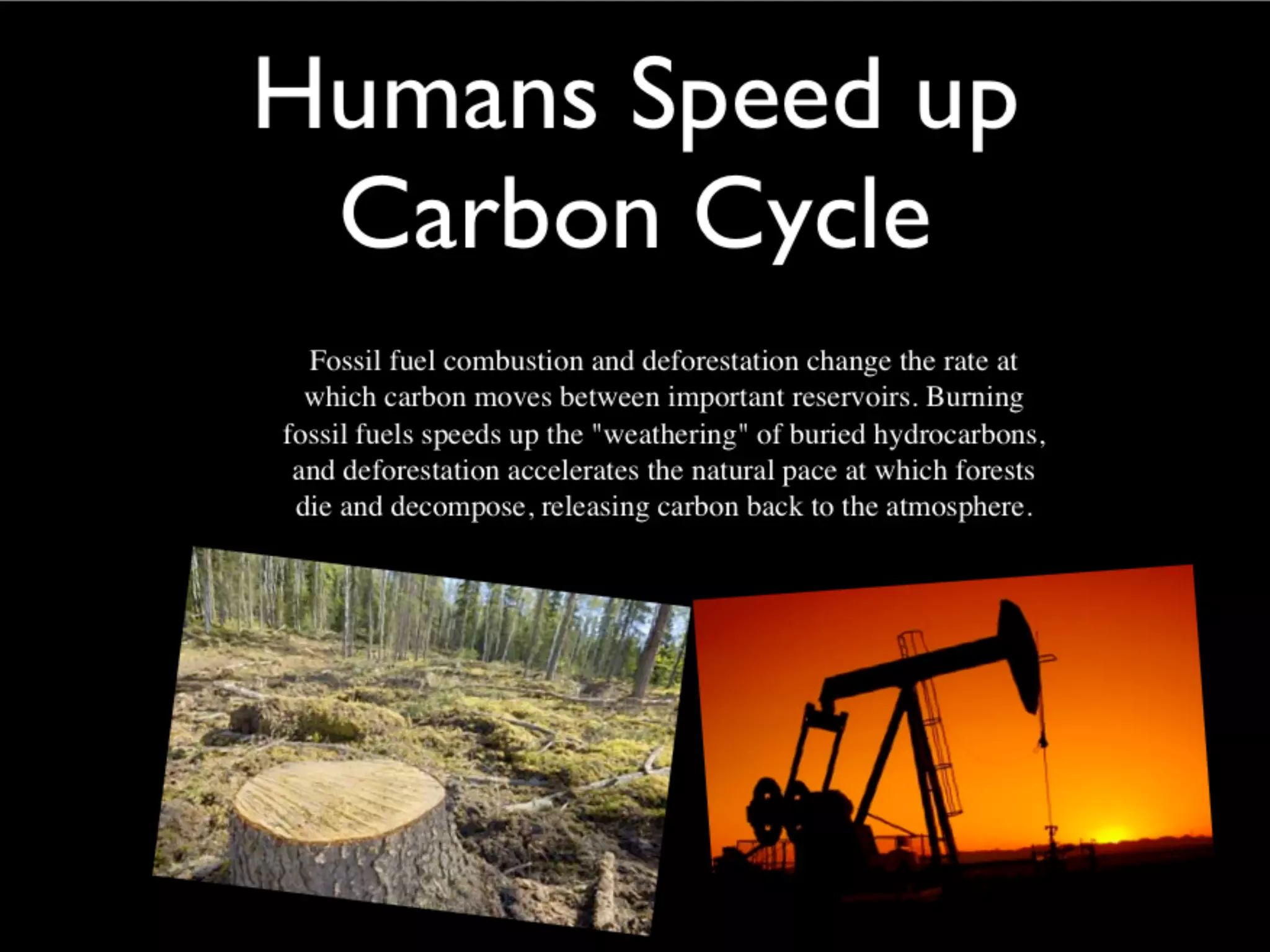
Carbon can stay in fossil fuel deposits
for millions of years before it eventually
returns to the atmosphere.
Human Impact
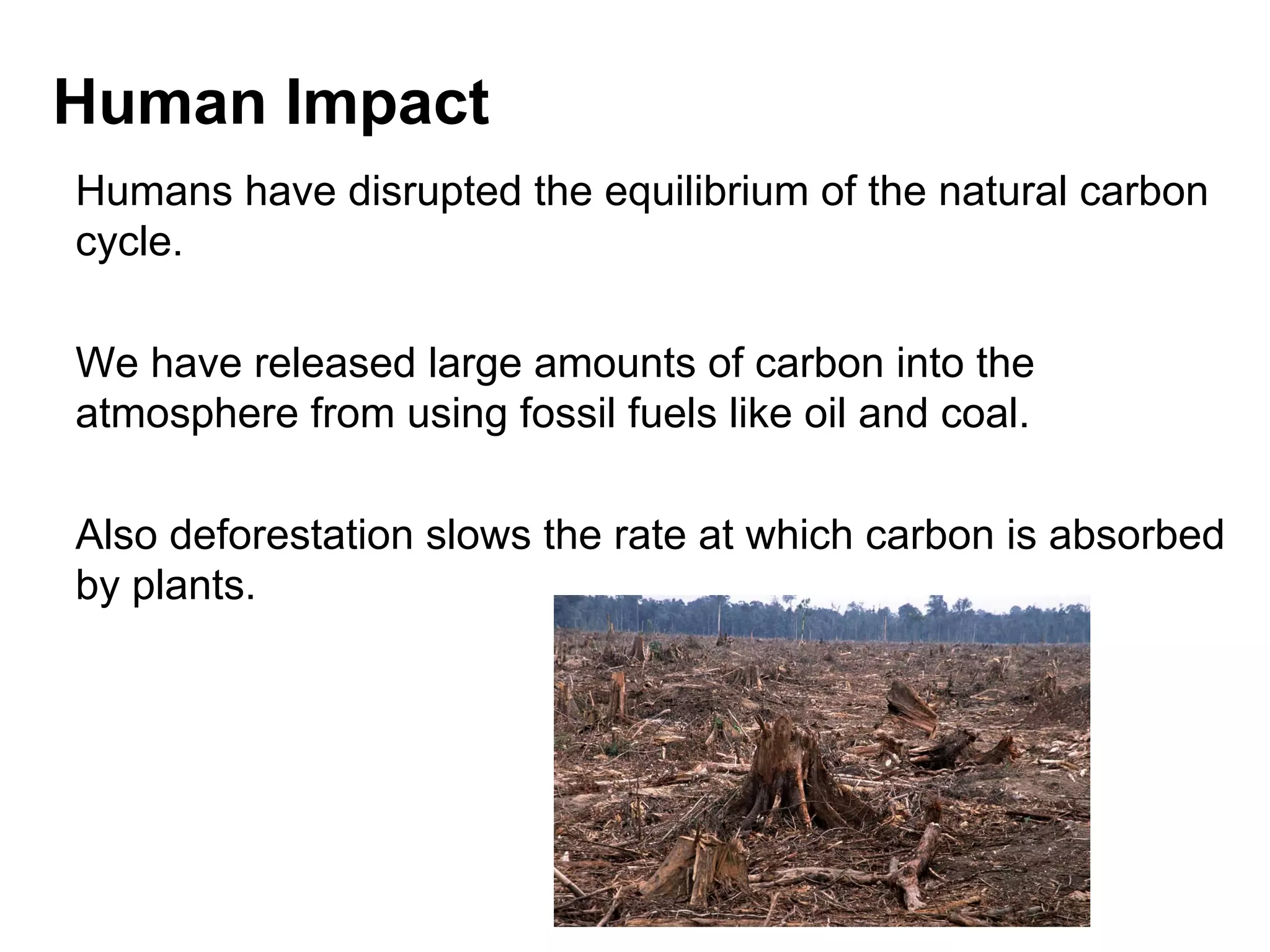
Humans have disrupted the equilibrium of the natural carbon
cycle.
We have released large amounts of carbon into the
atmosphere from using fossil fuels like oil and coal.
Also deforestation slows the rate at which carbon is absorbed
by plants.
The Global Carbon Cycle
McKenna Chase
Michaela Brost
What Are Feedbacks?
Feedbacks: Interactions between climate
variables such as temperature, precipitation,
and vegetation, also elements such as clouds
and albedo that control the Greenhouse Effect.
Positive Feedbacks

Positive Feedbacks amplify
temperature changes by strengthening
the Greenhouse effect or by reducing
albedo.
Positive Feedbacks Continued
Water Vapor Feedback- The presence of more water
vapor as temperatures increase raises the Greenhouse
Effect and the absorption of solar radiation which heats the
planet.
Cloud Feedback on Terrestrial Radiation- Warmer
temperatures increase water vapor amounts, which can
increase cloudiness and can increase the temperature
even further.
Ice-Albedo Feedback on Solar Radiation- Rising
temperatures cause polar glaciers and floating ice sheets to
recede, decreasing Earth’s albedo and raising
temperatures.
Negative Feedbacks
Negative Feedbacks make the climate
systems less sensitive to the factors
that trigger them.
Negative Feedbacks Continued
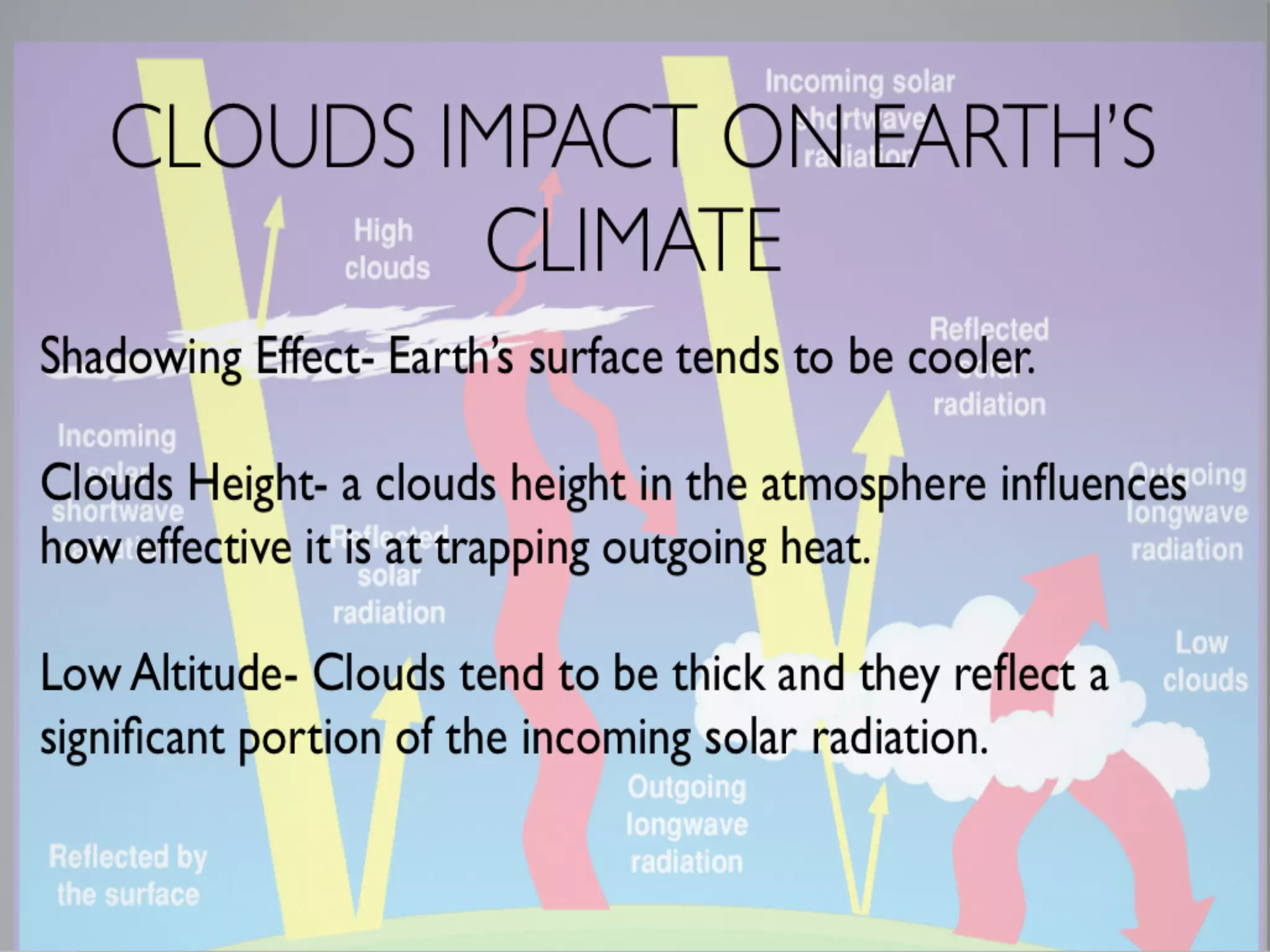
Cloud Feedbacks on Solar Radiation- As temperature
and atmospheric water vapor levels rise, cloudiness may
increase. Greater cloudiness raises Earth’s albedo,
reflecting more solar radiation back into space and lowering
the temperature.
Vegetation Feedback on Solar Radiation- Deserts may
expand as temperatures rise, which would increase Earth’s
albedo and lower the temperature.
Key Terms

(Katrina Moore)

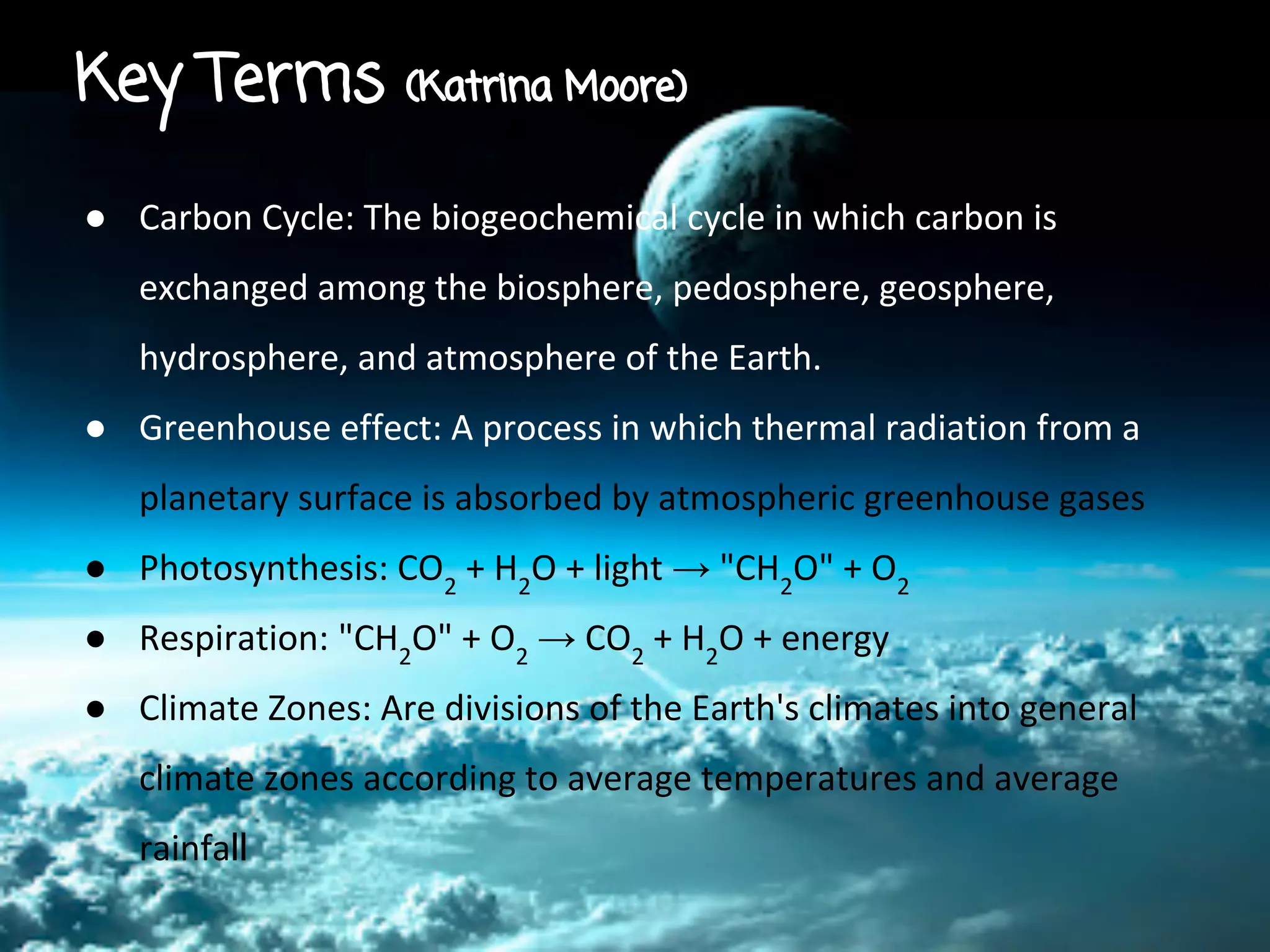
● Carbon Cycle: The biogeochemical cycle in which carbon is
exchanged among the biosphere, pedosphere, geosphere,
hydrosphere, and atmosphere of the Earth.
● Greenhouse effect: A process in which thermal radiation from a
planetary surface is absorbed by atmospheric greenhouse gases
● Photosynthesis: CO2 + H2O + light → "CH2O" + O2
● Respiration: "CH2O" + O2 → CO2 + H2O + energy
● Climate Zones: Are divisions of the Earth's climates into general
climate zones according to average temperatures and average
rainfall
Continued
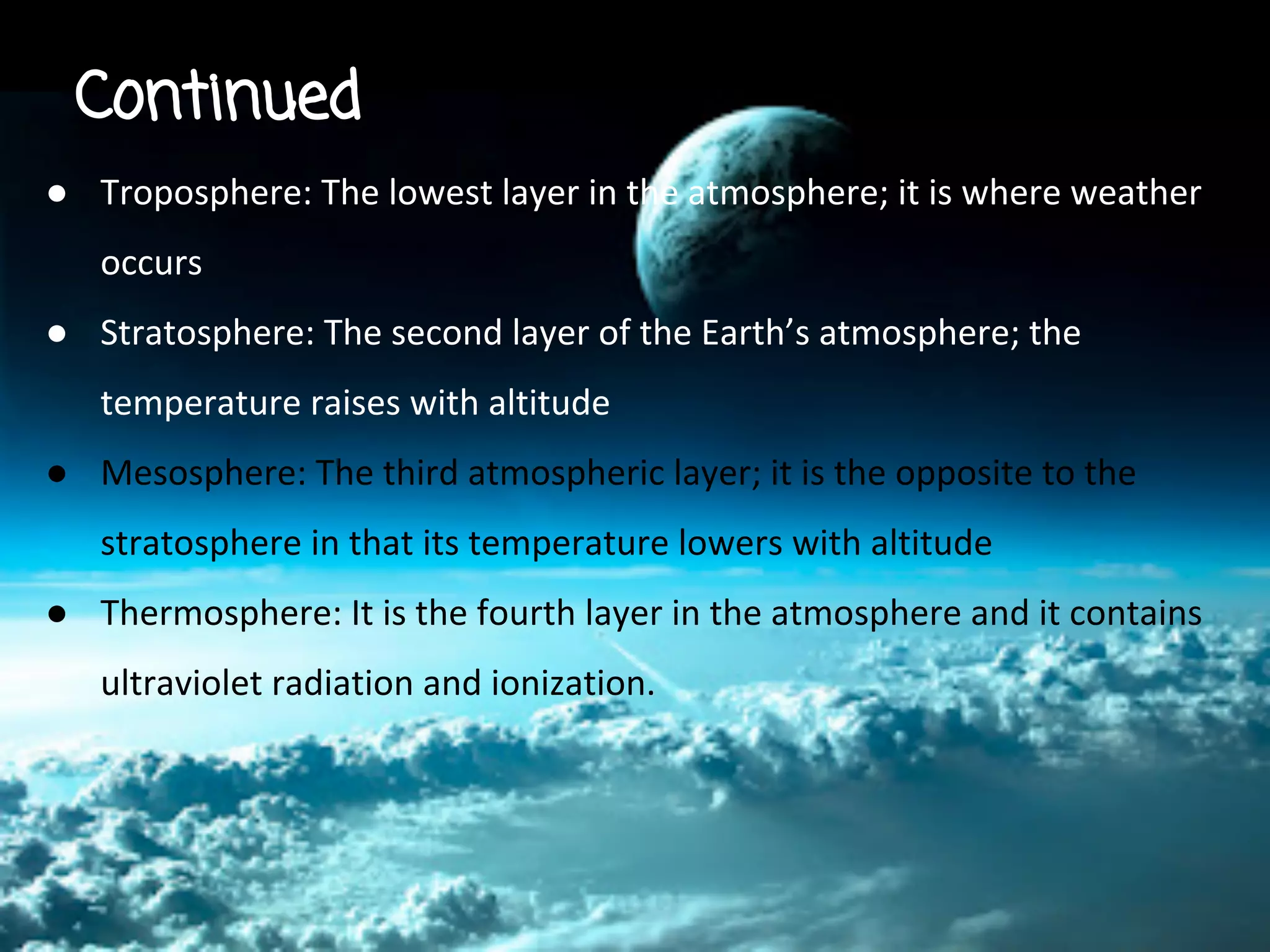
● Troposphere: The lowest layer in the atmosphere; it is where weather
occurs
● Stratosphere: The second layer of the Earth’s atmosphere; the
temperature raises with altitude
● Mesosphere: The third atmospheric layer; it is the opposite to the
stratosphere in that its temperature lowers with altitude
● Thermosphere: It is the fourth layer in the atmosphere and it contains
ultraviolet radiation and ionization.
More Continued
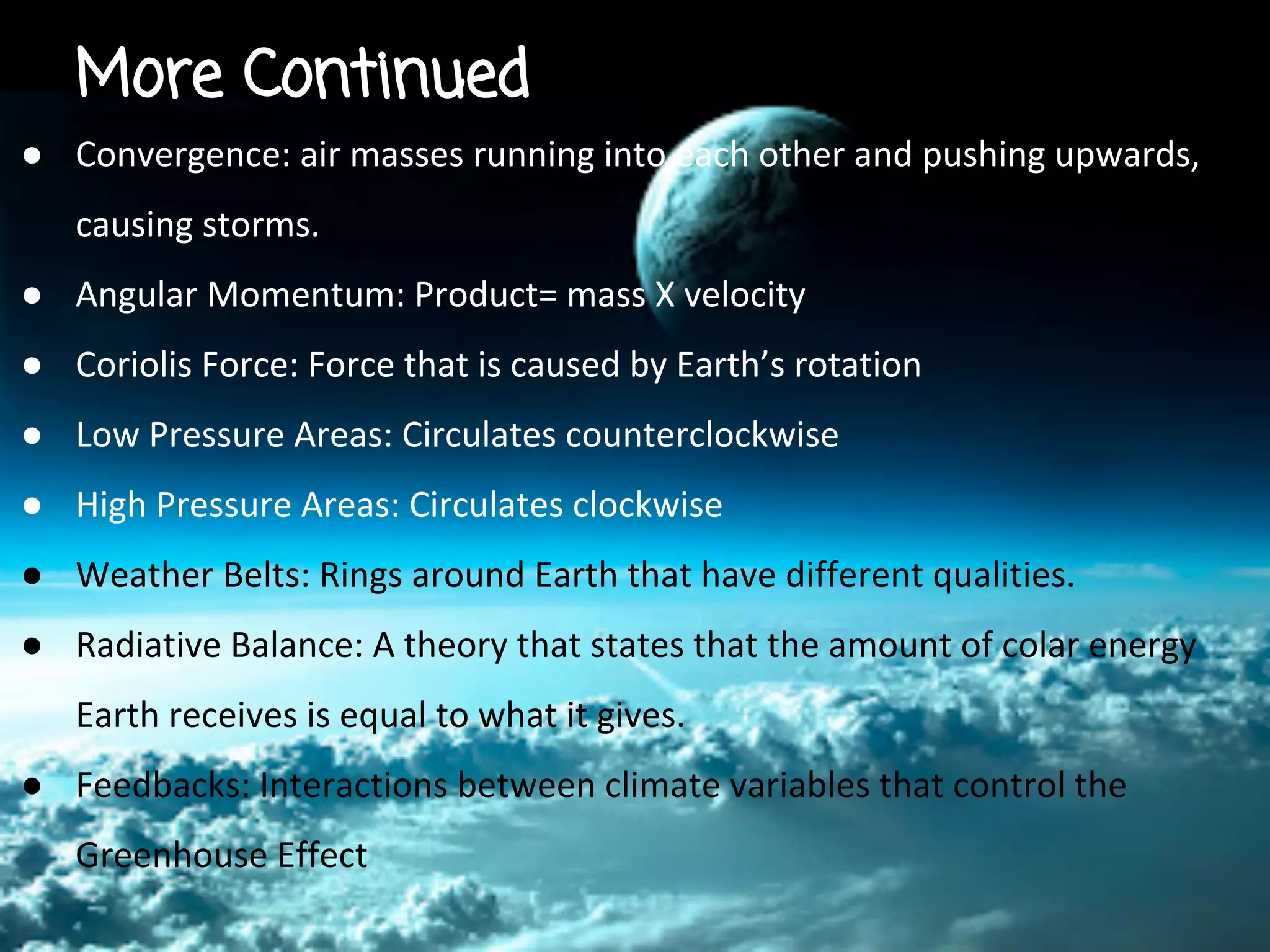
● Convergence: air masses running into each other and pushing upwards,
causing storms.
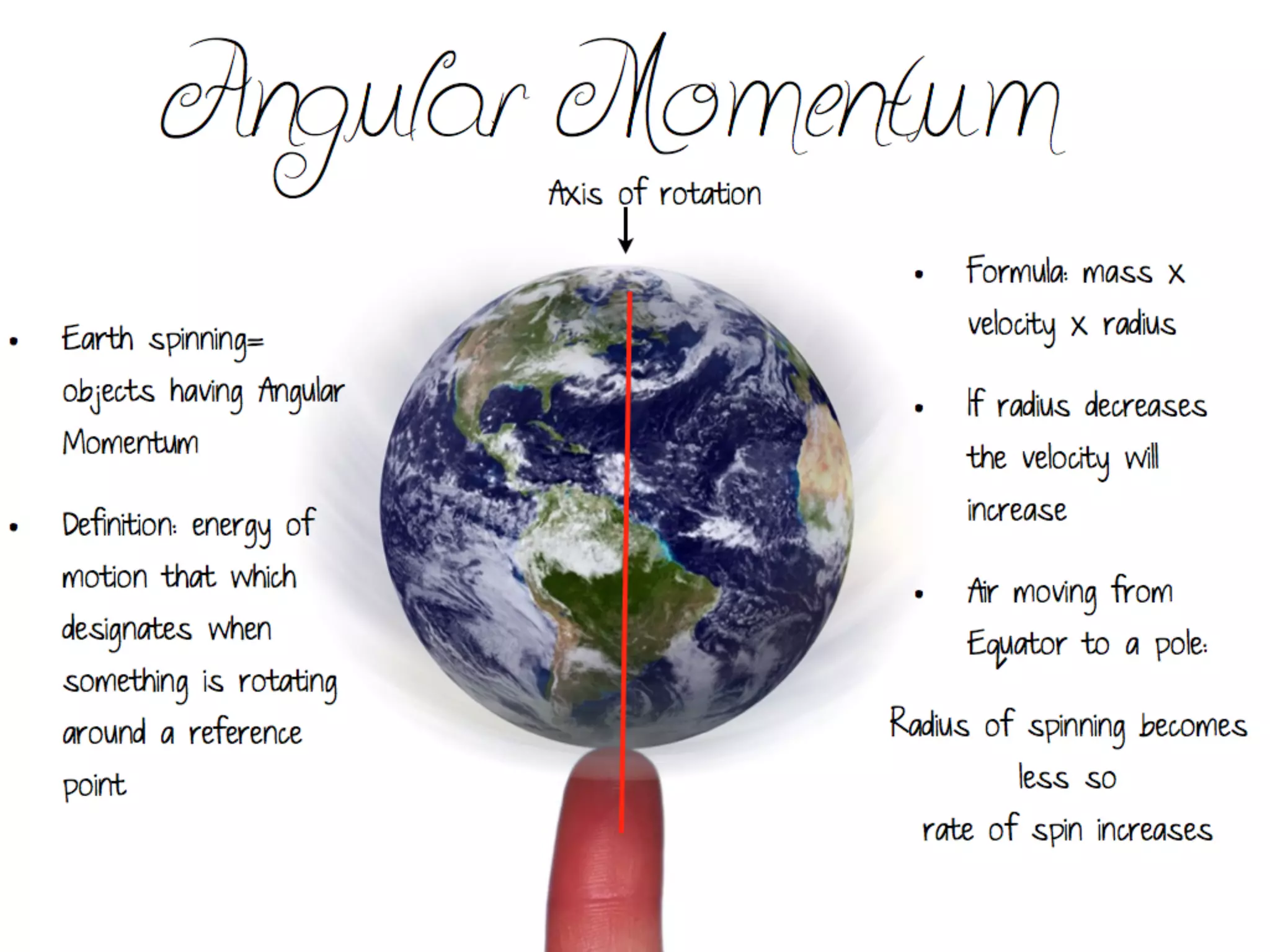
● Angular Momentum: Product= mass X velocity
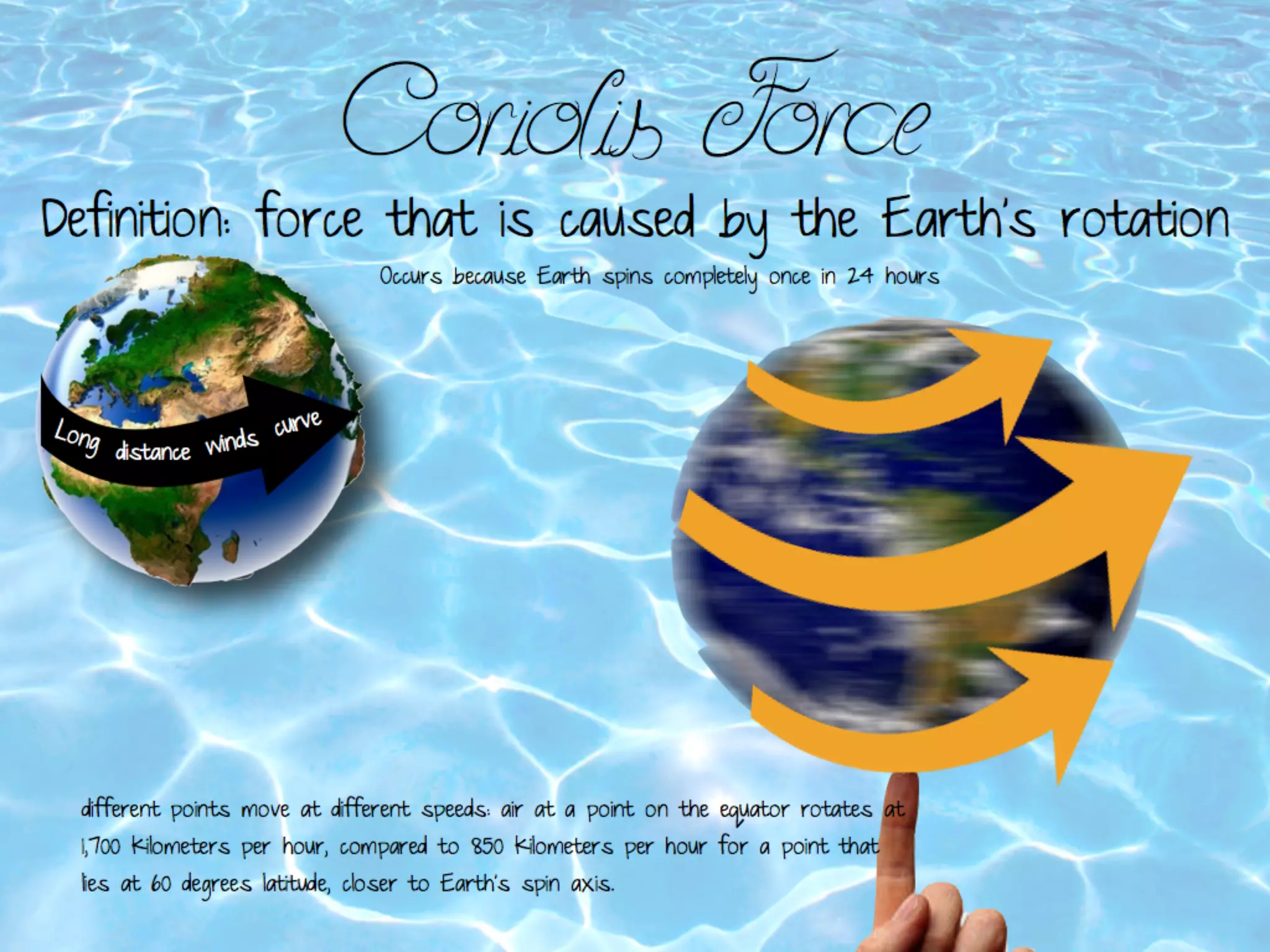
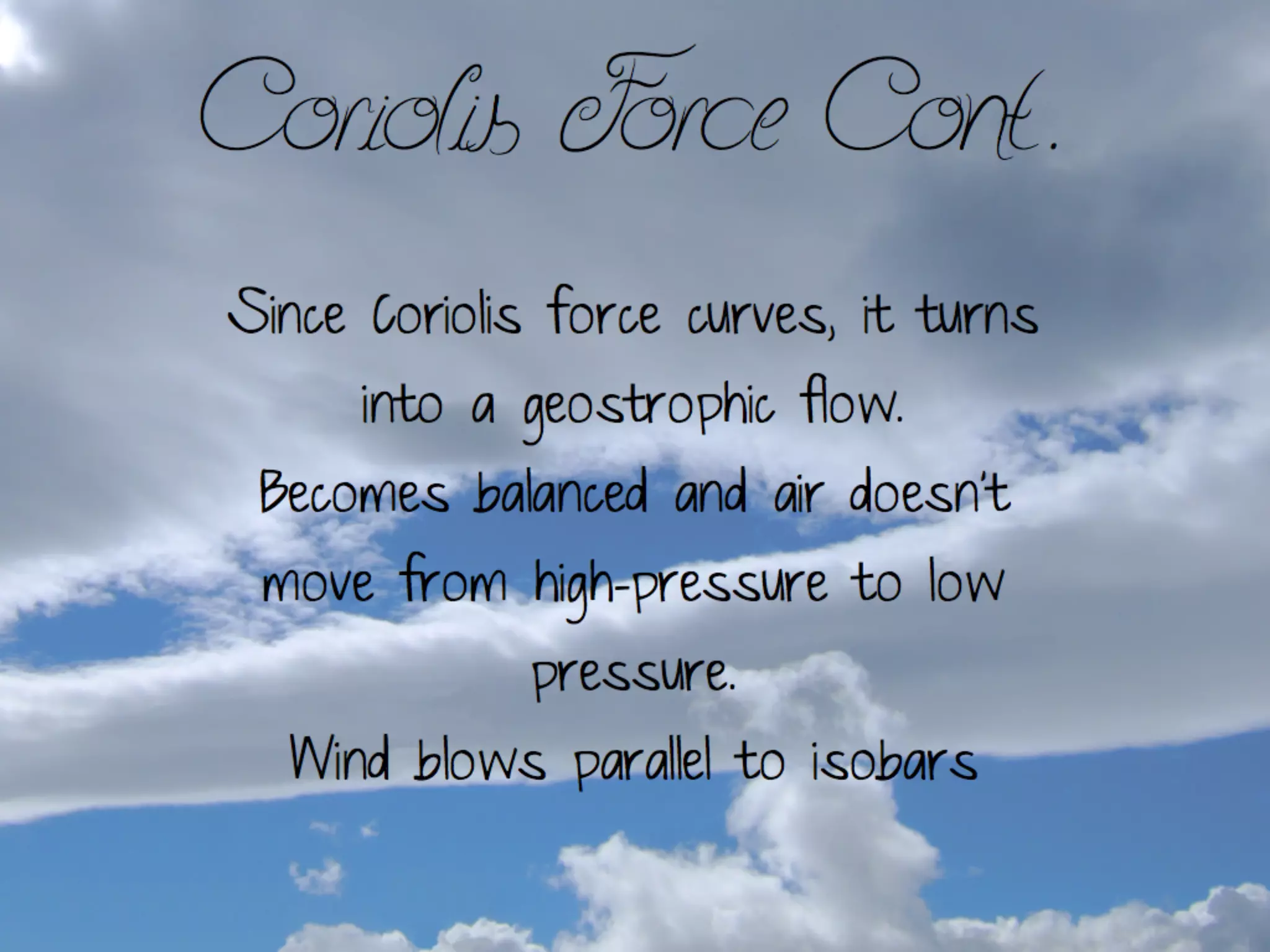
● Coriolis Force: Force that is caused by Earth’s rotation
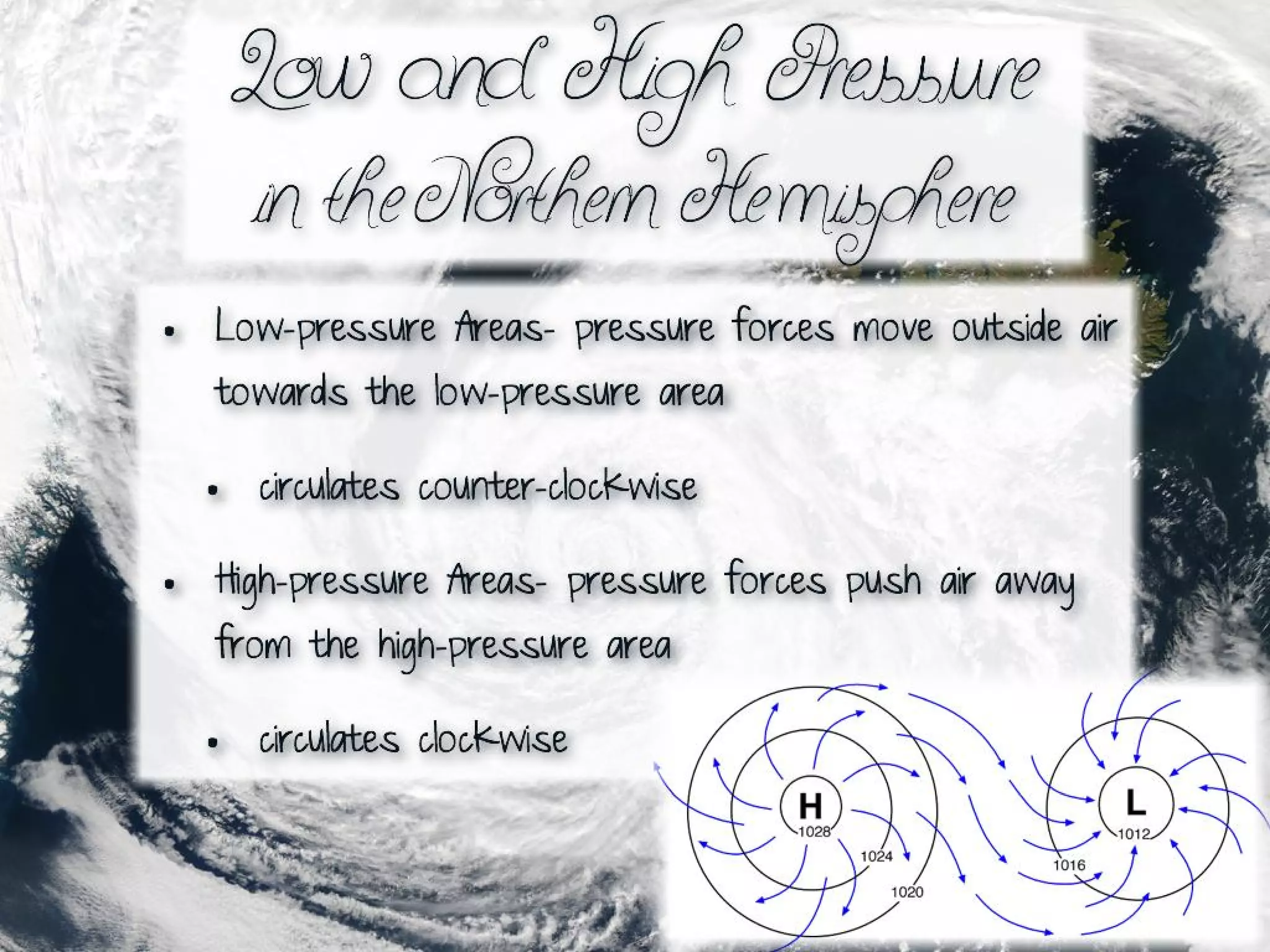
● Low Pressure Areas: Circulates counterclockwise
● High Pressure Areas: Circulates clockwise
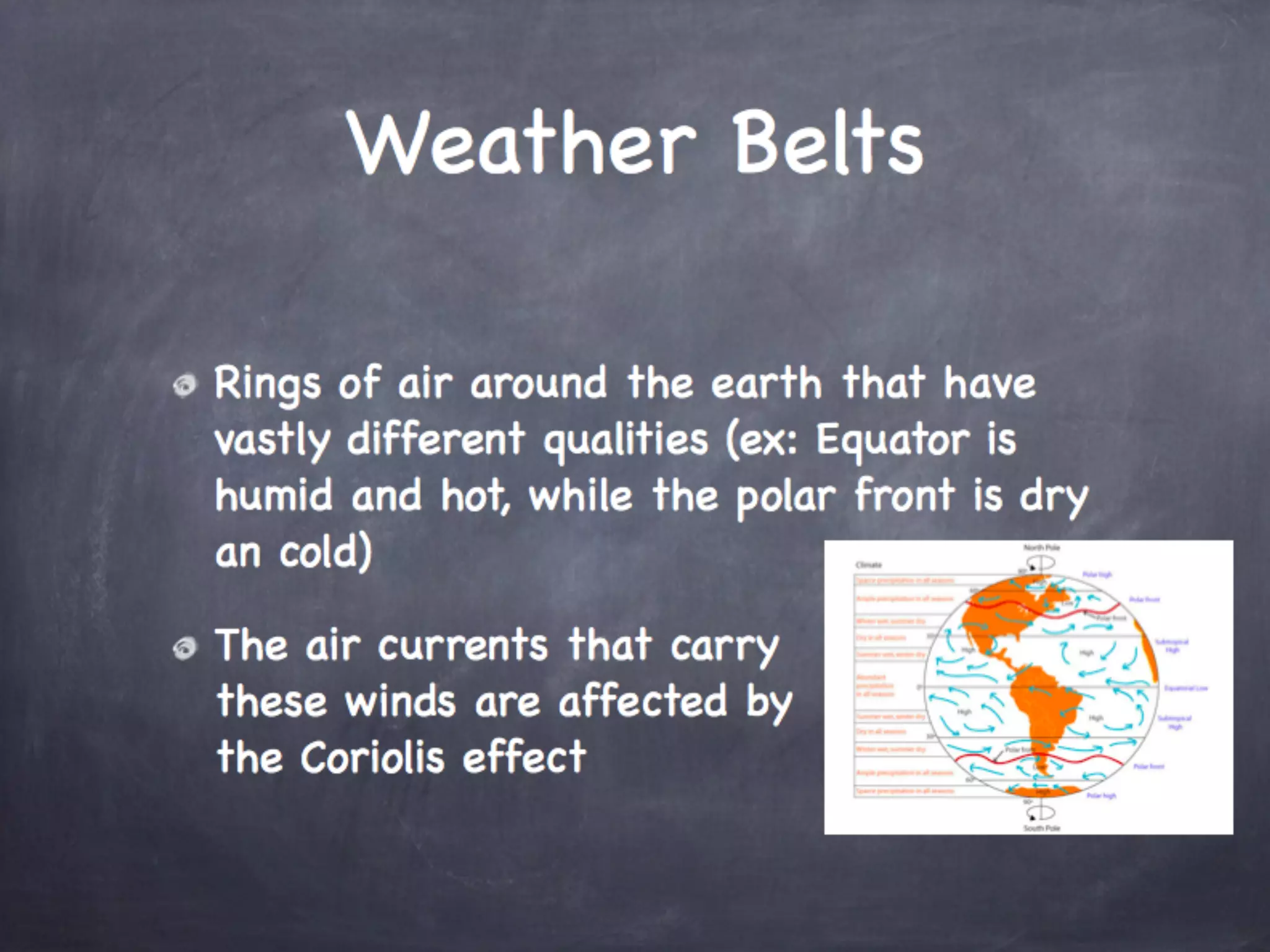
● Weather Belts: Rings around Earth that have different qualities.
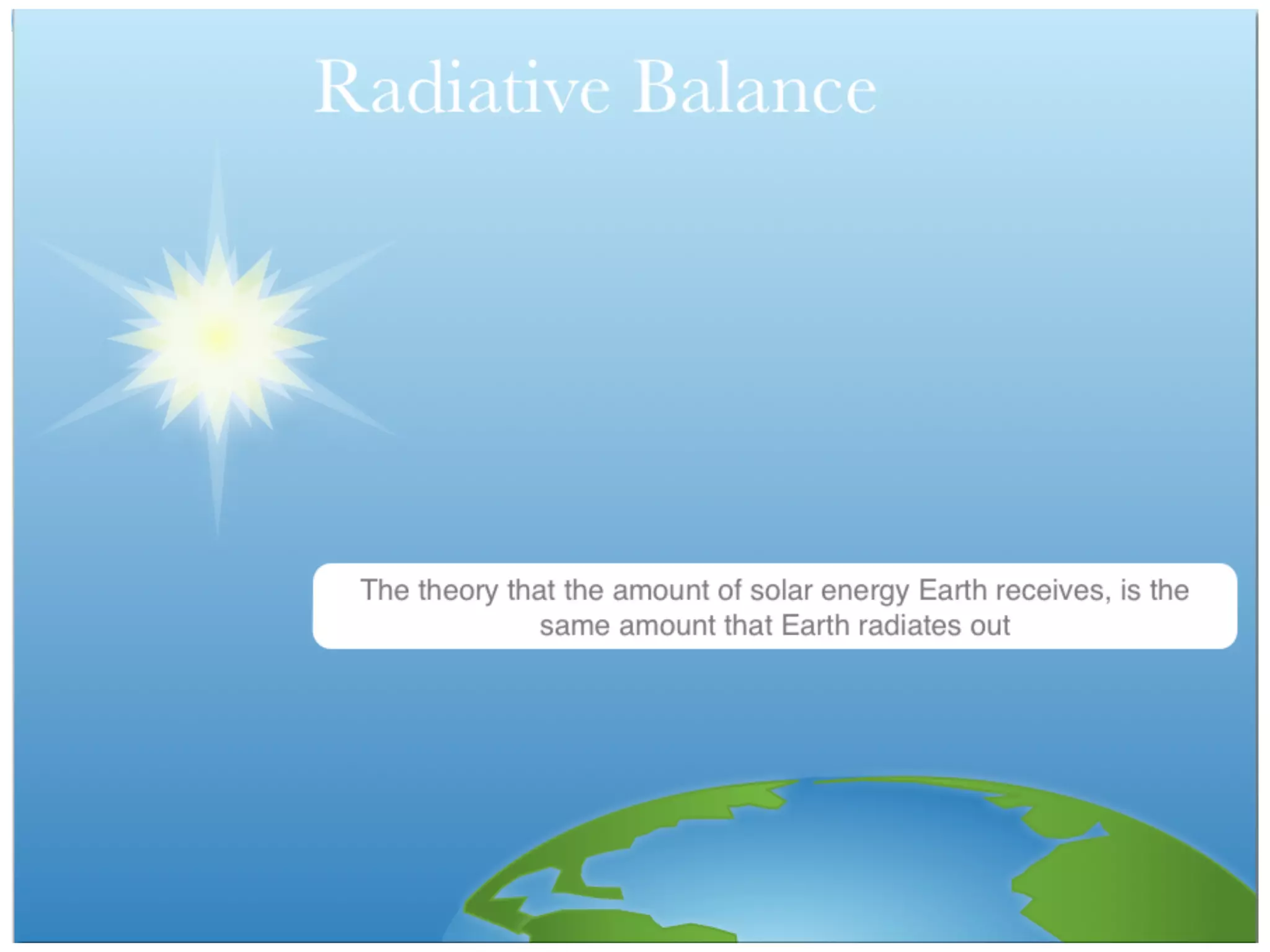
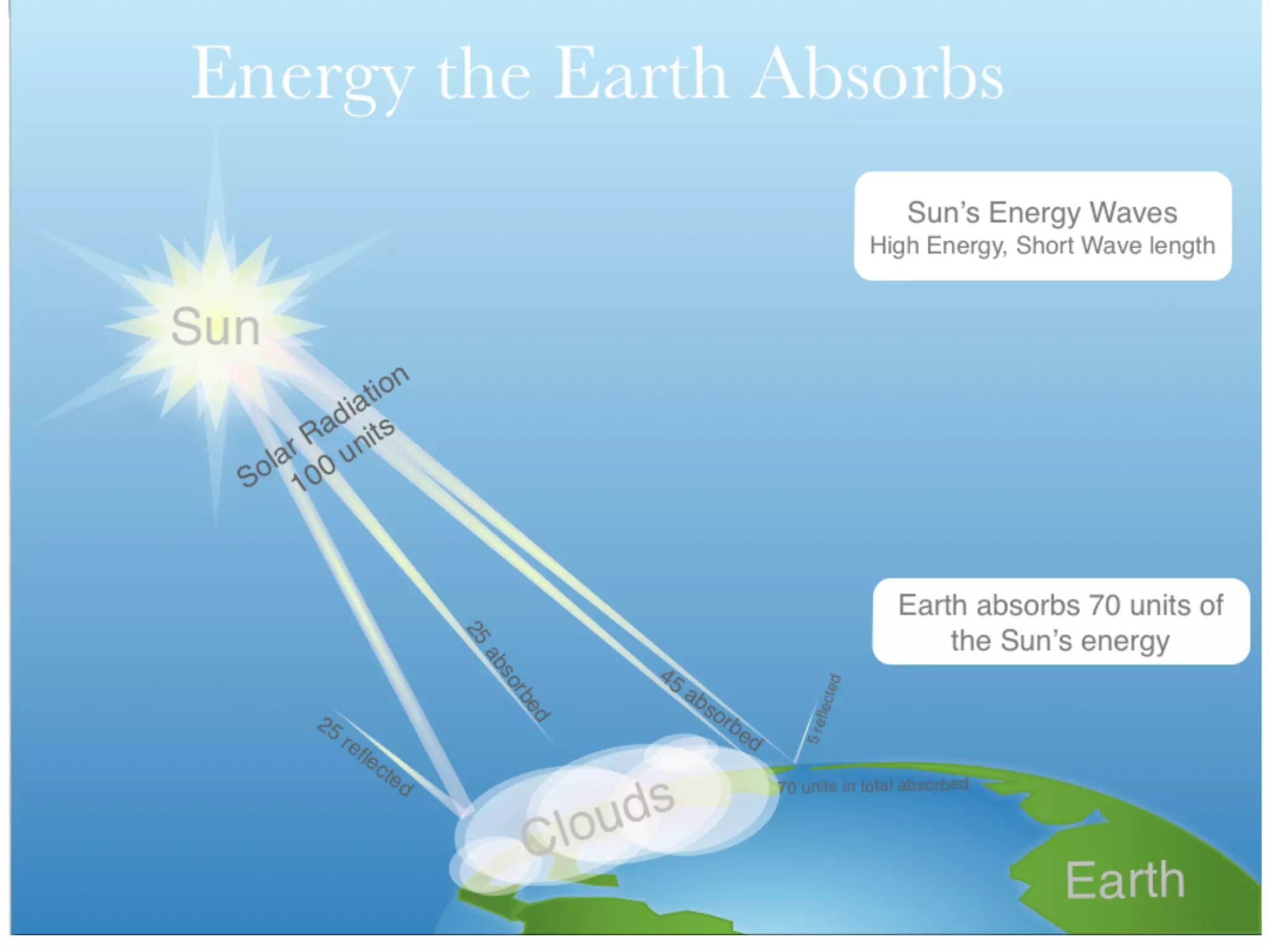
● Radiative Balance: A theory that states that the amount of colar energy
Earth receives is equal to what it gives.
● Feedbacks: Interactions between climate variables that control the
Greenhouse Effect
More More Continued
● Positive Feedbacks: Strengthen the Greenhouse Effect and/or
reduce albedo.
● Negative Feedbacks: Reduce the sensitivity in the climate system.

Unit 2 Earth's Atmosphere

  • 1.
  • 2.
    Introduction This Unit ● Greenhouseeffect: The greenhouse effect is a process by which thermal radiation from a planetary surface is absorbed by atmospheric greenhouse gases ● Cycling Carbon: The carbon cycle is the biogeochemical cycle by which carbon is exchanged among the biosphere, pedosphere, geosphere, hydrosphere, and atmosphere of the Earth. ● Climate Zones: Are divisions of the Earth's climates into general climate zones according to average temperatures and average rainfall ● Weather Patterns and Storms ● Creating conditions suitable for life
  • 4.
    The Structure ofthe Atmosphere By: Nicholas Cochrane
  • 5.
    Composition The Atmosphere containsa large amount of different gasses. Gas Mole fraction Water (H2O) 0.55x10⁻⁶ Nitrous Oxide (N2O) Oxygen (O2) 1.1x10⁻⁶ Hydrogen (H2) Nitrogen (N2) Krypton (Kr) 0.32x10⁻⁶ Carbon Monoxide (CO) 0.03x10⁻⁶ to 0.3x10⁻⁶ Chlorofluorocarbo ns 3.0x10⁻⁹ Carbonyl Sulfide (COS) 0.1x10⁻⁹ 0.78 0.21 0.04 to < 5x10⁻³; 4x10⁻⁶ — strat Argon (Ar) 0.0093 Carbon Dioxide (CO2) 370x10-6 (date: 2000) Neon (Ne) 18.2x10⁻⁶ -6 Ozone (O3) 0.02x10 to 10x10 Helium (He) 5.2x10⁻⁶ Methane (CH4) 1.7x10⁻⁶ -6
  • 6.
  • 7.
    Troposphere ● 8 to16 kilometers above Earth's surface ● Temperatures decrease by about 6.5°C with each kilometer ● At the top of the troposphere is the tropopause, a layer of cold air (about -60°C) forms
  • 8.
    Stratosphere ● 50 kilometersabove the earths surface ● temperatures increase with altitude ● About 90 percent of the ozone in the atmosphere is found in the stratosphere. ● one percent of total atmosphere’s water vapor ● slow vertical air motion ● temperatures peak at about -3°C
  • 9.
    Mesosphere ● 85 kilometersabove the earths surface ● Temperatures decrease with altitude ● low of about -93°C
  • 10.
    Thermosphere ● 1,000 kilometresabove the earths surface ● warm with altitude, rising higher than 1700° C.
  • 11.
    Radiative Balance andthe Natural Greenhouse Effect Victoria Owen
  • 16.
    Major Greenhouse Gasses Naturalvs. Human Made Maribeth Villanueva
  • 17.
    Natural Natural GHGs include: Watervapor Ozone Carbon dioxide Methane Nitrous oxide
  • 18.
    Human Made Synthetic Chemicalsare emitted because of human activity. Also, humans increase some of the natural chemicals, which throws off balance.
  • 19.
    Human Made Cont. Hydrofluorocarbonsand perfluorocarbonsAKA F gases.
  • 20.
    Vertical Motion inthe Atmosphere Karis Heidebrecht
  • 21.
    Weather Patterns • Manystart with rising air. This could happen by: •Convection •Winds running into mountains •Convergence - air masses running into each other and pushing upwards, causing storms.
  • 22.
    Atmospheric Conditions • Canbe stable or unstable • Unstable atmosphere more likely to produce clouds and storms • Stable atmosphere more likely to produce calm weather.
  • 23.
  • 29.
  • 32.
    Climate, Weather andStorms Geoffrey Ashton
  • 38.
    The Global CarbonCycle Daniel Monsalve
  • 39.
    The Cycle The carboncycle is based around different stores of carbon. ● CO2 in the atmosphere. ● Carbonate and carbonic acid in oceans. ● Organic matter on land or underwater. On average a carbon atom spends ● 5 years in the atmosphere ● 380 years in oceans or sediments ● 10 years in terrestrial vegetation
  • 40.
    Carbon Movements Carbon inthe atmosphere is scrubbed out by rain into oceans or sediment or absorbed into plants Carbon can stay in fossil fuel deposits for millions of years before it eventually returns to the atmosphere.
  • 41.
    Human Impact Humans havedisrupted the equilibrium of the natural carbon cycle. We have released large amounts of carbon into the atmosphere from using fossil fuels like oil and coal. Also deforestation slows the rate at which carbon is absorbed by plants.
  • 42.
    The Global CarbonCycle McKenna Chase
  • 47.
  • 48.
    What Are Feedbacks? Feedbacks:Interactions between climate variables such as temperature, precipitation, and vegetation, also elements such as clouds and albedo that control the Greenhouse Effect.
  • 49.
    Positive Feedbacks Positive Feedbacksamplify temperature changes by strengthening the Greenhouse effect or by reducing albedo.
  • 50.
    Positive Feedbacks Continued WaterVapor Feedback- The presence of more water vapor as temperatures increase raises the Greenhouse Effect and the absorption of solar radiation which heats the planet. Cloud Feedback on Terrestrial Radiation- Warmer temperatures increase water vapor amounts, which can increase cloudiness and can increase the temperature even further. Ice-Albedo Feedback on Solar Radiation- Rising temperatures cause polar glaciers and floating ice sheets to recede, decreasing Earth’s albedo and raising temperatures.
  • 51.
    Negative Feedbacks Negative Feedbacksmake the climate systems less sensitive to the factors that trigger them.
  • 52.
    Negative Feedbacks Continued CloudFeedbacks on Solar Radiation- As temperature and atmospheric water vapor levels rise, cloudiness may increase. Greater cloudiness raises Earth’s albedo, reflecting more solar radiation back into space and lowering the temperature. Vegetation Feedback on Solar Radiation- Deserts may expand as temperatures rise, which would increase Earth’s albedo and lower the temperature.
  • 59.
    Key Terms (Katrina Moore) ●Carbon Cycle: The biogeochemical cycle in which carbon is exchanged among the biosphere, pedosphere, geosphere, hydrosphere, and atmosphere of the Earth. ● Greenhouse effect: A process in which thermal radiation from a planetary surface is absorbed by atmospheric greenhouse gases ● Photosynthesis: CO2 + H2O + light → "CH2O" + O2 ● Respiration: "CH2O" + O2 → CO2 + H2O + energy ● Climate Zones: Are divisions of the Earth's climates into general climate zones according to average temperatures and average rainfall
  • 60.
    Continued ● Troposphere: Thelowest layer in the atmosphere; it is where weather occurs ● Stratosphere: The second layer of the Earth’s atmosphere; the temperature raises with altitude ● Mesosphere: The third atmospheric layer; it is the opposite to the stratosphere in that its temperature lowers with altitude ● Thermosphere: It is the fourth layer in the atmosphere and it contains ultraviolet radiation and ionization.
  • 61.
    More Continued ● Convergence:air masses running into each other and pushing upwards, causing storms. ● Angular Momentum: Product= mass X velocity ● Coriolis Force: Force that is caused by Earth’s rotation ● Low Pressure Areas: Circulates counterclockwise ● High Pressure Areas: Circulates clockwise ● Weather Belts: Rings around Earth that have different qualities. ● Radiative Balance: A theory that states that the amount of colar energy Earth receives is equal to what it gives. ● Feedbacks: Interactions between climate variables that control the Greenhouse Effect
  • 62.
    More More Continued ●Positive Feedbacks: Strengthen the Greenhouse Effect and/or reduce albedo. ● Negative Feedbacks: Reduce the sensitivity in the climate system.