Star Groups
   Mr. Silva
Ag Earth Science
Stars

ď‚—The visible stars you see at night are only some of
 the stars in our galaxy.

ď‚—Most stars seem to be single stars, but in actuality
 they are mostly doubles and triples.
      1/3 are doubles
      ¼ are singles
Constellations

ď‚—Constellations are patterns of starts.

ď‚—They may look like they are close together but really
 they are extremely far apart.
ď‚—We recognize 88 different constellations.

ď‚—Named after gods, heroes or fierce animals.
Galaxies
ď‚—The major components of the universe are
 galaxies.
ď‚—They are large groups of stars bound together by
 gravitational attraction.
ď‚—Made up of millions of stars, dust clouds and
 gases.
ď‚—Estimated 50 billion and 1 trillion galaxies in the
 universe.
ď‚—We live in the Milky Way Galaxies.
Types of Galaxies

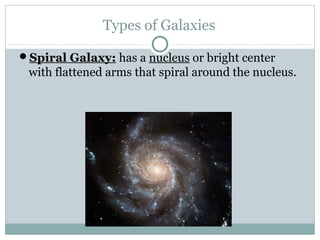
ď‚—Spiral Galaxy: has a nucleus or bright center
 with flattened arms that spiral around the nucleus.
Types of Galaxies

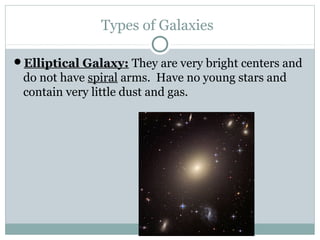
ď‚—Elliptical Galaxy: They are very bright centers and
 do not have spiral arms. Have no young stars and
 contain very little dust and gas.
Types of Galaxies

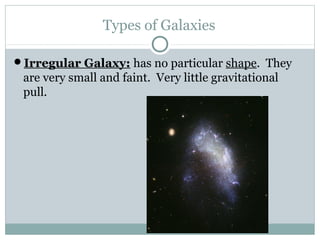
ď‚—Irregular Galaxy: has no particular shape. They
 are very small and faint. Very little gravitational
 pull.
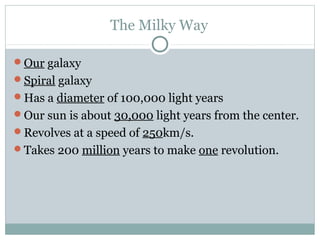
The Milky Way

ď‚—Our galaxy
ď‚—Spiral galaxy
ď‚—Has a diameter of 100,000 light years
ď‚—Our sun is about 30,000 light years from the center.
ď‚—Revolves at a speed of 250km/s.
ď‚—Takes 200 million years to make one revolution.
Formation of the Universe

ď‚—The big bang theory- matter was all concentrated in
 an extremely small volume

ď‚—Occurred 12-15 billion years ago.


ď‚—Galaxies are continuing to move outward.
Formation of the Universe

ď‚—The big bang theory- matter was all concentrated in
 an extremely small volume

ď‚—Occurred 12-15 billion years ago.


ď‚—Galaxies are continuing to move outward.

7.3 star groups

  • 1.
    Star Groups Mr. Silva Ag Earth Science
  • 2.
    Stars The visible starsyou see at night are only some of the stars in our galaxy. Most stars seem to be single stars, but in actuality they are mostly doubles and triples.  1/3 are doubles  ¼ are singles
  • 3.
    Constellations ď‚—Constellations are patternsof starts. ď‚—They may look like they are close together but really they are extremely far apart. ď‚—We recognize 88 different constellations. ď‚—Named after gods, heroes or fierce animals.
  • 4.
    Galaxies ď‚—The major componentsof the universe are galaxies. ď‚—They are large groups of stars bound together by gravitational attraction. ď‚—Made up of millions of stars, dust clouds and gases. ď‚—Estimated 50 billion and 1 trillion galaxies in the universe. ď‚—We live in the Milky Way Galaxies.
  • 5.
    Types of Galaxies ď‚—SpiralGalaxy: has a nucleus or bright center with flattened arms that spiral around the nucleus.
  • 6.
    Types of Galaxies ď‚—EllipticalGalaxy: They are very bright centers and do not have spiral arms. Have no young stars and contain very little dust and gas.
  • 7.
    Types of Galaxies ď‚—IrregularGalaxy: has no particular shape. They are very small and faint. Very little gravitational pull.
  • 8.
    The Milky Way ď‚—Ourgalaxy ď‚—Spiral galaxy ď‚—Has a diameter of 100,000 light years ď‚—Our sun is about 30,000 light years from the center. ď‚—Revolves at a speed of 250km/s. ď‚—Takes 200 million years to make one revolution.
  • 9.
    Formation of theUniverse ď‚—The big bang theory- matter was all concentrated in an extremely small volume ď‚—Occurred 12-15 billion years ago. ď‚—Galaxies are continuing to move outward.
  • 10.
    Formation of theUniverse ď‚—The big bang theory- matter was all concentrated in an extremely small volume ď‚—Occurred 12-15 billion years ago. ď‚—Galaxies are continuing to move outward.