Unit 4: Ecosystems
APES Period 4
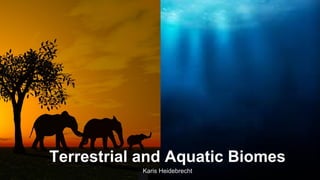
Terrestrial and Aquatic Biomes
Karis Heidebrecht
What is a Biome?

Definition: A major biological community, such
as a grassland or desert, characterized chiefly
by the dominant forms of plant life and the
prevailing climate.
Terrestrial Biomes Include
tropical rainforest, temperate rainforest,
deciduous forest, taiga, savanna,temperate
grasslands, alpine and tundra.
Aquatic Biomes Include
estuaries, oceans, lakes, rivers, ponds,
coral reefs and wetlands.
Energy Flow Through Ecosystems
McKenna
Biogeochemical Cycles
Daniel Monsalve
Carbon Cycle
Nitrogen Cycle
Nitrogen makes up 78% of the atmosphere it is also an essential nutrient for all
life.
Nitrogen fixation - Most organisms can’t use atmospheric oxygen, but certain
bacteria transfer it into other compounds like ammonia (NH4). Ammonia can then
be used as a source of nitrogen for other organisms. Lightning also fixes a small
amount of nitrogen.
Assimilation - Nitrogen that is fixed can then be used by plants where it is then
transferred to animals who eat the plants.
Nitrification - Is the process of turning ammonia into nitrates or nitrites. It is
carried out by b acteria.
Denitrification - Other bacteria take organic nitrogen and nitrates and turn it
back into gaseous nitrogen.
Effects of Excess Nitrogen
The burning of fossil fuels and the use of
manufactured fertilizers increase nitrogen on
land in the atmosphere and in oceans.
Ammonia (NH3) in the atmosphere has tripled
from human activity. This has led to water and
air pollution and in some cases acid rain.

Nitrogen Cycle Video
Phosphorus Cycle

Sulfur Cycle

Phosphorus Cycle Animation
Water Cycle
Population Dynamics
Geoffrey Ashton
The black bar was here when I got here I swear!
*Black Bar*
Natural Ecosystem Change
Michaela Brost
Succession

The process by which one natural community
changes into another over a time scale of
years to centuries is called succession.
Succession represents a natural transition
from r- K-selected species.
Primary Succession

Referring to colonization of a newly exposed
landform, such as sand dunes or lava flows
after a volcanic eruption.
Secondary Succession

Describing the return of an area to its natural
vegetation following a disturbance such as fire,
treefall, or forest harvesting.
Autogenic Succession

Change driven by the inhabitants of an
ecosystem, such as forests re-growing on
abandoned agricultural fields.
Allogenic Succession

Change driven by new external geophysical
conditions such as rising average temperatures
resulting from global climate change.
Key Terms
Victoria Owen
Key Terms (Continued) Maribeth Villanueva
Adaptation- make (something) suitable for a
new use or purpose; modify.
Adaptive trait- a trait with a current functional
role in the life history of an organism that is
maintained and evolved by means of natural
selection.
Age structure- A population pyramid, also
called an age pyramid or age picture diagram,
is a graphical illustration that shows the
distribution of various age groups in a
population, which forms the shape of a pyramid
when the population is growing
◊
Age distributions- the distributions of age in a
population

Unit 4 Ecosystems

  • 1.
  • 3.
    Terrestrial and AquaticBiomes Karis Heidebrecht
  • 4.
    What is aBiome? Definition: A major biological community, such as a grassland or desert, characterized chiefly by the dominant forms of plant life and the prevailing climate.
  • 5.
    Terrestrial Biomes Include tropicalrainforest, temperate rainforest, deciduous forest, taiga, savanna,temperate grasslands, alpine and tundra.
  • 6.
    Aquatic Biomes Include estuaries,oceans, lakes, rivers, ponds, coral reefs and wetlands.
  • 8.
    Energy Flow ThroughEcosystems McKenna
  • 12.
  • 13.
  • 14.
    Nitrogen Cycle Nitrogen makesup 78% of the atmosphere it is also an essential nutrient for all life. Nitrogen fixation - Most organisms can’t use atmospheric oxygen, but certain bacteria transfer it into other compounds like ammonia (NH4). Ammonia can then be used as a source of nitrogen for other organisms. Lightning also fixes a small amount of nitrogen. Assimilation - Nitrogen that is fixed can then be used by plants where it is then transferred to animals who eat the plants. Nitrification - Is the process of turning ammonia into nitrates or nitrites. It is carried out by b acteria. Denitrification - Other bacteria take organic nitrogen and nitrates and turn it back into gaseous nitrogen.
  • 15.
    Effects of ExcessNitrogen The burning of fossil fuels and the use of manufactured fertilizers increase nitrogen on land in the atmosphere and in oceans. Ammonia (NH3) in the atmosphere has tripled from human activity. This has led to water and air pollution and in some cases acid rain. Nitrogen Cycle Video
  • 17.
  • 22.
  • 23.
  • 32.
    The black barwas here when I got here I swear!
  • 38.
  • 47.
  • 48.
    Succession The process bywhich one natural community changes into another over a time scale of years to centuries is called succession. Succession represents a natural transition from r- K-selected species.
  • 49.
    Primary Succession Referring tocolonization of a newly exposed landform, such as sand dunes or lava flows after a volcanic eruption.
  • 50.
    Secondary Succession Describing thereturn of an area to its natural vegetation following a disturbance such as fire, treefall, or forest harvesting.
  • 51.
    Autogenic Succession Change drivenby the inhabitants of an ecosystem, such as forests re-growing on abandoned agricultural fields.
  • 52.
    Allogenic Succession Change drivenby new external geophysical conditions such as rising average temperatures resulting from global climate change.
  • 57.
  • 61.
    Key Terms (Continued)Maribeth Villanueva Adaptation- make (something) suitable for a new use or purpose; modify. Adaptive trait- a trait with a current functional role in the life history of an organism that is maintained and evolved by means of natural selection.
  • 62.
    Age structure- Apopulation pyramid, also called an age pyramid or age picture diagram, is a graphical illustration that shows the distribution of various age groups in a population, which forms the shape of a pyramid when the population is growing
  • 63.
    ◊ Age distributions- thedistributions of age in a population