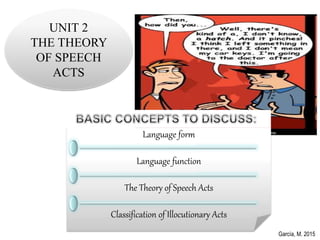
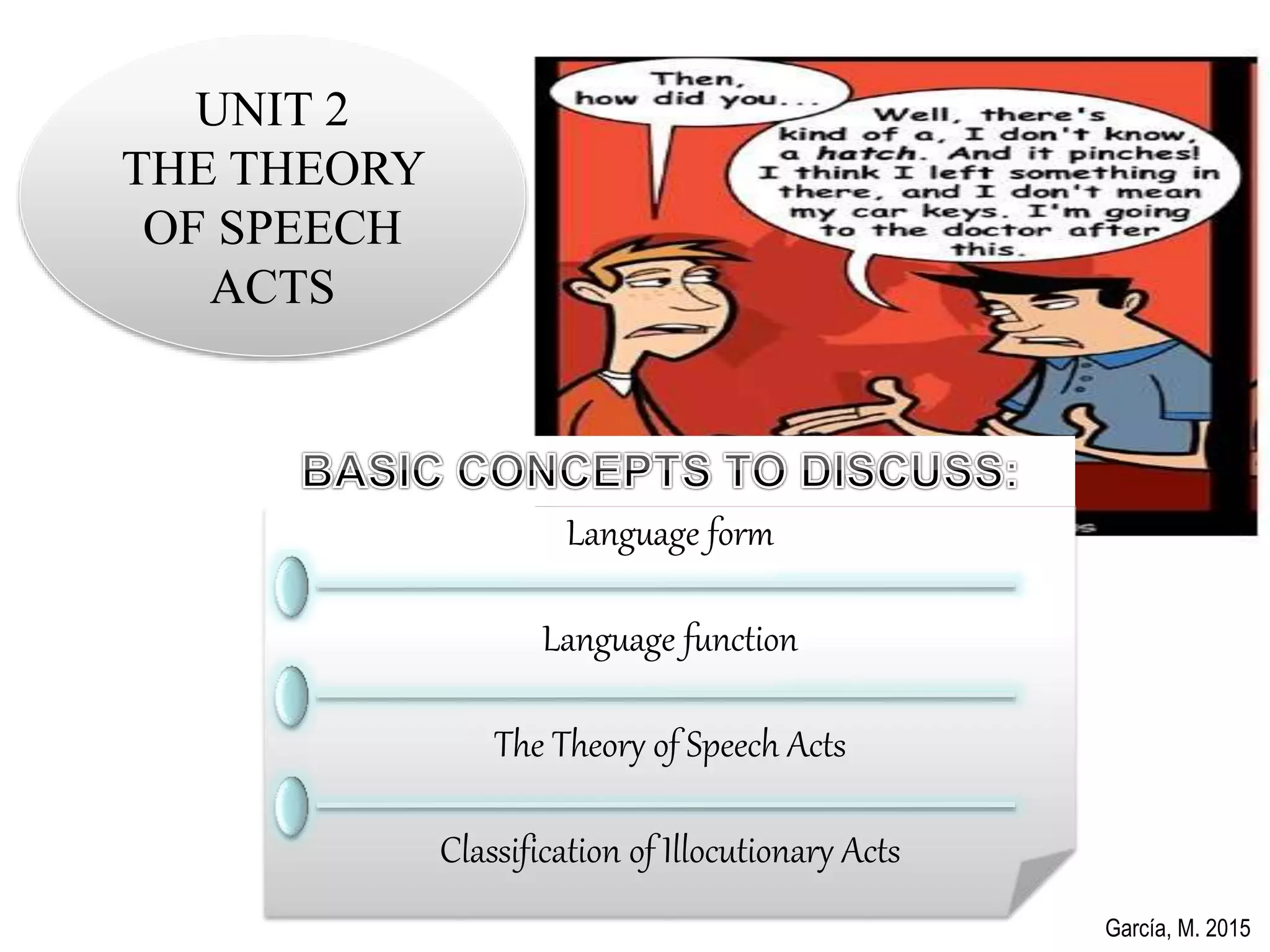
Language form
Language function
The Theory of Speech Acts
Classification of Illocutionary Acts
García, M. 2015
UNIT 2
THE THEORY
OF SPEECH
ACTS
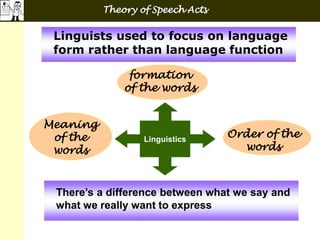
Linguistics
Theory of Speech Acts
Linguists used to focus on language
form rather than language function
formation
of the words
Order of the
words
Meaning
of the
words
There’s a difference between what we say and
what we really want to express
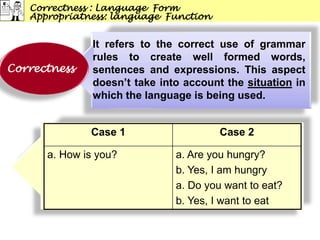
Correctness
It refers to the correct use of grammar
rules to create well formed words,
sentences and expressions. This aspect
doesn’t take into account the situation in
which the language is being used.
Correctness : Language Form
Appropriatness: language Function
Case 1 Case 2
a. How is you? a. Are you hungry?
b. Yes, I am hungry
a. Do you want to eat?
b. Yes, I want to eat
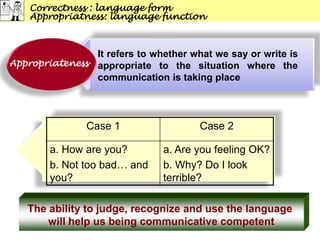
Appropriateness
It refers to whether what we say or write is
appropriate to the situation where the
communication is taking place
Case 1 Case 2
a. How are you?
b. Not too bad… and
you?
a. Are you feeling OK?
b. Why? Do I look
terrible?
The ability to judge, recognize and use the language
will help us being communicative competent
Correctness : language form
Appropriatness: language function
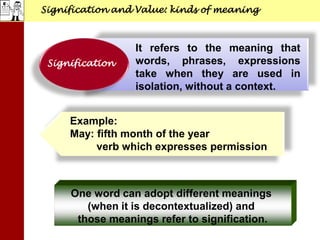
Signification and Value: kinds of meaning
Signification
One word can adopt different meanings
(when it is decontextualized) and
those meanings refer to signification.
It refers to the meaning that
words, phrases, expressions
take when they are used in
isolation, without a context.
Example:
May: fifth month of the year
verb which expresses permission
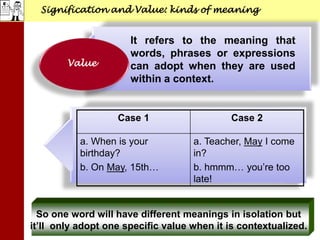
Signification and Value: kinds of meaning
Value
So one word will have different meanings in isolation but
it’ll only adopt one specific value when it is contextualized.
It refers to the meaning that
words, phrases or expressions
can adopt when they are used
within a context.
Case 1 Case 2
a. When is your
birthday?
b. On May, 15th…
a. Teacher, May I come
in?
b. hmmm… you’re too
late!
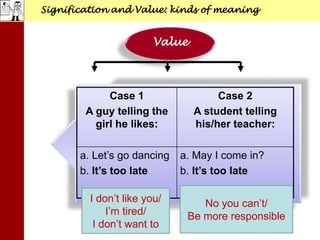
Signification and Value: kinds of meaning
Value
Case 1
A guy telling the
girl he likes:
Case 2
A student telling
his/her teacher:
a. Let’s go dancing
b. It’s too late
a. May I come in?
b. It’s too late
I don’t like you/
I’m tired/
I don’t want to
No you can’t/
Be more responsible
Signification and Value: kinds of meaning
The same word (or phrase) can adopt different
values because of the co-text and different situations
in which it is used.
This implies that we need to go beyond words and
focus on language function.
The theory of speech act is going to help us
achieve this goal
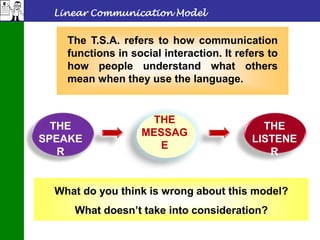
Linear Communication Model
THE
SPEAKE
R
THE
LISTENE
R
THE
MESSAG
E
What do you think is wrong about this model?
What doesn’t take into consideration?
The T.S.A. refers to how communication
functions in social interaction. It refers to
how people understand what others
mean when they use the language.
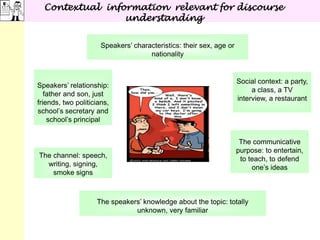
Contextual information relevant for discourse
understanding
Speakers’ characteristics: their sex, age or
nationality
Speakers’ relationship:
father and son, just
friends, two politicians,
school’s secretary and
school’s principal
Social context: a party,
a class, a TV
interview, a restaurant
The channel: speech,
writing, signing,
smoke signs
The communicative
purpose: to entertain,
to teach, to defend
one’s ideas
The speakers’ knowledge about the topic: totally
unknown, very familiar
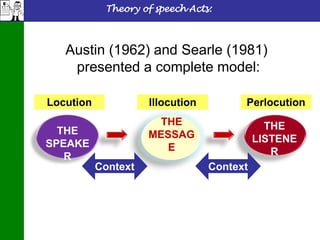
Theory of speech Acts:
THE
SPEAKE
R
THE
LISTENE
R
THE
MESSAG
E
Locution Illocution Perlocution
Context Context
Austin (1962) and Searle (1981)
presented a complete model:
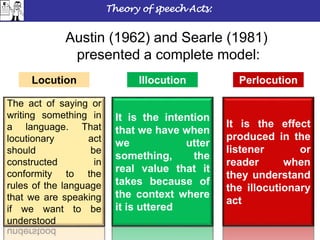
Theory of speech Acts:
Locution Illocution Perlocution
Austin (1962) and Searle (1981)
presented a complete model:
The act of saying or
writing something in
a language. That
locutionary act
should be
constructed in
conformity to the
rules of the language
that we are speaking
if we want to be
understood
It is the intention
that we have when
we utter
something, the
real value that it
takes because of
the context where
it is uttered
It is the effect
produced in the
listener or
reader when
they understand
the illocutionary
act
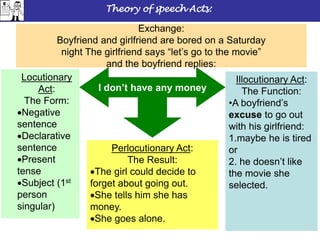
Theory of speech Acts:
Locutionary
Act:
The Form:
Negative
sentence
Declarative
sentence
Present
tense
Subject (1st
person
singular)
Illocutionary Act:
The Function:
•A boyfriend’s
excuse to go out
with his girlfriend:
1.maybe he is tired
or
2. he doesn’t like
the movie she
selected.
Perlocutionary Act:
The Result:
The girl could decide to
forget about going out.
She tells him she has
money.
She goes alone.
I don’t have any money
Exchange:
Boyfriend and girlfriend are bored on a Saturday
night The girlfriend says “let’s go to the movie”
and the boyfriend replies:
Watch the video related to Searle’s classification
https://www.youtube.com/watch?v=Pl2cZ0Eb1Bk
Answer the
following question
according to what
you understood
from the video
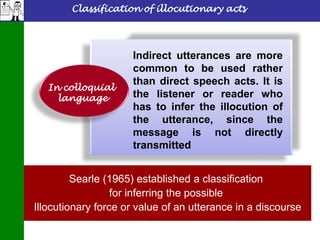
Classification of illocutionary acts
In colloquial
language
Indirect utterances are more
common to be used rather
than direct speech acts. It is
the listener or reader who
has to infer the illocution of
the utterance, since the
message is not directly
transmitted
Searle (1965) established a classification
for inferring the possible
Illocutionary force or value of an utterance in a discourse
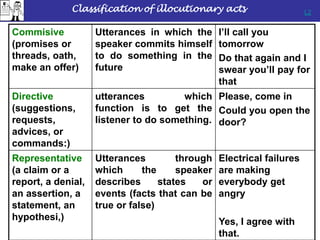
Classification of illocutionary acts
Commisive
(promises or
threads, oath,
make an offer)
Utterances in which the
speaker commits himself
to do something in the
future
I’ll call you
tomorrow
Do that again and I
swear you’ll pay for
that
Directive
(suggestions,
requests,
advices, or
commands:)
utterances which
function is to get the
listener to do something.
Please, come in
Could you open the
door?
Representative
(a claim or a
report, a denial,
an assertion, a
statement, an
hypothesi,)
Utterances through
which the speaker
describes states or
events (facts that can be
true or false)
Electrical failures
are making
everybody get
angry
Yes, I agree with
that.
L2
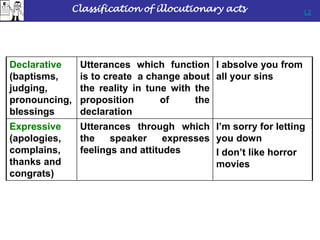
Classification of illocutionary acts
Declarative
(baptisms,
judging,
pronouncing,
blessings
Utterances which function
is to create a change about
the reality in tune with the
proposition of the
declaration
I absolve you from
all your sins
Expressive
(apologies,
complains,
thanks and
congrats)
Utterances through which
the speaker expresses
feelings and attitudes
I’m sorry for letting
you down
I don’t like horror
movies
L2
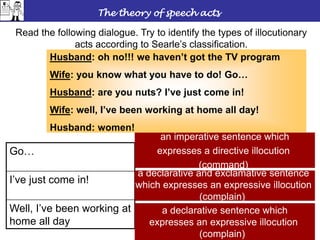
The theory of speech acts
Read the following dialogue. Try to identify the types of illocutionary
acts according to Searle’s classification.
Go…
I’ve just come in!
Well, I’ve been working at
home all day
an imperative sentence which
expresses a directive illocution
(command)
a declarative and exclamative sentence
which expresses an expressive illocution
(complain)
a declarative sentence which
expresses an expressive illocution
(complain)
Husband: oh no!!! we haven’t got the TV program
Wife: you know what you have to do! Go…
Husband: are you nuts? I’ve just come in!
Wife: well, I’ve been working at home all day!
Husband: women!
It is important for English teachers to keep in mind
that most of our discourse in normal communication
are indirect. This is why it is not enough to teach our
students grammar; it is our obligation to teach them
the multiple ways in which the grammatical structures
that they study in class are used in real
communication
Read carefully the lyrics of the song YOU
ROCK MY WORLD (MICHAEL JACKSON).
Select at least 3 sentences, analyzing them
in terms of form (locutionary force) and
function (the possible illocutionary forces).
Remember to classify its illocutionary force
according to Searle’s classification, justifying
your decision.
PRACTICE ACTIVITY
My life will never be the same cause girl, you came and changed
The way I walk, The way I talk
I cannot explain the things I feel for you but girl, you know it's true
Stay with me, fulfill my dreams
And I'll be all you'll need
Oh, oh, oh, oh, ooh, it feels so right
I've searched for the perfect love all my life
Oh, oh, oh, oh, ooh, it feels like I have
finally found her perfect love is mine
(See, I finally found, come on, girl)
You rocked my world, you know you did
And everything I own I give
The rarest love who’d think I’d find someone like you to call mine
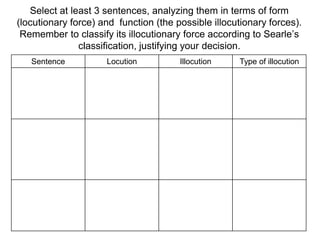
Sentence Locution Illocution Type of illocution
Select at least 3 sentences, analyzing them in terms of form
(locutionary force) and function (the possible illocutionary forces).
Remember to classify its illocutionary force according to Searle’s
classification, justifying your decision.

Unit 2

  • 1.
    Language form Language function TheTheory of Speech Acts Classification of Illocutionary Acts García, M. 2015 UNIT 2 THE THEORY OF SPEECH ACTS
  • 2.
    Linguistics Theory of SpeechActs Linguists used to focus on language form rather than language function formation of the words Order of the words Meaning of the words There’s a difference between what we say and what we really want to express
  • 3.
    Correctness It refers tothe correct use of grammar rules to create well formed words, sentences and expressions. This aspect doesn’t take into account the situation in which the language is being used. Correctness : Language Form Appropriatness: language Function Case 1 Case 2 a. How is you? a. Are you hungry? b. Yes, I am hungry a. Do you want to eat? b. Yes, I want to eat
  • 4.
    Appropriateness It refers towhether what we say or write is appropriate to the situation where the communication is taking place Case 1 Case 2 a. How are you? b. Not too bad… and you? a. Are you feeling OK? b. Why? Do I look terrible? The ability to judge, recognize and use the language will help us being communicative competent Correctness : language form Appropriatness: language function
  • 5.
    Signification and Value:kinds of meaning Signification One word can adopt different meanings (when it is decontextualized) and those meanings refer to signification. It refers to the meaning that words, phrases, expressions take when they are used in isolation, without a context. Example: May: fifth month of the year verb which expresses permission
  • 6.
    Signification and Value:kinds of meaning Value So one word will have different meanings in isolation but it’ll only adopt one specific value when it is contextualized. It refers to the meaning that words, phrases or expressions can adopt when they are used within a context. Case 1 Case 2 a. When is your birthday? b. On May, 15th… a. Teacher, May I come in? b. hmmm… you’re too late!
  • 7.
    Signification and Value:kinds of meaning Value Case 1 A guy telling the girl he likes: Case 2 A student telling his/her teacher: a. Let’s go dancing b. It’s too late a. May I come in? b. It’s too late I don’t like you/ I’m tired/ I don’t want to No you can’t/ Be more responsible
  • 8.
    Signification and Value:kinds of meaning The same word (or phrase) can adopt different values because of the co-text and different situations in which it is used. This implies that we need to go beyond words and focus on language function. The theory of speech act is going to help us achieve this goal
  • 9.
    Linear Communication Model THE SPEAKE R THE LISTENE R THE MESSAG E Whatdo you think is wrong about this model? What doesn’t take into consideration? The T.S.A. refers to how communication functions in social interaction. It refers to how people understand what others mean when they use the language.
  • 10.
    Contextual information relevantfor discourse understanding Speakers’ characteristics: their sex, age or nationality Speakers’ relationship: father and son, just friends, two politicians, school’s secretary and school’s principal Social context: a party, a class, a TV interview, a restaurant The channel: speech, writing, signing, smoke signs The communicative purpose: to entertain, to teach, to defend one’s ideas The speakers’ knowledge about the topic: totally unknown, very familiar
  • 11.
    Theory of speechActs: THE SPEAKE R THE LISTENE R THE MESSAG E Locution Illocution Perlocution Context Context Austin (1962) and Searle (1981) presented a complete model:
  • 12.
    Theory of speechActs: Locution Illocution Perlocution Austin (1962) and Searle (1981) presented a complete model: The act of saying or writing something in a language. That locutionary act should be constructed in conformity to the rules of the language that we are speaking if we want to be understood It is the intention that we have when we utter something, the real value that it takes because of the context where it is uttered It is the effect produced in the listener or reader when they understand the illocutionary act
  • 13.
    Theory of speechActs: Locutionary Act: The Form: Negative sentence Declarative sentence Present tense Subject (1st person singular) Illocutionary Act: The Function: •A boyfriend’s excuse to go out with his girlfriend: 1.maybe he is tired or 2. he doesn’t like the movie she selected. Perlocutionary Act: The Result: The girl could decide to forget about going out. She tells him she has money. She goes alone. I don’t have any money Exchange: Boyfriend and girlfriend are bored on a Saturday night The girlfriend says “let’s go to the movie” and the boyfriend replies:
  • 14.
    Watch the videorelated to Searle’s classification https://www.youtube.com/watch?v=Pl2cZ0Eb1Bk Answer the following question according to what you understood from the video
  • 16.
    Classification of illocutionaryacts In colloquial language Indirect utterances are more common to be used rather than direct speech acts. It is the listener or reader who has to infer the illocution of the utterance, since the message is not directly transmitted Searle (1965) established a classification for inferring the possible Illocutionary force or value of an utterance in a discourse
  • 17.
    Classification of illocutionaryacts Commisive (promises or threads, oath, make an offer) Utterances in which the speaker commits himself to do something in the future I’ll call you tomorrow Do that again and I swear you’ll pay for that Directive (suggestions, requests, advices, or commands:) utterances which function is to get the listener to do something. Please, come in Could you open the door? Representative (a claim or a report, a denial, an assertion, a statement, an hypothesi,) Utterances through which the speaker describes states or events (facts that can be true or false) Electrical failures are making everybody get angry Yes, I agree with that. L2
  • 18.
    Classification of illocutionaryacts Declarative (baptisms, judging, pronouncing, blessings Utterances which function is to create a change about the reality in tune with the proposition of the declaration I absolve you from all your sins Expressive (apologies, complains, thanks and congrats) Utterances through which the speaker expresses feelings and attitudes I’m sorry for letting you down I don’t like horror movies L2
  • 19.
    The theory ofspeech acts Read the following dialogue. Try to identify the types of illocutionary acts according to Searle’s classification. Go… I’ve just come in! Well, I’ve been working at home all day an imperative sentence which expresses a directive illocution (command) a declarative and exclamative sentence which expresses an expressive illocution (complain) a declarative sentence which expresses an expressive illocution (complain) Husband: oh no!!! we haven’t got the TV program Wife: you know what you have to do! Go… Husband: are you nuts? I’ve just come in! Wife: well, I’ve been working at home all day! Husband: women!
  • 20.
    It is importantfor English teachers to keep in mind that most of our discourse in normal communication are indirect. This is why it is not enough to teach our students grammar; it is our obligation to teach them the multiple ways in which the grammatical structures that they study in class are used in real communication
  • 21.
    Read carefully thelyrics of the song YOU ROCK MY WORLD (MICHAEL JACKSON). Select at least 3 sentences, analyzing them in terms of form (locutionary force) and function (the possible illocutionary forces). Remember to classify its illocutionary force according to Searle’s classification, justifying your decision. PRACTICE ACTIVITY
  • 22.
    My life willnever be the same cause girl, you came and changed The way I walk, The way I talk I cannot explain the things I feel for you but girl, you know it's true Stay with me, fulfill my dreams And I'll be all you'll need Oh, oh, oh, oh, ooh, it feels so right I've searched for the perfect love all my life Oh, oh, oh, oh, ooh, it feels like I have finally found her perfect love is mine (See, I finally found, come on, girl) You rocked my world, you know you did And everything I own I give The rarest love who’d think I’d find someone like you to call mine
  • 23.
    Sentence Locution IllocutionType of illocution Select at least 3 sentences, analyzing them in terms of form (locutionary force) and function (the possible illocutionary forces). Remember to classify its illocutionary force according to Searle’s classification, justifying your decision.