Presented by
Shabana perveen Roll no 28
Sajid Saleem Roll no 02
MPhil linguistic 1st semester
(University)Institute of southern
Punjab Multan
What is a speech act theory?
 Attempts to explain how speakers use language to
accomplish intended actions and how listeners
determine and intended meaning from what is said.
 Is a subfield of pragmatics concerned with the ways in
with words can be used to not only to present
information but also to carryout actions.
 This was purposed by J.L. Austin(1962) from the book
‘How to Do things with Words ‘and it was
supplemented by American philosopher John R Searle.
SPEECH ACTS:
DOING THINGS WITH LANGUAGE
 John Austin in his book "How to do things
with words" is the first to introduce the
idea of Speech Acts, analyzing the
relationships between utterances and
performance.
 Impressive success of Chomsky’s classic works made
difficulty for the philosophers of language who were
intended in semantics rather than syntactic aspects.
 Philosophers of language like Richard Montague and
his school of thoughts join hands with the formal
syntactic traditions and semantic orientation a called
intentional semantic.
 More contribution was made by J.L.Austin in the
branch of philosophy referred to as ‘ordinary
language philosophy’ .
History
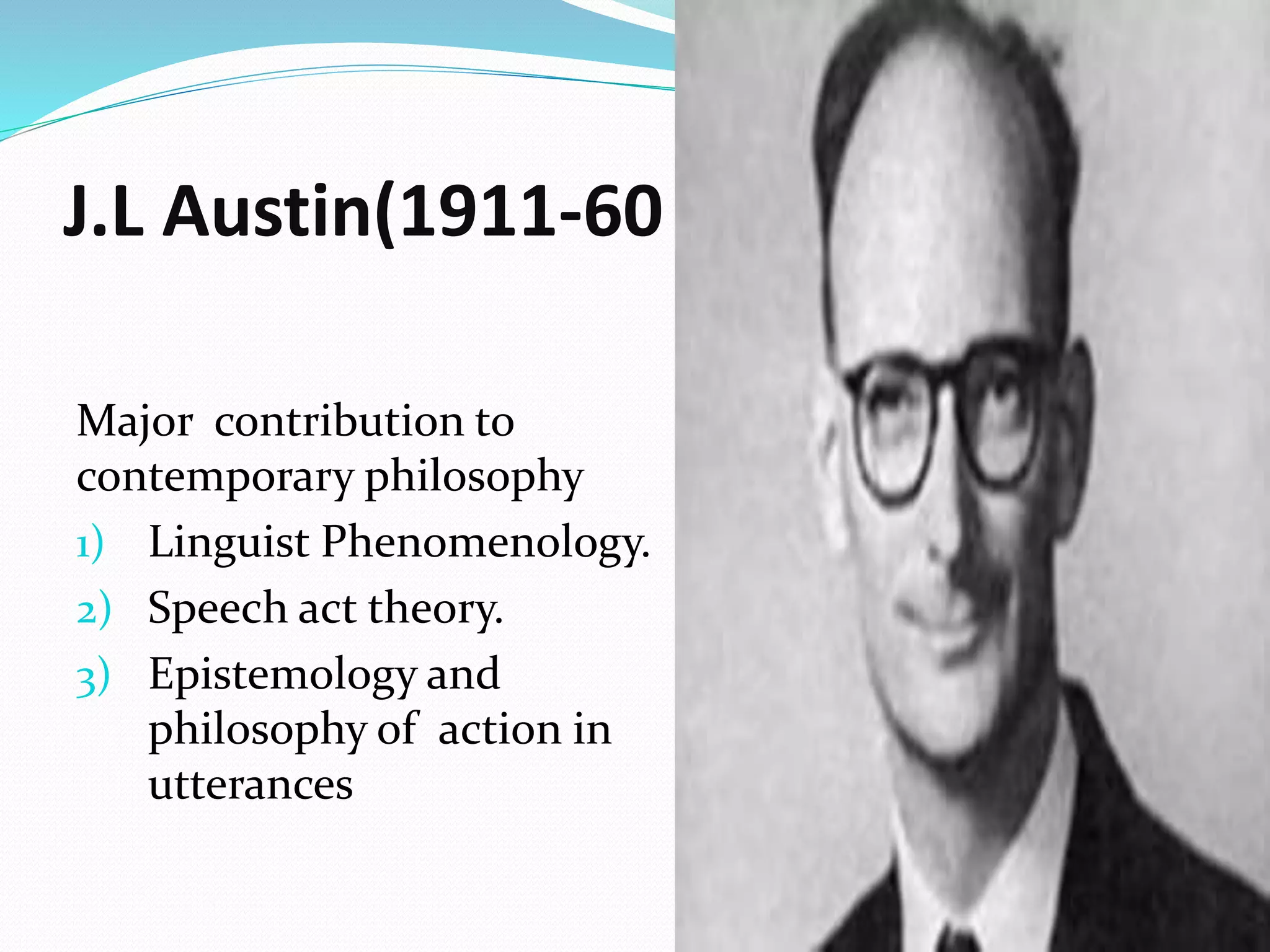
J.L Austin(1911-60
Major contribution to
contemporary philosophy
1) Linguist Phenomenology.
2) Speech act theory.
3) Epistemology and
philosophy of action in
utterances
 Developed new philosophical methodology and style
which became paradigmatic of ‘Ordinary language
philosophy’
 does not claim it as correct method but to remove
philosophical mistake ‘Philosophical mistakes’.
For Instance
 ‘It cold outside’. (Proposition)
 ‘Good luck’. ?
 ‘Congratulations’. ?
 ‘Well done’. ?
Language in use
 Assumptions about Human Language
‘Sound and meaning’(Descriptive Grammar)
‘Set of correct sentences’(Generative Grammar)
But
The basic or minimal unit of linguistic communication
which has generally been supposed ‘The symbol’ Word
or sentence’….but rather the production or word or
sentence in the ‘performance of speech act’.
 People use language with communicative intentions.
Speech acts are acts of communication
that express those intentions.
All speech's situated speech; a speech act
is never just an ‘act of speech’ but should
be considered in the total situation
activity of which it is a part.
Levinson(1979)
We will have to ask ourselves how
speech acts relate to our human activity
as a whole: thinking ‘globally’ while
acting ‘locally’,
How speech acts function
 Speech acts are verbal actions happening in the
world
For Instance
If I say to a new born human; I baptize thee in
the name of the Father and of the ‘Holy
Ghost’ then this human being is from now
on and forever a Christian.
Speech act theory
 A speech act can be divided into three different
smaller acts:
 Locutionary act
 Illocutionary act
 Perlocutionary act
The locutionary act
 The act of performing words into utterances that make
sense in a language with correct grammar and
pronunciation..
Locution: A form of expression; a phrase, an
expression Excerpted from Oxford Talking Dictionary.
1998
For instance:
‘Its cold in here’
The illocutionary act
 Intended communicative action by the speaker, bound
to certain conventions (the illocutionary act can only
be achieved if there is a convention in society that
makes it possible)
Illocution: An action performed by saying or writing
something, e.g. ordering, warning, promising Excerpted
from Oxford Talking Dictionary. 1998
For instance: John says to marry, ‘’pass me the
glasses please’’’.(order or request)
The Perlocutionary act
 The effect that an utterance has on the thoughts,
feelings or attitudes of the listener.
Perlocution: An act of speaking or writing which
aims to effect an action but which in itself does not
effect or constitute the action, as persuading,
convincing. Excerpted from Oxford Talking Dictionary.
1998.
Often the same utterance can have
different illocutionary force (intended
function) in different contexts.
Example: I’ll see you later
I predict that I’ll see you later
I warn you that I’ll see you later
I promise you that I’ll see you later
Functions of SA
 What we say (locution)
 What we mean when we say(Illucation)
 What we accomplish by saying
it(Perlocution)
FELICITY CONDITIONS
 The context and the situation that allow us to
recognize a speech act as intended by the
speaker.
 The conditions that must be fulfilled for a
speech act to be satisfactorily performed or
realized
 A sentence must not only be grammatically
correct, it must also be felicitous , that is
situational appropriate.
For instance
‘’I here by pronounce this person dead’’
In correct circumstances (Appropriate)
In other circumstance, (Speech misfire)
Types of Felicity Conditions
 There are several types of felicitous conditions:
• Propositional content, which requires
participants to understand language, not to act like
actors
• Preparatory, where the authority of the speaker
and the circumstances of the speech act are
appropriate to its being performed successfully
• Sincerity, where the speech act is being performed
seriously and sincerely
• Essential, where the speaker intends that an
utterance be acted upon by the addressee
For example
 Patrick Colm Hogan, in "Philosophical Approaches
to the Study of Literature," describes felicity
conditions with this example:
 "Suppose I am in a play and deliver the line
'I promise to kill the evil Don
Fernando.' I have not, in fact,
promised to kill anyone. ...
Speech act of promising
‘I promise’
(Speech act verb)
(Can lead to misunderstanding)
Speech act of promising
Depends on social frame
For instance:
‘’wilt thou have this woman for thy wife?’’
‘’There is a policeman at the corner’’
‘’I will be there at 7’’
A speech act’s physiognomy:
Promising
 How can we determine a speech act?
 How many speech act are there, and how are they
expressed in language?
 What is the relationship between a speech act and a
pragmatic act?
 Are there speech acts (or pragmatics act) that are
found across languages , or even are in all languages?
(The problem of the so-called ‘universal speech acts’.)
Promises: Conditions
 Condition 1) Normal condition must obtain for
uttering and receiving a promise.
 Condition 2) The promise must have a content.
(I promise I’ll be there tomorrow)
Promises: Conditions
 Condition 3) A promise must have to do with a future, possible
action of the speaker.
(I’m coming to Lahore tomorrow).
 Condition 4&5) condition 4&5 are often called(in
accordance with Searle’s terminology) preparatory
conditions, that is, condition that must have been met
before we can begin to talk about promises.
If you don’t behave, I promise you there’s going
to be trouble.
I can promise anybody that sun will rise
tomorrow
Promises
‘’A happily married man who
promises his wife he will not desert
her in the next week is likely to
provide more anxiety than comfort’’.
Promises: Conditions
 Condition 6) This condition has to do with the
sincerity of the promiser in carrying out the act of
promising.(Sincerity condition)
 Condition 7) A promise intends to put herself or
himself under the obligation of carrying out the
promised act.(Essential Condition)
Promises: Conditions
 Condition 8&9) These condition emphasize that the
language use in promising must be the normal one,
semantically and pragmatically correct.
‘’For Pennsylvanian, taking oaths are
forbidden’’.(Culture)
‘’Never trust a drunks promises’’. (Wisdom)
‘’Promises to wives and children don’t count’’.
It is Society that determines the validity
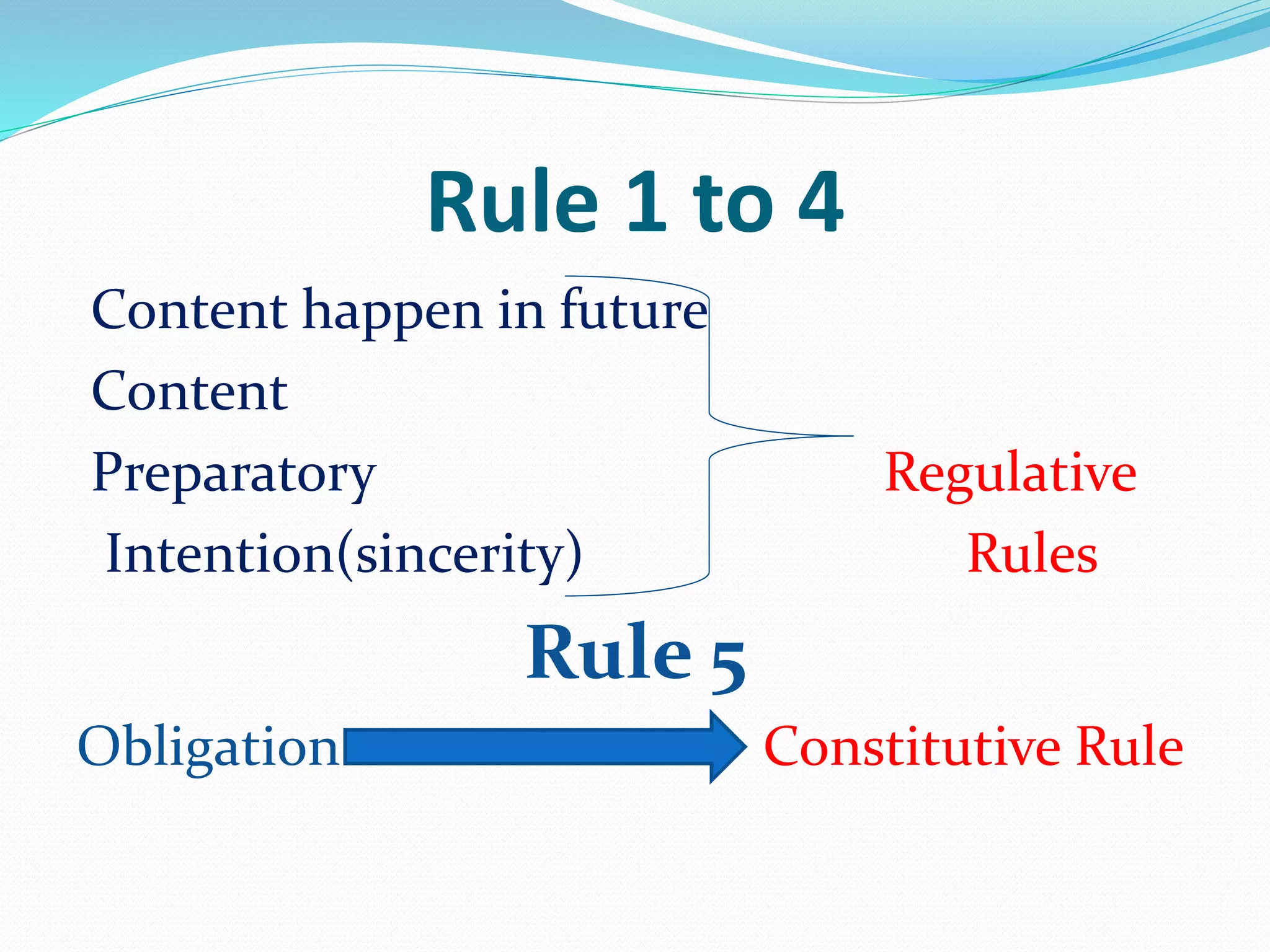
Rule 1 to 4
Content happen in future
Content
Preparatory Regulative
Intention(sincerity) Rules
Rule 5
Obligation Constitutive Rule
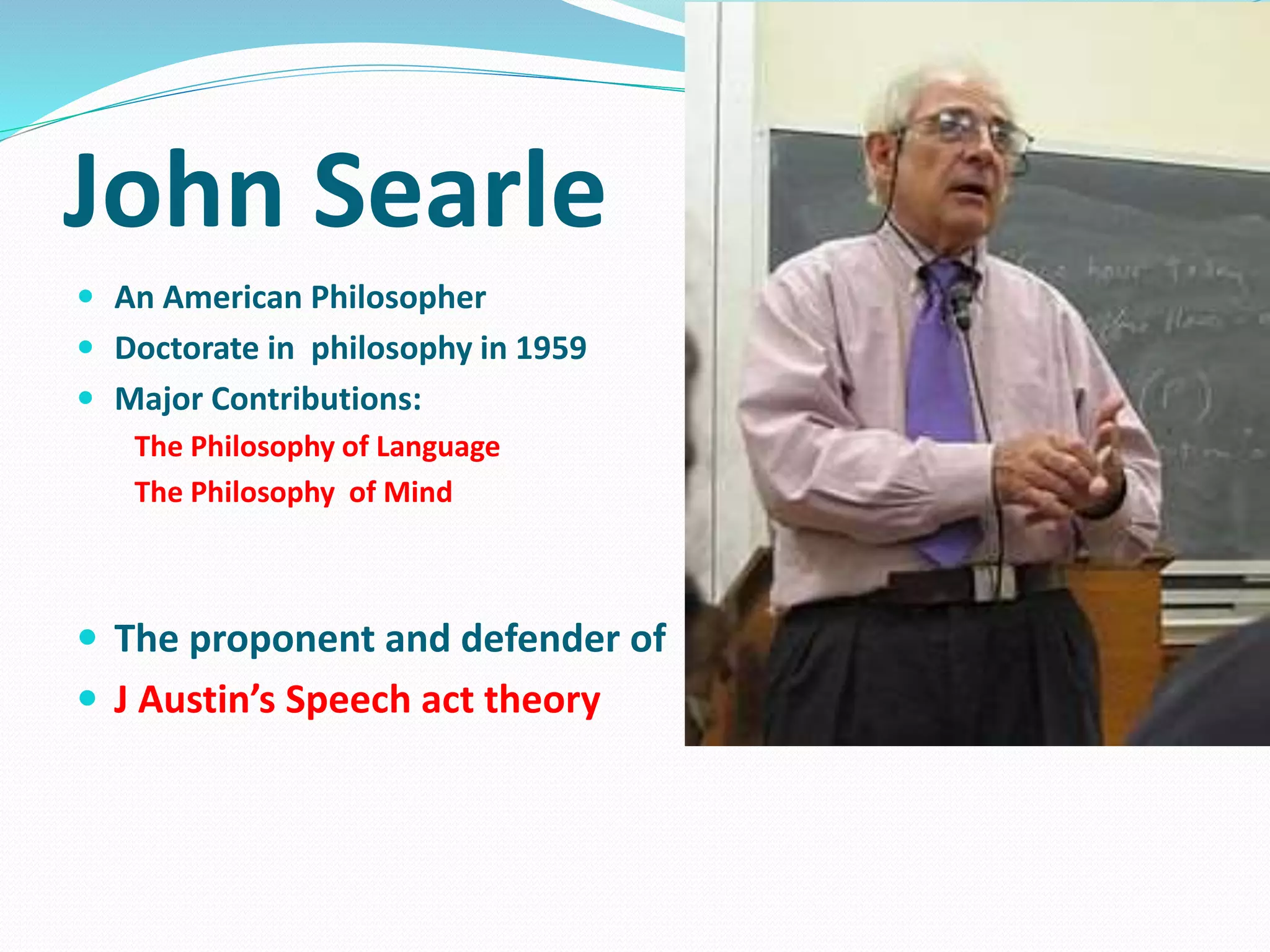
John Searle
 An American Philosopher
 Doctorate in philosophy in 1959
 Major Contributions:
The Philosophy of Language
The Philosophy of Mind
 The proponent and defender of
 J Austin’s Speech act theory
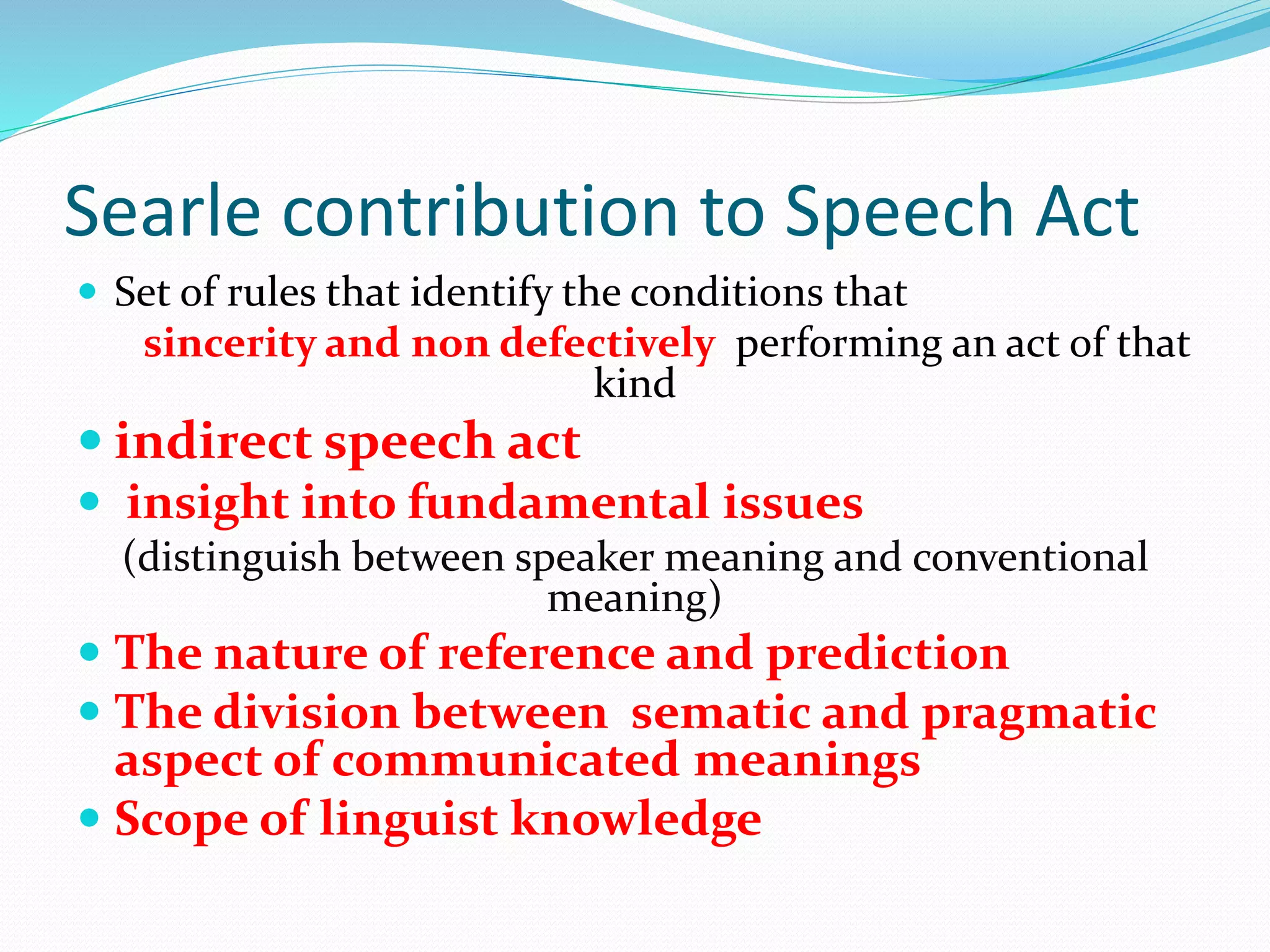
Searle contribution to Speech Act
 Set of rules that identify the conditions that
sincerity and non defectively performing an act of that
kind
 indirect speech act
 insight into fundamental issues
(distinguish between speaker meaning and conventional
meaning)
 The nature of reference and prediction
 The division between sematic and pragmatic
aspect of communicated meanings
 Scope of linguist knowledge
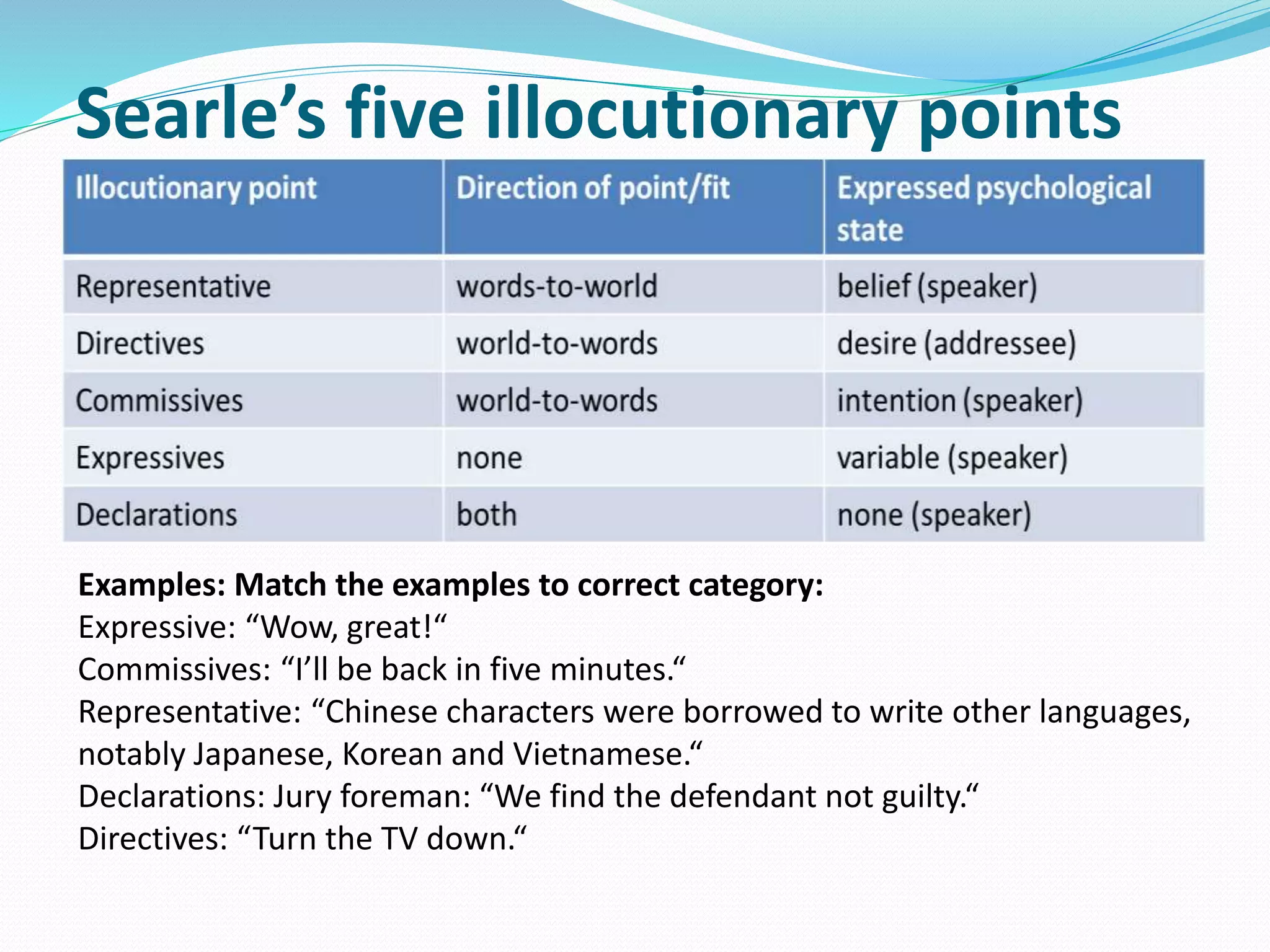
Searle’s five illocutionary points
Examples: Match the examples to correct category:
Expressive: “Wow, great!“
Commissives: “I’ll be back in five minutes.“
Representative: “Chinese characters were borrowed to write other languages,
notably Japanese, Korean and Vietnamese.“
Declarations: Jury foreman: “We find the defendant not guilty.“
Directives: “Turn the TV down.“
Criticism on SA
 Austin essays is not based on a definite set of basic
dimensions- resulted in inconsistent and overlapping
classification of an SA
 Unsystematic identification of unspoken
presupposition, implications and effects of speech act
in discourse analysis in literary criticism
 Overlapping of speech act performance with
theoretical and empirical and methodological issues
 Hearer place a passive thus interactional aspect are
neglected
pragmatics speech act theory promises, felicity conditions

pragmatics speech act theory promises, felicity conditions

  • 1.
    Presented by Shabana perveenRoll no 28 Sajid Saleem Roll no 02 MPhil linguistic 1st semester (University)Institute of southern Punjab Multan
  • 2.
    What is aspeech act theory?  Attempts to explain how speakers use language to accomplish intended actions and how listeners determine and intended meaning from what is said.  Is a subfield of pragmatics concerned with the ways in with words can be used to not only to present information but also to carryout actions.  This was purposed by J.L. Austin(1962) from the book ‘How to Do things with Words ‘and it was supplemented by American philosopher John R Searle.
  • 3.
    SPEECH ACTS: DOING THINGSWITH LANGUAGE  John Austin in his book "How to do things with words" is the first to introduce the idea of Speech Acts, analyzing the relationships between utterances and performance.
  • 4.
     Impressive successof Chomsky’s classic works made difficulty for the philosophers of language who were intended in semantics rather than syntactic aspects.  Philosophers of language like Richard Montague and his school of thoughts join hands with the formal syntactic traditions and semantic orientation a called intentional semantic.  More contribution was made by J.L.Austin in the branch of philosophy referred to as ‘ordinary language philosophy’ . History
  • 5.
    J.L Austin(1911-60 Major contributionto contemporary philosophy 1) Linguist Phenomenology. 2) Speech act theory. 3) Epistemology and philosophy of action in utterances
  • 6.
     Developed newphilosophical methodology and style which became paradigmatic of ‘Ordinary language philosophy’  does not claim it as correct method but to remove philosophical mistake ‘Philosophical mistakes’. For Instance  ‘It cold outside’. (Proposition)  ‘Good luck’. ?  ‘Congratulations’. ?  ‘Well done’. ?
  • 7.
    Language in use Assumptions about Human Language ‘Sound and meaning’(Descriptive Grammar) ‘Set of correct sentences’(Generative Grammar) But The basic or minimal unit of linguistic communication which has generally been supposed ‘The symbol’ Word or sentence’….but rather the production or word or sentence in the ‘performance of speech act’.
  • 8.
     People uselanguage with communicative intentions. Speech acts are acts of communication that express those intentions. All speech's situated speech; a speech act is never just an ‘act of speech’ but should be considered in the total situation activity of which it is a part. Levinson(1979)
  • 9.
    We will haveto ask ourselves how speech acts relate to our human activity as a whole: thinking ‘globally’ while acting ‘locally’,
  • 10.
    How speech actsfunction  Speech acts are verbal actions happening in the world For Instance If I say to a new born human; I baptize thee in the name of the Father and of the ‘Holy Ghost’ then this human being is from now on and forever a Christian.
  • 11.
    Speech act theory A speech act can be divided into three different smaller acts:  Locutionary act  Illocutionary act  Perlocutionary act
  • 12.
    The locutionary act The act of performing words into utterances that make sense in a language with correct grammar and pronunciation.. Locution: A form of expression; a phrase, an expression Excerpted from Oxford Talking Dictionary. 1998 For instance: ‘Its cold in here’
  • 13.
    The illocutionary act Intended communicative action by the speaker, bound to certain conventions (the illocutionary act can only be achieved if there is a convention in society that makes it possible) Illocution: An action performed by saying or writing something, e.g. ordering, warning, promising Excerpted from Oxford Talking Dictionary. 1998 For instance: John says to marry, ‘’pass me the glasses please’’’.(order or request)
  • 14.
    The Perlocutionary act The effect that an utterance has on the thoughts, feelings or attitudes of the listener. Perlocution: An act of speaking or writing which aims to effect an action but which in itself does not effect or constitute the action, as persuading, convincing. Excerpted from Oxford Talking Dictionary. 1998.
  • 15.
    Often the sameutterance can have different illocutionary force (intended function) in different contexts. Example: I’ll see you later I predict that I’ll see you later I warn you that I’ll see you later I promise you that I’ll see you later
  • 16.
    Functions of SA What we say (locution)  What we mean when we say(Illucation)  What we accomplish by saying it(Perlocution)
  • 17.
    FELICITY CONDITIONS  Thecontext and the situation that allow us to recognize a speech act as intended by the speaker.  The conditions that must be fulfilled for a speech act to be satisfactorily performed or realized  A sentence must not only be grammatically correct, it must also be felicitous , that is situational appropriate.
  • 18.
    For instance ‘’I hereby pronounce this person dead’’ In correct circumstances (Appropriate) In other circumstance, (Speech misfire)
  • 19.
    Types of FelicityConditions  There are several types of felicitous conditions: • Propositional content, which requires participants to understand language, not to act like actors • Preparatory, where the authority of the speaker and the circumstances of the speech act are appropriate to its being performed successfully • Sincerity, where the speech act is being performed seriously and sincerely • Essential, where the speaker intends that an utterance be acted upon by the addressee
  • 20.
    For example  PatrickColm Hogan, in "Philosophical Approaches to the Study of Literature," describes felicity conditions with this example:  "Suppose I am in a play and deliver the line 'I promise to kill the evil Don Fernando.' I have not, in fact, promised to kill anyone. ...
  • 21.
    Speech act ofpromising ‘I promise’ (Speech act verb) (Can lead to misunderstanding)
  • 22.
    Speech act ofpromising Depends on social frame For instance: ‘’wilt thou have this woman for thy wife?’’ ‘’There is a policeman at the corner’’ ‘’I will be there at 7’’
  • 23.
    A speech act’sphysiognomy: Promising  How can we determine a speech act?  How many speech act are there, and how are they expressed in language?  What is the relationship between a speech act and a pragmatic act?  Are there speech acts (or pragmatics act) that are found across languages , or even are in all languages? (The problem of the so-called ‘universal speech acts’.)
  • 24.
    Promises: Conditions  Condition1) Normal condition must obtain for uttering and receiving a promise.  Condition 2) The promise must have a content. (I promise I’ll be there tomorrow)
  • 25.
    Promises: Conditions  Condition3) A promise must have to do with a future, possible action of the speaker. (I’m coming to Lahore tomorrow).  Condition 4&5) condition 4&5 are often called(in accordance with Searle’s terminology) preparatory conditions, that is, condition that must have been met before we can begin to talk about promises. If you don’t behave, I promise you there’s going to be trouble. I can promise anybody that sun will rise tomorrow
  • 26.
    Promises ‘’A happily marriedman who promises his wife he will not desert her in the next week is likely to provide more anxiety than comfort’’.
  • 27.
    Promises: Conditions  Condition6) This condition has to do with the sincerity of the promiser in carrying out the act of promising.(Sincerity condition)  Condition 7) A promise intends to put herself or himself under the obligation of carrying out the promised act.(Essential Condition)
  • 28.
    Promises: Conditions  Condition8&9) These condition emphasize that the language use in promising must be the normal one, semantically and pragmatically correct. ‘’For Pennsylvanian, taking oaths are forbidden’’.(Culture) ‘’Never trust a drunks promises’’. (Wisdom) ‘’Promises to wives and children don’t count’’. It is Society that determines the validity
  • 29.
    Rule 1 to4 Content happen in future Content Preparatory Regulative Intention(sincerity) Rules Rule 5 Obligation Constitutive Rule
  • 31.
    John Searle  AnAmerican Philosopher  Doctorate in philosophy in 1959  Major Contributions: The Philosophy of Language The Philosophy of Mind  The proponent and defender of  J Austin’s Speech act theory
  • 32.
    Searle contribution toSpeech Act  Set of rules that identify the conditions that sincerity and non defectively performing an act of that kind  indirect speech act  insight into fundamental issues (distinguish between speaker meaning and conventional meaning)  The nature of reference and prediction  The division between sematic and pragmatic aspect of communicated meanings  Scope of linguist knowledge
  • 33.
    Searle’s five illocutionarypoints Examples: Match the examples to correct category: Expressive: “Wow, great!“ Commissives: “I’ll be back in five minutes.“ Representative: “Chinese characters were borrowed to write other languages, notably Japanese, Korean and Vietnamese.“ Declarations: Jury foreman: “We find the defendant not guilty.“ Directives: “Turn the TV down.“
  • 34.
    Criticism on SA Austin essays is not based on a definite set of basic dimensions- resulted in inconsistent and overlapping classification of an SA  Unsystematic identification of unspoken presupposition, implications and effects of speech act in discourse analysis in literary criticism  Overlapping of speech act performance with theoretical and empirical and methodological issues  Hearer place a passive thus interactional aspect are neglected