Syeda Ailya Raza
Roll no 01
CONVERSATIONAL
IMPLICATURE
 Inception of Implicature in Pragmatics
 Proponents of Implicature
 Conversational implicature
 Grice’ contributions towards implicature
 How flouting of cooperative conversational maxims
leads to implicature.
 Types of conversational implicature
 Conversational implicature v/s Conventional implicature
 Exercises and analysis
LIST OF CONTENTS
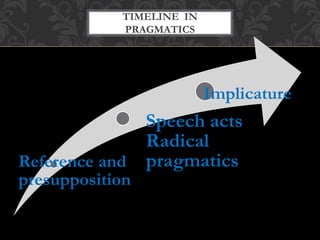
Reference and
presupposition
Speech acts
Radical
pragmatics
Implicature
TIMELINE IN
PRAGMATICS
 Peter Cole Syntax and Semantics (Pragmatics)
and Radical Pragmatics. (1978)
 Grice’ Note on Logic and Conversation and
Presupposition and Conversational Implicature.
 Levinson’s Pragmatics (1983) gave substantial
coverage to conversational implicature.
 In (1986) Sperber’s and Wilson’s Relevance, that
focused on Grice’ non-natural meaning and
implicature.
PROPONENTS TO IMPLICATURE
Whiting,
Daniel (2013) It's not
what you said, it's the
way you said
it:. Analytic
Philosophy, 54 (3), 364-
377.
 Conversational implicature are inferences that depend on the
existence of norms for the use of language, such as the
widespread agreement that communicators should aim to tell
the truth.
(Patrick Griffiths, 2006, An introduction to semantics and
pragmatics)
 One particular kind of implication is conversational
implicature.
(Goded Rambaud, 2012, Basic Semantics)
DEFINATIONS
 An utterance which conveys meaning beyond its
proposition.
 Proposition is the semantic content of the sentence.
 Recognizing implicature is like drawing the
conclusion based on the context, schemata, non
verbal cues, intonation patterns, speech pattern,
societal conventions, and cultural stances etc.
CONVERSATIONAL IMPLICATURE
 To Levinson an important contribution made by the
notion of implicature is that it provides some explicit
account of how it is possible to mean(in some general
sense) more than what is actually 'said' (i.e. more than
what is literally expressed by the conventional sense
of the linguistic expressions uttered).
 Grice uses the phrase what is said as a technical term
for the truth-conditional content of an expression,
which may in fact be somewhat less than the full
conventional content.
what is said must be understood in terms of what
philosophers define as meaning, that is, sense and
reference, what is said is the result of a linguistic
computation implying the description of a full proposition
with a truth value.
Frege account on sense and reference and truth value:
Pip believes that Shakespeare is the greatest dramatist of all
ages.
Pip believes that The author of Hamlet is the greatest
dramatist of all ages.
WHAT IS SAID
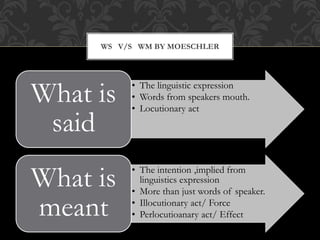
WS V/S WM BY MOESCHLER
• The linguistic expression
• Words from speakers mouth.
• Locutionary act
What is
said
• The intention ,implied from
linguistics expression
• More than just words of speaker.
• Illocutionary act/ Force
• Perlocutioanary act/ Effect
What is
meant
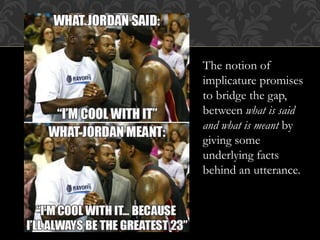
The notion of
implicature promises
to bridge the gap,
between what is said
and what is meant by
giving some
underlying facts
behind an utterance.
 H. P. Grice (1913–1988) was the first to
systematically study cases in which what
a speaker means differs from what the sentence used by
the speaker means.
 The notion of implicature can be defined is a new
way of describing meaning. Grice’s main contribution
to the theory of meaning was his original, non-
conventional way of treating meaning in a
conversation that he called as “Non Natural
Meanings.”
(Moeschler, Conversational and Conventional Implicature)
GRICE’ CONTRIBUTIONS
TOWARDS IMPLICATURE
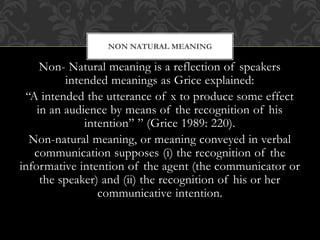
Non- Natural meaning is a reflection of speakers
intended meanings as Grice explained:
“A intended the utterance of x to produce some effect
in an audience by means of the recognition of his
intention” ” (Grice 1989: 220).
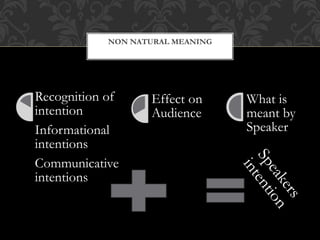
Non-natural meaning, or meaning conveyed in verbal
communication supposes (i) the recognition of the
informative intention of the agent (the communicator or
the speaker) and (ii) the recognition of his or her
communicative intention.
NON NATURAL MEANING
Recognition of
intention
Informational
intentions
Communicative
intentions
Effect on
Audience
What is
meant by
Speaker
NON NATURAL MEANING
 In order to make one’s conversation successful
it is very important to follow the Maxims of
Cooperation as stated by Paul Grice
 Lavinson has elaborated the other side of the
coin by stating that Grice's theory of meaning-
nn is construed as a theory of
communication, it has the interesting
consequence that it gives an account of how
communication might be achieved in the
absence of any conventional means for
expressing the intended message.
FLOUTING OF MAXIMS LEADS TO
IMPLICATURE
 BUT there is an immediate objection: the view may describe
a philosopher's paradise, but no one actually speaks like that
the whole time!
 Grice's point is subtly different as he says , in most ordinary
kinds of talk these principles are oriented to, such that
when talk does not proceed according to their
specifications, hearers assume that, contrary to
appearances, the principles are nevertheless being
adhered to at some deeper level.
 Flouting a maxim leads to provide a lot of unsaid details that
are associated with speakers intended meanings rather than
what he really or literary says, in other words one can implied
hidden information that is intended to be conveyed by
utterance.
(Levinson, Pragmatics)
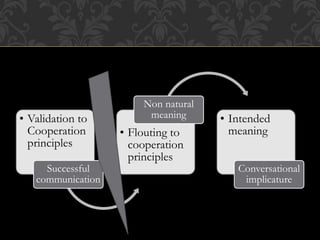
• Validation to
Cooperation
principles
Successful
communication
• Flouting to
cooperation
principles
Non natural
meaning • Intended
meaning
Conversational
implicature
This maxim of truth flouted in the following exchange:
1. A: What if the USSR blockades the Gulf and all the
oil?
B: Oh come now, sun rises from the west.
+> No, it can never happen.
A:Queen Victoria was made of iron.
B: (looking at the history book)Yes, it seems so.
+>Queen Victoria’ harsh decisions and power show.
IMPLICATURE FROM QUALITY
MAXIM
An implicature relating to the low end of the
quantity maxim – giving
too little information – is illustrated in
1. A. “Are you from America?”
B. “No” followed by silence
+> ‘I am not willing to talk to you any
further’
1. A. “That is an interesting accent. Let me guess
where you are from. Are you from America?”
B. “No”.
IMPLICATURE BY FLOUTING
QUANTITY MAXIM
Grice’s relevance maxim lays down that contributions
should be relevant to the assumed current goals of the
interlocutors.
1. A: (Picking up a book from a display in a bookshop)
“Have you
read Long Walk to Freedom?”
B: “I find autobiographies fascinating.”
+> ‘Long Walk to Freedom is an autobiography’
+> ‘Yes, I have read it’
IMPLICATURE FROM MAXIM OF
RELEVANCE
Grice’ maxim of brevity is violated here for the account
to give some underlying information to A.
1. A:What did Miss Singer sang yesterday?
B:Miss Singer produced a series of sounds
corresponding closely to the score of an aria from
Rigoletto.
+> B: Miss Singer song was different from the
definition of singing.
+> B: Satire on Miss Singer way of singing.
IMPLICATURE FROM MAXIM OF
MANNER
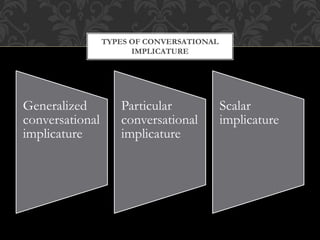
Generalized
conversational
implicature
Particular
conversational
implicature
Scalar
implicature
TYPES OF CONVERSATIONAL
IMPLICATURE
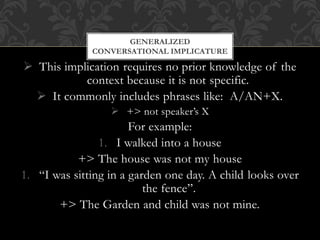
 This implication requires no prior knowledge of the
context because it is not specific.
 It commonly includes phrases like: A/AN+X.
 +> not speaker’s X
For example:
1. I walked into a house
+> The house was not my house
1. “I was sitting in a garden one day. A child looks over
the fence”.
+> The Garden and child was not mine.
GENERALIZED
CONVERSATIONAL IMPLICATURE
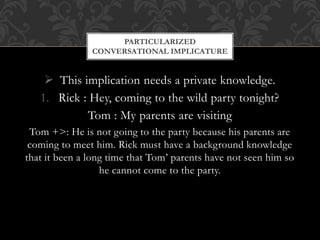
 This implication needs a private knowledge.
1. Rick : Hey, coming to the wild party tonight?
Tom : My parents are visiting
Tom +>: He is not going to the party because his parents are
coming to meet him. Rick must have a background knowledge
that it been a long time that Tom’ parents have not seen him so
he cannot come to the party.
PARTICULARIZED
CONVERSATIONAL IMPLICATURE
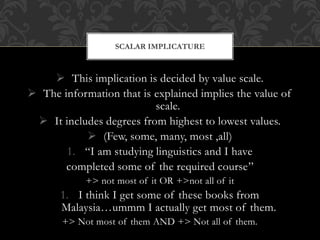
 This implication is decided by value scale.
 The information that is explained implies the value of
scale.
 It includes degrees from highest to lowest values.
 (Few, some, many, most ,all)
1. “I am studying linguistics and I have
completed some of the required course”
+> not most of it OR +>not all of it
1. I think I get some of these books from
Malaysia…ummm I actually get most of them.
+> Not most of them AND +> Not all of them.
SCALAR IMPLICATURE
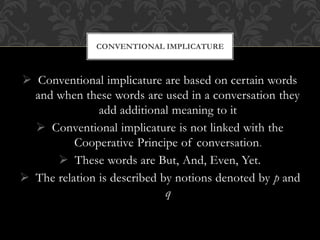
 Conventional implicature are based on certain words
and when these words are used in a conversation they
add additional meaning to it
 Conventional implicature is not linked with the
Cooperative Principe of conversation.
 These words are But, And, Even, Yet.
 The relation is described by notions denoted by p and
q
CONVENTIONAL IMPLICATURE
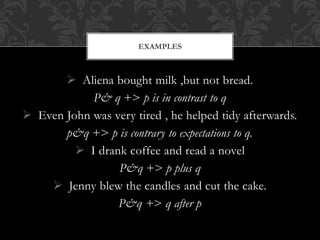
 Aliena bought milk ,but not bread.
P& q +> p is in contrast to q
 Even John was very tired , he helped tidy afterwards.
p&q +> p is contrary to expectations to q.
 I drank coffee and read a novel
P&q +> p plus q
 Jenny blew the candles and cut the cake.
P&q +> q after p
EXAMPLES
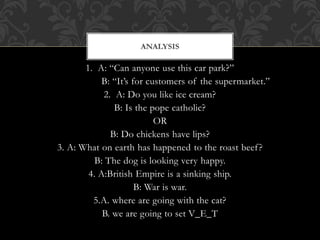
1. A: “Can anyone use this car park?”
B: “It’s for customers of the supermarket.”
2. A: Do you like ice cream?
B: Is the pope catholic?
OR
B: Do chickens have lips?
3. A: What on earth has happened to the roast beef?
B: The dog is looking very happy.
4. A:British Empire is a sinking ship.
B: War is war.
5.A. where are going with the cat?
B. we are going to set V_E_T
ANALYSIS
• Patrick Griffiths. (2006) An introduction to semantics
and pragmatics.
• Goded Rambaud. (2012) Basic Semantics.
• George Yule. (1996) Pragmatics.
• Levinson.(1983)Pragmatics.
• Moeschler, Jacques. (2012). Conversational and
conventional implicatures. Cognitive Pragmatics.
• Chapman.(2000)Philosophy for Linguistics: An
Introduction.
REFERENCE LIST

Conversational Implicature ,coperative principles , conventional implicature

  • 1.
    Syeda Ailya Raza Rollno 01 CONVERSATIONAL IMPLICATURE
  • 2.
     Inception ofImplicature in Pragmatics  Proponents of Implicature  Conversational implicature  Grice’ contributions towards implicature  How flouting of cooperative conversational maxims leads to implicature.  Types of conversational implicature  Conversational implicature v/s Conventional implicature  Exercises and analysis LIST OF CONTENTS
  • 3.
  • 4.
     Peter ColeSyntax and Semantics (Pragmatics) and Radical Pragmatics. (1978)  Grice’ Note on Logic and Conversation and Presupposition and Conversational Implicature.  Levinson’s Pragmatics (1983) gave substantial coverage to conversational implicature.  In (1986) Sperber’s and Wilson’s Relevance, that focused on Grice’ non-natural meaning and implicature. PROPONENTS TO IMPLICATURE
  • 5.
    Whiting, Daniel (2013) It'snot what you said, it's the way you said it:. Analytic Philosophy, 54 (3), 364- 377.
  • 6.
     Conversational implicatureare inferences that depend on the existence of norms for the use of language, such as the widespread agreement that communicators should aim to tell the truth. (Patrick Griffiths, 2006, An introduction to semantics and pragmatics)  One particular kind of implication is conversational implicature. (Goded Rambaud, 2012, Basic Semantics) DEFINATIONS
  • 7.
     An utterancewhich conveys meaning beyond its proposition.  Proposition is the semantic content of the sentence.  Recognizing implicature is like drawing the conclusion based on the context, schemata, non verbal cues, intonation patterns, speech pattern, societal conventions, and cultural stances etc. CONVERSATIONAL IMPLICATURE
  • 8.
     To Levinsonan important contribution made by the notion of implicature is that it provides some explicit account of how it is possible to mean(in some general sense) more than what is actually 'said' (i.e. more than what is literally expressed by the conventional sense of the linguistic expressions uttered).  Grice uses the phrase what is said as a technical term for the truth-conditional content of an expression, which may in fact be somewhat less than the full conventional content.
  • 9.
    what is saidmust be understood in terms of what philosophers define as meaning, that is, sense and reference, what is said is the result of a linguistic computation implying the description of a full proposition with a truth value. Frege account on sense and reference and truth value: Pip believes that Shakespeare is the greatest dramatist of all ages. Pip believes that The author of Hamlet is the greatest dramatist of all ages. WHAT IS SAID
  • 10.
    WS V/S WMBY MOESCHLER • The linguistic expression • Words from speakers mouth. • Locutionary act What is said • The intention ,implied from linguistics expression • More than just words of speaker. • Illocutionary act/ Force • Perlocutioanary act/ Effect What is meant
  • 11.
    The notion of implicaturepromises to bridge the gap, between what is said and what is meant by giving some underlying facts behind an utterance.
  • 12.
     H. P.Grice (1913–1988) was the first to systematically study cases in which what a speaker means differs from what the sentence used by the speaker means.  The notion of implicature can be defined is a new way of describing meaning. Grice’s main contribution to the theory of meaning was his original, non- conventional way of treating meaning in a conversation that he called as “Non Natural Meanings.” (Moeschler, Conversational and Conventional Implicature) GRICE’ CONTRIBUTIONS TOWARDS IMPLICATURE
  • 13.
    Non- Natural meaningis a reflection of speakers intended meanings as Grice explained: “A intended the utterance of x to produce some effect in an audience by means of the recognition of his intention” ” (Grice 1989: 220). Non-natural meaning, or meaning conveyed in verbal communication supposes (i) the recognition of the informative intention of the agent (the communicator or the speaker) and (ii) the recognition of his or her communicative intention. NON NATURAL MEANING
  • 14.
  • 15.
     In orderto make one’s conversation successful it is very important to follow the Maxims of Cooperation as stated by Paul Grice  Lavinson has elaborated the other side of the coin by stating that Grice's theory of meaning- nn is construed as a theory of communication, it has the interesting consequence that it gives an account of how communication might be achieved in the absence of any conventional means for expressing the intended message. FLOUTING OF MAXIMS LEADS TO IMPLICATURE
  • 16.
     BUT thereis an immediate objection: the view may describe a philosopher's paradise, but no one actually speaks like that the whole time!  Grice's point is subtly different as he says , in most ordinary kinds of talk these principles are oriented to, such that when talk does not proceed according to their specifications, hearers assume that, contrary to appearances, the principles are nevertheless being adhered to at some deeper level.  Flouting a maxim leads to provide a lot of unsaid details that are associated with speakers intended meanings rather than what he really or literary says, in other words one can implied hidden information that is intended to be conveyed by utterance. (Levinson, Pragmatics)
  • 17.
    • Validation to Cooperation principles Successful communication •Flouting to cooperation principles Non natural meaning • Intended meaning Conversational implicature
  • 18.
    This maxim oftruth flouted in the following exchange: 1. A: What if the USSR blockades the Gulf and all the oil? B: Oh come now, sun rises from the west. +> No, it can never happen. A:Queen Victoria was made of iron. B: (looking at the history book)Yes, it seems so. +>Queen Victoria’ harsh decisions and power show. IMPLICATURE FROM QUALITY MAXIM
  • 19.
    An implicature relatingto the low end of the quantity maxim – giving too little information – is illustrated in 1. A. “Are you from America?” B. “No” followed by silence +> ‘I am not willing to talk to you any further’ 1. A. “That is an interesting accent. Let me guess where you are from. Are you from America?” B. “No”. IMPLICATURE BY FLOUTING QUANTITY MAXIM
  • 20.
    Grice’s relevance maximlays down that contributions should be relevant to the assumed current goals of the interlocutors. 1. A: (Picking up a book from a display in a bookshop) “Have you read Long Walk to Freedom?” B: “I find autobiographies fascinating.” +> ‘Long Walk to Freedom is an autobiography’ +> ‘Yes, I have read it’ IMPLICATURE FROM MAXIM OF RELEVANCE
  • 21.
    Grice’ maxim ofbrevity is violated here for the account to give some underlying information to A. 1. A:What did Miss Singer sang yesterday? B:Miss Singer produced a series of sounds corresponding closely to the score of an aria from Rigoletto. +> B: Miss Singer song was different from the definition of singing. +> B: Satire on Miss Singer way of singing. IMPLICATURE FROM MAXIM OF MANNER
  • 22.
  • 23.
     This implicationrequires no prior knowledge of the context because it is not specific.  It commonly includes phrases like: A/AN+X.  +> not speaker’s X For example: 1. I walked into a house +> The house was not my house 1. “I was sitting in a garden one day. A child looks over the fence”. +> The Garden and child was not mine. GENERALIZED CONVERSATIONAL IMPLICATURE
  • 24.
     This implicationneeds a private knowledge. 1. Rick : Hey, coming to the wild party tonight? Tom : My parents are visiting Tom +>: He is not going to the party because his parents are coming to meet him. Rick must have a background knowledge that it been a long time that Tom’ parents have not seen him so he cannot come to the party. PARTICULARIZED CONVERSATIONAL IMPLICATURE
  • 25.
     This implicationis decided by value scale.  The information that is explained implies the value of scale.  It includes degrees from highest to lowest values.  (Few, some, many, most ,all) 1. “I am studying linguistics and I have completed some of the required course” +> not most of it OR +>not all of it 1. I think I get some of these books from Malaysia…ummm I actually get most of them. +> Not most of them AND +> Not all of them. SCALAR IMPLICATURE
  • 26.
     Conventional implicatureare based on certain words and when these words are used in a conversation they add additional meaning to it  Conventional implicature is not linked with the Cooperative Principe of conversation.  These words are But, And, Even, Yet.  The relation is described by notions denoted by p and q CONVENTIONAL IMPLICATURE
  • 27.
     Aliena boughtmilk ,but not bread. P& q +> p is in contrast to q  Even John was very tired , he helped tidy afterwards. p&q +> p is contrary to expectations to q.  I drank coffee and read a novel P&q +> p plus q  Jenny blew the candles and cut the cake. P&q +> q after p EXAMPLES
  • 28.
    1. A: “Cananyone use this car park?” B: “It’s for customers of the supermarket.” 2. A: Do you like ice cream? B: Is the pope catholic? OR B: Do chickens have lips? 3. A: What on earth has happened to the roast beef? B: The dog is looking very happy. 4. A:British Empire is a sinking ship. B: War is war. 5.A. where are going with the cat? B. we are going to set V_E_T ANALYSIS
  • 29.
    • Patrick Griffiths.(2006) An introduction to semantics and pragmatics. • Goded Rambaud. (2012) Basic Semantics. • George Yule. (1996) Pragmatics. • Levinson.(1983)Pragmatics. • Moeschler, Jacques. (2012). Conversational and conventional implicatures. Cognitive Pragmatics. • Chapman.(2000)Philosophy for Linguistics: An Introduction. REFERENCE LIST