Pragmatics
Speech act theory
Austin and Searle
 Austin, J. L. How to Do Things with Words.
Oxford, England: Oxford University Press,
1962.
Speech act theory
 Speech act theory was proposed by John . L. Austin
and has been developed by J. R. Searle. They believe
that language is not only used to inform or to describe
things, it is often used to “do things”, to perform acts.
 Ex. (1) You’re fired.
 (2) “There is a policeman on the corner”
 “I promise I’ll be there tomorrow.”
 This could be a threat or a promise, depending on
whether his presence tomorrow is a disadvantage or
an advantage to the listener. Contrast the sentence
above with:
 “If you don’t behave, I promise you there’s going to
be trouble.” This sentence says it’s a “promise,” but
it’s a “threat.”
(Searle Speech Acts 58)
 Actions performed via utterances are generally
called speech acts, the uttering of the relevant words
is the action itself; without the utterance the action is
not done. These are called performative sentences
and the verbs used are called performative verbs
(Vp):
 Austin suggests three kinds of acts
 a. locutionary act
 b. illocutionary act
 c. perlocutinary act
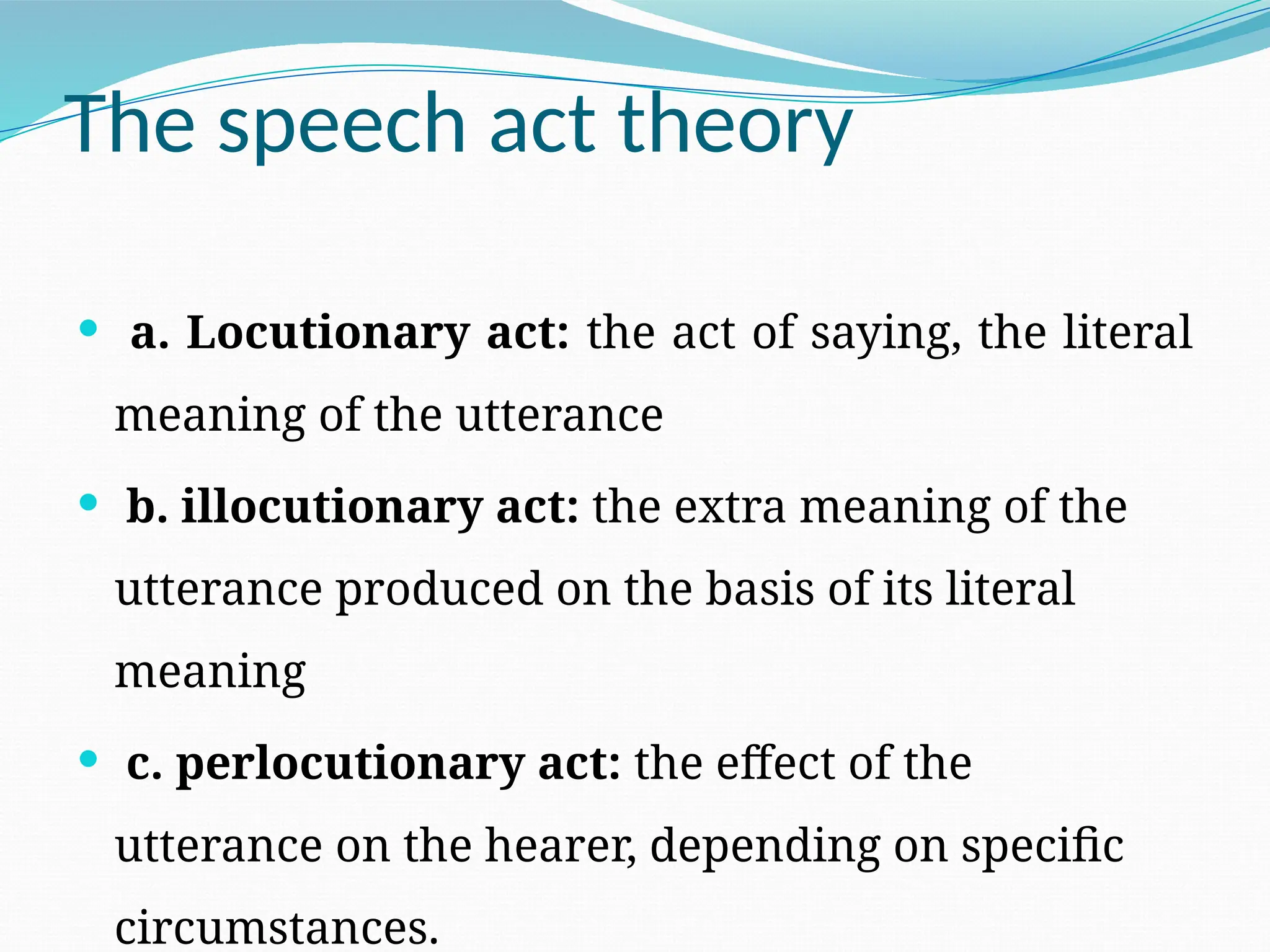
The speech act theory
 a. Locutionary act: the act of saying, the literal
meaning of the utterance
 b. illocutionary act: the extra meaning of the
utterance produced on the basis of its literal
meaning
 c. perlocutionary act: the effect of the
utterance on the hearer, depending on specific
circumstances.
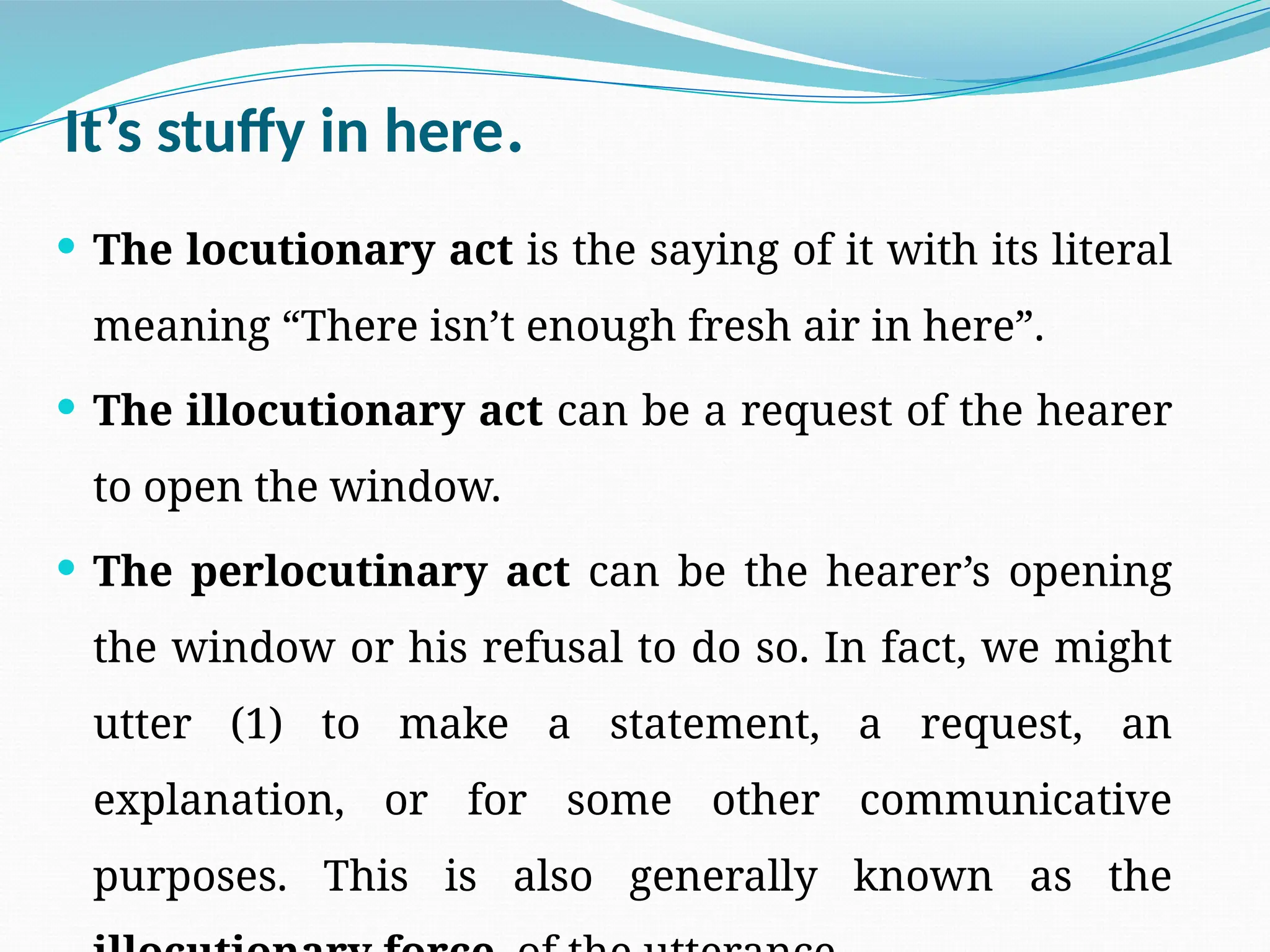
It’s stuffy in here.
 The locutionary act is the saying of it with its literal
meaning “There isn’t enough fresh air in here”.
 The illocutionary act can be a request of the hearer
to open the window.
 The perlocutinary act can be the hearer’s opening
the window or his refusal to do so. In fact, we might
utter (1) to make a statement, a request, an
explanation, or for some other communicative
purposes. This is also generally known as the
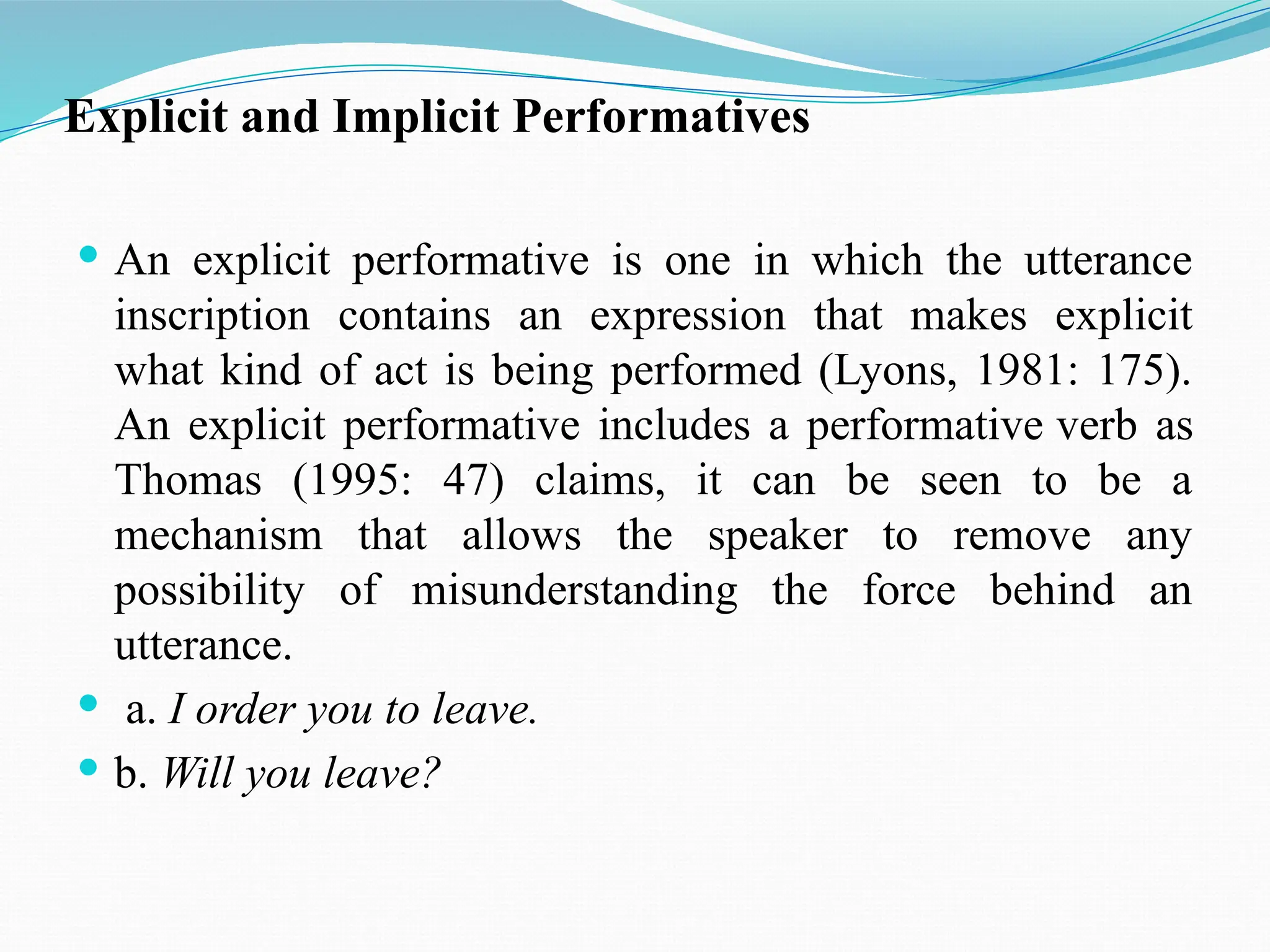
Explicit and Implicit Performatives
 An explicit performative is one in which the utterance
inscription contains an expression that makes explicit
what kind of act is being performed (Lyons, 1981: 175).
An explicit performative includes a performative verb as
Thomas (1995: 47) claims, it can be seen to be a
mechanism that allows the speaker to remove any
possibility of misunderstanding the force behind an
utterance.
 a. I order you to leave.
 b. Will you leave?
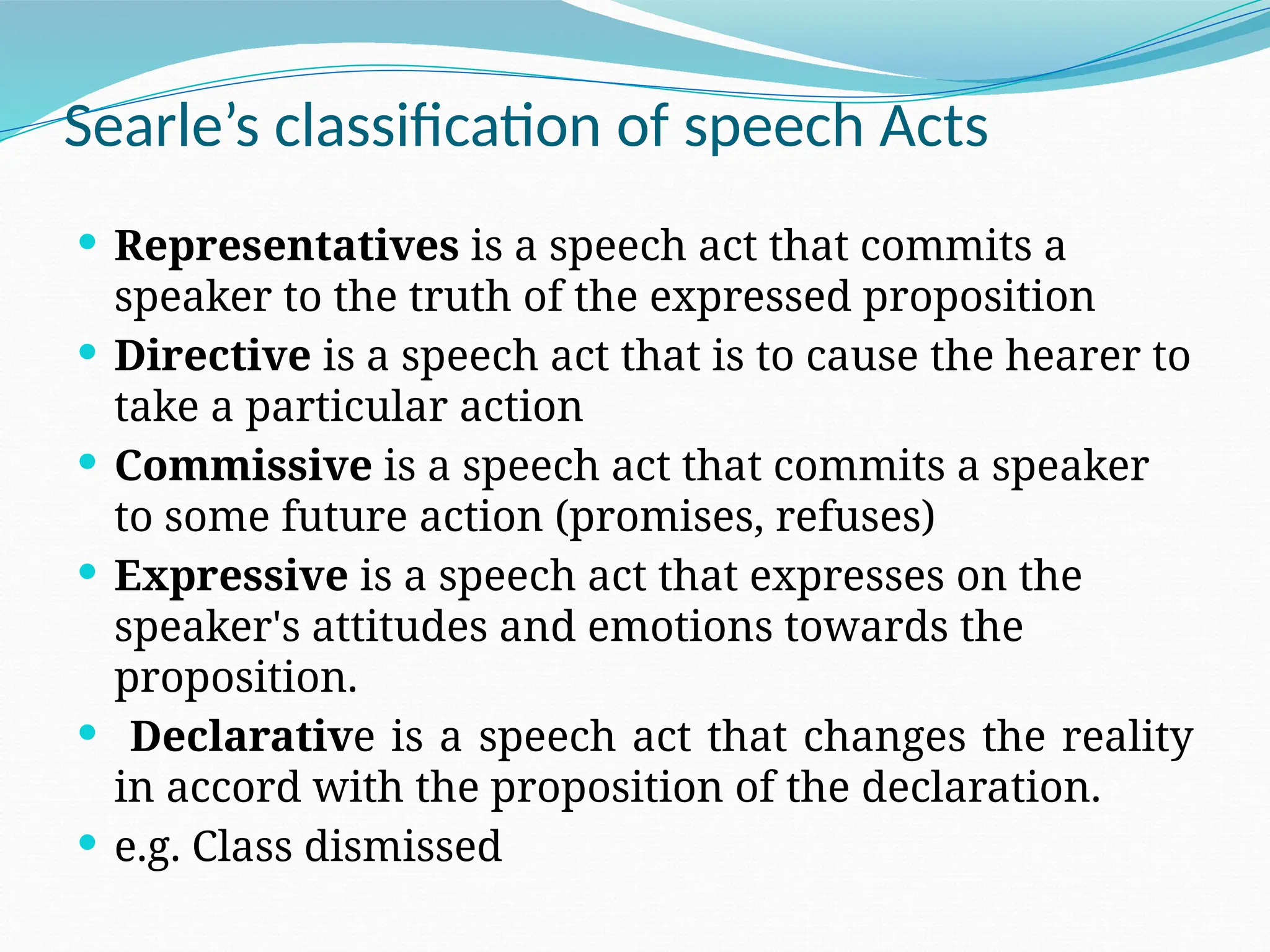
 Representatives is a speech act that commits a
speaker to the truth of the expressed proposition
 Directive is a speech act that is to cause the hearer to
take a particular action
 Commissive is a speech act that commits a speaker
to some future action (promises, refuses)
 Expressive is a speech act that expresses on the
speaker's attitudes and emotions towards the
proposition.
 Declarative is a speech act that changes the reality
in accord with the proposition of the declaration.
 e.g. Class dismissed
Searle’s classification of speech Acts
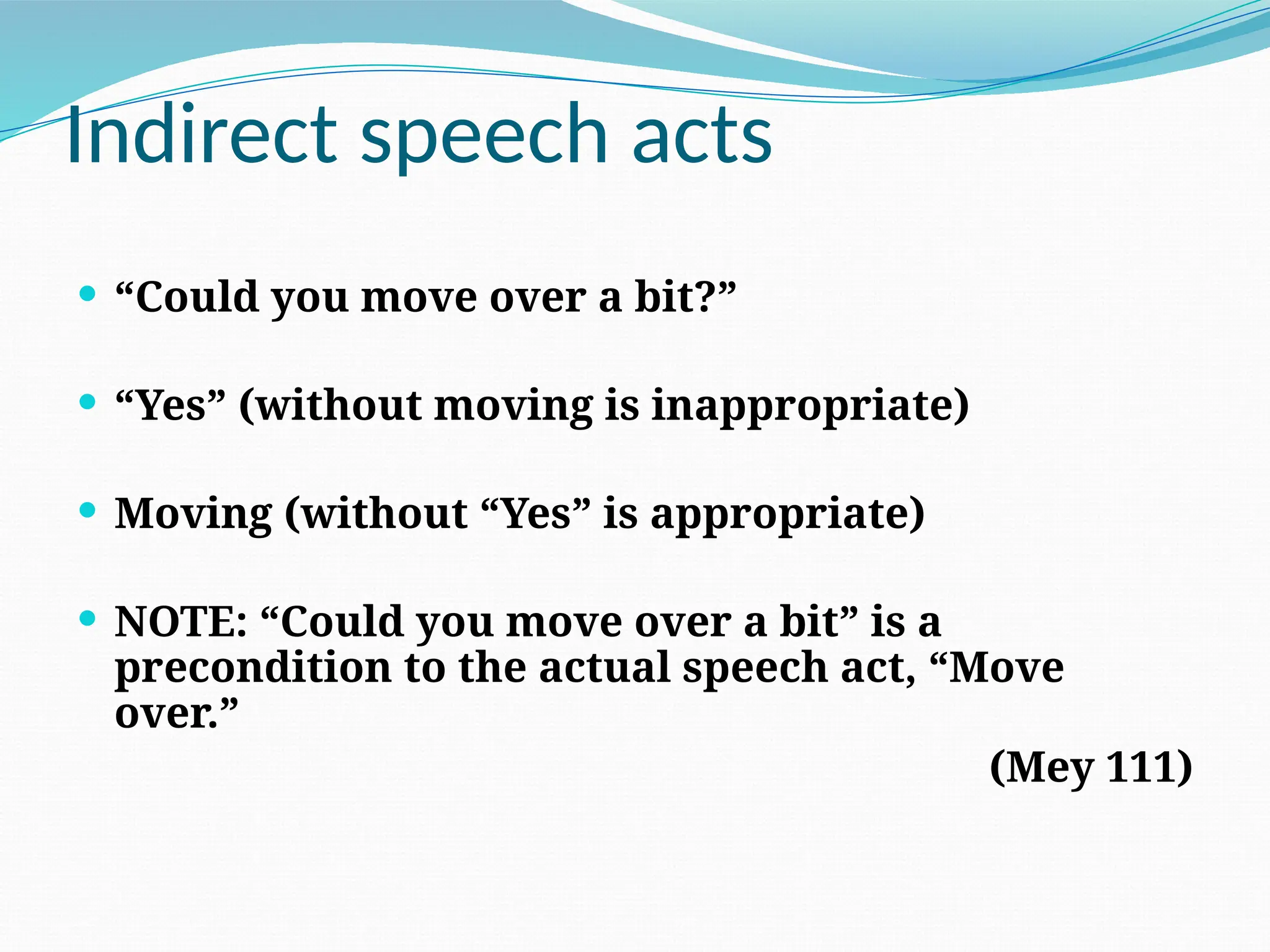
Indirect speech acts
 “Could you move over a bit?”
 “Yes” (without moving is inappropriate)
 Moving (without “Yes” is appropriate)
 NOTE: “Could you move over a bit” is a
precondition to the actual speech act, “Move
over.”
(Mey 111)
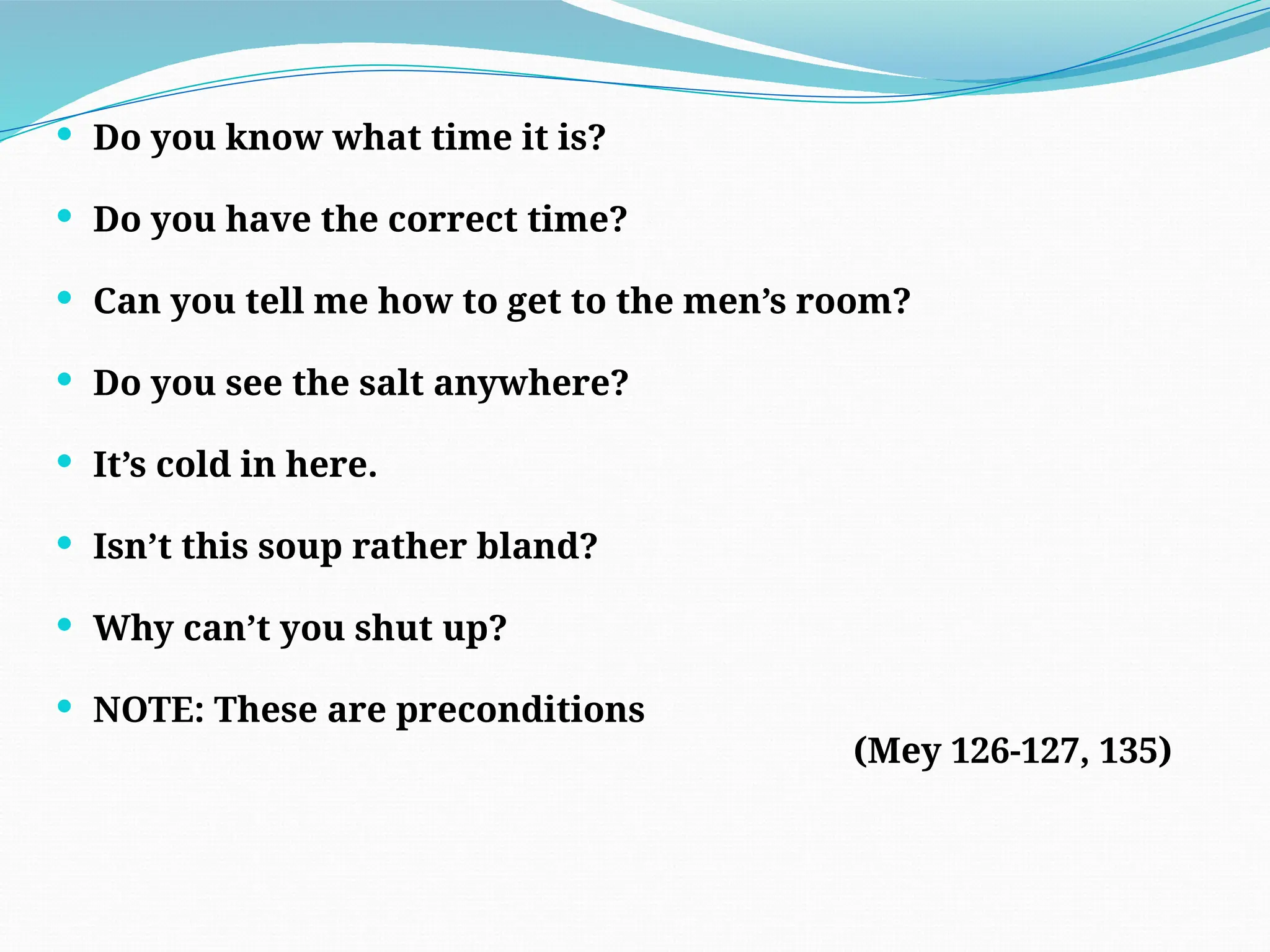
 Do you know what time it is?
 Do you have the correct time?
 Can you tell me how to get to the men’s room?
 Do you see the salt anywhere?
 It’s cold in here.
 Isn’t this soup rather bland?
 Why can’t you shut up?
 NOTE: These are preconditions
(Mey 126-127, 135)
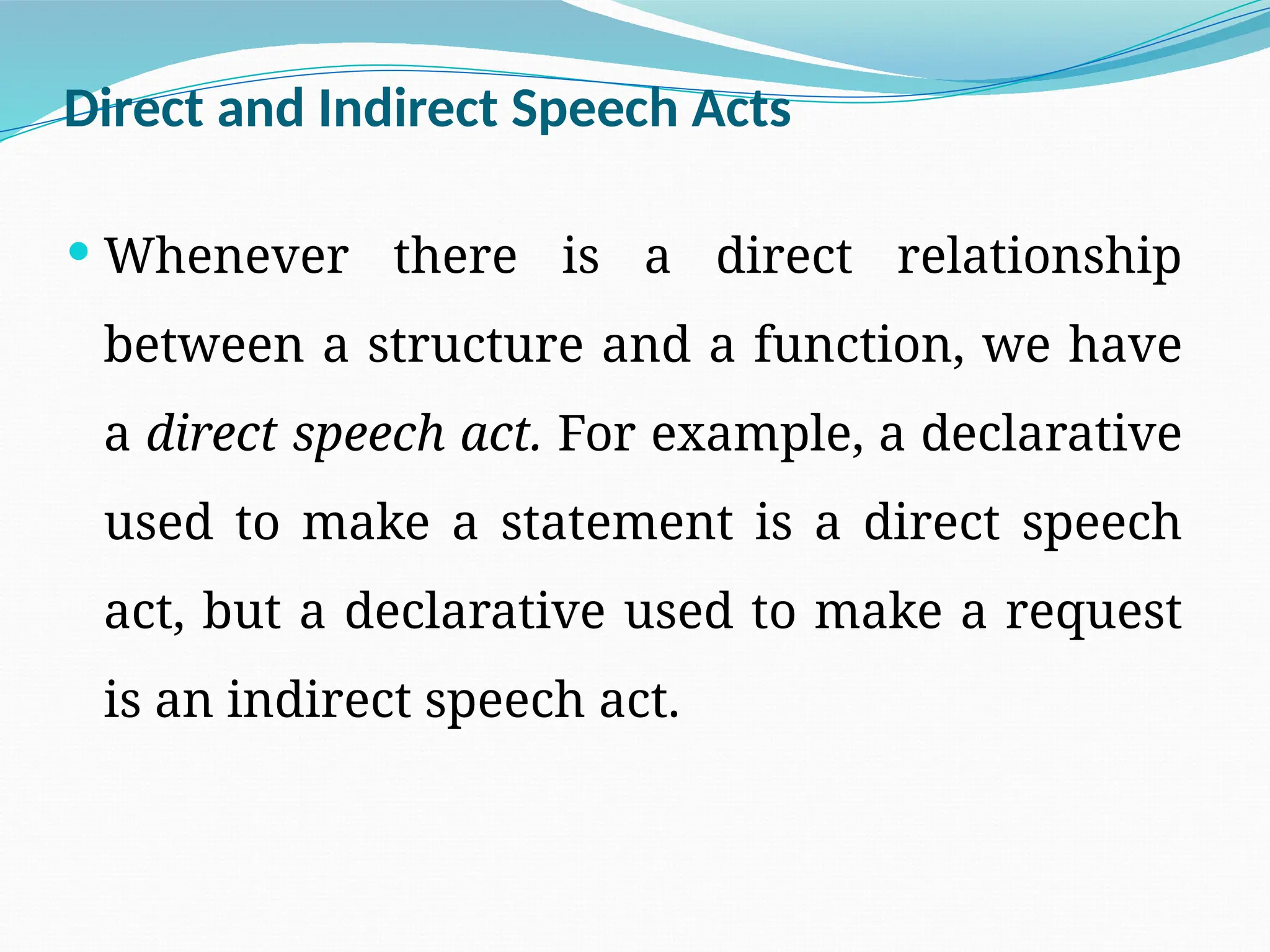
Direct and Indirect Speech Acts
 Whenever there is a direct relationship
between a structure and a function, we have
a direct speech act. For example, a declarative
used to make a statement is a direct speech
act, but a declarative used to make a request
is an indirect speech act.
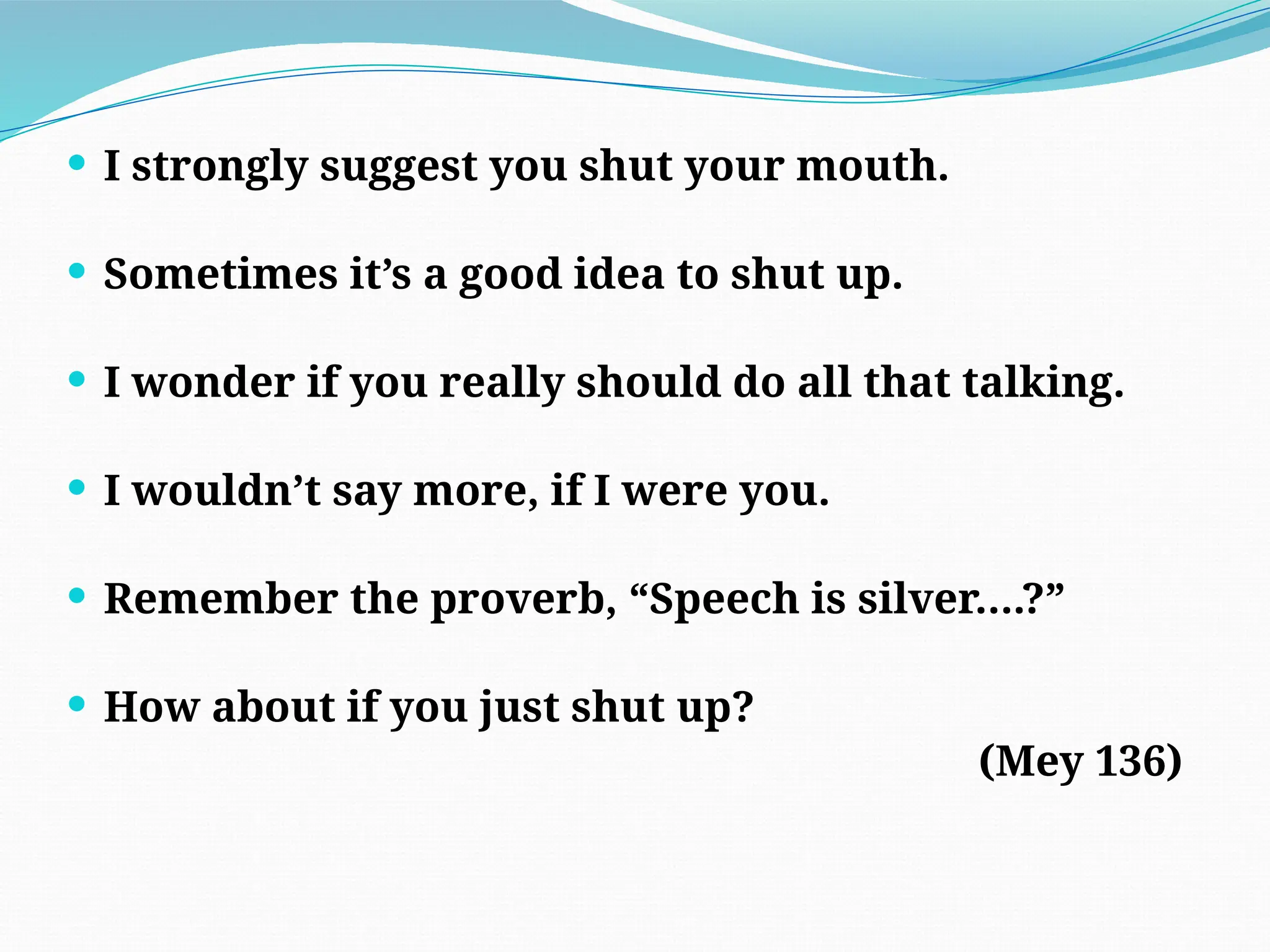
 I strongly suggest you shut your mouth.
 Sometimes it’s a good idea to shut up.
 I wonder if you really should do all that talking.
 I wouldn’t say more, if I were you.
 Remember the proverb, “Speech is silver….?”
 How about if you just shut up?
(Mey 136)
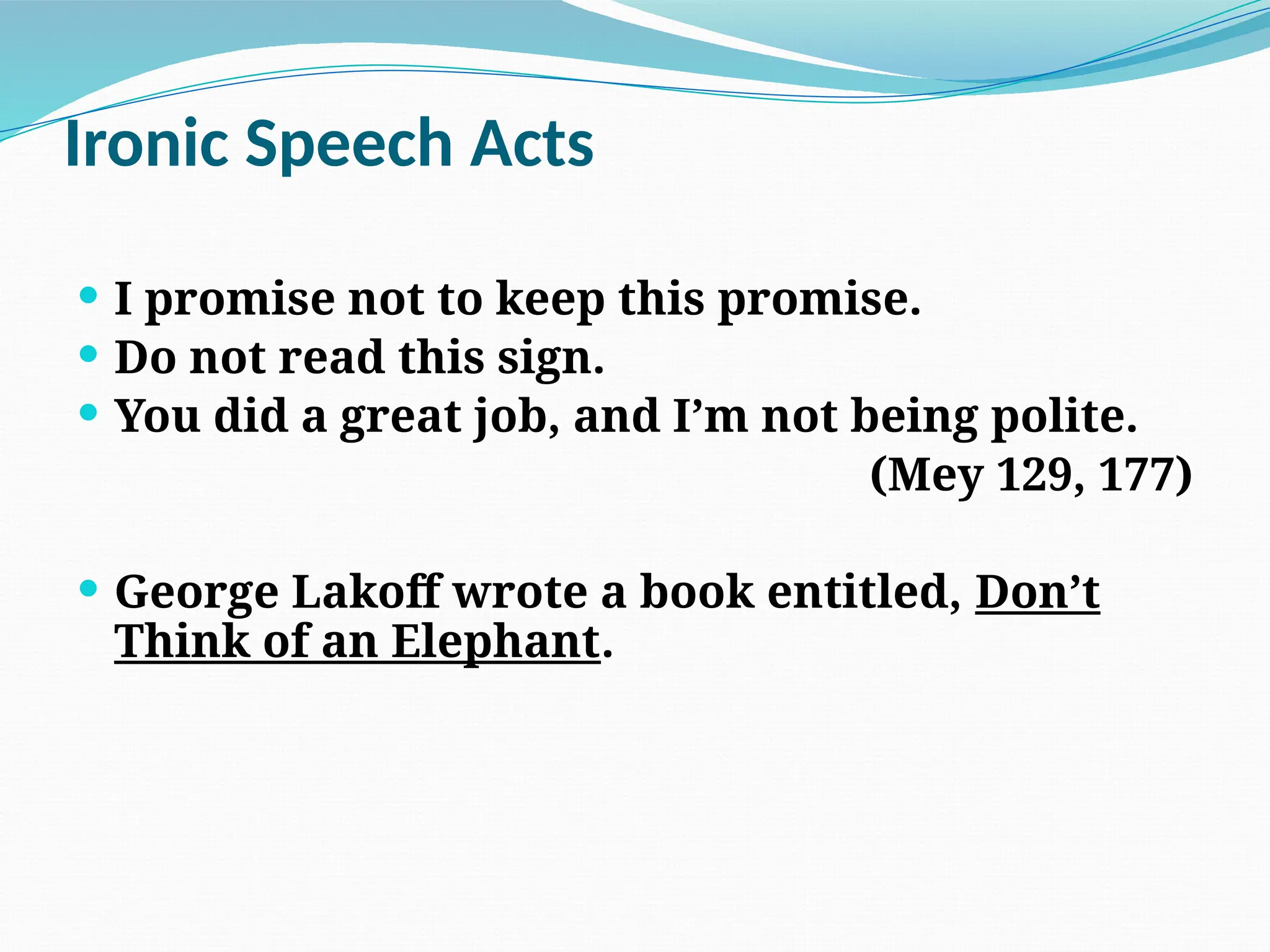
Ironic Speech Acts
 I promise not to keep this promise.
 Do not read this sign.
 You did a great job, and I’m not being polite.
(Mey 129, 177)
 George Lakoff wrote a book entitled, Don’t
Think of an Elephant.
Speech Acts.pptx speech acts pptx speech scts

  • 1.
  • 2.
    Austin and Searle Austin, J. L. How to Do Things with Words. Oxford, England: Oxford University Press, 1962.
  • 3.
    Speech act theory Speech act theory was proposed by John . L. Austin and has been developed by J. R. Searle. They believe that language is not only used to inform or to describe things, it is often used to “do things”, to perform acts.  Ex. (1) You’re fired.  (2) “There is a policeman on the corner”
  • 4.
     “I promiseI’ll be there tomorrow.”  This could be a threat or a promise, depending on whether his presence tomorrow is a disadvantage or an advantage to the listener. Contrast the sentence above with:  “If you don’t behave, I promise you there’s going to be trouble.” This sentence says it’s a “promise,” but it’s a “threat.” (Searle Speech Acts 58)
  • 5.
     Actions performedvia utterances are generally called speech acts, the uttering of the relevant words is the action itself; without the utterance the action is not done. These are called performative sentences and the verbs used are called performative verbs (Vp):  Austin suggests three kinds of acts  a. locutionary act  b. illocutionary act  c. perlocutinary act
  • 6.
    The speech acttheory  a. Locutionary act: the act of saying, the literal meaning of the utterance  b. illocutionary act: the extra meaning of the utterance produced on the basis of its literal meaning  c. perlocutionary act: the effect of the utterance on the hearer, depending on specific circumstances.
  • 7.
    It’s stuffy inhere.  The locutionary act is the saying of it with its literal meaning “There isn’t enough fresh air in here”.  The illocutionary act can be a request of the hearer to open the window.  The perlocutinary act can be the hearer’s opening the window or his refusal to do so. In fact, we might utter (1) to make a statement, a request, an explanation, or for some other communicative purposes. This is also generally known as the
  • 8.
    Explicit and ImplicitPerformatives  An explicit performative is one in which the utterance inscription contains an expression that makes explicit what kind of act is being performed (Lyons, 1981: 175). An explicit performative includes a performative verb as Thomas (1995: 47) claims, it can be seen to be a mechanism that allows the speaker to remove any possibility of misunderstanding the force behind an utterance.  a. I order you to leave.  b. Will you leave?
  • 10.
     Representatives isa speech act that commits a speaker to the truth of the expressed proposition  Directive is a speech act that is to cause the hearer to take a particular action  Commissive is a speech act that commits a speaker to some future action (promises, refuses)  Expressive is a speech act that expresses on the speaker's attitudes and emotions towards the proposition.  Declarative is a speech act that changes the reality in accord with the proposition of the declaration.  e.g. Class dismissed Searle’s classification of speech Acts
  • 11.
    Indirect speech acts “Could you move over a bit?”  “Yes” (without moving is inappropriate)  Moving (without “Yes” is appropriate)  NOTE: “Could you move over a bit” is a precondition to the actual speech act, “Move over.” (Mey 111)
  • 12.
     Do youknow what time it is?  Do you have the correct time?  Can you tell me how to get to the men’s room?  Do you see the salt anywhere?  It’s cold in here.  Isn’t this soup rather bland?  Why can’t you shut up?  NOTE: These are preconditions (Mey 126-127, 135)
  • 13.
    Direct and IndirectSpeech Acts  Whenever there is a direct relationship between a structure and a function, we have a direct speech act. For example, a declarative used to make a statement is a direct speech act, but a declarative used to make a request is an indirect speech act.
  • 14.
     I stronglysuggest you shut your mouth.  Sometimes it’s a good idea to shut up.  I wonder if you really should do all that talking.  I wouldn’t say more, if I were you.  Remember the proverb, “Speech is silver….?”  How about if you just shut up? (Mey 136)
  • 15.
    Ironic Speech Acts I promise not to keep this promise.  Do not read this sign.  You did a great job, and I’m not being polite. (Mey 129, 177)  George Lakoff wrote a book entitled, Don’t Think of an Elephant.