By Melinda Cachero Kim May 8 & 9, 2014
MALED 207
Will the learner’s first language affect
his second language acquisition?
Will old habits get in the way of learning
new habits
mckim05082014
The discourse theory has resulted from a
theory of language use.
The theory emphasizes that language
development should be viewed within the
framework of how the learner discovers the
meaning capacity of language by taking
part in communication.
 It is the technical term for “conversation”
 It is derived from the Latin word “discursus” which
means running to and from, and denotes written
and spoken communication.
mckim05082014
 Language can be learned by
communicating with the target
language speaker.
 Learners discover the potential meaning
of language by participating in
communication.
 Communication is treated as the matrix
of linguistic knowledge….
…. such that if we want to acquire a
second language, the main ways to learn
is by making a lot of interaction with the
target language speaker.
mckim05082014
 Even for the first language acquisition to
be successful, interaction, rather than
exposure is required.
 It is said that first language acquisition is
related to this theory.
Michael A.K. Halliday thinks that the process of first
language acquisition is actually the process of
learning how to communicate in that language.
mckim05082014
 Hatch agrees with Halliday and
perceives little difference between the
first language acquisition process and
the process of second language
acquisition. She thinks that only
through communication discourses
can the learner acquire the second
language.
 Phonology: Word sounds
 Morphology: Word parts and meanings
 Semantics: Word meanings and use
 Syntax: Complete sentences and sentence
structure
 Discourse: Multiple sentences (paragraphs,
stories, chapters, books)
mckim05082014
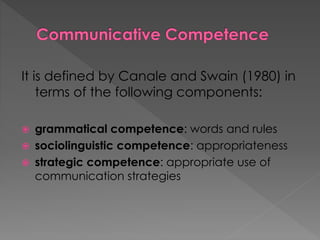
It is defined by Canale and Swain (1980) in
terms of the following components:
 grammatical competence: words and rules
 sociolinguistic competence: appropriateness
 strategic competence: appropriate use of
communication strategies
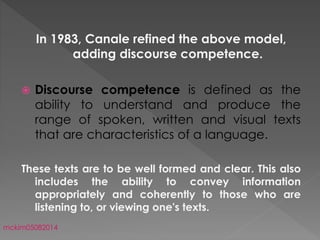
In 1983, Canale refined the above model,
adding discourse competence.
 Discourse competence is defined as the
ability to understand and produce the
range of spoken, written and visual texts
that are characteristics of a language.
These texts are to be well formed and clear. This also
includes the ability to convey information
appropriately and coherently to those who are
listening to, or viewing one's texts.
mckim05082014
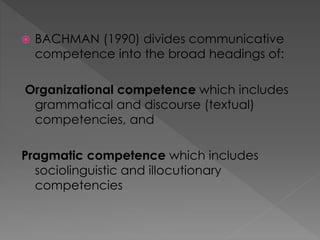
 BACHMAN (1990) divides communicative
competence into the broad headings of:
Organizational competence which includes
grammatical and discourse (textual)
competencies, and
Pragmatic competence which includes
sociolinguistic and illocutionary
competencies
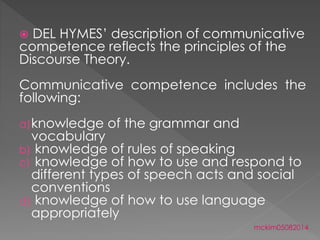
 DEL HYMES’ description of communicative
competence reflects the principles of the
Discourse Theory.
Communicative competence includes the
following:
a)knowledge of the grammar and
vocabulary
b) knowledge of rules of speaking
c) knowledge of how to use and respond to
different types of speech acts and social
conventions
d) knowledge of how to use language
appropriately
mckim05082014
Through the influence of communicative
language teaching,
it has become widely accepted that
communicative competence should be
the goal of language education, central
to good classroom practice.
“Language acquisition will successfully take
place when language learners “know” how
and when to use the language in various
settings and when they have successfully
“cognized” various forms of competence
such as grammatical competence (lexis,
morphology, syntax and phonology) and
pragmatic competence (e.g., speech
acts). A language learner needs to “know”
conversational strategies to acquire the
language.”
mckim05082014
It is defined as the analysis of language
'beyond the sentence'.
Discourse analysts consider the larger
discourse context in order to understand
how it affects the meaning of the sentence.
For example, Charles Fillmore points out
that two sentences taken together as
a single discourse can have meanings
different from each one taken
separately.
mckim05082014
mckim05082014
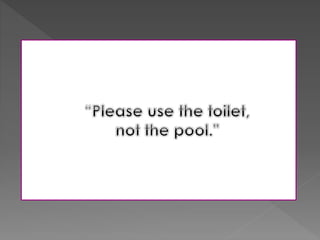
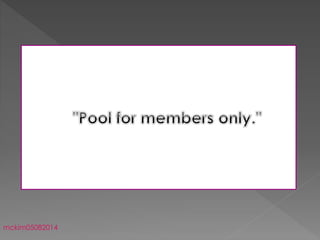
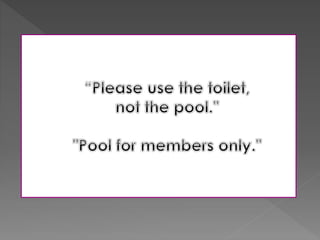
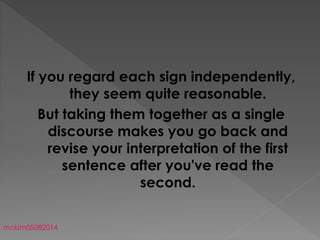
If you regard each sign independently,
they seem quite reasonable.
But taking them together as a single
discourse makes you go back and
revise your interpretation of the first
sentence after you've read the
second.
mckim05082014
A. In second language acquisition, the rules of
grammar are acquired in a natural order. This is
largely influenced by the learner’s age, context of
learning and learner’s L1 background.
 SLA has a controlling factor called “faculty for
language” that all human beings possess and
which is also responsible for the first language
acquisition.
B. When communicating with a non-native speaker,
the native speaker adjusts his discourse to
negotiate meaning with the speaker.
 In this principle, the native speaker enables the
non-native speaker to communicate while the
latter uses various strategies in the negotiation of
meaning. Together, they strive to overcome the
communicative difficulties which are always likely
to arise as a result of the learner’s limited second
language resources.
mckim05082014
C. The strategies and means used in
discourses and the adjusted language input
will influence the speed and order of
second language acquisition in the
following aspects:
 1. The learner learns the grammar of the L2 in the
same order as the frequency order of the various
features in the input. It means the first structures
that the L2 learner acquires are those that he/she is
exposed to most frequently.
 2. The learner acquires commonly occurring
formulas and then later analyzes these into their
component parts.
 3. The learner is helped to construct sentences
vertically. Learner utterances are constructed by
borrowing chunks of speech from the preceding
discourse.
mckim05082014
D. The natural order of second language acquisition is
the result of the learner’s learning to make
discourse interactions (how to hold conversations).
 This is the strongest claim for the role of interaction
in SLA. It emphasizes the role of the linguistic
environment, which is shaped jointly by the L2
learner and the native speaker in discourse, and
plays down the role of internal processing factors.
A. Modes of Discourse
 1. Exposition
 2. Narration
 3. Description
 4. Argument/Persuasion
mckim05082014
The following 4 slides show paragraphs
or passages lifted from articles and books.
Read each slide content carefully and
determine which one is an exposition,
narration, description, and argumentation
or persuation….
The curtains of his bed were drawn aside;
and Scrooge, starting up into a half-
recumbent attitude, found himself face-
to-face with the unearthly visitor who
drew them: as close to it as I am now to
you, and I am standing in the spirit at
your elbow.
mckim05082014
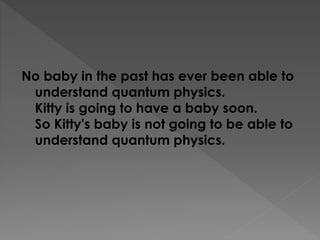
No baby in the past has ever been able to
understand quantum physics.
Kitty is going to have a baby soon.
So Kitty's baby is not going to be able to
understand quantum physics.
The Civil War was caused because of conflicts
between states on the subjects of states'
rights and slavery. Before the war the
southern states relied on slaves to plant and
harvest the crops. These southern states
wanted to make decisions separate from
the northern states and banded together as
"The Confederates," threatening to leave
the U.S. The northern soldiers were victories
in the Civil War, reestablishing that states in
the south had to confirm to U.S. laws,
including the abolishment of slavery.
mckim05082014
My most valuable possession is an old, slightly
warped blond guitar--the first instrument I taught
myself how to play. It's nothing fancy, just a
Madeira folk guitar, all scuffed and scratched
and finger-printed. At the top is a bramble of
copper-wound strings, each one hooked through
the eye of a silver tuning key. The strings are
stretched down a long, slim neck, its frets
tarnished, the wood worn by years of fingers
pressing chords and picking notes. The body of
the Madeira is shaped like an enormous yellow
pear, one that was slightly damaged in shipping.
The blond wood has been chipped and gouged
to gray, particularly where the pick guard fell off
years ago. No, it's not a beautiful instrument, but
it still lets me make music, and for that I will
always treasure it.
B. RULES OF CONVERSATION
 1. Attention getting
 2. Topic nomination
 3. Topic development
 4. Topic termination
mckim05082014
A. It shows how written, visual and oral texts
give more depth to the text when the
context is understood more deeply in the
relevant circumstances in the social
context.
B. Instructional dialogue should be closely
linked to the particular scenario in a
classroom. The thoughts and connections
between teachers and students during the
process of teaching and learning
acquisition develop the rigorous nature of
pedagogy.
C. Ideas and concepts will be mutually
understood. It calls for a variety of teaching
methods and teaching conditions specific
to that classroom.
 Accordingly, in the case of L2 acquisition,
language learners are encouraged to deal
with accomplishing actions, which are
thought to help them acquire the target
language.
mckim05082014
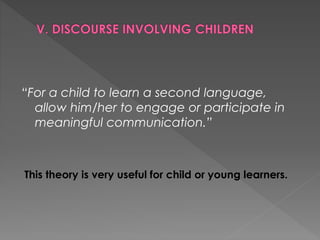
“For a child to learn a second language,
allow him/her to engage or participate in
meaningful communication.”
This theory is very useful for child or young learners.
 A. Children have some specific mental
structure to acquire language effortlessly.
 B. When a child is involved in participating
in different language learners, he can get
better mastery over the language.
mckim05082014
 C. Children interact better than the adults
do. They interact without any hesitations.
They don’t have qualms in making mistakes.
 D. Hatch shows that in child/young learners,
the child will always attempt to “open the
channels” by calling for an adult’s
attention.
 A. Encourage interaction among learners
 B. Be aware of the rules of conversation
 C. Create situations that will allow
interaction and communication
mckim05082014
 A. There is no certain method that can be
directly implemented to the learners.
 B. Language can’t be learned when
learners don’t have the interest to make an
interaction.
 C. The mood or character of the learner will
affect his learning. If he’s a shy person, he
might not feel comfortable
communicating.
 D. There should be a mastery of vocabulary
to be able to interact with the target
language speakers.
 E. It overemphasizes the role of external
factors in the process of language
acquisition and gives little importance to
internal learner strategies (i.e., innate
processes).
mckim05082014
The Discourse Theory is similar to the Behavioristic view of
language acquisition in that environmental factors
and input (or positive stimulus) are at the very center
in attempting to explicate the acquisition process.
The Discourse Theory is of course more sophisticated
than the Skinner’s views in accounting for the
complex structure of communication. Yet it
overstresses the role of “knowledge of competence
and functions” in acquiring a language, and hence
fails to notice universal principles that guide
language acquisition.
Chandy, Molly. (2012). Discourse Theory (http://www.brighthubeducation.com/teaching-tips-foreign-
languages/86266-impact-of-discourse-theory-on-language-learning-acquisition/)
Discourse (http://en.wikipedia.org/wiki/Discourse)
Kiymazarslan, Vedat. (2002). A Discussion of Language Acquisition Theories
http://naturalway.awardspace.com/articles/article006.html
Leon of Leon’s Planet. Language Competence. http://leonsplanet.com/langcomp.htm
Mao, Huaizhou and Luo, Rong (2012) The Complexity Structures of Conversational Interaction Among
Participants, ISSN 1798-4799, Journal of Language Teaching and Research Vol. 3, No.5 pp.1038-1045, Sept.
2012.
Modes of Discourse (blogs.harrisonhigh.org/stephanie_tatum/Modes%20of%20Discourse.ppt)
Ranjit, Kumar Jha. (2012). The Discourse Theory: A Research Paper
(http://eltlanguageandliterature.blogspot.com/2013/06/the-discourse-theory-research-paper.html)
Schroeder, Erica K. Definition: Discourse Competence (Michael Canale & Merrill Swain)
(http://slaencyclopediaf10.wikispaces.com/Discourse+Competence+%28Michael+Canale+%26+Merrill+Sw
ain%29)
Sun, Ruquing. (2013) The Discourse Theory
(http://www.sdlcsz.com:81/Article/ShowArticle.asp?ArticleID=33387)
Tannen, Deborah. Discourse Analysis-What Speakers Do in a Conversation
(http://www.linguisticsociety.org/resource/discourse-analysis-what-speakers-do-conversation)
Tibaldo, Janet. (2013) Discourse Theory (http://www.slideshare.net/janettie/discourse-theory)
mckim05082014

The Discourse Theory-an SLA Theory

  • 1.
    By Melinda CacheroKim May 8 & 9, 2014 MALED 207
  • 2.
    Will the learner’sfirst language affect his second language acquisition? Will old habits get in the way of learning new habits
  • 3.
  • 4.
    The discourse theoryhas resulted from a theory of language use. The theory emphasizes that language development should be viewed within the framework of how the learner discovers the meaning capacity of language by taking part in communication.
  • 5.
     It isthe technical term for “conversation”  It is derived from the Latin word “discursus” which means running to and from, and denotes written and spoken communication. mckim05082014
  • 6.
     Language canbe learned by communicating with the target language speaker.  Learners discover the potential meaning of language by participating in communication.
  • 7.
     Communication istreated as the matrix of linguistic knowledge…. …. such that if we want to acquire a second language, the main ways to learn is by making a lot of interaction with the target language speaker. mckim05082014
  • 8.
     Even forthe first language acquisition to be successful, interaction, rather than exposure is required.
  • 9.
     It issaid that first language acquisition is related to this theory. Michael A.K. Halliday thinks that the process of first language acquisition is actually the process of learning how to communicate in that language. mckim05082014
  • 10.
     Hatch agreeswith Halliday and perceives little difference between the first language acquisition process and the process of second language acquisition. She thinks that only through communication discourses can the learner acquire the second language.
  • 11.
     Phonology: Wordsounds  Morphology: Word parts and meanings  Semantics: Word meanings and use  Syntax: Complete sentences and sentence structure  Discourse: Multiple sentences (paragraphs, stories, chapters, books) mckim05082014
  • 12.
    It is definedby Canale and Swain (1980) in terms of the following components:  grammatical competence: words and rules  sociolinguistic competence: appropriateness  strategic competence: appropriate use of communication strategies
  • 13.
    In 1983, Canalerefined the above model, adding discourse competence.  Discourse competence is defined as the ability to understand and produce the range of spoken, written and visual texts that are characteristics of a language. These texts are to be well formed and clear. This also includes the ability to convey information appropriately and coherently to those who are listening to, or viewing one's texts. mckim05082014
  • 14.
     BACHMAN (1990)divides communicative competence into the broad headings of: Organizational competence which includes grammatical and discourse (textual) competencies, and Pragmatic competence which includes sociolinguistic and illocutionary competencies
  • 15.
     DEL HYMES’description of communicative competence reflects the principles of the Discourse Theory. Communicative competence includes the following: a)knowledge of the grammar and vocabulary b) knowledge of rules of speaking c) knowledge of how to use and respond to different types of speech acts and social conventions d) knowledge of how to use language appropriately mckim05082014
  • 16.
    Through the influenceof communicative language teaching, it has become widely accepted that communicative competence should be the goal of language education, central to good classroom practice.
  • 17.
    “Language acquisition willsuccessfully take place when language learners “know” how and when to use the language in various settings and when they have successfully “cognized” various forms of competence such as grammatical competence (lexis, morphology, syntax and phonology) and pragmatic competence (e.g., speech acts). A language learner needs to “know” conversational strategies to acquire the language.” mckim05082014
  • 18.
    It is definedas the analysis of language 'beyond the sentence'. Discourse analysts consider the larger discourse context in order to understand how it affects the meaning of the sentence.
  • 19.
    For example, CharlesFillmore points out that two sentences taken together as a single discourse can have meanings different from each one taken separately. mckim05082014
  • 21.
  • 23.
    If you regardeach sign independently, they seem quite reasonable. But taking them together as a single discourse makes you go back and revise your interpretation of the first sentence after you've read the second. mckim05082014
  • 24.
    A. In secondlanguage acquisition, the rules of grammar are acquired in a natural order. This is largely influenced by the learner’s age, context of learning and learner’s L1 background.  SLA has a controlling factor called “faculty for language” that all human beings possess and which is also responsible for the first language acquisition.
  • 25.
    B. When communicatingwith a non-native speaker, the native speaker adjusts his discourse to negotiate meaning with the speaker.  In this principle, the native speaker enables the non-native speaker to communicate while the latter uses various strategies in the negotiation of meaning. Together, they strive to overcome the communicative difficulties which are always likely to arise as a result of the learner’s limited second language resources. mckim05082014
  • 26.
    C. The strategiesand means used in discourses and the adjusted language input will influence the speed and order of second language acquisition in the following aspects:  1. The learner learns the grammar of the L2 in the same order as the frequency order of the various features in the input. It means the first structures that the L2 learner acquires are those that he/she is exposed to most frequently.
  • 27.
     2. Thelearner acquires commonly occurring formulas and then later analyzes these into their component parts.  3. The learner is helped to construct sentences vertically. Learner utterances are constructed by borrowing chunks of speech from the preceding discourse. mckim05082014
  • 28.
    D. The naturalorder of second language acquisition is the result of the learner’s learning to make discourse interactions (how to hold conversations).  This is the strongest claim for the role of interaction in SLA. It emphasizes the role of the linguistic environment, which is shaped jointly by the L2 learner and the native speaker in discourse, and plays down the role of internal processing factors.
  • 29.
    A. Modes ofDiscourse  1. Exposition  2. Narration  3. Description  4. Argument/Persuasion mckim05082014
  • 30.
    The following 4slides show paragraphs or passages lifted from articles and books. Read each slide content carefully and determine which one is an exposition, narration, description, and argumentation or persuation….
  • 31.
    The curtains ofhis bed were drawn aside; and Scrooge, starting up into a half- recumbent attitude, found himself face- to-face with the unearthly visitor who drew them: as close to it as I am now to you, and I am standing in the spirit at your elbow. mckim05082014
  • 32.
    No baby inthe past has ever been able to understand quantum physics. Kitty is going to have a baby soon. So Kitty's baby is not going to be able to understand quantum physics.
  • 33.
    The Civil Warwas caused because of conflicts between states on the subjects of states' rights and slavery. Before the war the southern states relied on slaves to plant and harvest the crops. These southern states wanted to make decisions separate from the northern states and banded together as "The Confederates," threatening to leave the U.S. The northern soldiers were victories in the Civil War, reestablishing that states in the south had to confirm to U.S. laws, including the abolishment of slavery. mckim05082014
  • 34.
    My most valuablepossession is an old, slightly warped blond guitar--the first instrument I taught myself how to play. It's nothing fancy, just a Madeira folk guitar, all scuffed and scratched and finger-printed. At the top is a bramble of copper-wound strings, each one hooked through the eye of a silver tuning key. The strings are stretched down a long, slim neck, its frets tarnished, the wood worn by years of fingers pressing chords and picking notes. The body of the Madeira is shaped like an enormous yellow pear, one that was slightly damaged in shipping. The blond wood has been chipped and gouged to gray, particularly where the pick guard fell off years ago. No, it's not a beautiful instrument, but it still lets me make music, and for that I will always treasure it.
  • 35.
    B. RULES OFCONVERSATION  1. Attention getting  2. Topic nomination  3. Topic development  4. Topic termination mckim05082014
  • 36.
    A. It showshow written, visual and oral texts give more depth to the text when the context is understood more deeply in the relevant circumstances in the social context. B. Instructional dialogue should be closely linked to the particular scenario in a classroom. The thoughts and connections between teachers and students during the process of teaching and learning acquisition develop the rigorous nature of pedagogy.
  • 37.
    C. Ideas andconcepts will be mutually understood. It calls for a variety of teaching methods and teaching conditions specific to that classroom.  Accordingly, in the case of L2 acquisition, language learners are encouraged to deal with accomplishing actions, which are thought to help them acquire the target language. mckim05082014
  • 38.
    “For a childto learn a second language, allow him/her to engage or participate in meaningful communication.” This theory is very useful for child or young learners.
  • 39.
     A. Childrenhave some specific mental structure to acquire language effortlessly.  B. When a child is involved in participating in different language learners, he can get better mastery over the language. mckim05082014
  • 40.
     C. Childreninteract better than the adults do. They interact without any hesitations. They don’t have qualms in making mistakes.  D. Hatch shows that in child/young learners, the child will always attempt to “open the channels” by calling for an adult’s attention.
  • 41.
     A. Encourageinteraction among learners  B. Be aware of the rules of conversation  C. Create situations that will allow interaction and communication mckim05082014
  • 42.
     A. Thereis no certain method that can be directly implemented to the learners.  B. Language can’t be learned when learners don’t have the interest to make an interaction.
  • 43.
     C. Themood or character of the learner will affect his learning. If he’s a shy person, he might not feel comfortable communicating.  D. There should be a mastery of vocabulary to be able to interact with the target language speakers.  E. It overemphasizes the role of external factors in the process of language acquisition and gives little importance to internal learner strategies (i.e., innate processes). mckim05082014
  • 44.
    The Discourse Theoryis similar to the Behavioristic view of language acquisition in that environmental factors and input (or positive stimulus) are at the very center in attempting to explicate the acquisition process. The Discourse Theory is of course more sophisticated than the Skinner’s views in accounting for the complex structure of communication. Yet it overstresses the role of “knowledge of competence and functions” in acquiring a language, and hence fails to notice universal principles that guide language acquisition.
  • 45.
    Chandy, Molly. (2012).Discourse Theory (http://www.brighthubeducation.com/teaching-tips-foreign- languages/86266-impact-of-discourse-theory-on-language-learning-acquisition/) Discourse (http://en.wikipedia.org/wiki/Discourse) Kiymazarslan, Vedat. (2002). A Discussion of Language Acquisition Theories http://naturalway.awardspace.com/articles/article006.html Leon of Leon’s Planet. Language Competence. http://leonsplanet.com/langcomp.htm Mao, Huaizhou and Luo, Rong (2012) The Complexity Structures of Conversational Interaction Among Participants, ISSN 1798-4799, Journal of Language Teaching and Research Vol. 3, No.5 pp.1038-1045, Sept. 2012. Modes of Discourse (blogs.harrisonhigh.org/stephanie_tatum/Modes%20of%20Discourse.ppt) Ranjit, Kumar Jha. (2012). The Discourse Theory: A Research Paper (http://eltlanguageandliterature.blogspot.com/2013/06/the-discourse-theory-research-paper.html) Schroeder, Erica K. Definition: Discourse Competence (Michael Canale & Merrill Swain) (http://slaencyclopediaf10.wikispaces.com/Discourse+Competence+%28Michael+Canale+%26+Merrill+Sw ain%29) Sun, Ruquing. (2013) The Discourse Theory (http://www.sdlcsz.com:81/Article/ShowArticle.asp?ArticleID=33387) Tannen, Deborah. Discourse Analysis-What Speakers Do in a Conversation (http://www.linguisticsociety.org/resource/discourse-analysis-what-speakers-do-conversation) Tibaldo, Janet. (2013) Discourse Theory (http://www.slideshare.net/janettie/discourse-theory) mckim05082014