SPEECH ACT
a. Identify the different types of speech act;
b. Explain the three types of speech act; and,
c. Appreciate the importance of responding
appropriately and effectively to a speech act
At the end of the lesson, you are
expected to:
Charles W. Kreidler
Kreidler, Charles W. Introducing English Semantics. Taylor &
Francis e-Library, 2002.
Speech act
Speech act theory was proposed by John L.
Austin and has been developed by J. R.
Searle. They believe that language is not only
used to inform or to describe things, it is
often used to “do things”, to perform acts.
Example.(1) You’re fired.
(2) “There is a policeman on the corner”
“There is a policeman at the corner.”
This could be a warning, an assurance, a dare, a hint, or a reminder to go and take your car
out of the handicapped space you are parked in.
• “I promise I’ll be there tomorrow.”
• This could be a threat or a promise, depending on
whether his presence tomorrow is a disadvantage
or an advantage to the listener. Contrast the
sentence above with:
• “If you don’t behave, I promise you there’s going to
be trouble.” This sentence says it’s a “promise,” but
it’s a “threat.”
• Actions performed via utterances are
generally called speech acts, the
uttering of the relevant words is the
action itself; without the utterance the
action is not done. These are called
performative sentences and the verbs
used are called performative verbs (Vp):
What is a SPEECH ACT?
Speech acts are speakers’ utterances which
convey meaning and make listeners do specific
things.
Three types of Speech Act
Locutionary Act
Illocutionary Act
Perlocutionary Act
LOCUTIONARY ACT
• refers to the actual utterance of the speaker.
Example: When you ask someone, “Can you pass
the salt?” – The literal meaning concerns the
hearer’s ability to pass the salt.
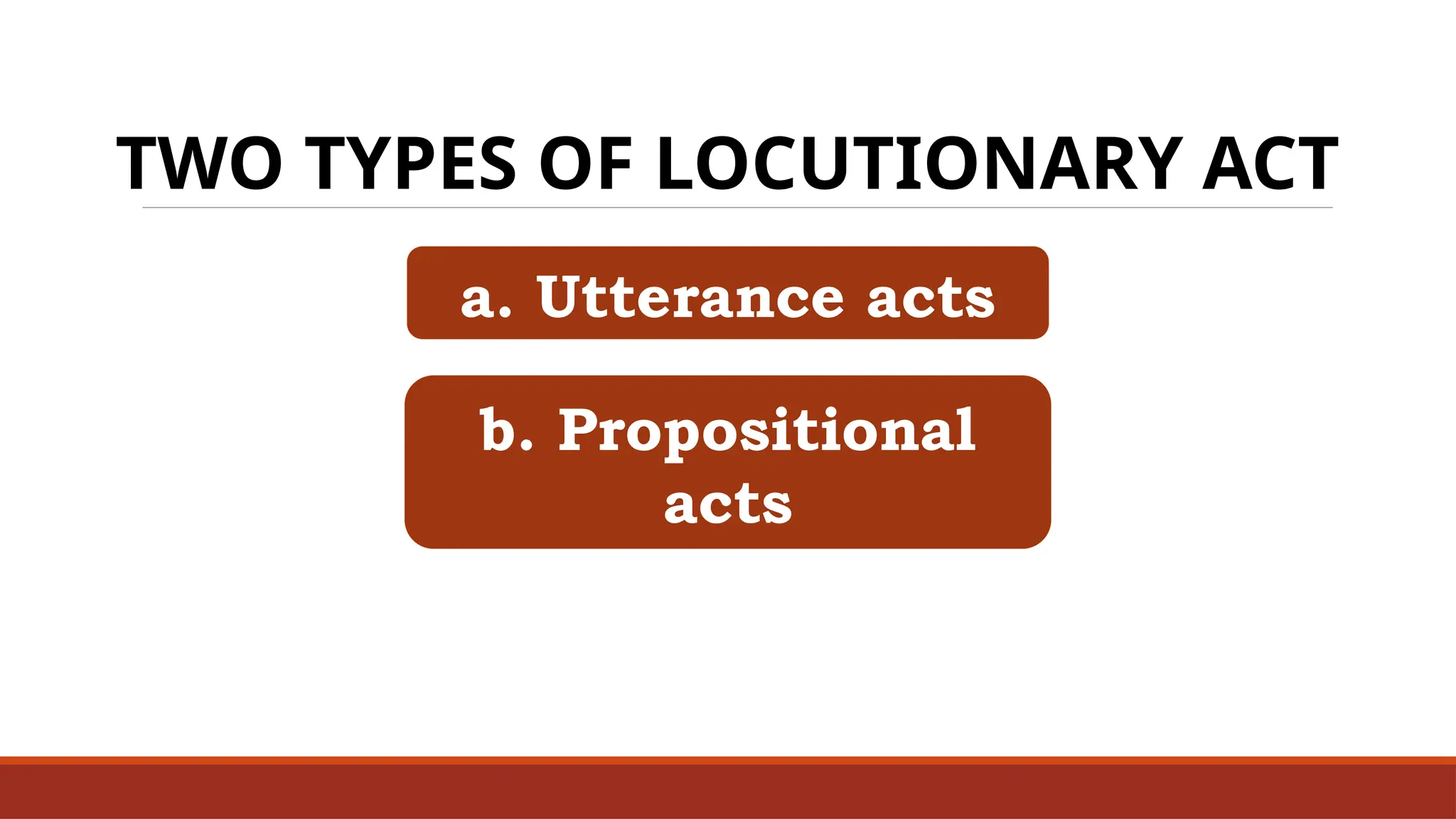
TWO TYPES OF LOCUTIONARY ACT
a. Utterance acts
b. Propositional
acts
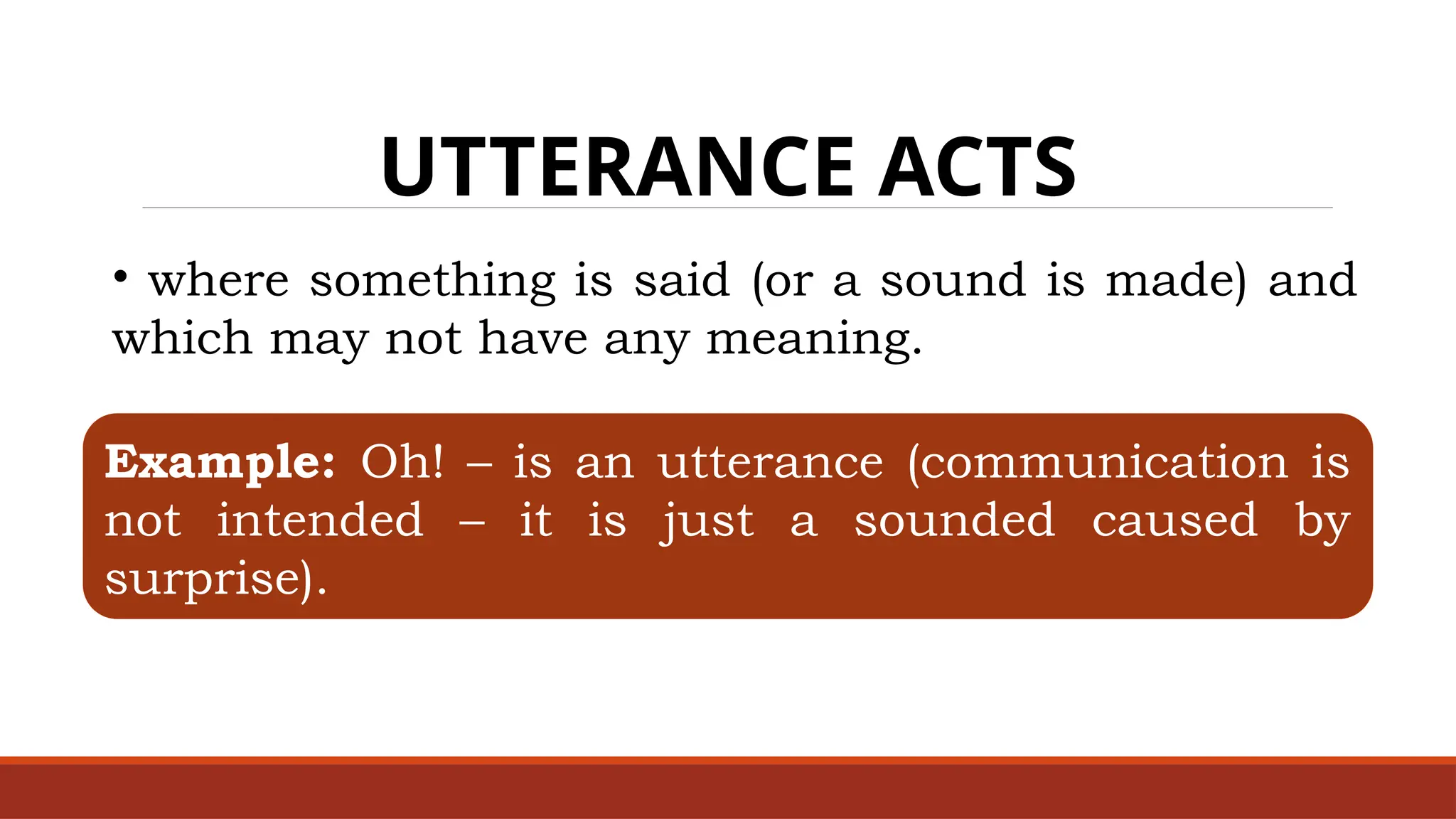
UTTERANCE ACTS
• where something is said (or a sound is made) and
which may not have any meaning.
Example: Oh! – is an utterance (communication is
not intended – it is just a sounded caused by
surprise).
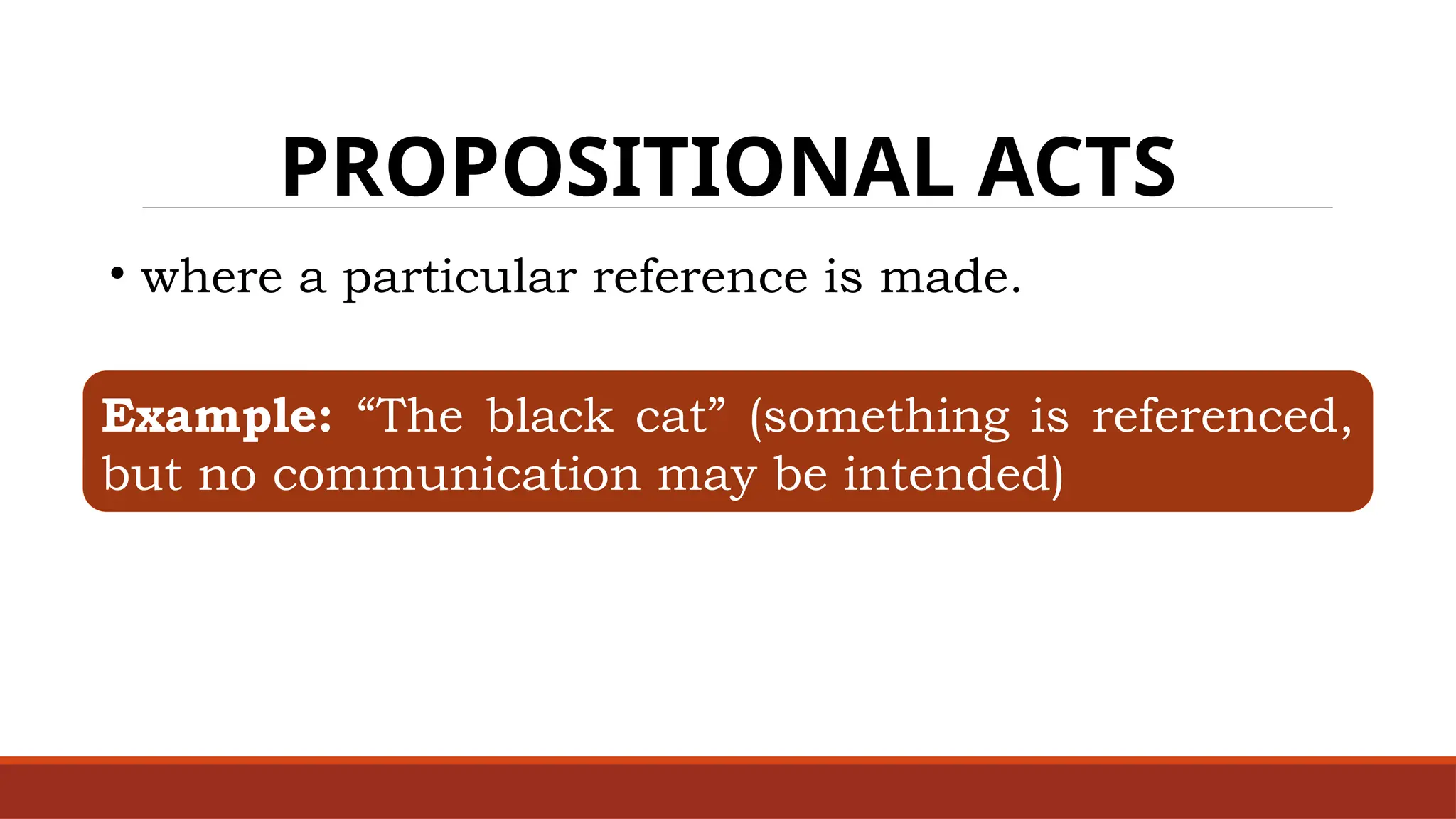
PROPOSITIONAL ACTS
• where a particular reference is made.
Example: “The black cat” (something is referenced,
but no communication may be intended)
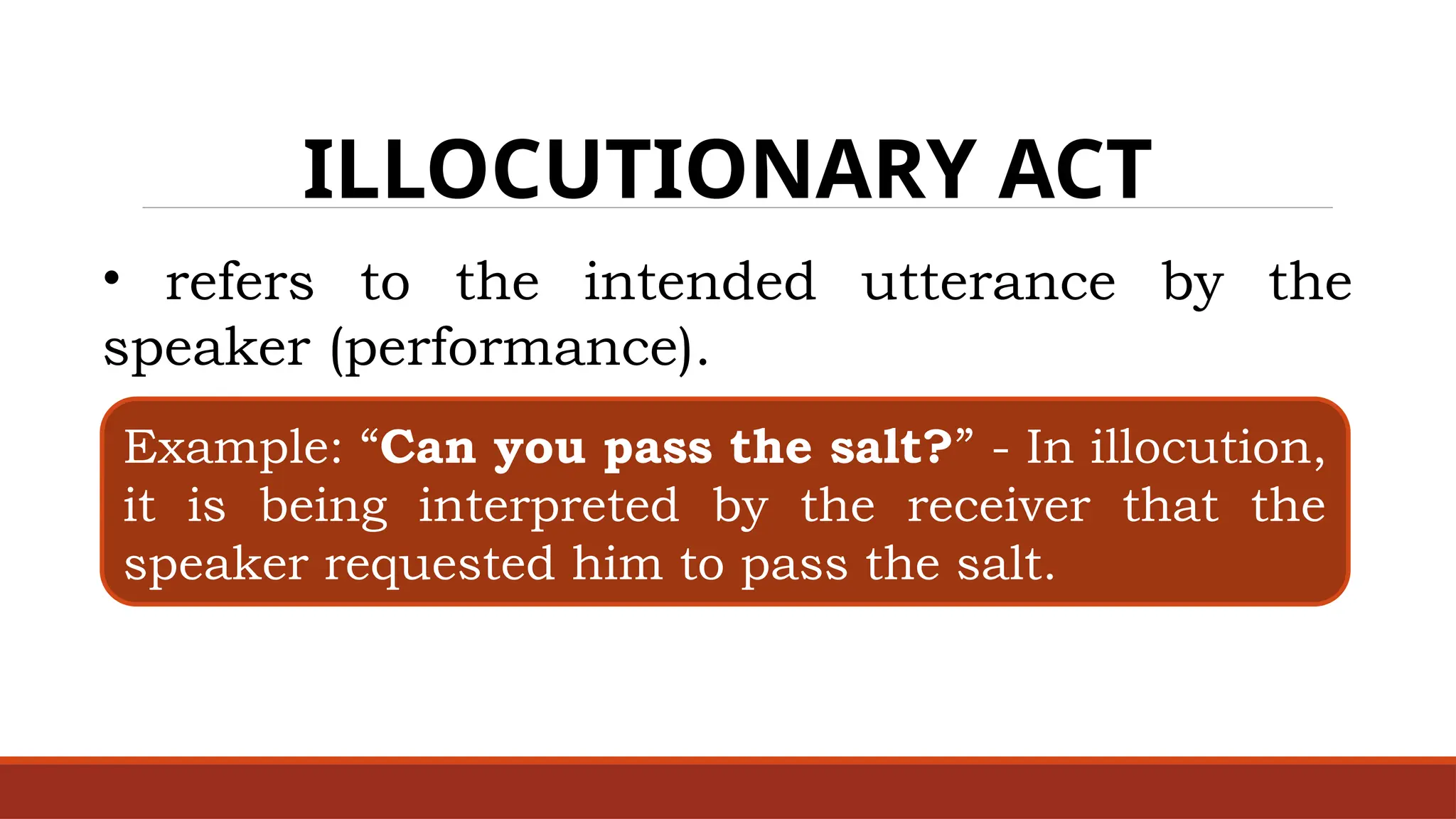
ILLOCUTIONARY ACT
• refers to the intended utterance by the
speaker (performance).
Example: “Can you pass the salt?” - In illocution,
it is being interpreted by the receiver that the
speaker requested him to pass the salt.
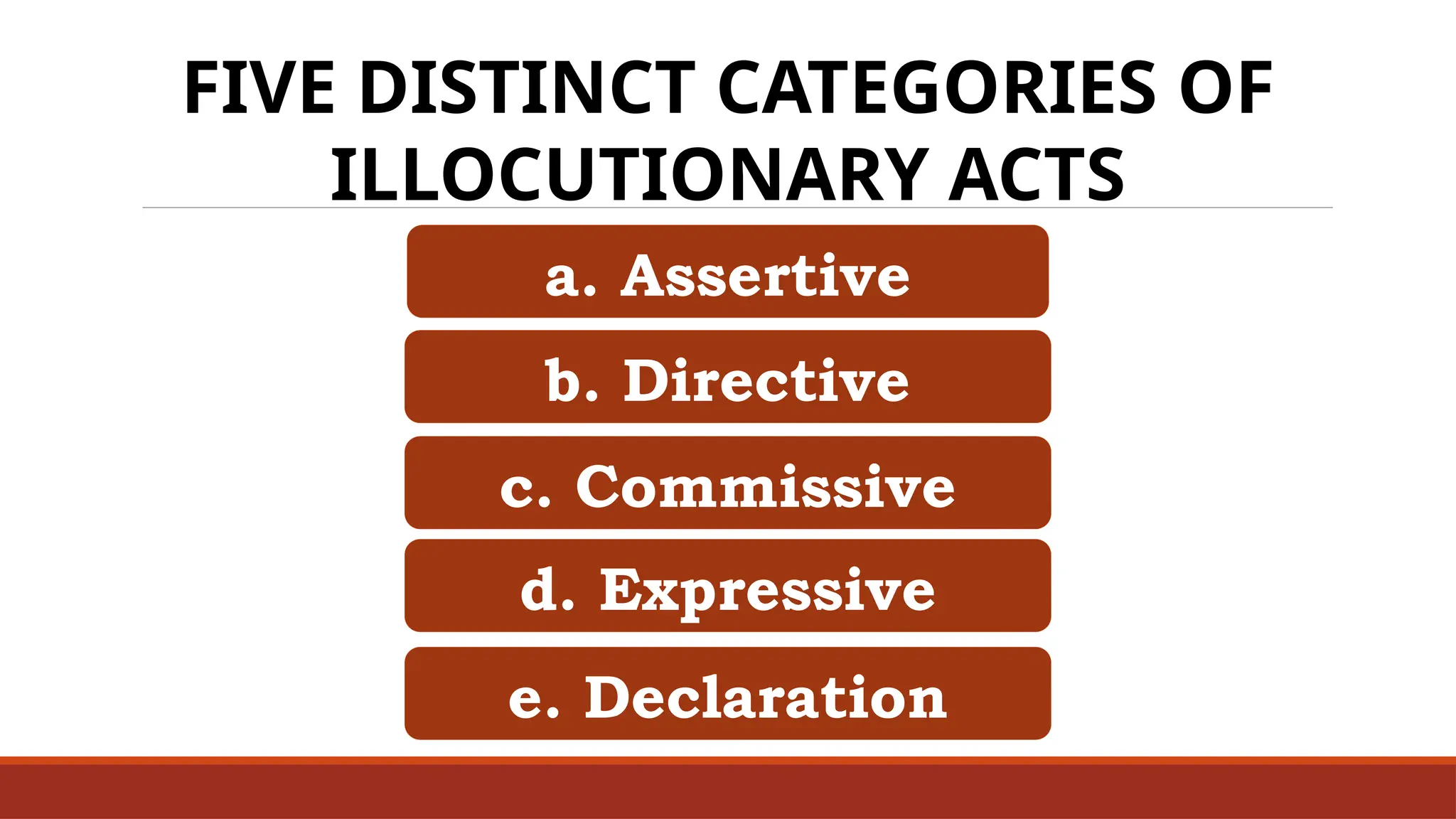
FIVE DISTINCT CATEGORIES OF
ILLOCUTIONARY ACTS
a. Assertive
b. Directive
c. Commissive
e. Declaration
d. Expressive
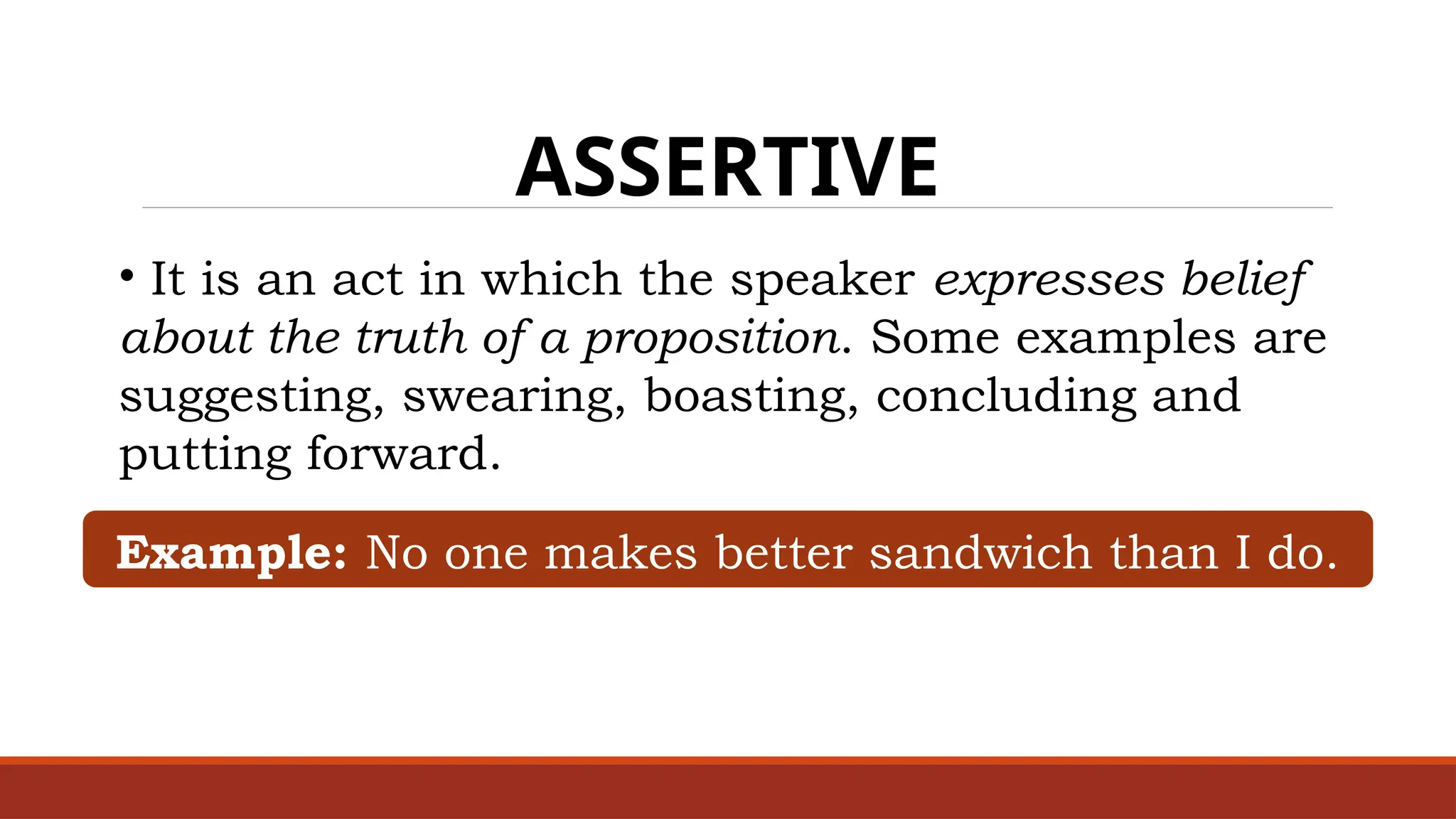
ASSERTIVE
• It is an act in which the speaker expresses belief
about the truth of a proposition. Some examples are
suggesting, swearing, boasting, concluding and
putting forward.
Example: No one makes better sandwich than I do.
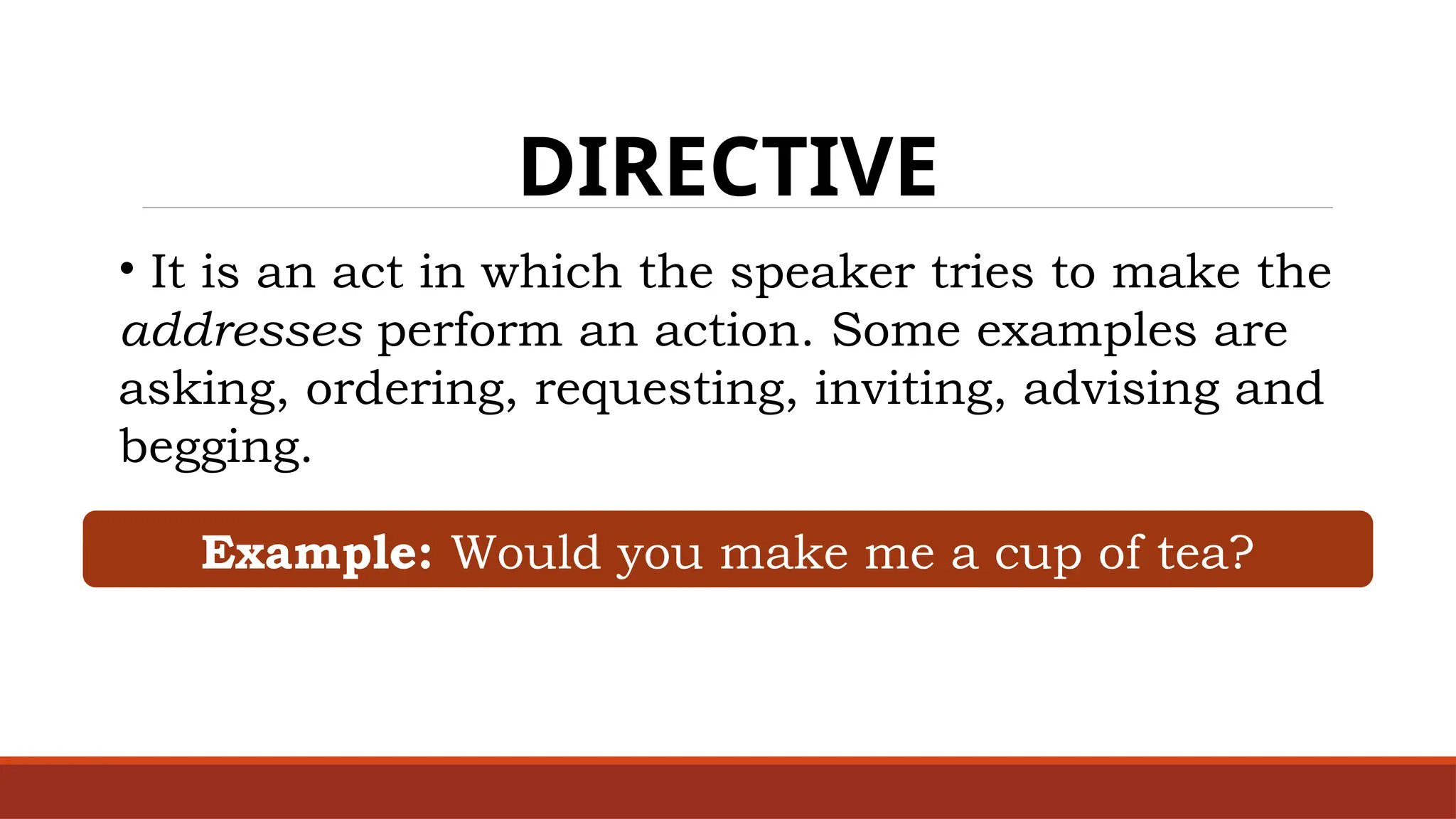
DIRECTIVE
• It is an act in which the speaker tries to make the
addresses perform an action. Some examples are
asking, ordering, requesting, inviting, advising and
begging.
Example: Would you make me a cup of tea?
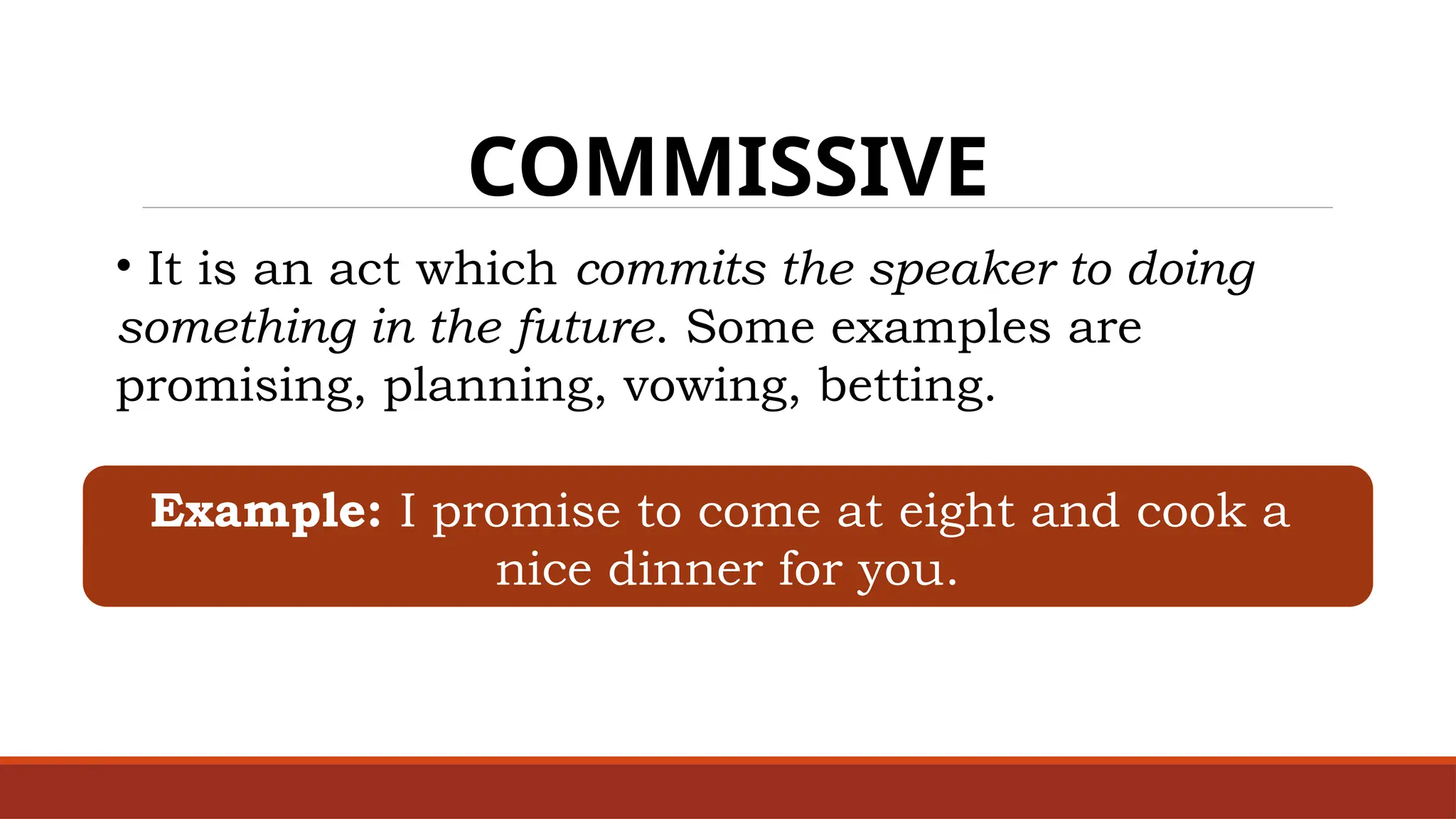
COMMISSIVE
• It is an act which commits the speaker to doing
something in the future. Some examples are
promising, planning, vowing, betting.
Example: I promise to come at eight and cook a
nice dinner for you.
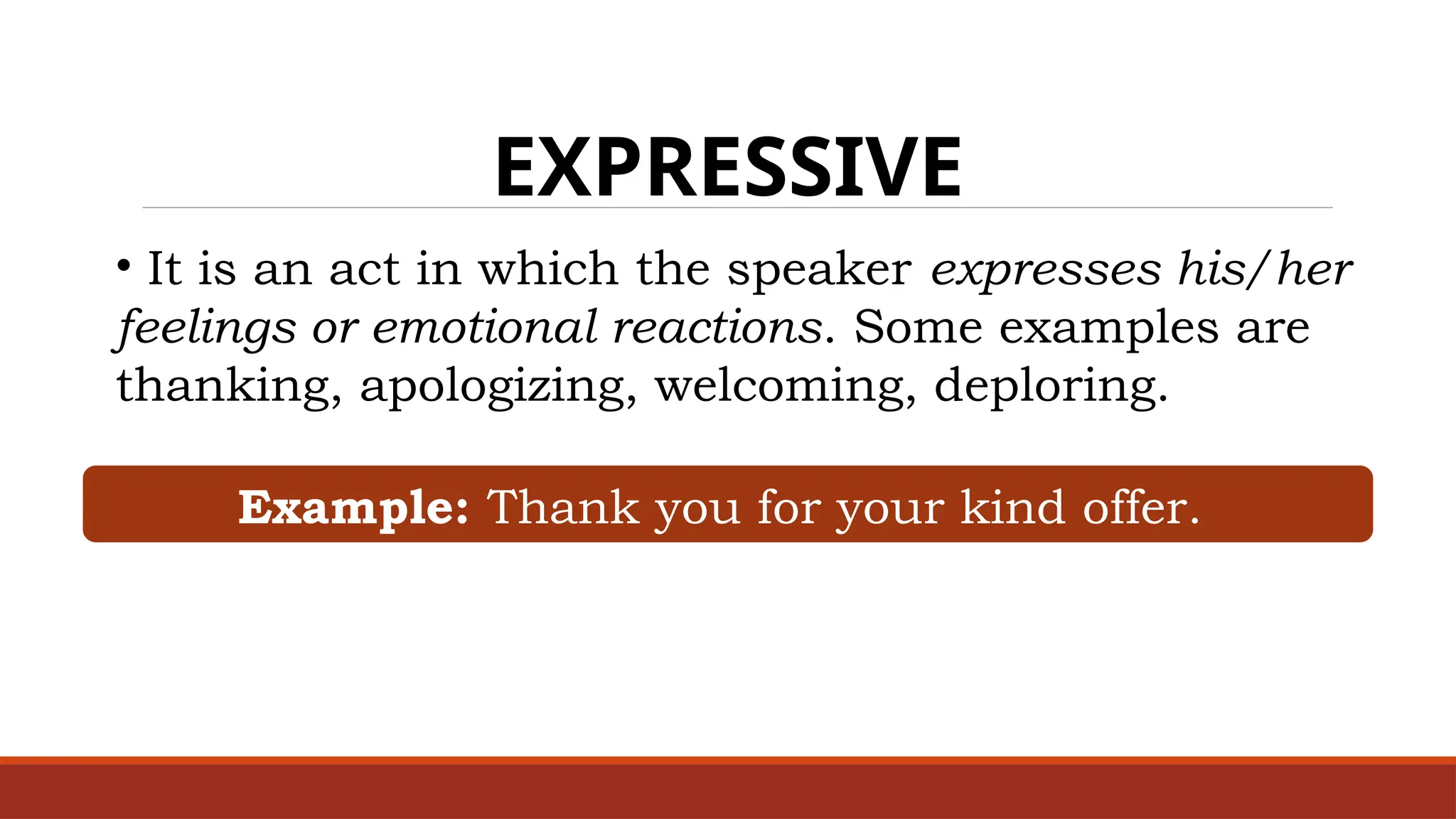
EXPRESSIVE
• It is an act in which the speaker expresses his/her
feelings or emotional reactions. Some examples are
thanking, apologizing, welcoming, deploring.
Example: Thank you for your kind offer.
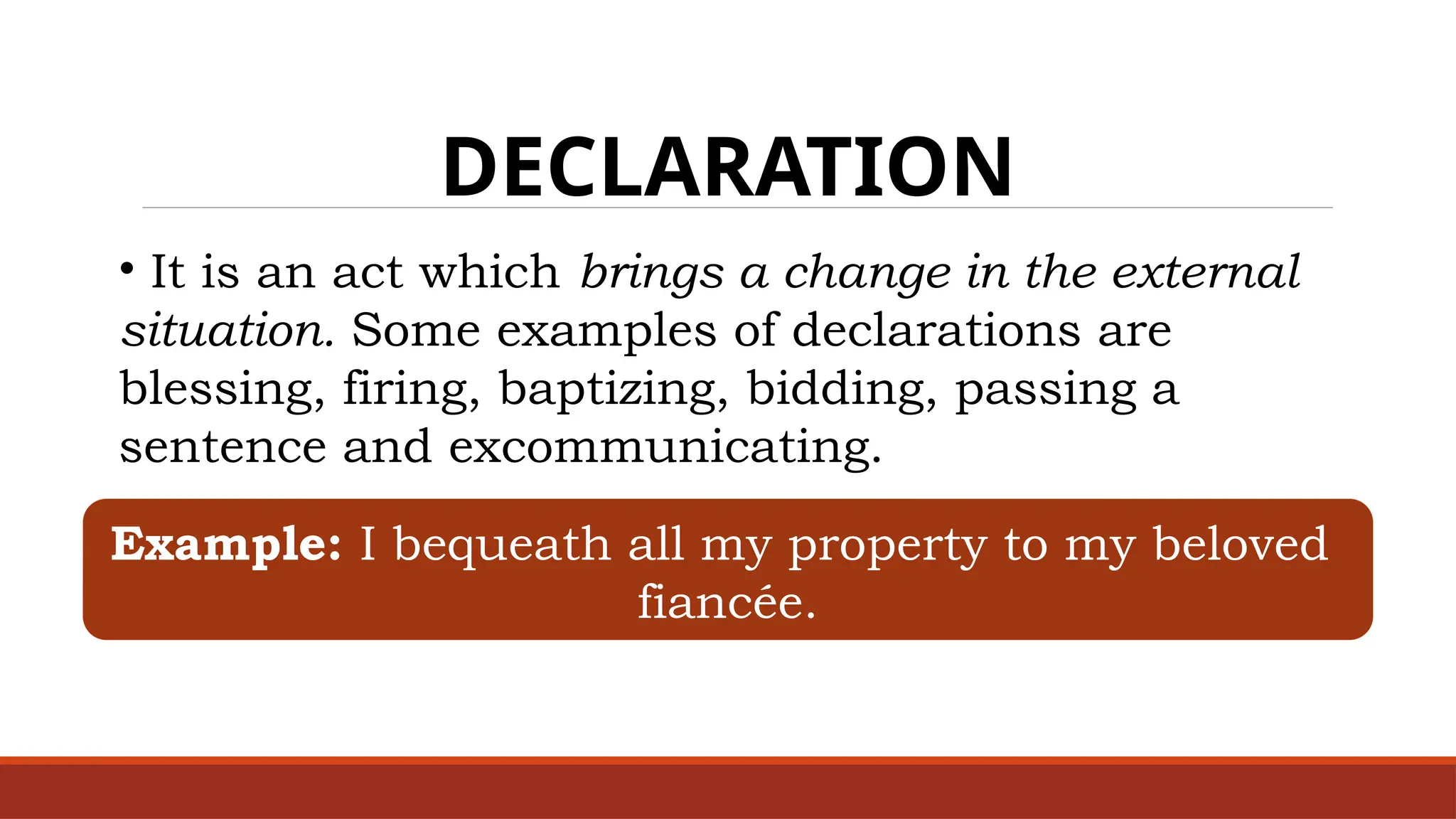
DECLARATION
• It is an act which brings a change in the external
situation. Some examples of declarations are
blessing, firing, baptizing, bidding, passing a
sentence and excommunicating.
Example: I bequeath all my property to my beloved
fiancée.
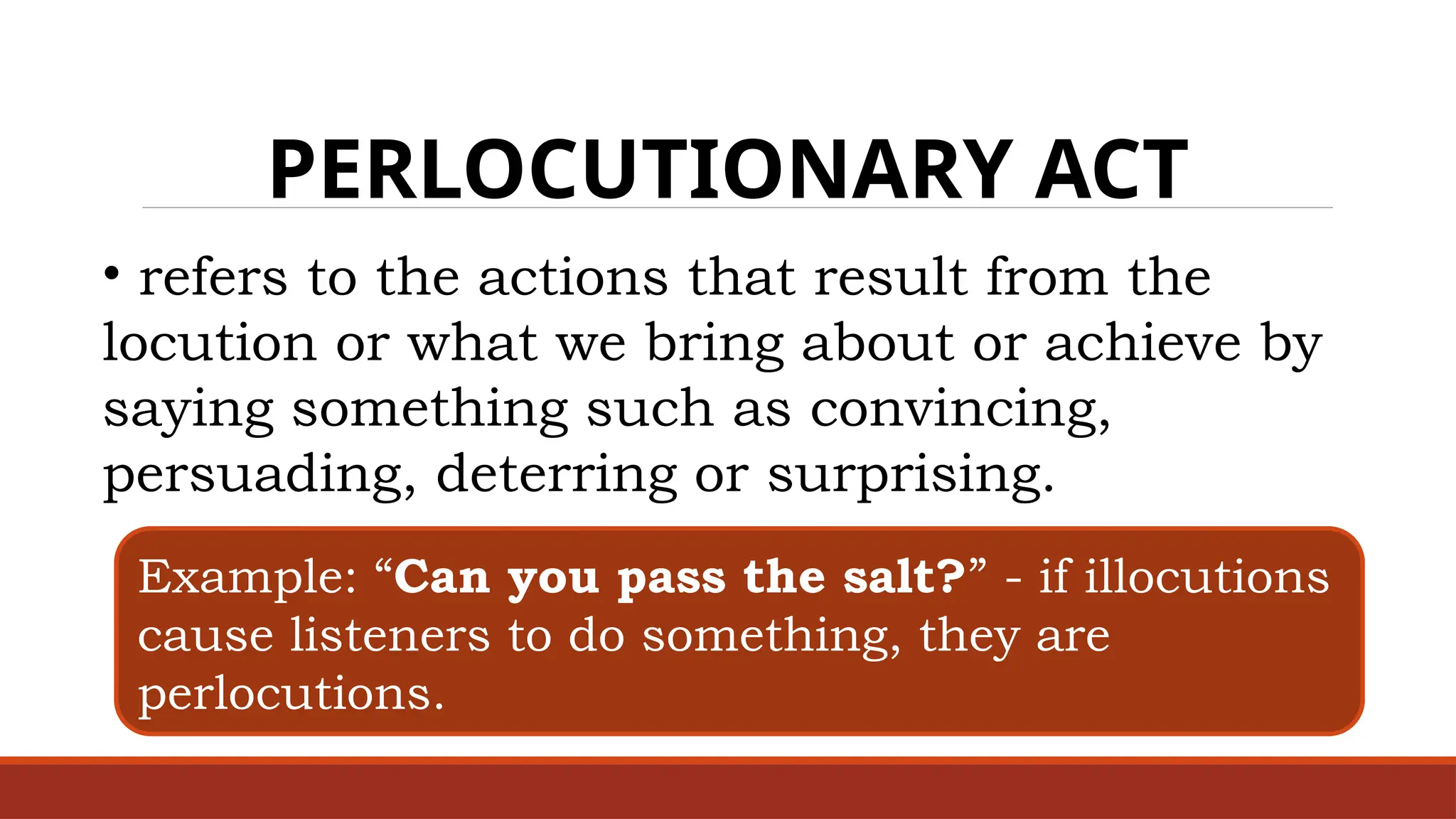
PERLOCUTIONARY ACT
• refers to the actions that result from the
locution or what we bring about or achieve by
saying something such as convincing,
persuading, deterring or surprising.
Example: “Can you pass the salt?” - if illocutions
cause listeners to do something, they are
perlocutions.
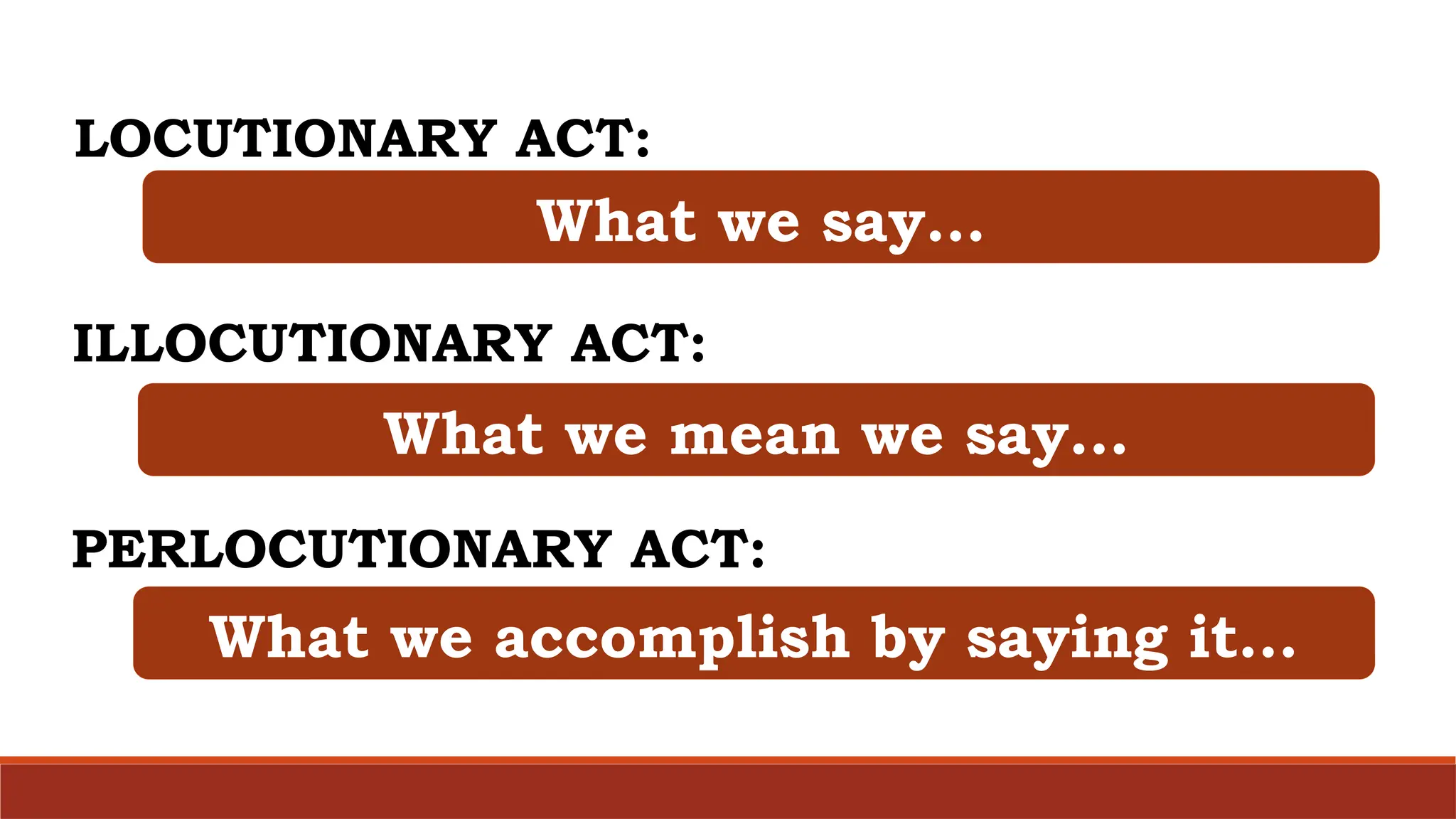
LOCUTIONARY ACT:
ILLOCUTIONARY ACT:
PERLOCUTIONARY ACT:
What we say…
What we mean we say…
What we accomplish by saying it…
Remember: A speaker can use different locution acts
to achieve the same illocutionary force or use one
locution for many different purposes. For instance,
when you ask someone, “Could you water the plants?”
The literal meaning concerns the hearer’s ability to
water the plants whereas its illocution is to request the
hearer to water the plants for the speaker. If illocutions
cause the listeners to do something, they are
perlocutions; in this case, the hearer is watering the
plants
(1) It’s stuffy in here.
• The locutionary act is the saying of it with its literal
meaning “There isn’t enough fresh air in here”.
• The illocutionary act can be a request of the hearer
to open the window.
• The perlocutinary act can be the hearer’s opening
the window or his refusal to do so. In fact, we might
utter (1) to make a statement, a request, an
explanation, or for some other communicative
purposes. This is also generally known as the
illocutionary force of the utterance.
a. Husband: That’s the phone.
b. Wife: I’m in the bathroom.
b. Husband: Okay.
Its illocutionary acts are:
(i) a refusal to comply with the request
(ii) a request to her husband to answer the phone
instead.
Speech act functions
• 1) Exchange factual information
The plain departs at 7:10.
• 2) Exchange intellectual information
These arguments are correct.
• 3) Exchange emotional attitudes
I’m worried about my term papers.
• 4) Exchange moral attitudes
I appreciate your help.
• 5) Persuasion
Hand in your assignments.
• 6) Socializing
Hi, Larry, how are you?
Indirect speech acts
• “Could you move over a bit?”
• “Yes” (without moving is inappropriate)
• Moving (without “Yes” is appropriate)
• NOTE: “Could you move over a bit” is a precondition
to the actual speech act, “Move over.”
Ironic Speech Acts
I promise not to keep this promise.
Do not read this sign.
You did a great job, and I’m not being polite.
George Lakoff wrote a book entitled, Don’t Think of an Elephant.
Silence as a speech acts
• In Mexico in the old days, the Federales would pull
a person over and ask to see their driver’s license.
• Before handing over the driver’s license the driver
would attach a $20 bill onto the back of the
license.
• Nothing was said by either party. Was this,
therefore, a bribe, or not?
That’s All
Any questions?

Speech Act, types of Speech Act in Pragmatics

  • 1.
  • 2.
    a. Identify thedifferent types of speech act; b. Explain the three types of speech act; and, c. Appreciate the importance of responding appropriately and effectively to a speech act At the end of the lesson, you are expected to:
  • 3.
    Charles W. Kreidler Kreidler,Charles W. Introducing English Semantics. Taylor & Francis e-Library, 2002.
  • 4.
    Speech act Speech acttheory was proposed by John L. Austin and has been developed by J. R. Searle. They believe that language is not only used to inform or to describe things, it is often used to “do things”, to perform acts.
  • 5.
    Example.(1) You’re fired. (2)“There is a policeman on the corner” “There is a policeman at the corner.” This could be a warning, an assurance, a dare, a hint, or a reminder to go and take your car out of the handicapped space you are parked in.
  • 6.
    • “I promiseI’ll be there tomorrow.” • This could be a threat or a promise, depending on whether his presence tomorrow is a disadvantage or an advantage to the listener. Contrast the sentence above with: • “If you don’t behave, I promise you there’s going to be trouble.” This sentence says it’s a “promise,” but it’s a “threat.”
  • 7.
    • Actions performedvia utterances are generally called speech acts, the uttering of the relevant words is the action itself; without the utterance the action is not done. These are called performative sentences and the verbs used are called performative verbs (Vp):
  • 8.
    What is aSPEECH ACT? Speech acts are speakers’ utterances which convey meaning and make listeners do specific things.
  • 9.
    Three types ofSpeech Act Locutionary Act Illocutionary Act Perlocutionary Act
  • 10.
    LOCUTIONARY ACT • refersto the actual utterance of the speaker. Example: When you ask someone, “Can you pass the salt?” – The literal meaning concerns the hearer’s ability to pass the salt.
  • 11.
    TWO TYPES OFLOCUTIONARY ACT a. Utterance acts b. Propositional acts
  • 12.
    UTTERANCE ACTS • wheresomething is said (or a sound is made) and which may not have any meaning. Example: Oh! – is an utterance (communication is not intended – it is just a sounded caused by surprise).
  • 13.
    PROPOSITIONAL ACTS • wherea particular reference is made. Example: “The black cat” (something is referenced, but no communication may be intended)
  • 14.
    ILLOCUTIONARY ACT • refersto the intended utterance by the speaker (performance). Example: “Can you pass the salt?” - In illocution, it is being interpreted by the receiver that the speaker requested him to pass the salt.
  • 15.
    FIVE DISTINCT CATEGORIESOF ILLOCUTIONARY ACTS a. Assertive b. Directive c. Commissive e. Declaration d. Expressive
  • 16.
    ASSERTIVE • It isan act in which the speaker expresses belief about the truth of a proposition. Some examples are suggesting, swearing, boasting, concluding and putting forward. Example: No one makes better sandwich than I do.
  • 17.
    DIRECTIVE • It isan act in which the speaker tries to make the addresses perform an action. Some examples are asking, ordering, requesting, inviting, advising and begging. Example: Would you make me a cup of tea?
  • 18.
    COMMISSIVE • It isan act which commits the speaker to doing something in the future. Some examples are promising, planning, vowing, betting. Example: I promise to come at eight and cook a nice dinner for you.
  • 19.
    EXPRESSIVE • It isan act in which the speaker expresses his/her feelings or emotional reactions. Some examples are thanking, apologizing, welcoming, deploring. Example: Thank you for your kind offer.
  • 20.
    DECLARATION • It isan act which brings a change in the external situation. Some examples of declarations are blessing, firing, baptizing, bidding, passing a sentence and excommunicating. Example: I bequeath all my property to my beloved fiancée.
  • 21.
    PERLOCUTIONARY ACT • refersto the actions that result from the locution or what we bring about or achieve by saying something such as convincing, persuading, deterring or surprising. Example: “Can you pass the salt?” - if illocutions cause listeners to do something, they are perlocutions.
  • 22.
    LOCUTIONARY ACT: ILLOCUTIONARY ACT: PERLOCUTIONARYACT: What we say… What we mean we say… What we accomplish by saying it…
  • 23.
    Remember: A speakercan use different locution acts to achieve the same illocutionary force or use one locution for many different purposes. For instance, when you ask someone, “Could you water the plants?” The literal meaning concerns the hearer’s ability to water the plants whereas its illocution is to request the hearer to water the plants for the speaker. If illocutions cause the listeners to do something, they are perlocutions; in this case, the hearer is watering the plants
  • 24.
    (1) It’s stuffyin here. • The locutionary act is the saying of it with its literal meaning “There isn’t enough fresh air in here”. • The illocutionary act can be a request of the hearer to open the window. • The perlocutinary act can be the hearer’s opening the window or his refusal to do so. In fact, we might utter (1) to make a statement, a request, an explanation, or for some other communicative purposes. This is also generally known as the illocutionary force of the utterance.
  • 25.
    a. Husband: That’sthe phone. b. Wife: I’m in the bathroom. b. Husband: Okay. Its illocutionary acts are: (i) a refusal to comply with the request (ii) a request to her husband to answer the phone instead.
  • 26.
    Speech act functions •1) Exchange factual information The plain departs at 7:10. • 2) Exchange intellectual information These arguments are correct. • 3) Exchange emotional attitudes I’m worried about my term papers.
  • 27.
    • 4) Exchangemoral attitudes I appreciate your help. • 5) Persuasion Hand in your assignments. • 6) Socializing Hi, Larry, how are you?
  • 28.
    Indirect speech acts •“Could you move over a bit?” • “Yes” (without moving is inappropriate) • Moving (without “Yes” is appropriate) • NOTE: “Could you move over a bit” is a precondition to the actual speech act, “Move over.”
  • 29.
    Ironic Speech Acts Ipromise not to keep this promise. Do not read this sign. You did a great job, and I’m not being polite. George Lakoff wrote a book entitled, Don’t Think of an Elephant.
  • 30.
    Silence as aspeech acts • In Mexico in the old days, the Federales would pull a person over and ask to see their driver’s license. • Before handing over the driver’s license the driver would attach a $20 bill onto the back of the license. • Nothing was said by either party. Was this, therefore, a bribe, or not?
  • 31.