Understanding Risk


Chapter 1 Undertaking Risk   Intorduction to Insurance and Risk Management
Learning Objectives
To understand the concept of risk
To understand risk vs. Uncertainty
To understand types of risk
To understand classifying pure risks
To understand methods of handling pure risk


             Chapter 1 Undertaking Risk
             Intorduction to Insurance and Risk Management
The Concept of Risk
Risk is a condition in which there is a possibility of an
adverse deviation from a desired outcome that is expected
or hoped for
At its most general level, risk is used to describe any
situation where there is uncertainty about what outcome
will occur. Life is obviously risky


             Chapter 1 Undertaking Risk
             Intorduction to Insurance and Risk Management
Risk vs. Uncertainty
Uncertainty is often confused with the risk
Uncertainty can be perceived as opposite of certainty
where you are assure of outcome or what will happen
Accordingly, some weights or probabilities can be
assigned into risky situations but uncertainty, the
psychological reaction to the absence of knowledge lacks
this privilege


            Chapter 1 Undertaking Risk
            Intorduction to Insurance and Risk Management
Loss and Chance of Loss
Loss refers to the Act or instance of losing the detriment
or a disadvantage resulting from losing
Loss means being without something previously
possessed


              Chapter 1 Undertaking Risk
              Intorduction to Insurance and Risk Management
Perils
A peril refers to the cause of loss or the contingency that
may cause a loss


              Chapter 1 Undertaking Risk
              Intorduction to Insurance and Risk Management
Hazards
1. Physical Hazards – Property Conditions
2. Intangible Hazards – Attitudes and Culture
  a) Moral Hazard – Fraud
  b) Moral Hazard – Indifference
  c) Societal Hazard – Legal and Cultural


              Chapter 1 Undertaking Risk
              Intorduction to Insurance and Risk Management
Types of Risks
Financial and Non-financial Risks
Individual and Group Risks
Pure and Speculative Risks
› Pure risk situations are those where there is a possibility of
  loss or no loss. There is no gain to the individual or the
  organization
› Speculative risks are those where there is possibility of
  gain as well as loss
Static and Dynamic Risks
Quantifiable and Non-quantifiable Risks
             Chapter 1 Undertaking Risk
             Intorduction to Insurance and Risk Management
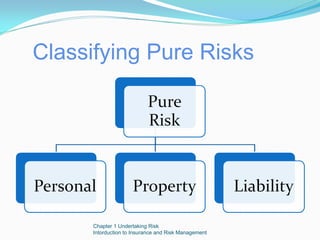
Classifying Pure Risks


      Chapter 1 Undertaking Risk
      Intorduction to Insurance and Risk Management
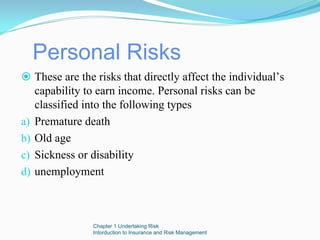
Personal Risks
     These are the risks that directly affect the individual’s
     capability to earn income. Personal risks can be
     classified into the following types
a)   Premature death
b)   Old age
c)   Sickness or disability
d)   unemployment


                  Chapter 1 Undertaking Risk
                  Intorduction to Insurance and Risk Management
Property Risks
These are the risks to persons in possession of the property
being damaged or lost


              Chapter 1 Undertaking Risk
              Intorduction to Insurance and Risk Management
Liability Risks
These are the risks arising out of the intentional or
unintentional injury to the persons or damages to their
properties through negligence or carelessness


              Chapter 1 Undertaking Risk
              Intorduction to Insurance and Risk Management
Methods of Handling Pure
Risk
Avoidance
  Avoid the risk to the circumstances which may lead to
  losses
Loss Control
  Loss Prevention – Reduce Loss Frequency
  Loss Reduction – Lower Loss Severity
Retention
  To retain in full or part of the risk


               Chapter 1 Undertaking Risk
               Intorduction to Insurance and Risk Management
Transfer
  To transfer the risk to another individual or organization
  either by
o Contractual Agreements – insurance, derivatives,
  diversification strategies etc.
o Corporatizing – converting the sole proprietor/partnership
  business into a company from an organization


              Chapter 1 Undertaking Risk
              Intorduction to Insurance and Risk Management
Summary
Risk is a condition in which there is a possibility of an
adverse deviation from a desired outcome that is expected
or hoped for
Uncertainty refers to a state of mind characterized by
doubt, based on the lack of knowledge about what will or
what will not happen in the future
Perils refer to the immediate causes of loss
Hazards are the conditions that increase the severity of
loss or the conditions affecting perils
Pure risk may be Personal, Property or Liability
             Chapter 1 Undertaking Risk
             Intorduction to Insurance and Risk Management
“Like” us on Facebook: 
   p //                 /
http://www.facebook.com/welearnindia 

“Follow” us on Twitter:
http://twitter.com/WeLearnIndia
http://twitter com/WeLearnIndia

Watch informative videos on Youtube: 
http://www.youtube.com/WelingkarDLP

Understaning Risk

  • 1.
    Understanding Risk Chapter 1Undertaking Risk Intorduction to Insurance and Risk Management
  • 2.
    Learning Objectives To understandthe concept of risk To understand risk vs. Uncertainty To understand types of risk To understand classifying pure risks To understand methods of handling pure risk Chapter 1 Undertaking Risk Intorduction to Insurance and Risk Management
  • 3.
    The Concept ofRisk Risk is a condition in which there is a possibility of an adverse deviation from a desired outcome that is expected or hoped for At its most general level, risk is used to describe any situation where there is uncertainty about what outcome will occur. Life is obviously risky Chapter 1 Undertaking Risk Intorduction to Insurance and Risk Management
  • 4.
    Risk vs. Uncertainty Uncertaintyis often confused with the risk Uncertainty can be perceived as opposite of certainty where you are assure of outcome or what will happen Accordingly, some weights or probabilities can be assigned into risky situations but uncertainty, the psychological reaction to the absence of knowledge lacks this privilege Chapter 1 Undertaking Risk Intorduction to Insurance and Risk Management
  • 5.
    Loss and Chanceof Loss Loss refers to the Act or instance of losing the detriment or a disadvantage resulting from losing Loss means being without something previously possessed Chapter 1 Undertaking Risk Intorduction to Insurance and Risk Management
  • 6.
    Perils A peril refersto the cause of loss or the contingency that may cause a loss Chapter 1 Undertaking Risk Intorduction to Insurance and Risk Management
  • 7.
    Hazards 1. Physical Hazards– Property Conditions 2. Intangible Hazards – Attitudes and Culture a) Moral Hazard – Fraud b) Moral Hazard – Indifference c) Societal Hazard – Legal and Cultural Chapter 1 Undertaking Risk Intorduction to Insurance and Risk Management
  • 8.
    Types of Risks Financialand Non-financial Risks Individual and Group Risks Pure and Speculative Risks › Pure risk situations are those where there is a possibility of loss or no loss. There is no gain to the individual or the organization › Speculative risks are those where there is possibility of gain as well as loss Static and Dynamic Risks Quantifiable and Non-quantifiable Risks Chapter 1 Undertaking Risk Intorduction to Insurance and Risk Management
  • 9.
    Classifying Pure Risks Chapter 1 Undertaking Risk Intorduction to Insurance and Risk Management
  • 10.
    Personal Risks These are the risks that directly affect the individual’s capability to earn income. Personal risks can be classified into the following types a) Premature death b) Old age c) Sickness or disability d) unemployment Chapter 1 Undertaking Risk Intorduction to Insurance and Risk Management
  • 11.
    Property Risks These arethe risks to persons in possession of the property being damaged or lost Chapter 1 Undertaking Risk Intorduction to Insurance and Risk Management
  • 12.
    Liability Risks These arethe risks arising out of the intentional or unintentional injury to the persons or damages to their properties through negligence or carelessness Chapter 1 Undertaking Risk Intorduction to Insurance and Risk Management
  • 13.
    Methods of HandlingPure Risk Avoidance Avoid the risk to the circumstances which may lead to losses Loss Control Loss Prevention – Reduce Loss Frequency Loss Reduction – Lower Loss Severity Retention To retain in full or part of the risk Chapter 1 Undertaking Risk Intorduction to Insurance and Risk Management
  • 14.
    Transfer Totransfer the risk to another individual or organization either by o Contractual Agreements – insurance, derivatives, diversification strategies etc. o Corporatizing – converting the sole proprietor/partnership business into a company from an organization Chapter 1 Undertaking Risk Intorduction to Insurance and Risk Management
  • 15.
    Summary Risk is acondition in which there is a possibility of an adverse deviation from a desired outcome that is expected or hoped for Uncertainty refers to a state of mind characterized by doubt, based on the lack of knowledge about what will or what will not happen in the future Perils refer to the immediate causes of loss Hazards are the conditions that increase the severity of loss or the conditions affecting perils Pure risk may be Personal, Property or Liability Chapter 1 Undertaking Risk Intorduction to Insurance and Risk Management
  • 16.
    “Like” us on Facebook:  p // / http://www.facebook.com/welearnindia  “Follow” us on Twitter: http://twitter.com/WeLearnIndia http://twitter com/WeLearnIndia Watch informative videos on Youtube:  http://www.youtube.com/WelingkarDLP