INTRODUCTION
1
UNIT-1
Unit 1: Introduction to risk management-elements of uncertainty peril, hazards; Sources of risk
and exposure, pure risk and speculative risk, acceptable and non-acceptable risks, static and
dynamic risk, various elements of cost of risk. Risk management process-definition, types and
various means of managing risk –limitations of risk management.
VIPULKUMAR N M
Assistant Professor,
Department of Commerce,
Kristu Jayanti College, Bengaluru
RISK MANAGEMENT AND INSURANCE
WHAT IS RISK?
2
WHAT IS RISK
The term risk is generally used to refer to a situation where the
outcome is uncertain and there is a possibility of loss the loss is
random in nature. It occurs by chance and may happen to anybody
and any property. It is not intentional. In insurance the term is also
identified with the peril which may cause the loss.
3
The word ‘peril’ is used to describe an event such as fire flood
earthquake etc. which could lead to economic loss. The
uncertainty about its happening. its frequency and its severity is
referred to as risk. Thus, risk has also been defined as the inability
to accurately predict the effects of future events
4
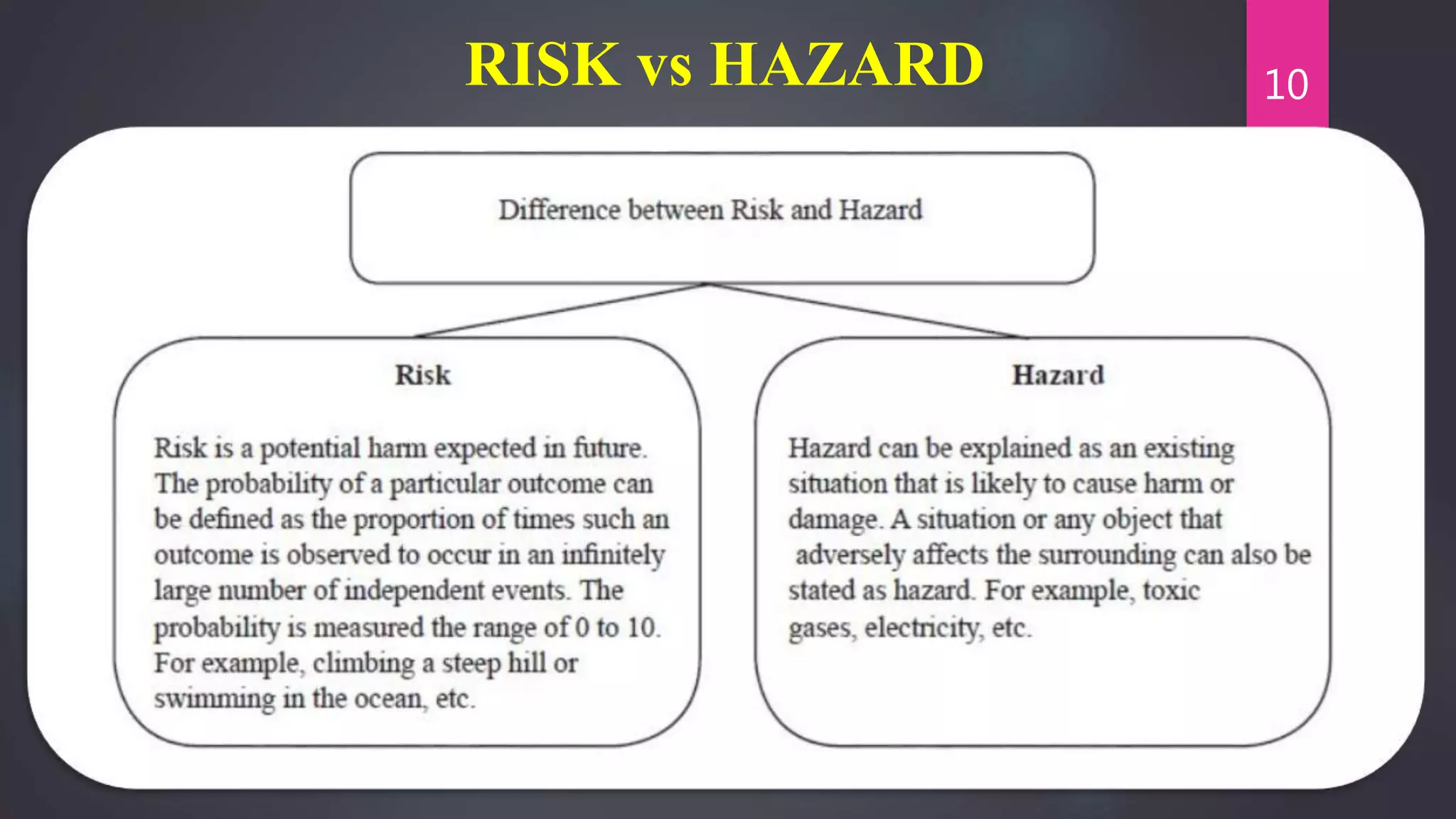
RISK, PERIL, AND HAZARD
 Risk, peril, and hazard are terms used to indicate the possibility of
loss, and are often used interchangeably, but the insurance industry
distinguishes these terms.
 Risk is simply the possibility of a loss,
 Peril is a cause of loss.
 Hazard is a condition that increases the possibility of loss.
5
RISK
Risk is nothing but possibility of loss or any other adverse
events that have the ability to interfere with an organization’s
ability to fulfil its mandate. Risk management offers a lucid
and planned approach to recognize risk. It helps in reducing
the losses or reducing the impact of loss on an organization
6
DEFINITION OF RISK
 The Oxford English Dictionary (OED) cites the earliest use of the word
in English (in the spelling of Risque from its French original, 'Risque') as
of 1621, and the spelling as risk from 1655. While including several
other definitions, the OED 3rd edition defines risk as:
 (Exposure to) the possibility of loss, injury, or other adverse or
unwelcome circumstance; a chance or situation involving such a
possibility.
 The Cambridge Advanced Learner’s Dictionary gives a simple summary,
defining risk as “the possibility of something bad happening”.
7
CAUSA PROXIMA
It is a rule of law that in actions on fire policies, full regard must be
had to the causa proxima. If the proximate cause of the loss is fire,
the loss is recoverable. If the cause is not fire but some other cause
remotely connected with fire, it is not recoverable, unless
specifically provided for. Fire risks do not cover damage by
explosion, unless the explosion causes actual ignition, which spreads
into fire. The cause of the fire is immaterial, unless it was the
deliberate act of the insured.
8
RISK EXPOSURE
Risk exposure is a quantified loss potential of business.
Risk exposure is usually calculated by multiplying the
probability of an incident occurring by its potential losses.
9
RISK vs HAZARD 10
TYPES OF RISK 11
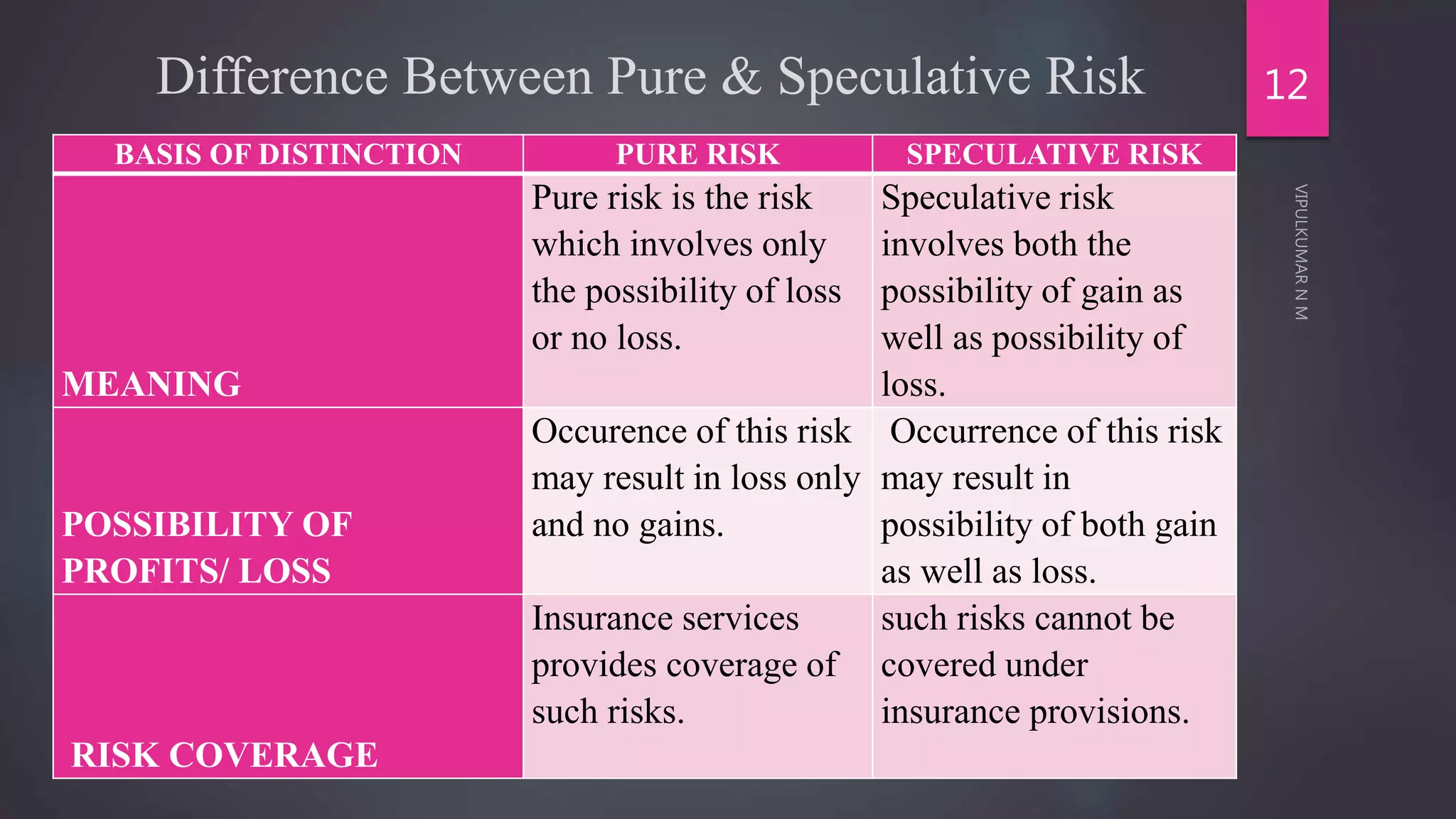
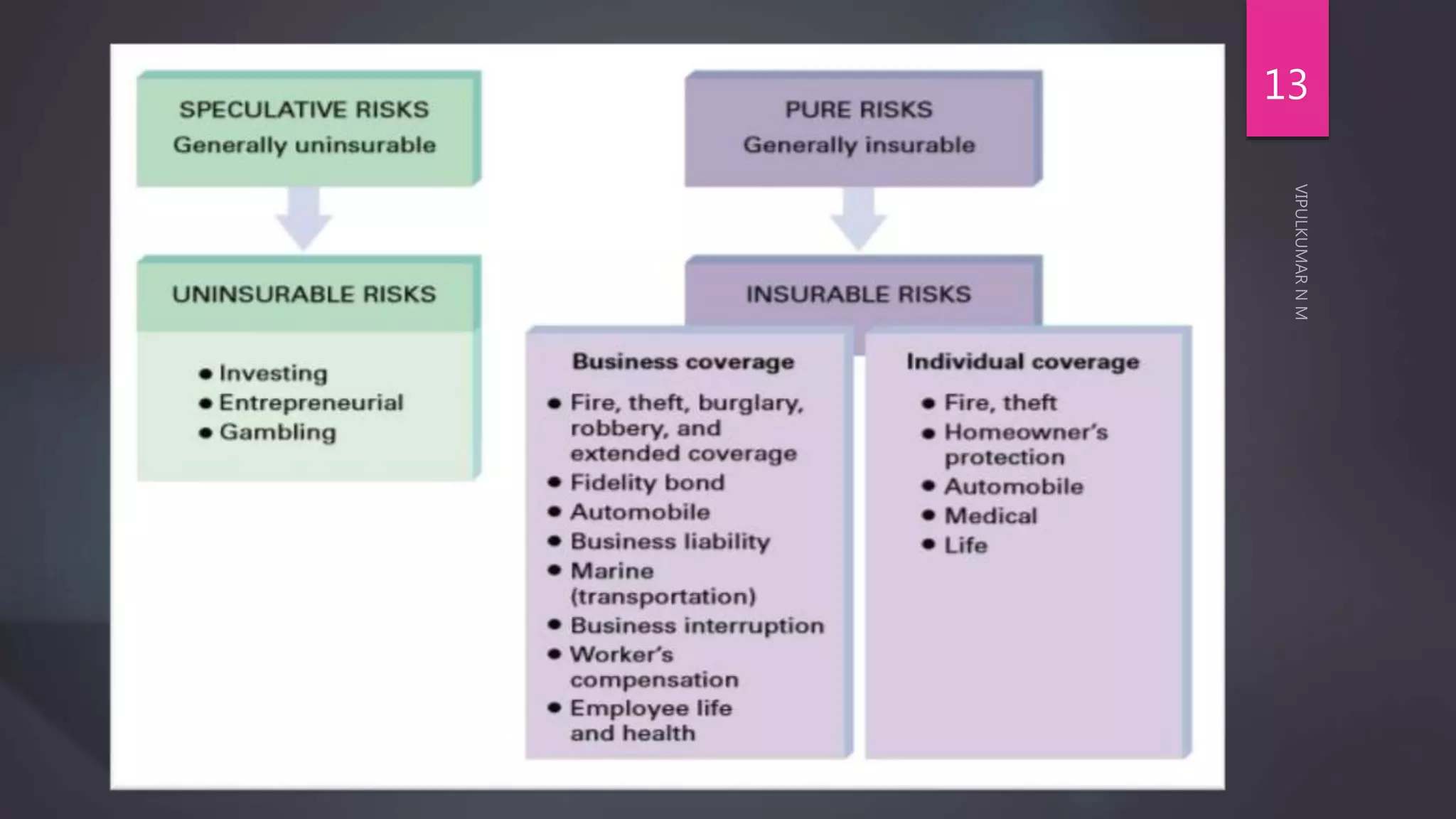
Difference Between Pure & Speculative Risk 12
BASIS OF DISTINCTION PURE RISK SPECULATIVE RISK
MEANING
Pure risk is the risk
which involves only
the possibility of loss
or no loss.
Speculative risk
involves both the
possibility of gain as
well as possibility of
loss.
POSSIBILITY OF
PROFITS/ LOSS
Occurence of this risk
may result in loss only
and no gains.
Occurrence of this risk
may result in
possibility of both gain
as well as loss.
RISK COVERAGE
Insurance services
provides coverage of
such risks.
such risks cannot be
covered under
insurance provisions.
13
TYPE OF PURE / STATIC RISK
• Personal Risks
• Property Risks
• Liability Risks
14
SOME OTHER TYPES OF RISK
 Financial and Non-financial Risks
 Individual and Group Risks
 Quantifiable and Non-quantifiable Risks
15
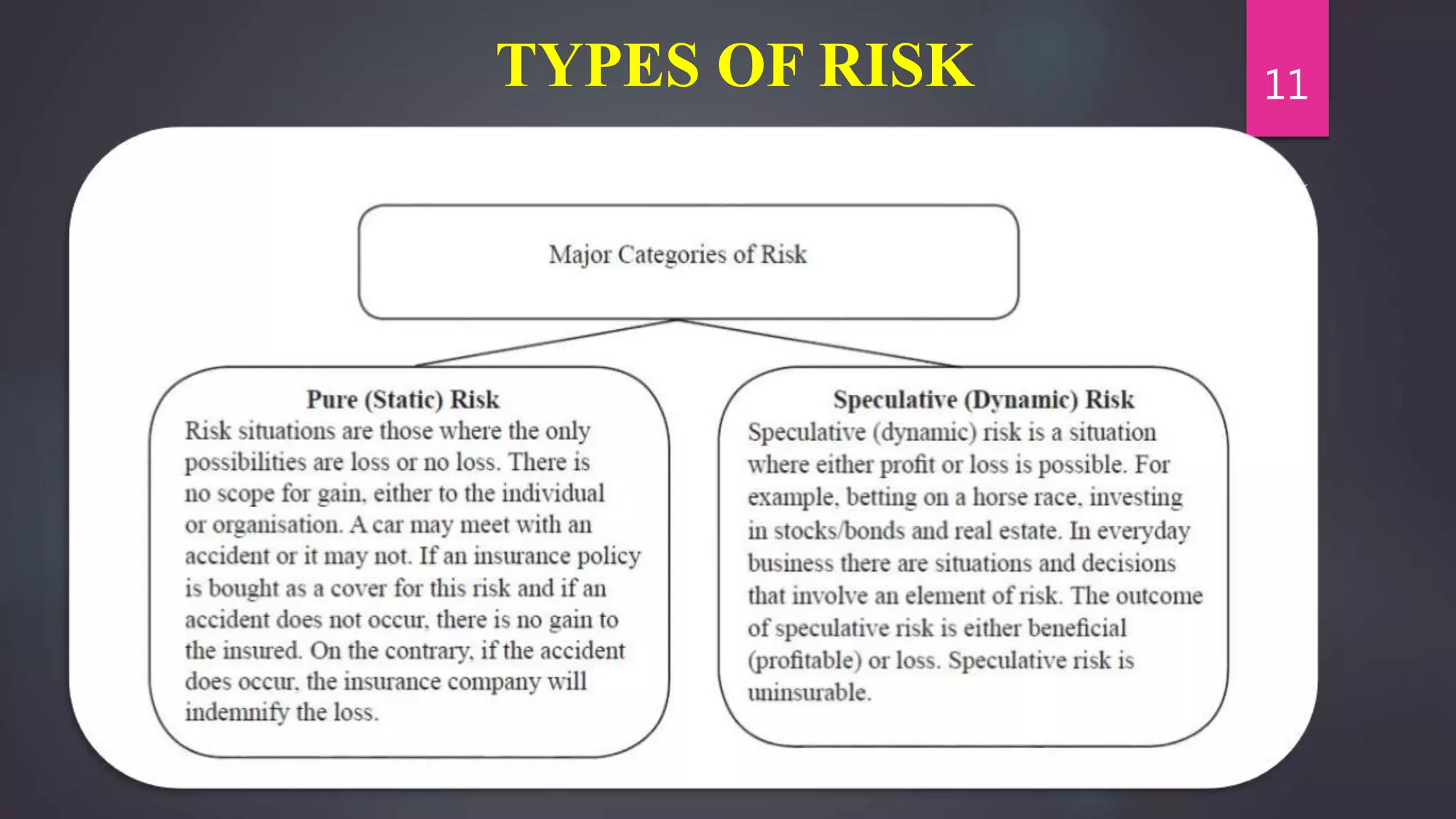
Types of Pure (static) Risk
Pure (Static) Risk is further classified into three different types, which are explained below.
Personal risks
These are the risks that directly affect an individual’s capability to earn. Personal risks can
further be classified as:
 Premature death: Death of the bread earner with unfulfilled or unprovided financial
obligations.
 Old age: The risk of not having sufficient income at the age of retirement or age causing
lack of capability to earn one’s livelihood.
 Sickness or disability: The risk of poor health or disability impairing the means to earn.
For example, the possibility of damage to the limbs of a driver caused by an accident.
 Unemployment: The risk of unemployment due to socio-economic factors resulting in
financial insecurity.
16
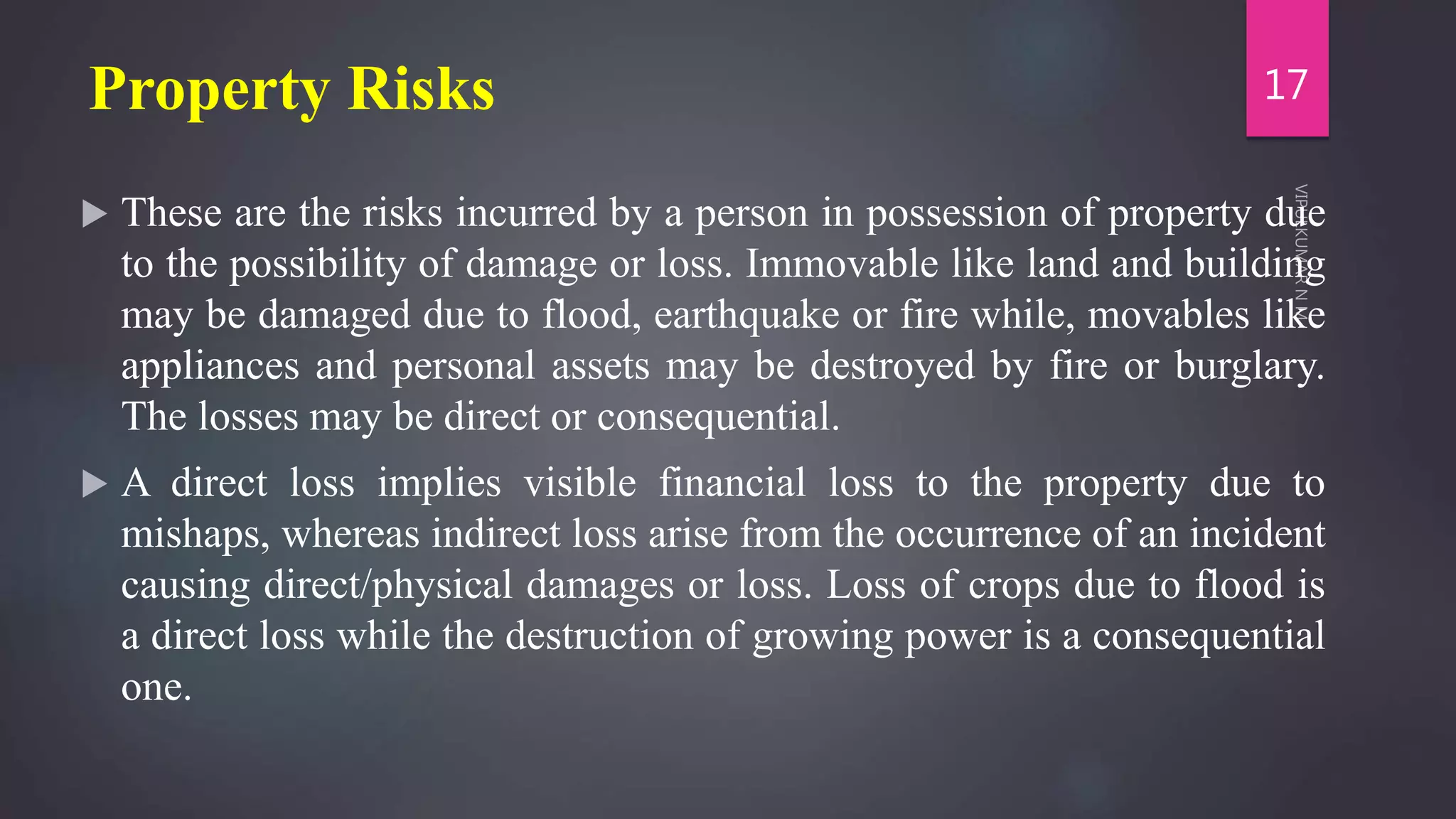
Property Risks
 These are the risks incurred by a person in possession of property due
to the possibility of damage or loss. Immovable like land and building
may be damaged due to flood, earthquake or fire while, movables like
appliances and personal assets may be destroyed by fire or burglary.
The losses may be direct or consequential.
 A direct loss implies visible financial loss to the property due to
mishaps, whereas indirect loss arise from the occurrence of an incident
causing direct/physical damages or loss. Loss of crops due to flood is
a direct loss while the destruction of growing power is a consequential
one.
17
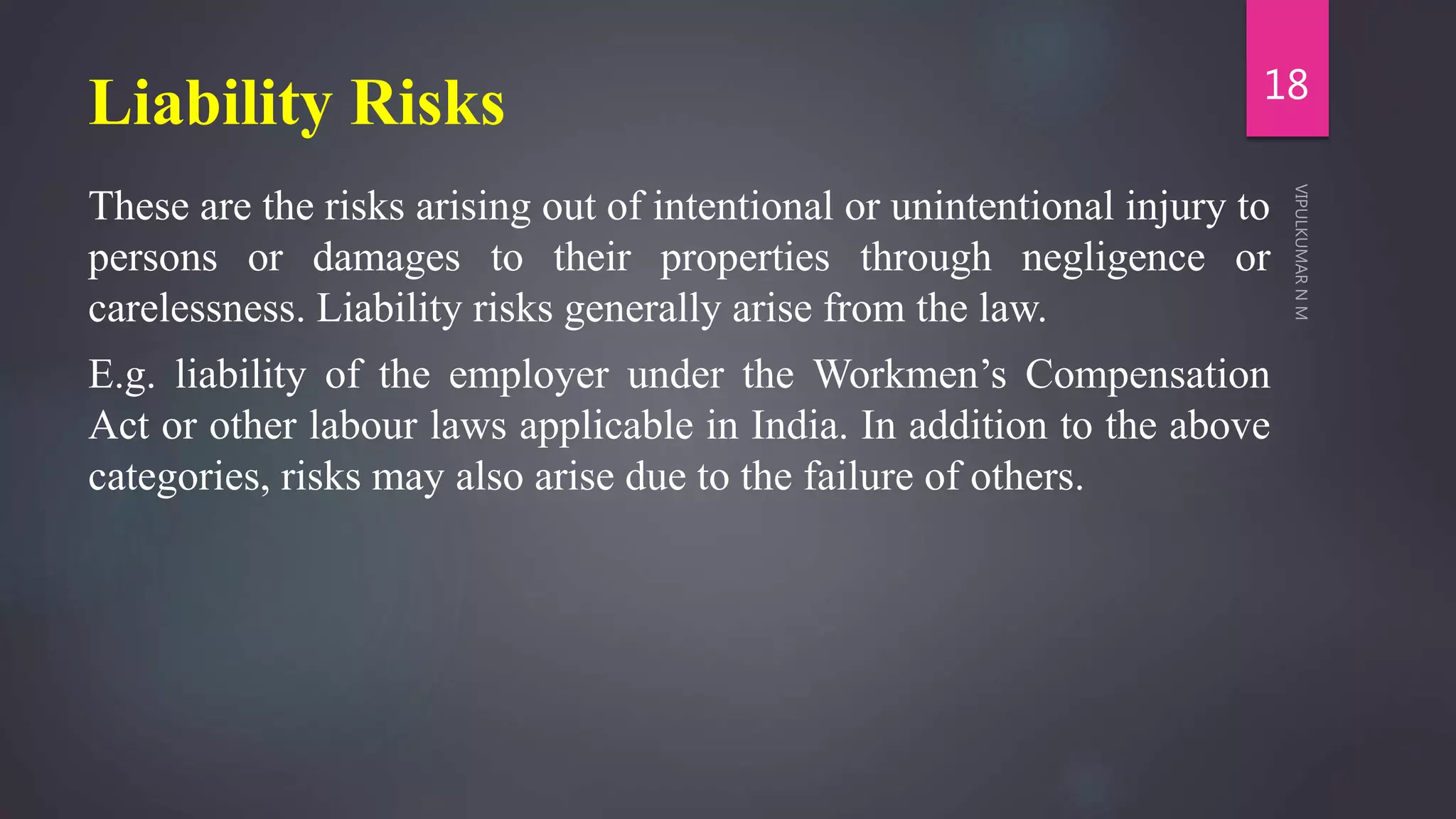
Liability Risks
These are the risks arising out of intentional or unintentional injury to
persons or damages to their properties through negligence or
carelessness. Liability risks generally arise from the law.
E.g. liability of the employer under the Workmen’s Compensation
Act or other labour laws applicable in India. In addition to the above
categories, risks may also arise due to the failure of others.
18
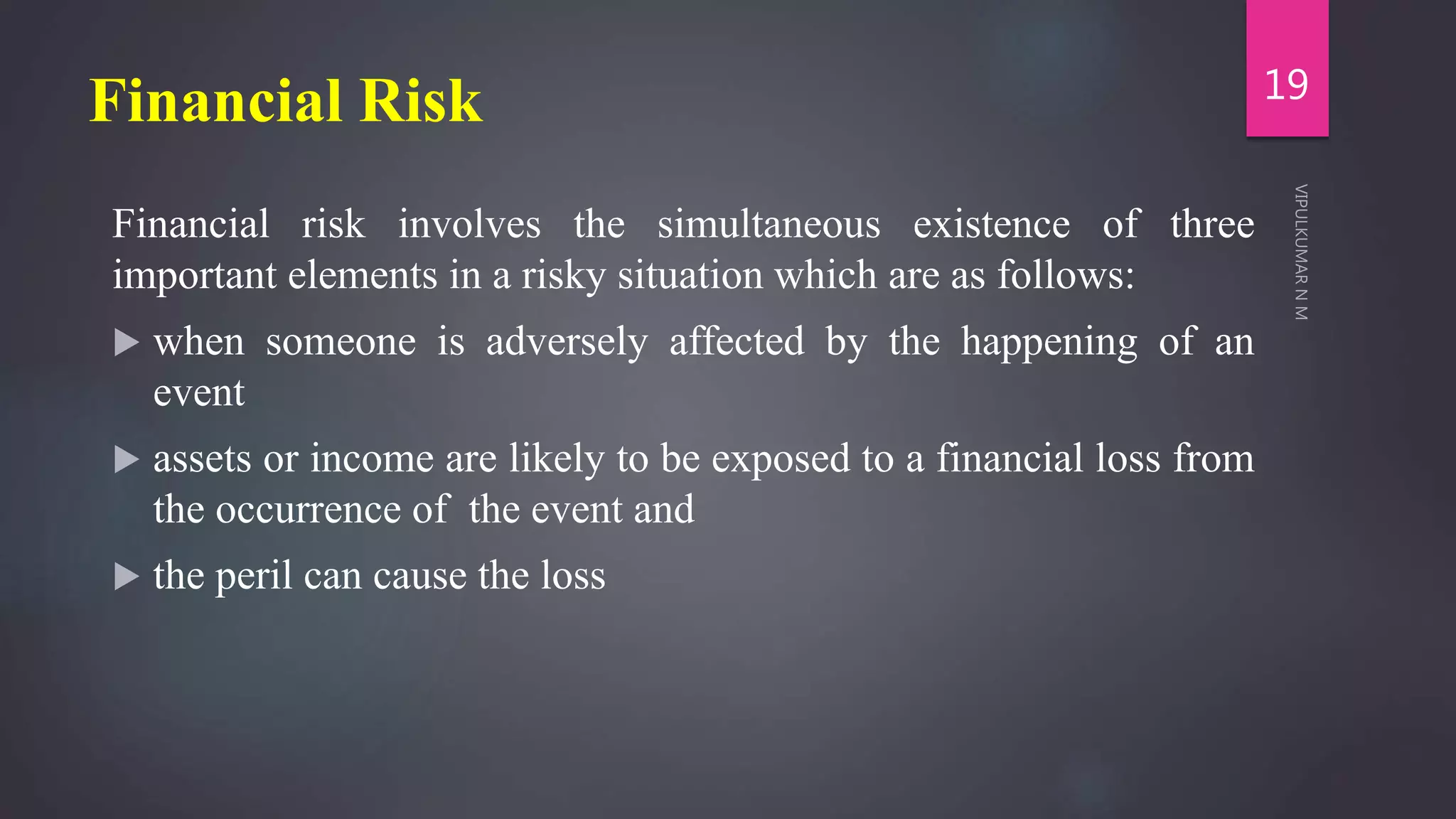
Financial Risk
Financial risk involves the simultaneous existence of three
important elements in a risky situation which are as follows:
 when someone is adversely affected by the happening of an
event
 assets or income are likely to be exposed to a financial loss from
the occurrence of the event and
 the peril can cause the loss
19
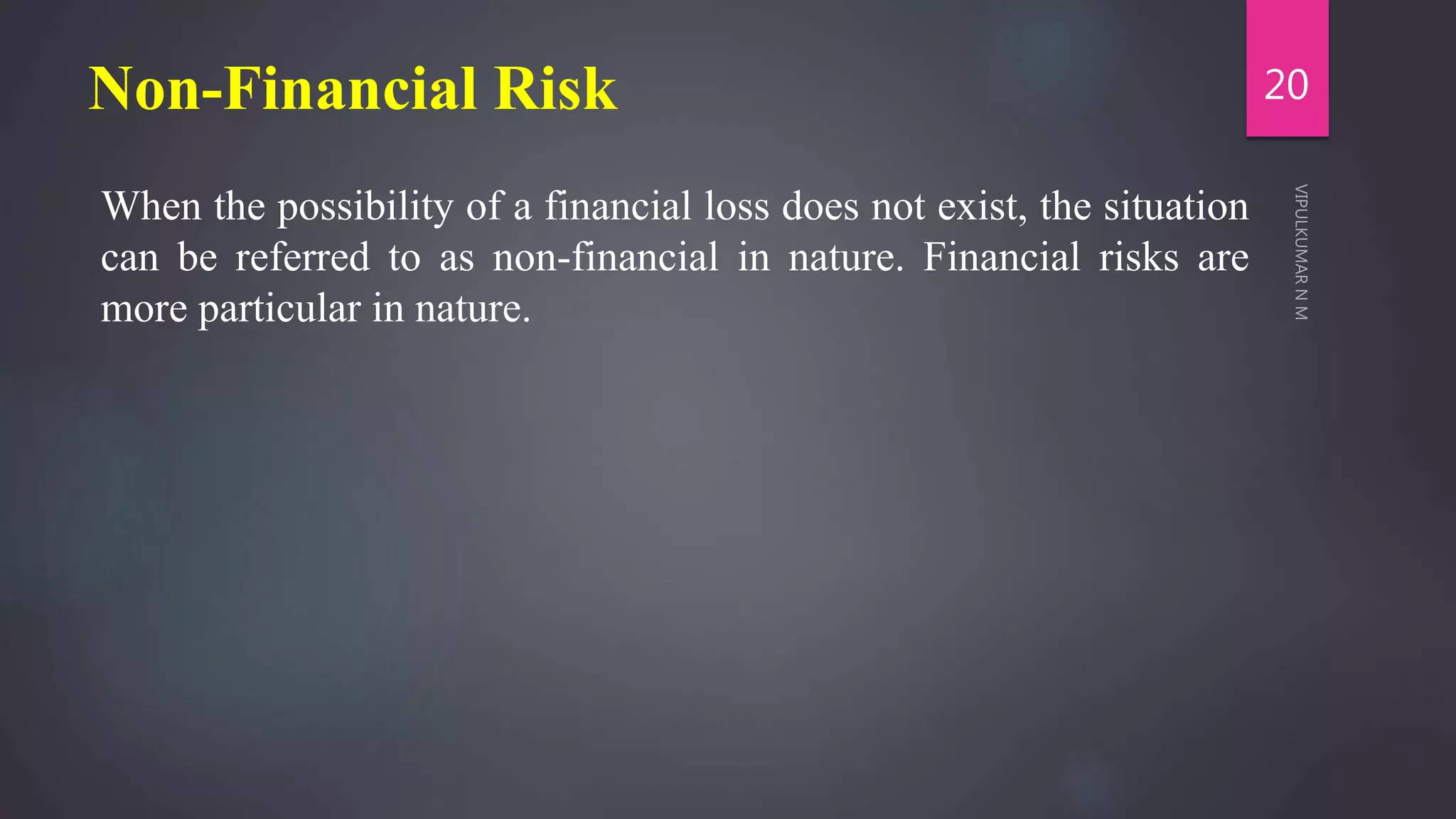
Non-Financial Risk
When the possibility of a financial loss does not exist, the situation
can be referred to as non-financial in nature. Financial risks are
more particular in nature.
20
Individual or particular risks
Individual or particular risks are confined to individuals or small
groups. Thefts, robbery, fire, etc. are risks that are particular in
nature. Some of these are insurable. Because of their very nature
methods of handling fundamental and particular risks differ. For
instance, social insurance programmes may be undertaken by the
government to handle fundamental risks while an individual may
buy a fire protection policy to overcome the adverse consequences
of fire.
21
Group Risk or Fundamental risk
A risk is said to be a group risk or fundamental risk if it
affects the economy or its participants on macro basis. These are
impersonal in origin and consequence. They affect most of the
social segments or the entire population. These risk factors may be
socio-economic or political or natural calamities e.g. earthquakes,
floods, wars, unemployment or situations like 11th September
attack in the U.S., etc.
22
Quantifiable and Non-quantifiable risks
Risks which can be measured, like financial risks are known to be
quantifiable, while situations, which may cause stress or ‘loss of
peace’ are termed as non-quantifiable.
23
TYPES OF RISK
1. Business Risk
2. Non-Business Risk
3. Financial Risk.
24
1. Business Risk
These types of risks are taken by business enterprises themselves
in order to maximize shareholder value and profits. As for
example, Companies undertake high-cost risks in marketing to
launch a new product in order to gain higher sales.
25
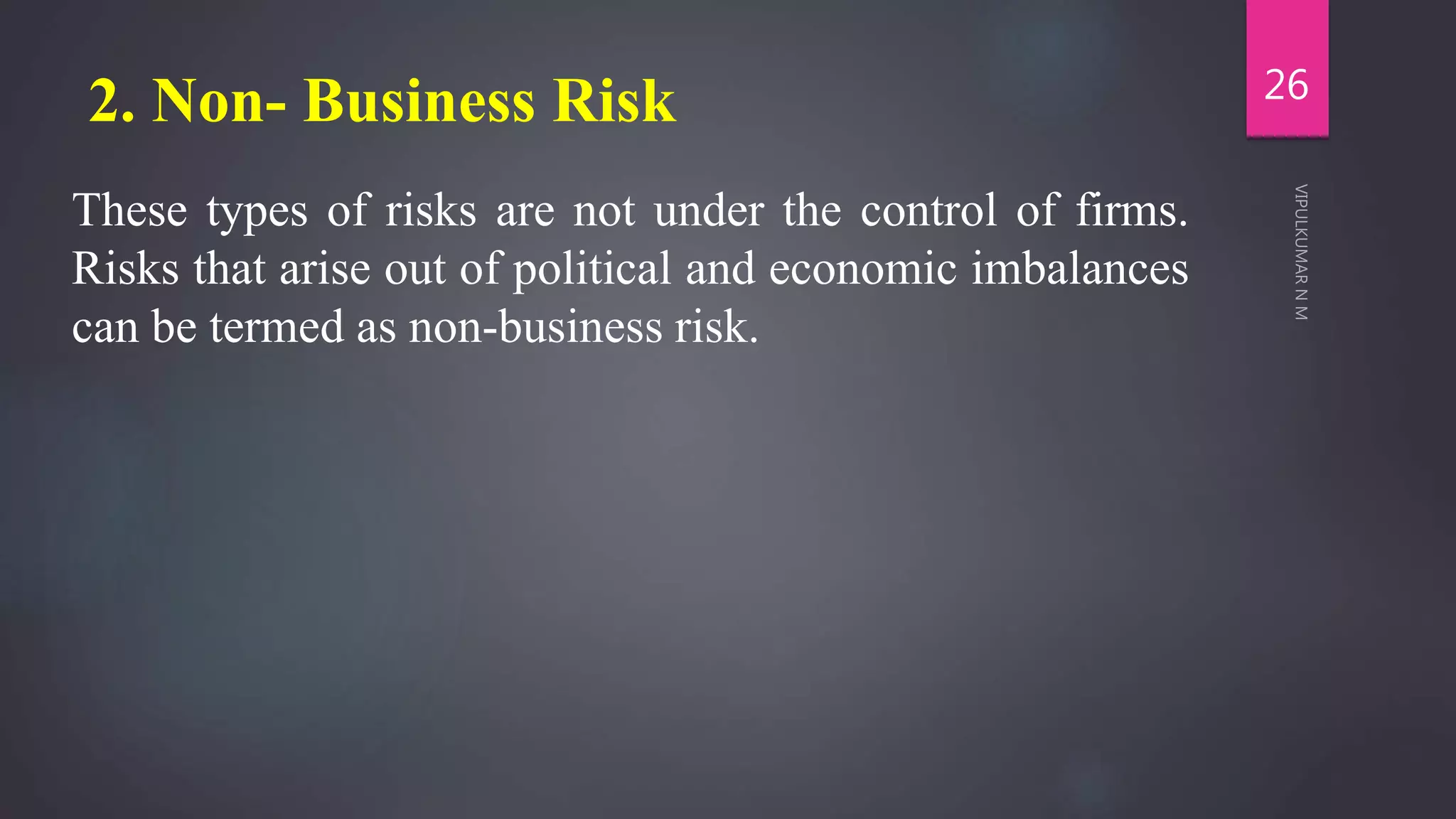
2. Non- Business Risk
These types of risks are not under the control of firms.
Risks that arise out of political and economic imbalances
can be termed as non-business risk.
26
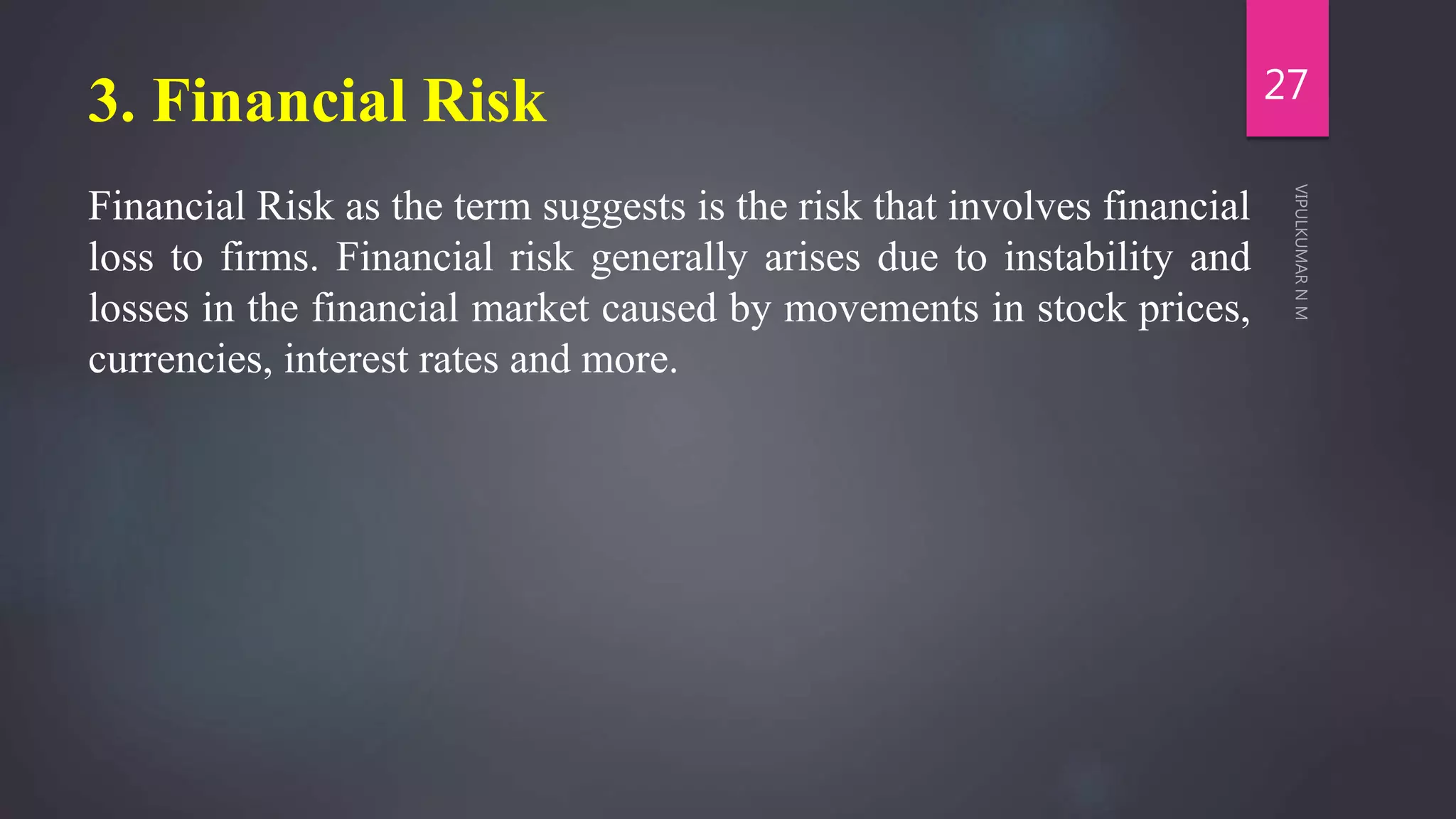
3. Financial Risk
Financial Risk as the term suggests is the risk that involves financial
loss to firms. Financial risk generally arises due to instability and
losses in the financial market caused by movements in stock prices,
currencies, interest rates and more.
27
28
TYPES OF FINANCIAL RISK
1. Market Risk:
This type of risk arises due to the movement in prices of financial instrument.
Market risk can be classified as Directional Risk and Non-Directional Risk.
Directional risk is caused due to movement in stock price, interest rates and
more. Non-Directional risk, on the other hand, can be volatility risks (risk of a
change of price of a portfolio as a result of changes in the volatility of risk
factor)
29
TYPES OF FINANCIAL RISK
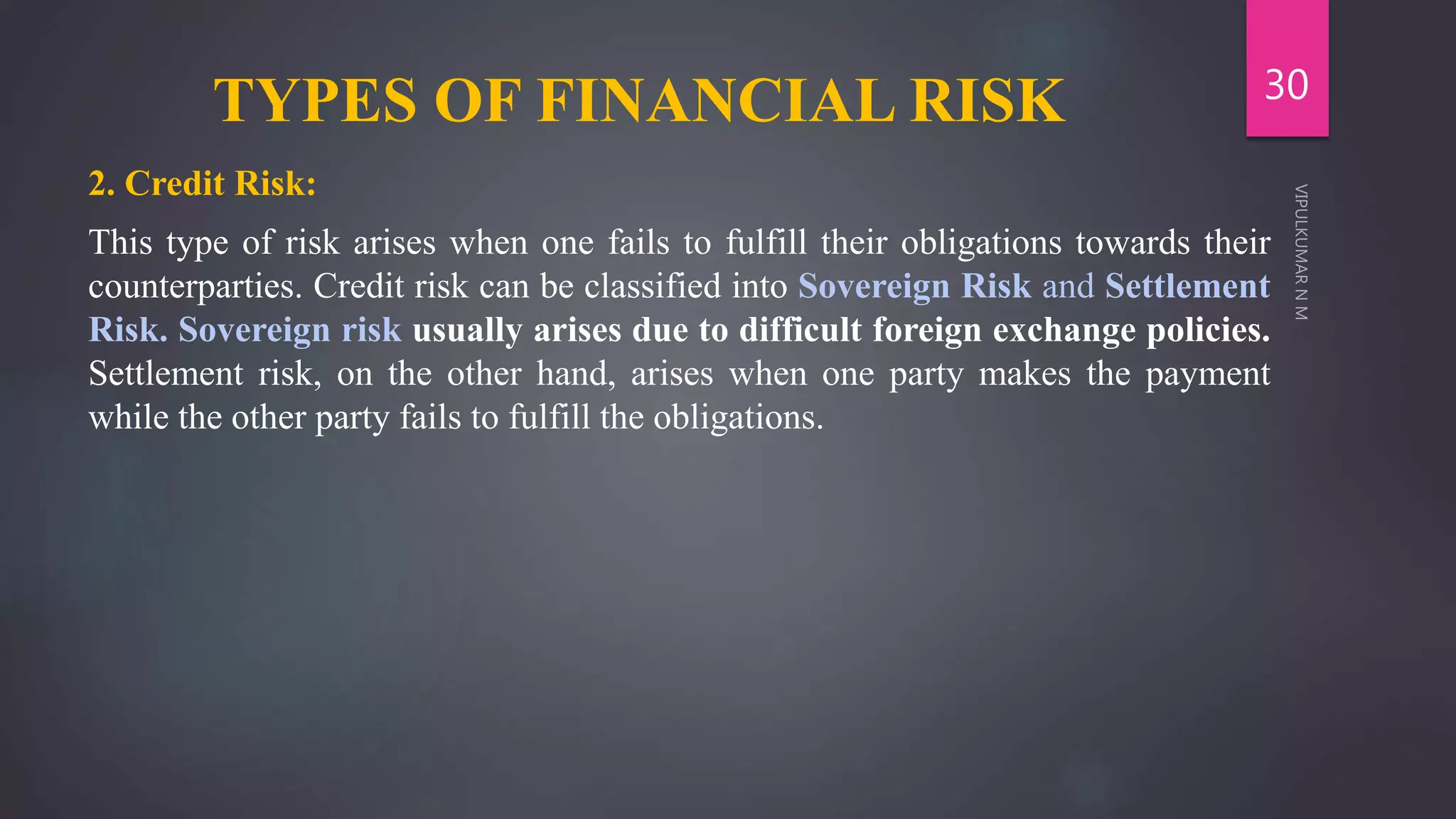
2. Credit Risk:
This type of risk arises when one fails to fulfill their obligations towards their
counterparties. Credit risk can be classified into Sovereign Risk and Settlement
Risk. Sovereign risk usually arises due to difficult foreign exchange policies.
Settlement risk, on the other hand, arises when one party makes the payment
while the other party fails to fulfill the obligations.
30
TYPES OF FINANCIAL RISK
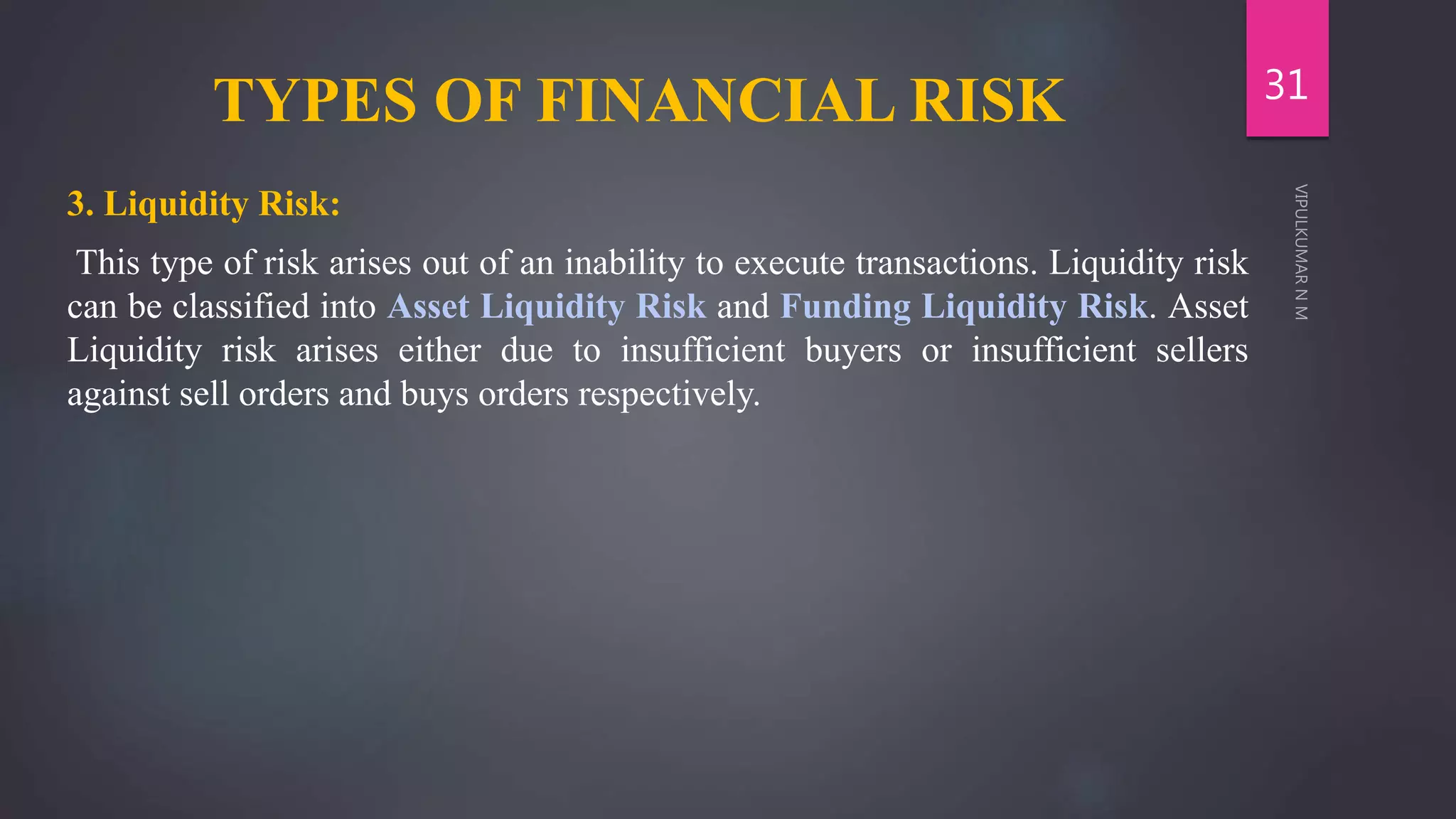
3. Liquidity Risk:
This type of risk arises out of an inability to execute transactions. Liquidity risk
can be classified into Asset Liquidity Risk and Funding Liquidity Risk. Asset
Liquidity risk arises either due to insufficient buyers or insufficient sellers
against sell orders and buys orders respectively.
31
TYPES OF FINANCIAL RISK
4. Operational Risk:
This type of risk arises out of operational failures such as mismanagement or
technical failures. Operational risk can be classified into Fraud Risk and Model
Risk. Fraud Risk arises due to the lack of controls and Model Risk arises due
to incorrect model application.
32
TYPES OF FINANCIAL RISK
5. Legal Risk:
This type of financial risk arises out of legal constraints such as lawsuits.
Whenever a company needs to face financial losses out of legal proceedings, it is
a legal risk.
33
MEANING OF RISK MANAGEMENT
The term ‘risk management’ refers to the systematic application of
principles, approach, and processes to the tasks of identifying and
assessing risks, and then planning and implementing risk responses.
This provides a disciplined environment for proactive decision-
making.
34
DEFINITION OF RISK MANAGEMENT
According to Jorion “Risk management is the process by
which various risk exposures are identified, measured and
controlled. Our understanding of risk has been much
improved by the development of derivatives markets”.
35
RISK MANAGEMENT
To the layman, risk means exposure to danger. The process of managing risk
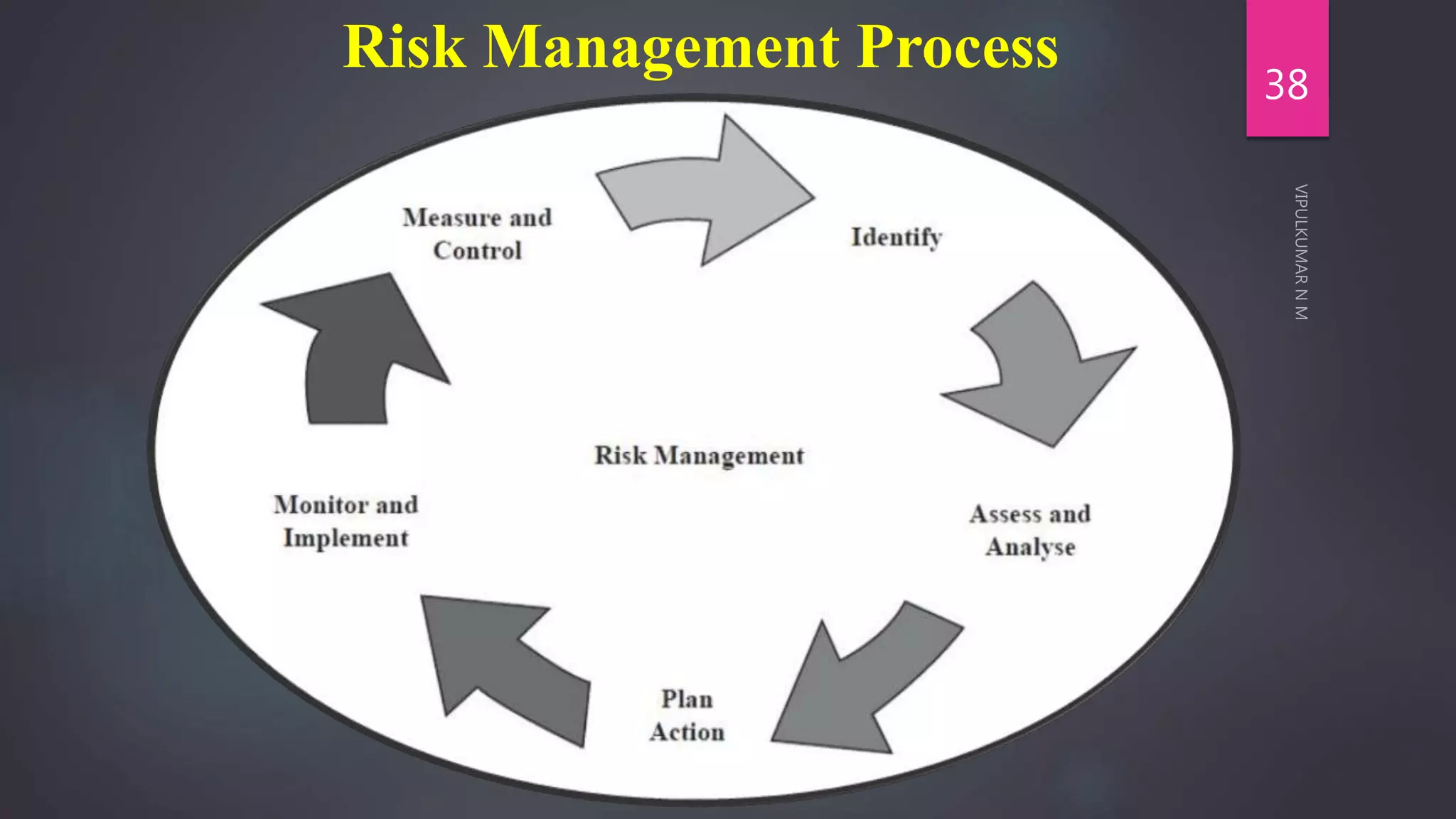
is called Risk Management It is defined as the identification analysis and
economic control of risks that threaten the assets or earning capacity of an
enterprise The importance of Risk Management has been recognized, and
organizations now employ risk managers to specifically manage the risk.
The Risk Management process involves the following important step:
 Identify all potential and significant risks
 Evaluate the cause frequency and severity of losses
 Develop and select methods to manage the risk
 Implement the method chosen
 Monitor performance on an on-going basis
36
RISK MANAGEMENT PROCESS
37
Risk Management Process
38
Risk Management process
1. Risk Identification
2. Risk Evaluation
3. Risk Control
4. Risk Avoidance
5. Risk Reduction
6. Risk Retention
7. Risk Transfer
39
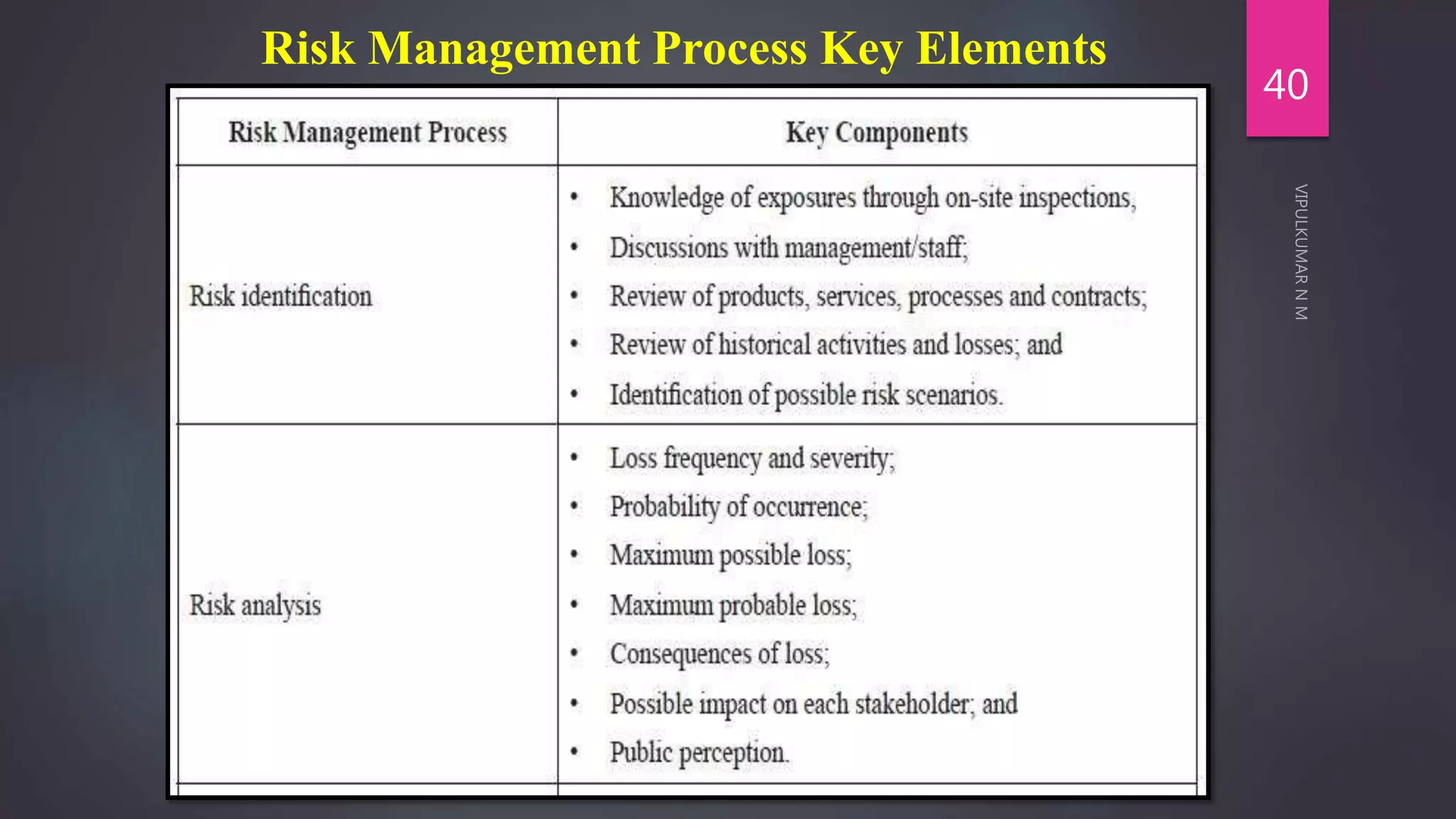
40
Risk Management Process Key Elements
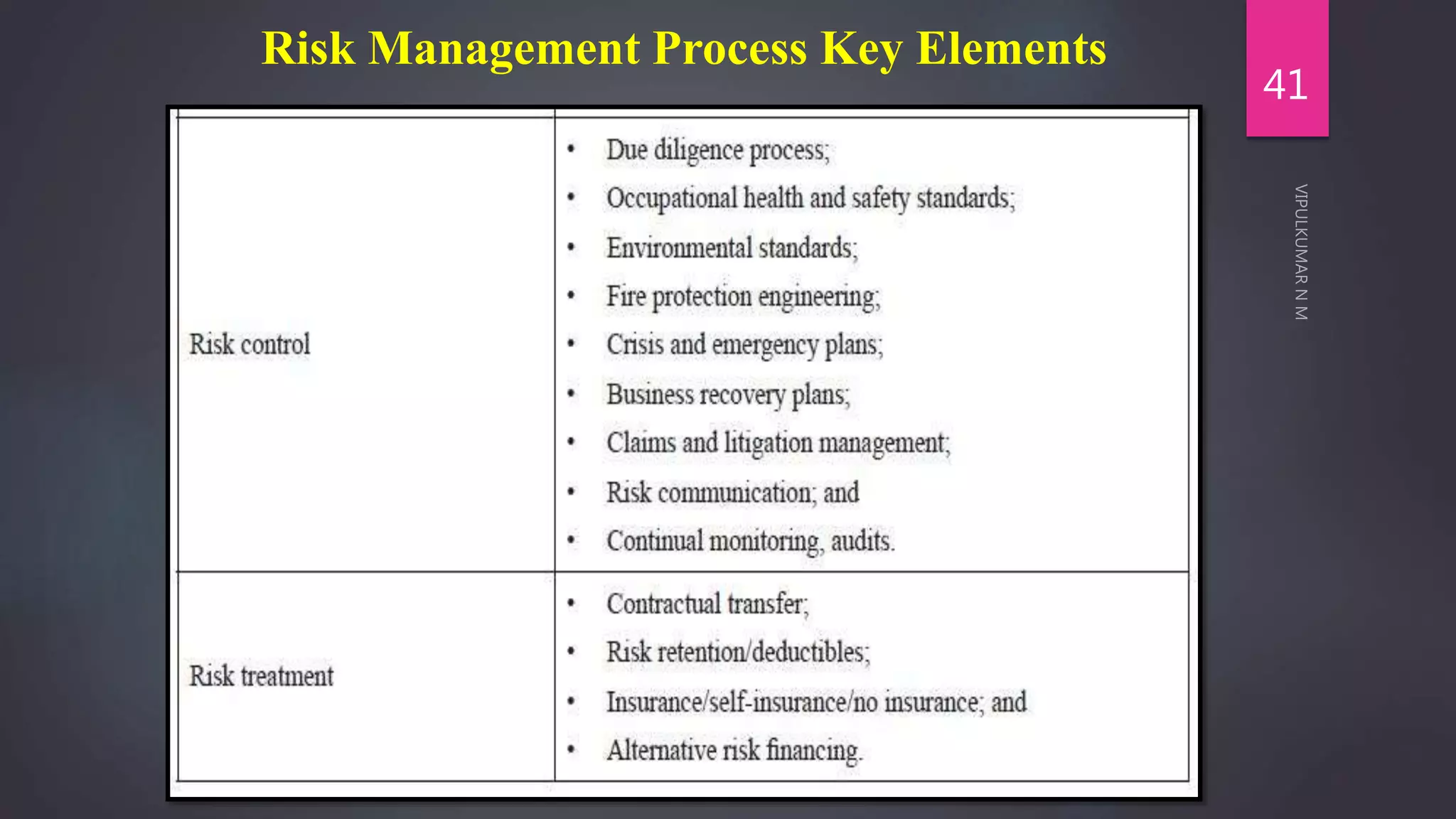
41
Risk Management Process Key Elements
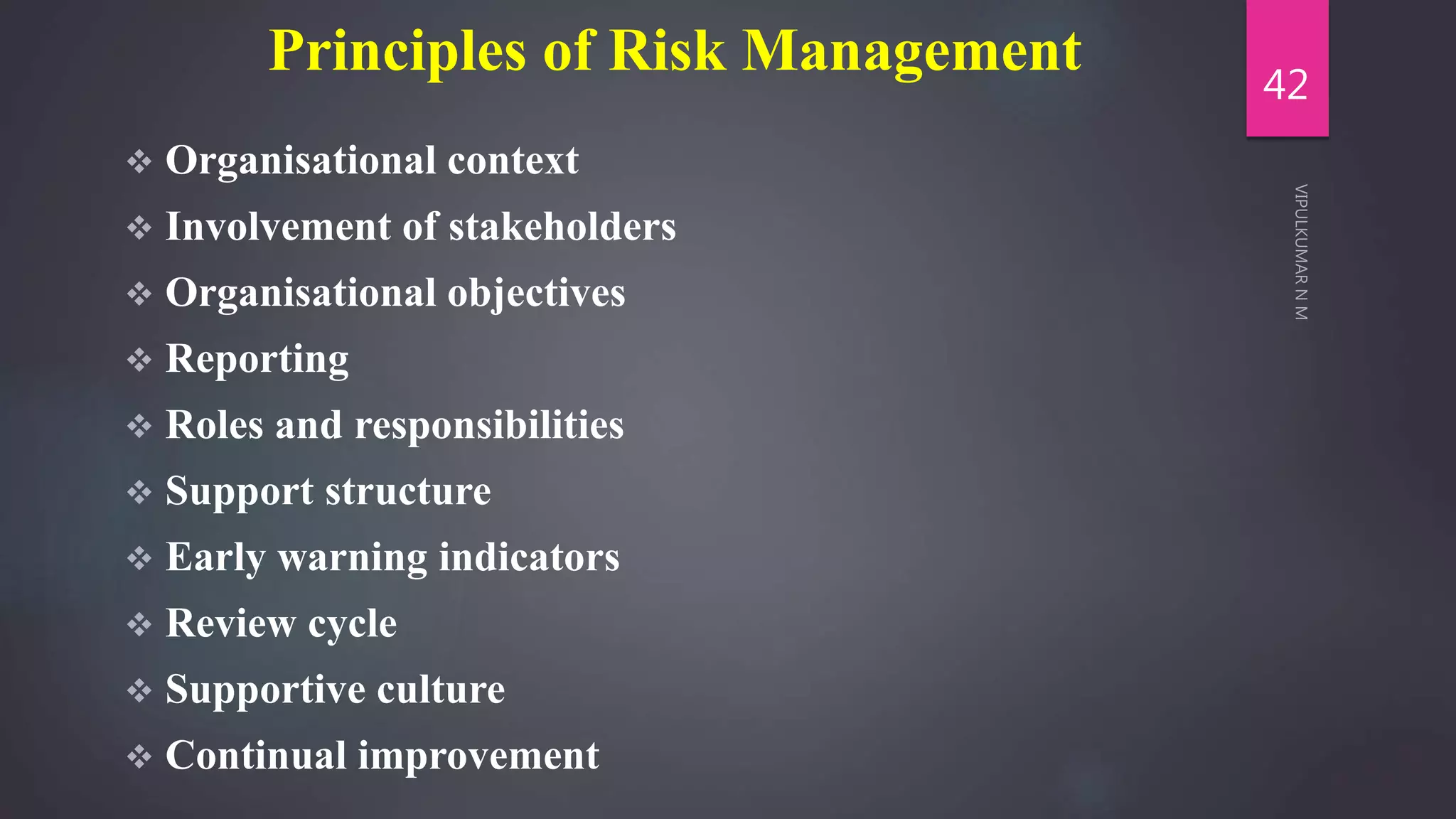
Principles of Risk Management
 Organisational context
 Involvement of stakeholders
 Organisational objectives
 Reporting
 Roles and responsibilities
 Support structure
 Early warning indicators
 Review cycle
 Supportive culture
 Continual improvement
42
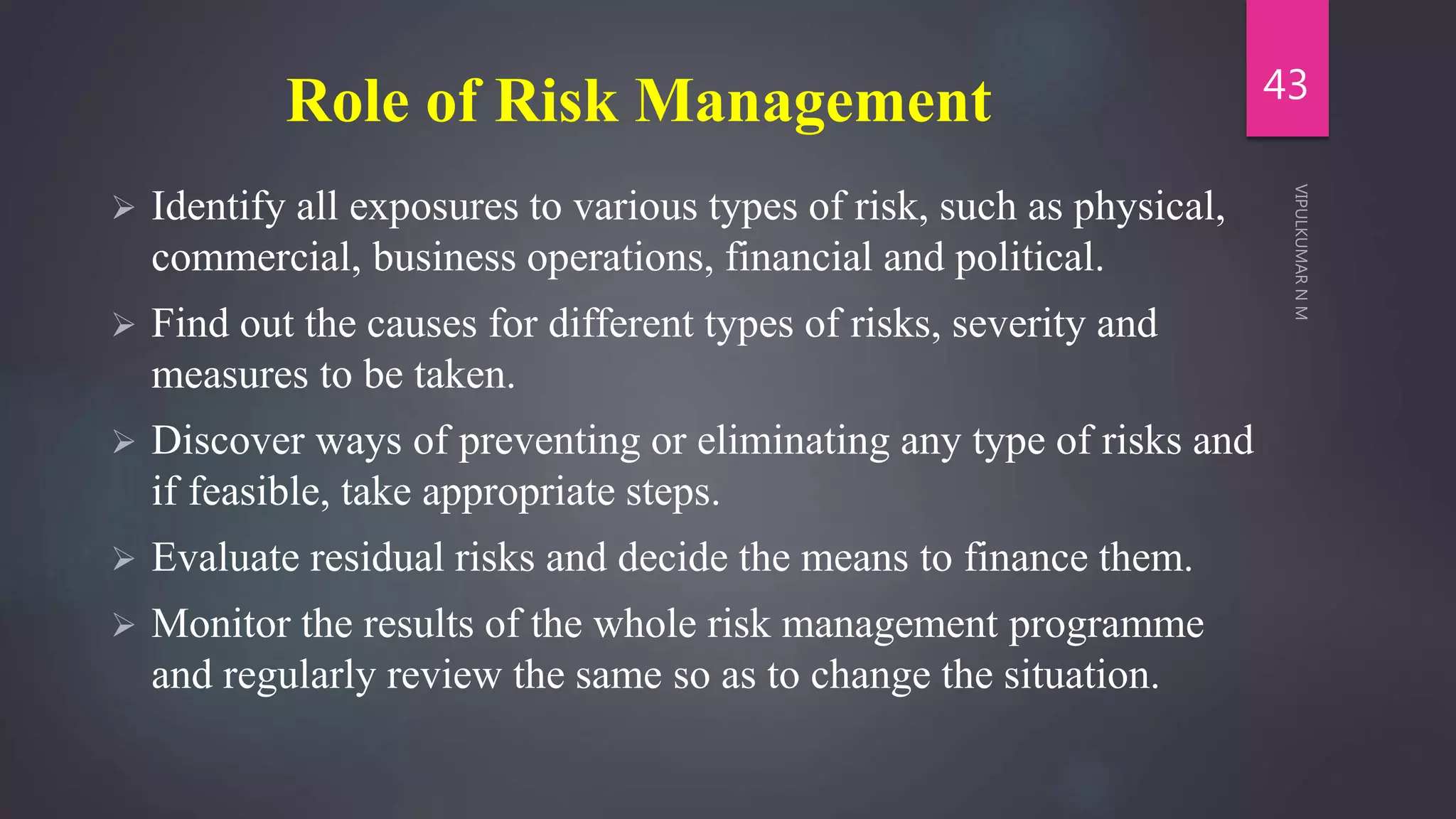
Role of Risk Management
 Identify all exposures to various types of risk, such as physical,
commercial, business operations, financial and political.
 Find out the causes for different types of risks, severity and
measures to be taken.
 Discover ways of preventing or eliminating any type of risks and
if feasible, take appropriate steps.
 Evaluate residual risks and decide the means to finance them.
 Monitor the results of the whole risk management programme
and regularly review the same so as to change the situation.
43
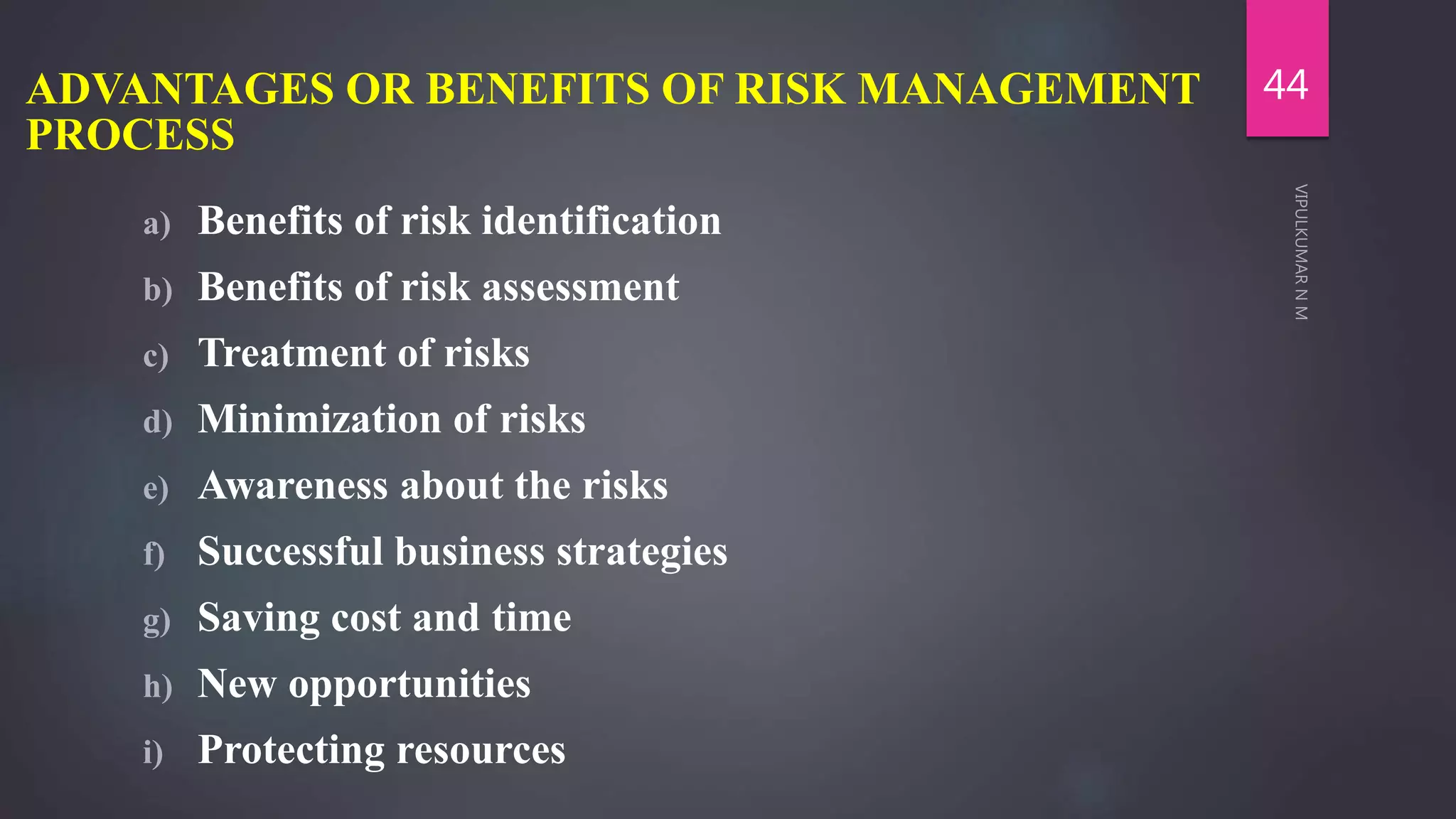
ADVANTAGES OR BENEFITS OF RISK MANAGEMENT
PROCESS
a) Benefits of risk identification
b) Benefits of risk assessment
c) Treatment of risks
d) Minimization of risks
e) Awareness about the risks
f) Successful business strategies
g) Saving cost and time
h) New opportunities
i) Protecting resources
44
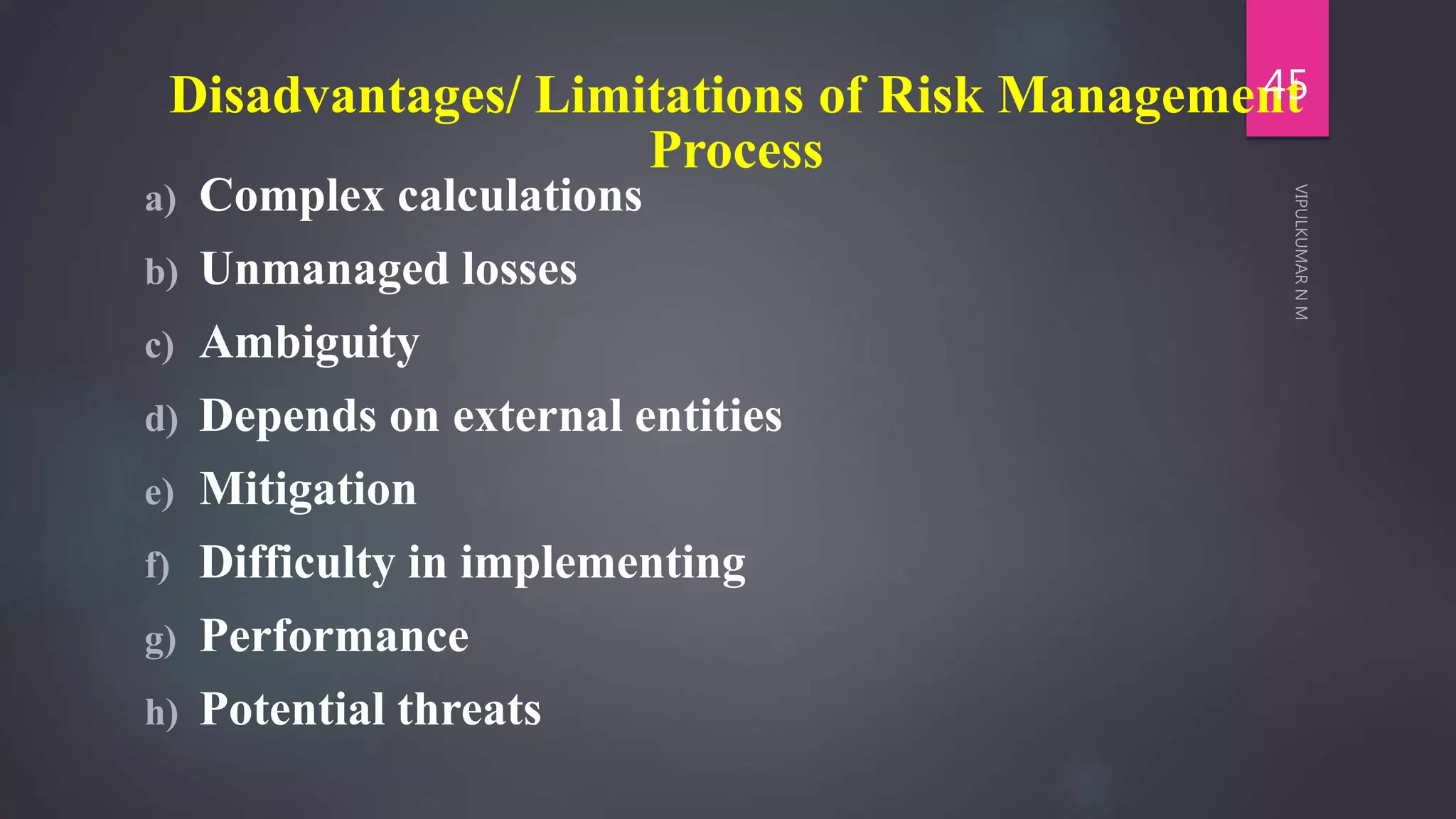
Disadvantages/ Limitations of Risk Management
Process
a) Complex calculations
b) Unmanaged losses
c) Ambiguity
d) Depends on external entities
e) Mitigation
f) Difficulty in implementing
g) Performance
h) Potential threats
45
COST OF RISK
Cost of risk is the cost of managing risk and
incurring losses due to risk. It is a metric that can be calculated
for a financial period or forecast for a future period.
46
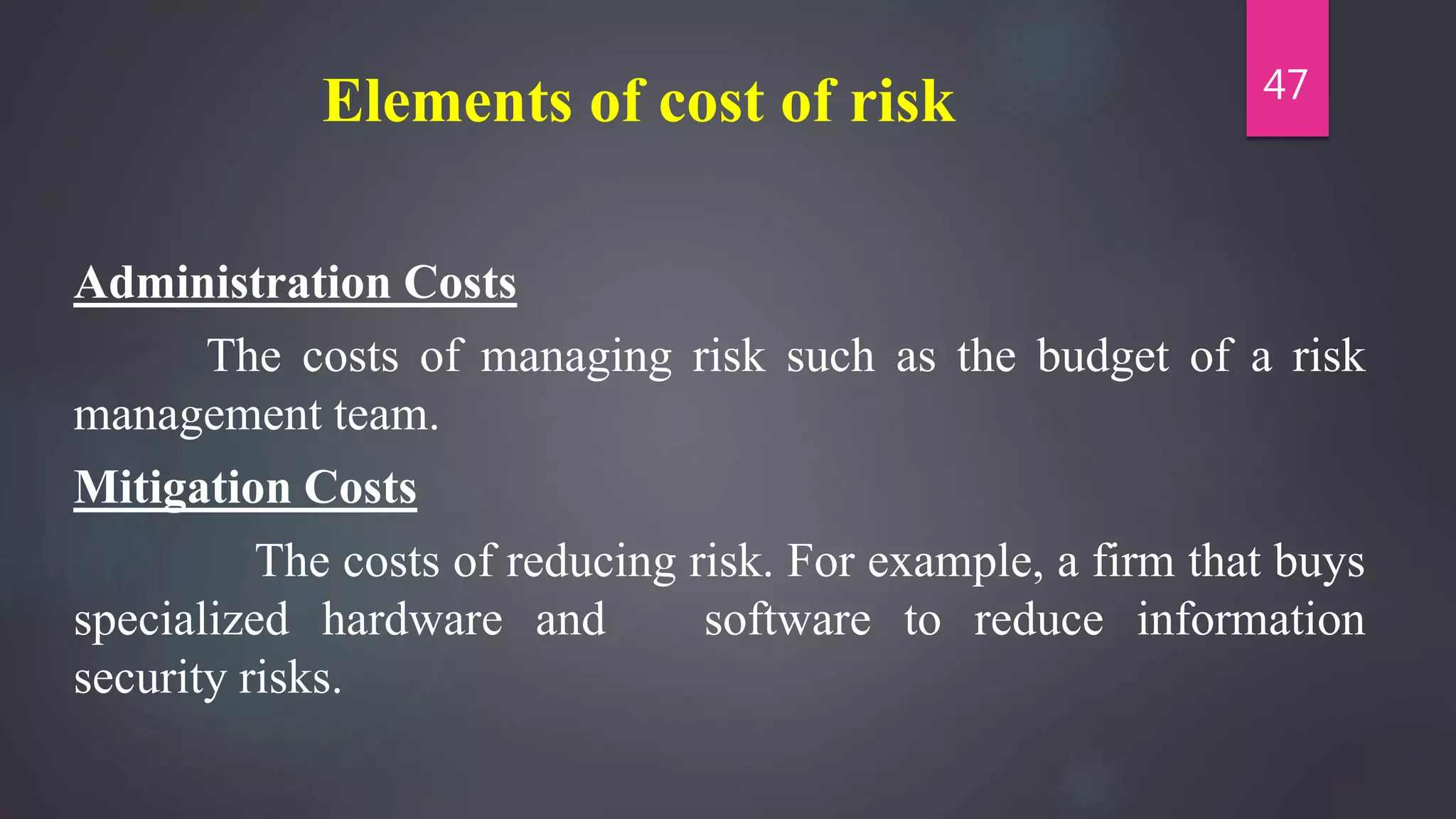
Elements of cost of risk
Administration Costs
The costs of managing risk such as the budget of a risk
management team.
Mitigation Costs
The costs of reducing risk. For example, a firm that buys
specialized hardware and software to reduce information
security risks.
47
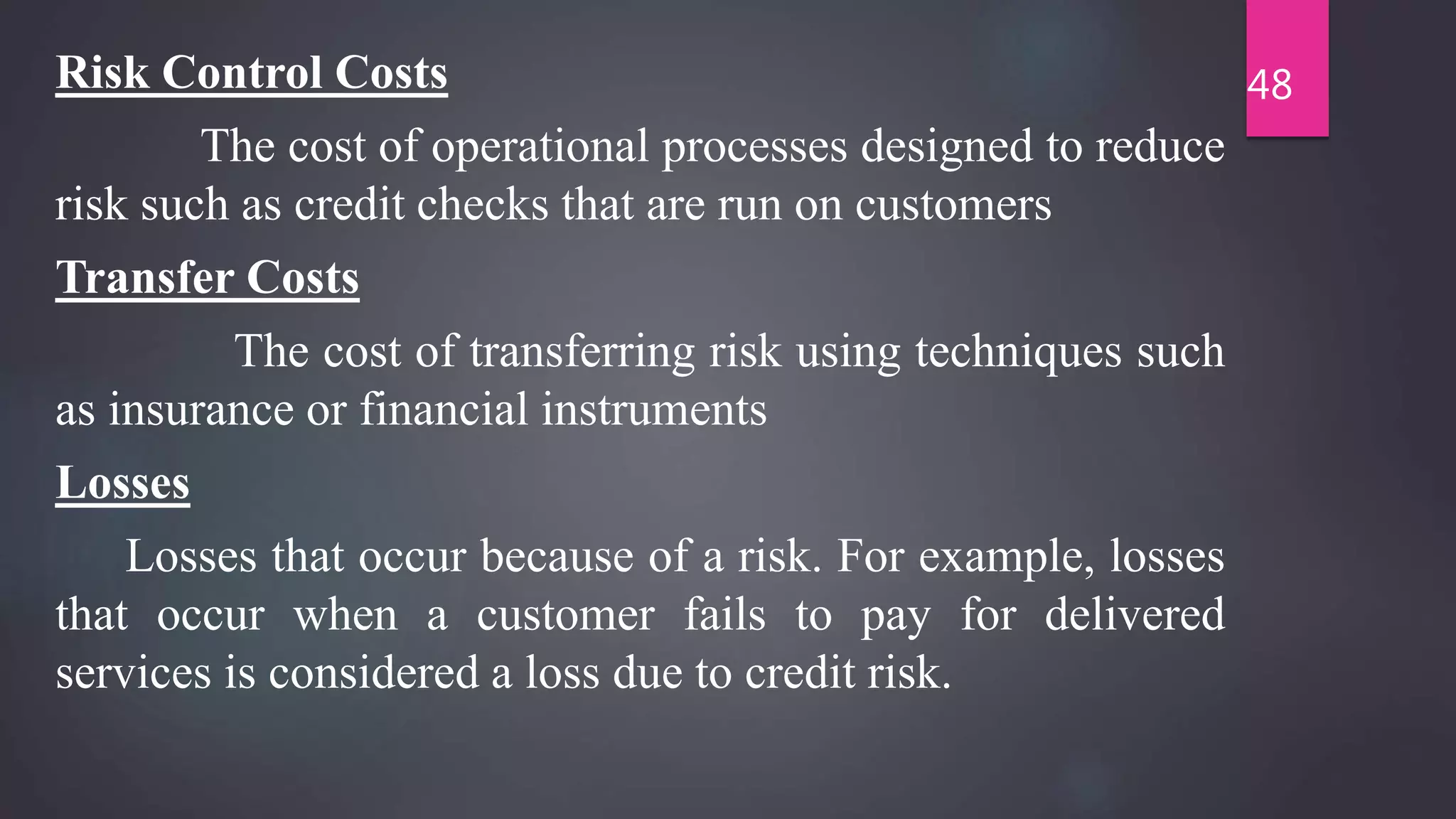
Risk Control Costs
The cost of operational processes designed to reduce
risk such as credit checks that are run on customers
Transfer Costs
The cost of transferring risk using techniques such
as insurance or financial instruments
Losses
Losses that occur because of a risk. For example, losses
that occur when a customer fails to pay for delivered
services is considered a loss due to credit risk.
48
Total Cost of Risk – Definition
 Total Cost of Risk or (TCOR) is the only accepted
measurement of an organization’s entire cost structure as it
relates to risk. Total cost of risk is the sum of all aspects of an
organization's operations that relate to risk, including retained
(uninsured) losses and related loss adjustment expenses, risk
control costs, transfer costs, and administrative costs
49
Components of Total Cost of Risk
Total Cost of Risk is the sum of 4 major components that
are individually measured and quantified. Risk Financing Costs,
Loss Costs (Direct and Indirect), Administration Costs and
Taxes & Fees.
 Risk Financing Costs
 Loss Costs
Direct Cost of Losses
Indirect Loss Costs
 Administration Costs
 Taxes and Fees
50
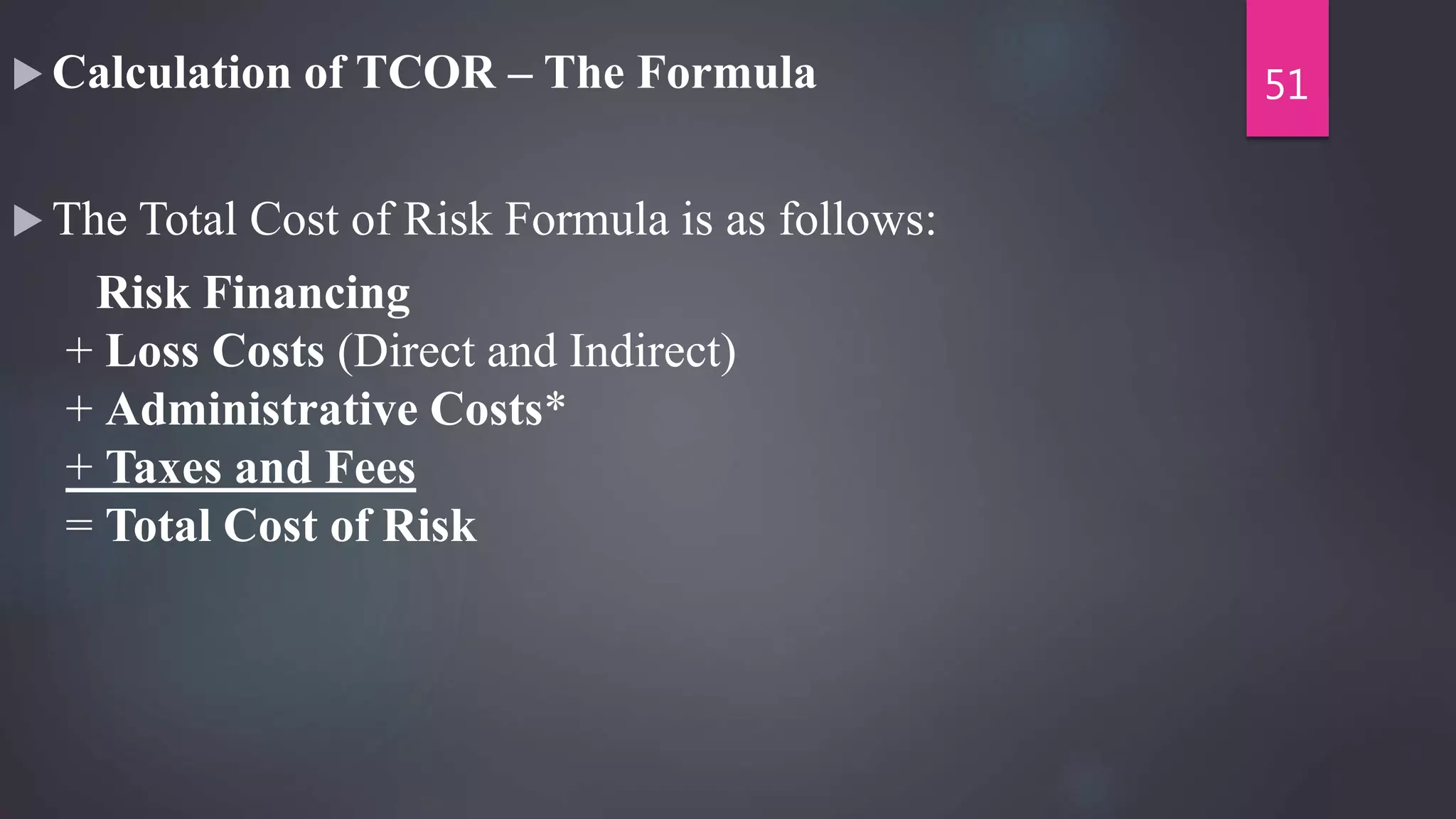
 Calculation of TCOR – The Formula
 The Total Cost of Risk Formula is as follows:
Risk Financing
+ Loss Costs (Direct and Indirect)
+ Administrative Costs*
+ Taxes and Fees
= Total Cost of Risk
51
Uses of Total Cost of Risk
Risk Management Professionals
C-Suite Executives
Brokerage and Risk Services Providers
52
THE END……
53

Introduction to Risk Mangement

  • 1.
    INTRODUCTION 1 UNIT-1 Unit 1: Introductionto risk management-elements of uncertainty peril, hazards; Sources of risk and exposure, pure risk and speculative risk, acceptable and non-acceptable risks, static and dynamic risk, various elements of cost of risk. Risk management process-definition, types and various means of managing risk –limitations of risk management. VIPULKUMAR N M Assistant Professor, Department of Commerce, Kristu Jayanti College, Bengaluru RISK MANAGEMENT AND INSURANCE
  • 2.
  • 3.
    WHAT IS RISK Theterm risk is generally used to refer to a situation where the outcome is uncertain and there is a possibility of loss the loss is random in nature. It occurs by chance and may happen to anybody and any property. It is not intentional. In insurance the term is also identified with the peril which may cause the loss. 3
  • 4.
    The word ‘peril’is used to describe an event such as fire flood earthquake etc. which could lead to economic loss. The uncertainty about its happening. its frequency and its severity is referred to as risk. Thus, risk has also been defined as the inability to accurately predict the effects of future events 4
  • 5.
    RISK, PERIL, ANDHAZARD  Risk, peril, and hazard are terms used to indicate the possibility of loss, and are often used interchangeably, but the insurance industry distinguishes these terms.  Risk is simply the possibility of a loss,  Peril is a cause of loss.  Hazard is a condition that increases the possibility of loss. 5
  • 6.
    RISK Risk is nothingbut possibility of loss or any other adverse events that have the ability to interfere with an organization’s ability to fulfil its mandate. Risk management offers a lucid and planned approach to recognize risk. It helps in reducing the losses or reducing the impact of loss on an organization 6
  • 7.
    DEFINITION OF RISK The Oxford English Dictionary (OED) cites the earliest use of the word in English (in the spelling of Risque from its French original, 'Risque') as of 1621, and the spelling as risk from 1655. While including several other definitions, the OED 3rd edition defines risk as:  (Exposure to) the possibility of loss, injury, or other adverse or unwelcome circumstance; a chance or situation involving such a possibility.  The Cambridge Advanced Learner’s Dictionary gives a simple summary, defining risk as “the possibility of something bad happening”. 7
  • 8.
    CAUSA PROXIMA It isa rule of law that in actions on fire policies, full regard must be had to the causa proxima. If the proximate cause of the loss is fire, the loss is recoverable. If the cause is not fire but some other cause remotely connected with fire, it is not recoverable, unless specifically provided for. Fire risks do not cover damage by explosion, unless the explosion causes actual ignition, which spreads into fire. The cause of the fire is immaterial, unless it was the deliberate act of the insured. 8
  • 9.
    RISK EXPOSURE Risk exposureis a quantified loss potential of business. Risk exposure is usually calculated by multiplying the probability of an incident occurring by its potential losses. 9
  • 10.
  • 11.
  • 12.
    Difference Between Pure& Speculative Risk 12 BASIS OF DISTINCTION PURE RISK SPECULATIVE RISK MEANING Pure risk is the risk which involves only the possibility of loss or no loss. Speculative risk involves both the possibility of gain as well as possibility of loss. POSSIBILITY OF PROFITS/ LOSS Occurence of this risk may result in loss only and no gains. Occurrence of this risk may result in possibility of both gain as well as loss. RISK COVERAGE Insurance services provides coverage of such risks. such risks cannot be covered under insurance provisions.
  • 13.
  • 14.
    TYPE OF PURE/ STATIC RISK • Personal Risks • Property Risks • Liability Risks 14
  • 15.
    SOME OTHER TYPESOF RISK  Financial and Non-financial Risks  Individual and Group Risks  Quantifiable and Non-quantifiable Risks 15
  • 16.
    Types of Pure(static) Risk Pure (Static) Risk is further classified into three different types, which are explained below. Personal risks These are the risks that directly affect an individual’s capability to earn. Personal risks can further be classified as:  Premature death: Death of the bread earner with unfulfilled or unprovided financial obligations.  Old age: The risk of not having sufficient income at the age of retirement or age causing lack of capability to earn one’s livelihood.  Sickness or disability: The risk of poor health or disability impairing the means to earn. For example, the possibility of damage to the limbs of a driver caused by an accident.  Unemployment: The risk of unemployment due to socio-economic factors resulting in financial insecurity. 16
  • 17.
    Property Risks  Theseare the risks incurred by a person in possession of property due to the possibility of damage or loss. Immovable like land and building may be damaged due to flood, earthquake or fire while, movables like appliances and personal assets may be destroyed by fire or burglary. The losses may be direct or consequential.  A direct loss implies visible financial loss to the property due to mishaps, whereas indirect loss arise from the occurrence of an incident causing direct/physical damages or loss. Loss of crops due to flood is a direct loss while the destruction of growing power is a consequential one. 17
  • 18.
    Liability Risks These arethe risks arising out of intentional or unintentional injury to persons or damages to their properties through negligence or carelessness. Liability risks generally arise from the law. E.g. liability of the employer under the Workmen’s Compensation Act or other labour laws applicable in India. In addition to the above categories, risks may also arise due to the failure of others. 18
  • 19.
    Financial Risk Financial riskinvolves the simultaneous existence of three important elements in a risky situation which are as follows:  when someone is adversely affected by the happening of an event  assets or income are likely to be exposed to a financial loss from the occurrence of the event and  the peril can cause the loss 19
  • 20.
    Non-Financial Risk When thepossibility of a financial loss does not exist, the situation can be referred to as non-financial in nature. Financial risks are more particular in nature. 20
  • 21.
    Individual or particularrisks Individual or particular risks are confined to individuals or small groups. Thefts, robbery, fire, etc. are risks that are particular in nature. Some of these are insurable. Because of their very nature methods of handling fundamental and particular risks differ. For instance, social insurance programmes may be undertaken by the government to handle fundamental risks while an individual may buy a fire protection policy to overcome the adverse consequences of fire. 21
  • 22.
    Group Risk orFundamental risk A risk is said to be a group risk or fundamental risk if it affects the economy or its participants on macro basis. These are impersonal in origin and consequence. They affect most of the social segments or the entire population. These risk factors may be socio-economic or political or natural calamities e.g. earthquakes, floods, wars, unemployment or situations like 11th September attack in the U.S., etc. 22
  • 23.
    Quantifiable and Non-quantifiablerisks Risks which can be measured, like financial risks are known to be quantifiable, while situations, which may cause stress or ‘loss of peace’ are termed as non-quantifiable. 23
  • 24.
    TYPES OF RISK 1.Business Risk 2. Non-Business Risk 3. Financial Risk. 24
  • 25.
    1. Business Risk Thesetypes of risks are taken by business enterprises themselves in order to maximize shareholder value and profits. As for example, Companies undertake high-cost risks in marketing to launch a new product in order to gain higher sales. 25
  • 26.
    2. Non- BusinessRisk These types of risks are not under the control of firms. Risks that arise out of political and economic imbalances can be termed as non-business risk. 26
  • 27.
    3. Financial Risk FinancialRisk as the term suggests is the risk that involves financial loss to firms. Financial risk generally arises due to instability and losses in the financial market caused by movements in stock prices, currencies, interest rates and more. 27
  • 28.
  • 29.
    TYPES OF FINANCIALRISK 1. Market Risk: This type of risk arises due to the movement in prices of financial instrument. Market risk can be classified as Directional Risk and Non-Directional Risk. Directional risk is caused due to movement in stock price, interest rates and more. Non-Directional risk, on the other hand, can be volatility risks (risk of a change of price of a portfolio as a result of changes in the volatility of risk factor) 29
  • 30.
    TYPES OF FINANCIALRISK 2. Credit Risk: This type of risk arises when one fails to fulfill their obligations towards their counterparties. Credit risk can be classified into Sovereign Risk and Settlement Risk. Sovereign risk usually arises due to difficult foreign exchange policies. Settlement risk, on the other hand, arises when one party makes the payment while the other party fails to fulfill the obligations. 30
  • 31.
    TYPES OF FINANCIALRISK 3. Liquidity Risk: This type of risk arises out of an inability to execute transactions. Liquidity risk can be classified into Asset Liquidity Risk and Funding Liquidity Risk. Asset Liquidity risk arises either due to insufficient buyers or insufficient sellers against sell orders and buys orders respectively. 31
  • 32.
    TYPES OF FINANCIALRISK 4. Operational Risk: This type of risk arises out of operational failures such as mismanagement or technical failures. Operational risk can be classified into Fraud Risk and Model Risk. Fraud Risk arises due to the lack of controls and Model Risk arises due to incorrect model application. 32
  • 33.
    TYPES OF FINANCIALRISK 5. Legal Risk: This type of financial risk arises out of legal constraints such as lawsuits. Whenever a company needs to face financial losses out of legal proceedings, it is a legal risk. 33
  • 34.
    MEANING OF RISKMANAGEMENT The term ‘risk management’ refers to the systematic application of principles, approach, and processes to the tasks of identifying and assessing risks, and then planning and implementing risk responses. This provides a disciplined environment for proactive decision- making. 34
  • 35.
    DEFINITION OF RISKMANAGEMENT According to Jorion “Risk management is the process by which various risk exposures are identified, measured and controlled. Our understanding of risk has been much improved by the development of derivatives markets”. 35
  • 36.
    RISK MANAGEMENT To thelayman, risk means exposure to danger. The process of managing risk is called Risk Management It is defined as the identification analysis and economic control of risks that threaten the assets or earning capacity of an enterprise The importance of Risk Management has been recognized, and organizations now employ risk managers to specifically manage the risk. The Risk Management process involves the following important step:  Identify all potential and significant risks  Evaluate the cause frequency and severity of losses  Develop and select methods to manage the risk  Implement the method chosen  Monitor performance on an on-going basis 36
  • 37.
  • 38.
  • 39.
    Risk Management process 1.Risk Identification 2. Risk Evaluation 3. Risk Control 4. Risk Avoidance 5. Risk Reduction 6. Risk Retention 7. Risk Transfer 39
  • 40.
  • 41.
  • 42.
    Principles of RiskManagement  Organisational context  Involvement of stakeholders  Organisational objectives  Reporting  Roles and responsibilities  Support structure  Early warning indicators  Review cycle  Supportive culture  Continual improvement 42
  • 43.
    Role of RiskManagement  Identify all exposures to various types of risk, such as physical, commercial, business operations, financial and political.  Find out the causes for different types of risks, severity and measures to be taken.  Discover ways of preventing or eliminating any type of risks and if feasible, take appropriate steps.  Evaluate residual risks and decide the means to finance them.  Monitor the results of the whole risk management programme and regularly review the same so as to change the situation. 43
  • 44.
    ADVANTAGES OR BENEFITSOF RISK MANAGEMENT PROCESS a) Benefits of risk identification b) Benefits of risk assessment c) Treatment of risks d) Minimization of risks e) Awareness about the risks f) Successful business strategies g) Saving cost and time h) New opportunities i) Protecting resources 44
  • 45.
    Disadvantages/ Limitations ofRisk Management Process a) Complex calculations b) Unmanaged losses c) Ambiguity d) Depends on external entities e) Mitigation f) Difficulty in implementing g) Performance h) Potential threats 45
  • 46.
    COST OF RISK Costof risk is the cost of managing risk and incurring losses due to risk. It is a metric that can be calculated for a financial period or forecast for a future period. 46
  • 47.
    Elements of costof risk Administration Costs The costs of managing risk such as the budget of a risk management team. Mitigation Costs The costs of reducing risk. For example, a firm that buys specialized hardware and software to reduce information security risks. 47
  • 48.
    Risk Control Costs Thecost of operational processes designed to reduce risk such as credit checks that are run on customers Transfer Costs The cost of transferring risk using techniques such as insurance or financial instruments Losses Losses that occur because of a risk. For example, losses that occur when a customer fails to pay for delivered services is considered a loss due to credit risk. 48
  • 49.
    Total Cost ofRisk – Definition  Total Cost of Risk or (TCOR) is the only accepted measurement of an organization’s entire cost structure as it relates to risk. Total cost of risk is the sum of all aspects of an organization's operations that relate to risk, including retained (uninsured) losses and related loss adjustment expenses, risk control costs, transfer costs, and administrative costs 49
  • 50.
    Components of TotalCost of Risk Total Cost of Risk is the sum of 4 major components that are individually measured and quantified. Risk Financing Costs, Loss Costs (Direct and Indirect), Administration Costs and Taxes & Fees.  Risk Financing Costs  Loss Costs Direct Cost of Losses Indirect Loss Costs  Administration Costs  Taxes and Fees 50
  • 51.
     Calculation ofTCOR – The Formula  The Total Cost of Risk Formula is as follows: Risk Financing + Loss Costs (Direct and Indirect) + Administrative Costs* + Taxes and Fees = Total Cost of Risk 51
  • 52.
    Uses of TotalCost of Risk Risk Management Professionals C-Suite Executives Brokerage and Risk Services Providers 52
  • 53.