Chapter 2
Insurance
and Risk
Copyright ©2014 Pearson Education, Inc. All rights reserved. 2-2
Agenda
• Definition and Basic Characteristics of
Insurance
• Characteristics of An Ideally Insurable Risk
• Adverse Selection and Insurance
• Insurance and Gambling Compared
• Insurance and Hedging Compared
• Types of Insurance
• Benefits and Costs of Insurance to Society
Copyright ©2014 Pearson Education, Inc. All rights reserved. 2-3
Definition of Insurance
• Insurance is the pooling of fortuitous losses
by transfer of such risks to insurers, who
agree to indemnify insureds for such losses,
to provide other pecuniary benefits on their
occurrence, or to render services connected
with the risk
Copyright ©2014 Pearson Education, Inc. All rights reserved. 2-4
Basic Characteristics of Insurance
• Pooling of losses
– Pooling involves spreading losses incurred by
the few over the entire group
– Risk reduction is based on the Law of Large
Numbers
– According to the Law of Large Numbers, the
greater the number of exposures, the more
closely will the actual results approach the
probable results that are expected from an
infinite number of exposures.
Copyright ©2014 Pearson Education, Inc. All rights reserved. 2-5
Basic Characteristics of Insurance
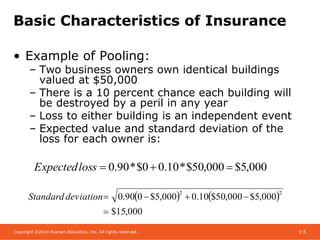
• Example of Pooling:
– Two business owners own identical buildings
valued at $50,000
– There is a 10 percent chance each building will
be destroyed by a peril in any year
– Loss to either building is an independent event
– Expected value and standard deviation of the
loss for each owner is:
000,5$000,50$*10.00$*90.0 lossExpected
   
000,15$
000,5$000,50$10.0000,5$090.0
22

deviationStandard
Copyright ©2014 Pearson Education, Inc. All rights reserved. 2-6
Basic Characteristics of Insurance
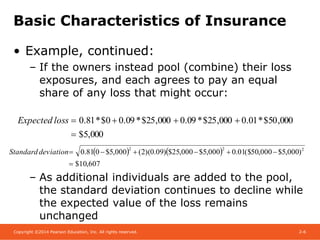
• Example, continued:
– If the owners instead pool (combine) their loss
exposures, and each agrees to pay an equal
share of any loss that might occur:
– As additional individuals are added to the pool,
the standard deviation continues to decline while
the expected value of the loss remains
unchanged
000,5$
000,50$*01.0000,25$*09.0000,25$*09.00$*81.0

lossExpected
   
607,10$
)000,5$000,50($01.0000,5$000,25$)09.0)(2(000,5$081.0 222

deviationStandard
Copyright ©2014 Pearson Education, Inc. All rights reserved. 2-7
Basic Characteristics of Insurance
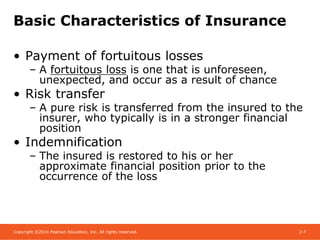
• Payment of fortuitous losses
– A fortuitous loss is one that is unforeseen,
unexpected, and occur as a result of chance
• Risk transfer
– A pure risk is transferred from the insured to the
insurer, who typically is in a stronger financial
position
• Indemnification
– The insured is restored to his or her
approximate financial position prior to the
occurrence of the loss
Copyright ©2014 Pearson Education, Inc. All rights reserved. 2-8
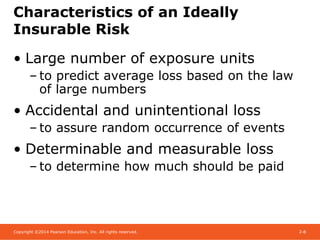
Characteristics of an Ideally
Insurable Risk
• Large number of exposure units
– to predict average loss based on the law
of large numbers
• Accidental and unintentional loss
– to assure random occurrence of events
• Determinable and measurable loss
– to determine how much should be paid
Copyright ©2014 Pearson Education, Inc. All rights reserved. 2-9
Characteristics of an Ideally
Insurable Risk
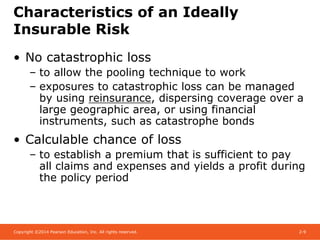
• No catastrophic loss
– to allow the pooling technique to work
– exposures to catastrophic loss can be managed
by using reinsurance, dispersing coverage over a
large geographic area, or using financial
instruments, such as catastrophe bonds
• Calculable chance of loss
– to establish a premium that is sufficient to pay
all claims and expenses and yields a profit during
the policy period
Copyright ©2014 Pearson Education, Inc. All rights reserved. 2-10
Characteristics of an Ideally
Insurable Risk
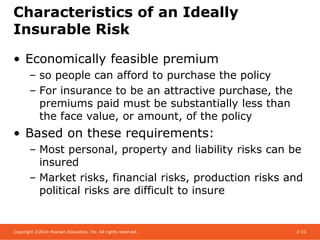
• Economically feasible premium
– so people can afford to purchase the policy
– For insurance to be an attractive purchase, the
premiums paid must be substantially less than
the face value, or amount, of the policy
• Based on these requirements:
– Most personal, property and liability risks can be
insured
– Market risks, financial risks, production risks and
political risks are difficult to insure
Copyright ©2014 Pearson Education, Inc. All rights reserved. 2-11
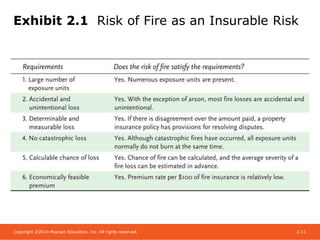
Exhibit 2.1 Risk of Fire as an Insurable Risk
Copyright ©2014 Pearson Education, Inc. All rights reserved. 2-12
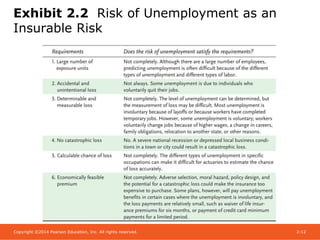
Exhibit 2.2 Risk of Unemployment as an
Insurable Risk
Copyright ©2014 Pearson Education, Inc. All rights reserved. 2-13
Adverse Selection and Insurance
• Adverse selection is the tendency of
persons with a higher-than-average chance
of loss to seek insurance at standard rates
• If not controlled by underwriting, adverse
selection results in higher-than-expected
loss levels
• Adverse selection can be controlled by:
– careful underwriting (selection and classification
of applicants for insurance)
– policy provisions (e.g., suicide clause in life
insurance)
Copyright ©2014 Pearson Education, Inc. All rights reserved. 2-14
Insurance vs. Gambling
Insurance
• Insurance is a
technique for
handing an already
existing pure risk
• Insurance is always
socially productive:
– both parties have a
common interest in
the prevention of a
loss
Gambling
• Gambling creates a
new speculative risk
• Gambling is not
socially productive
– The winner’s gain
comes at the
expense of the loser
Copyright ©2014 Pearson Education, Inc. All rights reserved. 2-15
Insurance vs. Hedging
Insurance
• Risk is transferred
by a contract
• Insurance involves
the transfer of pure
(insurable) risks
• Insurance can
reduce the objective
risk of an insurer
– through the Law of
Large Numbers
Hedging
• Risk is transferred
by a contract
• Hedging involves
risks that are
typically
uninsurable
• Hedging does not
result in reduced
risk
Copyright ©2014 Pearson Education, Inc. All rights reserved. 2-16
Types of Private Insurance
• Life and Health
– Life insurance pays death benefits to
beneficiaries when the insured dies
– Health insurance covers medical expenses
because of sickness or injury
– Disability plans pay income benefits
Copyright ©2014 Pearson Education, Inc. All rights reserved. 2-17
Types of Private Insurance
• Property and Liability
– Property insurance indemnifies property owners
against the loss or damage of real or personal
property
– Liability insurance covers the insured’s legal
liability arising out of property damage or bodily
injury to others
– Casualty insurance refers to insurance that
covers whatever is not covered by fire, marine,
and life insurance
Copyright ©2014 Pearson Education, Inc. All rights reserved. 2-18
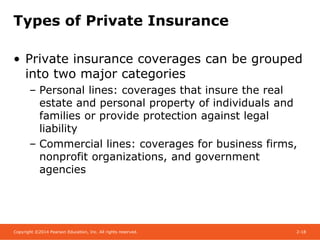
Types of Private Insurance
• Private insurance coverages can be grouped
into two major categories
– Personal lines: coverages that insure the real
estate and personal property of individuals and
families or provide protection against legal
liability
– Commercial lines: coverages for business firms,
nonprofit organizations, and government
agencies
Copyright ©2014 Pearson Education, Inc. All rights reserved. 2-19
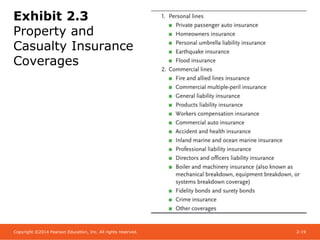
Exhibit 2.3
Property and
Casualty Insurance
Coverages
Copyright ©2014 Pearson Education, Inc. All rights reserved. 2-20
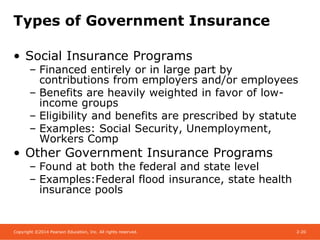
Types of Government Insurance
• Social Insurance Programs
– Financed entirely or in large part by
contributions from employers and/or employees
– Benefits are heavily weighted in favor of low-
income groups
– Eligibility and benefits are prescribed by statute
– Examples: Social Security, Unemployment,
Workers Comp
• Other Government Insurance Programs
– Found at both the federal and state level
– Examples:Federal flood insurance, state health
insurance pools
Copyright ©2014 Pearson Education, Inc. All rights reserved. 2-21
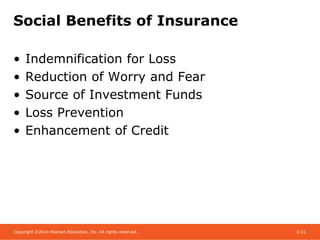
Social Benefits of Insurance
• Indemnification for Loss
• Reduction of Worry and Fear
• Source of Investment Funds
• Loss Prevention
• Enhancement of Credit
Copyright ©2014 Pearson Education, Inc. All rights reserved. 2-22
Social Costs of Insurance
• Cost of Doing Business
– An expense loading is the amount needed to pay
all expenses, including commissions, general
administrative expenses, state premium taxes,
acquisition expenses, and an allowance for
contingencies and profit
• Fraudulent Claims
• Inflated Claims
Higher premiums to cover additional losses
reduce disposable income and consumption
of other goods and services

Chapter 02 - Insurance and Risk

  • 1.
  • 2.
    Copyright ©2014 PearsonEducation, Inc. All rights reserved. 2-2 Agenda • Definition and Basic Characteristics of Insurance • Characteristics of An Ideally Insurable Risk • Adverse Selection and Insurance • Insurance and Gambling Compared • Insurance and Hedging Compared • Types of Insurance • Benefits and Costs of Insurance to Society
  • 3.
    Copyright ©2014 PearsonEducation, Inc. All rights reserved. 2-3 Definition of Insurance • Insurance is the pooling of fortuitous losses by transfer of such risks to insurers, who agree to indemnify insureds for such losses, to provide other pecuniary benefits on their occurrence, or to render services connected with the risk
  • 4.
    Copyright ©2014 PearsonEducation, Inc. All rights reserved. 2-4 Basic Characteristics of Insurance • Pooling of losses – Pooling involves spreading losses incurred by the few over the entire group – Risk reduction is based on the Law of Large Numbers – According to the Law of Large Numbers, the greater the number of exposures, the more closely will the actual results approach the probable results that are expected from an infinite number of exposures.
  • 5.
    Copyright ©2014 PearsonEducation, Inc. All rights reserved. 2-5 Basic Characteristics of Insurance • Example of Pooling: – Two business owners own identical buildings valued at $50,000 – There is a 10 percent chance each building will be destroyed by a peril in any year – Loss to either building is an independent event – Expected value and standard deviation of the loss for each owner is: 000,5$000,50$*10.00$*90.0 lossExpected     000,15$ 000,5$000,50$10.0000,5$090.0 22  deviationStandard
  • 6.
    Copyright ©2014 PearsonEducation, Inc. All rights reserved. 2-6 Basic Characteristics of Insurance • Example, continued: – If the owners instead pool (combine) their loss exposures, and each agrees to pay an equal share of any loss that might occur: – As additional individuals are added to the pool, the standard deviation continues to decline while the expected value of the loss remains unchanged 000,5$ 000,50$*01.0000,25$*09.0000,25$*09.00$*81.0  lossExpected     607,10$ )000,5$000,50($01.0000,5$000,25$)09.0)(2(000,5$081.0 222  deviationStandard
  • 7.
    Copyright ©2014 PearsonEducation, Inc. All rights reserved. 2-7 Basic Characteristics of Insurance • Payment of fortuitous losses – A fortuitous loss is one that is unforeseen, unexpected, and occur as a result of chance • Risk transfer – A pure risk is transferred from the insured to the insurer, who typically is in a stronger financial position • Indemnification – The insured is restored to his or her approximate financial position prior to the occurrence of the loss
  • 8.
    Copyright ©2014 PearsonEducation, Inc. All rights reserved. 2-8 Characteristics of an Ideally Insurable Risk • Large number of exposure units – to predict average loss based on the law of large numbers • Accidental and unintentional loss – to assure random occurrence of events • Determinable and measurable loss – to determine how much should be paid
  • 9.
    Copyright ©2014 PearsonEducation, Inc. All rights reserved. 2-9 Characteristics of an Ideally Insurable Risk • No catastrophic loss – to allow the pooling technique to work – exposures to catastrophic loss can be managed by using reinsurance, dispersing coverage over a large geographic area, or using financial instruments, such as catastrophe bonds • Calculable chance of loss – to establish a premium that is sufficient to pay all claims and expenses and yields a profit during the policy period
  • 10.
    Copyright ©2014 PearsonEducation, Inc. All rights reserved. 2-10 Characteristics of an Ideally Insurable Risk • Economically feasible premium – so people can afford to purchase the policy – For insurance to be an attractive purchase, the premiums paid must be substantially less than the face value, or amount, of the policy • Based on these requirements: – Most personal, property and liability risks can be insured – Market risks, financial risks, production risks and political risks are difficult to insure
  • 11.
    Copyright ©2014 PearsonEducation, Inc. All rights reserved. 2-11 Exhibit 2.1 Risk of Fire as an Insurable Risk
  • 12.
    Copyright ©2014 PearsonEducation, Inc. All rights reserved. 2-12 Exhibit 2.2 Risk of Unemployment as an Insurable Risk
  • 13.
    Copyright ©2014 PearsonEducation, Inc. All rights reserved. 2-13 Adverse Selection and Insurance • Adverse selection is the tendency of persons with a higher-than-average chance of loss to seek insurance at standard rates • If not controlled by underwriting, adverse selection results in higher-than-expected loss levels • Adverse selection can be controlled by: – careful underwriting (selection and classification of applicants for insurance) – policy provisions (e.g., suicide clause in life insurance)
  • 14.
    Copyright ©2014 PearsonEducation, Inc. All rights reserved. 2-14 Insurance vs. Gambling Insurance • Insurance is a technique for handing an already existing pure risk • Insurance is always socially productive: – both parties have a common interest in the prevention of a loss Gambling • Gambling creates a new speculative risk • Gambling is not socially productive – The winner’s gain comes at the expense of the loser
  • 15.
    Copyright ©2014 PearsonEducation, Inc. All rights reserved. 2-15 Insurance vs. Hedging Insurance • Risk is transferred by a contract • Insurance involves the transfer of pure (insurable) risks • Insurance can reduce the objective risk of an insurer – through the Law of Large Numbers Hedging • Risk is transferred by a contract • Hedging involves risks that are typically uninsurable • Hedging does not result in reduced risk
  • 16.
    Copyright ©2014 PearsonEducation, Inc. All rights reserved. 2-16 Types of Private Insurance • Life and Health – Life insurance pays death benefits to beneficiaries when the insured dies – Health insurance covers medical expenses because of sickness or injury – Disability plans pay income benefits
  • 17.
    Copyright ©2014 PearsonEducation, Inc. All rights reserved. 2-17 Types of Private Insurance • Property and Liability – Property insurance indemnifies property owners against the loss or damage of real or personal property – Liability insurance covers the insured’s legal liability arising out of property damage or bodily injury to others – Casualty insurance refers to insurance that covers whatever is not covered by fire, marine, and life insurance
  • 18.
    Copyright ©2014 PearsonEducation, Inc. All rights reserved. 2-18 Types of Private Insurance • Private insurance coverages can be grouped into two major categories – Personal lines: coverages that insure the real estate and personal property of individuals and families or provide protection against legal liability – Commercial lines: coverages for business firms, nonprofit organizations, and government agencies
  • 19.
    Copyright ©2014 PearsonEducation, Inc. All rights reserved. 2-19 Exhibit 2.3 Property and Casualty Insurance Coverages
  • 20.
    Copyright ©2014 PearsonEducation, Inc. All rights reserved. 2-20 Types of Government Insurance • Social Insurance Programs – Financed entirely or in large part by contributions from employers and/or employees – Benefits are heavily weighted in favor of low- income groups – Eligibility and benefits are prescribed by statute – Examples: Social Security, Unemployment, Workers Comp • Other Government Insurance Programs – Found at both the federal and state level – Examples:Federal flood insurance, state health insurance pools
  • 21.
    Copyright ©2014 PearsonEducation, Inc. All rights reserved. 2-21 Social Benefits of Insurance • Indemnification for Loss • Reduction of Worry and Fear • Source of Investment Funds • Loss Prevention • Enhancement of Credit
  • 22.
    Copyright ©2014 PearsonEducation, Inc. All rights reserved. 2-22 Social Costs of Insurance • Cost of Doing Business – An expense loading is the amount needed to pay all expenses, including commissions, general administrative expenses, state premium taxes, acquisition expenses, and an allowance for contingencies and profit • Fraudulent Claims • Inflated Claims Higher premiums to cover additional losses reduce disposable income and consumption of other goods and services