Personal Budget-
The key to a more secured financial future
What is Personal Budgeting?
 A budget is an assessment of income and expenses for attaining financial goals
 Personal budgeting is about understanding the equation between an individual’s
income and expenses to regulate the usage of money.
 Understanding personal budget results in a healthy financial life of an individual.
Key Elements
 This presentation will help you understand-
Importance of Budgeting
Steps to be followed
Ideas
Why prepare a budget?
Why is budgeting important What happens when you don’t have a budget
• Helps you identify and achieve financial goals
• Helps you manage your money
• Increases your saving
• Directs your money flow.
• Prepares you for contingencies
• Provides sense of financial security
• Without a budget, your are unaware of your
financial situation.
• By surviving month to month, you are not
prepared for any emergency.
• No budget = No savings.
• No investment ideas if you do not know your
budget
• Absence of a budget can keep you in debts.
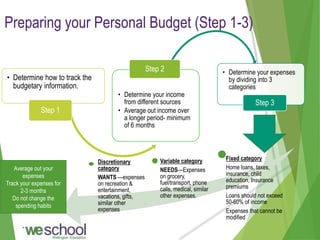
Preparing your Personal Budget (Step 1-3)
• Determine how to track the
budgetary information.
Step 1
• Determine your income
from different sources
• Average out income over
a longer period- minimum
of 6 months
Step 2 • Determine your expenses
by dividing into 3
categories
Step 3
Discretionary
category
WANTS —expenses
on recreation &
entertainment,
vacations, gifts,
similar other
expenses
Variable category
NEEDS—Expenses
on grocery,
fuel/transport, phone
calls, medical, similar
other expenses.
Fixed category
Home loans, taxes,
insurance, child
education, Insurance
premiums
Loans should not exceed
50-60% of income
Expenses that cannot be
modified
Average out your
expenses
Track your expenses for
2-3 months
Do not change the
spending habits
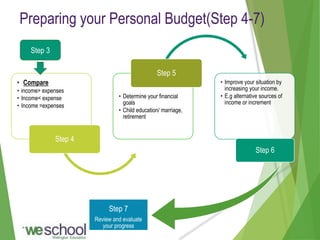
Preparing your Personal Budget(Step 4-7)
• Compare
• income> expenses
• Income< expense
• Income =expenses
Step 4
• Determine your financial
goals
• Child education/ marriage,
retirement
Step 5
• Improve your situation by
increasing your income.
• E.g alternative sources of
income or increment
Step 6
Step 3
Step 7
Review and evaluate
your progress
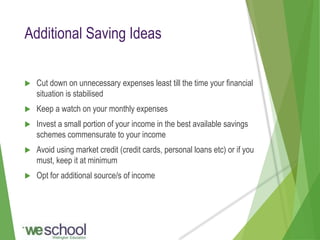
Additional Saving Ideas
 Cut down on unnecessary expenses least till the time your financial
situation is stabilised
 Keep a watch on your monthly expenses
 Invest a small portion of your income in the best available savings
schemes commensurate to your income
 Avoid using market credit (credit cards, personal loans etc) or if you
must, keep it at minimum
 Opt for additional source/s of income
Key highlights
 Devising a basic budget of personal finance is the key to financial security
 The basic comparison between income and expenses determines the financial
objective of an individual
 Monitoring is more important than planning, keeps you updated on a daily
basis and helps you remain on track
 To learn more about Finance Management, visit http://bit.ly/24oII0K
 Explore the next level in distance education at www.welingkaronline.org

Personal budgeting

  • 1.
    Personal Budget- The keyto a more secured financial future
  • 2.
    What is PersonalBudgeting?  A budget is an assessment of income and expenses for attaining financial goals  Personal budgeting is about understanding the equation between an individual’s income and expenses to regulate the usage of money.  Understanding personal budget results in a healthy financial life of an individual.
  • 3.
    Key Elements  Thispresentation will help you understand- Importance of Budgeting Steps to be followed Ideas
  • 4.
    Why prepare abudget? Why is budgeting important What happens when you don’t have a budget • Helps you identify and achieve financial goals • Helps you manage your money • Increases your saving • Directs your money flow. • Prepares you for contingencies • Provides sense of financial security • Without a budget, your are unaware of your financial situation. • By surviving month to month, you are not prepared for any emergency. • No budget = No savings. • No investment ideas if you do not know your budget • Absence of a budget can keep you in debts.
  • 5.
    Preparing your PersonalBudget (Step 1-3) • Determine how to track the budgetary information. Step 1 • Determine your income from different sources • Average out income over a longer period- minimum of 6 months Step 2 • Determine your expenses by dividing into 3 categories Step 3 Discretionary category WANTS —expenses on recreation & entertainment, vacations, gifts, similar other expenses Variable category NEEDS—Expenses on grocery, fuel/transport, phone calls, medical, similar other expenses. Fixed category Home loans, taxes, insurance, child education, Insurance premiums Loans should not exceed 50-60% of income Expenses that cannot be modified Average out your expenses Track your expenses for 2-3 months Do not change the spending habits
  • 6.
    Preparing your PersonalBudget(Step 4-7) • Compare • income> expenses • Income< expense • Income =expenses Step 4 • Determine your financial goals • Child education/ marriage, retirement Step 5 • Improve your situation by increasing your income. • E.g alternative sources of income or increment Step 6 Step 3 Step 7 Review and evaluate your progress
  • 7.
    Additional Saving Ideas Cut down on unnecessary expenses least till the time your financial situation is stabilised  Keep a watch on your monthly expenses  Invest a small portion of your income in the best available savings schemes commensurate to your income  Avoid using market credit (credit cards, personal loans etc) or if you must, keep it at minimum  Opt for additional source/s of income
  • 8.
    Key highlights  Devisinga basic budget of personal finance is the key to financial security  The basic comparison between income and expenses determines the financial objective of an individual  Monitoring is more important than planning, keeps you updated on a daily basis and helps you remain on track
  • 9.
     To learnmore about Finance Management, visit http://bit.ly/24oII0K  Explore the next level in distance education at www.welingkaronline.org