Participatory Extension
        Method


            R P Singh
   Associate Director Extension
Advantages

             •   Efficiency
             •   Effectiveness
             •   Self Reliance
             •   Coverage
             •   Sustainability
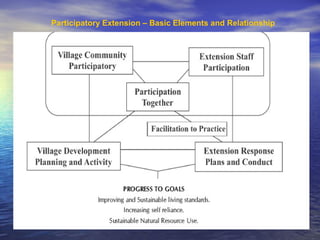
Participatory Extension – Basic Elements and Relationship
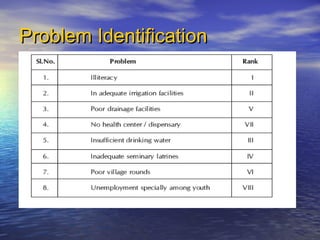
Problem Identification
Problem Analysis
• In the course of the diagnosis, the various socio-
   interest groups identify the major problems. In
   order to seek valid solutions, it is necessary to
   describe and understand the problem in detail by
   posing the following questions:
• What exactly causes the problems?
• Who are affected by these problems? How?
• What will happen if the problems are not solved?
• So far the problems have not been solved. Why?
• Do we intend to solve the problems?
• What can be done to solve the problems?
Objectives & Methodology

• The objectives of problems analysis are:
• To identify the causes and effects of priority
    problems indicated by the village residents.
•    To select the most relevant causes which the
    village residents can and wish to address
•   Methodology: The methods and tools used for
    problems analysis are:
•   a) Village introductory meeting and
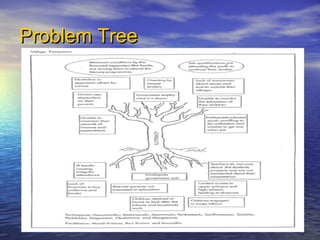
•   b) Problem tree
Village Introductory Meeting
• Selection of problems for analysis
  – A problem for which numerous causes have
    apparently been responsible.
  – One of the priority problems indicated by the
    majority of socio-interest groups; this may
  – indicate that a large number of people in the
    village have been affected by the problem.
  – Problems in the priority list which are of
    interest to the service agencies represented.
Cont..

• Course of the Meeting
  – The facilitator explains the objectives of problem
    analysis
  – The residents are divided into sub-groups and
    allocated problems analysis
  – The number of sub-groups should depend on the
    number of complex problems and the
  – number and the number of the facilitators available.
  – It is important that the technical staff from relevant
    service agencies participate in the problem analysis.
Problem Tree
Steps in Participatory Approaches
       • Rapport building
       • DIY (Do-It Yourself)
       • Consultations with the villagers
          and outsiders
        • Secondary Data Collection
        • Training of Trainers
        • Diagnosis
Some of the these approaches are

•   Rapid Rural Appraisal (RRA)
•   Participatory Rural Appraisal (PRA)
•   Participatory Learning Methods (PALM)
•   Agro-Ecosystem Analysis (AEA)
•   Participatory Action Research (PAR)
•   Participatory Assessment, Monitoring and
    Evaluation (PAME)
•   Farming Systems Research (FSR)
•   Participatory Rural Appraisal and Planning
    (PRAP)
Distinguishing Features of
Participatory Rural Appraisal (PRA)
       •   Closed to Open
       •   Measurement to Comparison
       •   Individual to Group
       •   Democracy of the Ground
       •   Verbal to Visual
       •   Higher to Lower
       •   Reserve to Rapport
Principles of PRA

• Listening and Learning
• Offsetting Biases
• Utilization of precious Community Time
• Seeking Diversity
• Triangulation /Cross checking
• Optimal ignorance and appropriate
  imprecision
• Multi-disciplinary Team
Behavioral Principles of PRA

       •   Handing over the Stick
       •   Self-critical Awareness
       •   Use Your Best Judgments
       •   From Stealing to Sharing
Participatory Tools and Techniques
 •Space related PRA Methods
 –   Social Map
 –   Resource Map
 –   Transect
 –   Mobility Map
 •Time Related PRA Methods
 –   Time line
 –   Trend Analysis
 –   Seasonal diagram
Cont..


• Relation Related PRA Methods
  – Cause and effect diagram
  – Well-being Ranking
  – Venn diagram
Participatory extension method

Participatory extension method

  • 1.
    Participatory Extension Method R P Singh Associate Director Extension
  • 2.
    Advantages • Efficiency • Effectiveness • Self Reliance • Coverage • Sustainability
  • 3.
    Participatory Extension –Basic Elements and Relationship
  • 4.
  • 5.
    Problem Analysis • Inthe course of the diagnosis, the various socio- interest groups identify the major problems. In order to seek valid solutions, it is necessary to describe and understand the problem in detail by posing the following questions: • What exactly causes the problems? • Who are affected by these problems? How? • What will happen if the problems are not solved? • So far the problems have not been solved. Why? • Do we intend to solve the problems? • What can be done to solve the problems?
  • 6.
    Objectives & Methodology •The objectives of problems analysis are: • To identify the causes and effects of priority problems indicated by the village residents. • To select the most relevant causes which the village residents can and wish to address • Methodology: The methods and tools used for problems analysis are: • a) Village introductory meeting and • b) Problem tree
  • 7.
    Village Introductory Meeting •Selection of problems for analysis – A problem for which numerous causes have apparently been responsible. – One of the priority problems indicated by the majority of socio-interest groups; this may – indicate that a large number of people in the village have been affected by the problem. – Problems in the priority list which are of interest to the service agencies represented.
  • 8.
    Cont.. • Course ofthe Meeting – The facilitator explains the objectives of problem analysis – The residents are divided into sub-groups and allocated problems analysis – The number of sub-groups should depend on the number of complex problems and the – number and the number of the facilitators available. – It is important that the technical staff from relevant service agencies participate in the problem analysis.
  • 9.
  • 10.
    Steps in ParticipatoryApproaches • Rapport building • DIY (Do-It Yourself) • Consultations with the villagers and outsiders • Secondary Data Collection • Training of Trainers • Diagnosis
  • 11.
    Some of thethese approaches are • Rapid Rural Appraisal (RRA) • Participatory Rural Appraisal (PRA) • Participatory Learning Methods (PALM) • Agro-Ecosystem Analysis (AEA) • Participatory Action Research (PAR) • Participatory Assessment, Monitoring and Evaluation (PAME) • Farming Systems Research (FSR) • Participatory Rural Appraisal and Planning (PRAP)
  • 12.
    Distinguishing Features of ParticipatoryRural Appraisal (PRA) • Closed to Open • Measurement to Comparison • Individual to Group • Democracy of the Ground • Verbal to Visual • Higher to Lower • Reserve to Rapport
  • 13.
    Principles of PRA •Listening and Learning • Offsetting Biases • Utilization of precious Community Time • Seeking Diversity • Triangulation /Cross checking • Optimal ignorance and appropriate imprecision • Multi-disciplinary Team
  • 14.
    Behavioral Principles ofPRA • Handing over the Stick • Self-critical Awareness • Use Your Best Judgments • From Stealing to Sharing
  • 15.
    Participatory Tools andTechniques •Space related PRA Methods – Social Map – Resource Map – Transect – Mobility Map •Time Related PRA Methods – Time line – Trend Analysis – Seasonal diagram
  • 16.
    Cont.. • Relation RelatedPRA Methods – Cause and effect diagram – Well-being Ranking – Venn diagram