Unit -3 Learning Disability
Mrs.R.Kohila Devi
Asst. Prof. in Education
Thiagarajar College of Preceptors
Madurai -9
“Life is not so much a
matter of holding good
cards but of playing a
poor hand well”
Let’s Define a
Learning Disability
A learning disability interferes with someone’s
ability to store, process or produce information
Such disabilities affect both children and adults
Its not always immediately obvious that a person has a
learning disability
They can be quite subtle and go undetected
throughout life
The most straightforward indication is academic
failure or underachievement by someone who
seems capable of more
For the students we see in our classrooms,
learning disabilities create a gap between a
students true capacity and his or her day to day
performance
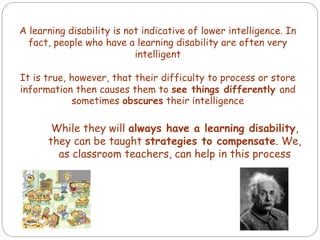
A learning disability is not indicative of lower intelligence. In
fact, people who have a learning disability are often very
intelligent
It is true, however, that their difficulty to process or store
information then causes them to see things differently and
sometimes obscures their intelligence
While they will always have a learning disability,
they can be taught strategies to compensate. We,
as classroom teachers, can help in this process
There is no clear and widely accepted definition
of "learning disabilities"
There are currently at least 12 definitions
that appear in the professional literature!
What is a Learning Disability?
Five Areas of Agreement
1.The learning disabled have difficulties with academic
achievement and progress, discrepancies exist
between a person's potential for learning and what he
actually learns
2.The learning disabled show an uneven pattern of
language development, and/or motor-development,
academic development and/or perceptual
development
3. All learning originates within the brain and, consequently,
a disorder in learning can be caused by a dysfunction in the
central nervous system
4. Learning problems are not due to an
environmental disadvantage
5. Learning problems are not due
to intellectual disabilities or
emotional disturbances
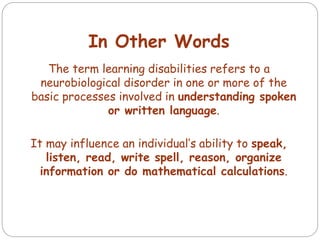
In Other Words
The term learning disabilities refers to a
neurobiological disorder in one or more of the
basic processes involved in understanding spoken
or written language.
It may influence an individual’s ability to speak,
listen, read, write spell, reason, organize
information or do mathematical calculations.
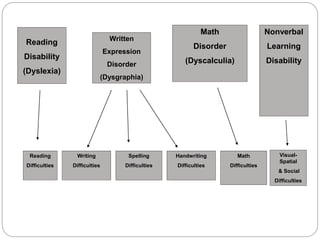
Reading
Disability
(Dyslexia)
Written
Expression
Disorder
(Dysgraphia)
Math
Disorder
(Dyscalculia)
Nonverbal
Learning
Disability
Reading
Difficulties
Spelling
Difficulties
Handwriting
Difficulties
Math
Difficulties
Visual-
Spatial
& Social
Difficulties
Writing
Difficulties
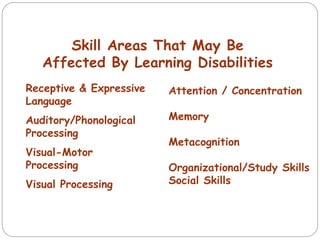
Skill Areas That May Be
Affected By Learning Disabilities
Receptive & Expressive
Language
Auditory/Phonological
Processing
Visual-Motor
Processing
Visual Processing
Attention / Concentration
Memory
Metacognition
Organizational/Study Skills
Social Skills
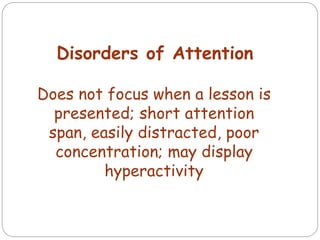
Disorders of Attention
Does not focus when a lesson is
presented; short attention
span, easily distracted, poor
concentration; may display
hyperactivity
Psychological Processing
Deficits
Problems in processing auditory
or visual information
(difficulty interpreting visual
or auditory stimuli)
Oral Language Difficulties
Underlying language disorders;
problems in language
development, listening,
speaking, and vocabulary
Lacks Phonological
Awareness
Poor at recognizing sounds of
language; cannot identify
phoneme sounds in spoken
language, and cannot
manipulate these sounds
Poor Motor Abilities
Difficulty with gross motor
abilities and fine motor
coordination
(exhibits general awkwardness
and clumsiness)
Writing Difficulties
Poor in tasks requiring written
expression, spelling, and
handwriting
Mathematics
Difficulty with quantitative
thinking, arithmetic, time,
space, and calculation facts
Reading Difficulties
About 80% of students with
learning disabilities have
disabilities in reading;
problems in learning to decode
words, basic word recognition
skills, or reading
comprehension
Looking just at the learning
disability is too limiting!
Students with learning
disabilities manifest
strengths and weaknesses in
!
different mental processes
Teachers need to look at
students’ islands of
competence!
Each Student is Unique!
Learning Styles
All learners have preferred ways of receiving
new and sometimes difficult information.
Awareness of these modalities for language
teachers are important so that they can
accommodate to the individual differences and
learning styles.
When we teach using the students'
different sensory modalities the class
as a whole receives information in one or
several channels
This Multisensory approach can also
reinforce a learner's use of their less
developed senses
Grinder, 1989
Sensory Modalities
Howard Gardner’s work on multiple
intelligences and the different ways that we
each learn, remember, perform, and understand
may be helpful
Of similar importance is Betty Edwards work on
the roles that the left-brain and the right-
brain play in our thinking, reasoning and
complex mental functions
Teachers can improve the learning climate for
many students and most assuredly for those
with a learning disability by planning tasks so
that differing intelligences are called upon and
by balancing the involvement required of each
hemisphere of the brain
Beginning learners of a second language do not
have native speaker competence in English
phonology
Thus, their language and literacy development
must take a somewhat different path than
from a native speaker's development
Many believe their path takes on qualities of a L1
learning disabled student, demanding a highly
individualized approach with linguistic
instruction and remediation (Jannuzi, 1998)
I Teach Everyone Like They
Are LD!
The burden is on us as teachers to ensure that the
classroom environment does not perpetuate learning
failure.
Students who encounter reading problems suffer from
many consequences of a reading disability. In school
these students are forced to see day after day, that
they use textbooks they cannot read and homework they
cannot do.
In response, they may turn to misbehavior or simply give
up, displaying what is called learned helplessness.
Whenever appropriate, present material
using graphic and/or sensory media
Combine both auditory and visual
stimuli, say it and write it on the board
whenever possible
Use videos, demonstrations, and
concrete materials

UNDERSTANDING LEARNING DISABILITIES

  • 1.
    Unit -3 LearningDisability Mrs.R.Kohila Devi Asst. Prof. in Education Thiagarajar College of Preceptors Madurai -9
  • 2.
    “Life is notso much a matter of holding good cards but of playing a poor hand well”
  • 3.
    Let’s Define a LearningDisability A learning disability interferes with someone’s ability to store, process or produce information Such disabilities affect both children and adults Its not always immediately obvious that a person has a learning disability They can be quite subtle and go undetected throughout life
  • 4.
    The most straightforwardindication is academic failure or underachievement by someone who seems capable of more For the students we see in our classrooms, learning disabilities create a gap between a students true capacity and his or her day to day performance
  • 5.
    A learning disabilityis not indicative of lower intelligence. In fact, people who have a learning disability are often very intelligent It is true, however, that their difficulty to process or store information then causes them to see things differently and sometimes obscures their intelligence While they will always have a learning disability, they can be taught strategies to compensate. We, as classroom teachers, can help in this process
  • 6.
    There is noclear and widely accepted definition of "learning disabilities" There are currently at least 12 definitions that appear in the professional literature! What is a Learning Disability?
  • 7.
    Five Areas ofAgreement 1.The learning disabled have difficulties with academic achievement and progress, discrepancies exist between a person's potential for learning and what he actually learns 2.The learning disabled show an uneven pattern of language development, and/or motor-development, academic development and/or perceptual development 3. All learning originates within the brain and, consequently, a disorder in learning can be caused by a dysfunction in the central nervous system
  • 8.
    4. Learning problemsare not due to an environmental disadvantage 5. Learning problems are not due to intellectual disabilities or emotional disturbances
  • 9.
    In Other Words Theterm learning disabilities refers to a neurobiological disorder in one or more of the basic processes involved in understanding spoken or written language. It may influence an individual’s ability to speak, listen, read, write spell, reason, organize information or do mathematical calculations.
  • 10.
  • 11.
    Skill Areas ThatMay Be Affected By Learning Disabilities Receptive & Expressive Language Auditory/Phonological Processing Visual-Motor Processing Visual Processing Attention / Concentration Memory Metacognition Organizational/Study Skills Social Skills
  • 12.
    Disorders of Attention Doesnot focus when a lesson is presented; short attention span, easily distracted, poor concentration; may display hyperactivity
  • 13.
    Psychological Processing Deficits Problems inprocessing auditory or visual information (difficulty interpreting visual or auditory stimuli)
  • 14.
    Oral Language Difficulties Underlyinglanguage disorders; problems in language development, listening, speaking, and vocabulary
  • 15.
    Lacks Phonological Awareness Poor atrecognizing sounds of language; cannot identify phoneme sounds in spoken language, and cannot manipulate these sounds
  • 16.
    Poor Motor Abilities Difficultywith gross motor abilities and fine motor coordination (exhibits general awkwardness and clumsiness)
  • 17.
    Writing Difficulties Poor intasks requiring written expression, spelling, and handwriting
  • 18.
    Mathematics Difficulty with quantitative thinking,arithmetic, time, space, and calculation facts
  • 19.
    Reading Difficulties About 80%of students with learning disabilities have disabilities in reading; problems in learning to decode words, basic word recognition skills, or reading comprehension
  • 20.
    Looking just atthe learning disability is too limiting! Students with learning disabilities manifest strengths and weaknesses in ! different mental processes Teachers need to look at students’ islands of competence! Each Student is Unique!
  • 21.
    Learning Styles All learnershave preferred ways of receiving new and sometimes difficult information. Awareness of these modalities for language teachers are important so that they can accommodate to the individual differences and learning styles.
  • 22.
    When we teachusing the students' different sensory modalities the class as a whole receives information in one or several channels This Multisensory approach can also reinforce a learner's use of their less developed senses Grinder, 1989 Sensory Modalities
  • 23.
    Howard Gardner’s workon multiple intelligences and the different ways that we each learn, remember, perform, and understand may be helpful Of similar importance is Betty Edwards work on the roles that the left-brain and the right- brain play in our thinking, reasoning and complex mental functions Teachers can improve the learning climate for many students and most assuredly for those with a learning disability by planning tasks so that differing intelligences are called upon and by balancing the involvement required of each hemisphere of the brain
  • 24.
    Beginning learners ofa second language do not have native speaker competence in English phonology Thus, their language and literacy development must take a somewhat different path than from a native speaker's development Many believe their path takes on qualities of a L1 learning disabled student, demanding a highly individualized approach with linguistic instruction and remediation (Jannuzi, 1998) I Teach Everyone Like They Are LD!
  • 25.
    The burden ison us as teachers to ensure that the classroom environment does not perpetuate learning failure. Students who encounter reading problems suffer from many consequences of a reading disability. In school these students are forced to see day after day, that they use textbooks they cannot read and homework they cannot do. In response, they may turn to misbehavior or simply give up, displaying what is called learned helplessness.
  • 26.
    Whenever appropriate, presentmaterial using graphic and/or sensory media Combine both auditory and visual stimuli, say it and write it on the board whenever possible Use videos, demonstrations, and concrete materials