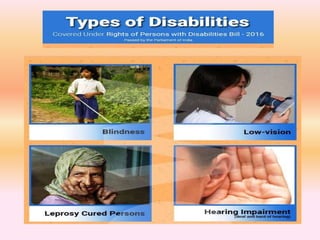

Types of Disabilities
Amit Singh
School of Education
Central University of Haryana
Blindness
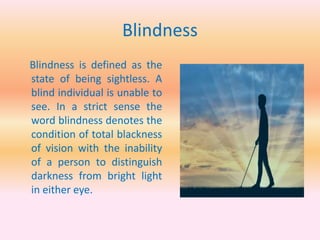
Blindness is defined as the
state of being sightless. A
blind individual is unable to
see. In a strict sense the
word blindness denotes the
condition of total blackness
of vision with the inability
of a person to distinguish
darkness from bright light
in either eye.
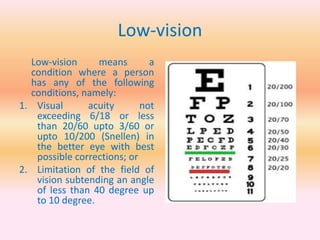
Low-vision
Low-vision means a
condition where a person
has any of the following
conditions, namely:
1. Visual acuity not
exceeding 6/18 or less
than 20/60 upto 3/60 or
upto 10/200 (Snellen) in
the better eye with best
possible corrections; or
2. Limitation of the field of
vision subtending an angle
of less than 40 degree up
to 10 degree.
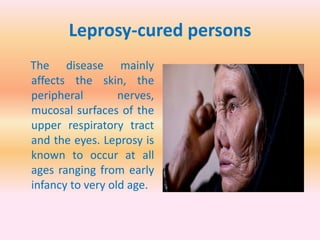
Leprosy-cured persons
The disease mainly
affects the skin, the
peripheral nerves,
mucosal surfaces of the
upper respiratory tract
and the eyes. Leprosy is
known to occur at all
ages ranging from early
infancy to very old age.
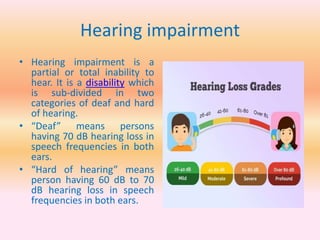
Hearing impairment
• Hearing impairment is a
partial or total inability to
hear. It is a disability which
is sub-divided in two
categories of deaf and hard
of hearing.
• “Deaf” means persons
having 70 dB hearing loss in
speech frequencies in both
ears.
• “Hard of hearing” means
person having 60 dB to 70
dB hearing loss in speech
frequencies in both ears.
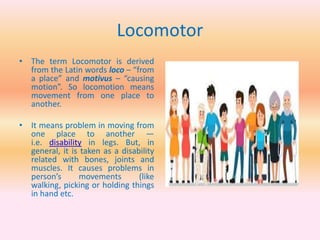
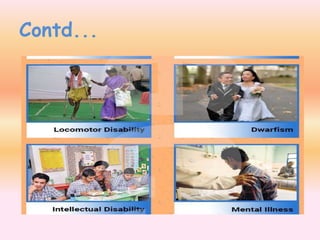
Locomotor
• The term Locomotor is derived
from the Latin words loco – “from
a place” and motivus – “causing
motion”. So locomotion means
movement from one place to
another.
• It means problem in moving from
one place to another —
i.e. disability in legs. But, in
general, it is taken as a disability
related with bones, joints and
muscles. It causes problems in
person’s movements (like
walking, picking or holding things
in hand etc.
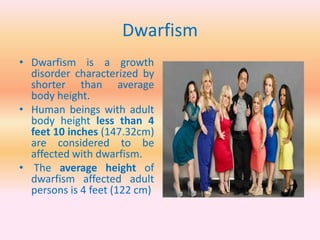
Dwarfism
• Dwarfism is a growth
disorder characterized by
shorter than average
body height.
• Human beings with adult
body height less than 4
feet 10 inches (147.32cm)
are considered to be
affected with dwarfism.
• The average height of
dwarfism affected adult
persons is 4 feet (122 cm)
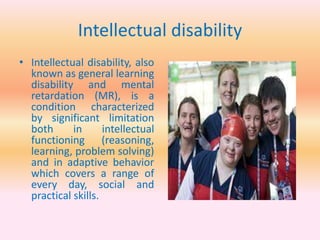
Intellectual disability
• Intellectual disability, also
known as general learning
disability and mental
retardation (MR), is a
condition characterized
by significant limitation
both in intellectual
functioning (reasoning,
learning, problem solving)
and in adaptive behavior
which covers a range of
every day, social and
practical skills.
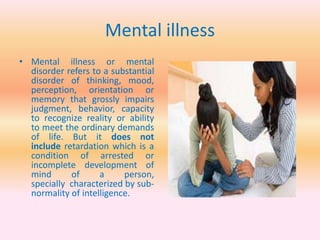
Mental illness
• Mental illness or mental
disorder refers to a substantial
disorder of thinking, mood,
perception, orientation or
memory that grossly impairs
judgment, behavior, capacity
to recognize reality or ability
to meet the ordinary demands
of life. But it does not
include retardation which is a
condition of arrested or
incomplete development of
mind of a person,
specially characterized by sub-
normality of intelligence.
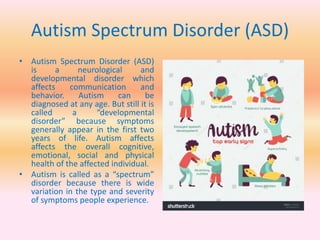
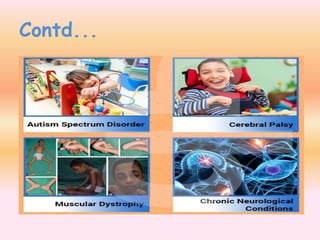
Autism Spectrum Disorder (ASD)
• Autism Spectrum Disorder (ASD)
is a neurological and
developmental disorder which
affects communication and
behavior. Autism can be
diagnosed at any age. But still it is
called a “developmental
disorder” because symptoms
generally appear in the first two
years of life. Autism affects
affects the overall cognitive,
emotional, social and physical
health of the affected individual.
• Autism is called as a “spectrum”
disorder because there is wide
variation in the type and severity
of symptoms people experience.
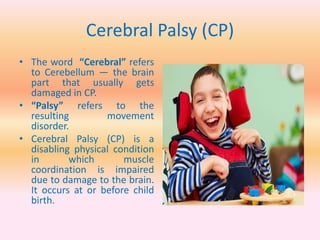
Cerebral Palsy (CP)
• The word “Cerebral” refers
to Cerebellum — the brain
part that usually gets
damaged in CP.
• “Palsy” refers to the
resulting movement
disorder.
• Cerebral Palsy (CP) is a
disabling physical condition
in which muscle
coordination is impaired
due to damage to the brain.
It occurs at or before child
birth.
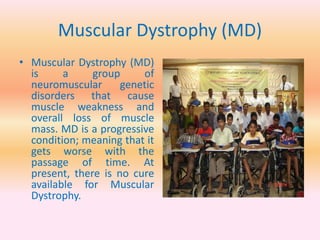
Muscular Dystrophy (MD)
• Muscular Dystrophy (MD)
is a group of
neuromuscular genetic
disorders that cause
muscle weakness and
overall loss of muscle
mass. MD is a progressive
condition; meaning that it
gets worse with the
passage of time. At
present, there is no cure
available for Muscular
Dystrophy.
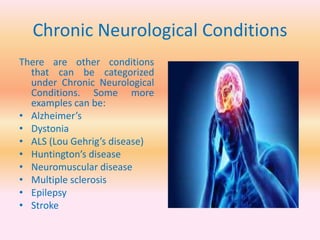
Chronic Neurological Conditions
There are other conditions
that can be categorized
under Chronic Neurological
Conditions. Some more
examples can be:
• Alzheimer’s
• Dystonia
• ALS (Lou Gehrig’s disease)
• Huntington’s disease
• Neuromuscular disease
• Multiple sclerosis
• Epilepsy
• Stroke
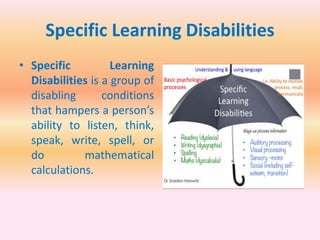
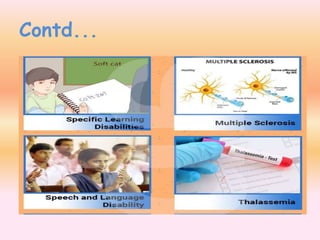
Specific Learning Disabilities
• Specific Learning
Disabilities is a group of
disabling conditions
that hampers a person’s
ability to listen, think,
speak, write, spell, or
do mathematical
calculations.
Multiple Sclerosis
• Multiple Sclerosis (often
referred to as MS) is a
disabling disease that
affects Central Nervous
System (CNS). It inhibits
the flow of information
within the brain and
between brain and
various body parts. MS
is not life-threatening.
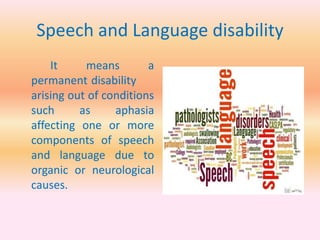
Speech and Language disability
It means a
permanent disability
arising out of conditions
such as aphasia
affecting one or more
components of speech
and language due to
organic or neurological
causes.
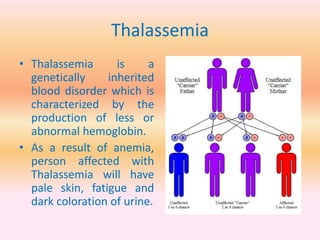
Thalassemia
• Thalassemia is a
genetically inherited
blood disorder which is
characterized by the
production of less or
abnormal hemoglobin.
• As a result of anemia,
person affected with
Thalassemia will have
pale skin, fatigue and
dark coloration of urine.
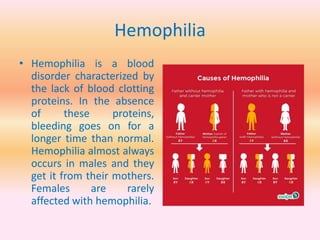
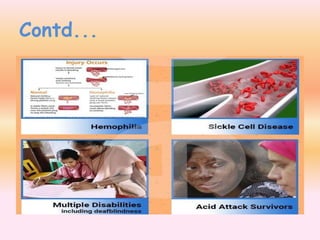
Hemophilia
• Hemophilia is a blood
disorder characterized by
the lack of blood clotting
proteins. In the absence
of these proteins,
bleeding goes on for a
longer time than normal.
Hemophilia almost always
occurs in males and they
get it from their mothers.
Females are rarely
affected with hemophilia.
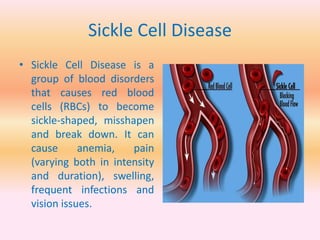
Sickle Cell Disease
• Sickle Cell Disease is a
group of blood disorders
that causes red blood
cells (RBCs) to become
sickle-shaped, misshapen
and break down. It can
cause anemia, pain
(varying both in intensity
and duration), swelling,
frequent infections and
vision issues.
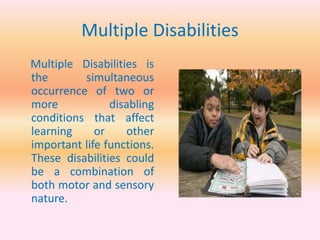
Multiple Disabilities
Multiple Disabilities is
the simultaneous
occurrence of two or
more disabling
conditions that affect
learning or other
important life functions.
These disabilities could
be a combination of
both motor and sensory
nature.
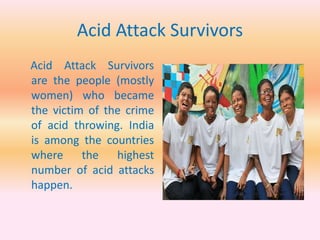
Acid Attack Survivors
are the people (mostly
women) who became
the victim of the crime
of acid throwing. India
is among the countries
where the highest
number of acid attacks
happen.
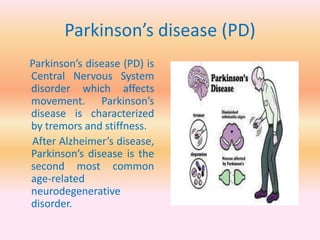
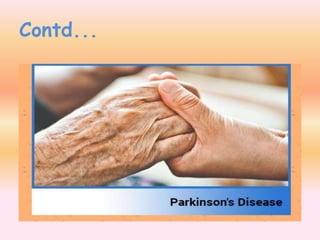
Parkinson’s disease (PD)
Parkinson’s disease (PD) is
Central Nervous System
disorder which affects
movement. Parkinson’s
disease is characterized
by tremors and stiffness.
After Alzheimer’s disease,
Parkinson’s disease is the
second most common
age-related
neurodegenerative
disorder.
RPWD Act 2016
Contd...
Contd...
Contd...
Contd...
Contd...
Thank you

Classification of CWSN.pptx

  • 1.
    Types of Disabilities AmitSingh School of Education Central University of Haryana
  • 3.
    Blindness Blindness is definedas the state of being sightless. A blind individual is unable to see. In a strict sense the word blindness denotes the condition of total blackness of vision with the inability of a person to distinguish darkness from bright light in either eye.
  • 4.
    Low-vision Low-vision means a conditionwhere a person has any of the following conditions, namely: 1. Visual acuity not exceeding 6/18 or less than 20/60 upto 3/60 or upto 10/200 (Snellen) in the better eye with best possible corrections; or 2. Limitation of the field of vision subtending an angle of less than 40 degree up to 10 degree.
  • 5.
    Leprosy-cured persons The diseasemainly affects the skin, the peripheral nerves, mucosal surfaces of the upper respiratory tract and the eyes. Leprosy is known to occur at all ages ranging from early infancy to very old age.
  • 6.
    Hearing impairment • Hearingimpairment is a partial or total inability to hear. It is a disability which is sub-divided in two categories of deaf and hard of hearing. • “Deaf” means persons having 70 dB hearing loss in speech frequencies in both ears. • “Hard of hearing” means person having 60 dB to 70 dB hearing loss in speech frequencies in both ears.
  • 7.
    Locomotor • The termLocomotor is derived from the Latin words loco – “from a place” and motivus – “causing motion”. So locomotion means movement from one place to another. • It means problem in moving from one place to another — i.e. disability in legs. But, in general, it is taken as a disability related with bones, joints and muscles. It causes problems in person’s movements (like walking, picking or holding things in hand etc.
  • 8.
    Dwarfism • Dwarfism isa growth disorder characterized by shorter than average body height. • Human beings with adult body height less than 4 feet 10 inches (147.32cm) are considered to be affected with dwarfism. • The average height of dwarfism affected adult persons is 4 feet (122 cm)
  • 9.
    Intellectual disability • Intellectualdisability, also known as general learning disability and mental retardation (MR), is a condition characterized by significant limitation both in intellectual functioning (reasoning, learning, problem solving) and in adaptive behavior which covers a range of every day, social and practical skills.
  • 10.
    Mental illness • Mentalillness or mental disorder refers to a substantial disorder of thinking, mood, perception, orientation or memory that grossly impairs judgment, behavior, capacity to recognize reality or ability to meet the ordinary demands of life. But it does not include retardation which is a condition of arrested or incomplete development of mind of a person, specially characterized by sub- normality of intelligence.
  • 11.
    Autism Spectrum Disorder(ASD) • Autism Spectrum Disorder (ASD) is a neurological and developmental disorder which affects communication and behavior. Autism can be diagnosed at any age. But still it is called a “developmental disorder” because symptoms generally appear in the first two years of life. Autism affects affects the overall cognitive, emotional, social and physical health of the affected individual. • Autism is called as a “spectrum” disorder because there is wide variation in the type and severity of symptoms people experience.
  • 12.
    Cerebral Palsy (CP) •The word “Cerebral” refers to Cerebellum — the brain part that usually gets damaged in CP. • “Palsy” refers to the resulting movement disorder. • Cerebral Palsy (CP) is a disabling physical condition in which muscle coordination is impaired due to damage to the brain. It occurs at or before child birth.
  • 13.
    Muscular Dystrophy (MD) •Muscular Dystrophy (MD) is a group of neuromuscular genetic disorders that cause muscle weakness and overall loss of muscle mass. MD is a progressive condition; meaning that it gets worse with the passage of time. At present, there is no cure available for Muscular Dystrophy.
  • 14.
    Chronic Neurological Conditions Thereare other conditions that can be categorized under Chronic Neurological Conditions. Some more examples can be: • Alzheimer’s • Dystonia • ALS (Lou Gehrig’s disease) • Huntington’s disease • Neuromuscular disease • Multiple sclerosis • Epilepsy • Stroke
  • 15.
    Specific Learning Disabilities •Specific Learning Disabilities is a group of disabling conditions that hampers a person’s ability to listen, think, speak, write, spell, or do mathematical calculations.
  • 16.
    Multiple Sclerosis • MultipleSclerosis (often referred to as MS) is a disabling disease that affects Central Nervous System (CNS). It inhibits the flow of information within the brain and between brain and various body parts. MS is not life-threatening.
  • 17.
    Speech and Languagedisability It means a permanent disability arising out of conditions such as aphasia affecting one or more components of speech and language due to organic or neurological causes.
  • 18.
    Thalassemia • Thalassemia isa genetically inherited blood disorder which is characterized by the production of less or abnormal hemoglobin. • As a result of anemia, person affected with Thalassemia will have pale skin, fatigue and dark coloration of urine.
  • 19.
    Hemophilia • Hemophilia isa blood disorder characterized by the lack of blood clotting proteins. In the absence of these proteins, bleeding goes on for a longer time than normal. Hemophilia almost always occurs in males and they get it from their mothers. Females are rarely affected with hemophilia.
  • 20.
    Sickle Cell Disease •Sickle Cell Disease is a group of blood disorders that causes red blood cells (RBCs) to become sickle-shaped, misshapen and break down. It can cause anemia, pain (varying both in intensity and duration), swelling, frequent infections and vision issues.
  • 21.
    Multiple Disabilities Multiple Disabilitiesis the simultaneous occurrence of two or more disabling conditions that affect learning or other important life functions. These disabilities could be a combination of both motor and sensory nature.
  • 22.
    Acid Attack Survivors AcidAttack Survivors are the people (mostly women) who became the victim of the crime of acid throwing. India is among the countries where the highest number of acid attacks happen.
  • 23.
    Parkinson’s disease (PD) Parkinson’sdisease (PD) is Central Nervous System disorder which affects movement. Parkinson’s disease is characterized by tremors and stiffness. After Alzheimer’s disease, Parkinson’s disease is the second most common age-related neurodegenerative disorder.
  • 24.
  • 25.
  • 26.
  • 27.
  • 28.
  • 29.
  • 30.