Earthwork & Excavation
Estimation and Costing
Earthwork & Excavation1
Earthwork & Excavation
Earthwork & Excavation2
 Generally all the Civil Engineering projects like roads,
railways, earth dams, canal bunds, buildings etc. involves
the earth work.
 This earth work may be either earth excavation or earth
filling or Some times both will get according to the
desired shape and level.
 Basically the volume of earthwork is computed from
length, breadth, and depth of excavation or filling.
Excavation Classification
The materials to be excavated shall be classified as follows
unless otherwise specified.
Earthwork & Excavation3
Earthwork & Excavation4
a) Soft / Loose Soil
b) Hard/Dense Soil
c) Mud
d) Soft/Disintegrated Rock ( Not Requiring Blasting )
e) Hard Rock( Requiring Blasting )
f) Hard Rock( Blasting Prohibited)
Earthwork & Excavation5
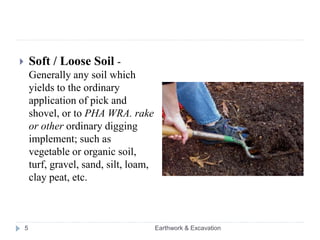
 Soft / Loose Soil -
Generally any soil which
yields to the ordinary
application of pick and
shovel, or to PHA WRA. rake
or other ordinary digging
implement; such as
vegetable or organic soil,
turf, gravel, sand, silt, loam,
clay peat, etc.
Earthwork & Excavation6
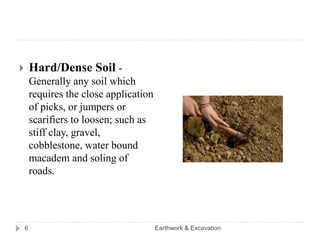
 Hard/Dense Soil -
Generally any soil which
requires the close application
of picks, or jumpers or
scarifiers to loosen; such as
stiff clay, gravel,
cobblestone, water bound
macadem and soling of
roads.
Earthwork & Excavation7
 Mud - A mixture of soil and
water in fluid or weak solid
state.
Earthwork & Excavation8
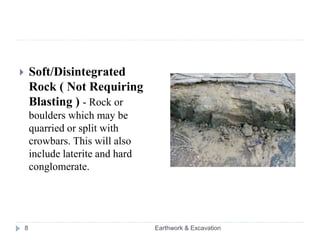
 Soft/Disintegrated
Rock ( Not Requiring
Blasting ) - Rock or
boulders which may be
quarried or split with
crowbars. This will also
include laterite and hard
conglomerate.
Earthwork & Excavation9
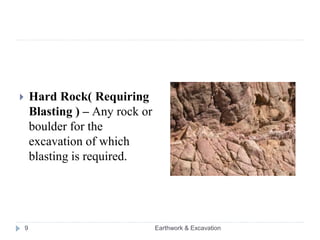
 Hard Rock( Requiring
Blasting ) – Any rock or
boulder for the
excavation of which
blasting is required.
Earthwork & Excavation10
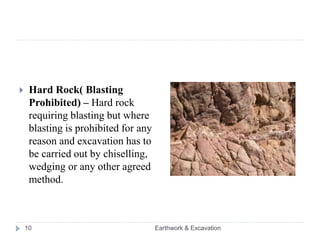
 Hard Rock( Blasting
Prohibited) – Hard rock
requiring blasting but where
blasting is prohibited for any
reason and excavation has to
be carried out by chiselling,
wedging or any other agreed
method.
METHOD OF CALCULATING THE
EARTH WORK QUANTITIES
Lead and Lift
Earthwork & Excavation11
Lead and Lift
Lead: Lift :
Earthwork & Excavation12
 It is the average horizontal
distance between the
centre of excavation to the
centre of deposition. The
unit of lead is 50m.
 It is the average height
through which the earth
has to be lifted from
source to the place of
spreading or heaping. The
unit of lift is 2.00m for
first lift and one extra lift
for every 1.0m.
DETAILED SPECIFICATIONS
Earthwork in excavation in foundation -
Earthwork & Excavation13
Excavation
Earthwork & Excavation14
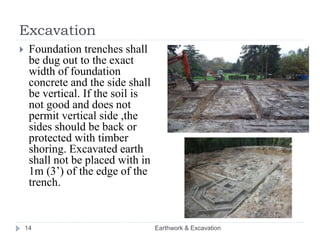
 Foundation trenches shall
be dug out to the exact
width of foundation
concrete and the side shall
be vertical. If the soil is
not good and does not
permit vertical side ,the
sides should be back or
protected with timber
shoring. Excavated earth
shall not be placed with in
1m (3’) of the edge of the
trench.
Finish of trench
Earthwork & Excavation15
 The bottom of foundation trenches
shall be perfectly levelled both
longitudinally and transversely and
the side of the trench shall be
dressed perfectly vertical from
bottom up to the lest thickness of
loose concrete so that concrete
may be laid to the exact width as
per design. The bed of the trench
shall be lightly watered and well
rammed. Excess digging if done
through mistake shall be filled
with concrete at the expense of the
contractor. Soft or defective spots
shall be dug out and remove filled
with concrete shall not be laid
before the inspection and approval
of the trench by the engineer-in-
charge.
Finds
Earthwork & Excavation16
 Any treasure and valuables
or materials found during
the excavation, shall be
property of the
government.
Water in foundation-water,
if any accumulates in the
trench, should be bailed or
pumped out without any
extra payment and
necessary precautions
shall be taken to prevent
surface water to enter into
the trench
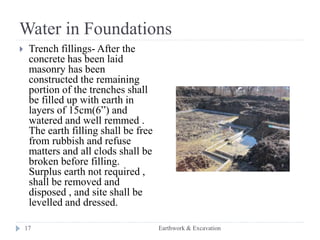
Water in Foundations
Earthwork & Excavation17
 Trench fillings- After the
concrete has been laid
masonry has been
constructed the remaining
portion of the trenches shall
be filled up with earth in
layers of 15cm(6”) and
watered and well remmed .
The earth filling shall be free
from rubbish and refuse
matters and all clods shall be
broken before filling.
Surplus earth not required ,
shall be removed and
disposed , and site shall be
levelled and dressed.
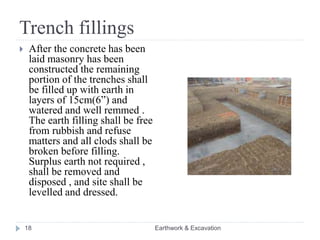
Trench fillings
Earthwork & Excavation18
 After the concrete has been
laid masonry has been
constructed the remaining
portion of the trenches shall
be filled up with earth in
layers of 15cm(6”) and
watered and well remmed .
The earth filling shall be free
from rubbish and refuse
matters and all clods shall be
broken before filling.
Surplus earth not required ,
shall be removed and
disposed , and site shall be
levelled and dressed.
Earthwork & Excavation19
Measurement
 The measurement of the
excavation shall be taken in cu
m (cu ft) as for rectangular
trench bottom width of
concrete multiplied by the
length of trenches even though
the contractor might have
excavated with sloping side for
his convenience. Rate shall be
for the completion of work for
30m(100ft) lead and 1.50m(5’)
lift, including all tools and
plants required for the
completion of work. For every
extra lead of 30m and every
extra life of 1.5 separate extra
rate is provided.
Earthwork & Excavation20
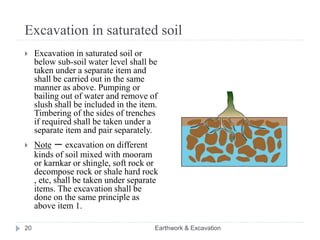
Excavation in saturated soil
 Excavation in saturated soil or
below sub-soil water level shall be
taken under a separate item and
shall be carried out in the same
manner as above. Pumping or
bailing out of water and remove of
slush shall be included in the item.
Timbering of the sides of trenches
if required shall be taken under a
separate item and pair separately.
 Note – excavation on different
kinds of soil mixed with mooram
or karnkar or shingle, soft rock or
decompose rock or shale hard rock
, etc, shall be taken under separate
items. The excavation shall be
done on the same principle as
above item 1.
EARTH FILLING
Earthwork & Excavation21
 Earth used for filling shall be free from saltpeter and white
ants and only foamy and clayey soil free from clods shall
be used. It shall be laid in 15 cm layers and each layer
shall be well watered and rammed with iron rammers. In
case of high embankments, the layers shall not exceed 30
cm depth and the settlement allowances shall be made @
10% of the height of uncomapacted fills.
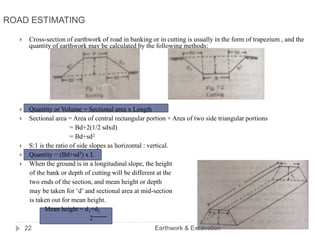
 Cross-section of earthwork of road in banking or in cutting is usually in the form of trapezium , and the
quantity of earthwork may be calculated by the following methods:
 Quantity or Volume = Sectional area x Length
 Sectional area = Area of central rectangular portion + Area of two side triangular portions
= Bd+2(1/2 sdxd)
= Bd+sd2
 S:1 is the ratio of side slopes as horizontal : vertical.
 Quantity = (Bd+sd2) x L
 When the ground is in a longitudinal slope, the height
of the bank or depth of cutting will be different at the
two ends of the section, and mean height or depth
may be taken for ‘d’ and sectional area at mid-section
is taken out for mean height.
Mean height = d1+d2
2
ROAD ESTIMATING
22 Earthwork & Excavation
ROAD ESTIMATING
 Alternatively, sectional area of the two ends may be calculated and the mean of
two sectional area is taken out.
 Different kinds of soil as sandy, rocky, clayey etc., estimated separately as the
rates vary.
23 Earthwork & Excavation
ROAD ESTIMATING
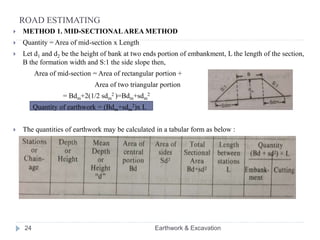
 METHOD 1. MID-SECTIONALAREA METHOD
 Quantity = Area of mid-section x Length
 Let d1 and d2 be the height of bank at two ends portion of embankment, L the length of the section,
B the formation width and S:1 the side slope then,
Area of mid-section = Area of rectangular portion +
Area of two triangular portion
= Bdm+2(1/2 sdm
2 )=Bdm+sdm
2
Quantity of earthwork = (Bdm+sdm
2)x L
 The quantities of earthwork may be calculated in a tabular form as below :
24 Earthwork & Excavation
ROAD ESTIMATING
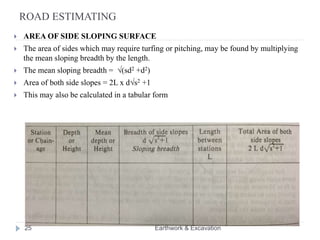
 AREA OF SIDE SLOPING SURFACE
 The area of sides which may require turfing or pitching, may be found by multiplying
the mean sloping breadth by the length.
 The mean sloping breadth = √(sd2 +d2)
 Area of both side slopes = 2L x d√s2 +1
 This may also be calculated in a tabular form
25 Earthwork & Excavation
ROAD ESTIMATING
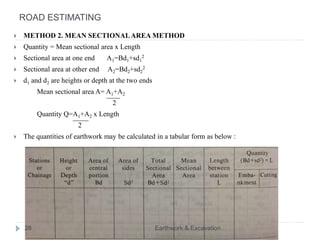
 METHOD 2. MEAN SECTIONALAREA METHOD
 Quantity = Mean sectional area x Length
 Sectional area at one end A1=Bd1+sd1
2
 Sectional area at other end A2=Bd2+sd2
2
 d1 and d2 are heights or depth at the two ends
Mean sectional area A= A1+A2
2
Quantity Q=A1+A2 x Length
2
 The quantities of earthwork may be calculated in a tabular form as below :
26 Earthwork & Excavation
ROAD ESTIMATING
 METHOD 3.PRISMOIDAL FORMULA METHOD
 Quantity or Volume = L/6 (A1+A2+4Am)
 Where A1 and A2 are the cross-sectional areas at the two ends of a portion of embankment of a
road of length L, and Am is the mid-sectional area
 Let d1 and d2 be the heights of bank at two ends, and dm be the mean height at the mid-section, B
be the formation width and S:1 be the side slope.
 Cross-sectional area at one end
A1=Bd1+sd1
2
 Cross-sectional area at other end
A2=Bd2+sd2
2
 Cross-section at middle
dm= d1+d2
2
Am=Bdm+sdm
2 =B(d1+d2)+s(d1+d2)2
2 2
 Quantity = L/6 (A1+A2+4Am)
= {B(d1+d2)+s(d1
2+d2
2+2d1d2)}x L
2 3
 The same is also applicable for cutting.
27 Earthwork & Excavation

Earthwork and excavation

  • 1.
    Earthwork & Excavation Estimationand Costing Earthwork & Excavation1
  • 2.
    Earthwork & Excavation Earthwork& Excavation2  Generally all the Civil Engineering projects like roads, railways, earth dams, canal bunds, buildings etc. involves the earth work.  This earth work may be either earth excavation or earth filling or Some times both will get according to the desired shape and level.  Basically the volume of earthwork is computed from length, breadth, and depth of excavation or filling.
  • 3.
    Excavation Classification The materialsto be excavated shall be classified as follows unless otherwise specified. Earthwork & Excavation3
  • 4.
    Earthwork & Excavation4 a)Soft / Loose Soil b) Hard/Dense Soil c) Mud d) Soft/Disintegrated Rock ( Not Requiring Blasting ) e) Hard Rock( Requiring Blasting ) f) Hard Rock( Blasting Prohibited)
  • 5.
    Earthwork & Excavation5 Soft / Loose Soil - Generally any soil which yields to the ordinary application of pick and shovel, or to PHA WRA. rake or other ordinary digging implement; such as vegetable or organic soil, turf, gravel, sand, silt, loam, clay peat, etc.
  • 6.
    Earthwork & Excavation6 Hard/Dense Soil - Generally any soil which requires the close application of picks, or jumpers or scarifiers to loosen; such as stiff clay, gravel, cobblestone, water bound macadem and soling of roads.
  • 7.
    Earthwork & Excavation7 Mud - A mixture of soil and water in fluid or weak solid state.
  • 8.
    Earthwork & Excavation8 Soft/Disintegrated Rock ( Not Requiring Blasting ) - Rock or boulders which may be quarried or split with crowbars. This will also include laterite and hard conglomerate.
  • 9.
    Earthwork & Excavation9 Hard Rock( Requiring Blasting ) – Any rock or boulder for the excavation of which blasting is required.
  • 10.
    Earthwork & Excavation10 Hard Rock( Blasting Prohibited) – Hard rock requiring blasting but where blasting is prohibited for any reason and excavation has to be carried out by chiselling, wedging or any other agreed method.
  • 11.
    METHOD OF CALCULATINGTHE EARTH WORK QUANTITIES Lead and Lift Earthwork & Excavation11
  • 12.
    Lead and Lift Lead:Lift : Earthwork & Excavation12  It is the average horizontal distance between the centre of excavation to the centre of deposition. The unit of lead is 50m.  It is the average height through which the earth has to be lifted from source to the place of spreading or heaping. The unit of lift is 2.00m for first lift and one extra lift for every 1.0m.
  • 13.
    DETAILED SPECIFICATIONS Earthwork inexcavation in foundation - Earthwork & Excavation13
  • 14.
    Excavation Earthwork & Excavation14 Foundation trenches shall be dug out to the exact width of foundation concrete and the side shall be vertical. If the soil is not good and does not permit vertical side ,the sides should be back or protected with timber shoring. Excavated earth shall not be placed with in 1m (3’) of the edge of the trench.
  • 15.
    Finish of trench Earthwork& Excavation15  The bottom of foundation trenches shall be perfectly levelled both longitudinally and transversely and the side of the trench shall be dressed perfectly vertical from bottom up to the lest thickness of loose concrete so that concrete may be laid to the exact width as per design. The bed of the trench shall be lightly watered and well rammed. Excess digging if done through mistake shall be filled with concrete at the expense of the contractor. Soft or defective spots shall be dug out and remove filled with concrete shall not be laid before the inspection and approval of the trench by the engineer-in- charge.
  • 16.
    Finds Earthwork & Excavation16 Any treasure and valuables or materials found during the excavation, shall be property of the government. Water in foundation-water, if any accumulates in the trench, should be bailed or pumped out without any extra payment and necessary precautions shall be taken to prevent surface water to enter into the trench
  • 17.
    Water in Foundations Earthwork& Excavation17  Trench fillings- After the concrete has been laid masonry has been constructed the remaining portion of the trenches shall be filled up with earth in layers of 15cm(6”) and watered and well remmed . The earth filling shall be free from rubbish and refuse matters and all clods shall be broken before filling. Surplus earth not required , shall be removed and disposed , and site shall be levelled and dressed.
  • 18.
    Trench fillings Earthwork &Excavation18  After the concrete has been laid masonry has been constructed the remaining portion of the trenches shall be filled up with earth in layers of 15cm(6”) and watered and well remmed . The earth filling shall be free from rubbish and refuse matters and all clods shall be broken before filling. Surplus earth not required , shall be removed and disposed , and site shall be levelled and dressed.
  • 19.
    Earthwork & Excavation19 Measurement The measurement of the excavation shall be taken in cu m (cu ft) as for rectangular trench bottom width of concrete multiplied by the length of trenches even though the contractor might have excavated with sloping side for his convenience. Rate shall be for the completion of work for 30m(100ft) lead and 1.50m(5’) lift, including all tools and plants required for the completion of work. For every extra lead of 30m and every extra life of 1.5 separate extra rate is provided.
  • 20.
    Earthwork & Excavation20 Excavationin saturated soil  Excavation in saturated soil or below sub-soil water level shall be taken under a separate item and shall be carried out in the same manner as above. Pumping or bailing out of water and remove of slush shall be included in the item. Timbering of the sides of trenches if required shall be taken under a separate item and pair separately.  Note – excavation on different kinds of soil mixed with mooram or karnkar or shingle, soft rock or decompose rock or shale hard rock , etc, shall be taken under separate items. The excavation shall be done on the same principle as above item 1.
  • 21.
    EARTH FILLING Earthwork &Excavation21  Earth used for filling shall be free from saltpeter and white ants and only foamy and clayey soil free from clods shall be used. It shall be laid in 15 cm layers and each layer shall be well watered and rammed with iron rammers. In case of high embankments, the layers shall not exceed 30 cm depth and the settlement allowances shall be made @ 10% of the height of uncomapacted fills.
  • 22.
     Cross-section ofearthwork of road in banking or in cutting is usually in the form of trapezium , and the quantity of earthwork may be calculated by the following methods:  Quantity or Volume = Sectional area x Length  Sectional area = Area of central rectangular portion + Area of two side triangular portions = Bd+2(1/2 sdxd) = Bd+sd2  S:1 is the ratio of side slopes as horizontal : vertical.  Quantity = (Bd+sd2) x L  When the ground is in a longitudinal slope, the height of the bank or depth of cutting will be different at the two ends of the section, and mean height or depth may be taken for ‘d’ and sectional area at mid-section is taken out for mean height. Mean height = d1+d2 2 ROAD ESTIMATING 22 Earthwork & Excavation
  • 23.
    ROAD ESTIMATING  Alternatively,sectional area of the two ends may be calculated and the mean of two sectional area is taken out.  Different kinds of soil as sandy, rocky, clayey etc., estimated separately as the rates vary. 23 Earthwork & Excavation
  • 24.
    ROAD ESTIMATING  METHOD1. MID-SECTIONALAREA METHOD  Quantity = Area of mid-section x Length  Let d1 and d2 be the height of bank at two ends portion of embankment, L the length of the section, B the formation width and S:1 the side slope then, Area of mid-section = Area of rectangular portion + Area of two triangular portion = Bdm+2(1/2 sdm 2 )=Bdm+sdm 2 Quantity of earthwork = (Bdm+sdm 2)x L  The quantities of earthwork may be calculated in a tabular form as below : 24 Earthwork & Excavation
  • 25.
    ROAD ESTIMATING  AREAOF SIDE SLOPING SURFACE  The area of sides which may require turfing or pitching, may be found by multiplying the mean sloping breadth by the length.  The mean sloping breadth = √(sd2 +d2)  Area of both side slopes = 2L x d√s2 +1  This may also be calculated in a tabular form 25 Earthwork & Excavation
  • 26.
    ROAD ESTIMATING  METHOD2. MEAN SECTIONALAREA METHOD  Quantity = Mean sectional area x Length  Sectional area at one end A1=Bd1+sd1 2  Sectional area at other end A2=Bd2+sd2 2  d1 and d2 are heights or depth at the two ends Mean sectional area A= A1+A2 2 Quantity Q=A1+A2 x Length 2  The quantities of earthwork may be calculated in a tabular form as below : 26 Earthwork & Excavation
  • 27.
    ROAD ESTIMATING  METHOD3.PRISMOIDAL FORMULA METHOD  Quantity or Volume = L/6 (A1+A2+4Am)  Where A1 and A2 are the cross-sectional areas at the two ends of a portion of embankment of a road of length L, and Am is the mid-sectional area  Let d1 and d2 be the heights of bank at two ends, and dm be the mean height at the mid-section, B be the formation width and S:1 be the side slope.  Cross-sectional area at one end A1=Bd1+sd1 2  Cross-sectional area at other end A2=Bd2+sd2 2  Cross-section at middle dm= d1+d2 2 Am=Bdm+sdm 2 =B(d1+d2)+s(d1+d2)2 2 2  Quantity = L/6 (A1+A2+4Am) = {B(d1+d2)+s(d1 2+d2 2+2d1d2)}x L 2 3  The same is also applicable for cutting. 27 Earthwork & Excavation