UMBILICAL CORD PROLAPSE
RCOG, 2008
Aboubakr Elnashar
Prof . Obs Gyn, Benha University Hospital
Aboubakr Elnashar
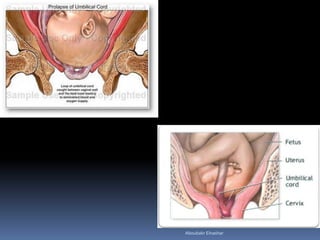
Definition
๏ฑCord prolapse:
cord through the cervix alongside (occult) or
past the presenting part (overt) in the presence of
ruptured membranes.
๏ฑCord presentation:
cord below presenting part with intact membranes
Aboubakr Elnashar
Aboubakr Elnashar
Incidence
Cord prolapse:
0.1% - 0.6%.
Breech presentation:
1%.
Aboubakr Elnashar
Perinatal mortality rate
๏ƒ˜91/1000.
๏ƒ˜ Prematurity
congenital malformations
birth asphyxia
๏ƒ˜Asphyxia:
{cord compression and umbilical arterial vasospasm:
preventing venous and arterial blood flow to and from
the fetus}:
hypoxicโ€“ischaemic encephalopathy and
cerebral palsy.
Aboubakr Elnashar
General
โ€ขMultiparity
โ€ขLow birth weight (<2.5 kg)
โ€ขPrematurity (<37 w)
โ€ขFetal congenital anomalies
โ€ขBreech presentation
โ€ขTransverse, oblique and unstable
lie
โ€ขPolyhydramnios
โ€ขLow-lying placenta, other
abnormal placentation
โ€ขUnengaged presenting part
โ€ขSecond twin
Procedure related 50%
โ€ขARM
โ€ขVaginal manipulation of
the fetus with ruptured
membranes
โ€ขECV (during procedure)
โ€ขInternal podalic version
โ€ขStabilising induction of
labour
โ€ขInsertion of uterine
pressure transducer
Risk factors
Aboubakr Elnashar
How:
1. Preventing close application of the presenting
part to the lower part of the uterus and/or pelvic
brim.
2. Rupture of membranes
3. Cord abnormalities: true knots or low content of
Whartonโ€™s jelly: may alter the turgidity of the cord
4. Fetal hypoxiaโ€“acidosis may alter the turgidity of
the cord
Induction of labour with prostaglandins is not
associated with cord prolapse.
Aboubakr Elnashar
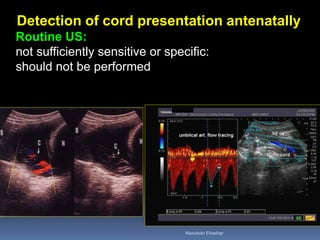
Detection of cord presentation antenatally
Routine US:
not sufficiently sensitive or specific:
should not be performed
Aboubakr Elnashar
Prevention of cord prolapse or its effects
1. Admission if
a. Transverse, oblique or unstable lie after 37+6 w
Refused: advise to present quickly if there are signs
of labour or suspicion of membrane rupture
{Inpatient care minimises delays in diagnosis and
management of cord prolapse.
Labour or ruptured membranes in the context of an
abnormal lie is an indication for CS} .
b. Noncephalic presentations and preterm
prelabour rupture of the membranes
Aboubakr Elnashar
3. Avoid ARM if
a. presenting part is mobile.
ARM necessary:
performed with arrangements for immediate CS.
Upward pressure on the presenting part should be
kept to a minimum .
b. cord is felt below the presenting part.
4. CS
When cord presentation in established labour
Aboubakr Elnashar
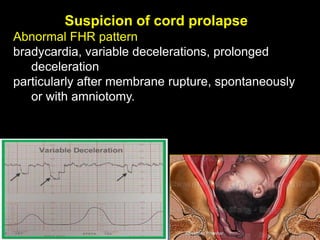
Suspicion of cord prolapse
Abnormal FHR pattern
bradycardia, variable decelerations, prolonged
deceleration
particularly after membrane rupture, spontaneously
or with amniotomy.
Aboubakr Elnashar
Speculum and/or digital vaginal examination should
be performed
1. At preterm gestations when cord prolapse is
suspected.
2. In labour:
after spontaneous rupture of membranes if
risk factors are present or if
CTG abnormalities commence soon thereafter.
No need:
With spontaneous rupture of membranes in the
presence of a normal FHR patterns and the
absence of risk factors for cord prolapse,
liquor is clear.
Aboubakr Elnashar
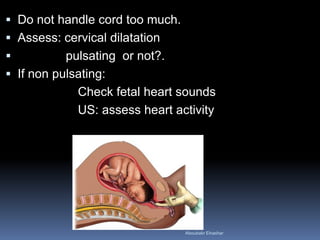
๏‚ง Do not handle cord too much.
๏‚ง Assess: cervical dilatation
๏‚ง pulsating or not?.
๏‚ง If non pulsating:
Check fetal heart sounds
US: assess heart activity
Aboubakr Elnashar
Initial management of cord prolapse in
hospital
1. Assistance should be immediately called
2. Preparations made for immediate delivery
Manual replacement of the prolapsed cord above
the presenting part to allow continuation of labour is
not recommended.
3. Prevent vasospasm:
minimal handling of loops of cord lying outside the
vagina.
Aboubakr Elnashar
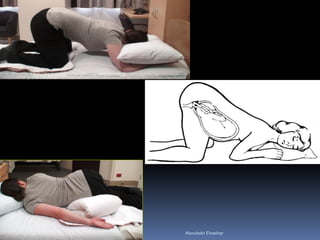
4. Prevent cord compression:
presenting part be elevated either
๏ƒผmanually or by
๏ƒผfilling the urinary bladder.
๏ƒผkneeโ€“chest position or
๏ƒผhead-down tilt (preferably in left-lateral position).
5. Tocolysis
while preparing for CS if there are
persistent FHR abnormalities after attempts to
prevent compression mechanically and when the
delivery is likely to be delayed.
Aboubakr Elnashar
Aboubakr Elnashar
๏‚งSwabs soaked in warm saline are wrapped
around the cord: unproven benefit.
๏‚งManual elevation:
By inserting a gloved hand or two fingers in the
vagina and pushing the presenting part upwards.
A variation is to remove the hand from the vagina
once the presenting part is above the pelvic brim
and apply continuous suprapubic pressure
upwards.
Excessive displacement may encourage more
cord to prolapse.
Aboubakr Elnashar
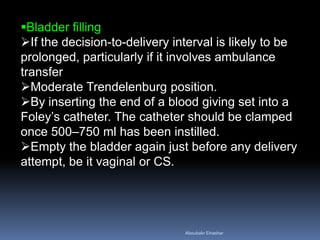
๏‚งBladder filling
๏ƒ˜If the decision-to-delivery interval is likely to be
prolonged, particularly if it involves ambulance
transfer
๏ƒ˜Moderate Trendelenburg position.
๏ƒ˜By inserting the end of a blood giving set into a
Foleyโ€™s catheter. The catheter should be clamped
once 500โ€“750 ml has been instilled.
๏ƒ˜Empty the bladder again just before any delivery
attempt, be it vaginal or CS.
Aboubakr Elnashar
๏‚งTocolysis
{reduce contractions and abolish bradycardia}
Terbutaline: 0.25 mg SC
Aboubakr Elnashar
Mode of delivery with cord prolapse
1. CS
when vaginal delivery is not imminent
{prevent hypoxiaโ€“acidosis}.
2. Vaginal:
When vaginal birth is imminent {outcomes are
similar or better when compared with CS}.
Aboubakr Elnashar
๏ฑCS:
๏ƒ˜Category 1:
Delivering within 30 min or less if there is
suspicious or pathological FHR
but without unduly risking maternal safety.
Verbal consent is satisfactory.
๏ƒ˜Category 2:
FHR is normal.
The outcome for emergency CS is not worse for
deliveries occurring up to 60 min from decision,
provided that the situation is not immediately life-
threatening for the fetus
Aboubakr Elnashar
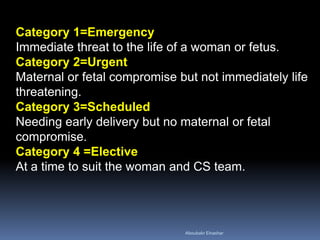
Category 1=Emergency
Immediate threat to the life of a woman or fetus.
Category 2=Urgent
Maternal or fetal compromise but not immediately life
threatening.
Category 3=Scheduled
Needing early delivery but no maternal or fetal
compromise.
Category 4 =Elective
At a time to suit the woman and CS team.
Aboubakr Elnashar
๏ฑRegional anaesthesia
๏ƒ˜may be considered in consultation with an
experienced anaesthetist. {With modern
techniques, the complications of general
anaesthesia are rare but still higher than for
regional anaesthesia.
๏ƒ˜The use of temporary measures, as described
above, can reduce cord compression, making
regional anaesthesia the technique of choice.}
๏ƒ˜Repeated attempts at regional anaesthesia
should be avoided.
Aboubakr Elnashar
๏ฑVaginal birth
๏ƒ˜Most cases operative
๏ƒ˜Very favourable characteristics:
full cervical dilatation
delivery would be accomplished quickly and safely.
Decision-to-delivery interval: 30 min or less.
๏ƒ˜Continuous CTG during labour
๏ƒ˜US: of F heart {audible heart tones and cord
pulsation may cease prior to delivery even though
the f remains alive}
Aboubakr Elnashar
๏ƒ˜Breech extraction:
ยฑPerformed after internal podalic version for the
second twin.
๏ƒ˜Forceps or ventouse:
Depend on clinical circumstances and level of skill.
No difference in neonatal outcomes for fetal
distress
Aboubakr Elnashar
๏ฑNeonatal care
๏ƒ˜Neonatologist should attend
๏ƒ˜Paired cord blood samples for pH and base
excess measurement
{strong predictive value of a normal paired cord
blood gas for the exclusion of intrapartum related
hypoxicโ€“ischemic brain damage}
Aboubakr Elnashar
Management in community settings
1. Waiting for hospital transfer:
kneeโ€“chest face-down position
2. During ambulance transfer:
๏ƒ˜left-lateral position
๏ƒ˜Elevate presenting part: manual or bladder filling
๏ƒ˜Prevent vasospasm: minimal handling of loops of
cord lying outside the vagina.
Aboubakr Elnashar
Management of cord prolapse before viability
Women should be counselled on both continuation and
termination of pregnancy
๏‚งExpectant management
๏ƒ˜Gestational age at the limits of viability.
๏ƒ˜Uterine cord replacement may be attempted.
๏ƒ˜Prolongation of pregnancy at such gestational ages
creates a chance of survival but morbidity from prematurity
remains a frequent serious problem.
๏‚งDelivery:
๏ƒ˜signs of severe fetal compromise
๏ƒ˜once viability has been reached or
๏ƒ˜gestational age associated with a reasonable neonatal
outcome is achieved.
,
Aboubakr Elnashar
๏ฑTraining
All staff involved in maternity care should receive at
least annual training in the management of
obstetric emergencies including the management
of cord prolapse.
Updates on the management of obstetric
emergencies (including the interpretation of fetal
heart rate patterns) are a proactive approach to
risk management.
All staff involved in maternity care should attend
annual multidisciplinary rehearsals (skill drills)
including the management of cord prolapse.
Aboubakr Elnashar
๏ฑClinical incident reporting
Clinical incident forms should be submitted for all
cases of cord prolapse.
๏ฑAuditable standards
1. Proportion of staff receiving annual training in
cord prolapse.
2. Audit of the management of cord prolapse in
hospital settings.
3. Audit of the management of cord prolapse in
community settings.
4. Diagnosisโ€“delivery interval for spontaneous and
assisted vaginal deliveries and CS in cases of cord
prolapse.
5. Critical analysis of adverse outcomes
(compliance with guidance).
Aboubakr Elnashar
Thanks
Aboubakr Elnashar

Umbilical Cord Prolapse

  • 1.
    UMBILICAL CORD PROLAPSE RCOG,2008 Aboubakr Elnashar Prof . Obs Gyn, Benha University Hospital Aboubakr Elnashar
  • 2.
    Definition ๏ฑCord prolapse: cord throughthe cervix alongside (occult) or past the presenting part (overt) in the presence of ruptured membranes. ๏ฑCord presentation: cord below presenting part with intact membranes Aboubakr Elnashar
  • 3.
  • 4.
    Incidence Cord prolapse: 0.1% -0.6%. Breech presentation: 1%. Aboubakr Elnashar
  • 5.
    Perinatal mortality rate ๏ƒ˜91/1000. ๏ƒ˜Prematurity congenital malformations birth asphyxia ๏ƒ˜Asphyxia: {cord compression and umbilical arterial vasospasm: preventing venous and arterial blood flow to and from the fetus}: hypoxicโ€“ischaemic encephalopathy and cerebral palsy. Aboubakr Elnashar
  • 6.
    General โ€ขMultiparity โ€ขLow birth weight(<2.5 kg) โ€ขPrematurity (<37 w) โ€ขFetal congenital anomalies โ€ขBreech presentation โ€ขTransverse, oblique and unstable lie โ€ขPolyhydramnios โ€ขLow-lying placenta, other abnormal placentation โ€ขUnengaged presenting part โ€ขSecond twin Procedure related 50% โ€ขARM โ€ขVaginal manipulation of the fetus with ruptured membranes โ€ขECV (during procedure) โ€ขInternal podalic version โ€ขStabilising induction of labour โ€ขInsertion of uterine pressure transducer Risk factors Aboubakr Elnashar
  • 7.
    How: 1. Preventing closeapplication of the presenting part to the lower part of the uterus and/or pelvic brim. 2. Rupture of membranes 3. Cord abnormalities: true knots or low content of Whartonโ€™s jelly: may alter the turgidity of the cord 4. Fetal hypoxiaโ€“acidosis may alter the turgidity of the cord Induction of labour with prostaglandins is not associated with cord prolapse. Aboubakr Elnashar
  • 8.
    Detection of cordpresentation antenatally Routine US: not sufficiently sensitive or specific: should not be performed Aboubakr Elnashar
  • 9.
    Prevention of cordprolapse or its effects 1. Admission if a. Transverse, oblique or unstable lie after 37+6 w Refused: advise to present quickly if there are signs of labour or suspicion of membrane rupture {Inpatient care minimises delays in diagnosis and management of cord prolapse. Labour or ruptured membranes in the context of an abnormal lie is an indication for CS} . b. Noncephalic presentations and preterm prelabour rupture of the membranes Aboubakr Elnashar
  • 10.
    3. Avoid ARMif a. presenting part is mobile. ARM necessary: performed with arrangements for immediate CS. Upward pressure on the presenting part should be kept to a minimum . b. cord is felt below the presenting part. 4. CS When cord presentation in established labour Aboubakr Elnashar
  • 11.
    Suspicion of cordprolapse Abnormal FHR pattern bradycardia, variable decelerations, prolonged deceleration particularly after membrane rupture, spontaneously or with amniotomy. Aboubakr Elnashar
  • 12.
    Speculum and/or digitalvaginal examination should be performed 1. At preterm gestations when cord prolapse is suspected. 2. In labour: after spontaneous rupture of membranes if risk factors are present or if CTG abnormalities commence soon thereafter. No need: With spontaneous rupture of membranes in the presence of a normal FHR patterns and the absence of risk factors for cord prolapse, liquor is clear. Aboubakr Elnashar
  • 13.
    ๏‚ง Do nothandle cord too much. ๏‚ง Assess: cervical dilatation ๏‚ง pulsating or not?. ๏‚ง If non pulsating: Check fetal heart sounds US: assess heart activity Aboubakr Elnashar
  • 14.
    Initial management ofcord prolapse in hospital 1. Assistance should be immediately called 2. Preparations made for immediate delivery Manual replacement of the prolapsed cord above the presenting part to allow continuation of labour is not recommended. 3. Prevent vasospasm: minimal handling of loops of cord lying outside the vagina. Aboubakr Elnashar
  • 15.
    4. Prevent cordcompression: presenting part be elevated either ๏ƒผmanually or by ๏ƒผfilling the urinary bladder. ๏ƒผkneeโ€“chest position or ๏ƒผhead-down tilt (preferably in left-lateral position). 5. Tocolysis while preparing for CS if there are persistent FHR abnormalities after attempts to prevent compression mechanically and when the delivery is likely to be delayed. Aboubakr Elnashar
  • 16.
  • 17.
    ๏‚งSwabs soaked inwarm saline are wrapped around the cord: unproven benefit. ๏‚งManual elevation: By inserting a gloved hand or two fingers in the vagina and pushing the presenting part upwards. A variation is to remove the hand from the vagina once the presenting part is above the pelvic brim and apply continuous suprapubic pressure upwards. Excessive displacement may encourage more cord to prolapse. Aboubakr Elnashar
  • 18.
    ๏‚งBladder filling ๏ƒ˜If thedecision-to-delivery interval is likely to be prolonged, particularly if it involves ambulance transfer ๏ƒ˜Moderate Trendelenburg position. ๏ƒ˜By inserting the end of a blood giving set into a Foleyโ€™s catheter. The catheter should be clamped once 500โ€“750 ml has been instilled. ๏ƒ˜Empty the bladder again just before any delivery attempt, be it vaginal or CS. Aboubakr Elnashar
  • 19.
    ๏‚งTocolysis {reduce contractions andabolish bradycardia} Terbutaline: 0.25 mg SC Aboubakr Elnashar
  • 20.
    Mode of deliverywith cord prolapse 1. CS when vaginal delivery is not imminent {prevent hypoxiaโ€“acidosis}. 2. Vaginal: When vaginal birth is imminent {outcomes are similar or better when compared with CS}. Aboubakr Elnashar
  • 21.
    ๏ฑCS: ๏ƒ˜Category 1: Delivering within30 min or less if there is suspicious or pathological FHR but without unduly risking maternal safety. Verbal consent is satisfactory. ๏ƒ˜Category 2: FHR is normal. The outcome for emergency CS is not worse for deliveries occurring up to 60 min from decision, provided that the situation is not immediately life- threatening for the fetus Aboubakr Elnashar
  • 22.
    Category 1=Emergency Immediate threatto the life of a woman or fetus. Category 2=Urgent Maternal or fetal compromise but not immediately life threatening. Category 3=Scheduled Needing early delivery but no maternal or fetal compromise. Category 4 =Elective At a time to suit the woman and CS team. Aboubakr Elnashar
  • 23.
    ๏ฑRegional anaesthesia ๏ƒ˜may beconsidered in consultation with an experienced anaesthetist. {With modern techniques, the complications of general anaesthesia are rare but still higher than for regional anaesthesia. ๏ƒ˜The use of temporary measures, as described above, can reduce cord compression, making regional anaesthesia the technique of choice.} ๏ƒ˜Repeated attempts at regional anaesthesia should be avoided. Aboubakr Elnashar
  • 24.
    ๏ฑVaginal birth ๏ƒ˜Most casesoperative ๏ƒ˜Very favourable characteristics: full cervical dilatation delivery would be accomplished quickly and safely. Decision-to-delivery interval: 30 min or less. ๏ƒ˜Continuous CTG during labour ๏ƒ˜US: of F heart {audible heart tones and cord pulsation may cease prior to delivery even though the f remains alive} Aboubakr Elnashar
  • 25.
    ๏ƒ˜Breech extraction: ยฑPerformed afterinternal podalic version for the second twin. ๏ƒ˜Forceps or ventouse: Depend on clinical circumstances and level of skill. No difference in neonatal outcomes for fetal distress Aboubakr Elnashar
  • 26.
    ๏ฑNeonatal care ๏ƒ˜Neonatologist shouldattend ๏ƒ˜Paired cord blood samples for pH and base excess measurement {strong predictive value of a normal paired cord blood gas for the exclusion of intrapartum related hypoxicโ€“ischemic brain damage} Aboubakr Elnashar
  • 27.
    Management in communitysettings 1. Waiting for hospital transfer: kneeโ€“chest face-down position 2. During ambulance transfer: ๏ƒ˜left-lateral position ๏ƒ˜Elevate presenting part: manual or bladder filling ๏ƒ˜Prevent vasospasm: minimal handling of loops of cord lying outside the vagina. Aboubakr Elnashar
  • 28.
    Management of cordprolapse before viability Women should be counselled on both continuation and termination of pregnancy ๏‚งExpectant management ๏ƒ˜Gestational age at the limits of viability. ๏ƒ˜Uterine cord replacement may be attempted. ๏ƒ˜Prolongation of pregnancy at such gestational ages creates a chance of survival but morbidity from prematurity remains a frequent serious problem. ๏‚งDelivery: ๏ƒ˜signs of severe fetal compromise ๏ƒ˜once viability has been reached or ๏ƒ˜gestational age associated with a reasonable neonatal outcome is achieved. , Aboubakr Elnashar
  • 29.
    ๏ฑTraining All staff involvedin maternity care should receive at least annual training in the management of obstetric emergencies including the management of cord prolapse. Updates on the management of obstetric emergencies (including the interpretation of fetal heart rate patterns) are a proactive approach to risk management. All staff involved in maternity care should attend annual multidisciplinary rehearsals (skill drills) including the management of cord prolapse. Aboubakr Elnashar
  • 30.
    ๏ฑClinical incident reporting Clinicalincident forms should be submitted for all cases of cord prolapse. ๏ฑAuditable standards 1. Proportion of staff receiving annual training in cord prolapse. 2. Audit of the management of cord prolapse in hospital settings. 3. Audit of the management of cord prolapse in community settings. 4. Diagnosisโ€“delivery interval for spontaneous and assisted vaginal deliveries and CS in cases of cord prolapse. 5. Critical analysis of adverse outcomes (compliance with guidance). Aboubakr Elnashar
  • 31.