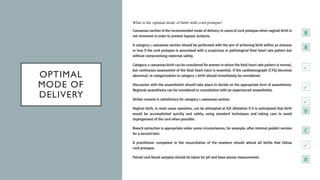
CORD PROLAPSE
Dr.Osheen izhar
Fcps Resident
Gynae unit-3 LGH
DEFINITION
• Abnormal descent of Umbilical cord by
side of presenting part is called
umbilical cord prolapse.
• Umbilical cord prolapse and cord
presentation are two different terms.
• Its an obstetric emergency and needs
prompt recognition and management
• Incidence 0.2-0.6% occurs 1:300
deliveries.
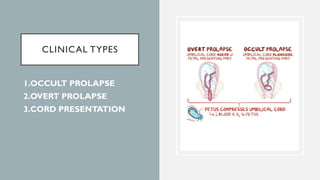
CLINICAL TYPES
1.OCCULT PROLAPSE
2.OVERT PROLAPSE
3.CORD PRESENTATION
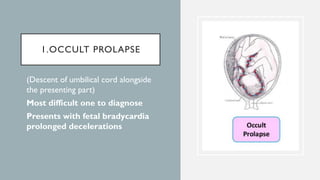
1.OCCULT PROLAPSE
• (Descent of umbilical cord alongside
the presenting part)
• Most difficult one to diagnose
• Presents with fetal bradycardia
prolonged decelerations
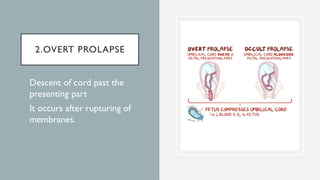
2.OVERT PROLAPSE
 Descent of cord past the
presenting part
 It occurs after rupturing of
membranes.
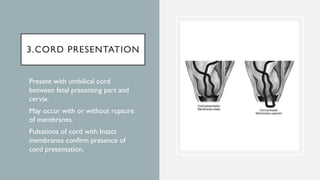
3.CORD PRESENTATION
 Present with umbilical cord
between fetal presenting part and
cervix.
 May occur with or without rupture
of membranes.
 Pulsations of cord with Intact
membranes confirm presence of
cord presentation.
OV E R A L L
I N C I D E N C E
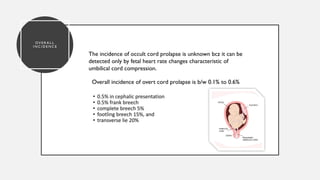
The incidence of occult cord prolapse is unknown bcz it can be
detected only by fetal heart rate changes characteristic of
umbilical cord compression.
Overall incidence of overt cord prolapse is b/w 0.1% to 0.6%
OTHER TYPES OF CORD ACCIDENTS
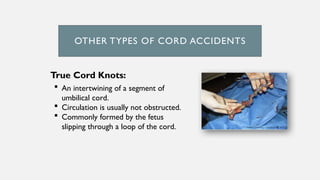
True Cord Knots:
 An intertwining of a segment of
umbilical cord.
 Circulation is usually not obstructed.
 Commonly formed by the fetus
slipping through a loop of the cord.
NUCHAL CORD
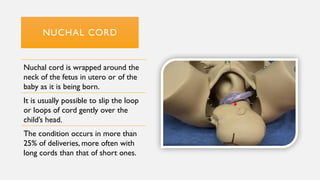
Nuchal cord is wrapped around the
neck of the fetus in utero or of the
baby as it is being born.
It is usually possible to slip the loop
or loops of cord gently over the
child’s head.
The condition occurs in more than
25% of deliveries, more often with
long cords than that of short ones.
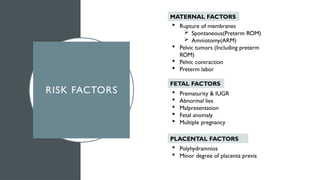
RISK FACTORS
MATERNAL FACTORS
 Rupture of membranes
 Spontaneous(Preterm ROM)
 Amniotomy(ARM)
 Pelvic tumors (Including preterm
ROM)
 Pelvic contraction
 Preterm labor
FETAL FACTORS
 Prematurity & IUGR
 Abnormal lies
 Malpresentation
 Fetal anomaly
 Multiple pregnancy
PLACENTAL FACTORS
 Polyhydramnios
 Minor degree of placenta previa
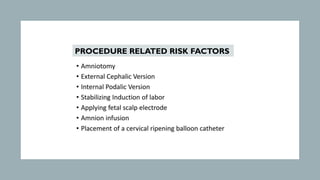
PROCEDURE RELATED RISK FACTORS
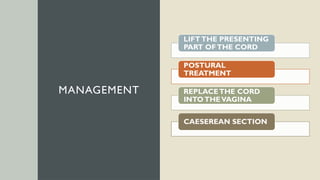
MANAGEMENT
LIFTTHE PRESENTING
PART OFTHE CORD
POSTURAL
TREATMENT
REPLACETHE CORD
INTOTHEVAGINA
CAESEREAN SECTION
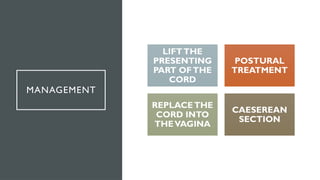
MANAGEMENT
LIFTTHE
PRESENTING
PART OFTHE
CORD
POSTURAL
TREATMENT
REPLACETHE
CORD INTO
THEVAGINA
CAESEREAN
SECTION
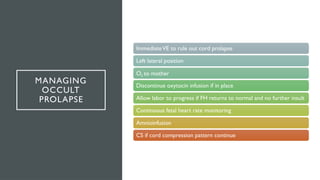
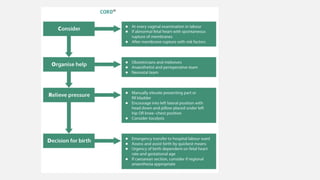
MANAGING
OCCULT
PROLAPSE
ImmediateVE to rule out cord prolapse
Left lateral position
O2 to mother
Discontinue oxytocin infusion if in place
Allow labor to progress if FH returns to normal and no further insult
Continuous fetal heart rate monitoring
Amnioinfusion
CS if cord compression pattern continue
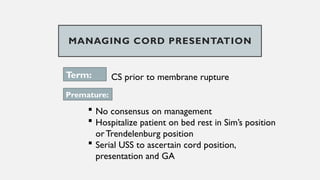
MANAGING CORD PRESENTATION
Term: CS prior to membrane rupture
Premature:
 No consensus on management
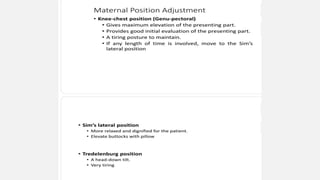
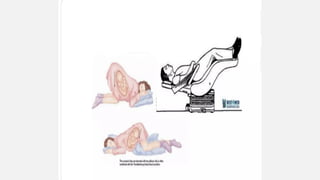
 Hospitalize patient on bed rest in Sim’s position
orTrendelenburg position
 Serial USS to ascertain cord position,
presentation and GA
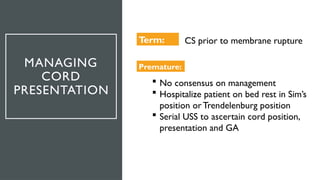
MANAGING
CORD
PRESENTATION
Term: CS prior to membrane rupture
Premature:
 No consensus on management
 Hospitalize patient on bed rest in Sim’s
position orTrendelenburg position
 Serial USS to ascertain cord position,
presentation and GA
MANAGING
CORD
PROLAPSE
PROCEDURE RELATED RISK FACTORS
MANAGEMENT
LIFTTHE
PRESENTING
PART OFTHE
CORD
POSTURAL
TREATMENT
REPLACETHE
CORD INTO
THEVAGINA
CAESEREAN
SECTION
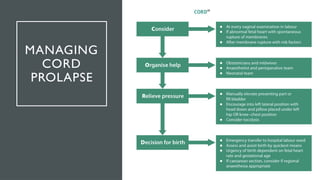
MANAGING
CORD PROLAPSE
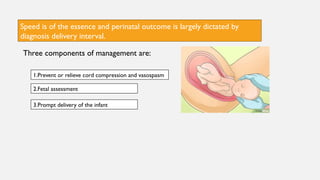
Speed is of the essence and perinatal outcome is
largely dictated by diagnosis delivery interval.
Three components of management are:
1.Prevent or relieve cord compression and vasospasm
2.Fetal assessment
3.Prompt delivery of the infant
•PROCEDURE RELATED
RISK FACTORS
Speed is of the essence and perinatal outcome is largely dictated by
diagnosis delivery interval.
Three components of management are:
2.Fetal assessment
3.Prompt delivery of the infant
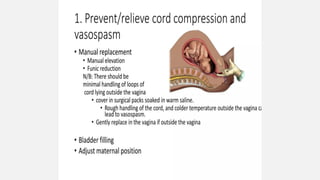
1.Prevent or relieve cord compression and vasospasm
PREVENTION
Women with transverse, oblique or
unstable lie should be offered elective
admission to hospital at 37 weeks of
gestation, or sooner if there are signs
of labour or suspicion
Women with non-cephalic
presentations and preterm pre-labour
rupture of the membranes should be
offered admission
PREVENTION
• Women with transverse, oblique or unstable lie
should be offered elective admission to hospital at
37 weeks of gestation, or sooner if there are signs of
labour or suspicion
• Women with non-cephalic presentations and
preterm pre-labour rupture of the membranes
should be offered admission
PREVENTION
Women with transverse, oblique or
unstable lie should be offered elective
admission to hospital at 37 weeks of
gestation, or sooner if there are signs
of labour or suspicion
Women with non-cephalic
presentations and preterm pre-labour
rupture of the membranes should be
offered admission
OPTIMAL
MODE OF
DELIVERY
Presentation (3) (1) - Copy - Copybb.pptx

Presentation (3) (1) - Copy - Copybb.pptx

  • 1.
    CORD PROLAPSE Dr.Osheen izhar FcpsResident Gynae unit-3 LGH
  • 2.
    DEFINITION • Abnormal descentof Umbilical cord by side of presenting part is called umbilical cord prolapse. • Umbilical cord prolapse and cord presentation are two different terms. • Its an obstetric emergency and needs prompt recognition and management • Incidence 0.2-0.6% occurs 1:300 deliveries.
  • 3.
    CLINICAL TYPES 1.OCCULT PROLAPSE 2.OVERTPROLAPSE 3.CORD PRESENTATION
  • 4.
    1.OCCULT PROLAPSE • (Descentof umbilical cord alongside the presenting part) • Most difficult one to diagnose • Presents with fetal bradycardia prolonged decelerations
  • 5.
    2.OVERT PROLAPSE  Descentof cord past the presenting part  It occurs after rupturing of membranes.
  • 6.
    3.CORD PRESENTATION  Presentwith umbilical cord between fetal presenting part and cervix.  May occur with or without rupture of membranes.  Pulsations of cord with Intact membranes confirm presence of cord presentation.
  • 7.
    OV E RA L L I N C I D E N C E The incidence of occult cord prolapse is unknown bcz it can be detected only by fetal heart rate changes characteristic of umbilical cord compression. Overall incidence of overt cord prolapse is b/w 0.1% to 0.6%
  • 8.
    OTHER TYPES OFCORD ACCIDENTS True Cord Knots:  An intertwining of a segment of umbilical cord.  Circulation is usually not obstructed.  Commonly formed by the fetus slipping through a loop of the cord.
  • 9.
    NUCHAL CORD Nuchal cordis wrapped around the neck of the fetus in utero or of the baby as it is being born. It is usually possible to slip the loop or loops of cord gently over the child’s head. The condition occurs in more than 25% of deliveries, more often with long cords than that of short ones.
  • 10.
    RISK FACTORS MATERNAL FACTORS Rupture of membranes  Spontaneous(Preterm ROM)  Amniotomy(ARM)  Pelvic tumors (Including preterm ROM)  Pelvic contraction  Preterm labor FETAL FACTORS  Prematurity & IUGR  Abnormal lies  Malpresentation  Fetal anomaly  Multiple pregnancy PLACENTAL FACTORS  Polyhydramnios  Minor degree of placenta previa
  • 11.
  • 12.
    MANAGEMENT LIFTTHE PRESENTING PART OFTHECORD POSTURAL TREATMENT REPLACETHE CORD INTOTHEVAGINA CAESEREAN SECTION
  • 13.
  • 14.
    MANAGING OCCULT PROLAPSE ImmediateVE to ruleout cord prolapse Left lateral position O2 to mother Discontinue oxytocin infusion if in place Allow labor to progress if FH returns to normal and no further insult Continuous fetal heart rate monitoring Amnioinfusion CS if cord compression pattern continue
  • 15.
    MANAGING CORD PRESENTATION Term:CS prior to membrane rupture Premature:  No consensus on management  Hospitalize patient on bed rest in Sim’s position orTrendelenburg position  Serial USS to ascertain cord position, presentation and GA
  • 16.
    MANAGING CORD PRESENTATION Term: CS priorto membrane rupture Premature:  No consensus on management  Hospitalize patient on bed rest in Sim’s position orTrendelenburg position  Serial USS to ascertain cord position, presentation and GA
  • 17.
  • 18.
  • 19.
  • 20.
    MANAGING CORD PROLAPSE Speed isof the essence and perinatal outcome is largely dictated by diagnosis delivery interval. Three components of management are: 1.Prevent or relieve cord compression and vasospasm 2.Fetal assessment 3.Prompt delivery of the infant
  • 21.
  • 22.
    Speed is ofthe essence and perinatal outcome is largely dictated by diagnosis delivery interval. Three components of management are: 2.Fetal assessment 3.Prompt delivery of the infant 1.Prevent or relieve cord compression and vasospasm
  • 28.
    PREVENTION Women with transverse,oblique or unstable lie should be offered elective admission to hospital at 37 weeks of gestation, or sooner if there are signs of labour or suspicion Women with non-cephalic presentations and preterm pre-labour rupture of the membranes should be offered admission
  • 29.
    PREVENTION • Women withtransverse, oblique or unstable lie should be offered elective admission to hospital at 37 weeks of gestation, or sooner if there are signs of labour or suspicion • Women with non-cephalic presentations and preterm pre-labour rupture of the membranes should be offered admission
  • 30.
    PREVENTION Women with transverse,oblique or unstable lie should be offered elective admission to hospital at 37 weeks of gestation, or sooner if there are signs of labour or suspicion Women with non-cephalic presentations and preterm pre-labour rupture of the membranes should be offered admission
  • 31.