Defintion
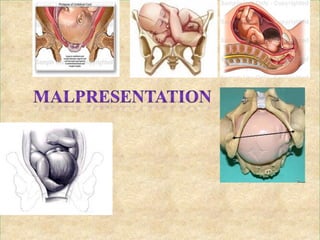
Fetal presenting part other than
vertex includes breech, face,
brow, transverse, and compound
presention.
Definition
More than one pregnancy
(e.g. Multipara,Grand multipara )
More than one fetus (e.g. Twins)
Too much or too little amniotic fluid (e.g.
Poly hydramnious, oligohydramnios)
Abnormal uterine shape (e.g. Arcuate
,septate, supseptate) or abnormal growth
(e.g Fibroid)
Placenta previa
The baby is preterm
Related Factors
Defintion
• Breech 3 in 100 (3%)
• Face 1 in 500 (0.5%)
• Brow 1 in 2000 (0.02%)
• Shoulder 1 in 300 (0.3%)
• Compound 1 in 5000 ( 0.05%)
Incidence of malpresentation
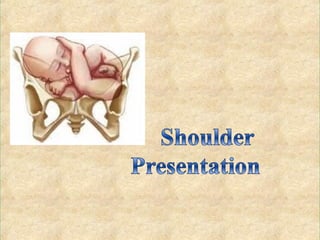
Shoulder presentation
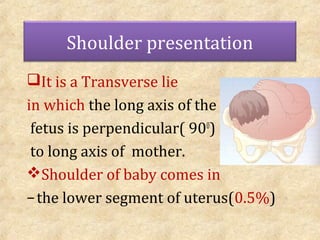
It is a Transverse lie
in which the long axis of the
fetus is perpendicular( 900
)
to long axis of mother.
Shoulder of baby comes in
–the lower segment of uterus(0.5%)
4 position in Shoulder presentation
 Acrimon- anterior(60%)
 Left
 Right
 Acrimo- posterior(40%)
 Right
 Left
 Acrimo anterior position is more common as the
concavity of front of fetus fix in convexity of
maternal spine
 Placenta is posterior in 60% of cases
Lt Acrimoanterior Rt Acrimoanterior
Rt Acrimoposterior Lt Acrimoposterior
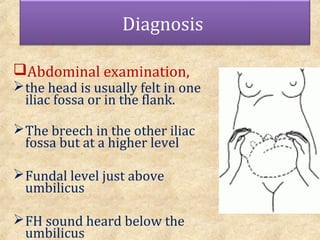
Diagnosis
Abdominal examination,
the head is usually felt in one
iliac fossa or in the flank.
The breech in the other iliac
fossa but at a higher level
Fundal level just above
umbilicus
FH sound heard below the
umbilicus
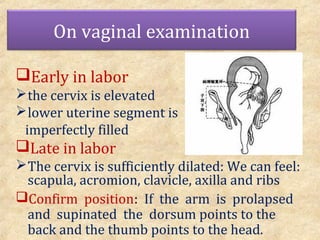
On vaginal examination
Early in labor
the cervix is elevated
lower uterine segment is
imperfectly filled
Late in labor
The cervix is sufficiently dilated: We can feel:
scapula, acromion, clavicle, axilla and ribs
Confirm position: If the arm is prolapsed
and supinated the dorsum points to the
back and the thumb points to the head.
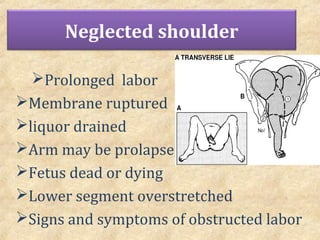
Neglected shoulder
Prolonged labor
Membrane ruptured
liquor drained
Arm may be prolapsed
Fetus dead or dying
Lower segment overstretched
Signs and symptoms of obstructed labor
Management
During pregnancy
A-External cephalic version
Can be tried up to full term,
Even early in labour before ROM
* Laxity of the abdominal & uterine walls
makes the procedure easier than in breech
* The fetus will be rotated only 90 degrees.
B. If fails, do external podalic version.
head.
During labor
External cephalic version (ECV) is tried with
intact membranes :
- If succeeded:
Rupture of membranes and application of
abdominal binder.
- If failed:
C.S. is the safest for the mother & fetus.
 If the membranes are ruptured before full
cervical dilatations do C.S.
Management
 In modern practice, persistent
transverse lie in labor is delivered by
caesarean section whether the fetus is
alive or dead
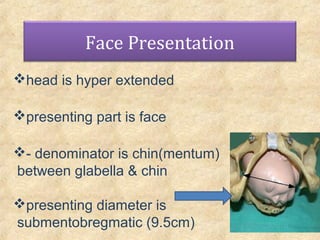
Face Presentation
head is hyper extended
presenting part is face
- denominator is chin(mentum)
between glabella & chin
presenting diameter is
submentobregmatic (9.5cm)
Types of Face Presentation
2ry face (during labor) commen
The majority of cases of face are
secondary to occipto-posterior which
transformed to mento anterior
Causes are maternal
1ry face (during pregnancy )rare
Causes are fetal
AETIOLOGY
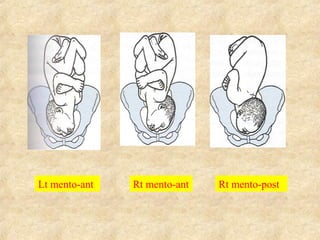
In Face presentation- 6 position
Lt mento-ant Rt mento-ant Rt mento-post
Diagnosis
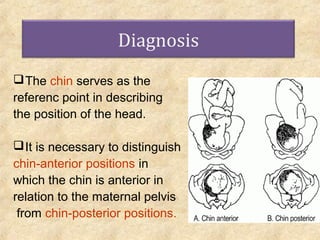
The chin serves as the
referenc point in describing
the position of the head.
It is necessary to distinguish
chin-anterior positions in
which the chin is anterior in
relation to the maternal pelvis
from chin-posterior positions.
Diagnosis
On abdominal examination,
a groove may be felt between
the occiput and the back.
On vaginal examination
Neither the occiput nor the
sinciput are palpable
supra-orbital ridges, chin,
alveolar margin ± ala nasi
Confirm presention
Mechanism of labor in MA
The head descends with the submento-bregmatic
diameter (9.5 cm).
Descent, engagement, increased extension of
the head
the chin meets the pelvic floor first and rotates
forwards 1/8 of a circle.
 With further descent the submental-region
hinges below the symphysis pubis
the head is delivered by flexion , followed by
restitution and external rotation of the chin as in
vertex presentation.
Mechanism of labor in MP
Normal mechanism: In 2/3 of cases
the chin rotates forwards 3/8 of a circle
and delivered as MA
Abnormal mechanism (In 1/3 of cases):
 The chin may rotate forwards
1/8 circle (deep transverse arrest of the face).
no rotation(persistent oblique MP).
The chin rotate backwards 1/8 circle (direct MP)
Cervix fully
dilated Cervix not fully
dilated
Allow normal child
birth
Allow normal child
birth
Slow
progress
with no
signs of
obstruction
Slow
progress
with no
signs of
obstruction
Descent
unsatisfactory
Descent
unsatisfactory
Augmentation
of labour
Augmentation
of labour
Forceps delivery
Augmentation of
labour
Augmentation of
labour
Management of Chin-anteriorManagement of Chin-anterior
It is a cephalic presentation with the
head midway between flexion and
extension.
Incidence: 1 /2000
The frontal bone is
the denominator.
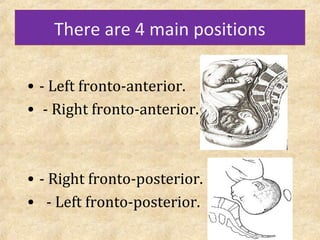
There are 4 main positions
• - Left fronto-anterior.
• - Right fronto-anterior.
• - Right fronto-posterior.
• - Left fronto-posterior.
Types &Etiology of brow
Transient brow(2RY)
• During conversion of vertex to face.
Persistent brow(1RY)
• Extremely rare
Etiology: same as face
Mechanism of labour
Transient brow(2RY)
brow may be converted spontaneously into
face (by extension) or vertex (by flexion)
and this followed by spontaneous delivery
Persistent brow:
There is no mechanism
for delivery because the
head descends by the mento
-vertical diameter (13.5 cm)
which is longer than any
of the diameters of the pelvic inlet.
 So, the head become arrested at the
pelvic inlet ,and labour is obstructed.
Diagnosis
Abdominal examination:
the occiput & sinciput
are felt at the same level
PV examination
frontal bone, supra-orbital
ridges and the root of the
nose are felt.
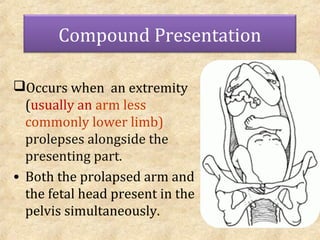
Compound Presentation
Occurs when an extremity
(usually an arm less
commonly lower limb)
prolepses alongside the
presenting part.
• Both the prolapsed arm and
the fetal head present in the
pelvis simultaneously.
Diagnosis
Suspect compound presentation
when
1.Active labor is arrested
2.The fetus fail to engage
3.The prolapsed extremity is palpated
directly
Management
Don’t manipulate the prolapsed extremity
In many cases the extremity will spontaneously
be pulled back and away from the presenting
part.
Spontaneous delivery in 75% of vertex /upper
extremity presentation
Do continuous FHR monitoring because of
associated occult cord prolapse
Reduce the extremity if
Prolapsed extremity prevent descent of
fetus gently reduce by pushing it upward
above the pelvic brim and hold it until a
contraction pushes the head into the pelvis.
Do CS if
Non reassuring FHR trace
Cord prolapsed
Failure of labor to progress
THANK YOUTHANK YOU

Shoulder presentation

  • 2.
    Defintion Fetal presenting partother than vertex includes breech, face, brow, transverse, and compound presention. Definition
  • 3.
    More than onepregnancy (e.g. Multipara,Grand multipara ) More than one fetus (e.g. Twins) Too much or too little amniotic fluid (e.g. Poly hydramnious, oligohydramnios) Abnormal uterine shape (e.g. Arcuate ,septate, supseptate) or abnormal growth (e.g Fibroid) Placenta previa The baby is preterm Related Factors
  • 4.
    Defintion • Breech 3in 100 (3%) • Face 1 in 500 (0.5%) • Brow 1 in 2000 (0.02%) • Shoulder 1 in 300 (0.3%) • Compound 1 in 5000 ( 0.05%) Incidence of malpresentation
  • 6.
    Shoulder presentation It isa Transverse lie in which the long axis of the fetus is perpendicular( 900 ) to long axis of mother. Shoulder of baby comes in –the lower segment of uterus(0.5%)
  • 7.
    4 position inShoulder presentation  Acrimon- anterior(60%)  Left  Right  Acrimo- posterior(40%)  Right  Left  Acrimo anterior position is more common as the concavity of front of fetus fix in convexity of maternal spine  Placenta is posterior in 60% of cases
  • 8.
    Lt Acrimoanterior RtAcrimoanterior Rt Acrimoposterior Lt Acrimoposterior
  • 9.
    Diagnosis Abdominal examination, the headis usually felt in one iliac fossa or in the flank. The breech in the other iliac fossa but at a higher level Fundal level just above umbilicus FH sound heard below the umbilicus
  • 10.
    On vaginal examination Earlyin labor the cervix is elevated lower uterine segment is imperfectly filled Late in labor The cervix is sufficiently dilated: We can feel: scapula, acromion, clavicle, axilla and ribs Confirm position: If the arm is prolapsed and supinated the dorsum points to the back and the thumb points to the head.
  • 11.
    Neglected shoulder Prolonged labor Membraneruptured liquor drained Arm may be prolapsed Fetus dead or dying Lower segment overstretched Signs and symptoms of obstructed labor
  • 12.
    Management During pregnancy A-External cephalicversion Can be tried up to full term, Even early in labour before ROM * Laxity of the abdominal & uterine walls makes the procedure easier than in breech * The fetus will be rotated only 90 degrees. B. If fails, do external podalic version. head.
  • 13.
    During labor External cephalicversion (ECV) is tried with intact membranes : - If succeeded: Rupture of membranes and application of abdominal binder. - If failed: C.S. is the safest for the mother & fetus.  If the membranes are ruptured before full cervical dilatations do C.S.
  • 14.
    Management  In modernpractice, persistent transverse lie in labor is delivered by caesarean section whether the fetus is alive or dead
  • 16.
    Face Presentation head ishyper extended presenting part is face - denominator is chin(mentum) between glabella & chin presenting diameter is submentobregmatic (9.5cm)
  • 17.
    Types of FacePresentation 2ry face (during labor) commen The majority of cases of face are secondary to occipto-posterior which transformed to mento anterior Causes are maternal 1ry face (during pregnancy )rare Causes are fetal
  • 18.
  • 19.
  • 20.
    Lt mento-ant Rtmento-ant Rt mento-post
  • 21.
    Diagnosis The chin servesas the referenc point in describing the position of the head. It is necessary to distinguish chin-anterior positions in which the chin is anterior in relation to the maternal pelvis from chin-posterior positions.
  • 22.
    Diagnosis On abdominal examination, agroove may be felt between the occiput and the back. On vaginal examination Neither the occiput nor the sinciput are palpable supra-orbital ridges, chin, alveolar margin ± ala nasi Confirm presention
  • 23.
    Mechanism of laborin MA The head descends with the submento-bregmatic diameter (9.5 cm). Descent, engagement, increased extension of the head the chin meets the pelvic floor first and rotates forwards 1/8 of a circle.  With further descent the submental-region hinges below the symphysis pubis the head is delivered by flexion , followed by restitution and external rotation of the chin as in vertex presentation.
  • 24.
    Mechanism of laborin MP Normal mechanism: In 2/3 of cases the chin rotates forwards 3/8 of a circle and delivered as MA Abnormal mechanism (In 1/3 of cases):  The chin may rotate forwards 1/8 circle (deep transverse arrest of the face). no rotation(persistent oblique MP). The chin rotate backwards 1/8 circle (direct MP)
  • 25.
    Cervix fully dilated Cervixnot fully dilated Allow normal child birth Allow normal child birth Slow progress with no signs of obstruction Slow progress with no signs of obstruction Descent unsatisfactory Descent unsatisfactory Augmentation of labour Augmentation of labour Forceps delivery Augmentation of labour Augmentation of labour Management of Chin-anteriorManagement of Chin-anterior
  • 27.
    It is acephalic presentation with the head midway between flexion and extension. Incidence: 1 /2000 The frontal bone is the denominator.
  • 28.
    There are 4main positions • - Left fronto-anterior. • - Right fronto-anterior. • - Right fronto-posterior. • - Left fronto-posterior.
  • 29.
    Types &Etiology ofbrow Transient brow(2RY) • During conversion of vertex to face. Persistent brow(1RY) • Extremely rare Etiology: same as face
  • 30.
    Mechanism of labour Transientbrow(2RY) brow may be converted spontaneously into face (by extension) or vertex (by flexion) and this followed by spontaneous delivery
  • 31.
    Persistent brow: There isno mechanism for delivery because the head descends by the mento -vertical diameter (13.5 cm) which is longer than any of the diameters of the pelvic inlet.  So, the head become arrested at the pelvic inlet ,and labour is obstructed.
  • 32.
    Diagnosis Abdominal examination: the occiput& sinciput are felt at the same level PV examination frontal bone, supra-orbital ridges and the root of the nose are felt.
  • 33.
    Compound Presentation Occurs whenan extremity (usually an arm less commonly lower limb) prolepses alongside the presenting part. • Both the prolapsed arm and the fetal head present in the pelvis simultaneously.
  • 34.
    Diagnosis Suspect compound presentation when 1.Activelabor is arrested 2.The fetus fail to engage 3.The prolapsed extremity is palpated directly
  • 35.
    Management Don’t manipulate theprolapsed extremity In many cases the extremity will spontaneously be pulled back and away from the presenting part. Spontaneous delivery in 75% of vertex /upper extremity presentation Do continuous FHR monitoring because of associated occult cord prolapse
  • 36.
    Reduce the extremityif Prolapsed extremity prevent descent of fetus gently reduce by pushing it upward above the pelvic brim and hold it until a contraction pushes the head into the pelvis. Do CS if Non reassuring FHR trace Cord prolapsed Failure of labor to progress
  • 37.