
GC-AAS
(GAS CHROMATOGRAPY –
ATOMIC ABSORPTION
SPECTROSCOPY)
PRESENTED BY
NAMITHA CHANDRAN
MPHARM FIRST YEAR
HYPHENATION:
 Hyphenation refers to the combination of a separation technique and
one or more spectroscopic detection technique.
 The direct conjugation of chromatographic technique with
spectroscopic examination constitutes several powerful analytical
techniques.
 Hyphenated techniques ranges from the combination of :
 Separation-separation
 Separation-identification
 Identification-identification techniques.
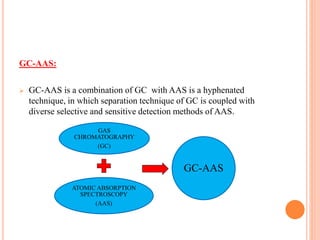
GC-AAS:
 GC-AAS is a combination of GC with AAS is a hyphenated
technique, in which separation technique of GC is coupled with
diverse selective and sensitive detection methods of AAS.
GAS
CHROMATOGRAPHY
(GC)
ATOMIC ABSORPTION
SPECTROSCOPY
(AAS)
GC-AAS
 GC performs the separation of the components and with the help of
AAS the elemental identification of the component is performed.
 For the determination of specific organometallic compounds in
various environmental samples, coupled gas chromatography-atomic
absorption spectroscopy(GC-AAS) has proved to be a useful
instrumental combination.
 It is widely used in the determination of arsenic, antimony, mercury,
lead and thallium.
 Advantages:
 extremely low limits of detection and quantification,
 insignificant influence of interferences on the determination process
 very high precision and repeatability of determinations.
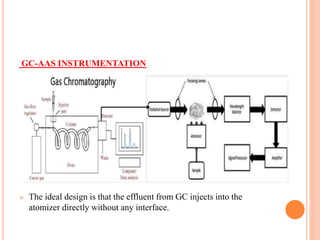
GC-AAS INSTRUMENTATION
 The ideal design is that the effluent from GC injects into the
atomizer directly without any interface.
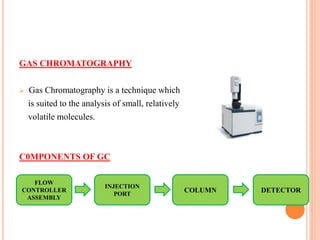
GAS CHROMATOGRAPHY
 Gas Chromatography is a technique which
is suited to the analysis of small, relatively
volatile molecules.
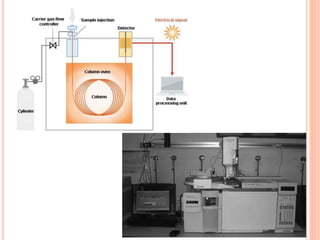
C0MPONENTS OF GC
FLOW
CONTROLLER
ASSEMBLY
INJECTION
PORT
DETECTOR
COLUMN
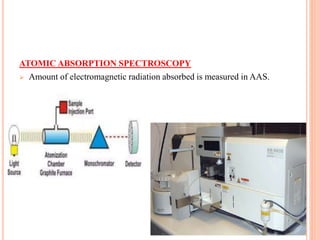
ATOMIC ABSORPTION SPECTROSCOPY
 Amount of electromagnetic radiation absorbed is measured in AAS.
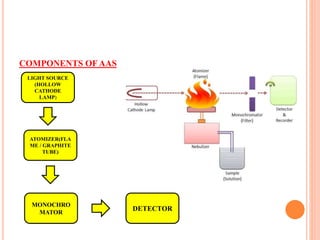
COMPONENTS OFAAS
LIGHT SOURCE
(HOLLOW
CATHODE
LAMP)
ATOMIZER(FLA
ME / GRAPHITE
TUBE)
DETECTOR
MONOCHRO
MATOR
GC-AAS
 In this technique coupling of a gas chromatography directly to the
burner head of a conventional, commercially available atomic
absorption is made.
 The controlling of the operating condition of a gas chromatograph
with the AAS atomizer makes this technique useful since the
analytes are already present in the gas phase.
 However , several conditions need to be optimized in order to obtain
good sensitivity and selectivity for specific analytical problems.
 Efforts have been made to optimize the process by using the quartz
furnace , heating with flame or a thermostat, or using the graphite
furnace as the atomization device.
 GC-AAS technology can perform morphological analysis on
complex mixtures containing metals and certain non-metal elements.
 GC-AAS technology can directly introduce the gaseous components
separated by gas chromatography and the carrier gas into the atomic
spectrum for direct analysis and determination.
Gas Chromatography-Flame Atomic Absorption Spectroscopy
(GC-FAAS)
 GC-FAAS is a flame atomizer that directly introduces the separated
components of GC into FAAS through a heated transfer line.
 GC-FAAS has the advantages of continuous operation and simple
instrumentation, and real-time chromatograms can be obtained
 However, the residence time of the atomic vapor in the flame
atomizer is short, and the analyte is diluted by the fuel gas and the
supporting gas.
 Therefore, the sensitivity of GC-FAAS is low, and it cannot meet
the current requirements of morphological analysis, and it has fewer
applications.
Gas Chromatography-Quartz Furnace Atomic Absorption
Spectroscopy (GC-QFAAS)
 GC-QFAAS has high sensitivity and is the mainstream technology
of GC-atom absorption spectroscopy.
 Quartz furnace can work continuously, with good reproducibility,
simple production, and slightly lower sensitivity than graphite
furnace.
Gas Chromatography-Graphite Furnace Atomic Absorption
Spectroscopy (GC-GFAAS)
 GC-GFAAS uses a graphite coated furnace to vaporize the sample.
 In GFAAS, samples are deposited in a small graphite coated tube
which can then be heated to vaporize and atomize the analyte.
 The graphite tubes are heated using a high current power supply.
 GC-GFAAS has good separation performance, high selectivity and
sensitivity.
 However, because the graphite furnace lasts for a long time at high
temperature (above 1000 degrees Celsius), the life of the graphite
furnace is shortened, the repeatability is poor, and the operating cost
is high.
 The development of GC-AAS technology has enabled the sensitive
determination of the morphology of many trace organometallic
compounds that cannot be detected by a single chromatographic
method.
 At the same time, the application of AAS has been extended from
the total amount of a single element to the field of morphological
analysis.
 GC-AAS is widely applicable to the morphological analysis of
organometallic compounds (such as organic mercury, organic
selenium, organic tin, organic germanium and organic lead, etc.) in
environmental and biological samples with little difference in
polarity, thermal stability, volatility, and low atomization
temperature.
APPLICATIONS OF GC-AAS
 Analysis of quantitative metal concentrations in solution
 Analysis of lead in paint
 Separation and identification of volatile materials, plastics, natural
and synthetic polymers, paints etc.
 It is a main tool used in sports antidote laboratories to test athelets
urine samples for prohibited performance enhancing drugs.
 Analysis of additives and purity in steels and other metal alloys
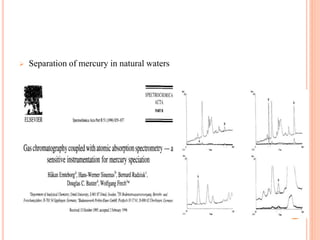
 Separation of mercury in natural waters
 Analysis of organometallic species in environment
 Analysis of organotin by GC-AAS
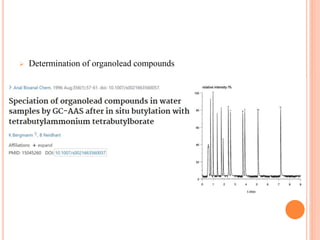
 Determination of organolead compounds
GC AAS.pptx

GC AAS.pptx

  • 1.
    GC-AAS (GAS CHROMATOGRAPY – ATOMICABSORPTION SPECTROSCOPY) PRESENTED BY NAMITHA CHANDRAN MPHARM FIRST YEAR
  • 2.
    HYPHENATION:  Hyphenation refersto the combination of a separation technique and one or more spectroscopic detection technique.  The direct conjugation of chromatographic technique with spectroscopic examination constitutes several powerful analytical techniques.  Hyphenated techniques ranges from the combination of :  Separation-separation  Separation-identification  Identification-identification techniques.
  • 3.
    GC-AAS:  GC-AAS isa combination of GC with AAS is a hyphenated technique, in which separation technique of GC is coupled with diverse selective and sensitive detection methods of AAS. GAS CHROMATOGRAPHY (GC) ATOMIC ABSORPTION SPECTROSCOPY (AAS) GC-AAS
  • 4.
     GC performsthe separation of the components and with the help of AAS the elemental identification of the component is performed.  For the determination of specific organometallic compounds in various environmental samples, coupled gas chromatography-atomic absorption spectroscopy(GC-AAS) has proved to be a useful instrumental combination.  It is widely used in the determination of arsenic, antimony, mercury, lead and thallium.  Advantages:  extremely low limits of detection and quantification,  insignificant influence of interferences on the determination process  very high precision and repeatability of determinations.
  • 5.
    GC-AAS INSTRUMENTATION  Theideal design is that the effluent from GC injects into the atomizer directly without any interface.
  • 6.
    GAS CHROMATOGRAPHY  GasChromatography is a technique which is suited to the analysis of small, relatively volatile molecules. C0MPONENTS OF GC FLOW CONTROLLER ASSEMBLY INJECTION PORT DETECTOR COLUMN
  • 8.
    ATOMIC ABSORPTION SPECTROSCOPY Amount of electromagnetic radiation absorbed is measured in AAS.
  • 9.
  • 10.
    GC-AAS  In thistechnique coupling of a gas chromatography directly to the burner head of a conventional, commercially available atomic absorption is made.  The controlling of the operating condition of a gas chromatograph with the AAS atomizer makes this technique useful since the analytes are already present in the gas phase.  However , several conditions need to be optimized in order to obtain good sensitivity and selectivity for specific analytical problems.  Efforts have been made to optimize the process by using the quartz furnace , heating with flame or a thermostat, or using the graphite furnace as the atomization device.
  • 11.
     GC-AAS technologycan perform morphological analysis on complex mixtures containing metals and certain non-metal elements.  GC-AAS technology can directly introduce the gaseous components separated by gas chromatography and the carrier gas into the atomic spectrum for direct analysis and determination. Gas Chromatography-Flame Atomic Absorption Spectroscopy (GC-FAAS)  GC-FAAS is a flame atomizer that directly introduces the separated components of GC into FAAS through a heated transfer line.  GC-FAAS has the advantages of continuous operation and simple instrumentation, and real-time chromatograms can be obtained
  • 12.
     However, theresidence time of the atomic vapor in the flame atomizer is short, and the analyte is diluted by the fuel gas and the supporting gas.  Therefore, the sensitivity of GC-FAAS is low, and it cannot meet the current requirements of morphological analysis, and it has fewer applications. Gas Chromatography-Quartz Furnace Atomic Absorption Spectroscopy (GC-QFAAS)  GC-QFAAS has high sensitivity and is the mainstream technology of GC-atom absorption spectroscopy.  Quartz furnace can work continuously, with good reproducibility, simple production, and slightly lower sensitivity than graphite furnace.
  • 13.
    Gas Chromatography-Graphite FurnaceAtomic Absorption Spectroscopy (GC-GFAAS)  GC-GFAAS uses a graphite coated furnace to vaporize the sample.  In GFAAS, samples are deposited in a small graphite coated tube which can then be heated to vaporize and atomize the analyte.  The graphite tubes are heated using a high current power supply.  GC-GFAAS has good separation performance, high selectivity and sensitivity.  However, because the graphite furnace lasts for a long time at high temperature (above 1000 degrees Celsius), the life of the graphite furnace is shortened, the repeatability is poor, and the operating cost is high.
  • 14.
     The developmentof GC-AAS technology has enabled the sensitive determination of the morphology of many trace organometallic compounds that cannot be detected by a single chromatographic method.  At the same time, the application of AAS has been extended from the total amount of a single element to the field of morphological analysis.  GC-AAS is widely applicable to the morphological analysis of organometallic compounds (such as organic mercury, organic selenium, organic tin, organic germanium and organic lead, etc.) in environmental and biological samples with little difference in polarity, thermal stability, volatility, and low atomization temperature.
  • 15.
    APPLICATIONS OF GC-AAS Analysis of quantitative metal concentrations in solution  Analysis of lead in paint  Separation and identification of volatile materials, plastics, natural and synthetic polymers, paints etc.  It is a main tool used in sports antidote laboratories to test athelets urine samples for prohibited performance enhancing drugs.  Analysis of additives and purity in steels and other metal alloys
  • 16.
     Separation ofmercury in natural waters
  • 17.
     Analysis oforganometallic species in environment
  • 18.
     Analysis oforganotin by GC-AAS
  • 19.
     Determination oforganolead compounds