Introduction
The soundis a wave generated by a mechanical
vibration that travels due to the elasticity of the
surrounding environment through longitudinal
waves (straight line)
A sound wave is often considered as a sinusoidal
plane wave which is particularly characterized by
Frequency (in Hz) and Wavelength (λ)
a) The frequency ( f ) in Hertz (Hz) or its
inverse, the period (T) in Seconds (s):
b) The wavelength (l) usually expressed in
nanometers (nm) or its inverse, the wave
number (n¯) in cm-1
:
c) The alternative pressure wave is also
characterized by its amplitude (P).
where Pmax is the maximal amplitude, t is the time
and f is the phase
Fig 1: Representation of the sinusoidal plane wave of sound
3.
Sound Waves
• Soundwaves are created by object vibrations
and produce pressure waves
• When atoms are set in vibration, they move
back and forth
• This continuous back-and-forth motion results
in a high-pressure and a low-pressure region
in the medium
• Sound waves are sometimes referred to as
pressure waves because they consist of a
repeating pattern of high-pressure
(compressions) and low-pressure (rarefactions)
regions moving through a medium
• Compression occurs when particles move
close together creating regions of high
pressure
• Rarefactions occur in low-pressure areas
when particles are spread apart from each other
Fig 2: Longitudinal Nature of Sound
4.
Sonochemistry
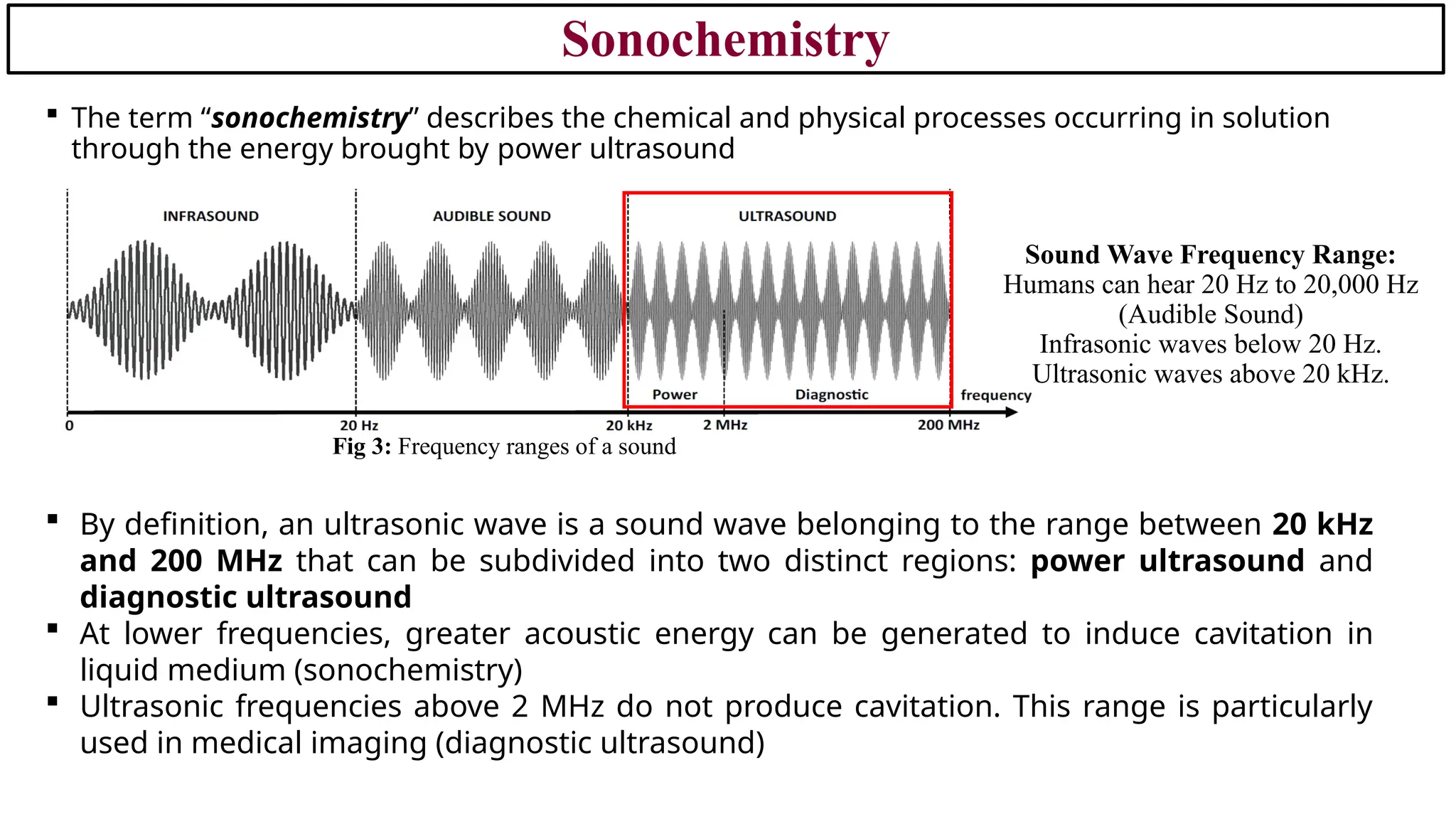
Sound Wave FrequencyRange:
Humans can hear 20 Hz to 20,000 Hz
(Audible Sound)
Infrasonic waves below 20 Hz.
Ultrasonic waves above 20 kHz.
Fig 3: Frequency ranges of a sound
By definition, an ultrasonic wave is a sound wave belonging to the range between 20 kHz
and 200 MHz that can be subdivided into two distinct regions: power ultrasound and
diagnostic ultrasound
At lower frequencies, greater acoustic energy can be generated to induce cavitation in
liquid medium (sonochemistry)
Ultrasonic frequencies above 2 MHz do not produce cavitation. This range is particularly
used in medical imaging (diagnostic ultrasound)
The term “sonochemistry” describes the chemical and physical processes occurring in solution
through the energy brought by power ultrasound
5.
Cavitation Phenomenon
• Theeffects of ultrasound are the consequence of the cavitation phenomenon, which is the formation, the growth, and the
collapse of gaseous microbubbles in the liquid phase
• When sonicating liquids at high intensities, the sound waves that propagate into the liquid media result in alternating
high-pressure (compression) and low-pressure (rarefaction) cycles, with rates depending on the frequency.
• During the low-pressure cycle, high-intensity ultrasonic waves create small vacuum bubbles or voids in the liquid.
• When the bubbles attain a volume at which they can no longer absorb energy, they collapse violently during a high-
pressure cycle. This phenomenon is termed cavitation.
• During the implosion, very high temperatures (approx. 5,000K) and pressures (approx. 2,000atm) are reached.
Fig 4: Schematic representation of acoustic cavitation phenomenon
6.
Cavitation Phenomenon
• Cavitationbubbles are often accompanied by the formation of several physical and chemical effects. These
include high-pressure bubble collapses, powerful shockwaves, high-speed concentrated liquid jets, and even
nanosecond flashes of light bearing intense temperatures.
• It is these physical and chemical effects that ultimately form the backbone of multiple novel manufacturing
Sono chemical processes
• In water, at an ultrasonic frequency ( f ) of 20 kHz, each cavitation bubble collapse represents a localized
hot spot, generating temperatures of about 5,000 K and pressures superior to 1,000 bars
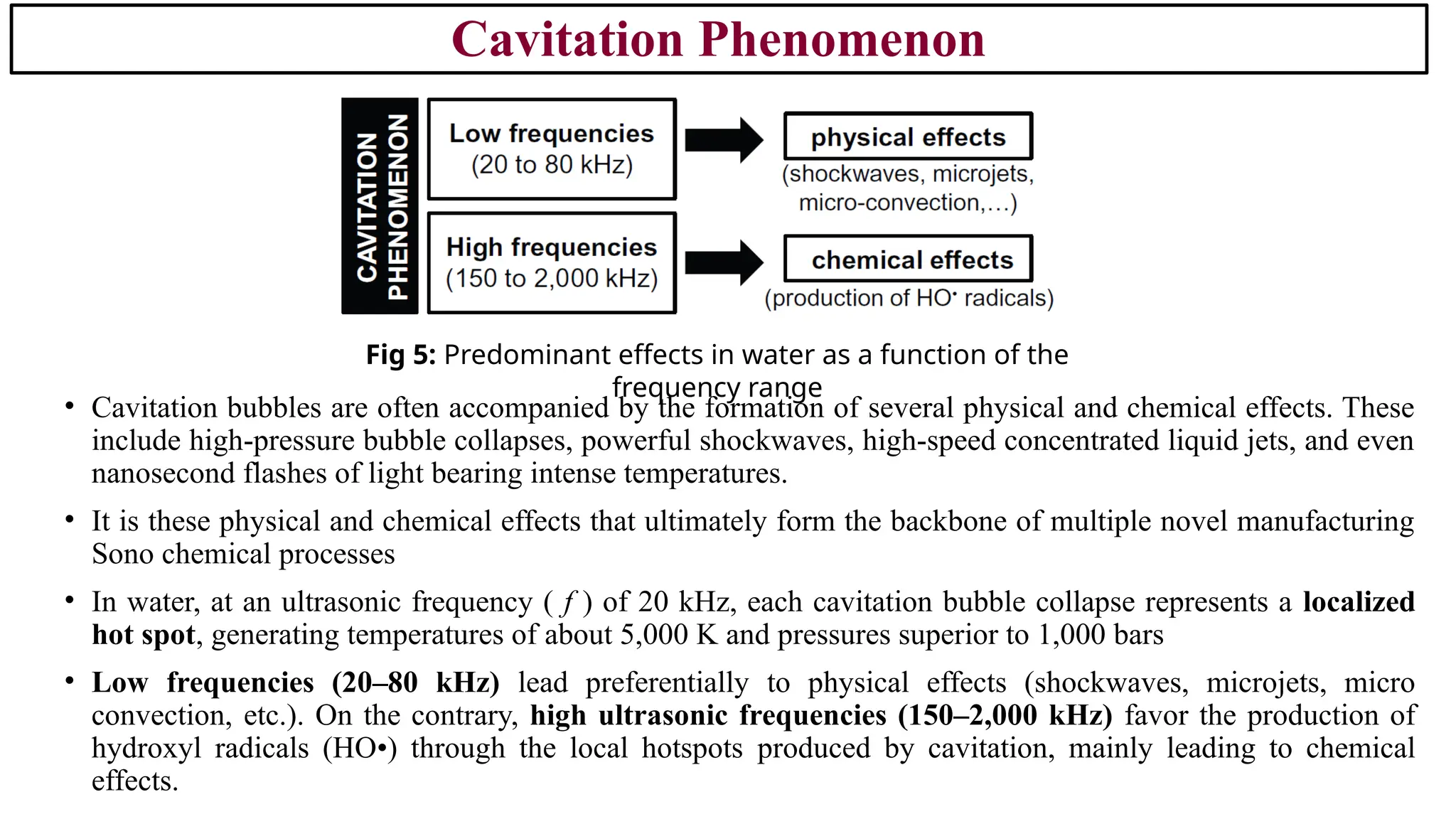
• Low frequencies (20–80 kHz) lead preferentially to physical effects (shockwaves, microjets, micro
convection, etc.). On the contrary, high ultrasonic frequencies (150–2,000 kHz) favor the production of
hydroxyl radicals (HO•) through the local hotspots produced by cavitation, mainly leading to chemical
effects.
Fig 5: Predominant effects in water as a function of the
frequency range
7.
Instrumentation- Probe Sonicator
ASonicator system comprises of 3 main components:
1. Generator,
2. Transducer and
3. Horn (probe)
Fig 6: Schematic representation of the
sonochemistry experimental setup- Probe Sonicator
The generator transforms AC line power into high-frequency electrical energy. The generator features a
keypad or buttons that allow the user to control the Sonication parameters. The generator provides high
voltage pulses of energy at a frequency of 20KHz that drives a piezoelectric convertor
The transducer is a cylindrical device that is connected to the generator by a high-voltage cable. The
transducer transforms electrical energy into mechanical vibrations
The vibration is amplified and transmitted down the length of the probe/horn
The ultrasound energy is the creation of cavitation which causes the disruption of the sample and makes it
easy to break down the particles into smaller ones.
8.
Advantages of Sonochemistry
•Ultrasound-assisted synthesis aids in the preparation of uniformly distributed and uniformly sized
nanocomposites in a short time and utilizes less energy as compared to methods like mechanical attrition,
electrodeposition, etc.
• High reaction rates can be achieved using sonochemistry, resulting in time-efficient synthesis
• Enhanced properties were observed in the field of kinetics, selectivity, extraction, dissolution, filtration, and
crystallinity
• Till today the maximum specific capacitance reached by the supercapacitor electrode material which as
prepared using the sonochemical method is ≈1000-1200 F/g whereas that for the hydrothermal method was
found to be ≈80-100 F/g and that for solvothermal is ≈200F/g
Sonochemical Synthesis ofNanoparticles
Sonochemistry is a crucial application for synthesizing nanoparticles, particularly those with small dimensions, such as 2-50 nm.
These nanoparticles can act as excellent catalysts in water chemistry due to their massive surface area.
Sonolytic production involves the reduction of metals by primary and secondary radicals generated during the formation, growth,
and violent collapse of acoustic cavity bubbles.
The chemical reactions describe the process
H2O → •OH + •H (1)
•H + •H → H2 (2)
•H + •OH → H2O (3)
RH + •OH (or •H) → reducing species + H2O (or H2) (4)
RH + H2O → •R + unstable products (5)
M+n
+ •H/H2/•R → M0 (6)
where: M+n
corresponds to a metal ion and RH to an organic additive.
Reactions Equations (1) and (2) show the formation of reducing agents: (i) •H from pyrolysis of water inside the collapsing cavity
bubbles, (ii) H2 from the reaction of RH with •OH or •H. Reaction Equation (5) shows the formation of secondary radicals (•R) from
pyrolysis of the organic additive. In the presence of these species, the metal salt is readily reduced to the zero-valent form (M0
), which
is then converted to M0
n+1 via adsorption onto M0
n. The organic additives, which function as stabilizers, are generally alcohols,
surfactants and water-soluble polymers.
11.
Synthesis of NanostructuredInorganic Materials
• The sonochemical method is superior to all other techniques in the following topics related to nanomaterials:
(1) preparation of amorphous products
(2) insertion of nanomaterials into mesoporous materials
(3) deposition of nanoparticles on ceramic and polymeric surfaces and
(4) morphology control of nanomaterials.
• Wang et al., synthesized Fe3O4 nanoparticles by an ultrasonic-
assisted reverse co-precipitation method (US-RP)
• In a typical procedure, 5.0 mL of 1.0 mol L1 FeCl3 solution and 10.0
mL of 0.5 mol L-1
FeSO4 solutions were mixed.
• The mixed Fe2+
/Fe3+
solution was added dropwise into 20 mL of 3.5
mol L-1
ammonia water at 60°C under ultrasound irradiation, which
was carried out in an ultrasound clean bath operating at 25 kHz with
a power of 140 W.
• After 30 min for the reaction, the generated black Fe3O4
nanoparticles were collected by magnetic separation, washed with
water to neutral pH, and then re-dispersed to 50 mL of water and
stored for use
12.
No. Nanoparticles Poweror Frequency Size and Shape Media
1 Fe3O4 130 kHz 180 nm NH4Cl
2 Fe3O4@GOS 60 W
96 nm
spherical
sodium acetate
Polyvinylpyrrolidone
3 Fe3O4 ……….
15 nm
amorphous
NH4OH
4 Fe3O4@MWCNTs 40 kHz
20 nm
amorphous
water/ethylene glycol
5 Fe3O4 40 kHz, 150 W
22.41 nm
Semi-spherical
ethylenediamine
6 Fe3O4
20 kHz
1500 W
80 nm
cubes
distilled water
7 AuNPs 20 kHz/17.9 W·cm2 18 nm
semi-spherical
distilled water
8 AuNPs 495 kHz
22 nm
spherical
aqueous solution
9 Au–Ru NPs 355 kHz
15 nm
spherical
polyethylene glycol
perchloric acid
10 GO-wrapped Au NPs 200 W
500 nm
sphere
water and ethylene
glycol
Synthesis of Nanostructured Inorganic Materials
13.
Ultrasound-assisted green synthesis
•Below are some of the important applications of ultrasound in chemical synthesis. The symbol ))))is used for reactions carried
out on exposure to ultrasound
1) Esterification:
This reaction is generally carried out in the presence of a catalyst like sulphuric acid, p-toluene sulphonic acid, tosyl chloride,
polyphosphoric acid, dicyclohexylcarbodiimide, etc.
The reaction takes longer time and yields are low.
A simple procedure for the esterification of a variety of carboxylic acids with different alcohols at ambient temperature using
ultrasound has been reported
2) Oxidation:
The oxidation of alcohols by solid potassium permanganate in hexane or benzene is enhanced considerably by sonication. Using
the above method, octan-2-01 gives the corresponding ketone in 92.8% yield in 5 hr compared to 2% yield by mechanical
stirring. Similarly, cyc1ohexanol gave 53% yield of cyc1ohexanone by oxidation under sonication (5 hr) compared to the 4% yield
under usual conditions.
14.
Ultrasound-assisted green synthesis
3)Coupling Reactions:
• The classical Ullmann's coupling occurs at high temperatures, giving low yields.
• However, in sonication, the size of the metal powder is considerably reduced.
• Breaking of the particles brings them in contact with the reactive solutions on a fresh surface, the reactivity of
which is not hindered by the usual oxide layer. The coupling of o-iodonitrobenzene with copper powder is
given below
• Ultrasound assisted organic synthesis gives excellent yields compared to other reactions. It can dramatically
effect the rates of chemical reactions and is helpful for a large number of organic transformations. In fact, a
combination of sonication with other techniques, e.g., phase transfer techniques, reactions in aqueous media
etc. give best results.
15.
References
1. Ahluwalia, V.K.; Kidwai, M. (2004). New Trends in Green Chemistry
Ultrasound-Assisted Green Synthesis. , 10.1007/978-1-4020-3175-5, 73–
87.





![Zingiberene [Best one]](https://cdn.slidesharecdn.com/ss_thumbnails/zingiberene-181127020411-thumbnail.jpg?width=640&height=640&fit=bounds)


![Ultrasonic reactions [autosaved]](https://cdn.slidesharecdn.com/ss_thumbnails/ultrasonicreactionsautosaved-211008145954-thumbnail.jpg?width=640&height=640&fit=bounds)


