MODIFICATION OF THE PEPTIDE
BACKBONE, ICORPORATING
COFORMATIONAL CONSTRAINTS
LOCALLY OR GLOBALLY
Presenting by ,
Mr Purushotham KN
Asst.Professor
Department of
Ph.Chemistry.
SACCP,B.G.Nagara
2021-2022
01
Contents
 Introduction
 Modification of the Peptide backbone
 Incorporating conformational constraints locally or globally
02
Introduction
 Peptidomimetics are compounds whose essential elements
(pharmacophore) mimic natural peptide or protein in a 3D space
and which upon modification, retain the ability to interact with the
biological target and produce the same biological effect as that of
the natural protein or peptide.
 And these peptidomimetics binds to enzymes/receptors with the
higher affinity than the previous peptide. And overall it leads either
increase(agonist) or decrease(inhibition) in the activity.
03
•Apart from being much more selective, efficient and lowered
enzymatic degradation than native peptides, they also results I
fewer side effects.
•Peptidomimetics are mainly designed to overcome some of the
problems associated with natural peptides and proteins such as
stability problems and poor oral bioavailability, receptor
selectivity and potency issue.
04
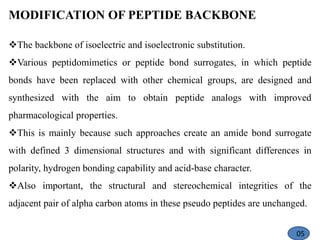
MODIFICATION OF PEPTIDE BACKBONE
The backbone of isoelectric and isoelectronic substitution.
Various peptidomimetics or peptide bond surrogates, in which peptide
bonds have been replaced with other chemical groups, are designed and
synthesized with the aim to obtain peptide analogs with improved
pharmacological properties.
This is mainly because such approaches create an amide bond surrogate
with defined 3 dimensional structures and with significant differences in
polarity, hydrogen bonding capability and acid-base character.
Also important, the structural and stereochemical integrities of the
adjacent pair of alpha carbon atoms in these pseudo peptides are unchanged.
05
INCORPORATING CONFORMATIONAL CONSTRAINTS
LOCALLY OR GLOBALLY
Peptide derivatives that contain conformationally restricting amino acid
units or other conformational constraints called conformationally
constrained (or restricted)peptide analogs.
Conformational restriction is a very powerful method for probing the
bioactive conformations of peptides.
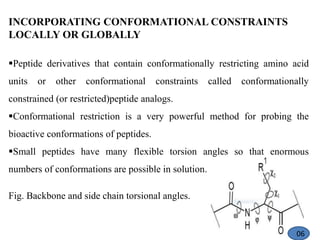
Small peptides have many flexible torsion angles so that enormous
numbers of conformations are possible in solution.
Fig. Backbone and side chain torsional angles.
06
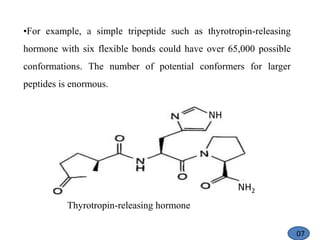
•For example, a simple tripeptide such as thyrotropin-releasing
hormone with six flexible bonds could have over 65,000 possible
conformations. The number of potential conformers for larger
peptides is enormous.
Thyrotropin-releasing hormone
NH
NH2
07
Methodologies for design peptides
for reducing the number of the accessible conformations and
rendering the selectivity of synthetic peptides more stringent than
that afford by the sequence could take advantage by introduction of
two main constraints in to peptide
Two main methods are used:-
local constraints
Global constraints
08
Global restrictions
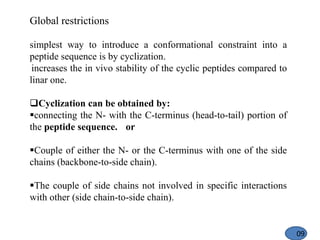
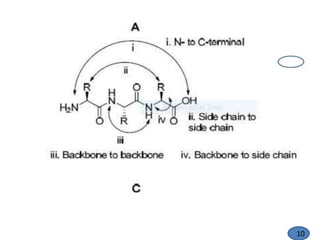
simplest way to introduce a conformational constraint into a
peptide sequence is by cyclization.
increases the in vivo stability of the cyclic peptides compared to
linar one.
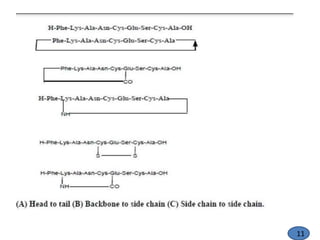
Cyclization can be obtained by:
connecting the N- with the C-terminus (head-to-tail) portion of
the peptide sequence. or
Couple of either the N- or the C-terminus with one of the side
chains (backbone-to-side chain).
The couple of side chains not involved in specific interactions
with other (side chain-to-side chain).
09
10
11
Local restrictions
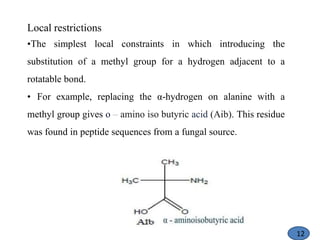
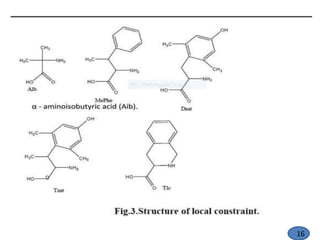
•The simplest local constraints in which introducing the
substitution of a methyl group for a hydrogen adjacent to a
rotatable bond.
• For example, replacing the α-hydrogen on alanine with a
methyl group gives o – amino iso butyric acid (Aib). This residue
was found in peptide sequences from a fungal source.
12
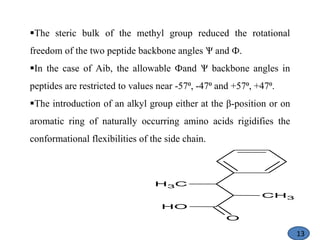
The steric bulk of the methyl group reduced the rotational
freedom of the two peptide backbone angles Ѱ and Ф.
In the case of Aib, the allowable Фand Ѱ backbone angles in
peptides are restricted to values near -57⁰, -47⁰ and +57⁰, +47⁰.
The introduction of an alkyl group either at the β-position or on
aromatic ring of naturally occurring amino acids rigidifies the
conformational flexibilities of the side chain.
CH3
O
O
H
C
H3
13
•Three of natural amino acids show β - disubstitutions :
•Valine (two methyl groups)
•Isoleucine (a methyl and an ethyl) and
•Threonine (a methyl and a hydroxyl).
Additionally, b-substitution leads to a second asymmetric center
in the amino acid structure.
14
 It allowing the peptide backbone and the side chain some degree
flexibility.
Another advantage of these modifications is that the extra alkyl
groups can enhance the liphophilicity of peptide, and therefore can
help it overcome membrane barrier.
The introduction of a Covalent bond between the of an α-amino
acid residue and the peptide backbone has proven to be a useful
further conformation restriction,
15
16
References
17
 Guarna A, Trabocchi A, Peptidomimetics in organic and
medicinal chemistry. John Wiley & sons;
Kharb R, Rana M, Sharma PC, Yar MS. Therapeutic
importance of peptidomimetics in medicinal chemistry.
18
WHEN YOU STOP LEARNING…
YOU STOP GROWING.
17

modify of peptidomimetics.pptx

  • 1.
    MODIFICATION OF THEPEPTIDE BACKBONE, ICORPORATING COFORMATIONAL CONSTRAINTS LOCALLY OR GLOBALLY Presenting by , Mr Purushotham KN Asst.Professor Department of Ph.Chemistry. SACCP,B.G.Nagara 2021-2022 01
  • 2.
    Contents  Introduction  Modificationof the Peptide backbone  Incorporating conformational constraints locally or globally 02
  • 3.
    Introduction  Peptidomimetics arecompounds whose essential elements (pharmacophore) mimic natural peptide or protein in a 3D space and which upon modification, retain the ability to interact with the biological target and produce the same biological effect as that of the natural protein or peptide.  And these peptidomimetics binds to enzymes/receptors with the higher affinity than the previous peptide. And overall it leads either increase(agonist) or decrease(inhibition) in the activity. 03
  • 4.
    •Apart from beingmuch more selective, efficient and lowered enzymatic degradation than native peptides, they also results I fewer side effects. •Peptidomimetics are mainly designed to overcome some of the problems associated with natural peptides and proteins such as stability problems and poor oral bioavailability, receptor selectivity and potency issue. 04
  • 5.
    MODIFICATION OF PEPTIDEBACKBONE The backbone of isoelectric and isoelectronic substitution. Various peptidomimetics or peptide bond surrogates, in which peptide bonds have been replaced with other chemical groups, are designed and synthesized with the aim to obtain peptide analogs with improved pharmacological properties. This is mainly because such approaches create an amide bond surrogate with defined 3 dimensional structures and with significant differences in polarity, hydrogen bonding capability and acid-base character. Also important, the structural and stereochemical integrities of the adjacent pair of alpha carbon atoms in these pseudo peptides are unchanged. 05
  • 6.
    INCORPORATING CONFORMATIONAL CONSTRAINTS LOCALLYOR GLOBALLY Peptide derivatives that contain conformationally restricting amino acid units or other conformational constraints called conformationally constrained (or restricted)peptide analogs. Conformational restriction is a very powerful method for probing the bioactive conformations of peptides. Small peptides have many flexible torsion angles so that enormous numbers of conformations are possible in solution. Fig. Backbone and side chain torsional angles. 06
  • 7.
    •For example, asimple tripeptide such as thyrotropin-releasing hormone with six flexible bonds could have over 65,000 possible conformations. The number of potential conformers for larger peptides is enormous. Thyrotropin-releasing hormone NH NH2 07
  • 8.
    Methodologies for designpeptides for reducing the number of the accessible conformations and rendering the selectivity of synthetic peptides more stringent than that afford by the sequence could take advantage by introduction of two main constraints in to peptide Two main methods are used:- local constraints Global constraints 08
  • 9.
    Global restrictions simplest wayto introduce a conformational constraint into a peptide sequence is by cyclization. increases the in vivo stability of the cyclic peptides compared to linar one. Cyclization can be obtained by: connecting the N- with the C-terminus (head-to-tail) portion of the peptide sequence. or Couple of either the N- or the C-terminus with one of the side chains (backbone-to-side chain). The couple of side chains not involved in specific interactions with other (side chain-to-side chain). 09
  • 10.
  • 11.
  • 12.
    Local restrictions •The simplestlocal constraints in which introducing the substitution of a methyl group for a hydrogen adjacent to a rotatable bond. • For example, replacing the α-hydrogen on alanine with a methyl group gives o – amino iso butyric acid (Aib). This residue was found in peptide sequences from a fungal source. 12
  • 13.
    The steric bulkof the methyl group reduced the rotational freedom of the two peptide backbone angles Ѱ and Ф. In the case of Aib, the allowable Фand Ѱ backbone angles in peptides are restricted to values near -57⁰, -47⁰ and +57⁰, +47⁰. The introduction of an alkyl group either at the β-position or on aromatic ring of naturally occurring amino acids rigidifies the conformational flexibilities of the side chain. CH3 O O H C H3 13
  • 14.
    •Three of naturalamino acids show β - disubstitutions : •Valine (two methyl groups) •Isoleucine (a methyl and an ethyl) and •Threonine (a methyl and a hydroxyl). Additionally, b-substitution leads to a second asymmetric center in the amino acid structure. 14
  • 15.
     It allowingthe peptide backbone and the side chain some degree flexibility. Another advantage of these modifications is that the extra alkyl groups can enhance the liphophilicity of peptide, and therefore can help it overcome membrane barrier. The introduction of a Covalent bond between the of an α-amino acid residue and the peptide backbone has proven to be a useful further conformation restriction, 15
  • 16.
  • 17.
    References 17  Guarna A,Trabocchi A, Peptidomimetics in organic and medicinal chemistry. John Wiley & sons; Kharb R, Rana M, Sharma PC, Yar MS. Therapeutic importance of peptidomimetics in medicinal chemistry.
  • 18.
    18 WHEN YOU STOPLEARNING… YOU STOP GROWING. 17