BY:-
Saumya Ranjan Behura
CONTENTS
INTRODUCTION.
 WORKING.
 CLASSIFICATION.
 ADVANTAGES.
 APPLICATIONS.
 FUTURE WORK.
INTRODUCTION
 An Ultrasonic motor (USM) is a type of electric motor driven
by ultrasonic vibration of a piezoelectric transducer.
 The ultrasonic vibration is transformed into output torque by
friction between the stator and the rotor.
 USMs are often called solid state motors.
 Most common application is in camera lenses as a part of
autofocus system is used to move lens element.
WORKING
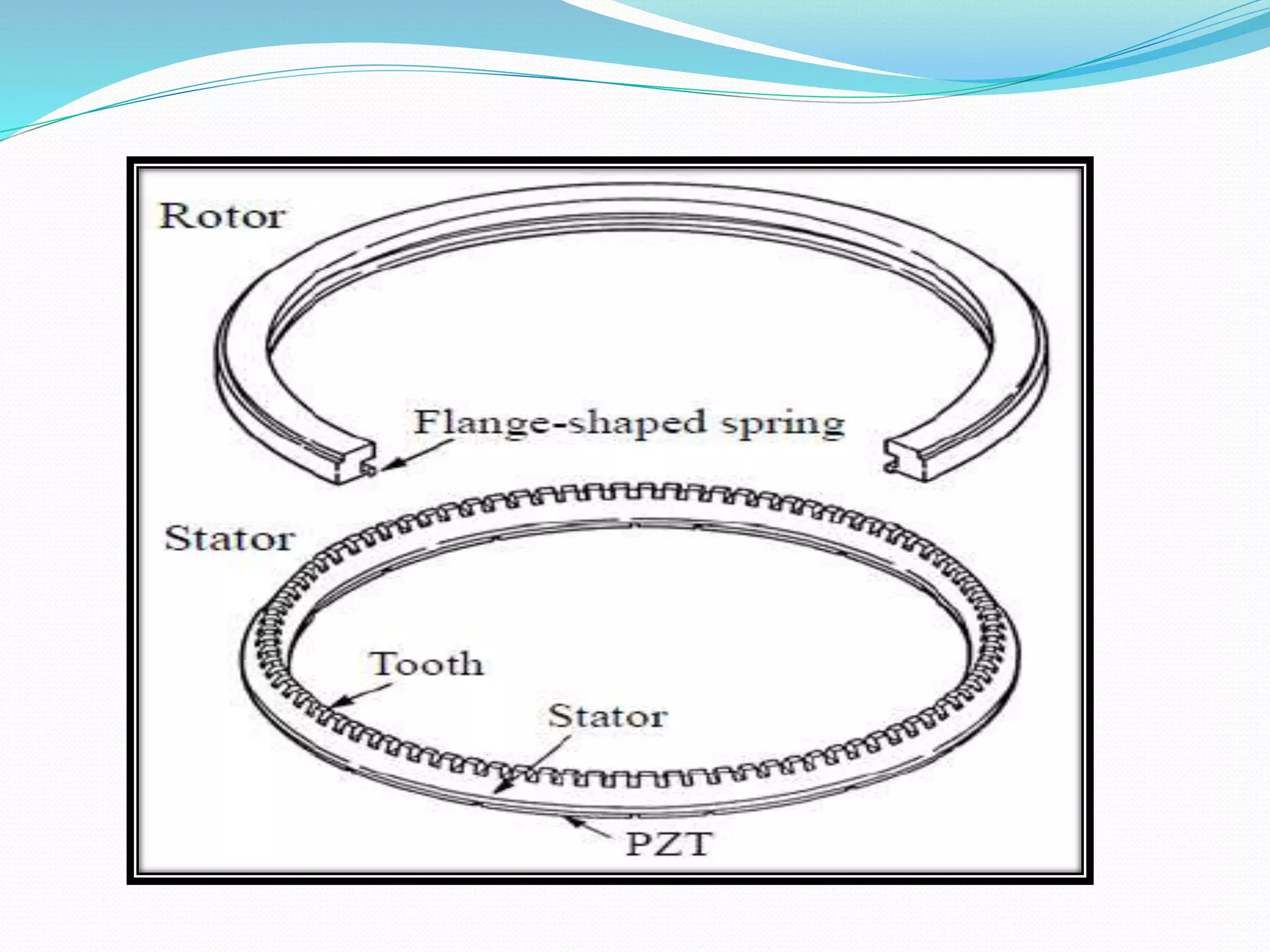
 A traveling wave is established over the stator
surface, which behaves as an elastic ring and produces
elliptical motion at the inter face with the rotor.
This elliptical motion of the contact surface propels
the rotor and the drive shaft connected to it.
The teeth which are attached to the stator are intended
to increase the moment arm to amplify the speed.
TRAVELLING WAVE IN USM
CLASSIFICATION
USMs can be classified in the following ways:
 Mode of operation:
• Static
• Resonant
 Type of motion:
• Rotary
• Linear
 Shape of implementation:
• Beam
• Rod
• Disk
PROTOTYPES OF USM
 Linear standing wave USM
Rotary Ultrasonic Motor
Spherical ultrasonic motor
SPHERICAL USM
This particular USM consists of a thin square plate,
30x30mm in area.
It can rotate in more than 4 individual directions.
ADVANTAGES
The major advantages of USMs are:
 Compact, lightweight, flexible and robust.
 High positioning accuracy.
 High low-speed torque and holding torque.
 Unaffected by external electric or magnetic fields.
 Quiet drive system.
 Hard brake with no backlash.
 Variable stroke.
 Quick response.
APPLICATIONS
Some applications where USMs have been used are:
 Camera lens autofocus.
 Spacecraft planetary instruments.
 Medical equipment (MRIs etc).
 Small robotic joints.
FUTURE WORK
 One very promising research area is in medical
diagnostic instruments.
 The Robotics Institute of Carnegie Mellon University and
the Division of Cardiac Surgery at the University of
Pittsburgh are teaming up to create a tiny robot called the
HeartLander.
 The HeartLander is a
tiny robot that surgeons
could insert into a
patient’s chest cavity
through a minimally
invasive incision which
could move along the
surface.
 The surgeon would be
able to control every
movement external to
the patients body.
CONCLUSION
Hence the ultrasonic motors, which is a
new step in the miniaturized electrical
technology has got many applications in
small appliances because of its high
torque at low density.
Ultrasonic motor

Ultrasonic motor

  • 1.
  • 2.
    CONTENTS INTRODUCTION.  WORKING.  CLASSIFICATION. ADVANTAGES.  APPLICATIONS.  FUTURE WORK.
  • 3.
    INTRODUCTION  An Ultrasonicmotor (USM) is a type of electric motor driven by ultrasonic vibration of a piezoelectric transducer.  The ultrasonic vibration is transformed into output torque by friction between the stator and the rotor.  USMs are often called solid state motors.  Most common application is in camera lenses as a part of autofocus system is used to move lens element.
  • 5.
    WORKING  A travelingwave is established over the stator surface, which behaves as an elastic ring and produces elliptical motion at the inter face with the rotor. This elliptical motion of the contact surface propels the rotor and the drive shaft connected to it. The teeth which are attached to the stator are intended to increase the moment arm to amplify the speed.
  • 6.
  • 8.
    CLASSIFICATION USMs can beclassified in the following ways:  Mode of operation: • Static • Resonant  Type of motion: • Rotary • Linear  Shape of implementation: • Beam • Rod • Disk
  • 9.
    PROTOTYPES OF USM Linear standing wave USM Rotary Ultrasonic Motor Spherical ultrasonic motor
  • 10.
    SPHERICAL USM This particularUSM consists of a thin square plate, 30x30mm in area. It can rotate in more than 4 individual directions.
  • 11.
    ADVANTAGES The major advantagesof USMs are:  Compact, lightweight, flexible and robust.  High positioning accuracy.  High low-speed torque and holding torque.  Unaffected by external electric or magnetic fields.  Quiet drive system.  Hard brake with no backlash.  Variable stroke.  Quick response.
  • 12.
    APPLICATIONS Some applications whereUSMs have been used are:  Camera lens autofocus.  Spacecraft planetary instruments.  Medical equipment (MRIs etc).  Small robotic joints.
  • 13.
    FUTURE WORK  Onevery promising research area is in medical diagnostic instruments.  The Robotics Institute of Carnegie Mellon University and the Division of Cardiac Surgery at the University of Pittsburgh are teaming up to create a tiny robot called the HeartLander.
  • 14.
     The HeartLanderis a tiny robot that surgeons could insert into a patient’s chest cavity through a minimally invasive incision which could move along the surface.  The surgeon would be able to control every movement external to the patients body.
  • 15.
    CONCLUSION Hence the ultrasonicmotors, which is a new step in the miniaturized electrical technology has got many applications in small appliances because of its high torque at low density.